227
Some
Mathematical
Considerations
on Parent-Offspring
Conflict
Phenomenon
Hiromi
SENO
and Hiroki
TOKUDA
Department
of
Mathematics, Facultyof
Science, Hiroshima University子の独立時期についての親子間衝突に関する数理モデル解析
瀬野裕美・徳田博樹
広島大学理学部
Astochastic dynamicprogramming model for
parent-offspring confictisanalyzed anddiscussed. Itisdiscussed
how the confiict is resolved and how the ultilllate
off-spring’s independence age is determined between parent
and offspring. Results by the mathematical model
in-dicates such possibility that the observed behaviour of
parentalcare may ch ange depending on the parent’sage.
Thisisbecause the compromise conclusion of the
parent-offspring conflict depends on the parent’s age, that is
essentially, on the parent’s expected futurereproductive
value. Moreover, it is shown that the observed
parent-offspring confbct possibly depends on the parent’s age, too.
INTRODUCTION
In behavioural ecology, many researchers have
been interested in and have discussed the
parent-offspring conflict phenomenon: offspring wantsto
become independent ofparent and to feed by
it-self after an age$t_{o},$ $w1_{1}ile$parentofits age$a$ wants
tostopfeeding after an offspring’s age $t_{p}(a)$. The
critical day $t_{p}(a)$ from the parent’s viewpoint is
assumed to depend on theparent’s age $a$
.
When$t_{o}$ and $t_{p}(a)$ do not coincide with each other, a
conflict takes place between parent and offspring.
Thereare possiblytwodifferenttypesof such
con-flict: $t_{o}^{l}<t_{p}(a);t_{o}>t_{p}^{l}(a)$
.
Under the conflict inthe case when $t_{o}<t_{p}(a)$, offspring wants to
be-come independent of parent, while parent wants
to feed offspring. On the other hand,in the case
when $t_{o}>t_{p}(a)$, offspring wants to befed, while
parent wants to stop feeding. Only when $t_{o}=$
$t_{p}(a)$, any conflict doesn’t take place. However,
since $t_{o}$ does not depend on the parent’s age $a$,
whereas $t_{p}(a)$ does, the conflict between parent
and offspringisobservable very much.
In thiswork,we analyze astochasticdynamic
pro-gramming model which corresponds tothe model
constructed by Clark and Ydenberg (1990). In
our model, differently from their model, parentis
assumed to have a finite reproducible age-span,
so that its future reproductive value is explicitly
variable depending on the parent’s age. A
spe-cificgrowthfunctionand a specific terminal fitness
function areintroduced. Analyzing themodel,we
discuss the characteristics of the optimal critical
ages$t_{o}$and$t_{p}(a)$, anditis shown that possibly
ex-istentconflictisonly thetype that $t_{o}>t_{p}(a)$,
in-dependently ofthe parent’sage and the other
pa-rameterscharacterizing the relation between
par-ent and offspring. Further, we discuss how the
conflict is resolved and how tbe ultimate
indepen-dence age isdetermined between parent and
off-spring.
MODEL
Parent’s and Offsprrng’s
AgesLet $a$ denote the parent’s age, for instance, in
year, where $a_{f}\leq a\leq a_{1}$
.
$a_{f}$ and $a_{1}$ arerespec-tively the first and the last ages for the parent’s
$”’$
$\infty aen$ $\sim_{s}$
$\vdash’’+^{\prime d\text{下_{}-}sa\underline{fter0\Uparrow}\underline{sbi}rt\text{加^{}\backslash }\backslash }\infty’\div-\infty^{\backslash }\{""\prime y_{-}sp\dot{n}n_{9_{-}’\backslash }\backslash \backslash \backslash \backslash$
12 $t_{l}$ r-l $T$
$-hnnt*\prime c_{n}\text{\’{e}} n(o_{f},\sigma)arrow 2^{o\kappa_{\epsilon m\eta\dot{\}}}j_{nm_{\sigma_{r}^{n}}\infty_{\sigma_{o})}}$
(
Fig.1. Modelling the parent-offspringrelauon.
reproduction. Hence, the reproducible age-span
for every parent is given by $a\iota-a_{f}+1$. The
off-spring’s age in day during a breeding season is
denoted by $t$,where $1\leq t\leq T$. $T$is the length in
dayofbreeding season (seeFig. 1).
Offsp7ring$s$
Growth
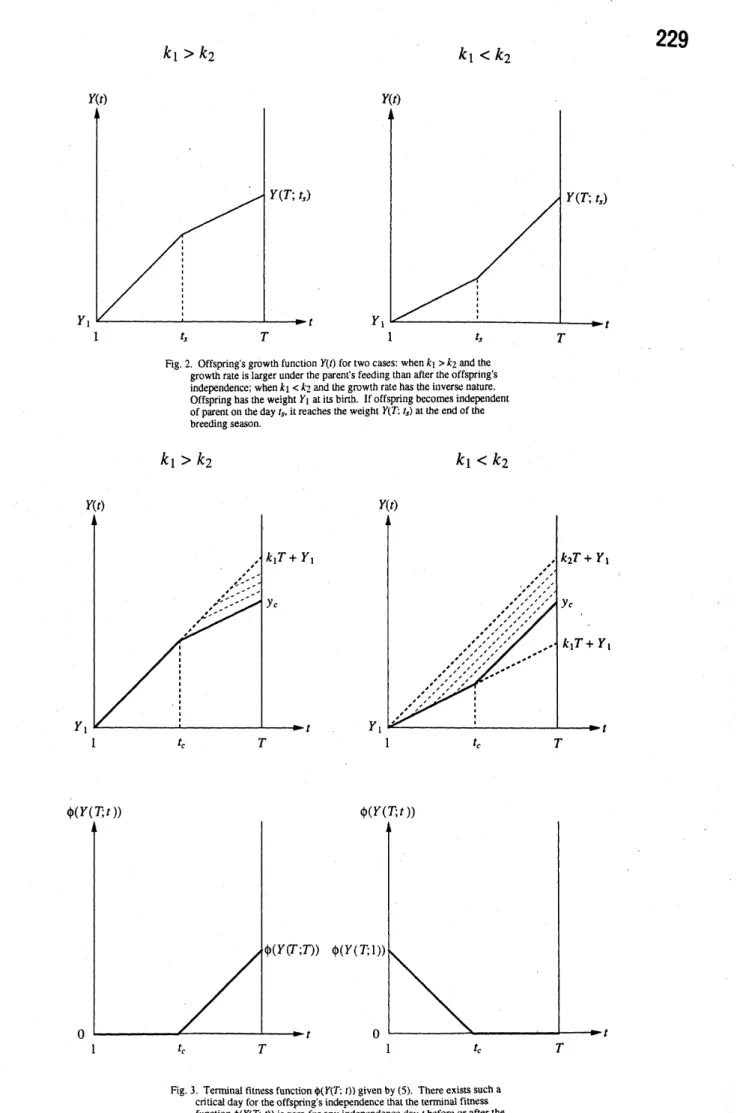
We use the following specific growth function
foroffspring:
$Y(t+1)=\{Y(t)+Y(t)+k_{t=t,t_{S}+1^{s},..,T-1}fort^{1}=1_{s}2,\ldots,t-.1r\circ r^{k_{2}}(I)$
$Y(1)=Y_{1}$, (2)
that is,
$Y(t)=\{\begin{array}{l}k_{1}(t-1)+Y_{1}k_{2}(t\frac{}{f}t_{S})+k_{s^{1}}(t_{\delta}-1)+Y_{1}r_{ort=1,2_{\prime}}ort=t+1_{\prime}t^{t_{s^{S}}}+2,\ldots,T\end{array}$ (3)
where$Y(t)$ is the offspring’s weight at the
begin-ning of day$t$,and $Y_{1}$ is the offspring’s weight at its
birth. $t_{s}$ is theoffspring’s age when parent stops
. feeding and offspring becomes independent. $k_{1}$ is
a positive constant which means the offspring’s
daily growth rate with the parent’s feeding, while
$k_{2}$ is a positive constant which means the
inde-pendent offspring’s daily growth rate(see Fig. 2).
Now, consider the offspring’s weight$Y(T;t_{s})$ at
the beginning of thelast day$T$of thebreeding
sea-son, under the condition that offspring becomes
independent at day $t_{s}$. From (3), $Y(T;t_{s})$ is
ex-pressed as follows:
$Y(T, t_{\theta})=k_{2}(T-t_{S})+k_{1}(t_{S}-1)+Y_{1}$. (4)
Offspring’s
FitnessWe define thedaily survival probability $\sigma_{n}$ for
offspring fed by parent, the daily survival
proba-bility $\sigma_{o}$ for offspring independent ofparent, the
daily survivalprobability $\sigma_{f}$forparentfeeding
off-spring, and the daily survival probability $\sigma_{p}$ for
parent not feeding offspring (see Fig. 1). As
Ydenberg (1989) showed in general for alcids, it
is naturally assumed that $\sigma_{o}<\sigma_{n}$ and $\sigma_{f}<\sigma_{p}$
.
The following events significant to determine the
offspring’s fitness are assumed on each day: (i)
Ifparent survives and feeds offspring with
prob-ability $\sigma_{f}$, offspring grows following to (3) with
its survival probability $\sigma_{n}$; (ii)$|If$parent dies with
probability $1-\sigma_{f}$,offspring becomes independent
togrow followingto (3)withits survival
probabil-ity $\sigma_{o}$; (iii) Ifparent stops feeding offspring with
its survival probability$\sigma_{p}$,offspring becomes
inde-pendent togrow following to (3) with its survival
probability$\sigma_{o}$.
Consider such probability $\phi(1^{\prime’}(T;t_{\dot{\theta}}))$ that
off-spring $wit1_{1}$ weight $Y(T;t_{s})$ at the end of the
breeding season will survive
after
thebreedingsea-son and reach thereproducible age to reproduce
the next generation. The probability $\phi(Y(T;t_{s}))$
is called the terminal
fitness function
foroffspring,andgiven as follows:
$\phi(1’(T;t_{s}))=\{$ $\gamma(YT\cdot t)0oth’erwise^{y}!t_{S})>y_{C};(5)$
where $\gamma$is a positiveconstant translating the
ad-vantage ofweight gain $Y(T;t_{s})-y_{C}$ to the
prob-ability $\phi(Y(T;t_{S}))$
.
$y_{C}$ is theoffspring’s minimumbody weight at the end of the breeding season,
sufficient tosurvive
after
thebreeding season andreach its reproducible age to reproduce the next
generation (seeFig. 3).
Conventionally, we define the critical day $t_{c}$
such that $Y(T;t_{c})=y_{c}$, which is given by
$t_{c} \equiv\frac{y_{C}-Y_{1}+k_{1}-k_{2}T}{k_{1}-k_{2}}$. (6)
Used the notation $t_{c}$, the probability $\phi(Y(T;t_{s}))$
can beexpressed in thefollowing way:
When $k_{1}>k_{2}$,
$\phi(Y(T;t_{s}))=\{\begin{array}{l}\gamma(k_{1}-k_{2})(t_{s}ift_{S}>^{-}t^{t_{c^{c}}.,)}0otherwise\end{array}$ (7)
When $k_{1}<k_{2}$,
(8)
$\phi(Y(\mathcal{T};t_{\delta}))=\{\begin{array}{l}\gamma(k_{2}-k_{1})(t_{c}if\ell_{S}<^{-}\ell^{\iota_{c^{s}}.)}0otherwise\end{array}$
Eventually, it is assumed that $1<t_{c}<T$. In the
case when$k_{1}>k_{2}$, iftheoffspring’sindependence
day$t_{s}$ is earlier than the critical day$[t_{c}]+1$ given
by (6), theoffspring’s weight $Y(T;t,)$ at the end
of the breeding season is below$y_{c}$so that the
ter-minal fitness function $\phi(Y(T;t_{s})$ is zero (Fig. 3).
In contrast, in the case when $k_{1}<k_{2}$, ifthe
off-spring’s independence day $t_{s}$is later than $[t_{c}]$,the
terminal fitness function $\phi(Y(T;t_{s})$ is zero.
Now, we consider the offspring’s fitness $F_{o}(t_{s})$
defined as such probability that offspring can
sur-vive through and
after
the breeding season and$k_{1}>k_{2}$ $k_{1}<k_{2}$
Fig.2. Offspring’s growth function$Y(t)$fortwocases:when$k_{1}>k?\sim$and the
growthrateis larger under the parent’s feeding than after the offspring’s
independence; when$k_{1}<k_{2}$andthe growth rate has the inverse nature.
Offspring hastheweight$Y_{1}$atits birth. lf offspnng becomes independent
ofparentontheday$t_{S}$
.
itreaches the weight$Y(T;t_{s})$atthe endofthebreedingseason.
$k_{1}>k_{2}$ $k_{1}<k_{2}$
Fig.3. Terrmnalfitness function$\phi(Y(T;t))$given by(5). Thereexists sucha
cnuca! day fortheoffspnng’s independencethat theterminalfitness
function$\phi(Y(T;t))$iszerotoranyindependence day$t$beforeorafterthe
generation, under the condition that it becomes
independent on day $t_{S}$ of the breeding season. If
offspring becomes independent on the first day,
that is, $t_{s}=1$, it survives through the breeding
season with probability $\sigma_{o}^{T}$. Growingupwith (3),
the offspring’s weight reaches $Y(T;1)$ at the last
day $T$of thebreeding season, which means that,
after
thebreedingseason,offspring gets theprob-ability $\phi(Y(T;1))$ to survive and reach its
repro-ducible age. Hence, the offspring’s fitness $F_{o}(1)$ is
given by
$F_{o}(1)=\sigma_{o}^{T}\phi(Y(T;1))$. (9)
In the case when $t_{s}=2$, two cases arise to be
considered. The first case isthat,ifparentdies on
the first day with probability $1-\sigma_{f}$, offspring is
i
糖鍛鰯響鞭
\not\in n
漉難窺難
$pt$嚇
hernepet
撫
ability $\sigma_{o}^{T}$
.
Therefore, the fitness in this case isgiven by$F_{o}(1)$with probability $1-\sigma_{f}$. Thesecond
詳諸認織雅
r
認撒響
fd, 講
r
離播
and survives for oneday with probability $\sigma_{n}$
.
For$o^{s}n\overline{\overline{d}}d^{\sim}t_{therest\circ fthebreedingseason^{ri_{W1}survives}}^{0ffs}Tl9throug^{a}f_{en,theindependentoffspng_{thproba-}}^{ri\iota\iota gbecomesindependentonthe\sec-}$
bilty$\sigma_{O}^{T-1}$
.
Theoffspring‘sweight reaches$Y(T;2)$on day $T$, which means that,
after
the breedingseason, offspring gets the probability $\phi(Y(T;2))$
to survive and reachits reproducible age. Lastly,
the offsping’sfitness $F_{o}(2)$ isgiven by
$F_{O}(2)=$($1$–a
$f$)$\sigma_{O}^{T}\phi(Y(T;1))$
(10)
$+\sigma_{f}\sigma_{n}\sigma_{o}^{T-1}\phi(Y(’\Gamma;^{o}\sim))$.
In the case when $t_{s}=3$, three cases arise. The
first case is that parentdies on the first day with
probability $1-\sigma_{f}$. Thesecondcase is that parent
survives on the first day with probability $\sigma_{f}$ and
dies on the second daywith probability $1-\sigma_{f}$. In
this case from the second day, offspring becomes
$independ_{en}t$ and survives through the rest of the
$Caseisb\circ thofbreedin_{t}fi_{th^{a}e}^{se_{t}asonwithprobabi1ity_{feedsoffs}}\not\in arentsurvivesandf_{proba-}^{ringon}$
$T-1$. The third
bility $\sigma_{f}^{2}$
.
In this case, offspringsurvives for twodays with probability $\sigma_{n}^{2}$. For $t_{s}=3$, offspring
becomes independent on the third day. The
mde-pendent offspring survives through the rest of the
breeding season with probability$\sigma_{o}^{T-2}$. Lastly,the
offspring’s fitness$F_{o}(3)$ is givenby
$F_{o}(3)=(1-\sigma_{f})\sigma_{o}^{T}\phi(Y(T;1))$
$+\sigma_{f}(1-\sigma_{f})\sigma_{n}\sigma_{o}^{T-1}\phi(Y(T;2))$ (11) $+\sigma_{f}^{2}\sigma_{n}^{2}a_{o}^{T-2}\phi(Y(T;3))$.
For the case when $t_{s}=4,5,$$\ldots,$$T,$$F_{o}(t_{s})$is given
in the sameway.
Consequently, except for the case when $t_{s}=$
$1,$ $F_{o}(t_{s})$ is expressedin general as follows:
$F_{O} \langle l,)=\sum_{j=1}^{t_{*}-1}\sigma_{f}^{j-1}\langle 1-\sigma_{j})\sigma_{\mathfrak{n}}^{j-1}\sigma_{O}^{T-j+1}\phi(Y^{-}(T:j))$
$+\sigma_{j}^{1-1}\sigma_{n^{l}}^{l-1}\sigma_{o}^{T-t_{9}+1}\phi(Y(T;\ell_{i}))$.
(12)
Parent’s
Survival
ProbabilityIn this section, We consider the parent’s
sur-vival probability $F_{p}(t_{s})$, which is defined as
such probability thatparentsurvives through the
breeding season under the condition that it stops
feeding on day$t_{s}$in the breeding season. Now, $\sigma_{w}$
is defined assuch probability that parentsurvives
through the interval period between two sequent
breeding seasons and reaches the next breeding
season.
If parent never feeds offspring on any day
through the breeding season, that is, if $t_{S}=1$,
parentsurvives through the breeding season with
probability $\sigma_{p}^{T}$. Then, parent can reach the next
breedingseason with probability $\sigma_{w}$
.
Hence, theparent’ssurvival probability $F_{p}(1)$ is given by
$F_{P}(1)=\sigma_{p}^{T}\sigma_{w}$. (13)
Ifparent feeds offspring on the first day and
stopsfeeding on the second day, that is, if$t_{s}=2$,
parent survives on the first day with probability
$\sigma_{f}$ and through the rest of the breeding season
with probability $\sigma_{p}^{T-1}$
.
Hence, the parent’ssur-vival probability $F_{p}(2)$ isgiven by
$F_{p}(2)=a_{f}a_{p}^{T-1}\sigma_{w}$. (14)
In the case when $t_{s}=3$, two cases arise to be
considered. The first case is that parent feeds
off-springon the first day with its survival probability
$\sigma_{f}$,while offspring dies on the first day with
prob-ability $1-\sigma_{n}$. Then, parentsurvives through the
restofthebreedingseason with probability$\sigma_{p}^{T-1}$.
The second case is thatparent feeds offspring on
the firstdaywithits survival probability$\sigma_{f}$,while
offspring survives on the secondday with its
sur-vival probability $\sigma_{n}$
.
Parent feeds offspring alsoon the second day with its survival probability
$\sigma_{f}$
.
For $t_{s}=3$, parent stops feeding on the thirdday. Then, parentsurvives through the rest of the
breeding season with probability$\sigma_{p}^{T-2}$. Lastly, the
$F_{p}(3)=\{(1-\sigma_{n})a_{f}\sigma_{p}^{T-}+a_{n}a_{f}^{2}\sigma_{p}^{T-2}\}\sigma_{w}.(15)$
For the case when $t_{S}=4,5,$$\ldots,$$T,$$F_{p}(t_{s})$ is given
in thesame $wav$.
Consequently, except for the case when $t_{s}=1$
or$t_{s}=2,$ $F_{p}(t_{s})$is expressed in general as follows:
$F_{p}(t_{s})$ $=a_{w} \sum_{j=1}^{t,-2}\sigma_{n}^{j-1}(1-a_{n})\sigma_{f}^{j}a_{p}^{T-j}$
(16)
$+a_{w}\sigma_{n}^{t.-2}\sigma_{f}^{t.-1}\sigma_{p}^{T-\iota.+1}$.
reproductive value $R(a_{1}-1)$ for the age$a\iota-1$ is
determined by
$R(a_{l}-I)$ $=$ $\sigma_{w}J(t_{p}(a_{\iota});R(a_{\iota}))$
$=$ $a_{w}F_{O}(i_{p}(a_{\iota}))$, (19)
and, further, in general, the value $R(a_{l}-i)(i=$
$1,2,$$\ldots,$$a\iota$ –a
$’$) for the age $a\iota-i$is given by the
following backwardrecurrence equation:
$R(a_{\iota}-i)=\sigma_{w}J(t_{p}(a_{\iota}-i+1);R(a_{l}-i+1)).(20)$
MODEL Parent’s Fitness
Consider the parent’s fitness atits age$a$, under
thecondition thatitstopsfeeding on day$t_{s}$ of the
breeding season. The parent’s fitness $J(t_{s}; R(a))$
is defined by the parent’s survival probability
$F_{p}(t_{s})$, its offspring’s fitness $F_{o}(t_{s})$, and the
par-ent’s expected future reproductive value $R(a)$ at
thelast day of the breeding season at the parent’s
age$a$, which satisfies thefollowing:
$R(a)=a_{w}J(t_{S}; R(a+1))$
(17)
$(a=a_{f}, a_{f}+1, \ldots, a_{\iota}-1)^{-}$
$J(t_{s} ; R(a+1))$ means the parent’s fitness at its
age $a+1$
.
Since $\sigma_{w}$ means the probability thatparent survives between the end of the breeding
season at its age$a$ and thebeginning of the next
breeding season atits age$a+1$,therighthandside
of (17) means the expected future reproductive
value. Remark that$R(a)$should be monotonically
decreasing in terms of the age $a$, and $R(a\iota)=0$
because $a_{l}$ is the last age for the parent’s
repro-duction.
As in Clark and Ydenberg (1990), $J(t_{s}; R(a))$
isgiven in this paper as follows:
$J(t_{S} ; R(a))=F_{O}(t_{S})+R(a)F_{p}(t_{S})$. (18)
From (17)and (18),wecan obtain the backward
recurrenceequation todetermine the expected
fu-ture reproductive value $R(a)$ for every age $a$
.
Itis assumed that, since the expected future
repro-ductive value$R(a)$is considered only forparentto
determine its behaviour$t_{p}(a)$ from its viewpoint,
it has no relationwith$t_{o}$from the offspring’s
view-point. Thus, since $R(a_{\iota})=0$, the expected future
ANALYSIS
The Optimal
Offsp
ring$s$ IndependenceAge
From The
Offspring’s
ViewpointThe $opt_{!}md$ offspring’s independence age $t_{o}$
from offspring’s $viewp_{01}nt$ is defined as the day
to maximize the offspring’s fitness $F_{o}(t_{s})$ in the
breeding season. Therefore, by analyzing $F_{o}(t_{s})$
givenby (9) and (12) (as for the way of analysis,
see Appendix A), $t_{o}$ can be obtained as follows
(Fig. 4): When $k_{1}>k_{2}$, $\ell_{O}=T$. (21) When $k_{1}<k_{2}$, $t_{o}=\{\begin{array}{l}n1ift<\nu+if\nu^{c}+n<t_{c\leq}^{2}\nu+n+1(n=2,3,\ldots\prime T-1)\end{array}$ (22) where $\nu\equiv\frac{1}{\sigma_{n}/\sigma_{O}-1}$. (23)
Since $\sigma_{n}>\sigma_{o}$ from the assumption, $0<\nu<\infty$
.
For convenience, we will hereafter use thenotation
$\nu$
.
As seen in Fig. 4, those conditions for$t_{o}$in the
case when $k_{1}<k_{2}$,givenby (22), are
complemen-taryeach $otl\iota er$, and the possibly maximal $F_{o}(t_{s})$
is$T-1$ in the case.
The
Optimal Offspring’s Independence AgeFrom Parent’s Viewpoint
Theoptimaloffspring’s independence age$t_{p}^{l}(a)$
from the parent’s viewpoint is defined as the
off-spring’s age $t_{s}|$ to maximize the parent’s fitness
Fig. 4. Inthecasewhen$k_{1}<k_{2}$,theoptimal offspnng’s independenceage$t_{o^{*}}$
fromtheoffspnng’sviewpointontheparameterspace$(V, t_{c})$. For$1<t_{c}<$
$T,$ $t_{o}^{*}<T$.
Fig.5. In thecasewhen$k_{1}>k_{2}$,the parameterspace$(p. K(n))$iscategorized
into$I_{1}-I_{7}$,dependingonthe typeotthe division of the parameterspace $(v, t_{c})$intermsof the value$0\dot{f}t_{p}^{*}(\iota)$.
$I_{1}$ $I_{2}$
$I_{3}$ $L$
Fig. 6. $\ln$thecasewhen$k_{1}>k_{2}$,theoptimaloftspring$s$independence,Igc
$t_{p}^{*}(a)$from the parent’sviewpointonthe$pu\phi met_{C^{\backslash }}r$space$(v, t\cdot)$forthe
parameter sets$I_{1}-I_{4}$of theparameterspace$(p, K(\iota))$.
Fig.7. In thecasewhen$k_{1}>k_{2}$,the optimal offspring’sindependenceage $t_{p^{*}}(a)$fromthe parent’sviewpointonthe parameterspace$(v, t_{c})$torthe
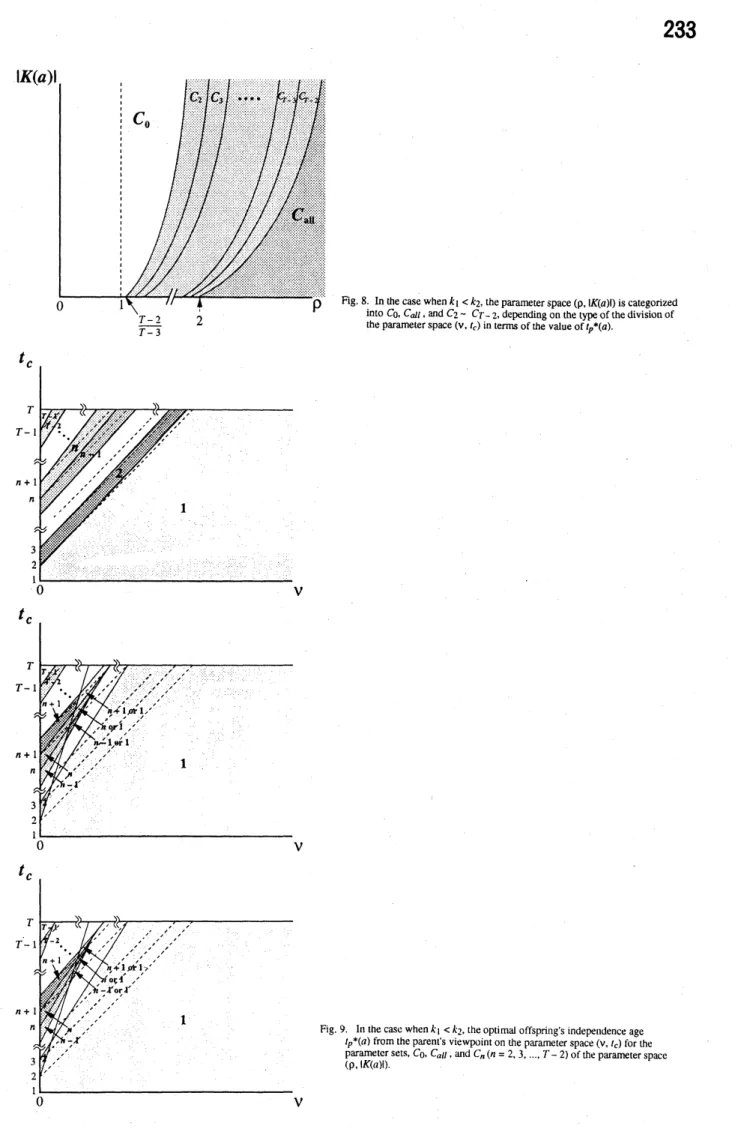
Fig.8. In thecasewhen$k_{1}<k_{2}$,theparameterspace$(p, \mathfrak{l}K(a)1)$is categonzed
into$C0$
.
$C_{dt}$,and$C_{2}\sim Cr-2$,dependingonthetype ofthedivision ofthe parameterspace$(v, t_{c})$intermsof the value of$t_{p^{*}}(a)$.
Fig.9. Inthecasewhen$k_{l}<k_{2}$,theoptimaloffspnng’s independenceage
$t_{P^{*}}(a)$fromthe parent’sviewpointonthe parameterspace$(v, t_{c})$for the
parametersets,$C_{0},$$C_{all}$,and$C_{n}(n=2,3, \ldots, T-2)$oftheparameterspace
(18), $t_{p}(a)$ can be obtained for the parent’s age
$a$, when $R(a)>0$,that is, when a$f\leq a\leq a_{\iota}-1$,
as follows: When $k_{1}>k_{2}$,
$t_{p}(a)=\{Tlni^{i\leq_{+_{\ell}^{t<}}^{(\nu_{C}\cdot a\rangle_{(\nu\cdot.\alpha_{\circ)}}}}i_{ T\leq_{T\frac{9}{h}}}i^{ft>_{(n_{l}=}}orilt<^{2}orii\ell<_{\mathfrak{n}+_{2^{l_{\prime}}}^{n^{l_{\frac{\{}{ct_{3}}}}}}^{n}n_{an_{d^{c^{l}}h_{C}\nu.a.)\leq t_{C}<h_{n}\langle\nu.\alpha)}}^{c}an_{-}^{d_{C}h^{g}\nu\cdot...a_{\nu}).\leq.l_{C}<.g_{\mathfrak{n}}\{\nu\cdot..a\rangle}and\ell c<r^{<_{l}\tau^{T_{)}-l)}}an^{-}d\ell<\tau^{l}t^{n}’$ (24)
When $k_{1}<k_{2}$,
$t_{p}(a)=\{n1i^{ft<h(\nu.\cdot a)}i_{fh^{c_{n}}(\nu\cdot.a)<t_{c}..\leq h_{n+}(n=^{1}2,3,.,T-1^{1})^{(\nu\cdot.a)}}$ (25) where
$g_{n}( \nu;a)\equiv n+\frac{\rho^{T-n+2}\nu}{K(a)\nu+1}$ (26)
$h_{\hslash}( \nu;a)\equiv n+(1-\frac{\rho^{T-n+2}}{K(a)})\nu$ (27)
$\rho\equiv\frac{\sigma_{p}}{\sigma_{O}}$ (28)
$K(a) \equiv\frac{\gamma(k_{1}-k_{2})\sigma_{P}/\sigma_{w}}{R(a)\sigma_{p}/\sigma_{f}-1}$. (29)
Note that those conditions for $t_{p}(a)$ are not
complementary each other. For example, in the
case when $k_{1}>k_{2},$ there exist such parameters
that$g_{2}(\nu;a)<t_{c}<h_{T}(\nu;a)<T-1$
.
Thismeansthat, with such parameters, $t_{p}^{l}(a)$ should be 1 or
$T$
.
In this case, $t_{p}(a)$ can be ultimatelydeter-mined by comparing $J(1;R(a))$ with $J(T;R(a))$
.
In this paper, avoiding a mess of calculations, we
no longer discuss the ultimately determined$t_{p}(a)$
insuch case, because our presented analysesgive
sufficiently significant qualitative results valuable for the discussion on the parent-offspring conflict phenomenon.
As indicatedbythoseconditions for$t_{p}(a)$,given
by (24)and (25), theultimately determined$t_{p}(a)$
strongly depends on parameters (Fig. 6, Fig. 7,
Fig. 9). The parameter space $(\nu, t_{c})$ can be
de-vided into some subregions depending on what
value is possiblefor $t_{p}(a)$. The way of the
devi-sion depends on the otherparameters$\rho$and $K(a)$
(Fig. 5, Fig. 8).
In the case when $k_{1}>k_{2}$, depending on the
$Wtecateg\circ rizetheparemeterreg\circ 7_{\iota\circ f(\rho,K(a^{c})^{)})}^{rspace(\nu,t}$
into thoseregions $I_{1}\sim I_{7}$ as shown iu Fig. 5 (as
for theanalyzingway,see AppendixB).According
tothoseparametersubregions of$(\rho, I(a))$,the
ul-timatelydetermined $t_{p}(a)$is shownin the
param-eter space $(\nu, t_{c})$ as in Fig. 6 and Fig. 7. In cases
of$I_{1},$ $I_{2}$, and $I_{4}$, the possible value of $t_{p}(a\rangle$ is $T$
or less than an $N$, while, in case of$I_{3}$, it is any
value from 1 to $T$
.
In cases of$I_{5}\sim I_{7}$, only 1 or$T$ispossiblefor $t_{p}(a)$.
In contrast, in thecase when $k_{1}<k_{2}$, we
cat-egorize the paremeter region of $(\rho, |K(a)|)$ into
thoseregions $C_{0},$$C_{n}(n=2,3, \ldots, T-2)$, and$C_{a1l}$
as shown in Fig. 8 (Appendix B). For those
re-gions, the ultimately determined$t_{p}(a)$ is shown in
the parameterspace$(\nu, t_{c})$ asin Fig. 9.
Indepen-dently of which caseisconsidered, any value from
1 to $T-1$ is possible for$t_{p}(a)$.
When $a=a_{1}$, since $R(a_{1})=0$ from the
defini-tion, it is followed that $J(t_{s}; R(a_{t}))=J(t_{s} ; 0)=$
$F_{o}(t_{s})$
.
Therefore, $t_{p}(a_{1})=t_{o}$given by (21) and(22), and there does not occur any conflict
be-tween parent and offspring.
The offspring’s independence age $t_{p}\sim$ to
maxi-mize the parent’s survival probability $F_{p}(t_{s})$is
al-ways 1 independently of the values ofparameters,
because $F_{o}(t_{s})$ is monotonically decreasing.
In-deed,since$a_{p}>\sigma_{f}$, for any $\downarrow s$
’
$F_{P}(t_{S}+1)-F_{P}(t_{s})$
$=\sigma_{n}^{t.-1}\sigma_{f}^{t.-1}\sigma_{p}^{T-t}(a_{f}-a_{P})\sigma_{w}<0$. (30)
From the definition (18), when parent is
suf-ficiently young and $R(a)$ is so large, it is
ex-pected that$t_{p}(a)$is near $t_{p}\sim$,because $J(t_{s} ; R(a))\approx$
$R(a)F_{p}(t_{s})$
.
Indeed, asseen in Fig. 6, Fig. 7, andFig. 9, the parameterregion for $t_{p}(a)=t_{p}\sim=1$
is relatively larger for the smaller $|K(a)|$ than for
thelarger.
Existence
of
Parent-Offsp$7^{\vee}ing$Conflict
Compared Fig. 4 to Fig. 6, Fig. 7, and Fig.
9, the parent-offspring confict presents for awide
range ofparameters.
In the case when $k_{1}>k_{2}$, as shown in Fig. 6
and Fig. 7, especially forrelativelylarge value of
$t_{c}$, the parent-offspring conflict canexist, because $t_{o}=T$. The typeof conflictis eventually for $t_{o}>$ $t_{p}(a)$, that is, underconflict, parent tendsto stop
feeding its offspring, while offspring wants to be
fed. Only forsufficiently small values of$t_{c}$ and $\nu$,
parentkeepsfeeding its offspring who wants to be fed.
As well, in the case when $k_{1}<k_{2}$, as shown
in Fig. 9, only one type of conflict, $t_{o}>t_{p}^{l}(a)$,
is possible to exist and occur. This result can
be easily proved that any slope of boundaries of
parameterregions in$(\nu, t_{c})$,givenby (27),is more
than 1.
Parent’s Age Dependence
of Confiict
The optimal offspring’s independence age$t_{p}(a)$
from the parent’s viewpoint for a breeding season
is determined depending on the value of $K(a)$,
that is, of $R(a)$ as shown by the above
analy-sis. Following the definition, $|K(a)|$ is
monoton-ically increasing to infinite as the parent’s age $a$
increases, since $R(a)$monotonically decreases as$a$
increases, and reaches zero at the age$a_{\iota}$
.
There-fore, as the parent’s age increases, theparameter
point moves upinthe$par\dot{a}meter$space$(\rho, |K(a)|)$.
In the case when $k_{1}>k_{2}$ and $0<K(a)$, if
$\rho\geq 1$, as the parent’s ageincreases, the
parame-ter point $(\rho, It’(a))$ moves as$I_{5}arrow I_{6}arrow I_{7}$ in Fig.
5. Therefore, since $t_{o}=T$in this case, whenever
theconflict occurs, $t_{p}(a)=1$, and parent tends to
stopfeeding its offspring on everyday of the
breed-ingseason, while offspring wants to be fed allover
the breeding season. Otherwise, when the
con-flict does not occur, then parent keeps feeding its
offspring allover the breedingseason. Moreover,
for someparameters of $(\nu, t_{c})$, as seen in Fig. 7,
the conflict does not occur for parent older than
acritical agedetermined by the parameter $(\nu,$$t_{c}$,
while theconflict occurs for the youngerparent.
If $\rho<1$ when $k_{1}>k_{2}$, as the parent’s age
increases, theparameterpoint$(\rho, K(a))$movesup
inFig. 5 through the following order ofparameter
regions in it: $I_{5}arrow I_{1}arrow I_{2}arrow I_{3}arrow I_{4}arrow I_{7}$.
Theparameter point $(\rho, K(a))$does not pass any
region with any order inverse to thisorder. The
argument similar to that for $\rho\geq 1$ is applicable
for this case. As the parent’s age increases, $t_{p}(a)$
tends to be tlte same orto increase, therefore,it is
likely that,afteracriticalparent’sage, the conflict
does not occur and parent keeps feeding all over
the breeding season.
As mentionedbefore, at theparent’s age$a\iota$ last
in the reproducible age span, in the case when
$k_{1}>k_{2}$, the conflict does notoccur and $t_{p}(a)=$ $t_{o}=T$, so that parent keeps feeding all over the
breedingseason.
It is concluded for $tl\iota e$ case when $k_{1}>k_{2}$ that
the optimal offspring’s independence age $t_{p}(a)$
from the parent’s viewpoint stays the same or
tends to become the larger toward $T$ as the
par-ent’s age$a$ increases, and the conflict of thetype
for $t_{o}>t_{p}(a)$ disappears after a parent’s age,
then. parent keeps feeding all over the breeding
season.
On the other hand, in the case when $k_{1}<k_{2}$
and $K(a)<0$ , as the parent’s age$a$increases,the
parameter point $(\rho, |K(a)|)$ moves up in Fig. 8
through the following order of parameterregions
init: $C_{a\downarrow\iota}arrow c_{\tau-2}arrow C_{T-3}arrow\cdotsarrow C_{3}arrow C_{2}arrow$
$C_{0}$. Theparameterpoint$(\rho, |K(a)|)$does not pass
any region with any order inverse to this order.
Therefore, as seen in Fig. 9, since the conflict is
only of the type that $t_{o}^{l}>t_{p}(a)$, the conflict can
disappear after a critical age of parent for some
parametersof$(\nu, t_{c})$. For the otherparametersof $(\nu, \ell_{c})$, the conflict oftype that $t_{o}>t_{p}(a)$ occurs
through the parent’s reproducibleage-spanexcept
for the last age$a\iota$
.
In bothcases, the optimaloff-spring’sindependence age$t_{p}(a)$ from theparent’s
viewpoint staysthe same or tendsto become the
largerastheparent’sage$a$increases, as wellas in
the case when $k_{1}>k_{2}$.
Resolution
of
Parent-OffspringConflict
By the above anaiysis, it is shown that the
parent-offspring conflict possibly occurs
depend-ing on those parameters including the parent’s
age. The conflict is resolved once parent or
off-springyields toanother. In this section, we discuss
how theconflictisresolved, and how the
compro-mised day $t^{\star}(a)$ whenoffspring becomes
indepen-dent isdetermined.
For the resolution of parent-offspring conflict,
the cost for conflict is taken into account. Now,
the cost for conflict is assumed to be introduced
asthe decrease of fitness(Higashi andYamamura,
1993). That is, under the conflict, it is assumed
that offspring must pay acost $c$ to counter
par-ent, while parent must pay a cost $\alpha c$ to counter
offspring, where $c$ is monotonically increasing as
the duration of the behaviour to counter another
side per conflict, and $\alpha$ is a positiveconstant. At
the beginning of any day under the conflict
sit-uation, $c=0$ because the behaviour to counter
another side is not yet started. Those costs are
subtracted from fitnesses ofparent and offspring.
In the following, we consider the resolution of
mentioned above, for two distinct cases: $t_{o}^{r}>$
$t_{p}^{r}(a);t_{o}^{l}<t_{p}(a)$.
CASE $A:t_{o}>t_{p}(a)$
The compromised day $t^{\star}(a)$ naturally satisfies
that $t_{p}(a)\leq t^{\star}(a)\leq t_{o}$. The fitness gain $D_{p}(t;a)$
forparenton a day $t$under theconflict (expected
forthe case in whichparent wins the conflict and
succeeds in making offspring independent),
rela-tive to such fitness thatparentyielded tooffspring
in the first place and let offspring depending on the
parent’sfeeding, is now givenby
$D_{p}(t;a)=J(t;R(a))-J(i+1;R(a))-\alpha c$. (31)
On the otherhand,the fitness gain $D_{o}(t;a)$for
offspring on a day $t$under the conflict (expected
for the case in which offspring wins the conflict
and succeeds in making parent feeding), relative
to such fitness that offspring yielded to parent in
the first place and became independent, is now
givenby
$D_{o}(t_{1}\cdot a)=F_{O}(t+1;a)-F_{O}(l;a)-c$. (32)
When $t_{p}(a)\leq t<t^{*}(a)$, the fitness gains $D_{p}(t;a)$and $D_{o}(t;a)$musteventuallydecline from
positive toward zero on the day $t$, because the
cost $c$ is temporally increasing as the behaviour
of conflict continues. Therefore, when $D_{p}(t;a)$
becomes zero while $D_{o}(t;a)$ is still positive,
par-ent yields to offspring and feeds it. Thus, when
$t_{p}(a)\leq t<t^{\star}(a)$, there exists such a value of $c$
that $D_{p}(t;a)=0$ and $D_{o}(t_{;}a)>0$. On the other
hand,on thedaywhen $t=t^{\star}(a)$, parentdoesnot
yield to offspring before offspring yields to
par-ent, from thedefinition of$t^{\star}(a)$
.
This means thatthere exists such a value of $c$ tbat $D_{o}(t;a)=0$
and $D_{p}(t;a)\geq 0$
.
It is assured that $t^{\star}(a)\leq t_{o}$,because $D_{o}(t_{o} ; a)\leq-c$ from the definition of $t_{o}$
so that the compromised independence day does
not be beyond the day $t_{o}$. This argument can be
simplified with the following function$\theta(t;\alpha, a)$:
$\theta(t;\alpha, a)\equiv\alpha\{F_{o}(t+1;a)-F_{o}(t;a)\}$ $+\{J(t+1;R(a))-J(t;R(a))\}$ $=(\alpha+1)\{F_{O}(t+1 ; a)-F_{O}(t;a)\}$ $+R(a)\{F_{p}(t+1;a)-F_{P}(t;a)\}$ $=(\alpha+1)\{J(t+1;\alpha\#^{a}t)-J(t_{\urcorner T}^{R(a)};_{\alpha})\}$ . (33)
Remark that$\theta(t;\alpha, a)>0$when$t_{p}(a)\leq t<t^{\star}(a)$,
while$\theta(t;\alpha, a)\leq 0$ when $t=t^{\star}(a)$
.
Therefore,thecompromised day$t^{\star}(a)$ is given by
$t^{\star}(a)= \min_{t}\{t|\theta(t;\alpha, a)\leq 0, t_{p}(a)\leq t\leq t_{\circ}\}$ (34)
CASE $B:t_{\circ}<t_{p}(a_{1})$
Asbefore, the compromised day $t^{\star}(a)$naturally‘
satisfies that $t_{o}\leq t^{\star}(a\rangle$ $\leq t_{p}^{t}(a)$. Contrarily to
CASE $A$, the fitness gain $D_{p}(t;a)$ for parent on
a day $t$under the conflict (expected for the case
in which parent wins the conflict and succeeds in
keeping offspring under theparent’s feeding),
rela-tivetosuchfitness thatparent yielded tooffspring
$ln$ the first placeand let$0ffsprlIlg$independent, is
now given by
$D_{P}(t;a)=J(t+1;R(a))-J(t;R(a))-\alpha c$. (35)
Thefitness gain$D_{o}(t;a)$for offspring on aday$t$
under the conflict(expected for the case in which
offspring wins the conflict and succeeds in
becom-ingindependent),relative tosuch fitness that
off-$sriyie1dedt\circ Cept$
ac-$D_{o}(t, a)=F_{o}(t, a)-F_{o}(\ell+1;a)-c$. (36)
By the same argument as in CASE $A$, when
$t_{o}\leq t<t^{\star}(a)$, there exists such a value of $c$
that $D_{p}(t;a)>0$ and $D_{o}(t;a)=0$
.
On theday when $t=t^{\star}(a)$, there exists such a value of
$c$ that $D_{o}(t;a)\geq 0$ and $D_{p}(t;a)=0$
.
Also inthiscase, it is assured tbat $t^{\star}(a)\leq t_{p}\{a$), because
$D_{p}(t_{p}(a);a)\leq-\alpha c$ from the definition of $t_{p}(a)$
.
This argument can be simplified with the same
function (33), $\theta(t;\alpha, a)$. Moreover, the compro$\cdot$
mised day $t^{\star}(a)$is givenbythe following equation
similar to (34):
$\ell^{\star}(a)=\min_{t}\{\ell|\theta(t|\alpha, a)\leq 0, \ell_{\circ}\leq t\leq t_{p}(a)\}$. (37)
We note that, since the considered signiture
of $\theta(\ell;\alpha, a)$ is determined by the difference of
$J(t;R(a)/(\alpha+1)),$ $t^{\star}(a)$isregarded as the smallest
value thatgives the maximal of$J(t;R(a)/(\alpha+1))$
when $mi_{I}\iota\{t_{o}, t_{p}(a)\}\leq t\leq\max\{t_{o}^{*}, t_{p}(a)\}$
.
Exis-tence ofsuch $t^{\star}(a)$ is assured by the above
argu-ment.
By the result for our model, it is shown that
the conflict is only of the type that $t_{o}>t_{p}(a)$,
that is, of CASE $A$, and as the parent’s age $a$
increases and the expected future reproductive
value $R(a)$ decreases, $t_{p}(a)$ stays the same or
be-comes the larger and approacbes $t_{o}$ from below.
Therefore, the above result indicates that the
com-promise between parent with the expected future
reproductive value $R(a)$ and its offspring shifts
the offspring’s independence day to that
corre-sponding to the favorable (not necessarily
opti-mal!) independenceage from the viewpoint of
par-ent $\iota vith$ the expected future reproductive value
$R(a)/(\alpha+1)$
.
Eventually, the compromisedinde-pendence day $t^{\star}(a)$ is the nearer to $t_{o}$ as $\alpha$ isthe
In thecase when$k_{1}>k_{2}$ and$\rho\geq 1,$$t_{o}=T$and $t_{p}(a)$is 1 or $T$, as resulted in the previous section
(Fig. 7). Thus, the compromise can cause only
twoalternative conclusion of the parent-offspring
conflict: offspring becomes independent on the
first dayofbreedingseason,orparent keeps
feed-ing offspring all over the breeding season. Since
$t_{p}^{r}(a)$ is 1 or $T$by our analysis, ifparent yields to
offspring on the first day of breedingseason, the
offspring’s independencedoes not occur until the
last day ofbreedingseason.
On the other hand, in the case when $k_{1}>k_{2}$
and $\rho<1$, the compromise can cause the
off-spring’s independence on the day $t^{\star}(a)$ such that
$1<t^{\star}(a)<T$ (see Fig. 6). Dependingon the
pa-rameters, the compromise conclusion same as in
the case when $k_{1}>k_{2}$ and $\rho\geq 1$ still possibly
occurs.
In thecase when $k_{1}<k_{2}$, both of$i_{o}$ and $t_{p}(a)$
can take any value less than $T$, depending on
theparameters,whereasitis always satisfied that
$t_{o}>t_{p}(a)$,asresultedinthe previoussection (Fig.
9). Therefore, the compromise can cause the
off-spring’s independence on theday$t^{\star}(a)$ as defined
as $t_{p}(a)\leq t^{\star}(a)\leq t_{o}$.
CONCLUSION
Results by our mathematical model indicates such possibility that the observed behaviour of
parental care may change depending on the
par-ent’s age. This is because the compromise
con-clusion of the parent-offspring conflict depends on
the parent’s age, that is essentially, on the
par-ent’s expected future reproductive value.
More-over, the observed parent-offspring conflict
possi-bly dependson the parent’s age, too.
As long as in the framework of our
mathemat-icalmodel, thepossiblyobserved parent-offspring
conflict is of the type that $t_{o}>t_{p}(a)$, that is,
parent intends to stop feeding itsoffspring, while
offspring wants to be fed. Hence, if another type
that $t_{o}^{*}<t_{p}(a)$, that is, parent intends to feed,
while offspring wants to become independent, is
observed,some improved mathematical model will
be required for themathematical theoretic
expla-nation on it. REFERENCES
Clark, C. W. and Ydenberg, R.C. (1990)The risks
of parenthood. I. Generaltheoryand applications.
Evol. Ecol. 4: 21-34.
Higashi, M. and Yamamura, N. (1993) What
de-termines the animal group size: insider-outsider
conflict and its resolution. personal
communica-tions
Ydenberg, R. C. (1989) Growth-mortality trade
offs and the evolution of juvenile life histories in
the Alcidae. Ecology 70: 1494-1506. APPENDIX A
In this appendix, we show the waytodetermine
analytically$t_{o}$ and $t_{p}(a)$. The optimal offspring’s
$diefinedasthe(f_{ayt^{\circ}o\max imizetheoffspring’ sfit-}^{etfr\circ m\circ ffspring’ sviewpointis}$
ness$F_{o}(t_{s})$in the breeding season. Thus, $t_{o}$should
be one of maximals of $F_{o}(t_{s})$ for $t_{s}=1,2,$$\ldots,$$T$.
The necessary condition for $t_{o}=1$ is
$F_{O}(2)-F_{O}(1)<0$.
In the same way, the necessary condition for $t_{o}=$
$T$is
$F_{O}(T)-F_{o}(T-1)>0$,
where it is assumed that, if $F_{o}(T)=F_{o}(T-1)$,
then, $t_{o}\leq T-1$
.
In contrast, the necessarycon-dition for$t_{o}^{l}=n(n=2,3, \ldots, T-1)$ isasfollows:
$\{F_{o}(n)-F_{O}(n-1)>0F^{o}(n+1)-F_{O}(\mathfrak{n})\leq 0$
Some cumbersome analyses of those necessary
conditions can lead to possible values of$t_{o}$ given
as (21)and (22).
Also as for$t_{p}^{*}(a)$, the same argument is
adapt-able for $J(t_{s} ; R(a))$ given by (18). In this case,
as long as is considered parent-offspring relation
within a breeding season, the expected future
reproductive value can be regarded as a
non-negative constant independent of $t_{s}$. Therefore,
the same way of analysis can be carried out for
$J(t_{s}; R(a))$ and give those possible values of$t_{p}(a)$
as (24) and (25).
APPENDIX $B$
In this appendix, some outlines of analyzing
way on the parameterdependenceofthe optimal
offspring’s independence age from parent’s
view-point,given by Fig. 5 and Fig. 8.
In the case when $k_{1}>k_{2},$ $t_{p}^{l}$ is givenby (24).
Function$g_{n}(\nu;a)$ has the following asymptote:
Therefore, depending on the position of the
above asymptote, the valid condition of (24)
switches, because the positional relation among
those functions $g_{n}(\nu;a)$ and $h_{n}(\nu;a)$changes(see
Fig. A). Further, the positional relation depends
also on $n$. Thus, asseen in casesof$I_{1},$$I_{2}$, and $I_{4}$
ofFig. 6, there is such case that$t_{p}$cannotbe less
than $\exists_{N}>1$
.
For$n<\exists_{N}$ insuchcase, theposi-tionalrelation corresponds to (a) or (b)in Fig. A..
$ti\circ na1e1ati\circ namongt^{zed^{e_{@}}}be^{S}ana_{r^{yyeg^{A}’ yana1yzingthe_{I_{n}^{o_{+}si-}}}}1tica11catori_{h\circ sepointsP_{n}and}^{thositiona1re1ationca_{1}n}AindicatedinFig$
.
givenby
$P_{n}$: $(n-1,$$\frac{1}{\rho^{T-n+2}/I\backslash ’(a)-1})$
$P_{n+1}$ : $(n-1,$$\frac{2}{\rho^{T-n+1}/K(a)-1})$ .
If $P_{n+1}$ is located left to $P_{n}$, there exists some
region for $t_{p}=n$, seen in thecase (d) ofFig. A.
Even if $P_{n+1}$ islocated right to $P_{n}$, when $\rho<1$,
there can exist a region for $t_{p}=n$, seen as the
case (e) in Fig. $A$, under the following condition:
$\frac{n}{\rho^{T-n+1}/K(a)-1}<\frac{n-1}{\rho^{T-n+2}/K(a)-1}$
This condition means that the cross section of
$h_{n+1}(\nu;a)$ on $\nu$ axis is located left to that of $h_{n}(\nu;a)$
.
In Fig. 5, no distinction is indicatedbetween twocases (d) and (e) of Fig. A.
Includ-ing these cases, the parameter region of$(\rho, K(a))$
further shows a detail structure, when $k_{1}>k_{2}$,
as shown in
Fig.
$B$:those regions $I_{3}$ and $I_{4}$ arerespectively$di_{V1}ded$intodistincttworegions. For
parametersof$I_{3U}$, as increasing$n$for$t_{p}=n$,both
cases of(d) and (e) occurin the orderfrom(d) to
(e) of Fig. $A$, while, for those of $I_{3L}$, only the
case (d) occurs. Similarly, for parameters of$I_{4U}$,
as increasing $n$, if $n<\exists_{N}$ the case (a) occurs,
and when $n=\exists_{N}(c)$occurs. Then, for$n>\exists_{N}$
both cases of(d) and (e) occurs from (d) to (e).
However, for those of $I_{4L}$, the case (e) does not
occurs, taken the place by (d). As another case,
if thefollowingconditionis satisfied for $\exists_{N}$ when
$\rho<1$,
$\frac{\rho^{T-N+2}}{K(a)}\leq 1<\frac{\rho^{T-N+1}}{K(a)}$
there exist some regioll for $t_{p}=N$as givenby (c)
in Fig. A. Thiscaseisincludedin the region$I_{4}$ of
Fig. 5, as seen in Fig. 6.
In the case when $k_{1}<k_{2}$, the same way can
be carried out for $h_{n}(\nu;a)$ and $h_{n+1}(\nu;a)$. For
$C_{n}$, the regionof $(\nu, t_{c})$-space for $t_{p}=j$ less than $n+1$ and more than 1 appears astrianglebecause $h_{n}(\nu;a)$ and $h_{n+1}(\nu;a)$ cross, as in Fig. 9.
Fig.A.Schematic descnption of the configuration pattem for$g_{n}(v;a)$and$h_{n}(v$:
$a)$. For detail explanation,seetext.
Fig. B. In thecasewhen$k_{1}>k_{2}$and$p\leq 1$
.
theparameterspace$(p, K(a))$consists ofadetail stmcture dependingonthetypeof the division ofthe
parameterspace($v,$$t_{c}\rangle$in terms of the value of$t_{p^{*}}(a)$. Compare with Fig. 5.