I
IntroductionSince the 1997 Asian financial crisis trade and investment integration among East Asian economies has increased rapidly. This is reflect-ed in the increasreflect-ed volume of exports and imports, and expansion in the size of capital in-flows and outin-flows. Brunei Darussalam has increasingly participated in the East Asian economy and has been integrated in the re-gional economic activities through trade and foreign direct investment(FDI). While re-search on trade and financial integration has been done for East Asia as a regional group (see for example, Capannelli and Filippini, 2009; Shin, 2008), we lack a comprehensive picture of trade and financial linkages of individual countries. This paper takes a first step towards filling that gap.
Brunei is a tiny country but is not without economic significance. Whilst it is a very small player on the world oil and gas market, its reve-nues provide it with some leverage on international investment markets. Brunei has become the first country in Asia to establish trade links with Japan in 1972 to supply LNG (liquefied natural gas). Since then Brunei has played a significant role in terms of exports and imports to and from Japan and other countries in East Asia. Brunei has become formally inte-grated in the economic activities of other countries in ASEAN (Association of Southeast Asian Nations) through joining the organiza-tion in 1984. In addiorganiza-tion, Brunei has been an active participant in BIMP-EAGA (Brunei In-donesia Malaysia Philippines-East ASEAN Growth Area), which was launched in March 1994.
Brunei Economy
and its Integration
in the Regional
Economic Activities*
Saiful Islam
Faculty of Business and Computing Institute Technology Brunei-University / Senior lecturer
This paper examines the extent of the partici-pation of Brunei in the economic activities of other countries in East Asia. This article has two main objectives. The first objective is to provide an up to date account of economic growth of Brunei. The second objective is to explore the trade and investment linkages of Brunei to various economic activities of other East Asian economies.
The title of this paper contains the words re-gional economic activities. Region here refers to East Asia which includes Japan, South Ko-rea, and People’s Republic of China, and the ten ASEAN countries (Brunei, Cambodia, In-donesia, Laos, Malaysia, Myanmar, Philippines, Singapore, Thailand and Vietnam). The term East Asia is also called “ASEAN Plus Three” since the cooperation between ASEAN and its three dialogue partners was institutionalized in 1997. Economic activities are the production and distribution of goods and services for the satisfaction of human wants (Samuelson and Nordhaus, 2006, p. 408). Examples of eco-nomic activities are farming, manufacturing and mining. Brunei has oil and gas as main economic activity, Japan and South Korea have manufacturing as their main economic activity. On a national scale, examples of economic ac-tivity include gross domestic product (GDP), per capita GDP, international trade, and rate of inflation. In this paper we explore how trade and FDI activity of Brunei is linked to various economic activities (e.g. farming, manufactur-ing and minmanufactur-ing ) in other East Asian economies.
The remainder of this paper is organized as follows. The next section shows comparison of economic characteristics between Brunei and other countries in the region for 2009.
Eco-nomic growth of Brunei and sources of growth is presented in Section III. Results of regres-sion on sources of GDP growth of Brunei are also presented in this section. Policies adopted for promoting economic growth in Brunei is presented in Section IV. Trade and investment linkages of Brunei with the rest of East Asia are then discussed in Section V, followed by a con-cluding section.
II
Brunei andOther East Asia Today: Some Data
Brunei Darussalam – the “Abode of Peace” – is a small Sultanate, occupying 5,765 square kilometers (2,226 square miles) on the north-west corner of the island of Borneo. The country is slightly larger than Mie prefecture of Japan. Brunei is bordered by the South China Sea to the north and the Malaysian state of Sar-awak to the south, east and west. It achieved independence from the British in January 1984. The location of Brunei is shown in Figure 1.
Population of Brunei was estimated at 406,000 in 2009 and is growing at an average rate of 2.1 percent per annum. Brunei has a multi-racial society, comprising of 66.3 percent Malays and 11.0 percent Chinese. The rest are Indians, indigenous ethnic groups and expatri-ates. Brunei has a young population: 57 percent are in the 20-54 working age, another 35 per-cent are below the age of 19 while only 8 percent are 55 and above.
Almost 75 percent of the land area in Brunei is undeveloped and covered by tropical rainfor-est, with about 95.94 percent of the land area belonging to the government and the rest owned by private landowners (Shiem and Ee,
2005, p. 48). On the economic front, Brunei was crowned champion in macroeconomic sta-bility by the World Economic Forum, taking the number-one position globally in the cate-gory in the “Global Competitiveness Report” (Oxford Business Group, 2010, p. 8). One mea-sure of macroeconomic stability is low inflation. Brunei has been successful in main-taining inflation at moderate levels. In 2009, the consumer price inflation was recorded at 1.8 percent. The government subsidies on rice, sug-ar, fuel, and liquefied petroleum gas, which allows consumer inflation to be more moderate than it would otherwise be.
Oil and natural gas form the backbone of the economy of Brunei, accounting for 60 percent of GDP and 96 percent of exports in 2009. This wealth of natural resources has enabled a
very high standard of living for its people in terms of GDP per capita. In 2009, per capita GDP for Bruneians was U.S.$25,386. This high standard of living is also supported by a com-prehensive welfare system that provides free housing, education and medical care. In addi-tion, there is no personal income tax.
Table 1 shows differences of Brunei with oth-er East Asian economies in toth-erms of land area, population, total GDP, GDP per capita, real GDP growth and rate of inflation for 2009. One major difference among East Asian na-tions is population sizes. East Asia contains the most populous countries in the world. With a population of 1341 million in 2009, China is the largest in the world in terms of population size. Interestingly, one of the smallest countries in the world can also be found in East Asia. Figure 1: Brunei in East Asia
With a population of only 406,000 in 2009, Brunei is considered relatively small.
Economically, East Asia consists of countries with widely varied living standards and growth rates. With PPP (purchasing power parity) GDP per capita of U.S.$ 1,197 and $1,993 re-spectively, Myanmar and Cambodia are very poor relative to the rest of East Asia. On the other hand, Brunei has one of the highest stan-dards of living with GDP per capita at PPP in U.S.$47,930. As seen in Table 1, poorer coun-tries have higher growth rates: Laos 7.6 percent, Myanmar 4.9 percent, and Vietnam 5.3 per-cent. A faster-growing country is also found in East Asia. With a growth rate of 9.1 percent in 2009, China has received the biggest buzz in
the business and economic press in recent years.
Another difference among the East Asian na-tions is shown in Lim (2009, p. 3). He suggests that the political system differs greatly among the Southeast Asian countries. For example, Indonesia, the Philippines and Singapore are republics, while Laos and Vietnam are commu-nist states, and Brunei, Cambodia, Malaysia and Thailand are constitutional monarchies. In Myanmar, a military regime is running the country. Japan is also a constitutional monar-chy as shown in our another paper (Islam and Odano, 2010). Some other economic compari-sons between Brunei and Japan can also be found in that paper.
Table 1: Key Economic Indicators of Brunei and Other East Asian Economies, 2009
Note: PPP is purchasing power parity
Source: Australian Government, Department of Foreign Affairs and Trade, “Country and Region Fact Sheets” (updated in December 2010).
III
Economic Growth of BruneiThis section looks at real GDP growth rates of Brunei, and factors contributing economic growth.
A: GDP Growth Rates
Economic growth is an increase in real gross domestic product (GDP) (that is, GDP adjust-ed for inflation). The growth rate of real GDP is the percentage change in real GDP from one year to the next.
Growth of GDP for Brunei is heavily depen-dent on oil and gas sector and on development
projects of the government. As a small player in the world oil and gas market, Brunei does not play a significant role in the international pric-ing of oil and gas. The country is a price taker; whatever price is set by the oil market, Brunei has to take, and this will be reflected in GDP of Brunei (Shiem and Ee, 2005, p. 47).
Figure 2 shows the GDP growth of Brunei between 1994 and 2009. The overall GDP growth rate figures during the period show the economy recorded its peak in 1995 with a growth rate of 4.5 percent. This was coincided with the boom period of construction industry. The main driver of the construction boom was a large construction company – the Amedeo
Figure 2: Growth Rate of Real GDP for Brunei, 1994-2009(%)
Source: Data taken from Brunei Government, Brunei Darussalam Annual National Accounts 2000-2004 (2000 = 100) and Brunei Darussalam Statistical Yearbook 2008. Data for 2009 from Statistics Department,
Corporation. However, the last quarter of 1997 was marked with the East Asian financial crisis and for Brunei economy, that event together with drastic drop in the price of oil in 1998, and the collapse of the Amedeo Corporation in the same year (1998), brought the economy down. In 1998 the price of oil has slumped to its lowest of about U.S.$13 on average (Brunei Government, 2003, p. 20). The adverse effect of the low oil price has not only brought the sector down with a negative growth of 9.0 per-cent but the whole economy was down with a growth rate of -1.5 percent in 1997 and -0.6 per-cent in 1998.
Fortunately, though, the price of oil has re-covered in short time and this could have possibly brought the economy back to rate of growth 3.1 percent in 1999 (Figure 2). For Brunei, recovery in the international oil price in 1999 was also followed by increase in the level of oil production during the same year. At the same time, the exchange rate of the Brunei dollars with respect to U.S. dollars has also increased, favorable for oil export (Brunei Government, 2003, p. 22). After 1999, howev-er, the growth rates fluctuated only slightly until 2003 and in 2006 the economy was esti-mated to grow at 4.4 percent.
GDP growth slowed to 0.5 percent and 0.4 percent in 2004 and 2005 respectively, owing to temporarily lower oil and gas production, as production facilities were repaired and upgrad-ed. The economy contracted again in 2008 and 2009 with a negative growth rate of -1.9 per-cent and -1.8 perper-cent respectively. This was again due mainly to lower oil and gas produc-tion and prices, and subsequent low earnings from oil and gas exports.
B: Sources of Economic Growth
As stated above sources of growth in Brunei are natural resources (oil and gas), especially abundant supply of oil. Therefore a great per-centage of the GDP is from exports. Table 2 shows exports and other components of GDP for Brunei from 1998 to 2009. From this table, exports of goods and services accounted for 50.5 percent of current GDP in 1998. In 2009, their share had increased to 72.8 percent. On the other hand, share of imports of goods and services had declined to 35.8 percent of GDP in 2009 from 57. 4 percent in 1998.
This section assesses whether export revenues can lead to significant and positive economic growth in Brunei. To achieve this, this section uses a regression model to test the relationship between exports and economic growth. Other variables like imports and FDI flows to Brunei may be added into the model to capture their contribution to economic growth. The model used here consists of four equations as follows:
log GDP = a0 + a1 log EX + u1 (1)
log GDP = b0 + b1 log EX + b2 log FDI
+ u2 (2)
log GDP = c0 + c1 log EX + c2 log IM + u3
(3) log GDP = d0 + d1 log EX + d2 log IM
+ d3 log FDI + u4 (4)
GDP is gross domestic product of Brunei; EX and IM are exports from and imports to Brunei; FDI is total foreign direct investment flows to Brunei; a, b, c, d are the coefficients to be estimated; and u’s are the error terms. The signs of a1, b1, b2, c1, c2, d1, d2, and d3 are ex-pected to be positive.
Regression 1 tries to capture the effect of ex-port on GDP, isolated from other factors. Regression 2 includes the effect of exports and FDI on GDP, regression 3 shows the effects of exports and imports, and regression 4 com-bines the effects of exports, imports and FDI.
For estimating the model, annual time series data are used for the period 1990-2009 (20 ob-servations). Data for GDP, exports and imports are taken from Brunei Government sources (Annual National Accounts 2000-2004, Sta-tistical Yearbook 2008 and 2000/2001 editions, and External Trade Statistics 2008 edition). FDI data are from UNCTAD (http://unctad-stat.unctad.org ) and converted to Brunei dollars (B$) using annual average exchange
rates as published in the same source.
The four regression equations are estimated by OLS. The results are reported in Table 3. Since the model is specified in terms of loga-rithms, the coefficient values give elasticity of GDP growth with respect to the independent variables. The examinations of the individual variables show that only export gives the signif-icant coefficient estimates. Considering all the four regressions, we can say that a one percent increase in export increases the GDP by ap-proximately 0.63 percent. The coefficient for imports is positive, although not significant. The reason is that the imports of goods in Bru-nei, so far are more oriented on consumption rather than on investments. Looking at the
ef-Table 2: Breakdown of GDP for Brunei, 1998-2009 (Percent of current GDP)
Source: Brunei Government, Annual National Accounts 2000-2004 (Table G.3, p. 96);
Brunei Government, Brunei Darussalam Statistical Yearbook 2008 (Table 3.8, p. 70);
Data for 2009 from Statistics Department, Department of Economic Planning and Development, Prime Minister’s Office.
fect of FDI in regressions 2 and 4, we find a negative coefficient, even though not statisti-cally significant.
It is to be noted here that the OLS results presented in Table 3 are corrected results for se-rial correlation. In our original estimation, DW (Durbin Watson) statistics are low for all the regressions. For example, with 20 observations and two independent variables (logEX and logFDI), we get DW = 0.8451. From Durbin Watson table for sample size of 20 and two re-gressors, we find that lower and upper critical values are dL = 0.862 and dU = 1.270 at the 1% level of significance. Since our estimated DW value of 0.8451 is less than 0.862, we have posi-tive first-order serial correlation in the residuals. We have corrected the serial correla-tion by using an autoregressive (or AR1) model. The AR(1) is also called the Cochrane-Orcutt correction for serial correlation. After we cor-rect for serial correlation, DW values have increased, so have the R2s, but the t-statistics
have fallen.
IV
Policies to PromoteEconomic Growth
As the preceding section has emphasized, economic growth of Brunei has depended heavily on the revenue benefits of oil and gas sector. The share of this sector in GDP stood at 60 percent in 2009, accounting for 96 percent of total exports and 87 percent of government revenue. The increased shares of oil and gas sec-tors in exports, together with its contribution to government revenue are largely due to the rise in oil and gas prices. Large share of oil and gas in GDP has continued to be a cause for concern in recent years, mainly due to fluctua-tions in oil and gas prices in the world market. The fluctuations in international petroleum prices highlighted the need for policies to en-courage economic diversification and private-sector participation in the economy.
A: Diversifying the Economy
Since 1986, the Brunei Government has sought to diversify its economy away from the upstream production of oil and gas. Priorities for diversification include domestic food
pro-Table 3: OLS Estimates of GDP Determinants for Brunei, 1990-2009 Dependent Variable log GDP
duction, value-added industries using local resources (silica sand and clay, fish stocks and forest timber) and eco-tourism. Over the years new sectors are added to priority sectors for economic diversification. In the current Ninth National Development Plan (2007-2012) the government has intensified efforts to diversify the economy by promoting the downstream and petrochemical industry, tourism, financial services, and the development of halal prod-ucts.
In relation to developing downstream indus-try, oil and natural gas sector has diversified by adding LNG to its range of exported products. Another downstream plant in the natural gas sector is methanol plant. The plant began com-mercial production of methanol from natural gas in May 2010, with plans to produce 850,000 tons annually. This methanol plant is the first petrochemical project materialized un-der the leaun-dership of the Brunei government. The Japan Bank for International Cooperation (JBIC) has provided financing in the methanol plant of Brunei. For JBIC, it is the first project in Brunei it supported in project financing.
The methanol plant has enabled Brunei to use its own natural resources to produce value-added products. For Japan, which relies on Brunei for about 10 percent of its imports of liquefied natural gas (LNG), the methanol project is also important because it will strengthen Japan-Brunei ties. Brunei has worked with Japan since the 1970s to develop its own LNG supply chain. In fact, the first LNG project financed by the Export-Import Bank of Japan (JBIC’s predecessor) was locat-ed in Brunei. At present, about 90 percent of the LNG produced in Brunei is exported to Ja-pan (see Islam and Odano, 2010 for details).
Because methanol is one of the basic chemi-cals, there is extensive demand for it in producing a variety of chemical products. That demand is expected to grow considerably in the future, especially for use as a low-pollution fuel for biodiesel vehicles and as a source of hy-drogen for fuel cells.
As part of the diversification strategy contin-ued investment in agriculture to increase national food security is also highlighted in the current National Development Plan (2007-2012). In July 2009, His Majesty Sultan Haji Hassanal Bolkiah officiated the harvesting of Beras Laila - own rice variety of Brunei, which is intended to improve the food security of the country. During the same month, Brunei launched its own international halal brand de-veloped by the Ministry of Industry and Primary Resources, which will build on Bru-nei’s reputation of compliance with Islamic norms in food processing.
Despite the emphasis of the Government on diversification, the economy seems to have be-come even more heavily dependent on the oil and gas sector. Non-oil and gas sector remains weak and underdeveloped. It would appear that, overall, diversification policy of Brunei has met with little success (WTO 2008, p. 11).
B: Developing Private Sector
The government has also laid emphasis on private sector development as a strategy to fos-ter economic growth. The purpose is to enhance opportunities for supplementing in-come and to encourage employment in that sector. The oil and natural gas currently con-tributes 60 percent of GDP of Brunei, but is only able to provide jobs for about 3 percent of its workforce. The rest of the employment
mar-ket is the public sector, which has over the years been trying to create enough jobs for all Bruneians. The strategy to improve private sec-tor include finance for construction of infrastructure such as industrial estates and other supporting facilities.
The government also provides a number of tax incentives to stimulate investment by pri-vate sector. The investment incentives include an exemption of the 30 percent corporate tax; exemption from taxes on imported duties on plant, machinery, and equipment; exemption from taxes on imported raw material not avail-able or produced in Brunei intended for the production of the pioneer products. Despite the provision of investment incentives for the private sector success of achieving this goal has been slow so far (WTO, 2008).
The government of Brunei has also made a 30-year plan for diversification. The long-term development plan, Wawasan Brunei 2035, states the need to shift emphasis from hydro-carbons towards value-added, downstream activities, labor-intensive, knowledge-based in-dustries, with the private sector playing an increasingly important role. The council for the Long-Term Development Plan released the text of the Brunei Vision 2035 at the start of 2008 (Brunei Government, 2008).
V
Trade and InvestmentLinkages of Brunei with Other East Asian Economies
This section seeks to establish the degree of integration of Brunei into the East Asian econ-omy. Brunei has expanded its trade relations with the global economy through bilateral and
multilateral free trade agreements. It signed its first bilateral free trade agreements with Japan in the ‘Brunei-Japan Economic Partnership Agreement (BJEPA)’ in June 2007. The agree-ment entered into force on 1 July 2008, and has 11 chapters on various trade issues such as in-vestment, customs and cooperation between the two countries.
A: Trade Linkage
The trade linkages are seen when Brunei ex-ports goods to East Asia and imex-ports another goods from East Asia. The relative importance of the trading relationship between Brunei and other East Asian economies can be measured using the intensity of trade. The intensity of trade is defined as follows:
Export intensity = Import intensity =
where xbct denotes total nominal exports (B$ value) from Brunei to country c (c = Cam-bodia, Indonesia, Japan, etc) during period t; mbct denotes total nominal imports (B$ value) from country c to Brunei during period t; and Xbt and Mbt denote total global exports and imports of Brunei during period t.
Tables 4 shows the export intensity results between Brunei and other East Asian countries from 1998 to 2009. The export share of Brunei was higher with Japan, Korea and Indonesia in 2009, the share is 0.46 for Japan, 0.12 for Ko-rea, and 0.11 for Indonesia. This finding suggests that Brunei has strong trade (export) integration with these three countries in the re-gion. In contrast, export share of Brunei is 0.02 for Malaysia and Thailand. Export trade of
xbct Xbt mbct
Brunei with Japan declined to 46 percent in 2009 from 52 percent in 1998.
Table 5 shows the import intensity results for Brunei. The results show that the import share for Brunei was higher with Singapore (0.26), and Malaysia (0.19) in 2009. The share of Japan and China are close to 0.1. The results suggest that Brunei depends significantly on Malaysia and Singapore as its sources of import.
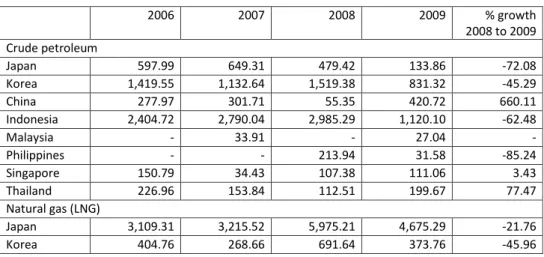
From Table 4, major export trading partners of Brunei in 2009, were Japan, Korea and Indo-nesia in decreasing order of importance. Top exports from Brunei to these countries were crude oil and natural gas (see Table 6).
Export of natural gas (LNG) from Brunei to Japan was up 86 percent to B$5975 million in
2008, while export of crude oil was down 26 percent to $479 million. However, in 2009 ex-ports of both LNG and crude oil from Brunei to Japan declined to 22 percent and 72 percent, respectively, compared to 2008. The fall in im-port of crude oil by Japan reflects Japanese concern of environmental pollution. Burning of oil produces more pollution than gas. In contrast, export of crude petroleum from Bru-nei to China and Thailand was up 660 percent, and 77 percent respectively, in 2009.
B: FDI Linkage
Investment linkages come when Brunei in-vests money in East Asia and East Asian countries invest in Brunei. Total foreign direct
Table 4: Export Intensity of Brunei 1998-2009
Source: Calculated by author from Brunei Government data,
Brunei Darussalam External Trade Statistics 2008 (Table 13);
and from 2009 data from Statistics Department,
Department of Economic Planning and Development, Prime Minister’s Office. Note: “0” means nil and “0.0000” means data not meaningful.
Table 5: Import Intensity of Brunei 1998-2009
Source: Calculated by author from Brunei Government data,
Brunei Darussalam External Trade Statistics 2008 (Table 12);
and from 2009 data from Statistics Department, Department of Economic Planning and Development, Prime Minister’s Office.
Table 6: Major Export Commodities from Brunei to East Asian countries, 2006-2009 (Millions of Brunei Dollars)
Source: Brunei Government, Brunei Darussalam Statistical Yearbook 2006, 2007 and 2008 editions;
Data for 2009 from Statistics Department, Department of Economic Planning and Development, Prime Minister’s Office. Percent growth (2008 to 2009) is calculated by author.
investment in Brunei was U.S.$311 million in 2009, compared with U.S.$852 million per year during 1995-2005 (UNCTAD, 2010). Outward FDI flows from Brunei was U.S.$30 million in 2009, this figure is similar to that of average an-nual FDI (U.S.$33 million) during 1995-2005. Another fact is that FDI inward flows to Bru-nei is declining since 1995 (Table 7).
FDI inward and outward flows between Bru-nei and other East Asian economies are not available for 2009. The latest data available in Statistics of Foreign Direct Investment in
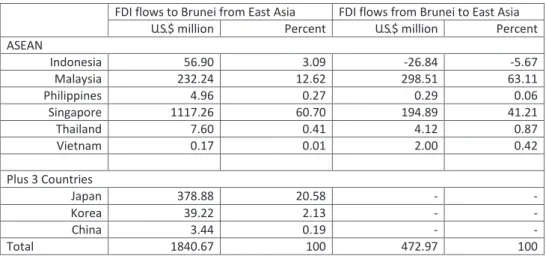
ASEAN (2006) are for the period 1995-2005. FDI inflows and outflows between Brunei and East Asian economies are presented in Table 8. From this table, FDI outflow from Brunei to East Asia is much lower than FDI inflow from East Asia.
Brunei invested U.S.$472.97 million in East Asia during 1995-2005. Sixty three percent of this went to Malaysia (U.S.$298.51), 41 percent to Singapore (U.S.$194.89), and a very small per-cent to Philippines, Thailand and Vietnam. The majority of FDI from Brunei to East Asia was
Table 8: Brunei’s Investment in East Asia and East Asia’s Investment in Brunei, 1995-2005
Source: Compiled by author from ASEAN Secretariat data,
Statistics of Foreign Direct Investment in ASEAN, Eighth edition 2006. Tables 2.1.4 and 4.1.3.
Table 7: Inward and Outward Flows of FDI to and from Brunei, Selected Years (Millions of U.S. dollars)
Source: UNCTAD, World Investment Report 2010. “Country Fact Sheet: Brunei Darussalam”.
in the trade and commerce sectors – none went into mining and quarrying or manufacturing.
On the other hand, Brunei received U.S.$1840.7 million from East Asia. Of total FDI from Asian countries, Singapore, Japan and Malaysia accounted for a combined 93.9 percent, with Indonesia and Korea accounting for 5.22 percent.
VI
ConclusionAbove analysis on Brunei economic growth and on trade and investment relationship be-tween Brunei and other East Asian countries revealed some important results. First, our dis-cussion of some indicators suggests that Brunei is a small country with high standards of living after Japan and Singapore.
Second, the relationship between economic growth, exports, imports, and FDI are investi-gated for Brunei using regression analysis for the period 1990-2009. Our results suggest that export is an important determinant of growth of Brunei. The impact of FDI and imports on growth is not significant.
Third, exports from Brunei comprise of oil and gas which accounts for 96 percent of total exports, 87 percent of government revenue and 60 percent of GDP in 2009. Fluctuations in international petroleum (oil and gas) prices highlighted the need for diversification of the economy from oil and gas to other non oil pri-vate sector. Priorities for diversification include mainly developing downstream industry, tour-ism and financial services.
Fourth, export from Brunei to East Asia re-mains heavily concentrated in Japan, Korea and Indonesia, accounting for 68 percent in 2009. Japan is the most important trading partner for
Brunei, receiving 46 percent of export from Brunei, although export declined from 51 per-cent in 1998.
Fifth, crude oil and LNG are major exports from Brunei – LNG to Japan and Korea, and crude oil to Indonesia. Import from East Asia to Brunei remains mainly concentrated in two countries, with Singapore 26 percent and Ma-laysia 19 Percent in 2009. Machinery and transport equipment, food, and manufactured goods are major imports from East Asia.
Finally, Brunei invested U.S.$472.97 million in East Asia during 1995-2005. Sixty three per-cent of this went to Malaysia, 41 perper-cent to Singapore, and a very small percent to Philip-pines, Thailand and Vietnam. The majority of FDI from Brunei to East Asia was in the trade and commerce sectors – none went into min-ing and quarrymin-ing or manufacturmin-ing.
Given the reliance of Brunei on external trade, and the relatively high proportion of ex-port trade accounted for by three East Asian countries (Japan, Korea and Indonesia ), and import trade by Singapore and Malaysia Brunei will need to continue a critical interest in main-taining strong external relations in terms of trade and investment. For this purpose, much of economic focus of Brunei has to be concen-trated on improving access for Brunei products in the East Asian and global markets.
There may be scope for outward FDI from Brunei to Sabah and Sarawak states of Malay-sia, Southern Philippines and Kalimantan and Sulawesi provinces of Indonesia. These areas are poor, less developed and suffer from poor infrastructure. These states and provinces and oil rich Brunei are partners of BIMP-EAGA subregion. As a rich partner of EAGA, Brunei entrepreneurs can investment in energy sector
and marine fishing joint ventures in the EAGA countries. In particular, with experience in the oil and gas sector, Brunei entrepreneurs are able to invest in larger projects like developing and processing natural resources of the subre-gion .
References
⦿Australian Government (2010) /
“Country and Region Fact Sheets”
(updated in December).
Department of Foreign Affairs and Trade/ Available: www.dfat.gov.au/geo/fs/
⦿ASEAN Secretariat(2006) / Statistics of Foreign Direct Investment in ASEAN, 8th Edition.
⦿Brunei Government (2009) /
Brunei Darussalam Statistical Yearbook 2008,
Department of Statistics
Department of Economic Planning and Development, Prime Minister’s Office, August
⦿Brunei Government (2009) /
Brunei Darussalam External Trade Statistics 2008, Department of Statistics,
Department of Economic Planning and Development, Prime Minister’s Office, August
⦿Brunei Government (2008) /
Brunei Darussalam Long-Term Development Plan: Wawasan Brunei 2035, Outline of Strategies and Policies for Development (OSPD) 2007-2017, National Development Plan (RKN) 2007-2012,
January
⦿Brunei Government (2007) /
Brunei Darussalam Statistical Yearbook 2007, Department of Statistics,
Department of Economic Planning and Development, Prime Minister’s Office, July
⦿Brunei Government (2007) /
Brunei Darussalam Statistical Yearbook 2006, Department of Statistics,
Department of Economic Planning and Development, Prime Minister’s Office, June
⦿Brunei Government (2006) /
Brunei Darussalam Annual National Accounts 2000-2004 (2000 = 100), Department of Statistics,
Department of Economic Planning and Development, Prime Minister’s Office, February
⦿Brunei Government (2003) /
Brunei Economic Bulletin, Volume 2, Issue 3,
October, Department of Economic Planning and Development, Prime Minister’s Office.
⦿Brunei Government (2001) /
Brunei Darussalam Statistical Yearbook 2000/2001,
Department of Statistics,
Department of Economic Planning and Development, Prime Minister’s Office
⦿Capannelli, Giovanni and Carlo Filippini (2009)/
East Asian and European Economic Integration: A Comparative Analysis, Working Paper Series
on Regional Economic Integration, Asian Development Bank, No. 29, May
⦿Islam, Saiful and Sumimaru Odano (2010) /
LNG Exports from Brunei to Japan,
CRR Working Paper No. A-20 March, Center for Risk Research, Faculty of Economics, Shiga University, Japan
⦿Lim, Chong Yah (2009) / Southeast Asia: The Long Road Ahead, 3rd Edition, Singapore:
World Scientific Publishing Co., May
⦿Oxford Business Group (2010) /
The Report: Brunei Darussalam 2010
⦿Samuelson, Paul and William Nordhaus (2006) /
Economics, 18th edition, New Delhi:
Tata-McGraw-Hill
⦿Shiem, Leong Vai and Tan Siew Ee (2005) /
“Brunei Darussalam: Consumption and Marketing in an Islamic Monarchy” in Anthony Pecotich (editor),
Handbook of Markets and Economies: East Asia, Southeast Asia, Australia,
and New Zealand. New York: M.E. Sharp, Inc.,
pp. 47-75
⦿Shin, Kwanho (2008) / Global and Regional Shocks: Challenges to Asian Economies.
ADBI Working Paper 120. Tokyo: Asian Development Bank Institute.
Available: www.adbi.org/working-paper/2008/11/05/ 2737.global.regional.shocks.asian.economy.challenges/
⦿UNCTAD (2010) / World Investment Report 2010. “Country Fact Sheet: Brunei Darussalam”.
Available: www.unctad.org/sections/dite_dir/docs/ wir10_fs_bn_en.pdf
⦿World Trade Organization (2008) /
Trade Policy Review: Brunei Darussalam,
WT/TPR/S/196, January.
Available: www.wto.org/english/tratop_e/tpr_e/ tp296_e.htm.
Brunei Economy and its Integration in the Regional Economic Activities
Saiful Islam
Trade and investment integration in East Asia has increased considerably after the 1997 Asian financial crisis. Oil-rich Brunei has in-creasingly participated in this process, through trade and FDI activities. This paper looks at the extent of the participation of Brunei in the eco-nomic activities of the region. The main objectives of this paper are to provide an up to date account of the economic growth of Bru-nei, and to explore trade and FDI activities of Brunei in other East Asian economies.
Section II of this paper compares economic characteristics of Brunei with other East Asian economies. Statistical data shows that Brunei-ans enjoy a standard of living that is third highest in East Asia after Japan and Singapore in terms of per capita GDP. Its PPP (purchas-ing power parity) GDP per capita of U.S.$ 47,930 is second only to Singapore.
Section III looks at real GDP growth of Bru-nei and sources of growth. Our regression analysis on the sources of growth shows that export and economic growth of Brunei is posi-tively related for the period 1990-2009.
Section IV is about government policies to stimulate economic growth. The government has sought to diversify the economy away from oil and gas by promoting downstream industry, tourism, and financial services and halal prod-ucts.
Finally, Section V explores trade and invest-ment linkages of Brunei with other East Asian economies. Our results show that export from Brunei to East Asia (export integration) re-mains heavily concentrated in three countries, with Japan, Korea and Indonesia, accounting for 68 percent in 2009. Crude oil and LNG are major exports from Brunei – LNG to Japan and Korea, and crude oil to Indonesia. Import from East Asia to Brunei (import integration) remains mainly concentrated in two countries, with Singapore 26 percent and Malaysia 19 per-cent in 2009. Machinery and transport equipment, food, and manufactured goods are major imports from East Asia.
Brunei invested U.S.$472.97 million in East Asia during 1995-2005. Sixty three percent of this went to Malaysia, 41 percent to Singapore, and a very small percent to Philippines, Thai-land and Vietnam. The majority of FDI from Brunei to East Asia was in the trade and com-merce sectors – none went into mining and quarrying or manufacturing.