〈 論文 〉
Using guided planning and task sequencing to improve grammar instruction
Colin ThompsonAbstract
This study investigated the effects of guided planning and task sequencing for improving students’ use of a grammatical feature known for its difficulty with Japanese learners: English relative clauses. The study consisted of a pre- post-test design with treatment that involved participants performing a series of oral narratives under three different planning conditions: guided planning consisting of 10 minutes guidance towards English relative clauses and cognitive state verbs, unguided planning involving 10 minutes with no guidance, and a control group who received no planning time. The treatment narratives increased in cognitive complexity over a three week period. The results of the pre- post-tests support the claims of the cognition hypothesis which states that tasks sequenced according to an increase in their cognitive demands facilitate conditions for L2 oral development. The guided planning groups benefitted the most from the treatment in terms of accurate use of English relative clauses and cognitive state verbs, whilst gains were also reported using fluency and structural complexity measures.
Key words: guided planning, task sequencing, task complexity, the cognition hypothesis. 1. Introduction
Task planning
The past thirty years has seen a considerable amount of research on the use of tasks as a means for developing second language (L2) production skills. Numerous definitions of a task have been provided in the literature, however the one used by Nunan (2004) is generally recognizable as:
a piece of classroom work which involves learners in comprehending, manipulating, producing or interacting in the target language while their attention is focused on mobilising their grammatical knowledge in order to express meaning, and which the intention is to convey meaning rather than to manipulate form. (p.4)
Tasks provide opportunities for students to use their linguistic resources to express meaning and communicate in the L2 in order to achieve some real-world purpose, for example solving a problem. As a result, tasks serve as tools that enable learners to develop their oral communication skills. Although a task’s primary emphasis is on meaning, it is important for teachers to guide learners’ attention towards language form at some stage during language use in order for learners to notice L2 structures which helps to facilitate language learning (Schmidt, 1990). One way of attending to language form is through pre-task planning also referred to as ‘strategic planning’
which allows learners time to prepare what they are going to say before performing a task (Ellis, 2005). Researchers have investigated ways strategic planning can be manipulated in order to find optimal task-based learning conditions. For example, planning that involves teacher-led guidance towards certain grammatical features vs unguided planning in which learners rely on their own linguistic resources to prepare for tasks, and how these conditions influence L2 speech in terms of fluency, accuracy and complexity (Foster and Skehan, 1999; Mochizuki and Ortega, 2008). These studies have shown that strategic planning provides time for learners to attend to the content of communicative messages as well as the linguistic encoding of messages, in other words, what learners want to say and how they want to say it. These messages are then stored in a learner’s short-term memory and later produced during task performance resulting in more fluent, complex and / or accurate L2 speech.
An additional value of strategic planning is that it enables teachers to guide learners’ attention to specific linguistic forms known for their difficulty in L2 production. Learners can focus their attention towards the form during planning and subsequently practice using the target feature during task performance. A specific grammatical feature known for its difficulty with Japanese learners are English relative clauses (RCs). The focus of this study attempts to see whether strategic planning and task sequencing can improve learners’ use of the structure.
English relative clauses
Japanese learners are taught English RCs from the second year of junior high school. English RCs are well known for their difficulty as an aspect of English grammar with Japanese learners because of the differences that exist between English RCs and Japanese RCs. Schachter (1974) highlighted three areas of difference that exist between the forms:
1. The location of the RC in relation to the head noun. Japanese RCs are situated to the left of the head noun phrase whereas English RCs are situated to the right.
2. English RCs use a subordinate marker ‘that’ between the head noun phrase and the RC, or relative pronouns ‘who’, ‘whom’, ‘which’, ‘whose’. Japanese RCs do not consist of subordination markers or relative pronouns but instead involve subordinate affixes.
3. Japanese RCs consist of pronominal reflexes whereas English RCs do not. According to Schachter (1974, p.209), if English RCs did contain these pronouns, they would resemble the following:
Subject: the boy that he came Direct Object: the boy that John hit him Indirect Object: the boy that I sent a letter to him Object of Preposition: the boy that I sat near him
avoidance in using English RCs.
Mochizuki and Ortega (2008) investigated whether strategic planning that included grammar guidance towards RCs, referred to as ‘guided planning’ would improve Japanese high school learners’ use of the form. A picture story-telling narrative task was specifically designed to elicit seven cases of the structure. The guided planning conditions consisted of ten minutes planning time in which learners were provided with written examples of RCs and instructions to try and use the grammar in the task. The results of the study showed significant gains in accurate use of RCs for learners who received guided planning compared with learners who received unguided planning time. However, in line with Schachter (1974), the results of Mochizuki and Ortega (2008) were disappointing in the sense that the sample as a whole produced a low mean average of RCs despite the narrative’s design to elicit seven instances of the form. Mochizuki and Ortega (2008) attributed this to the lack of task essentialness for producing the form as the learners could complete the task by avoiding using RCs, as well as the fact that their beginner level proficiency may not have been high enough to benefit from having planning time.
A limitation of Mochizuki and Ortega’s (2008) study was that it only addressed the immediate effects of planning i.e. a one-off experiment that examined task planning at certain point in time. Consequently, we could not infer the pedagogic value of guided planning towards RCs with tasks that are sequenced over time. In order to develop learners’ use of a linguistic form over time, the task would need to be sequenced with similar tasks designed to elicit the structure. The following section discusses a theoretically grounded proposal for sequencing tasks to ensure optimal conditions for L2 development.
Task sequencing and the cognition hypothesis
The cognition hypothesis (Robinson, 2010) claims that task sequencing should be done by ‘having learners perform tasks simple on all the relevant parameters of task demands first, and then gradually increasing their cognitive complexity on subsequent versions’ (p.242). Increasing the complexity of tasks, referred to as ‘task complexity’ can be achieved in the following two ways: increasing ‘resource-dispersing’ and ‘resource-directing’ dimensions (Robinson, 2010, p.245). The former relates to the performance demands that tasks place on learners, for example the availability of planning time. Robinson (2010) favours reducing planning time when sequencing tasks as this helps promote ‘greater control over, and faster access to existing interlanguage systems of knowledge’ (p.248), and primes learners to perform tasks under normal time constraints. The latter concerns the conceptual and linguistic demands that tasks place on learners and can vary in their cognitive complexity. For example, tasks that involve explaining the reasons behind people’s actions (intentional reasoning) require the use of complex L2 syntax such as cognitive state verbs i.e. she thinks that…, he knows… as well as additional L2 structures that accompany them such as relative clauses, for example - she thinks that she likes the dog which has long hair. As a result,
increasing the complexity of tasks along resource-directing dimensions can facilitate greater use of this language. The aim of this study is to sequence tasks to increase learners’ use of relative clauses. Research Question and Hypotheses
This study addresses the following question:
To what extent does guided planning and task sequencing facilitate oral development for Japanese lower and upper-intermediate learners of English?
Hypothesis 1: Guided planning and task sequencing will facilitate L2 development to a greater extent than unguided planning and task sequencing in terms of accurate use of English relative clauses.
Hypothesis 2: Guided planning and task sequencing will facilitate L2 development to a greater extent than unguided planning and task sequencing in terms of accurate use of cognitive state verbs.
Hypothesis 3: Guided planning and task sequencing will facilitate L2 development to a greater extent than unguided planning and task sequencing in terms of syntactic complexity.
Hypothesis 4: Guided planning and task sequencing will not result in L2 oral development in terms of fluency. It is expected that unguided planning and task sequencing will show the most improvement in this area.
2. Methodology The participants
Twelve Japanese University students of English participated in the study. Six students were studying in a lower-intermediate level English course and the remaining six were enrolled in a separate advanced English program. The lower-intermediate students (B1) averaged a TOEFL English score of 470, the learners taking the advanced program averaged 541. However, given the latter group’s TOEFL scores, they shall be referred to as upper-intermediate students (B2) for the purpose of this study. All the students were aged between 18–22 years old.
During the treatment sessions, the B1 and B2 learners were randomly assigned into three pairs per proficiency level: guided planning (GP), unguided planning (UP) and a control group (CP).
Table 1
The groups
Guided Planners (GP) 2 B1 learners 2 B2 learners Unguided Planners (UP) 2 B1 learners 2 B2 learners Control Group (CP) 2 B1 learners 2 B2 learners Materials: pre and post-tests
the task used in Mochizuki and Ortega’s (2008) study which involved a mother, son and daughter buying a dog at a pet shop. It consisted of eight pictures sequenced in correct order and it contained seven obligatory cases of RC use, for example, in one picture a girl is thinking about a dog which has long hair. In the present study, it was assumed that the task would also elicit cognitive state verbs because certain pictures contained thought bubbles from the character’s head illustrating their feelings and was intended to elicit language such as, the girl thinks that she likes a dog…
In the test, each participant was asked to narrate the story one-on-one with the researcher who acted as the listener. The narrative was performed in a monologue format. The immediate and delayed post-test narratives were designed by the researcher and were based on the narrative used in Mochizuki and Ortega (2008). Each narrative was similar in terms of cognitive difficulty but differed in content. For example, they each contained seven obligatory cases of RCs, however the story lines were different. The immediate narrative test involved two brothers and their sister going to a shoe shop to buy shoes, the delayed narrative test involved three sisters going to a garden centre to buy plants. Finally, no planning time was allocated prior to the tests so as to reflect normal conditions for language use (Robinson, 2005, p.7). All the narrative tests were pre-piloted to ensure they elicited the targeted forms.
Treatment tasks
Six narratives were designed by the researcher for the treatment sessions, again based on the narrative used in Mochizuki and Ortega (2008). However, these tasks differed in terms of content and cognitive complexity. In terms of content, they contained different storylines and characters. In terms of cognitive complexity, the narratives were sequenced according to an increase in resource directing dimensions by containing additional cases of RCs and cognitive state verbs. For example, each week the pictures contained extra cases of characters thinking about something (see Notes for a sample picture task). Table 2 shows the number of obligatory cases of RCs per narrative during the treatment.
Table 2
Obligatory cases of relative clauses per narrative
Pre-test Task complexity sequencingtreatment ImmediatePost-test DelayedPost-test Narrative
1 Narrative2 & 3 Narrative4 & 5 Narrative6 & 7 Narrative8 Narrative9 Relative
Procedure
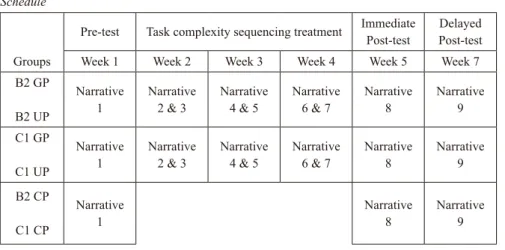
The study was carried out in a recording studio over seven weeks. In week one, all the participants performed the pre-test narrative. In week two, the treatment sessions began for the GP and UG learners. The tasks in week two had reduced complexity along resource dispersing dimensions because ten minutes planning time was allocated for the GP and UG learners prior to task performance. The GP learners received guidance in the form of note-sheets that contained written examples of English relative clauses and cognitive state verbs. The GP learners were instructed to read the examples during planning and to try and use the grammar when they performed the task. The UP learners received no guidance on how to plan. Weeks three and four of the treatment were repeated in the same format as week two (see table 3).
Table 3
Schedule
Pre-test Task complexity sequencing treatment ImmediatePost-test DelayedPost-test Groups Week 1 Week 2 Week 3 Week 4 Week 5 Week 7
B2 GP B2 UP
Narrative
1 Narrative 2 & 3 Narrative4 & 5 Narrative6 & 7 Narrative8 Narrative9 C1 GP
C1 UP
Narrative
1 Narrative2 & 3 Narrative4 & 5 Narrative6 & 7 Narrative 8 Narrative9 B2 CP
C1 CP
Narrative
1 Narrative8 Narrative9
L2 oral measures
Accuracy: This study investigated two linguistic forms: English relative clauses and cognitive state verbs. Mochizuki and Ortega (2008) targeted only simple RC types: ‘object-subject (OS, I like the dog which has long ears), object-direct object (OO, I want the dog which the little girl has in her arms)’ (2008, p.19). However, the results of the study were disappointing in terms of the amount of RCs produced by the full sample. As a result, this study used the same RC types but with B1 and B2 participants with the intention that higher level learners would have sufficient L2 ability to be able to produce more complex and accurate output.
In line with previous studies (Yuan and Ellis, 2003) accuracy was measured in terms of error-free clauses, specifically, the percentage of clauses produced that do not contain any lexical, syntax or morphology error. Consequently, accuracy was measured according to the percentage of error-free relative clauses. For example, the girl likes the dog which has long ears. Only the relative clause was measured.
Finally, to ensure gains in the targeted forms were attributable to the treatment and not through external exposure, the researcher confirmed that English RCs were not instructed in the participants’ English classes during the study.
Cognitive state verbs were chosen in response to Robinson’s (2007) study which reported their use in producing more complex speech when explaining the intentions of other people and were considered compatible with RC production, for example, he thinks that he likes the dog which has long ears. Accurate use of cognitive state terms was measured in a similar fashion to RCs - the percentage of error-free cognitive terms. Typical errors would include incorrect use of the verbs themselves and how they were used, for example, he think that he…, he thinks like dog…
Complexity: Following Mochizuki and Ortega’s (2008) study, the amount of relative clauses per t-unit was used for syntactic complexity. Although in this study an as-unit was used instead of a t-unit. An as-unit is defined as ‘an independent clause or subordinate unit, together with any subordinate clause(s) associated with it’ (Foster, Tonkyn and Wigglesworth, 2000, p.365). Conventional phrases such as hello, that’s all were excluded from the analysis.
Fluency: in line with Gilabert’s (2007) study, two measures of fluency were used: unpruned and pruned speech rates. The former measure is defined as the total number of syllables produced divided by the total number of seconds multiplied by 60. The latter measure used the same formula but omitted reformulations, repetitions, false starts, and L1 use.
Analysis
The above measures were calculated using the software program CLAN. Small sample sizes such as the present study (n = 2) limit the possibility for inferential statistical analysis (Cohen 1998). As a result, an analysis of the descriptive statistics was performed instead. The analysis began by comparing the pre-tests and the posts-tests for developmental mean gains in accuracy. The results of the B1 and B2 guided planners’ mean gains were compared against their respective unguided planners and control groups to see which condition showed the largest gains. Comparisons were then made across proficiency levels to analyse any similarities. This procedure was then repeated for cognitive state verbs, followed by complexity and fluency.
3. Results
Hypothesis 1: The effects of guided planning and task sequencing on the accuracy of English relative clauses
It was hypothesized that guided planning and task sequencing would result in larger gains in the accuracy of RCs for B1 and B2 learners compared to unguided planning and task sequencing. The results of the narrative tests are shown in Table 4. Each group contains their mean scores. The pre-test - immediate post-test variance represents the difference between the pre-test and the
immediate post-test scores, whilst the pre–test - delayed post-test variance shows the difference between the pre-test and the delayed post-test scores.
Table 4
Percentage of error-free relative clauses Group
Means Pre-test ImmediatePost-test Post-testDelayed
Pretest -Immediate Post-test variance Pre-test - Delayed Post-test variance B1 GP 25 8.34 87.5 -16.67 62.5 B1 UP 25 0 50 -25 25 B1 CP 0 0 25 0 25 B2 GP 10 28.57 70.84 18.57 60.84 B2 UP 50 0 0 -50 -50 B2 CP 50 0 0 -50 -50
Comparing the mean scores shows a clear effect for guided planning for the B1 and B2 learners compared with their respective unguided planners and the control groups. Apart from the B1GP immediate test score (-16.67) there are clear gains in the accuracy of the guided planners’ performance compared to the unguided planners and the control groups. However, the B2GP learners show the greatest gains in error-free relative clause production. As a result, hypothesis one is confirmed.
Hypothesis 2: The effects of guided planning and task sequencing on the accuracy of cognitive state verbs
It was hypothesized that guided planning and task sequencing will result in larger gains in the accuracy of cognitive state verbs for B1 and B2 learners compared to unguided planning and task sequencing. The narrative results are displayed in table 5.
Table 5
Percentage of error-free cognitive state verbs Group
Means Pre-test ImmediatePost-test DelayedPost-test
Pre-test - Immediate post-test Variance Pre-test - Delayed post-test variance B1 GP 83.34 91.67 100 8.33 16.67 B1 UP 30 30 16.67 0 -13.34 B1 CP 12.5 33.34 0 20.84 -12.5 B2 GP 64.29 88.89 100 24.61 35.72 B2 UP 0 50 62.5 50 62.5 B2 CP 25 0 8.34 -25 -16.67
For the B1 learners, the control group showed the largest developmental gains in cognitive state verbs at the immediate post-test (20.84), although the guided planners showed the greatest gains at the delayed post-test (16.67). As for the B2 learners, the unguided planners produced greater gains over the immediate post-test (50) and delayed post-test (62.5). As a result, hypothesis two is largely confirmed for the B1 guided planners but it is not confirmed for the B2 guided planners.
Hypothesis 3: The effects of guided planning and task sequencing on syntactic complexity It was hypothesized that guided planning and task sequencing will result in larger gains in syntactic complexity for B1 and B2 learners compared to unguided planning. The complexity results are shown in table 6.
Table 6
Syntactic complexity; relative clauses per as-unit Group
Means Pre-test Immediate Post-test DelayedPost-test
Pre-test Immediate Post-test Variance Pre-test Delayed Post-test variance B1 GP 39.09 64.78 47.78 25.69 8.69 B1 UP 33.09 14.48 48.72 -18.61 15.63 B1 CP 23.18 37.98 44.45 14.8 21.27 B2 GP 27.98 68.06 80 40.08 52.02 B2 UP 37.5 0 22.22 -37.5 -15.28 B2 CP 16.67 25 23.61 8.33 6.94
The B1 guided planners showed larger gains than the unguided planners and the control group at the immediate post-test, although the B1GP’s delayed post-test score (8.69) is lower than the other two groups. The B2 guided planners showed greater gains than the unguided planners and the control group. As a result, hypothesis three is largely confirmed for the B1 guided planners, and is confirmed for the B2 guided planners.
Hypothesis 4: The effects of guided planning and task sequencing on fluency
It was hypothesized that guided planning and task sequencing will lead to no gains in fluency for B1 and B2 learners and that unguided planning and task sequencing will show the largest gains. The results of unpruned fluency are displayed in table 7.
Table 7
Fluency; unpruned rate (number of syllables per minute) Group
Means Pre-test Immediate Post-test DelayedPost-test
Pre-test Immediate Post-test Variance Pre-test Delayed Post-test variance B1 GP 83.13 93.77 83.33 10.64 5.2 B1 UP 77.66 76.56 87.07 -1.1 9.41 B1 CP 94.5 95.63 91 1.13 -3.5 B2 GP 122.81 104.46 122.14 -18.35 -0.67 B2 UP 89.85 103.33 110.10 13.48 20.25 B2 CP 90.56 154.21 112.99 63.65 22.43
For the B1 learners, both the guided and unguided learners showed improvements in fluency. The guided planners increased the most at the immediate post-test (10.64) whereas the unguided learners benefited more at the delayed post-test (9.41). The results from the B2 learners showed that guided planning had a negative effect (-18.35) and (-0.67) and there were larger gains from the unguided planners and the control group. As a result, hypothesis four is not confirmed using the unpruned fluency measure for the B1GP learners but it is confirmed for the B2GP learners. Fluency results for the pruned speech measure are shown in table 8.
Table 8
Fluency pruned speech rate (number of syllables per minute excluding repetitions, reformulations, false starts and L1 use)
Group
Means Pre-Test ImmediatePost-test DelayedPost-test
Pre-Immediate Post-test Variance Pre-test - Delayed Post-test Variance B1 GP 71.16 80.72 82.26 9.56 11.1 B1 UP 52.8 57.31 67.53 4.51 14.73 B1 CP 70.79 72.07 69.08 1.28 -1.71 B2 GP 98.27 91.86 109.4 -6.41 11.13 B2 UP 59.37 93.68 91.61 34.31 32.24 B2 CP 76.58 121.84 92.8 45.26 16.22
For the B1 learners, both the guided and unguided learners showed improvements in pruned speech. The guided planners showed the largest gains at the immediate post-test (9.56) and the unguided learners benefited more at the delayed post-test (14.73). The results for the B2 learners were more complex as guided planning produced a negative effect at the immediate test (-6.41). However, gains were made with the unguided planners and the control group. The guided planners achieved improvements at the delayed post-test (11.13) but it was less than the other two groups. As a result, hypothesis four is not confirmed using the pruned fluency measure for the B1GP learners, whilst it is largely confirmed for the B2GP learners.
4. Discussion
The purpose of this study was to investigate the effects of guided planning and task sequencing on Japanese University learners’ use of English relative clauses. The results of the study showed that guided planning and task sequencing facilitates L2 development with regards to the accuracy of RCs and cognitive state verbs, syntactic complexity and fluency for this sample of B1 learners and B2 learners. This treatment also appears more powerful than unguided planning and task sequencing, except in the case of fluency and cognitive state verb development for the B2 guided planners. These findings therefore support the claims of the cognition hypothesis which states that tasks sequenced according to an increase in their cognitive demands facilitates L2 oral development.
So how do we account for the pre- post-test gains of the guided planners and the unguided planners when there was no planning time allocated during the tests? As we know during the treatment, both groups had been accustomed to planning and performing narratives that involved the production of RCs. Consequently, at the post-tests both groups were probably able to re-call the RC input from their working memory to meet the demands of the task, resulting in more complex and accurate speech. The treatment would have also benefitted fluency in a similar fashion due to the repetition of performing similar L2 output during the task sequencing treatment which Gilabert
(2007) claims can lead to ‘more efficient message planning and faster lexical access and selection’ (p.64). In this case, the continual process of planning for RC output during the treatment would have helped ‘speed-up’ learners’ production of the targeted language resulting in a more fluent performance at the post-tests.
In terms of the accuracy results, this study has pedagogic implications for task planning research as one of the criticisms levelled at task-based research is the apparent failure to show how tasks can facilitate complex L2 production. For example, Seedhouse (1999) claims that during task-based performance, learners often use the minimum amount of L2 speech because they “appear to be so concentrated on completing the task that linguistic forms are treated as a vehicle of minor importance (p.154). As a result, task-based performance can often result in impoverished language use. In the case of the present study, it is true that learners could complete the narratives by avoiding RCs and using alternative structures, for example, ‘I like the dog with long hair’. Learners could also choose a variety of more simple linguistic structures to complete the narratives. However, the fact that RCs are known for their difficulty in L2 production yet the treatment facilitated clear gains in the accuracy and complexity of the form shows its pedagogic value.
Let us now discuss the mixed fluency results in which the B1 guided planners produced greater gains in fluency compared to the unguided planners yet the B2 guided planners produced less gains in fluency compared to the unguided planners. This appears to be on account of the guided planning conditions towards the targeted forms which affected the B1 and B2 learners in different ways. For example, in the case of the B2GP learners, guided planning towards form seems to have focused their attention towards the obligatory RC contexts at the post-tests. As a result, the B2 guided planners may have prioritized accuracy over fluency as shown in the RC accuracy gains in table four (M = 18.57), and fluency results in table seven (M = -18.35). The B2 unguided planners, however, were not drawn towards form during their treatment planning conditions and therefore may have focused more on meaning and the storyline at the post-tests which appears to have benefitted fluency.
On the other hand, the B1 guided planners disconfirmed hypotheses four by producing greater gains in fluency compared to the unguided planners. This outcome may have been caused by the B1 guided learners development of ‘formulaic language’. Kormos (2011) informs us that ‘the majority of our utterances are memorized phrases, clauses and sentences which together are called formulaic language’ (p.46), for example, communicative functions such as accepting and refusing. Formulaic language is ‘produced faster and with less conscious effort than creatively-constructed elements of the message’ (Kormos, 2011, p.46). According to Kormos, L2 learners can develop formulaic language through practice opportunities that involve the encoding of words which facilitates automatization. Guided planning and task sequencing may have resulted in the B1 learners automatizing RCs into formulaic chunks which would have enabled them to produce the form with greater fluency. For example, the B1GP pre-immediate gain (M = 9.56) was greater than the B1UP
gain (M = 4.51), see table 8. The unguided planners, however, were not provided with guidance towards RCs and therefore were less likely to practice and develop formulaic language involving the target structures.
Thus, the results of this study tell us that form-focused treatment involving guided planning and task sequencing influences learners’ L2 speech in different ways. In the case of the upper intermediate learners, a focus on form may have resulted in them prioritizing accuracy and complexity over fluency compared to the unguided planners. On the other hand, lower-intermediate learners’ attention to form may have enabled them to develop formulaic language that resulted in gains in fluency, as well as accuracy and complexity compared to unguided planners of the same proficiency.
5. Implications and limitations
This study showed how tasks can be designed in simplistic fashion to elicit specific linguistic forms known for their difficulty with Japanese learners in L2 oral production. By incorporating strategic planning that draws learners’ attention to the targeted forms, task sequencing provided practice opportunities for learners to automatize their use of the structures within a communicative context. As a result, the joint effects of guided planning and task sequencing appear to be a powerful combination for promoting L2 oral development.
A number of limitations regarding this study exit. Firstly, generalisations regarding the effects of this study cannot be made due to the small sample size. Furthermore, the developmental gains of the treatment were not significant because the small sample size prevented inferential statistic analysis from being carried out. Future studies would need to include more participants per planning group in order to confirm the effects of guided planning and task sequencing on L2 development. Second, although developmental gains were reported in the post-test narratives, the benefits of the treatment are limited unless gains can be shown in other forms of assessment, both productive and receptive. Future studies could incorporate different assessments of the targeted forms, for example, grammatical judgement tests to assess acquisition receptively.
References
Cohen, J. (1988). Statistical power analysis for the behavioural sciences. Hillsdale, NJ: Lawrence Erlbaum.
Ellis, R. (2005). Planning and task-based performance: Theory and research. In R. Ellis (Eds.), Planning and Task performance in a second language (pp. 3-37). John Benjamins Publishing Company.
Foster, P., & Skehan, P. (1999). The influence of source planning and focus of planning on task-based performance. Language Teaching Research, 3, 3, 215-247.
Foster, P., Tonkyn, A., & Wigglesworth, G. (2000). Measuring spoken language: A unit for all reasons. Applied Linguistics, 21, 354–375.
Gilabert, R. (2007). The simultaneous manipulation of task complexity along planning time and [+- Here-and-Now]. In M.D.P. Garcia-Mayo (Eds.), Investigating tasks in formal language learning (pp. 44-68). Clevedon, UK: Multilingual Matters.
Kormos, J. (2011). Speech production and the Cognition Hypothesis. In P.Robinson (Eds.), Second language task complexity: Researching the Cognition Hypothesis of language learning and performance (pp. 39-61). Amsterdam: Benjamins.
Mochizuki, N., & Orgtega, L. (2008). Balancing communication and grammar in beginning level foreign classrooms. Language Teaching Research, 12, 11-37.
Nunan, D. (2004). Task-Based Language Teaching. Cambridge University Press.
Robinson, P. (2005). Cognitive complexity and task sequencing: Studies in a componential framework for second language task design. International Review of Applied Linguistics, 43, 1–32.
Robinson, P. (2007).Task complexity, theory of mind, and intentional reasoning: Effects on L2 speech production, interaction, uptake, and perceptions of task difficulty. International Review of Applied Linguistics, 45, 193–213.
Robinson, P. (2010). Situating and distributing cognition across task demands: The SSARC model of pedagogic task sequencing. In M. Putz & L. Sicola (Eds.), Inside the Learner’s Mind: Cognitive Processing in Second Language Acquisition (pp. 243-268). John Benjamins Publishing.
Schachter, J. (1974). An error in error analysis. Language Learning, 24, 2, 205–214.
Schmidt, R. (1990). The role of consciousness in second language learning. Applied Linguistics, 11 (2), 129–58.
Seedhouse, P. (1999). Task-based Interaction, ELTJ, 53, 3, 149-156.
Yuan, F., & Ellis. R. (2003). The Effects of Pre-Task Planning and On-Line Planning on Fluency, Complexity and Accuracy in L2 Monologic Oral Production. Applied Linguistics, 24/1, 1-27.
Notes