原 著 東女医大誌 90(4): 84-93, 2020.8
献腎ドナーにおける移植前クレアチニンによる評価と移植後腎機能への影響
東京女子医科大学病院腎臓外科(指導:渕之上昌平准教授) ク ツ ナ イ ケ イ コ コ ヤ マ イチロウ ナカジマ イチロウ フ チ ノ ウ エショウヘイ テラオカ サトシ 久都内慶子・小山 一郎・中島 一朗・渕之上 昌平・寺岡 慧 (受理 2020 年 6 月 20 日)Donor Creatinine Levels as Factors in Graft Function in Deceased-Donor Kidney Transplantation: A Single-Center Report
Keiko Kutsunai, Ichiro Koyama, Ichiro Nakajima, Shohei Fuchinoue, and Satoshi Teraoka
Department of Surgery, Kidney Center, Tokyo Women s Medical University Hospital, Tokyo, Japan
Progress in dialysis therapy has widely improved the prognosis of chronically ill dialysis patients, but kidney transplantation is particularly known to improve patient prognosis significantly. However, the shortage of organ transplant donors remains a global issue. Additionally, the donor s pre-transplant serum creatinine (sCr) is a known indicator of post-transplant kidney function, but the time point of sCr measurement has not been suffi-ciently reported. In this study, we defined 2 time points of pre-transplantation donor sCr measurement: (1) sCr taken just before surgical resection (final sCr) and (2) sCr taken on admission to the hospital (sCrmin). Thus, we
in-vestigated the level of pre-transplantation sCr in the donor and post-transplantation renal function in the trans-plant patients.
In this single-center study, we included 157 patients who underwent donated kidney transplantation between January 1995 and December 2015 at the Department of Surgery, Kidney Center, Tokyo Women s Medical Uni-versity Hospital. We compared the postoperative renal function with sCrminand final sCr before transplantation.
Donor sCr may be affected by acute renal failure or acute tubular necrosis under various situations, such as re-duction in organ blood flow in the period from admission to organ donation. Therefore, donor sCr was highly likely to change depending on the time point in the treatment.
The comparison showed a significant difference between the levels of sCr and postoperative renal function (sCr of more than 1.0 mg/dl and lower). However, there was no correlation between higher final sCr and lower postop-erative renal function. We believed that donor sCrminreflected the original renal function of the donor, and we
ob-tained a significant difference in the multivariate analysis to designate it as a prognostic factor.
We concluded that that sCrminvalues are a better reflection of the donor s original renal function as compared to
fi-nal sCr. Our findings are significant because they address the current research gap on preoperarive sCr values and prove that sCr taken on admission can accurately predict the donor s post-transplant kidney health, which could lead to better post-operative care for the donor.
Key Words: deceased donor kidney transplantation, warm ischemic time, total ischemic time, graft function
Corresponding Author: 久都内慶子 〒162―8666 東京都新宿区河田町 8―1 東京女子医科大学病院腎臓外科 Email: [email protected]
doi: 10.24488/jtwmu.90.4_84
Copyright Ⓒ 2020 Society of Tokyo Women s Medical University. This is an open access article distributed under the terms of Creative Commons Attribution License (CC BY), which permits unrestricted use, distribution, and reproduction in any medium, provided the original source is properly credited.
緒 言 わが国における 2017 年末時の透析導入患者数は 40,959 人であり,慢性透析患者は 334,505 人と増加 の一途を っている1) .透析療法の進歩により慢性透 析患者の予後は改善してきたが,腎代替療法の中で は特に腎移植が予後を大きく改善することが知られ ている.世界的に末期腎臓病患者に対するドナー不 足がある中,わが国において expanded criteria do-nor(ECD)からの腎移植も貴重なドナーソースと なっている.わが国の生体・献腎移植の 5 年生着率 (2010∼2016 年)は献腎移植 88.0%,生体 94.3% と良 好である2) が,ECD からの提供も多くドナー条件と 移植後経過の関係を解析することは重要であると考 える.ドナーの臓器提供前の血清クレアチニン値 (sCr)は移植後腎機能を予測する因子3) であること が知られており,これまでも 2009 年に提唱された the Kidney Donor Risk Index(KDRI),KDRI を基に 作成された the Kidney Donor Profile Index(KDPI) 等,ドナー sCr を始めとしたドナー因子と移植条件 を考慮した予後予測式が考案されてきた4)∼6) .一方 で,これらの計算式は人種や搬送,診療システムの 違いにより,結果が変わりうることも指摘されてき た7) .ドナー条件の中で特にドナー sCr は臓器提供 までの死戦期が長い場合,血圧低下による臓器血流 の低下などにより容易に急性腎障害をきたすため, 採血の時点によって測定値が大きく変動し得る.今 回われわれは,東京女子医科大学病院腎臓外科(当 科)における献腎移植症例について,当院および日 本臓器移植ネットワーク(JOTNW)のデータをもと に,ドナー条件,特にドナー入院期間中の最小 sCr (sCrmin)および摘出直前の最終 sCr(final sCr)と移 植後腎機能について後ろ向きコホート研究として検 討した. 対象および方法 1995 年 1 月から 2015 年 12 月の間に当科におい て献腎移植を行った 157 症例(男性 93 例/女性 64 例,平均移植時年齢 54±16 歳,待機期間 10.9±10.1 年)を対象とした.このうち,心臓が停止した死後 の(心停止下)献腎移植は 128 例,脳死下献腎移植 は 29 例であった.これらの症例について,ドナー年 齢,性 別,死 因,摘 出 条 件,温 阻 血 時 間(warm ischemic time:WIT),総阻血時間(total ischemic time:TIT),sCr(ドナー入院期間中の sCrminおよび 摘出直前の final sCr),無尿の有無とその期間,レシ ピエント年齢,性別,原疾患,免疫抑制療法などの 条件による生着率の差の有無および術前 sCr と術 後 sCr の経過について解析を行った.なお WIT お よび TIT の基準については厚生労働省 第 49 回臓 器移植委員会参考資料「図 3 透析離脱不能原因及び 温・総阻血時間」8) を参考に設定を行った. 1.手術および免疫抑制療法 手術については,搬送後腎を灌流し,標準術式に より左あるいは右腸骨窩に移植した.移植腎静脈は レシピエントの外腸骨静脈に,移植腎動脈はレシピ エントの外あるいは総腸骨動脈にそれぞれ端側吻合 し,移植腎尿管を膀胱に吻合した.免疫抑制療法に ついては,当科の献腎移植プロトコールに則り,カ ルシニューリンインヒビターとしてシクロスポリン またはタクロリムスを,代謝拮抗薬として 2000 年ま ではアザチオプリン,2001 年からはミコフェノール 酸モフェチルを,ステロイド製剤としてメチルプレ ドニゾロンを用い,これらに抗 IL-2Rα 鎖単抗体(抗 CD25 抗体)であるバシリキシマブを加えた 4 剤併 用療法を行っている.拒絶反応の診断は,sCr の上 昇,尿量の減少,ドップラー超音波検査による血流 パターン,移植腎生検による病理診断で行った.拒 絶反応時にはメチルプレドニゾロンによるパルス療 法,抗ヒト胸腺細胞グロブリンであるサイモグロブ リン等,拒絶反応の経過により追加加療を行った. なお,本研究は東京女子医科大学倫理委員会により 後 ろ 向 き 観 察 研 究 と し て 承 認 を 得 た(承 認 番 号 4954). 2.統計学的検討 統 計 解 析 に つ い て は Mathematica version 9.0 (Wolfram Research Inc., Campaign, IL, USA)を 用 いた.生存率および生着率については Kaplan-Meier 法により算出し,log-rank test にて有意差検定を行 い,p 値は 0.05 未満を有意とした.その際移植後維 持透析開始日を移植腎機能喪失となった日と定義し 生存率および生着率を求め,また,移植腎生着率に ついては,death with functioning graft の場合を除 いて比較するため,死亡日を移植腎機能喪失(graft loss)とは扱わず,死亡日をもって観察期間を打ち切 り(death censored graft survival)とした.また,
Table 2∼4
では条件ごとに反復測定分散分析(re-peated measures analysis of variance)を行い,要因 による移植後の sCr の差を比較した.また,Table
5 においては移植腎生着における複数の要因を評価
するため,Stepwise 法による多変量解析を行った結 果を示した.
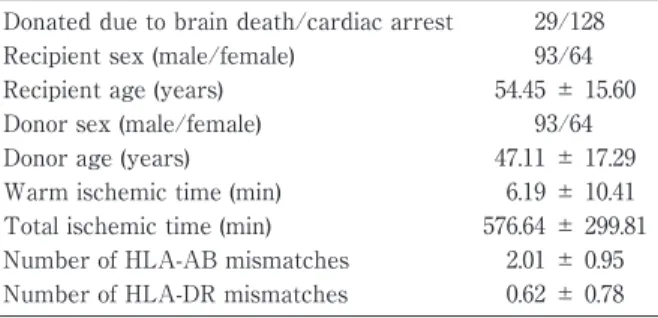
Table 1 Patient background.
Donated due to brain death/cardiac arrest 29/128 Recipient sex (male/female) 93/64 Recipient age (years) 54.45 ± 15.60 Donor sex (male/female) 93/64 Donor age (years) 47.11 ± 17.29 Warm ischemic time (min) 6.19 ± 10.41 Total ischemic time (min) 576.64 ± 299.81 Number of HLA-AB mismatches 2.01 ± 0.95 Number of HLA-DR mismatches 0.62 ± 0.78 HLA: human leukocyte antigen.
Table 2 Post-transplantation changes in sCr according to the WIT period and the TIT period when WIT ≥ 31 minutes.
After 1 month After 3 months After 6 months After 12 months WIT ≤ 30 min 2.93 ± 0.51 2.10 ± 0.25 1.69 ± 0.23 1.78 ± 0.28 ≥ 31 min 2.82 ± 1.04 2.93 ± 2.45 3.49 ± 1.57 2.64 ± 1.32 WIT/TIT ≥ 31 min/< 12 h 1.29 ± 0.35 1.05 ± 0.65 1.33 1.34 ≥ 31 min/≥ 12 h 7.45 ± 1.46 4.80 ± 2.04 3.92 ± 1.29 3.07 ± 1.22 Repeated measures ANOVA p < 0.001.
Table 3 Differences in post-transplantation changes in sCr according to donor age.
Donor age After 1 month After 3 months After 6 months After 12 months ≤ 30 yrs. 2.06 ± 0.63 1.64 ± 1.34 1.45 ± 0.23 1.48 ± 0.53 31-60 yrs. 2.82 ± 0.47 2.14 ± 0.23 1.72 ± 0.30 1.80 ± 0.36 ≥ 61 yrs. 3.86 ± 0.68 2.43 ± 0.40 2.30 ± 0.91 2.11 ± 0.50 Repeated measures ANOVA p < 0.001.
Table 4 (Correct) Differences in post-transplantation changes in sCr due to minimum donor sCr (sCrmin) and final donor sCr (final sCr).
Group NO. After 1 year After 2 years After 3 years After 4 years After 5 years sCrmin (mg/dl)* ≤ 1 (n = 105) 1.46±0.38 1.36±0.42 1.33±0.38 1.75±0.71 1.76±1.46 > 1 (n = 31) 1.96±0.44 1.79±0.50 1.64±0.52 2.05±0.78 1.85±1.20 final sCr (mg/dl)** ≤ 1 (n = 49) 1 2.17±0.86 1.56±0.48 1.49±0.61 2.15±1.06 1.79±1.42 1 <, ≤ 3 (n = 46) 2 1.79±0.70 1.75±0.86 1.50±0.43 1.82±0.87 1.55±0.57 3 <, ≤ 5 (n = 21) 3 1.90±0.45 1.76±0.39 1.74±0.59 1.71±0.61 2.51±1.92 5 < (n = 18) 4 1.75±0.39 2.09±1.11 2.04±1.26 2.28±1.16 1.75±1.15 Repeated measures ANOVA *p < 0.001; **Group 1 vs Group 4 p=0.005; Group 2 vs Group 4 p < 0.001; Group 3 vs Group 4 p = 0.029. 結 果 1.患者背景 対象となった献腎移植症例の患者背景を Table 1 に示す.移植条件としては脳死下腎移植 29 症例,心 停止下腎移植 128 症例,レシピエントの性別は男性 93 症例, 女性 64 症例, ドナー性別は男性 93 症例, 女性 64 症例であった.WIT の中央値(四分位範囲) は 2(0∼5)分,TIT の中央値(四分位範囲)は 470 (370∼757)分であった.なお,平均観察期間は 10.5 ±5.8 年であった.
Figure 1 Graft survival rates of donated kidneys following transplantation.
The 1-year survival rate of the transplanted donated kidneys (n = 157) was 91.72% (n = 145) and the 5-year survival rate was 85.49% (n = 118).
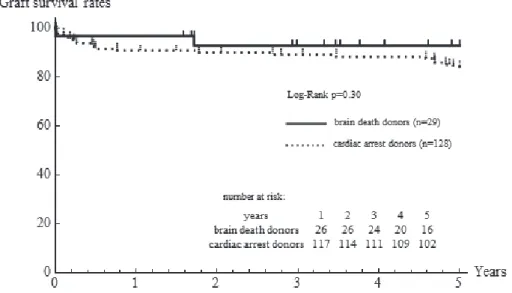
Figure 2 Comparison of graft survival rates of kidneys from donors who died due to car-diac arrest and brain death.
The 5-year graft survival rate was 96.55% for kidneys from brain dead donors (n = 29, mean observation period: 4.09 ± 1.37 years) and 84.12% for kidneys from cardiac arrest do-nors (n = 128, mean observation period: 4.32 ± 1.47 years).
Table 5 Stepwise and multivariate Cox regression to calculate the graft survival risk factor.
Univariate HR p-value Stepwise HR p-value Donor age 1.055 0.0043 1.058 0.013 final sCr 1.029 0.69 NS sCrmin 1.81 0.34 7.38 0.016 Donor cause of death:
celebrovascular disease 6.13 0.0038 4.90 0.016 Stepwise HR, adjusted hazard ratio of graft failure.
Figure 3A Kidney graft survival rates according to recipient age.
The 5-year graft survival rate was 90.90% in recipients aged 30 years or younger (n = 22), 85.0% in those aged 31-60 years, and 82.60% in those aged 61 years or older.
Figure 3B Differences in kidney graft survival rates by donor age.
The 5-year graft survival rate was 100% in kidneys from donors aged 30 years or younger, 85.60% for those aged 31-60 years, and 71.60% for those over the age of 61 years. The p-value by log-rank test between donors aged 30 years or younger and 31-60 years is 0.021, between donors aged 30 years or younger and aged 61 years and older is < 0.001, and be-tween donors aged 31-60 years and aged 61 years and older is 0.060.
2.移植腎生着率 対象症例全体の移植腎生着率を示す.1 年生着率 は 91.7%, 5 年生着率は 85.5% であった(Figure 1). また,心停止ドナー 128 症例および脳死ドナー 29 症例からの移植における移植腎生着率を Figure 2 に示す.心停止ドナーにおける移植腎の 1 年生着率 90.6%,5 年生着率 84.1%,脳死ドナーは 1 年生着率 96.6%,5 年生着率 92.8% であったが,両群間に有意 差を認めなかった. レシピエントの年齢ごとの生着率においては, Figure 3A で示されるように,3 群間に統計学的な 有意差は認めなかった.ドナーの年齢ごとの生着率 においては,Figure 3B で示されるように,ドナー年 齢が上がるにつれ生着率の低下を認めた.ドナー年 齢 30 歳以下では 5 年生着率は 100%,ドナー年齢 31 歳∼60 歳 で は 85.4%,ド ナ ー 年 齢 61 歳 以 上 で は
Figure 4 Kidney graft survival rates by donor cause of death.
The 5-year graft survival rate was 76.20% in kidneys from donors whose cause of death was cerebrovascular disease. The p-value by log-rank test between the cerebrovascular disease group and other causes group was < 0.001.
71.6% であり,log-rank test において 30 歳以下の群 と 31 歳∼60 歳群間では p=0.021,30 歳以下群と 61 歳以上群間では p<0.001 と有意差を認めた. また, ドナーの死因ごとの生着率を Figure 4 に示す.ド ナーの死因ごとの 5 年生着率の比較では,頭部外傷 97.1%,心血管障害 100%,脳血管障害 76.0%,その他 の内因死(脳腫瘍,呼吸器疾患を含む)100%,その 他の外因死(窒息を含む)91.5% であった.脳血管障 害群が他の群に比較して生着率が低い傾向を示し, 脳血管障害群とそれ以外の死因群の 5 年生着率の差 は log-rank test にて p<0.001 と有意差を認めた. 次に,WIT を 30 分以下,31 分以上の群に分けた 生 着 率 を Figure 5A に,TIT を 12 時 間 未 満,12 時間以上に分けて比較した各群の生着率を Figure 5B に,さらに WIT30 分以下と 31 分以上,TIT12 時間未満と 12 時間以上を組み合わせて 4 群に分け た生着率を Figure 5C に示す.WIT が 31 分以上の 群では移植後早期の移植腎不全がみられたものの, 生着率としては統計学的有意差を認めなかった. 3.移植腎機能 腎移植後の 5 年生着率の比較に加え,移植後早期 の移植腎機能の推移についても検討を行った.今回 WIT と TIT, ドナー年齢, ドナー入院中の sCrmin,
ドナーの臓器摘出前の final sCr ごとに変動要因と して分類し,移植後の sCr の時間経過による推移を 結果として比較を行った.Table 2A に WIT 毎によ る移植後 sCr の推移を示したが,移植後の sCr の値 は移植後時間の推移とともに差が開いており,2 群 間で p<0.001 と有意差を認めた.さらに WIT が 31 分を超過した場合,TIT が 12 時間を超えるかどう かで比較した場合も,移植後 sCr の推移では p< 0.001 と有意差を認めた.Table 3 にドナーの年齢ご との sCr の推移を示した.ドナー年齢が上昇するご とに移植後 sCr は有意に高値を示し(p<0.001),こ の傾向は移植後 1 か月から 12 か月までの期間を通 して変わらなかった.また,摘出前のドナー腎機能 と移植後腎機能を比較する目的として,sCrminおよ び final sCr について検討した.Table 4 にドナーの 入院時における sCrminまたは final sCr ごとの移植後 sCr を,移植後 5 年までの推移を示したが,sCrmin では sCrmin!1 と sCr>1 の群で有意差を認めており (p<0.001),final sCr については final sCr>5 とそれ 以外の群の間に有意差を認めた.また,この 2 つの 要因についてピアソンの相関係数(r)=0.303 と弱い 相関のみ示されたが,移植腎生着に影響する複数の 要因を評価するため Cox 回帰分析,Stepwise 法に よる多変量解析を行った結果(Table 5)では,前述 の単変量解析においても有意差を認めたドナー年齢 (p=0.013),ドナー死因の脳血管障害(p=0.016)に加 えて,sCrmin(p=0.016)が移植腎生着に影響する因子 として挙げられた.このとき,final sCr は危険因子と して有意ではなかった. 考 察 本研究は,献腎ドナーにおける移植前 sCr による
Figure 5 Kidney graft survival rates according to (A) WIT period, (B) TIT period, (C) WIT and TIT periods.
A A B B C C
評価と移植後腎機能への影響を検討することを目的 とした.その結果,final sCr と比較し,sCrminが,移 植後腎機能をより反映している可能性が示唆され た.また,献腎移植において移植後腎機能に及ぼす 影響を WIT と TIT を用いて検討したところ,可能 な限り WIT を短縮すること(30 分以内)が望まし く,WIT が 31 分を超える場合は,TIT をできる限 り短縮することが重要と考えられた.さらに,ドナー 死因において,脳血管障害はその他の疾患と比較し 移植後生着率は不良であり,61 歳以上の高齢ドナー での移植腎生着率も不良であった. ドナーの移植前 sCr が移植後腎機能に及ぼす影 響を検討した過去の報告3)4) では,摘出時のドナーの 移植前 sCr として final sCr が用いられているが,fi-nal sCr と sCrminのどちらがより有用な指標である か検討されておらず,本研究で両者を用いて生着率 を比較した結果,sCrminが final sCr よりも移植後の 腎機能をより反映していると考えられた.final sCr より sCrminが移植後腎機能をより反映している理由 として,final sCr はもともとの腎機能に加えドナー の死戦期における阻血低酸素状態から組織障害を受 け,その結果として急性尿細管壊死(acute tubular necrosis:ATN)の影響を受けている9)10) ことが考え られた.生着率についての多変量解析において final sCr よりも sCrminにおいて有意差が示されたことも これを支持する結果と考えられた.今回の検討にお いて final sCr≧3.0 mg/dl の症例は 157 症例中 40 症 例存在していたが,その中で sCrmin≧1.5 mg/dl の症 例 は 2 症 例(5%)の み で あ り,final sCr と sCrmin の差が大きい症例も少なくないことから,final sCr が高値な症例においても sCrminが保たれている場合 は術後の腎機能回復が期待できることが考えられ た.これまでも final sCr(at the time of harvest)が 高値のドナー腎の移植において術後腎機能が良好に 発現する場合7)11) が報告されているが,final sCr 高値 であっても sCrmin低値の症例であれば良好な移植後 腎機能が期待できると考えられた.final sCr が高値 のドナーにおいても sCrminを含めた詳細な評価・検 討を行うことが限られたドナーソースを有効に生か すことにつながると考えられた. WIT および TIT の組み合わせによる比較検討で は,生着率について有意差を認めなかった.今回の 解析では WIT 31 分以上の症例数が少なくサンプル サイズの偏りがあったためと考えられた.過去には TIT は 24 時間以上,WIT と TIT の両因子の組み合
わせでは WIT が 30 分以内でも総阻血時間が 24 時 間以上で生着率が低下したとする報告12) や,WIT が 31 分以上となった場合など一定以上の温阻血傷 害がある場合は TIT が 12 時間を超えると生着率が 低下するという報告13) ,TIT については 12 時間以内 の場合がもっとも生着率が優れているという報告が 存在しており14) ,今回の解析においても,移植後腎機 能については有意差がみられていることから,観察 期間を延長することで長期的な生着率に影響が出る 可能性は否定できない. なお,WIT と TIT の組み合わせによる移植腎機 能の比較検討について,WIT30 分以下の群は WIT 31 分以上の群と比較し移植後 1 か月から 12 か月ま での期間を通して有意に低い sCr を示した.また WIT30 分以下の群では移植後,時間の推移ともに sCr が改善したのに対し,WIT31 分以上の群におい ては移植後 12 か月の時点においても sCr の改善の 程度は少なかった.一定時間以上の虚血に曝される と,移植後における虚血傷害からの改善には限界が あることを示唆しているものと考えられた. WIT31 分以上/TIT12 時間未満の症例では 12 時 間以上の症例と比較して sCr は有意に低値で経過 し,WIT31 分以上/TIT12 時間以上の群では移植後 12 か月の時点においても高値で推移した.温阻血傷 害に一定時間以上の冷阻血が加わると,術後速やか な移植腎機能の回復が困難となり移植腎機能発現遅 延(delayed graft function:DGF)となると考えられ る.移植後早期の生着率に有意差は認めなかったが, DGF は急性拒絶反応(acute rejection:AR)の危険 因子であることが知られており,長期の生着率には AR が危険因子であることから15) ,長期的には透析再 導入までの期間に影響を与えうると考えられた.虚 血による障害は WIT,冷阻血時間(cold ischemic time:CIT)を組み合わせた結果であり,その曝露時 間の遷延は腎臓に慢性的あるいは遷延する影響を与 えうる3) .移植腎機能にとっては,WIT を可能な限り 短縮することが最も重要であるが,虚血障害が WIT および CIT の総合的な影響の結果3) であることを考 慮し,WIT が一定時間(今回の検討では 31 分)を超 えた場合は可能な限り TIT を短縮することが望ま しいと考えられた. ECD は年齢 60 歳以上,脳血管疾患による死亡, sCr 1.5 mg/dl 以上というドナー条件をもとに規定 されている.本研究においても,ドナーの年齢毎に 移植後腎機能を比較したところ,30 歳以下,31 歳∼
60 歳,61 歳以上とドナー年齢が高いほど移植後 12 か月の期間を通して sCr が高値で経過しているこ とから,ドナー年齢は移植後腎機能に強く影響する 因子と考えられた.理由としては腎の加齢による変 化が挙げられ,病理学的には糸球体硝子化,足細胞 の萎縮,有効ネフロン数の減少,尿細管の萎縮・消 失,間質拡大,髄質の脂肪・石灰沈着,微小血管の 消耗や粗化10)16) が知られている.特に糸球体は 40 歳 以 上 ま た は 55 歳 以 上 で 総 数 の 10% 以 上 に 硬 化 が17)18) ,60 歳以上のドナー腎は移植直前の腎生検(0-hour biopsy)の時点で糸球体の 10∼20% に硬化性 病変が認められる19) と報告されている.本研究にお いても 61 歳以上のドナー腎には上記の加齢性変化 が内在すると推定され,さらに腎摘出から腎移植の 過程における温虚血傷害,冷阻血傷害,再灌流傷害 が加わることで ATN の影響を受けやすく回復が遅 れる可能性が考えられた.多変量解析においてド ナー年齢が移植腎生着率の有意なリスク因子であっ たこともこれを支持する結果と考えられた.ドナー 死因についての検討では,脳血管障害群が他の群に 比較して生着率が低い傾向を示し,頭部外傷群と脳 血管障害群の 5 年生着率の差を認めた.脳血管障害 群では頭部外傷群に比較し不安定な血行動態や脳死 に至った原因の多くが動脈硬化性疾患によることが 挙げられ,臓器血流も動脈硬化の影響を受けている ことが理由の一つとして考えられた20) . 本研究の限界として,1 施設での後ろ向き観察研 究であるため総症例数が少ないこと,症例数の偏り による解析の限界が挙げられる.腎移植の生着率や 移植後腎機能はドナー要因・レシピエント要因・環 境要因と様々な要因の影響を受けた結果であり21) , 今後他施設との連携を行った上で長期的な移植成績 についての検討を行っていきたい. 結 論 ドナー腎機能の評価を行うにあたり,final sCr に 比べ sCrminがドナー本来の腎機能をより反映してい る因子であることが示唆された. 開示すべき利益相反はない. 文 献 1)日本透析医学会統計調査委員会:II.2017 年日本透 析医学会統計調査報告書 調査結果と考察.「わが 国 の 慢 性 透 析 療 法 の 現 況(2017 年 12 月 31 日 現 在)」,pp707―710. http://docs.jsdt.or.jp/overview/ file/2017/pdf/1.pdf (Accessed June 23, 2020) 2)米田龍生:III.腎臓.8.腎移植成績(レシピエント
追跡調査).「2018 臓器移植ファクトブック」,pp32― 38 ,日本移植学会 . http://www.asas.or.jp/jst/pdf/ factbook/factbook2018.pdf (Accessed June 23, 2020) 3)Peters-Sengers H, Heemskerk MBA, Geskus RB et al: Validation of the Prognostic Kidney Donor Risk Index Scoring System of Deceased Donors for Renal Transplantation in the Netherlands. Trans-plantation 102 (1): 162―170, 2018
4)Dahmen M, Becker F, Pavenstädt H et al: Valida-tion of the Kidney Donor Profile Index (KDPI) to as-sess a deceased donor s kidneys outcome in a Euro-pean cohort. Sci Rep 9 (1): 11234, 2019
5)U.S. Department of Health and Human Services: Organ Procurement and Transplantation Net-work : KDPI Calculator. ( 2017 ) . https://optn.
transplant.hrsa.gov/resources/allocation-calculators/kdpi-calculator ( Accessed June 23, 2020)
6)U.S. Department of Health and Human Services: Organ Procurement and Transplantation Net-work: Kidney Donor Profile Index (KDPI) Guide for Clinicians. (2017). https://optn.transplant.hrsa.gov/ resources/guidance/kidney-donor-profile-index-kdpi-guide-for-clinicians (Accessed June 23, 2020) 7)日下 守,星長清隆:心停止下献腎移植におけるド ナー評価・管理の現状と課題.Organ Biol 19(1): 53―58,2012 8)厚生労働省:第 49 回厚生科学審議会疾病対策部会 臓器移植委員会資料.10.参考資料 1-4 献腎が無機能 であった場合の待機期間についての提言書(2017). https://www.mhlw.go.jp/file/05-Shingikai-
10601000-Daijinkanboukouseikagakuka-Kouseikagakuka/0000209987.pdf ( Accessed June 23, 2020)
9)Kusaka M, Kubota Y, Sasaki H et al: Combined predictive value of the experienced donor criteria for long-term graft survival of kidneys from donors after cardiac death : A single-centor experience over the decades. Int J Urol 23 (4): 319―324, 2016 10)黒川真奈絵,尾崎志雲,吉川英志ほか:阻血再灌流
後の腎組織障害に対する Fas 依存性アポトーシス 抑制による治療効果.Inflammation Regenerat 27 (2):124―129,2007
11)Seo CH, Ju JI, Kim MH et al: Risk factors and long-term outcomes of delayed graft function in de-ceased donor renal transplantation. Ann Surg Treat Res 89 (4): 208―214, 2015 12)中村信之,塚本美保,島野祐介ほか:西日本地区に おける心停止下提供献腎移植のドナー要因の移植 腎生着率への影響に関しての解析.西日泌 78: 292―298,2016 13)寺岡 慧,大島伸一,平野哲夫ほか:献腎移植の現 状と今後の課題.今日の移植 15(2):147―153, 2002 14)寺岡 慧,平野哲夫,里見 進ほか:脳死移植法施 行後の心停止下腎移植成績.Organ Biol 9(3): 243―264,2002
15)Seo CH, Ju JI, Kim MH et al: Risk factors and long-term outcomes of delayed graft function in de-ceased donor renal transplantation. Ann Surg
Treat Res 89 (4): 208―214, 2015
16)吉田政彦:加齢に伴う腎病変.順天堂医 31:31― 36,1985
17)Kaplan C, Pasternack B, Shah H et al: Age-related incidence of sclerotic glomeruli in human kidneys. Am J Pathol 80: 227―234, 1975
18)Fukuda N, Suzuki Y, Sato K et al: Estimation of age from sclerotic glomeruli. Forensic Sci Int 15 :
123.e1-4, 2010
19)Zhou XJ, Rakheja D, Yu Xueqing et al: The aging kidney. Kidney Int 74: 710―720, 2008
20)Schmitt R, Melk A: Molecular mechanisms of renal aging. Kidney Int 92 (3): 569―579, 2017
21)Chan KW, Leung CY, Chan CW et al: Age-related glomerular sclerosis: baseline values in Hong Kong. Pathology 22 (4): 177―180, 1990