The Japanese Psychonomic Society
NII-Electronic Library Service
TheJapanesePsychonomicSociety
lhe
1itPanes'e
fou7w.at
of
Ao'(/honomic
Science
2002,
Vol.
Zl,No,
1,49-50
Prizewinner's
SummaryP-2A-16
The
effects
ofthe
information
'multiple
object
Hirokazu
OGAwA
Ktvansei
and
Gahblin
of
untracked
objects
on
tracking
Akjhiro
YAGi
Uitivei:sity'
The
present
study used a contextualcueing
paradigm
to
investigate
contextualinformation
in
a complexvisual
scene
which
changeddynamical]y.
An
observerhad
te
truck
five
identical
targets
which movedindependently
and unpredictablyamong
five
identical
distracters
(a
rnultiple objecttracking
task),
The
motionpatterns
(trajectories)
of
the
items
were
made
invariant
by
repeatingthem
throughout
the
entire
experimental
session.
The
results showedthat
repetition ofthe
target
motionpattern
facilitated
the
tracking
performance.
A
moreirnportant
finding
wasthat
repe・atingthe
motion
pattern
of
the
distractor
resultedin
greater
facilitation.
An
inciclental
recognitiontest
confirmed
that
an observer could not noticethe
repetitionprocedure,
We
concludethat
not, onlythe
target
motionpattern,
but
also
the
distractor
motionpattem,
w,as encodedas
contextual
information
in
anirnplicit
manner,Key
words :implicit
learning,
contextual
cueing, multiple objecttracking
Recently
Chun
and
his
colleagues
(Chun
&
Jtang,
1998,
1999)
have
developed
aparadigm,
calledcentex-tual
cueing,
te
investigate
how
a visua] contextis
'
formed
in
a
laboratory
situation,In
their
studiesthe
observer was asked
to
perform
a
visual
search
task
in
which
the
configuration ofthe
search
items
wasdefined
as a context, andparticular
display
layouts
were
presented
repeatedlyacross
the
blocks.
The
study
shuwed
that
search
performance
wasfacilitated
by
a consistentlayout
witheut an observer'saware-ness
of
such
aprocedure.
The
results suggesteclthat
the
ob$erverslearned
the
configurat,ion as contextualknowledge
in
animplicit
manner.In
the
present
study
we
investigatecl
the
nature
ofthe
contextualinformation
in
a
cornplex
visual scene whichchanged
dynamically.
We
used a multiple'object
tracking
paradigm
(Pylyshyn
&
Storm,
1988),
'
'
The
present
studyposed
two
questions.
First,
does
repetition of
the
motionpatterns
(trajectories)
of
tracked
items
ferm
the
visual contextancl
facilitate
'
Department
of
Psychology,
Kwansei
Gakuin
University,
1'155,
Uegahara,
Nishinomiya,
Hyogo,
662-8501
the
performance
of
multipleobject
trucking?
Second,
what
information
is
encodedinto
the
inemory as avisual
context?
Method
Sixteen
undergraduate studentsparticipatecl
in
the
experiment,
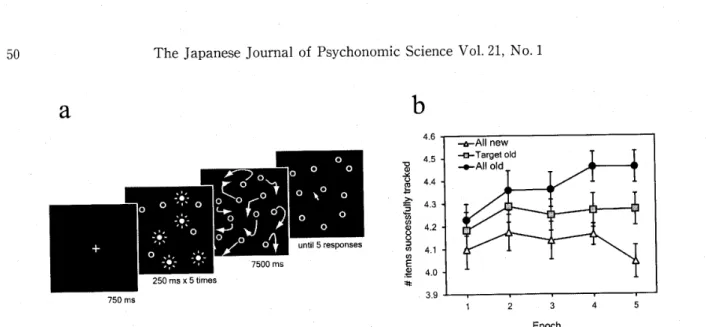
Figure1a
shows
the
sequence of eventsduring
atrial.
The
display
consisted of10
whitecircle
items
(O.83
degrees
in
diameter),
on ablack
background
(14.7
×14.7
degrees).
At
the
start of atrial
5
of10
items
weredesignated
asthe
target
iterns
which
wereto
be
tracked
by
flashing
them
on, and off,five
times,
After
the
targets
had
been
designated
each
item
startedto
move with avelocityvector
that
was changed randomly everyfew
hundred
milliseconds.The
items
arso
changed
their
velocity veetors whenthe
distance
from
the
edge ofthe
display,
orfrom
other
items,
wasless
than
O.2
degrees.
A
smooth
motion
continuedfor
7,500ms.
At
the
endof
the
movement a meuse cursor appeared
at
the
center
of
the
display.
An
observer
then
had
to
indicate
five
targets
by
meuseclicks,
Nb
feedback
wasgiven.
The
investigation
used
a
3
×5
design,
Each
ofthree
The Japanese Psychonomic Society
NII-Electronic Library Service
TheJapanesePsychonomic Society
50
a
The
Japanese
Journal
750ms
of
Psvchonomic
'
7500ms
Figure
1.
(a)
The
sequence ofevents
during
atrial.
function
ofthe
epoch
for
each repetitioncondition.
factor:
an "allold"
conditien;
an "oldtarget"
condi-tion;or
an
"allnew" condition.
In
the
"all old" condition,all
ofthe
items
(targets
and
distractors)
had
motionpatterns
which weremade
invariant
by
repeatingthem
throughout
the
entire experimental sessien.In
the
"oldtarget"
conditien,
the
pattern
of
the
target
items
was rnadeinvariant.
In
the
d"all
new"
'
condition
all efthe
motionpatterns
were newgenera-tions
for
eachblock.
The
trajectories
for
the
first
second and
the
last
second ofthe
display
period
were recalculatedfor
each
repetition.Another
'
tal
factor
involved
an
"epoch"or
group
oftrials.
'
Each
epoch was comprisedof
three
blocks,
each of whichjncluded
five
"all
old"
condition
trials,
five
`Loldtarget''
condition
trials
andfive
"all new" conditiontrials.
Aiter
the
last
block
ofthe
tracking
task
the
observer was asked
to
perform
aninciclental
explicit
recognitiQntest
in
whichfive
"all old"patterns
and
five
newlygenerated
patterns
werepresented
in
arandorn
order.
The
observer wasrequired
to
answer whetheror
not apattern
had
been
presented
in
the
preceding
tracking
task.
Results
andDiscuepien
Figurelb
showsthe
mean number of correctlytracked
items
as afunction
ofthe
epoeh
for
eachrepetition
condition,
The
tracking
performances
in
the
"allo]d"
and
the
`"oldtarget"
cunditions were
better
than
those
in
the
"allnew" condition :`iall
old"
vs.
"allnew"
conditions,
F(1,l6)==28.40,
P<.eOl;
Science
Vol.
21,
No.
1
b
4.6 4.5:trt4,4b
4.3Sij42thmE
4.12 4.Dlt 3.9 1 2'3 4.' 5Epoch
'
(b)
The
mean
number of correctlytracked
items
as a'
The
errorbars
indicate
the
standarderror
of
the
mean."old
target"
vs. "all new"
conditions,
F(i,
16)=11.36,
p<.O05,
A
moreimportant
finding
is
that
mances
in
the
"al! old" condition werebetter
than
those
in
the
"oldtarget"
condition
(F(1,
16)=8.25,
P
<.05).
Although
7
of16
observers
reportedthat
they
were
aware of
the
repetition manipulation,the
accuracyof
expl{cit
recognition wasat
chance
level
(overall
accuracy=49.4%,
hit
rate=:42.3%,false
alarm=43.5%).
,
"Je
concludethat
learning
ofthe
motien
patterns
occurred witheut
explicit
encoding ufthe
display
and
that
the
implicit
representations
ofdynamic
contextfacilitated
tracking,
Furthermore,
the
resultsshow
that
the
motionpatterns
of untrackeditems,
whichwere
to
be
ignored,
facilitated
tracking
performances.
The
present
results suggestthat
the
human
visual
system
encodes
complex
dynamic
covariationbetween
objectsin
a visual scene andthis
encoding
serves
to
reduce uncertainty.References
'
Chun,
M,M,,
&
Jiang,
Y.
1998
Contextual
cueing:Implicit
learning
and
memory
of visual contextguides
spatial
attention.Cagnitive
Ils),cholQgy,
36,