Bulletins of the Pharmaceutical Society of Japan
Catalytic production of oxo-fatty acids by lipoxygenases is mediated by the radical- radical dismutation between fatty acid alkoxyl radicals and fatty acid peroxyl radicals in
fatty acid assembly
--Manuscript Draft--
Manuscript Number: MS19-00975R1
Article Type: CPB-Regular Article
Full Title: Catalytic production of oxo-fatty acids by lipoxygenases is mediated by the radical- radical dismutation between fatty acid alkoxyl radicals and fatty acid peroxyl radicals in fatty acid assembly
First Author: Yuta Takigawa
Order of Authors: Yuta Takigawa
Ichiro Koshiishi
Abstract: Oxo-octadecadienoic acids (OxoODEs) act as peroxisome proliferator-activated receptor (PPAR) agonists biologically, and are known to be produced in the
lipoxygenase/ linoleate system. OxoODEs seem to originate from the linoleate alkoxyl radicals that are generated from (E/Z)-hydroperoxy octadecadienoic acids ((E/Z)- HpODEs) by a pseudoperoxidase reaction that is catalyzed by ferrous lipoxygenase.
However, the mechanism underlying the conversion of alkoxyl radical into OxoODE remains obscure. In the present study, we confirmed that OxoODEs are produced in the lipoxygenase/ linoleate system in an oxygen-dependent manner. Interestingly, we revealed a correlation between the (E/Z)-OxoODEs content and the (E/E)-HpODEs content in the system. (E/E)-HpODEs could have been derived from (E/E)-linoleate peroxyl radicals, which are generated by the reaction between a free linoleate allyl radical and an oxygen molecule. Notably, the ferrous lipoxygenase-linoleate allyl radical (LOx(Fe2+)-L•) complex, which is an intermediate in the lipoxygenase/ linoleate system, tends to dissociate into LOx(Fe2+) and a linoleate allyl radical. Subsequently, LOx(Fe2+) converts (E/Z)-HpODEs to an (E/Z)-linoleate alkoxyl radical through one- electron reduction. Taken together, we propose that (E/Z)-OxoODEs and (E/E)- HpODEs are produced through radical-radical dismutation between (E/Z)-linoleate alkoxyl radical and (E/E)-linoleate peroxyl radical. Furthermore, the production of (E/Z)- OxoODEs and (E/E)-HpODEs was remarkably inhibited by a hydrophobic radical scavenger, 2,2,6,6-tetramethylpiperidine 1-oxyl (TEMPO). On the contrary, water- miscible radical scavengers, 4-hydroxyl-2,2,6,6-tetramethylpiperidine 1-oxyl (OH- TEMPO) and 3-carbamoyl-2,2,5,5-tetramethyl-3-pyrroline-N-oxyl (CmΔP) only modestly or sparingly inhibited the production of (E/Z)-OxoODEs and (E/E)-HpODEs.
These facts indicate that the radical-radical dismutation between linoleate alkoxyl radical and linoleate peroxyl radical proceeds in the interior of micelles.
Manuscript Classifications: Regulatoryscience
Keywords: oxo-octadecadienoic acids; 13-oxo-tridecadienoic acid; fatty acid alkoxyl radical;
beta-scission; radical-radical dismutation.
Response to Reviewers: Answer to the reviewer’s comments Reviewer #1:
1.We spelled out PPAR and added to Abbreviations; P1 “Abbreviations”, and P2 L1.
2.We altered CmDP to CmΔP; P7 L12.
3.According to the reviewer’s comment, we performed statistical analysis again by using Dunnett’s test; P7 L19.
4.It is difficult to show the content of linoleate and that of activated lipoxygenase in the reaction lesion in vivo. So far, many investigators studied the reaction mechanism of lipoxygenases using soybean 15-lipoxygenase as a model enzyme, and they usually fixed linoleic acid content to mM order and lipoxygenase content to hundred nM ~ few μM order. It is generally known that 15-lipoxygenase reacts with polyunsaturated fatty acids existing as a component of phospholipids in the lipid membrane, Furthermore, in the stimulated cells, 15-lipoxygenase seems to be localized and concentrated on the Powered by Editorial Manager® and ProduXion Manager® from Aries Systems Corporation
lipid membrane, so we cannot deny radical-radical dismutation in the lipid assembly like as lipid membrane.
5.Salch et al. studied on soybean lipoxygenases very well (Ref. 20). The optimal pH of type 1 15-lipoxygenase is pH 9.8, and that of type 2 15-lipoxygenase is pH 6.5. The lipoxygenase activity of type 1 15-lipoxygenase at pH 6.5 is almost 1% of that of type 1 15-lipoxygenase at pH 9.8. 13-OTA generating activity of type 2 15-lipoxygenase is larger than that of type 1 15-lipoxygenase.
6.According to the reviewer’s comment, we added the curve-fitting results in Fig. 5A and 5B, and discussed it (P10 L2).
7.We made a mistake uploading Figure 7 using Figure 9 file, so, this time, we correctly upload Figure 7.
8.According to the reviewer’s comment, we discussed the reactivity of TEMPO and OH-TEMPO toward peroxyl radical (P10 L21). Both TEMPO and OH-TEMPO reduce CH2(OH)OO• and reaction rate constants are 1.0 x 10⁸ M-1 s-1 and 0.44 x 10⁸ M-1 s- 1, respectively. However, TEMPO significantly prevented the (E/E)-HpODE generation, but OH-TEMPO did not prevent it at all. We cannot explain this fact via the slight difference in reaction rate constant.
Reviewer #2
1.According to the reviewer’s comment, we corrected the sentence (P5 L15).
2.According to the reviewer’s comment, we added UV spectra of OxoODE and HpODE in Fig.2B, and discussed it in Figure legend (P15 L14). We identified the peak eluted at 31.5 min as (E/E)-OxoODE, which is thought to be generated from (E/E)-HpODEs. To tell the truth, we found a fact that hydrogen polysulfides isomerize (E/Z)-OxoODEs to (E/E)-OxoODEs. Now, we are preparing a next manuscript.
3.The optimal pH of soybean 15-lipoxygenase used here is approximately 9.5-9.8. In the Figure 3, we examined whether soybean 15-lipoxygenase reacts with linoleic acid at pH 7.4. We discussed the statement “a correlation between the 13-(E/Z)-OxoODE content and the 13-(E/E)-HpODE content in the system” in the Figure 5.
4.According to the reviewer’s comment, we explained Fig. 4A-1 (P8 L22).
5.We made a mistake uploading Figure 7 using Figure 9 file, so, this time, we correctly upload Figure 7.
6.According to the reviewer’s comment, we pointed Fig. 9 in the text (P11 L6).
7.“Other Comments”: According to the reviewer’s comment, we corrected exactly.
Thank you so much for reviewing.
Additional Information:
Question Response
[Human Research]
Your manuscript deals with scientific investigations involving human subjects and/or human tissues
No
[Animal Research ]
Your manuscript deals with scientific investigations involving animal studies.
No
[Natural Products and Crude Extract Materials (NP/CEM) or not]
Your manuscript deals with NP/CEM.
No
Has this manuscript been carefully reviewed by an experienced scientist whose first language is English?
Yes
Name of the English checker [company]
or [person + country of his/her first language (mother tongue)]
Editage
Powered by Editorial Manager® and ProduXion Manager® from Aries Systems Corporation
Editor of Chemical and Pharmaceutical Bulletin
November 25, 2019 Dear Editor:
Thank you very much for your mail of November 18, 2019, with regard to our
manuscript (Ms. No. MS19-00975) together with the comment from the reviewers. We are sending herewith a revised manuscript.
Our alterations as a result of the reviewer’s comments are written in separate pages.
We believed the revised manuscript has been improved satisfactorily and hope it will be accepted for publication in Chemical and Pharmaceutical Bulletin
Very sincerely yours,
Dr. Ichiro Koshiishi, Professor
Graduate School of Health Sciences, Gunma University, 3-39-22 Showa-machi, Maebashi, Gunma 371-8511, Japan
Tel +81-27-220-8916 Fax +81-27-220-8916
e-mail [email protected]
Cover Letter Click here to access/download;Cover
Letter;renamed_720c2.doc
Answer to the reviewer’s comments Reviewer #1:
1. We spelled out PPAR and added to Abbreviations; P1 “Abbreviations”, and P2 L1.
2. We altered CmDP to CmP; P7 L12.
3. According to the reviewer’s comment, we performed statistical analysis again by using Dunnett’s test; P7 L19.
4. It is difficult to show the content of linoleate and that of activated lipoxygenase in the reaction lesion in vivo. So far, many investigators studied the reaction mechanism of lipoxygenases using soybean 15-lipoxygenase as a model enzyme, and they usually fixed linoleic acid content to mM order and lipoxygenase content to hundred nM ~ few M order. It is generally known that 15-lipoxygenase reacts with polyunsaturated fatty acids existing as a component of phospholipids in the lipid membrane, Furthermore, in the stimulated cells, 15-lipoxygenase seems to be localized and concentrated on the lipid membrane, so we cannot deny radical-radical dismutation in the lipid assembly like as lipid membrane.
5. Salch et al. studied on soybean lipoxygenases very well (Ref. 20). The optimal pH of type 1 15-lipoxygenase is pH 9.8, and that of type 2 15-lipoxygenase is pH 6.5. The lipoxygenase activity of type 1 15-lipoxygenase at pH 6.5 is almost 1% of that of type 1 15-lipoxygenase at pH 9.8. 13-OTA generating activity of type 2 15-lipoxygenase is larger than that of type 1 15-lipoxygenase.
6. According to the reviewer’s comment, we added the curve-fitting results in Fig. 5A and 5B, and discussed it (P10 L2).
7. We made a mistake uploading Figure 7 using Figure 9 file, so, this time, we correctly upload Figure 7.
8. According to the reviewer’s comment, we discussed the reactivity of TEMPO and OH-TEMPO toward peroxyl radical (P10 L21). Both TEMPO and OH-TEMPO reduce CH2(OH)OO• and reaction rate constants are 1.0 x 10⁸ M-1 s-1 and 0.44 x 10⁸ M-1 s-1, respectively. However, TEMPO significantly prevented the (E/E)-HpODE generation, but OH-TEMPO did not prevent it at all. We cannot explain this fact via the slight difference in reaction rate constant.
Reviewer #2
1. According to the reviewer’s comment, we corrected the sentence (P5 L15).
2. According to the reviewer’s comment, we added UV spectra of OxoODE and HpODE in Fig.2B, and discussed it in Figure legend (P15 L14). We identified the peak eluted at 31.5 min as (E/E)-OxoODE, which is thought to be generated from (E/E)-HpODEs. To tell the truth, we found a fact that hydrogen polysulfides isomerize (E/Z)-OxoODEs to (E/E)-OxoODEs. Now, we are preparing a next manuscript.
3. The optimal pH of soybean 15-lipoxygenase used here is approximately 9.5-9.8. In the Figure 3, we examined whether soybean 15-lipoxygenase reacts with linoleic acid at pH 7.4. We discussed the statement “a correlation between the 13-(E/Z)-OxoODE content and the 13-(E/E)-HpODE content in the system” in the Figure 5.
4. According to the reviewer’s comment, we explained Fig. 4A-1 (P8 L22).
5. We made a mistake uploading Figure 7 using Figure 9 file, so, this time, we correctly upload Figure 7.
6. According to the reviewer’s comment, we pointed Fig. 9 in the text (P11 L6).
7. “Other Comments”: According to the reviewer’s comment, we corrected exactly.
Thank you so much for reviewing.
R
1R
2Fe
2+R
1R
2O
2Fe
3+R
1R
2H
O
Fe
2+R
1R
2HOO
Fe
3+R
1O R
2R
1R
2HOO R
2 HR
1R
1 HR
2O
OO R
1R
2 HR
1CHO
CH
2-R
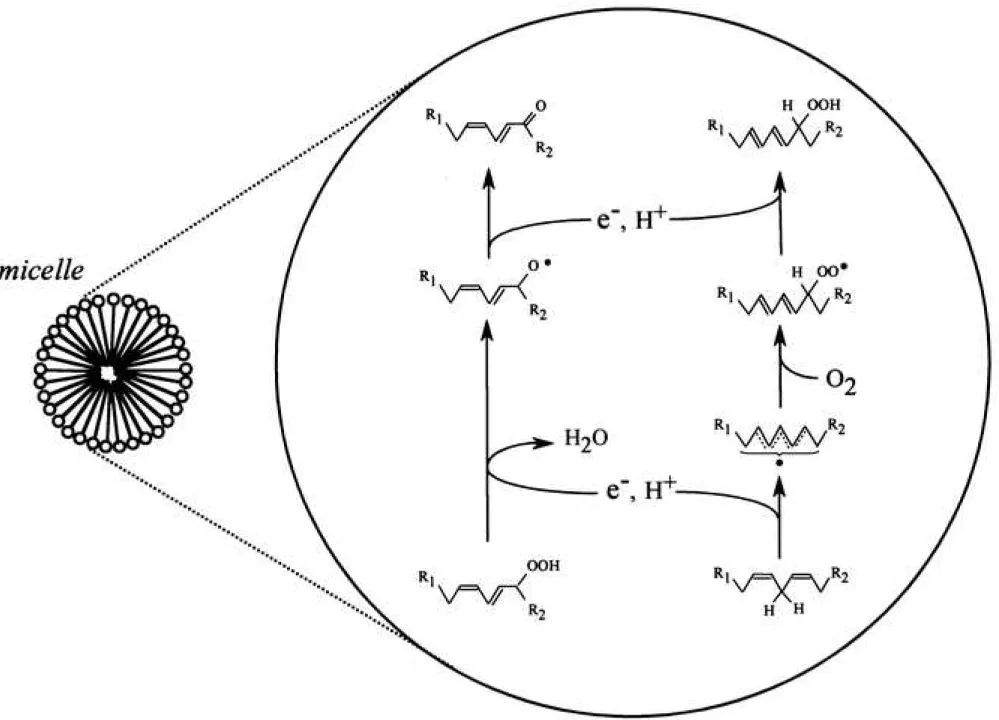
2Micelle
R
1 HO R
2Graphical Abstract Click here to access/download;Graphical Abstract;Graphical abstract.pptx
1
Chemical and Pharmaceutical Bulletin Regular Articles
Catalytic production of oxo-fatty acids by lipoxygenases is mediated by the radical-radical dismutation between fatty acid alkoxyl radicals and fatty acid peroxyl radicals in fatty acid
assembly
Yuta Takigawa, Ichiro Koshiishi*
Graduate School of Health Sciences, Gunma University, 3-39-22 Showa-machi, Maebashi, Gunma 371-8511, Japan
*Corresponding author. Tel. & Fax.: +81-27-220-8916 E-mail address: [email protected] (I. Koshiishi)
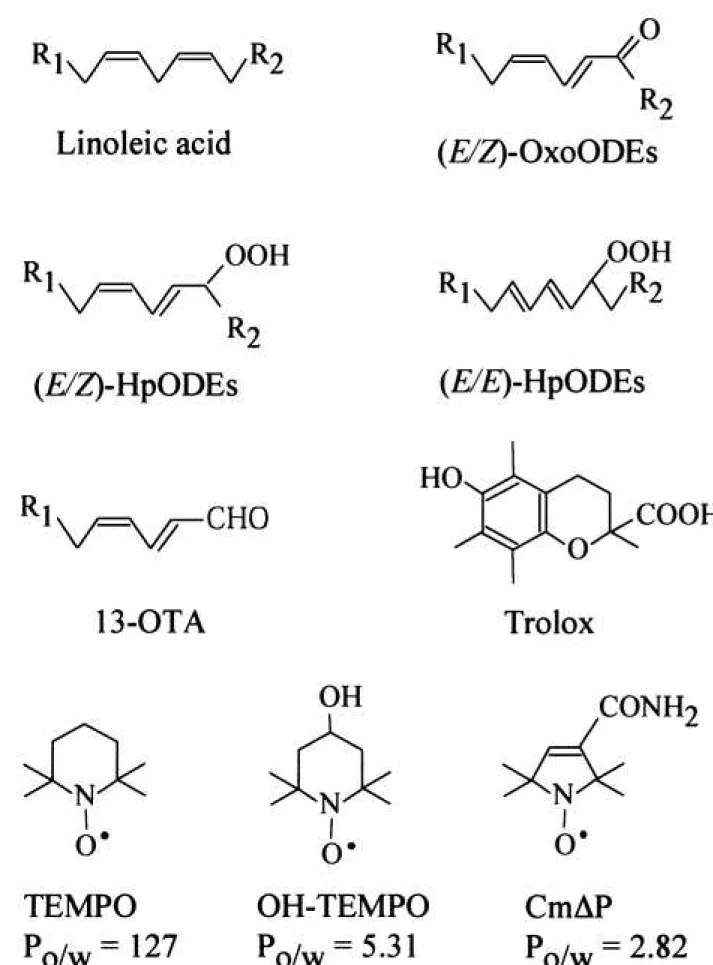
Abbreviations: CmP, 3-carbamoyl-2,2,5,5-tetramethyl-3-pyrroline-N-oxyl; DMSO, dimethyl sulfoxide; 13-OTA, 13-oxo-tridecadienoic acid; HpODEs, hydroperoxyoctadecadienoic acids;
LOx, lipoxygenase; OH-TEMPO, 4-hydroxy-2,2,6,6-tetramethylpiperidine 1-oxyl; OxoODEs, oxo-octadecadienoic acids; Po/w, octanol water partition coefficient; PPAR, Peroxisome Proliferator-Activated Receptor; TEMPO, 2,2,6,6-tetramethylpiperidine 1-oxyl; Trolox, 6- hydroxy-2,5,7,8-tetramethylchroman-2-carboxylic acid.
Manuscript Click here to
access/download;Manuscript;OxoODEs_generation__CPB_Re
2
Summary
Oxo-octadecadienoic acids (OxoODEs) act as peroxisome proliferator-activated receptor (PPAR) agonists biologically, and are known to be produced in the lipoxygenase/ linoleate system. OxoODEs seem to originate from the linoleate alkoxyl radicals that are generated from (E/Z)-hydroperoxy octadecadienoic acids ((E/Z)-HpODEs) by a pseudoperoxidase reaction that is catalyzed by ferrous lipoxygenase. However, the mechanism underlying the conversion of alkoxyl radical into OxoODE remains obscure. In the present study, we confirmed that OxoODEs are produced in the lipoxygenase/ linoleate system in an oxygen-dependent manner.
Interestingly, we revealed a correlation between the (E/Z)-OxoODEs content and the (E/E)- HpODEs content in the system. (E/E)-HpODEs could have been derived from (E/E)-linoleate peroxyl radicals, which are generated by the reaction between a free linoleate allyl radical and an oxygen molecule. Notably, the ferrous lipoxygenase-linoleate allyl radical (LOx(Fe2+)-L•) complex, which is an intermediate in the lipoxygenase/ linoleate system, tends to dissociate into LOx(Fe2+) and a linoleate allyl radical. Subsequently, LOx(Fe2+) converts (E/Z)-HpODEs to an (E/Z)-linoleate alkoxyl radical through one-electron reduction. Taken together, we propose that (E/Z)-OxoODEs and (E/E)-HpODEs are produced through radical-radical dismutation between (E/Z)-linoleate alkoxyl radical and (E/E)-linoleate peroxyl radical. Furthermore, the production of (E/Z)-OxoODEs and (E/E)-HpODEs was remarkably inhibited by a hydrophobic radical scavenger, 2,2,6,6-tetramethylpiperidine 1-oxyl (TEMPO). On the contrary, water- miscible radical scavengers, 4-hydroxyl-2,2,6,6-tetramethylpiperidine 1-oxyl (OH-TEMPO) and 3-carbamoyl-2,2,5,5-tetramethyl-3-pyrroline-N-oxyl (CmP) only modestly or sparingly inhibited the production of (E/Z)-OxoODEs and (E/E)-HpODEs. These facts indicate that the radical-radical dismutation between linoleate alkoxyl radical and linoleate peroxyl radical proceeds in the interior of micelles. 237 Words
3
Keywords; oxo-octadecadienoic acids, 13-oxo-tridecadienoic acid, fatty acid alkoxyl radical,
-scission, radical-radical dismutation.
4
Introduction
Lipoxygenases that possess non-heme iron are known to occur widely in organisms from plants to mammals. In general, ferric lipoxygenases insert molecular oxygen into polyunsaturated fatty acids to produce fatty acid hydroperoxides by a dioxygenase reaction.
The region-specificity and stereo-specificity of the resultant fatty acid hydroperoxides are precisely controlled. On the contrary, ferrous lipoxygenases catalyze the production of oxo- fatty acids from fatty acid hydroperoxides as substrates.1-3) The Oxo-fatty acids are widely accepted to be bioactive substances, such as PPAR agonists.4-7) In this pseudoperoxidase reaction, ferrous lipoxygenase donates one electron to fatty acid hydroperoxide, producing fatty acid alkoxyl radical through cleavage of the O-O bond.8-12) Even though the fate of the fatty acid alkoxyl radical remains obscure, it seems reasonable to assume that the fatty acid alkoxyl radical is converted to oxo-fatty acid by one-electron oxidation. In the lipoxygenase/
polyunsaturated fatty acid system, one-electron oxidation of fatty acid alkoxyl radical is thought to be coupled with one-electron reduction of a free radical by radical-radical dismutation (R(- H)-O• + R’• → R=O + R’-H). At the initial stage of fatty acid dioxygenation by lipoxygenase, an allylic hydrogen should be abstracted from the polyunsaturated fatty acid accompanied by reduction of ferric lipoxygenase to a ferrous form. At this step, it has been speculated that lipoxygenase could occur in the form of fatty acid allyl radical-ferrous lipoxygenase (LOx(Fe2+)-L•) complex at a lower oxygen content.13-17) In 1998, Berry et al.8) proposed a branched kinetic scheme for soybean lipoxygenase-1 reaction, in which the LOx(Fe2+)-L•
complex dissociated into LOx(Fe2+) and fatty acid allyl radical at a lower oxygen content.
LOx(Fe2+) was restored to LOx(Fe3+) through pseudoperoxidation of fatty acid hydroperoxide to fatty acid alkoxyl radical. Concomitantly, the liberated fatty acid allyl radicals reacted with an oxygen molecule producing fatty acid peroxyl radicals, the conjugated diene moiety of which was a trans/ trans form (E/E form). Therefore, the possible free radical as an electron recipient
5
seemed to be a fatty acid allyl radical (E/E form), a fatty acid alkoxyl radical (E/Z form), or a fatty acid peroxyl radical (E/E form).
It is generally known that the production of oxo-fatty acids is accompanied by the production of reactive aldehyde species. In 1971, Garssen et al.18) reported that in the anaerobic soybean lipoxygenase/ linoleate system, a main reaction product, 13-HpODE, was subjected to structural rearrangements leading to the formation of reactive aldehyde species, 13-oxo- tridecadienoic acid (13-OTA). Thereafter, it was revealed that the reactive aldehyde species, including 13-OTA are commonly produced by -scission of fatty acid alkoxyl radicals.19) In 1995, Salch et al.20) reported that a certain type of soybean lipoxygenase converts 13-HpODE to 13-OTA under anaerobic conditions. They proposed a reaction mechanism leading to the cleavage product, 13-OTA, as catalyzed by ferrous ions at the active site of lipoxygenase. The ferrous lipoxygenase reduced 13-HpODE to linoleate alkoxyl radical, where the C(13)-C(14) bond was spontaneously cleaved by -scission. Nuñet et al.17) reported that a certain type of lipoxygenase from Chlorella pyrenoidosa could convert 13-HpODE to 13-OTA (yield, ~50%) and 13-OxoODE (yield, ~40%). However, it remains elusive how the production of 13- OxoODE and 13-OTA is regulated in the lipoxygenase/ linoleate system.
In the present study, we focused on elucidating the mechanism, especially regarding the type of free radical functions (as electron recipients) that can facilitate the conversion of a fatty acid alkoxyl radical to an oxo-fatty acid, and if the fate of fatty acid alkoxyl radicals is decided by one-electron oxidation or-scission.
Experimental
Materials Soybean 15-lipoxygenase (Type I-b; activity, 70800 units/mg; molecular size, 108 kDa) and linoleic acid were purchased from Sigma Co. (Missouri, USA). 2,2,6,6-
Tetramethylpiperidine 1-Oxyl (TEMPO), 3-Carbamoyl-2,2,5,5-tetramethyl-3-pyrrolin-N-oxyl
6
(CmP), and 4-hydroxy-2,2,6,6-tetramethylpiperidine 1-oxyl (OH-TEMPO) were purchased from Aldrich Chemical Co., Inc. (Wisconsin, USA). 13-Hydroperoxy-(9Z,11E)-
octadecadienoic acid (13-(E/Z)-HpODE), 13-hydroperoxy-(9E,11E)-octadecadienoic acid (13- (E/E)-HpODE), 9-hydroperoxy-(10E,12Z)-octadecadienoic acid (9-(E/Z)-HpODE), 9-
hydroperoxy-(10E,12E)-octadecadienoic acid (9-(E/E)-HpODE), 13-oxo-(9Z,11E)- octadecadienoic acid (13-(E/Z)-OxoODE), and 9-oxo-(10E,12Z)-octadecadienoic acid (9- (E/Z)-OxoODE) were purchased from Larodan (Stockholm, Sweden). TSKgel ODS-80Ts QA and TSKguardgel ODS-80Ts were purchased from Tosoh Co. (Tokyo, Japan). All other chemicals were of reagent grade.
HPLC analyses of HpODEs, OxoODEs, and 13-OTA 13-(E/Z)-HpODE, 9-(E/Z)- HpODE, 13-(E/E)-HpODE, 9-(E/E)-HpODE, 13-(E/Z)-OxoODE, 9-(E/Z)-OxoODE, and 13- OTA were analyzed using reversed phase HPLC with dual wavelength UV detection or photodiode array detection. The HPLC assembly comprised a HPLC pump (515; Waters, USA), a sample injector (Rheodyne, 7725), temperature control module (Waters, USA), column heater module (Waters, USA), a dual absorbance detector (2487; Waters, USA), a data station (; SIC, Japan), and a photodiode array detector (DAD; Hewlett Packard, USA).
The chromatographic conditions for the analyses of these substances were as follows:
Column, TSKgel ODS-80Ts QA (2.0 mm i.d. x 150 mm); eluent, 0.05% formic acid
containing 50% acetonitrile; flow rate, 0.3 ml/min; column temperature, 35°C; detection, at 234 nm (for 13-(E/Z)-HpODE, 9-(E/Z)-HpODE, 13-(E/E)-HpODE, and 9-(E/E)-HpODE)) and at 280 nm (13-(E/Z)-OxoODE, 9-(E/Z)-OxoODE, and 13-OTA). In the present study, the relative abundances of these analytes in the reaction solutions were presented in the peak area because the commercially available standard substances used were qualitative grade but not quantitative grade.
7
Effects of radical scavengers, Trolox, and nitroxyl radicals on the production of HpODEs, OxoODEs, and 13-OTA Twenty microliters of 2 mM linoleic acid emulsion in 0.1 M phosphate buffer (pH 7.4) containing 2% ethanol was mixed with 10 L of 0.8 M soybean 15-lipoxygenase in 0.1 M phosphate buffer (pH 7.4) and 10 L of Trolox or nitroxyl radicals in 0.1 M phosphate buffer (pH 7.4) in a polypropylene microtube (inner volume, 0.6 mL), and then the solution was incubated at room temperature (25-28°C) for the times indicated in the figure legends. The reaction solution was subjected to HPLC analysis.
Estimation of the octanol water partition coefficients of TEMPO, OH-TEMPO, and CmP Two milliliters of aqueous solution containing 1 mM TEMPO, 1 mM OH-TEMPO, or 1 mM CmP were mixed with 2.0 mL of octanol in a centrifuge glass tube with cap, and the tubes were shaken vigorously for 10 min at room temperature. After centrifugation at 1000 ×g for 10 min, each phase was subjected to HPLC analysis. TEMPO, OH-TEMPO, and CmP in the octanol phase or water phase, were quantified by HPLC analysis. The
chromatographic conditions for the analyses of these substances were as follows: Column, TSKgel ODS-80Ts QA (4.6 mm i.d. x 150 mm); eluent, 0.05% formic acid containing 50%
acetonitrile; flow rate, 1.0 ml/min; column temperature, 35°C; detection, at 450 nm. The octanol water partition coefficient of each nitroxyl radical was estimated using the quantification data.
Statistical analysis Data are expressed as the mean ± SD. The statistical analyses were performed using Dunnett’s test for multiple comparison.
Results and Discussion
Production of HpODEs, OxoODEs, and 13-OTA in the soybean lipoxygenase/ linoleate system When 1 mM linoleic acid was incubated with a comparatively lower concentration of soybean 15-lipoxygenase (0.05 M) in phosphate buffer solution (pH 7.4) for 10 min at room
8
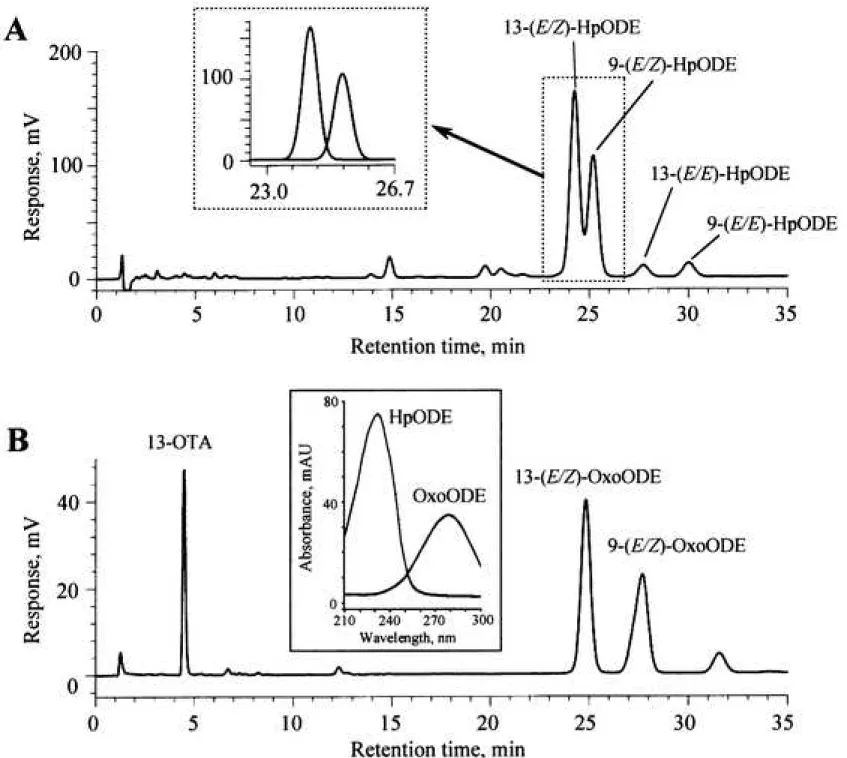
temperature, the major 13-(E/Z)-HpODE and the minor 9-(E/Z)-HpODE was produced (data not shown). On the contrary, when 1 mM linoleic acid was similarly incubated with a comparatively higher concentration of lipoxygenase (0.2-2.0 M), 13-(E/Z)-HpODE and 9- (E/Z)-HpODE as well as 13-(E/Z)-OxoODE, 9-(E/Z)-OxoODE, 13-(E/E)-HpODE, 9-(E/E)- HpODE, and 13-OTA were found to be produced (Fig. 2A and 2B).
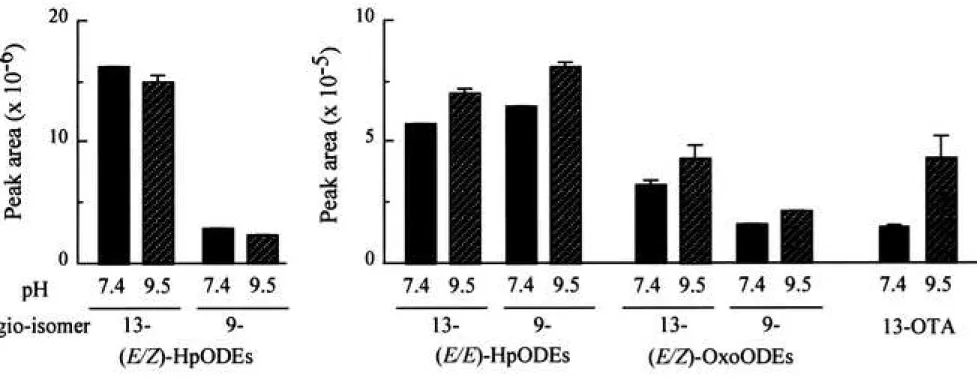
Salch et al.20) reported that when soybean lipoxygenases were subjected to chromatographic separation, at least two fractions were obtained, and the optimum pH for type 1 and type 2 activity was determined to be 9.8 and 6.5, respectively. It should be noted that the authors determined the activity of these lipoxygenases for 13-OTA production at pH 7.5 and speculated a mechanism for 13-OTA production. So, we estimated the reactivity of a commercially available soybean 15-lipoxygenase toward linoleic acid in the buffer solutions at pH 7.4 and 9.5. Figure 3 shows the production of (E/E)-HpODEs, (E/Z)-OxoODEs, and 13-OTA in the soybean lipoxygenase/ linoleate system at pH 7.4 and pH 9.5. Even though the concentration of (E/Z)-HpODEs in the neutral solution was slightly higher than that in the alkaline solution, the concentrations of (E/E)-HpODEs, (E/Z)-OxoODEs, and 13-OTA in the alkaline solution were significantly higher than those in the neutral solution. In the present study, even though the pH of the soybean lipoxygenase/ linoleate system was not optimized for the side reactions, we examined the production of (E/E)-HpODEs, (E/Z)-OxoODEs, and 13-OTA in a neutral buffer solution.
As shown in Fig. 4A-2, the concentrations of (E/Z)-OxoODEs and 13-OTA were remarkably increased with a higher content of lipoxygenases. On the contrary, at a higher concentration of lipoxygenase, the concentration of HpODEs tend to decrease due to consumption for the production of (E/Z)-OxoODEs and 13-OTA (Fig. 4A-1). In addition, the time course for concentration of the reaction products in the lipoxygenase/ linoleate system at pH 7.4 are shown in Fig. 4B. The production of (E/Z)-OxoODEs started just after the onset of
9
the reaction whereas the production of 13-OTA was initiated after the concentration of (E/Z)- HpODEs reached a maximum. Hence, the cleavage of the C(13)-C(14) bond of linoleate alkoxyl radical through -scission should proceed just after the depletion of oxygen content in the aqueous phase, consistent with the literature.18,20)
Radical-radical dismutation between linoleate peroxyl radicals and linoleate alkoxyl radicals In the dioxygenation of linoleic acid by lipoxygenases, the conjugated diene moiety of the resultant HpODEs was strictly held in the trans/cis (E/Z) form. On the contrary, (E/E)- HpODEs, which possesses the thermodynamically stable conjugated diene moiety (trans/trans), are generated via a non-enzymatic radical reaction in linoleic acid assembly. In the lipoxygenase/ linoleate system, non-regiospecific (E/E)-HpODEs were generated (Fig. 3), indicating that linoleate allyl radicals were liberated by the dissociation of the LOx(Fe2+)-L•
complex, which is an intermediate in the lipoxygenase/ linoleate system. In the present study, we fixed the linoleic acid content at 1.0 mM, which is higher than the critical micelle concentration of linoleic acid (approximately 600 M), so that the liberated linoleate allyl radical could accumulate in micelles that contain oxygen molecules at high levels via hydrophobic interactions, as compared to that in the aqueous phase. Therefore, the linoleate allyl radicals react with oxygen molecule producing (E/E)-linoleate peroxyl radicals, which stay in the micelles. The production of (E/E)-linoleate peroxyl radicals should continue until the dissolved oxygen in micelles is depleted.
In the lipoxygenase/ linoleate system, LOx(Fe2+) is liberated through the dissociation of the LOx(Fe2+)-L• complex. Lowering the oxygen content in the aqueous phase through consumption of the oxygen molecule by dioxygenation of linoleic acid results in the superiority of the dissociation of the complex.8) The resultant LOx(Fe2+) converts the (E/Z)-HpODEs to linoleate alkoxyl radicals, which also stay in the micelles. Thus, the linoleate alkoxyl radicals seem to coexist with (E/E)-linoleate peroxyl radicals in the linoleic acid assembly, and have an
10
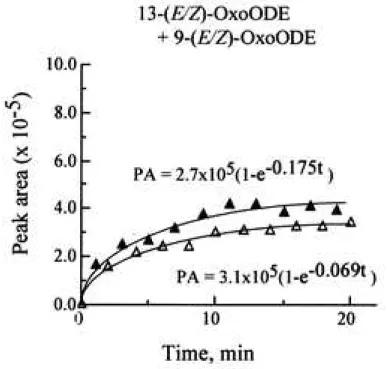
opportunity to be in contact with each other. The time course of (E/E)-HpODEs content and that of (E/Z)-OxoODEs content in the reaction solution of 0.2 M lipoxygenase with 1.0 mM linoleic acid in phosphate buffer solution (pH 7.4) is shown in Fig. 5A and 5B, respectively.
The data from two replicate experiments were plotted. As shown in these figures, we estimated an apparent formation rate constant of (E/E)-HpODEs (k1) and that of (E/Z)-OxoODEs (k2) using curve-fitting. As a result, k1 and k2 were calculated to be 0.11 min-1 and 0.12 min-1 (average of two individual experiments), respectively. Figure 5C shows a correlation between the concentrations of (E/Z)-OxoODEs and that of (E/E)-HpODEs (r = 0.961 and 0.982, respectively). Based on these facts, it is conceivable that the radical-radical dismutation between linoleate alkoxyl radical and linoleate peroxyl radical in micelles results in the production of (E/Z)-OxoODEs and (E/E)-HpODEs, respectively (Fig. 6).
Effects of radical scavengers, Trolox, and nitroxyl radicals on the production of HpODEs, OxoODEs, and 13-OTA Furthermore, to confirm that (E/E)-HpODEs and (E/Z)-OxoODEs are generated through radical reactions, and that the radical-radical dismutation between linoleate alkoxyl radical and linoleate peroxyl radical proceeds in micelles, we examined what types of radical scavengers can prevent the production of (E/E)-HpODEs and (E/Z)-OxoODEs.
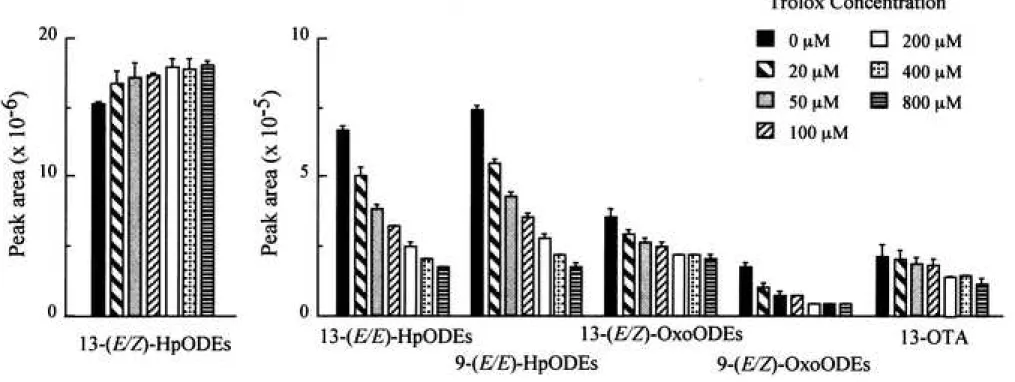
Initially, we tested Trolox, an analog of -tocopherol, which scavenges oxygen-centered radicals, including peroxyl radicals and alkoxyl radicals.22) Figure 7 shows that Trolox dose- dependently prevented the production of (E/E)-HpODEs and (E/Z)-OxoODEs in the lipoxygenase/ linoleate system. This fact indicates that (E/E)-HpODEs and (E/Z)-OxoODEs are generated through radical reactions. Notably, Trolox also prevented the production of 13-OTA in the lipoxygenase/ linoleate system. Next, we tested the cyclic nitroxyl radicals (>N-O•), including TEMPO, OH-TEMPO, and CmP (Fig. 1). Goldstein and Samuni23) demonstrated that both TEMPO and OH-TEMPO can reduce peroxyl radicals forming the respective oxoammonium cations (>N+=O), and estimated the reaction rate constant of TEMPO and that
11
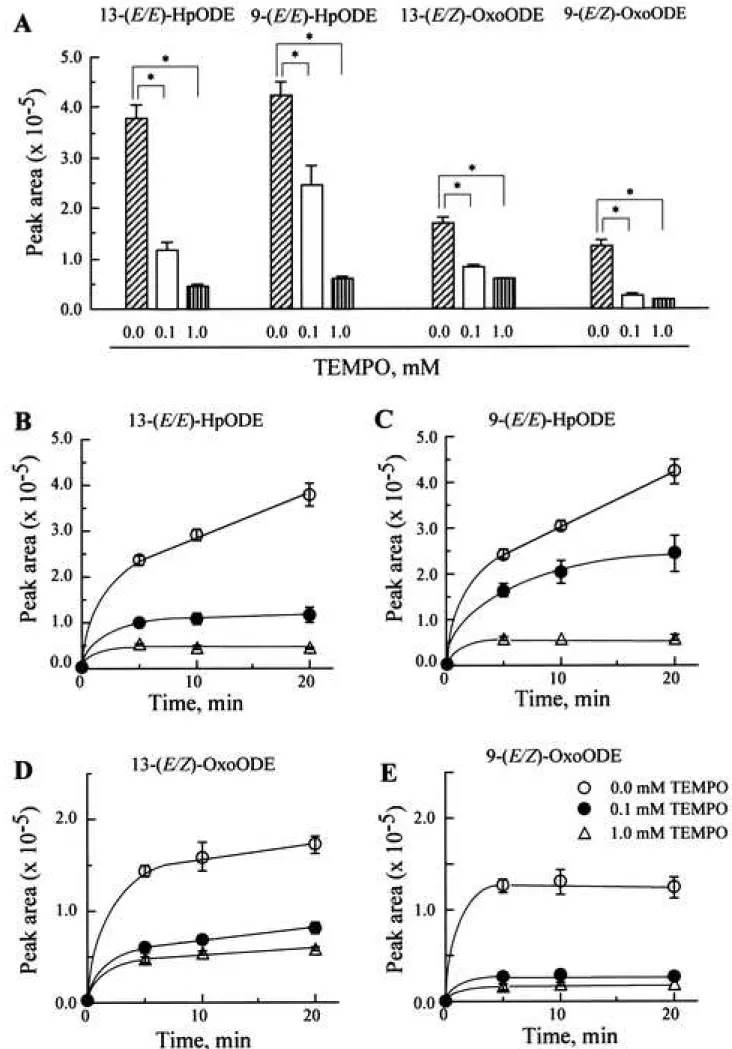
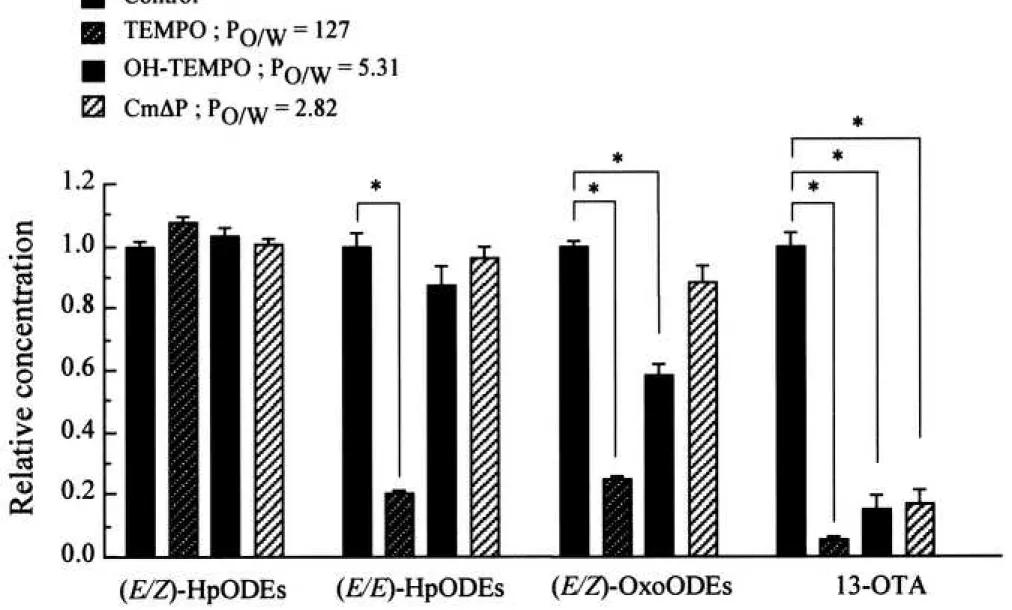
of OH-TEMPO toward peroxyl radical (CH2(OH)OO•) to be 1.0 x 10⁸ M-1 s-1 and 0.44 x 10⁸ M-1 s-1, respectively. In contrast, the octanol water partition coefficient (Po/w) of TEMPO, OH-TEMPO, and CmP was estimated to be 127, 5.31, and 2.82, respectively. It seems that the hydrophobic TEMPO should accumulate in the linoleate micelles in the lipoxygenase/ linoleate system via the hydrophobic interaction. On the contrary, Damiani et al.24) demonstrated that OH-TEMPO could not inhibit ultraviolet-induced lipid peroxidation in liposomal membrane because of its hydrophilicity. As shown in Fig. 8 and Fig. 9, TEMPO remarkably prevented both the production of (E/E)-HpODEs and (E/Z)-OxoODEs. In contrast, OH-TEMPO did not prevent the production of (E/E)-HpODEs at all, but slightly prevented the production of (E/Z)- OxoODEs. CmP did not prevent the production of either (E/E)-HpODEs or (E/Z)-OxoODEs.
However, hydrophobic TEMPO, water-miscible OH-TEMPO, and CmP remarkably prevented the production of 13-OTA. Thus, the nitroxyl radicals tested here appeared to scavenge the fatty acid oxygen-centered radicals, including alkoxyl radicals in the aqueous phase. Taken together, it is likely that the radical-radical dismutation between linoleate alkoxyl radical and linoleate peroxyl radical proceeds in the interior of micelles whereas -scission of linoleate alkoxyl radical proceeds in the exterior of micelles.
Conclusions
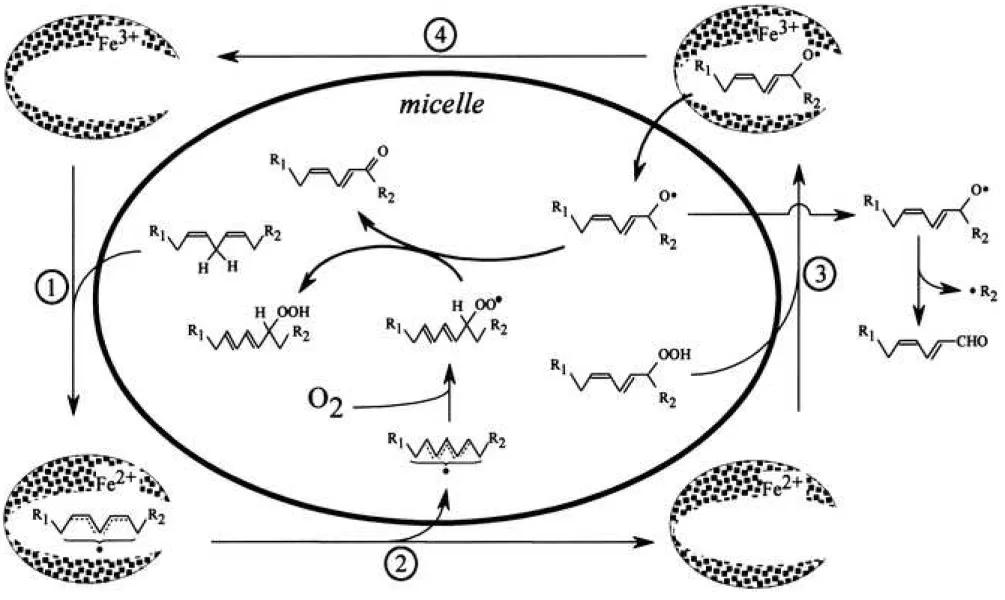
Possible pathways involved in the production of (E/E)-HpODEs, (E/Z)-OxoODEs, and 13- OTA in the soybean lipoxygenase/ linoleate system are shown in Fig. 10. In soybean lipoxygenase reactions with linoleic acid, it is speculated that both (E/E)-linoleate peroxyl radicals and (E/Z)-linoleate alkoxyl radicals accumulate in the linoleate micelles. In these tiny particles, (E/Z)-linoleate alkoxyl radicals are easily in contact with (E/E)-linoleate peroxyl radicals and donate one electron to the peroxyl radicals through radical-radical dismutation.
12
Through electron-transfer, (E/E)-HpODEs and (E/Z)-OxoODEs are produced simultaneously so that there is a correlation between the (E/E)-HpODEs content and (E/Z)-OxoODEs content in the reaction solution. At a lower oxygen content in the aqueous phase, dissociation of the LOx(Fe2+)-L• complex is superior to the conjunction with oxygen molecules, thus a significant amount of linoleate allyl radicals is liberated and accumulated in micelles as (E/E)-linoleate peroxyl radicals because a large amount of oxygen molecules should be retained in micelles through hydrophobic interaction. Concomitantly, a significant amount of linoleate alkoxyl radicals are liberated and parts of them diffuse from linoleate micelles to the aqueous phase.
Linoleate alkoxyl radicals in the aqueous phase spontaneously decompose into 13-OTA and pentyl radical through -scission. Consequently, the fate of fatty acid alkoxyl radicals is decided by their behaviors, namely they stay in the fatty acid micelles or diffuse into the aqueous phase.
Acknowledgements This work was financially supported by JSPS KAKENHI, Grant Number JP18K11015. We would like to thank Editage (www.editage.com) for English language editing.
Conflict of Interest The authors declare no conflict of interest.
13
References
1) Kühn H., Belkner J., Wiesner R., Alder L., Arch. Biochem. Biophys. 279, 218-224 (1990).
2) Kühn H., Wiesner R., Rathmann J., Schewe T., Eicosanoids 4, 9-14 (1991).
3) Yu Z., Schneider C., Boeglin W. E., Marnett L. J., Brash A. R., Proc. Natl. Acad. Sci. USA 100, 9162-9167 (2003).
4) Altmann R., Hausmann M., Spöttl T., Gruber M., Bull A. W., Menzel K., Vogl D., Herfarth H., Schölmerich J., Falk W., Rogler G., Biochem. Pharmacol. 74, 612-622 (2007).
5) Kim Y. I., Hirai S., Takahashi H., Goto T., Ohyane C., Tsugane T., Konishi C., Fujii, T. Inai S., Iijima Y., Aoki K., Shibata D., Takahashi N., Kawada T., Mol. Nutr. Food Res. 55, 585- 593 (2011).
6) Shiraki T., Kamiya N., Shiki S., Kodama T. S., Kakizuka A., Jingami H., J. Biol. Chem. 280, 14145-14153 (2005).
7) Takahashi H., Hara H., Goto T., Kamakari K., Wataru N., Mohri S., Takahashi N., Suzuki H., Shibata D., Kawada T., Lipids 50, 3-12 (2015).
8) Berry H., Débat H., Garde V. L., J. Biol. Chem. 273, 2769-2776 (1998).
9) Knapp M. J., Klinman J. P., Biochemistry 42, 11466-11475 (2003).
10) Kühn H., Borchert A., Free Radic. Biol. Med. 33, 154-172 (2002).
11) Takajo T., Tsuchida K., Ueno K., Koshiishi I., J. Lipid Res. 48, 1371-1377 (2007).
12) Verhagen J., Veldink G. A., Egmond M. R., Vliegenthart J. F., Boldingh J., van der Star J., Biochim. Biophys. Acta 529, 369-379 (1978).
13) Nelson M. J., Seitz S. P., Cowling R. A., Biochemistry 29, 6897-6903 (1990).
14) Nelson M. J., Cowling R. A., Seitz S. P., Biochemistry 33, 4966-4973 (1994).
15) Nelson M. J., Chase D. B., Seitz S. P., Biochemistry 34, 6159-6163 (1995).
16) Koshiishi I., Tsuchida K., Takajo T., Komatsu M., J. Lipid Res. 46, 2506-2513 (2005).
14
17) Koshiishi I., Tsuchida K., Takajo T., Komatsu M., Biochem. J. 395, 303-309 (2006).
18) Garssen G. J., Vliegenthart J. F. G., Boldingh J., Biochem. J. 122, 327-332 (1971).
19) Gardner H. W., Free Radic. Biol. Med. 7, 65-86 (1989).
20) Salch Y. P., Grove M. J., Takamura H., Gardner H. W., Plant Physiol. 108, 1211-1218 (1995).
21) Nuñez A., Foglia T. A., Piazza G. J., Biochem. Soc. Trans. 28, 950-953 (2000).
22) Castro I. A., Rogero M. M., Junqueira R. M., Carrapeiro M. M., Int. J. Food Sci. Nutr. 57, 75-82 (2006).
23) Goldstein S., Samuni A., J. Phys. Chem. A 111, 1066-1072 (2007).
24) Damiani E., Castagna R., Greci L., Free Radic. Biol. Med. 33, 128-136 (2002).
15
Figure Legends
Figure 1 Chemical structures of linoleic acid, oxo-octadecadienoic acids (OxoODEs), hydroperoxy octadecadienoic acids (HpODEs), 13-oxo-tridecadienoic acid (13-OTA), 6- hydroxy-2,5,7,8-tetramethylchroman-2-carboxylic acid (Trolox), 2,2,6,6-tetramethylpiperidine 1-oxyl (TEMPO), 4-hydroxy-2,2,6,6-tetramethylpiperidine 1-oxyl (OH-TEMPO), and 3- carbamoyl-2,2,5,5-tetramethyl-3-pyrroline-N-oxyl (CmP)
Figure 2 Chromatographic analyses of HpODEs, OxoODEs, and 13-OTA
A and B, 20 L of 2 mM linoleic acid emulsion in 0.1 M phosphate buffer (pH 7.4) containing 2% ethanol was mixed with 10 L of 0.1 M phosphate buffer (pH 7.4) and 10 L of 4 M soybean lipoxygenase-1 in 0.1 M phosphate buffer (pH 7.4) in a polypropylene microtube (inner volume, 0.6 mL). The solution was then incubated at room temperature (25-28°C) for 10 min. HpODEs, OxoODEs, and 13-OTA were detected using a dual absorbance detector (A, 234 nm; B, 280 nm). Inset of A, the overlapped two peaks were resolved to individual peaks using the data station, 7. UV spectra of OxoODE and HpODE are shown in inset of B. It should be noted that it is possible to simultaneously detect HpODE and OxoODE via dual wavelength detection at 234 nm and 280 nm, respectively.
Figure 3 Production of HpODEs, OxoODEs, and 13-OTA in the linoleic acid/ lipoxygenase system
Twenty microliters of 2 mM linoleic acid emulsion in 0.1 M phosphate buffer (pH 7.4 or pH 9.5) containing 2% ethanol was mixed with 20 L of 0.4 M soybean lipoxygenase-1 in 0.1 M phosphate buffer (pH 7.4 or pH 9.5) in a polypropylene microtube (inner volume, 0.6 mL), and the solution was then incubated at room temperature (25-28°C) for 10 min. The reaction
16
solutions were subjected to HPLC. Each column and bar represents the mean ± SD of three experiments, respectively.
Figure 4 Effects of lipoxygenase contents on the production of HpODEs, OxoODEs, and 13-OTA in the linoleic acid/ lipoxygenase system (A), and the time course of HpODEs, OxoODEs, and 13-OTA contents in the linoleic acid/ lipoxygenase system (B)
A, Lipoxygenase content was varied from 0.1 M to 2.0 M. Twenty microliters of 2 mM linoleic acid emulsion in 0.1 M phosphate buffer (pH 7.4) containing 2% ethanol was mixed with 20 L of soybean lipoxygenase-1 (0.2, 0.4, 1.0, 2.0, or 4.0 M) in 0.1 M phosphate buffer (pH 7.4) in a polypropylene microtube (inner volume, 0.6 mL), and the solution was then incubated at room temperature (25-28°C) for 30 min. B, Twenty microliters of 2 mM linoleic acid emulsion in 0.1 M phosphate buffer (pH 7.4) containing 2% ethanol was mixed with 20
L of 2.0 M soybean lipoxygenase-1 in 0.1 M phosphate buffer (pH 7.4) in a polypropylene microtube (inner volume, 0.6 mL), and the solution was then incubated at room temperature (25-28°C) for the time intervals indicated in the figure. The results represent the mean ± SD of triplicate experiments.
Figure 5 Correlation between (E/Z)-OxoODEs content and (E/E)-HpODEs content in the linoleic acid/ lipoxygenase system
Twenty microliters of 2 mM linoleic acid emulsion in 0.1 M phosphate buffer (pH 7.4) containing 2% ethanol was mixed with 20 L of 0.4 M soybean lipoxygenase-1 in 0.1 M phosphate buffer (pH 7.4) in a polypropylene microtube (inner volume, 0.6 mL), and the solution was then incubated at room temperature (25-28°C) from 1 min up to 20 min. The data from two individual experiments (○ and ●) were plotted. A, Time course of (E/E)-HpODEs
17
concentration. B, Time course of (E/Z)-OxoODEs concentration. C, Correlation between the concentrations of (E/Z)-OxoODEs and (E/E)-HpODEs.
Figure 6 Possible mechanism for radical-radical dismutation between linoleate peroxyl radical and linoleate alkoxyl radical in linoleate micelles
Figure 7 Effect of Trolox on the production of HpODEs, OxoODEs, and 13-OTA in the linoleic acid/ lipoxygenase system
Twenty microliters of 2 mM linoleic acid emulsion in 0.1 M phosphate buffer (pH 7.4) containing 2% ethanol was mixed with 10 L of 0.8 M soybean lipoxygenase-1 in 0.1 M phosphate buffer (pH 7.4) and 10 L of Trolox solution (from 0.08 mM to 3.2 mM) in a polypropylene microtube (inner volume, 0.6 mL), and then the solution was incubated at room temperature (25-28°C) for 10 min. The data represent the mean ± SD of three experiments, respectively.
Figure 8 Effect of TEMPO on the production of (E/E)-HpODEs and (E/Z)-OxoODEs in the linoleic acid/ lipoxygenase system (A), and time course of (E/E)-HpODEs content and (E/Z)- OxoODEs content in the linoleic acid/ lipoxygenase system containing TEMPO (B-E)
A, 20 L of 2 mM linoleic acid emulsion in 0.1 M phosphate buffer (pH 7.4) containing 2% ethanol was mixed with 10 L of 0.8 M soybean lipoxygenase-1 in 0.1 M phosphate buffer (pH 7.4) and 10 L of TEMPO (0.4 mM or 4.0 mM) in a polypropylene microtube (inner volume, 0.6 mL), and the solution was then incubated at room temperature (25-28°C) for 10 min. The data represent the mean ± SD of three experiments. The asterisks indicate significant differences as compared to the control experiment (*P < 0.01). B-E, 20 L of 2 mM linoleic acid emulsion in 0.1 M phosphate buffer (pH 7.4) containing 2% ethanol was mixed with 10
18
L of TEMPO (0.4 mM or 4.0 mM) in 0.1 M phosphate buffer (pH 7.4) and 10 L of 0.8 M soybean lipoxygenase-1 in 0.1 M phosphate buffer (pH 7.4) in a polypropylene microtube (inner volume, 0.6 mL), and the solution was then incubated at room temperature (25-28°C).
The results represent the mean ± SD of triplicate experiments.
Figure 9 Effect of nitroxyl radicals on the production of HpODEs, OxoODEs, and 13-OTA in the linoleic acid/ lipoxygenase system
Twenty microliters of 2 mM linoleic acid emulsion in 0.1 M phosphate buffer (pH 7.4) containing 2% ethanol was mixed with 10 L of 0.8 M soybean lipoxygenase-1 in 0.1 M phosphate buffer (pH 7.4) and 10 L of 0.1 M phosphate buffer (pH 7.4) containing 4.0 mM TEMPO, OH-TEMPO, or CmP in a polypropylene microtube (inner volume, 0.6 mL), and the solution was then incubated at room temperature (25-28°C) for 10 min. Each column and bar represents the mean ± SD of three experiments, respectively. The asterisks indicate significant differences as compared to the control experiment (*P < 0.01).
Figure 10 Possible reaction paths in the linoleic acid/ lipoxygenase system. Ferric lipoxygenase reacts with linoleic acid to form LOx(Fe2+)-L• complex
The LOx(Fe2+)-L• complex dissociates into LOx(Fe2+) and linoleate allyl radical. The liberated linoleate allyl radicals enter into micelles and react with oxygen molecules, producing (E/E)-linoleate peroxyl radicals. Concomitantly, LOx(Fe2+) converts (E/Z)-HpODEs to (E/Z)- linoleate alkoxyl radicals, and the liberated linoleate alkoxyl radicals enter into the micelles. In micelles, (E/Z)-linoleate alkoxyl radicals easily come in contact with (E/E)-linoleate peroxyl radicals, and donate one electron to the peroxyl radicals through radical-radical dismutation. A significant amount of linoleate alkoxyl radicals diffuses into the linoleate micelles and the
19
aqueous phase. The linoleate alkoxyl radicals in the aqueous phase spontaneously decompose into 13-OTA and pentyl radicals through -scission.
Figure 1 Click here to access/download;Figure/Table;Figure 1.TIF
Figure 2 Click here to access/download;Figure/Table;Figure 2-2 Corrected.TIF
Figure 3 Click here to access/download;Figure/Table;Figure 3.TIF
Figure 4 Click here to access/download;Figure/Table;Figure 4.TIF
Figure 5 Click here to access/download;Figure/Table;Figure 5 Corrected.TIF
Figure 6 Click here to access/download;Figure/Table;Figure 6.TIF
Figure 7 Click here to access/download;Figure/Table;Figure 7 Corrected.TIF
Figure 8 Click here to access/download;Figure/Table;Figure 8.TIF
Figure 9 Click here to access/download;Figure/Table;Figure 9.TIF
Figure 10 Click here to access/download;Figure/Table;Figure 10.TIF