PAPER
Special Section on Data Engineering and Information ManagementRevision Graph Extraction in Wikipedia Based on Supergram Decomposition and Sliding Update ∗
Jianmin WU†a),Nonmember andMizuho IWAIHARA†b),Member
SUMMARY As one of the popular social media that many people turn to in recent years, collaborative encyclopedia Wikipedia provides informa- tion in a more “Neutral Point of View” way than others. Towards this core principle, plenty of efforts have been put into collaborative contribution and editing. The trajectories of how such collaboration appears by revisions are valuable for group dynamics and social media research, which suggest that we should extract the underlying derivation relationships among revisions from chronologically-sorted revision history in a precise way. In this pa- per, we propose a revision graph extraction method based on supergram decomposition in the document collection of near-duplicates. The plain text of revisions would be measured by its frequency distribution of su- pergram, which is the variable-length token sequence that keeps the same through revisions. We show that this method can effectively perform the task than existing methods.
key words: Wikipedia, collaboration, revision history
1. Introduction
In recent years, social media becomes more and more at- tractive to many people since it involves means of interac- tions among people in which they create, share, exchange and comment contents among themselves in virtual commu- nities and networks [3]. As a collaborative project, online encyclopedia Wikipedia receives contribution from all over the world [13] and its content is well accepted by those who want reliable social news and knowledge.
Guiding by the fundamental principle of “Neutral Point of View”, Wikipedia articles need plenty of extra editorial efforts other than simply content expanding and fact updat- ing. Users can choose to edit on an existing revision and override the current one or revert to a previous revision.
However, there is no explicit mechanism in Wikipedia to trace such derivation relationship among revisions, while the trajectories how such collaboration appears in Wikipedia ar- ticles in terms of revisions are valuable for group dynamics and social media research [12]. Also, research exploiting re- vision history for term weighting [2] requires clean history without astray, which can be accomplished by such trajecto- ries.
Manuscript received July 11, 2013.
Manuscript revised October 30, 2013.
†The authors are with Waseda University, Kitakyushu-shi, 808–0135 Japan.
∗This work is based on an earlier work: Revision graph extrac- tion in Wikipedia based on supergram decomposition, In Proceed- ing of Joint International Symposium on Wikis and Open Collabo- ration, ACM, Hong Kong, 2013.
a) E-mail: [email protected] b) E-mail: [email protected]
DOI: 10.1587/transinf.E97.D.770
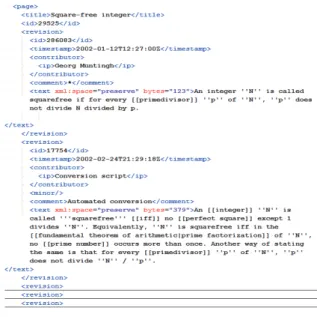
Wikipedia now keeps all the versions’ contents for each article and make the edit history publicly available. The meta-data of the edit history, such as timestamps, contrib- utors, and edit comments is also recorded. Figure 1 shows a snapshot of typical Wikipedia edit history, which con- sists of article revision content and meta-data. Most exist- ing research modeling Wikipedia’s revision history choose tree [7], [18] or graphs [12] to represent the relationship, but few of them concern about the accuracy of their models.
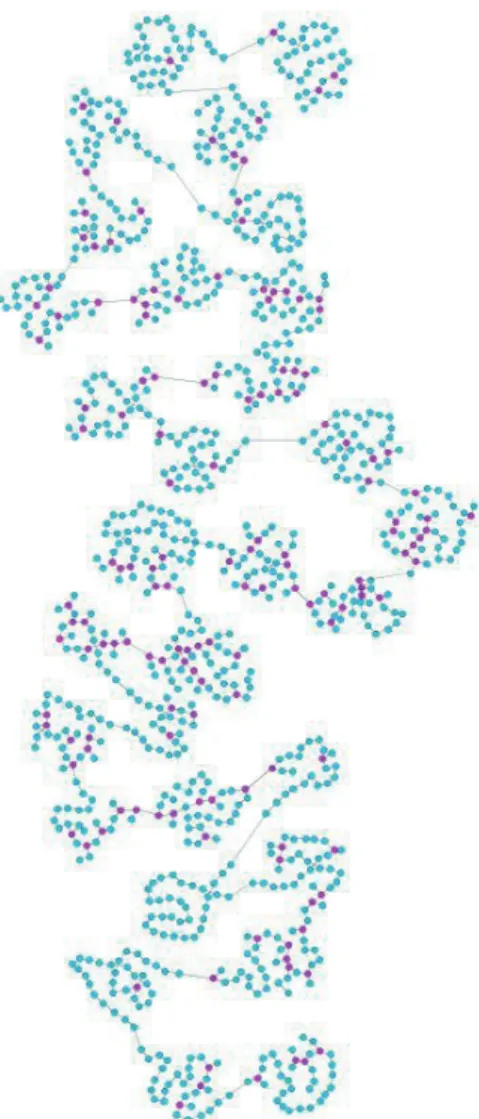
We propose a method to model such trajectories as re- vision graphs, where revisions and their derivation relation- ships are well presented [19], from chronologically-sorted revision history. We extract these directed acyclic graphs based on supergram decomposition. The revision graph can be outputted in the XML-based “GraphML” format [24] and visualized by existing graph editor software, as shown in Fig. 2. This paper is extending from [20] by incorporating sliding update to improve efficiency, also detailed perfor- mance studies are carried out.
For a given revisionr, at least one parent revisionrp
should be identified inr’s previous revisions, which involves comparison with those revisions. The best candidate should be decided by a certain similarity measure as well as the characteristics of Wikipedia editing. We consider the chal- lenge of revision graph extraction (RGE) is twofold. The first part is the strategy that should be adopted to perform
Fig. 1 Typical edit history of Wikipedia.
Copyright c2014 The Institute of Electronics, Information and Communication Engineers
Fig. 2 Revision graph for first 1000 revisions of Wikipedia article “Edith Wharton,” pink nodes indicate where branch happens.
comparisons over previous revisions. The second part is the existing differencing method and similarity metric for pair- wise comparison.
By such description, RGE is close to the classic near- est neighbor search (NNS) problem in text mining: given a collection of n points, build a data structure which, given any query point, reports the data point that is closest to the query [1]. However, RGE differs from NNS in prob- lem setting. First, the dissimilarity among a revision set is much lower than the text corpus that conventional NNS deals with [15]. The most popular algorithm for NNS, LSH- based algorithms [10], [11] would fail to distinguish among such near-duplicates texts. Moreover, the existence of the timestamps in the meta-data suggests that sequential rela- tionship among revisions should be exploited.
There is another issue we should notice. The overview of Wikipedia mining [14] shows that the text amount of diff between two adjacent revisions is not proportional to the length of the article, that is, users would not contribute more text because of a longer article. With the relatively stable
edit contribution amount, the longer an article grows, the less difference can be told by Jaccard distance, which sug- gests that we need absolute measure.
The remaining part of this paper is organized as fol- lows: In Sect. 2 we introduce existing work related to our research. In Sect. 3 we explain the motivation and basic process of supergram decomposition. We extend the model in Sect. 4 by exploiting dependencies among revisions and narrowing down comparison scope for scalability. Section 5 evaluates the result generated by our method and compare with other representative methods by performance and pre- cision evaluation. Finally we conclude our paper by sum- marizing findings and discussing several key issues.
2. Related Work
As mentioned before, a revision history modeling method should include two parts: comparison strategy and text dif- ferencing method with similarity metric. Most existing work focused on the second part. Fong et al. [9] proposed a detailed text differencing algorithm that finds all the dif- ferent parts, including the case of phrase movement and sentence re-writing, between two given revisions based on hierarchical decomposition and the longest common subse- quence (LCS) method, which is however way too computa- tionally expensive in terms of large scale revision compari- son.
In an investigation on structure and dynamics of Wikipedia’s breaking news collaborations [11], Keegan et al. construct article trajectories of editor interactions as they coauthor an article. Examining a subset of this cor- pus, their analysis demonstrates that articles about current events exhibit structures and dynamics distinct from those observed among articles about non-breaking events. How- ever, the similarity metric adopted in this research is over- simplified and the correctness of the trajectories they build is not assured.
In [8], Fl¨ock et al. reconsider the algorithm for detect- ing reverts, which is an important role of revision modeling.
This work refines the original definition of “revert” and pro- poses an algorithm based on the mixture model of paragraph alignment and comparison by LCS, slightly simplified than [9]. This model still cannot achieve a precise text differenc- ing result due to the LCS.
Cao et al. [5] proposed a version tree reconstruction method for Wikipedia articles based on keyword clustering.
This method uses tf-idf (term frequency and inverted docu- ment frequency) score to cluster similar revisions and then LCS would be used for more precise comparison, which is closer to string matching problem. The initial clustering suf- fers from a fixed number of signature values.
Wu et al. [19] proposed a revision graph extraction method for Wikipedia articles based onn-gram cover. An n-gram is a consecutive occurrence ofnletters or words in a text. This research uses word-leveln-gram distribution to denote revisions of the given articles with timestamps and find how a revision’sn-gram distribution can be formed by
specific previous revisions’. But this method still suffers from error rate due to the plain model ofn-gram diffscore.
3. Supergram Decomposition
Arevision setRis a set of revisions{r1,r2, . . . ,rn}, where each revision has a timestamp. Atimestamp orderingri <
rjis a total ordering on their timestamps, meaning that ri’s timestamp is earlier than rj’s. The revision graph extrac- tion problem onRis to find a directed acyclic graph (DAG) where nodes are revisions and edges<ri, rj>are such that ri<rjholds and rjis created directly from ri. We call rias rj’srevision parent. In general, a revision may have multi- ple parents due to merge of revisions and the revision graph is a DAG. But empirically such merges are rare, and in this paper we focus on the case where only branches happen.
Based on the characteristics of Wikipedia editing, we assume that the best candidate for rj is the one that takes least efforts to convert to ri. More specifically:
a) Adding takes more efforts than deleting.
b) Long edits take more efforts than short edits.
c) Multiple short edits take more effort than a single long edit
These assumptions require that the diffgenerated by certain method should reflect the integrity of the original text order as much as possible.
As the further research of [19], we carefully consider the model ofn-gram cover. Then-gram frequency compar- ison method inn-gram cover model is from the shingling method, which has been a conventional method in NNS [4], [16]. Inn-gram cover, only the different text among revi- sions has been noted and measured. Diff caused by edit behaviors will be detected as changes inn-gram frequency distribution. Although the positional information among tokens can be reserved partially by longer shingle (bigger n), the integrity of different edits cannot be recovered. On the other hand, it takes O(MN) time to achieve integrity by the LCS-based diffalgorithm, whereMandN are the total number of tokens in each revision. Although each article in Wikipedia English poses 136.7 revisions in average [21], the number of revisions often exceeds one thousand in pop- ular articles. In such a situation, pairwise comparison onX revisions by certain measures requires O(X2) comparisons, which make full comparisons too expensive.
We find that there are some token sequences that keep appearing throughout the whole revision set. For a small re- vision set of several revisions, such token sequences is little but with long length. As the size of the revision set grows larger, long token sequences are split into shorter fragile due to modifications. Formally, we define such units as:
Definition 3.1 (Supergram)
Asupergram s = t1t2. . .tn in a revision subsetC ⊆ R, whereCis called acomparison scope, is ann-gram (n>=
2) such thatsoccurs in all the revision inC.
Ex. 3.1Given the following revisions R1: I am iOS device user.
R2: I am a core iOS device user.
R3: I am a light iOS device user.
R4: Of course I am an iOS device user.
R5: I am an iOS device user of course.
“I am” and “iOS device user” are supergrams, since they both keep the same through R1to R5against other changes.
3.1 Word Transition Graph Construction
Given an article’s revision setRwith revisionsr1,r2, . . . ,rn, each of them consists of tokens from a vocabulary D =
{t1,t2, . . . ,tl}. In the following paragraphs, we denote
• vi: vertexilabeled withti;
• <vi,vj>: edgexfrom vito vj;
• w(vi,vj): weight of<vi,vj>, labeled with the collection frequency of bigram titj;
• out(vi): set of all edges from vi;
• in(vi): set of all edges to vi. Definition 3.2 (Word transition graph)
Given a revision set R on vocabulary D, a word tran- sition graph (WTG)G = (V,E) is a directed weighted graph such that each vertexvi∈Vdenotes a termti∈D.
For two terms ti and tj ∈ D, a weighted directed edge e(vi,vj) ∈ Eexists between their corresponding vertices vi andvj if and only if the bigram titj has a frequency f(titj)>0 inR, andf(titj) is assigned as the edge weight.
The word transition graph is allowed to contain cycles since a multiple appearance of frequent terms causes a path that starts and ends at the same vertex, as shown in Fig. 3.
On the other hand, there exist chain-like subgraphs at which only one path exists, which correspond to Definition 3.1.
Here we define such structure formally:
Definition 3.3 (Chain)
Achain Qis a sequence of edges<v1,v2>,<v2,v3>, ..,
<vn−1,vn>(n≥3) in G such that v1,..,vnare distinct, and
each middle vertex, called achain vertex,vi (1 <i<n) has only one incoming edge and one outgoing edge, i.e.
|out(vi)| = |in(vi)| = 1. The rest vertices in G are called non-chain vertices.
Given a revision ri, andri’s comparison scopeCi, a word transition graphG=(V, E)will be constructed for ri by scanning all revisions withinCi∪ {ri}.
FORr∈(Ci∪ {ri}) FOR tk∈r
IF tk ∈V
w(vk−1, vk)←w(vk−1, vk)+1 ELSE
add<vk−1, vk>in E w(vk−1, vk)←1
Since each tokentkis scanned only once, the construc- tion time is proportional to the total token numberLin the revisions within Ci∪ {ri}, i.e. O(L) time. After G is con- structed, the indegree and outdegree of each vertex is clear
Fig. 3 Word transition graph for Ex. 3.1.
so that the chain vertex setVchain and non-chain vertex set Vnon can be identified. Another scan will be executed to extract supergram that between chain vertices. Then each revision within Ci∪ {ri} can be decomposed according to the extracted supergrams and get the supergram frequency distribution.
4. Sliding Update and DiffEvaluation
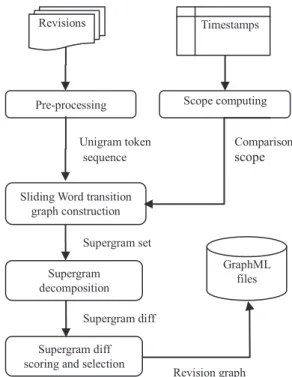
We start this section by the full process of revision graph extraction based on supergram decomposition with sliding update on revision collectionR. The comparison stage con- sists of 5 stages:
1. Pre-processing
For each revision ri ∈ R, generate its unigram token sequence.
2. Comparison scope computing
Calculateri’scomparison scope Cibased onri’s times- tamp.
3. Sliding decomposition
a. If i=0, construct a word transition graphGiof all the revisions withinCi,decomposeriand all revisions inCibased on the supergram setS extracted fromGi. b. If i>0, performsliding updateforGi−1and the su- pergram frequency distribution.
4. Supergram diffscore computing
Compareriwith all revisions in Ciby a diffscore de- fined on supergrams.
5. Candidate selection
Forri, Pick up the revisions with lowest k supergram diffscore as the candidates for parents.
The following figure shows the work flow of decomposition based on sliding word transition graph.
4.1 Pre-Processing
We first split the original revision text into a unigram to- ken sequence. The text content in the original revision files contains plenty ofWiki Markups[23], which give specific metadata tags on plain text. While splitting the text, such markups are extracted by regular expression and will be re- served as single tokens in the following steps. The second task is replacing the URLs appearing in the text. No matter how many terms a URL involves, it has no more contribu- tion to add a new URL than to add a single word. We replace each URL with a 16-byte string generated by MD5 for con- sistency.
Fig. 4 Full process of supergram decomposition by sliding update.
4.2 Comparison Scope Computing
Recall the observation of supergrams we mentioned before:
a narrower scope will produce longer supergrams. This is because the number of edits is proportional to the scope size and fewer edits mean smaller chances, and supergrams tend to be undivided. Longer supergrams are preferable in super- gram decomposition because it reserves more integrity and reduces the total number of supergrams.
We can draw the assumption based on the characteris- tics of Wikipedia editing: The further one revision is from the current revision, the less possible that the current one is derived from that revision.
But before we limit the comparison scope to a fixed number of previous revisions, we consider the frequent edit behavior within a certain period of time as another impor- tant factor according to the timestamps in the edit history’s meta information. Intense editing activity could be caused by edit wars, increasing popularity of the article, or immedi- ate updates after related events happen, and the total number of edits in a week could easily exceed any preset number.
Figure 5 shows the edit count of Wikipedia article “Barack Obama” during 2008, the year of the U.S. presidential elec- tion, and significant peak can be found in November, when the election was held. Thus, all the previous revisions within certain time span should be examined, regarding the fact that contributors’ attention can last for a period of time.
A fixed scope would not be able to capture the whole process of the intense edit activity, while fixed time span can cover only little revisions. Considering such trade-off, we employ maximum comparison scopeto denote the largest number of previous revisions to be compared, which is de-
Fig. 5 Edit count of Wikipedia article “Barack Obama” during 2008, the year of the U.S. presidential election†.
fined as below.
Definition 4.1 (Maximum comparison scope)
Given a revision history H = {(r1,ts1),(r2,ts2), . . . , (rm,tsm)}, where (ri,tsi) denote a revision ri with its timestamptsi, the maximum comparison scopeCfor revi- sionrkis the collection of revisions determined by either:
a)C = {rk−SL,rk−SL+1, . . . ,rk−1}, if tSk−S L −tSk > Tl, other wise
b) All revisions withinTl.
whereSLdenotes the minimum revision number to ensure enough comparison for unpopular documents, Tl denotes the minimum time span to avoid the limit of fixed number of revision during the periods of intense edits. For exam- ple, for a popular article, the minimum revision number SL will not be applied because we might loss important revert or rollback by stopping at the middle.
Notice that there could be a series of consecutive edits by the same contributor. In this case, we take only the latest revision and omit the others, since we focus on the collab- orative authoring and editing process rather than individual perspective.
Another issue we should notice is the phenomenon of remote copy, which is the behavior that copying a piece of text from an ancient revision such that there is no appear- ance of such text within the scope ofMaximum compari- son scope. Simply expanding the scope to that ancient re- vision includes unnecessary revisions and lowers the effi- ciency. We choose to include this kind of ancient revision as individual revision alone. Formally, an ancient revision is identified as follows:
A revisionrjis a potential remote ancestor ofriif and only if there is a bigrambkthat appears inrjandribut not in revisions betweenrjandri.
4.3 Sliding Update
So far for each revision, a word transition graph will be con- structed and the supergram frequency distribution according to the graph can be calculated. Notice that the adjacent com- parison scopes are mostly overlapped, i.e. most of their revi- sions are the same, it is much efficient to update the different
†http://en.wikipedia.org/wiki/Barack Obama
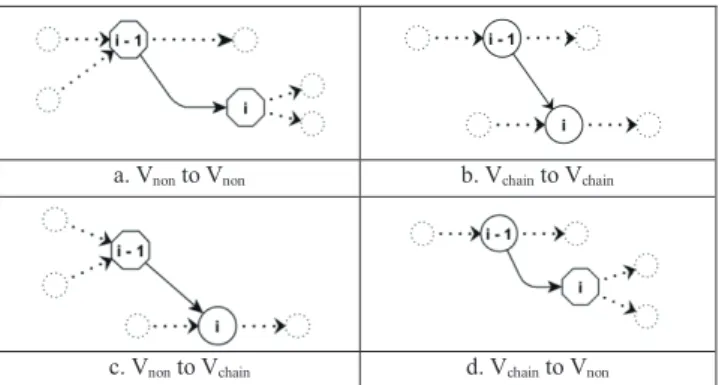
Fig. 6 Examples of chain breaking situations.
revisions upon an existing transition graph than to construct a new transition graph for all revisions in the later compar- ison scope. Moreover, by update the changed supergram frequency of the updated transition graph, we do not have to perform supergram decomposition for overlapped revisions again. Such updates on transition graph and supergram dis- tribution is calledsliding update.
The sliding update considers two operations: adding the new revision, and deleting the revisions that are out of the new scope. The adding operation on WTG is basically the same with the construction of WTG but with more con- cerns on the update for supergram distribution. For each tokentithat is read from the new revision, if edge<ti−1,ti>
exists in the WTG, we should simply update w(ti−1,ti) and the corresponding supergram frequency. But if not, a new edge is created and a new bigram of (ti−1ti) will be added into supergram distribution. The new edge <ti−1,ti>con- nects vertices in the following situations:
a. Non-chain vertex to Non-chain vertex chain vertex.
b. Chain vertex to chain vertex.
c. Non-chain vertex to chain vertex.
d. Chain vertex to non-chain vertex.
Figure 6 shows examples of the four situations, where a circle indicates a chain vertex and an octagon indicates a non-chain vertex. Also, since in situation b, c and d the chain property of existing chain vertex has been violated by the new edge, the involved chain has to be broken and an update on the corresponding supergram in the distribution is needed. For a chain H=<v1,v2>,<v2,v3>, . . . ,<vi,vi+1>
..,<vn−1,vn>(1<i<n,n≥3) that breaks at vi, the existing entry of the corresponding supergram s=(t1. . .ti. . .tn) in the supergram distribution will be replaced by the entry of (t1...ti) and (ti. . .tn) with the same frequency.
To delete a revision from the transition graph is the in- verse operation of adding. The edge weights will be sub- tracted according to the bigram frequency in the deleted re- vision. When the weight of an edge turns to 0, that edge should be deleted. Notice that the involved vertices might regain the chain property likewise, so an update of merging entry in the supergram distribution should be needed.
After the sliding update, the word transition graph is ready for further updates and the supergram frequency dis- tribution can be used for pairwise comparison.
4.4 Supergram DiffScore Computing
For pairwise revision comparison, we first create thesuper- gram diff for two revisions, and then calculate thesuper- gram diffscoreto measure their difference.
Definition 4.2 (Supergram diff)
Given a supergram setS, we denote the supergram fre- quency distribution of revisionraas f(si,ra) (si∈S). For two revisionsraandrb, the supergram diffSDis the set of supergrams with a non-zero residual frequency between raandrb:
S D(ra,rb)={s∈S| |f(s,ra)−f(s,rb)|>0} (1) Definition 4.3 (Supergram diffscore)
diffScore(ra,rb)=w1·
s∈S Dadd|f(s,ra)−f s, rb·|S|+w2·s∈S Ddel f s, ra−f s, rb.log|s| (2) whereSDaddis the set of all supergrams such that f(s,ra)− f(s,rb)>0, andSDdelis defined similarly,wiis the weight for discrimination between adding and deleting operations.
We setw1 =0.65 andw2 =0.35 empirically to maxi- mize the difference. As heuristics, the logarithms are to the base of 10, since the deleting operation is a less effort-taking job.
4.5 Candidate Selection and Output
After the calculation of supergram diffscore has been done, revisions will be ranked by their scores. Basically, the one with the lowest score will be considered as the parent revi- sion. However, sometimes there could be multiple candi- dates with the same score. In that case, we select the latest one, since.
Once every revision’s parent revision has been found, the revision graph is finished. We choose to serialize the revision graph in a common format for graph, “GraphML”.
Then the graph can be utilized by other software or pro- grams.
5. Experimental Evaluation
To evaluate the precision and performance, we conduct two accuracy evaluations and an execution time test on the pro- posed method with 4 representative methods: sentence- level Jaccard distance [18], keyword clustering [5], n-gram cover [19] and the conventional token-level Edit distance.
For each method, we compare its result revision graphs with manually extracted revision graphs on the dataset of selected Wikipedia articles.
5.1 Dataset
Long article with many revisions are good for distinguishing the performance and effectiveness of methods in the RGE
problem because they involve more edit behavior. We en- list 50 articles in Wikipedia that satisfy the following basic criteria:
• In English Wikipedia.
• Has at least 300 tokens in the latest revision.
• Has at least 200 revisions.
More precisely, we select the articles by four categories:
• Random articles (RA): We use the official “Random ar- ticle” function on Wikipedia page and pick up the qual- ified articles in order to be non-bias sampling. RA rep- resents the majority of Wikipedia article and all meth- ods are supposed to work with them.
• Featured (FA) and non-featured articles (NFA): An ar- ticle with a “Feature” label in Wikipedia is the sym- bol of high quality content, which requires much more effort than original articles [17]. We adopt the arti- cle list from WPQAC (Wikipedia Quality Assessment Corpus) [6] as the second part. WPQAC is constructed for evaluating relationship between the writing process and article quality. It includes 10 pairs of comparable FA and NFA that cover a broad quality spectrum, each with nearly identical text volume (in characters) and edit frequency.
• Top-edited articles: We select the top 15 articles with the most revisions in English Wikipedia, according to the official statistics [22]. Such articles include all kinds of edit behaviors.
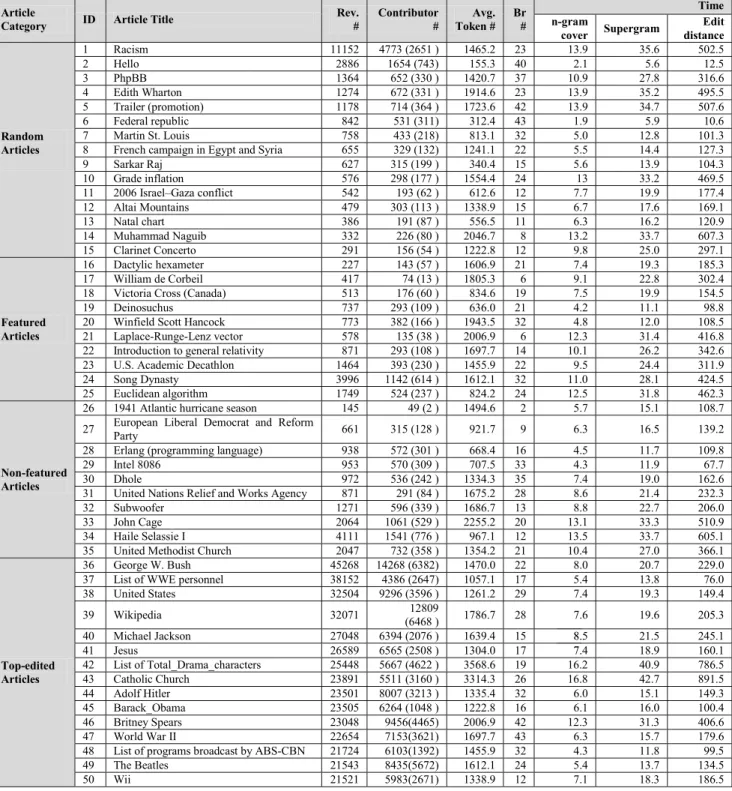
The titles of the articles in the dataset are listed in Ta- ble 1, with the general statistics including their total num- ber of revision (Rev. #), total number of unique contributors (Contributor #, unregistered users’ number is shown in the parentless), the average token number of each revision (Avg.
Token #) and the number of branches (Br. #) in the manual graph. The articles in the dataset cover topics that vary from political, historical issues to bibliography. The right part of the table will be addressed in Sect. 5.3.
For each article, we dump the first 200 revisions from the official export site, with an exception that the article of
“1941 Atlantic hurricane season” has only 149 revisions.
We perform the manual extraction by a 3-researcher team and build up a ground truth dataset of 9949 revisions in- volving more than 14 million tokens
5.2 Precision Evaluation
In this evaluation, all the revisions have been pre-processed according to Sect. 4.1 so that all methods start with the same token sequence. Each compared method adopts the default parameter and initial setting, and the comparison scope for each revision is all of its previous revisions.
The parent accuracy is evaluated as the percentage of the revisions that has the same parent revision as in the ground truth revision graph, which is shown in Fig. 7.
We evaluate branching errors that happen in differ- ent stages by reachability comparison. Given two revision
Table 1 Article list and Execution time test.
graphsG1,G2 on the same revision setD, thereachability accuracyof G2on G1is defined as follows:
C(G1,G2)=2G+1 ∩G+2
|D|2 (3)
whereG+1,G+2 are the transitive closures ofG1,G2,|D|2/2 is half the number of all the node pairs. By formula (3) we focus on how far (in terms of number of total descant revisions) an error can reach, so errors that happen in the
early stage or those that involve more succeeding revisions have greater loss in accuracy.
In both evaluations, the proposed method prevails on most of the test articles, as we can see from the scatter plot and the average accuracy. The Edit distance method achieve the second best position because it can separate more in- tact diff, but it fails to deal with the case of text movement and expansion. The n-gram cover method results in more false-positive branches because it treats the deletion content
Fig. 7 Parent accuracy result.
Fig. 8 Reachability accuracy.
as the same as the adding content and fails to handle those revisions that both addition and deletion happen. The key- word clustering method performs worse than n-gram cover on most articles with more false-negative branches. The Jac- card distance method has the most false-negative branches in the later stage of the revision set, since the relative differ- ence is too small to distinguish a branch. All methods fail to choose the nearest revision as the parent for those severe vandalism cases of heavily deletion or even full text dele- tion.
Regarding the difference among article categories, the only finding is that the proposed method has slightly bigger advantage to Edit distance method on RA and TA categories than on FA and NFA.
5.3 Execution Time Test
We also run an execution time test for 3 methods with the top precision, Edit distance, n-gram cover and the proposed method.
Each method is implemented in Java with default pa- rameter setting and executed in the same environment. Revi- sions are with the same pre-processing equipped with com- parison scope based on timestamps so that the execution time will be recorded by the same criteria.
In Table 1, we list up the articles’ ID and their aver- age revision token numbers. In each cell under the name of method, the average execution time (by millisecond) that a
method takes to determine the parent revision for each re- vision is shown. The n-gram cover method achieves best efficiency because it treats and evaluates revisions in the simplest way so that the pairwise comparison is performed in a linear time. The proposed method takes about 2.5 times more than n-gram model due to the extra cost of word transition graph construction and supergram decomposition, which is the trade-offbetween precision and efficiency. The edit distance method’s result is much slower than others, given that the time complexity is square time.
6. Conclusion
In this paper, we proposed supergram technique for accurate revision graph extraction from Wikipedia edit history. Revi- sion are decomposed and compared by supergrams, which are extracted from a word transition graph. Our proposed method outperforms existing text comparison methods. In the future, we will investigate further optimization of com- parison scopes, and develop applications utilizing extracted revision graphs, such as visualizations.
Acknowledgments
This research was in part supported by “Ambient SoC Global Program of Waseda University” of the Ministry of Education, Culture, Sports, cience and Technology, Japan nd JSPS KAKENHI Grant Number 25330367.
References
[1] A. Andoni and P. Indyk, “Near-optimal hashing algorithms for ap- proximate nearest neighbor in high dimensions,” Commun. ACM, vol.51, no.1, pp.117–122, Jan. 2008.
[2] A. Aji, Y. Wang, E. Agichtein, and E. Gabrilovich, “Using the past to score the present: Extending term weighting models through re- vision history analysis,” CIKM ’10, pp.629–638, ACM, New York, NY, USA, 2010.
[3] T. Ahlqvist, A. B¨ack, M. Halonen, and S. Heinonen, “Social me- dia roadmaps exploring the futures triggered by social media,” VTT Tiedotteita, vol.2454, p.13, 2008.
[4] A.Z. Broder, “On the resemblance and containment of documents,”
Proc. Compression and Complexity of Sequences, pp.21–29, Posi- tano, Italy, 1997.
[5] Z. Cao and M. Iwaihara, “Wikipedia version tree reconstruction by clustering revisions through keywords,” IEICE Technical Report, DE2011-32, 2011.
[6] J. Daxenberger and I. Gurevych, “A corpus-based study of edit cat- egories in featured and non-featured Wikipedia articles,” Proc. 24th COLING, pp.711–726, Mumbai, India, 2012.
[7] M. Ekstrand and J.T. Riedl, “rv you’re dumb: Identifying discarded work in Wiki article history,” WikiSym ’09, ACM, New York, NY, USA, 2009.
[8] F. Fl¨ock, D. Vrandeˇci´c, and E. Simperl, “Revisiting reverts: Accu- rate revert detection in Wikipedia,” Proc. Hypertext and social me- dia, pp.3–12, ACM, New York, USA, 2012.
[9] P.K. Fong and R.P. Biuk-Aghai, “What did they do? Deriving high- level edit histories in Wikis,” WikiSym ’10, ACM, New York, NY, USA, 2010.
[10] P. Indyk and R. Motwani, “Approximate nearest neighbor: Towards removing the curse of dimensionality,” Proc. STOC ’98, pp.614–
623, Dallas, USA, 1998.
[11] P. Indyk, “Nearest neighbors in high-dimensional spaces,” in Hand- book of Discrete and Computational Geometry, pp.877–892, CRC Press, 2003.
[12] B. Keegan, D. Gergle, and N. Contractor, “Staying in the Loop:
Structure and dynamics of Wikipedia’s breaking news collabora- tions,” WikiSym ’12, ACM, New York, NY, USA, 2012.
[13] A. Lih, “Wikipedia as participatory journalism: Reliable sources:
Metrics for evaluating collaborative media as a news resource,” Proc.
Int. Symp. Online Journalism, 2004.
[14] O. Medelyan, D. Milne, C. Legg, and I.H. Witten, “Mining meaning from Wikipedia,” Int. J. Hum.-Comput. Stud., vol.67, no.9, pp.716–
754, Sept. 2009.
[15] G.S. Manku, A. Jain, and A.D. Sarma, “Detecting near-duplicates for web crawling,” WWW ’07, pp.141–150, ACM, New York, NY, USA, 2007.
[16] U. Manber, “Finding similar files in a large file system,” Proc.
USENIX Conference, pp.1–10, 1994.
[17] B. Stvilia, M.B. Twidale, L.C. Smith, and L. Gasser, “Informa- tion quality work organization in Wikipedia,” Journal of the Amer- ican Society for Information Science and Technology, vol.59, no.6, pp.983–1001. 2008.
[18] M. Sabel, “Structuring wiki revision history,” WikiSym ’07, ACM, New York, NY, USA, pp.125–130, 2007.
[19] J. Wu and M. Iwaihara, “Wikipedia revision graph extraction based on n-gram cover,” Proc. Int. Workshop on Graph Data Management and Mining, WAIM 2012, pp.29–38, 2012.
[20] J. Wu and M. Iwaihara, “Revision graph extraction in Wikipedia based on supergram decomposition,” Proc. Int. Joint International Symposium on Wikis and Open Collaboration, ACM, Hong Kong, 2013.
[21] T. Yasseri and J. Kert´esz, “Value production in a collaborative en- vironment,” Journal of Statistical Physics, vol.151, pp.414–439, Springer US, 2013.
[22] http://en.wikipedia.org/wiki/Wikipedia:Database reports/Pages with the most revisions
[23] http://en.wikipedia.org/wiki/Help:Wiki markup [24] http://graphml.graphdrawing.org/specification.html
Jianmin Wu received his B.S. degrees in Software Engineering from Nanjing University in 2010. He received his D.Eng. degree from Graduate School of IPS, Waseda University in 2012. He is now a Ph.D candidate in Waseda University.
Mizuho Iwaihara received his B.Eng, M.Eng. and D.Eng. degrees all from Kyushu University, in 1988, 1990, and 1993 respec- tively. He was a research associate and then associate professor in Kyushu University, from 1993 to 2001. From 2001 to 2009, he was an associate professor at Department of Social In- formatics, Kyoto University. Since 2009, he is a professor at Graduate School of IPS, Waseda University. He is a member of IEICE, IPSJ, ACM and IEEE CS.