The Impact of Insurance on a Sustainable Society Exposed to Natural Disaster Risks
1)Yoshihiko SUZAWA Nicos A. SCORDIS
Abstract
Natural disasters caused by seismic activity and extreme weather events have an increasingly significant impact. This rise is, at least partly, attributed to global warming and/or economic growth in disaster- prone areas. Despite the encouragement by the Principles for Sustainable Insurance (PSI) suggesting that insurers finance macroeconomic risk, it is challenging for the private market alone to do so. A viable alternative is to finance macroeconomic risk through collaborations between insurers and governments (or other public institutions). We examine model plans of such private-public partnerships currently operating in Asia, North America, and Europe. We identify commonalities in the different plans including coverage limitations, government-sponsored reinsurance, strict rate regulation, and compulsor y par ticipation. We conclude that the plans contain features complementar y to the insurability-of-risk concept and that they preserve the availability of insurance coverage. These features, however, exacerbate basis risk, encourage excessive development in high-risk locations, and increase the cost of screening uninsured exposures. We also observe that attempts to improve on one attribute of the plan create problems in other attributes. Finally, we offer suggestions for improving the design of public-private insurance plans.
Keywords: Sustainable Society, Natural Disaster Insurance, Insurability of Risk
1. Purpose
An insurance industry reports that mainly due to economic development, population growth, and a higher concentration of assets in exposed areas, catastrophic losses are on the rise.
2)Climate change is
1) This study is supported by the Japan Society for the Promotion of Science, Grant-in-Aid for Scientific Research (C), No.
25380584. Yoshihiko Suzawa is an associate professor of Faculty of Business Administration, Kyoto Sangyo University, Japan. Nicos A. Scordis is a professor of Peter J. Tobin College of Business, St. Johnʼs University, U.S.A.
2) See, for example, Swiss Reinsurance Conpany (2011a; 2011b).
also contributing to this rise. More people live concentrated in cities than spread out in the countryside.
Many of these cities are vulnerable to natural disaster risks. While cities in developed countries are more resilient to macroeconomic risk than cities in less-developed countries, in absolute terms, the damage to developed countries is costlier. Some have suggested that insurers, in cooperation with governments, have a role in creating a resilient system to fund emerging perils. This includes those disasters caused by the unpredictable effects of climate change. The suggestions of these authors are similar to actions insurers are urged to take in compliance with the Principles for Sustainable Insurance (PSI). The PSI was launched at the 2012 United Nations Conference on Sustainable Development. The PSI includes suggestions for insurers to contribute to the resiliency of global society in the face of increasingly severe natural disasters.
3)Even so, the insurance industr y by itself cannot finance all natural catastrophe risk. There are issues of capacity, highly correlated losses, parameter uncertainty, moral hazard, and adverse selection. An intriguing idea for financing catastrophic risk is to unbundle catastrophic losses into two components. One component will be independent among all exposure units and the other will be perfectly correlated. The independent component could then be easily handled by insurers while the correlated component could be financed in the capital markets.
An alternative to such unbundling is for insurers to collaborate with entities that are better able to manage systematic risk. Indeed, we are now observing an increasing number of collaborations between insurers and governments. Suzawa and Scordis (2013) discuss optimal overall private-public insurance collaborations. These include natural disaster insurance, social security insurance, and liability insurance programs as a whole.
4)This study specifically focuses on natural catastrophe risks and addresses the absence of a framework for linking government and insurance industry efforts (including the PSI) to finance those risks. This research also presents perspectives of a cooperative framework for designers of natural disaster insurance plans.
2. Background of the Study
(1) Increasing Impacts of Natural Disasters
The financial cost of natural catastrophes on global society has been rising for over twenty years. In the 1980s, the cost of natural catastrophes was, on average, about USD 25 billion per year on an inflation- adjusted basis.
5)This rose to USD 95 billion per year in the 1990s and reached an annual average of USD 130 billion during 2000-2010. More recently, natural catastrophe-related losses were around USD
3) UNEP Finance Initiative (2012), pp.3-9.
4) Suzawa and Scordis (2013), pp.55-70.
5) Swiss Reinsurance Company (2011a), p.4.
131 billion in 2013, stemming mostly from floods and other extreme weather events around the globe.
6)There seem to be two complementar y factors that aggravate losses from weather: the growing global economy and changing climate. Economic development and population growth in urban areas results in a higher concentration of economic activities and assets that are threatened by loss.
7)Many of these urban centers including coastal cities in China and Southeast Asia are located on the coast and are threatened by floods and storms, and some are in active seismic areas such as the Pacific-Rim Region and are exposed to earthquakes and tsunami. Global warming also increases the frequency and severity of losses caused by extreme weather events. Both developed and developing countries are now affected by catastrophic events, and this trend is expected to continue. Dlugolecki (2008) estimates that the annual economic impact of weather related events could reach over USD 1 trillion by the year 2040.
8)While we expect the global economy to expand by 2040, a trillion will still be of material consequence to global society.
(
2) Sustainable Insurance Initiative
The Finance Initiative of the United Nations Environment Programme (UNEP), in cooperation with a group of insurers and non-profit organizations, launched the PSI in 2012. The PSI recognizes that global society will be increasingly impacted by future natural disasters. The PSI also highlights the ability of insurers to contribute to risk reduction by developing innovative solutions for financing risk.
The PSI also suggests that there will be an improvement in overall governance if there is a recognition of the risks associated with natural disasters to environmental, social, and economic sustainability. The PSI has four main principles. Principle 3 calls on insurers to work together with government, regulators, and other key stakeholders to promote action across environmental and social issues.
9)The PSI, however, does not fully elaborate on the characteristics of an ideally insurable risk nor does it note the implied costs of providing insurance coverage for risks that deviate from those ideal characteristics. Risks related to natural disasters are not fully insurable in the private market, as discussed in the following section. Insurers are forced to charge higher premium loadings that reflect the higher capital costs needed to under write exposures. The higher premiums allow insurers to provide insurance coverage for exposures not meeting the ideal requirements for insurability. As a
6) Swiss Reinsurance Company (2014), p.4.
7) Swiss Reinsurance Company (2011a), p.4.
8) Dlugolecki (2008), p. 87.
9) UNEP Finance Initiative (2012), p.5. PSI also requests that the insurance companies include in their decision-making environmental, social, and governance issues relevant to their business (Principle 1), to work with clients and business partners to raise awareness of these issues (Principle 2), and to demonstrate accountability and transparency in disclosing publicly their progress in implementing PSI (Principle 4).
result, the supply of insurance coverage is constrained.
Meanwhile, the public sector alone may not be able to provide the answer to financing catastrophic losses. Strong flooding, severe storms, or major earthquakes place a huge burden on the public sector.
In these instances, the public not only shoulders the cost of relief efforts, but also is responsible for rebuilding public infrastructure.
10)The escalating impact of natural disasters is driving up the cost of relief and reconstruction for the public sector. Therefore, a private and public partnership could make societies more resilient by efficiently allocating both the risk financing and the risk control aspects of nature-related, catastrophic events.
This paper uses the term ʻsustainabilityʼ in a very general sense without defining the term. The original definition of the word centered on human needs, but over time the sustainability discussion drifted away from human needs to that of both human and non-human rights. Such drift, in turn, has associated sustainability with wider questions of equity and social justice.
11)Existing definitions of sustainability are both vague and lack consensus over what is to be sustained.
(3) Government Involvement in Natural Disaster Insurance
Public-private partnerships already play a key role in compensation programs that ensure the relief of victims of natural disasters. Such government sponsored insurance plans generally cover major natural disaster risks in individual markets, such as hurricanes, floods, and earthquakes. Some of these programs have come to be regarded internationally as models of how to deal with disaster risks: Japan Earthquake Insurance Program, Taiwan Residential Earthquake Insurance Fund (TREIF), Earthquake and Natural Disaster Insurance provided by the Earthquake Commission (EQC Insurance) in New Zealand, U.S. National Flood Insurance Program (NFIP), California Earthquake Authority Insurance (CEA Insurance), Catastrophe Naturelles (Cat Nat) in France, and Consorcio de Compensacion de Seguros (CCS) in Spain. The Appendix to this paper gives details about each of these programs.
12)10) Swiss Reinsurance Company (2008), p.3.
11) Scordis et al. (2014), pp.266-267.
12) Oda (2007), pp.1-47, Vaughan and Vaughan (2008), pp.621-622, Non-life Insurance Organization of Japan (2011), pp.93- 103, Swiss Reinsurance Company (2011b), pp.5-10, and AXCO (2013), France: pp.1-21, Japan: pp.1-26, New Zealand: pp.1- 22, Spain: pp.1-17, Taiwan: pp.1-14, the U.S.: pp.1-24 of Natural Hazards Section in Insurance Market Reports. According to AXCO (2013), France: pp.1-2 the managing authority of Nat Cat is regularly consulted by countries seeking to protect their populations against the disastrous consequences of natural catastrophes.
3. Risk Transfer by Insurance and Insurability of Risk
(1) Social Sustainability and Risk Transfer Functions of Insurance
A number of previous studies have discussed in theory how insurance facilitates the development and stability of markets and have empirically shown the causal relationship between insurance activities and development.
13)Much of the literature elaborates on the two ways that insurance activities facilitate social sustainability. The first is through the primar y operation of insurance itself; the insurance industry is capable of generating a significant and productive impact on global society by providing risk transfer and indemnification schemes. The second is through insurers operating in the economy as key institutional investors in the capital market worldwide.
14)Their investment funds, generated between the time they collect premiums and the time they need to pay losses on those premiums, can have a significant, economic impact. Comparing these two contributions shows that the transfer of risk is the important function in public-private partnerships, which are designed to insure natural disasters. This is consistent with the core of the PSIʼs Principle 3 that was mentioned previously.
15)Beneficiaries of insurance include not only individuals but also business enterprises. Insufficient risk transferring schemes within an economy create the potential for losses that destroy much of the build-up value of equity. This can affect initial investments and reinvestment decisions.
16)On the other hand, by transferring various types of risks to insurers, economic units can promote their own financial stability. Much of the literature suppor ts the idea that well-diversified (and thus risk-neutral) shareholders still have an interest in firms insuring against possible losses to avoid bankruptcy costs.
17)Collectively, such cost reduction ought to have a positive effect on society.
The risk transfer function of insurance can also enhance capital productivity and innovation. Firms with insurance can then concentrate their attention and resources on their core business. Insurance also enables firms to hold a lower amount of highly liquid capital. It releases funds, making them available for real investment. If the projects the insured firm invests in are of positive net present value, then economic wealth is generated. Hence, insurance plays a key role in freeing the entrepreneurial spirit and encouraging the innovation and development of new products and technologies. These innovations include development of sustainable energy systems and risk control and loss mitigation techniques that contribute to social sustainability.
13) See, for example, Webb, Grace and Skipper (2002), pp.1-38.
14) Skipper and Kwon (2007), p.505.
15) UNEP Finance Initiative (2012), p.5.
16) Webb, Grace and Skipper (2002), pp.1-38.
17) Mayers and Smith (1982), pp.281-296, Doherty (2000), pp.506-509, Harrington and Niehaus (2004), pp.171-173.
Skipper (1997) also discusses that the insurance industry may contribute to the economy by means of efficient risk management.
18)An insurer provides policyholders with risk control services by utilizing excellence in under writing and risk assessment. Risk control ser vices enhance loss mitigation by policyholders and, as a result, reduce the expected loss. In addition, the risk assessment by the insurer will be reflected in the policy price and conditions when it is renewed based on experience rating and risk differentiation. Consequently, firms and individuals have increased incentives to modify their behavior to reduce losses.
(2) Factors Limiting Insurability of Risk
Although the risk transfer function of insurance contributes to the sustainability of society, risks are not always covered in the private insurance market. The insurability of risk is limited by such factors as high correlation of losses, parameter uncertainty, and incentive problems.
19)High Correlation and Parameter Uncertainty. Premium loadings factored in insurance premiums reflect the administrative and capital costs of an insurer. As loadings increase, peopleʼs demand for insurance coverage declines, thus limiting insurance supply. When losses are highly correlated among exposures, the variance and the standard deviation of losses are also very high. An insurer, then, needs to hold a large amount of liquid capital to avoid insolvency, resulting in high opportunity cost for that capital.
Moreover, when an insurer faces parameter uncer tainty―dif ficulty in identifying the true loss distribution from historic data used to predict future losses―it needs to overcapitalize in the event of supra large losses. Risks relating to extreme climate and seismic events generally entail high correlation of losses and parameter uncertainty of the expected loss. This violates the principle of risk insurability and limits the supply of catastrophe insurance coverage in the private market.
Moral Hazard. The insurability of risk is also limited by incentive problems known as moral hazard.
Moral hazard arises because insurance protection changes the behavior of the policyholder or the insured, discouraging them from taking precautions. Policyholders, assuming that they are economic- rational, weaken their incentive to reduce expected losses when they are protected against possible losses by insurance. The moral hazard problem, particularly in regards to natural disaster insurance, discourages policyholdersʼ mitigation efforts such as building reinforcement. In addition to ex-post moral hazard, insurance protection may cause a critical ex-ante moral hazard problem. It possibly leads to more buildings and construction in some flood plains and other high-risk areas.
20)The insurance market responds to moral hazard by contractual provisions that limit coverage such as deductibles,
18) Skipper (1997), pp.2-7.
19) Harrington and Niehaus (2004), pp.179-188.
20) Harrington and Niehaus (2004), pp.291-293.
coinsurance, and policy limits instead of providing full coverage. On the other hand, if an insurer provides high-risk exposures with sufficient protection at relatively low premiums, the moral hazard problem can be more serious.
Apparent Adverse Selection. Adverse selection exists when a potential policyholder is better informed about expected claims costs than an insurer. In the case where the pooled, subsidized premiums are applied to all exposures, regardless of their risk characteristics, policyholders with high-risk exposures are willing to purchase insurance coverage. Those with lower-risk tend to refrain from doing so because the subsidized premiums look excessive compared to their risk. In the natural disaster insurance market, insurers are not always information-inferior to potential policyholders, because information relating to disasters is equally available. This incentive problem differs from adverse selection in conventional discussions. However, the insurer faces apparent adverse selection as long as property owners with higher expected losses are more likely to purchase insurance coverage. The problem is partly addressed by risk classification, i.e., calculating separate premium rates based on expected claim costs. However, risk classification is not costless in practice, and it is too costly to dif ferentiate exposures perfectly. Since adverse selection cannot be completely eliminated, rational insurers will limit the supply of insurance coverage or apply prohibitive rates to high-risk exposures.
4. Efficacy of Government Involvement in Natural Disaster Insurance
There are several cases where the government and the private insurance sector collaborate in a natural disaster insurance plan as indicated in Section 2. The form and level of government involvement vary among individual jurisdictions, depending on regulatory framework, socio-historical background, and level of market maturity. We can observe, however, a global commonality as follows:
(1) Natural disaster insurance plans generally cover only personal exposures with significant coverage limitations.
(2) The government often retains its role as a reinsurer of last resort, and the plan is partly tax-funded in some cases.
(3) The government generally allows cross-subsidy among high- and low-risk exposures under a strict rate regulation.
(4) The regulation often unifies rating plans throughout the market and largely restricts price competition.
(5) Governments often mandate property owners to purchase insurance coverage and insurers to underwrite insurance policies.
This section investigates these common features and examines the ef ficacy of government
involvement. The focus is on how government involvement redresses the problems by limiting the insurability of risk and preserving insurance availability.
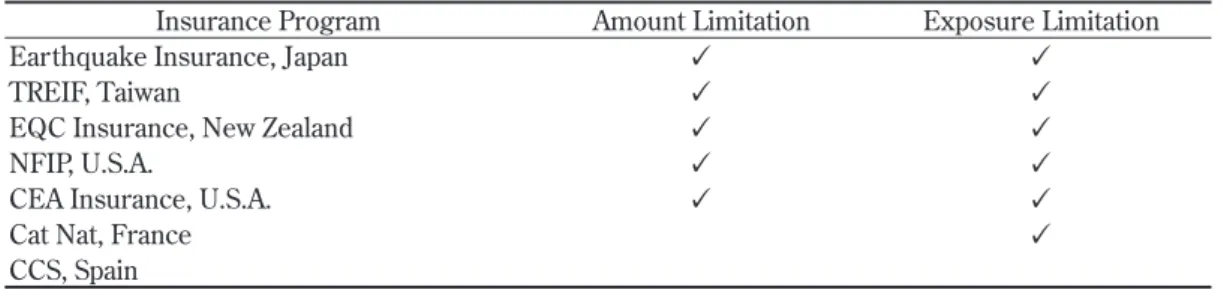
Table 1. Coverage Limitations of Natural Disaster Insurance
Insurance Program Amount Limitation Exposure Limitation
Earthquake Insurance, Japan
㾎 㾎TREIF, Taiwan
㾎 㾎EQC Insurance, New Zealand
㾎 㾎NFIP, U.S.A.
㾎 㾎CEA Insurance, U.S.A.
㾎 㾎Cat Nat, France
㾎CCS, Spain
Note: EQC Insurance of New Zealand has deductible and coinsurance, and Cat Nat of France has deductible in addition to amount and/or exposure limitations listed above.
(1) Coverage Limitation
Most of the insurance plans only provide limited protection―some of them set an upper limit on the insured amount such as Japan Earthquake Insurance, TREIF, EQC Insurance, NFIP, and CEA Insurance as described in Table 1. In the Japanese case, for example, the ear thquake insurance coverage allows insured amounts at only 50% of the insurable value of a covered property. This indicates the insurance program will not provide sufficient indemnity for policyholders when an event occurs.
While it is rational to set coverage limitations to preser ve the solvency of an insurance plan and to minimize moral hazard, limitations expose policyholders to significant basis risk. In fact, victims of the earthquake and tsunami that hit northeastern Japan in 2011 are unable to completely recover their losses solely based on their earthquake insurance payments. It would then be necessary for private insurers to provide their own insurance policies to cover the excess of loss and to fill the gap between actual losses and payments from a disaster insurance plan. We actually observed such cases in the EQC Insurance in New Zealand and with voluntar y earthquake insurance provided in California.
21)The supply of voluntar y coverage, however, fluctuates in the private market, depending on reinsurance capacity and the condition of financial markets.
Another issue is that disaster insurance plans provide no or limited protection for business entities.
22)While relief for people afflicted by a catastrophic event should doubtlessly be assigned the highest priority, limited insurance availability for firms detracts from the productivity of capital. The supply of disaster insurance is not always stable in the private market. This gives firms reasons to forego
21) See notes in the Appendix.
22) CCS is an exception among above-listed plans.
investments that are other wise profitable except for the uncertainty associated with the timing of weather events. A government-private partnership would then be expected to provide a certain level of protection for not only individuals but also for business entities to encourage entrepreneurship.
Enhancing the risk transferring function does not mean that an insurance plan should expand protection to be as generous as possible. Full protection may result in a moral hazard problem including encouraging excessive development in vulnerable areas as discussed previously. As highlighted in both EQC Insurance and Cat Nat, excessive development can be discouraged by deductibles or coinsurance, but this may also increase basis risk. The designer of a disaster insurance plan has to find a solution to balance these seemingly incompatible goals of maintaining insurance solvency while minimizing moral hazard and reducing basis risk.
(
2) Government Reinsurance Arrangement
Despite the insufficient insurability of risk, private insurance companies still service the natural disaster insurance market in many countries including the Japan Ear thquake Insurance, EQC Insurance, NFIP, CEA, and Cat Nat as described in the Appendix. This is because governments sponsor a reinsurance program from the primary disaster insurance market and bear (at least partly) the risk that insurers have underwritten. A possible rationale for publicly-arranged reinsurance is that it reduces the cost of maintaining a pool of capital to finance future catastrophe losses compared with private reinsurance arrangements. This assumes preferential tax treatment on investment earnings is obtained as obser ved in NFIP.
23)Even if the government could extend favorable tax treatment to private reinsurance contracts, additional monitoring costs would still be necessary to ensure that participating insurers can adequately estimate their expected losses and fulfill their obligation to pay for future claims.
Another advantage of government-sponsored reinsurance is that the program can transfer capital across time. When losses exceed expectations, the program borrows from the governmentʼs future tax revenue to pay claims. This encourages efficient risk pooling over time. The ability to borrow allows the participating insurers to pool catastrophe risk over time. This is because the high correlation in losses over a short period of time makes natural disaster risks undiversifiable through private reinsurance arrangements.
One factor that undermines the effectiveness of public reinsurance is an inadequate estimation of losses because of parameter uncertainty in natural disaster risks. When a government reinsurance program withdraws large amounts of capital from the state budget, a greater burden is imposed on
23) Harrington and Niehaus (2004), p. 293.
taxpayers. Limiting coverage may be a practical measure to avoid insolvency and to ease the taxpayersʼ burden. However, it aggravates basis risk as discussed previously. Another problem is the possibility that insurance funds accumulated over time can be ʻborrowedʼ for other purposes.
24)Given that aging Japanese and Western societies are increasingly facing fund shortages for social security and public welfare, a well-capitalized reinsurance fund will likely be exposed to political interference. Additional monitoring costs of fund usage may be necessary.
Table 2. Rate Regulation of Natural Disaster Insurance
Tariff Market or
State-made Rates
Fixed Percentage of Primary Fire Policy Earthquake Insurance, Japan
TREIF, Taiwan NFIP, U.S.A.
CEA Insurance, U.S.A.
EQC Insurance, New Zealand Cat Nat, France
CCS, Spain
(
3) Price Regulation
―Subsidized Premium Rates
Moral Hazard and Insurance Availability. Natural disaster insurance systems are generally subject to a strict rate regulator y super vision as described on Table 2. Such cases as TREF, NFIP, and CEA Insurance are operated under the state-made rate system or tariff market system, where private insurers use a rating plan prescribed by the regulator y authority.
25)A state-made rating plan generally has limited risk factors and allows substantial cross subsidy, regardless of the risk characteristics of exposures. The unified tariff facilitates the insurance availability as it does not allow an insurer to set prohibitive prices for high-risk properties. Meanwhile, in such cases as EQC Insurance, Cat Nat, and CCS, premium rates are fixed according to the percentage of primar y insurance policies―risk classification depends on the same classifications found in the fire insurance rating structure. In those cases, the regulator would rigidly monitor the rating plan for fire insurance filed by an insurer to avoid excessive risk classification and cream-skimming.
Risk Classification and Loss Mitigation. Limited risk classification is both praised and criticized. It is praised because it preserves insurance availability through cross subsidies. It is criticized because it intensifies the moral hazard problem―people have a weaker incentive to promote loss mitigation and, instead, develop proper ties in areas vulnerable to disasters. Risk classification can motivate policyholders to reduce their expected loss when the differentiating factors are those enhancing loss
24) Harrington and Niehaus (2004), p. 293.
25) In the Japanese case, insurers are not mandated to use the prescribed tariff rates. However, all insurers simply use the tariff to avoid the additional cost to obtain regulatory approval for their own rating plan. Thus, the premium rates are virtually unified throughout the market.
control and mitigation activities. Risk classification based on region and zoning may discourage high- risk property development, but the classification should be fine-tuned enough to distinguish the risk difference of individual areas. NFIP based zoning code and CEA Insurance use ZIP codes to enhance mitigation. Prefectural classification of Japan Earthquake Insurance appears not to have such an incentive control function even though each individual prefecture consists of areas with a variety of disaster vulnerability. The risk factors that need to be taken into account include construction structure, seismic reinforcement, and years after construction. These factors are used in Japan Earthquake Insurance and CEA insurance. The risk factors facilitate the disaster resistance of properties. Therefore, the designers of natural disaster insurance need to create a balance between insurance availability and moral hazard when designing the rating structure of an insurance plan.
Risk Classification Linked with Public Loss Mitigation. Risk classification, when applied to individual policyholders, is of limited use because a natural disaster can cause widespread destr uction.
Consequently, actions at a community or a municipal level should be emphasized. NFIPʼs joint participation rule is an effective example. Participation in NFIP is based on an agreement between local communities and the federal government. In this case, the government will make flood insurance available within an area when the community implements the prescribed mitigation measures, which include strict zoning regulation.
26)The joint purchase can encourage loss control and mitigation activities by the community when combined with risk classification that is based on zoning.
27)CEA Insurance provides policyholders with State Assistance for Earthquake Retrofitting (SAFER) by which homeowners receive an earthquake risk inspection service from an engineering firm.
28)A discount will be applied to insurance premiums when homeowners reinforce their buildings according to the inspection report. This government initiative for loss mitigation combined with risk classification efficiently reduces the expected losses and contributes to social resiliency.
(4) Price Regulation―Restricted Competition
Under the tariff market or the state-made rating system, insurers are generally required to use a predetermined unified rating plan as adopted in TREIF, NFIP, and CEA Insurance.
29)The premium rates are calculated on the full gross base including not only pure premiums but also expense loadings regardless of the size and operating efficiency of the individual insurers. The unified tariff rate system is often criticized because it discourages insurers from enhancing efficiency and allows larger-scale
26) AXCO (2013): U.S.: pp.14-17.
27) The joint purchase makes insurance policies totally unavailable for property owners in non-participating communities.
28) Oda (2007), p.33.
29) Japan Earthquake Insurance also adopts an apparent tariff market system. See Note 25.
insurers to earn more under writing profit suppor ted by the scale merit.
30)Reduction of price competition, which is encouraged, helps to preserve insurance availability. However, for private insurers to constantly supply coverage regardless of legal and/or ethical mandates does not come without a cost.
Expense loadings that consist of the tariff rates is one incentive factor that encourages insurers to actively underwrite insurance policies. This improves their efficiency as noted by Yoneyama and Suzawa (2011).
31)Insurers can gain profits if their operating efficiency is higher when compared to their expense loadings if tarif f rates are factored in. Inef ficient insurers will run shor t of loadings to compensate for their administrative costs. The expense loadings are externally determined, but the actual administrative costs can be internally controlled by individual insurers. Consequently, the unified tariff rate system is expected to encourage insurers to provide insurance coverage, improve efficiency, and discourage inefficient insurers from underwriting contracts. The level of expense loadings needs to be closely monitored by the regulator so that policyholders wonʼt be overcharged and insurers wonʼt gain excessive profit.
Contrary to theoretical expectation, the penetration of natural disaster insurance is not sufficiently high in some cases including the TREIF and NFIP.
32)Moreover, empirical studies such as Miyashita et al. (2011) and Yoneyama and Suzawa (2011) find no definitive evidence to show that an active underwriting of insurance under unified tariff rates would contribute to the profitability of an insurer.
33)Therefore, the current rating regulation in these plans may still have room for improvement to reinforce an insurerʼs incentive for selling policies.
Table 3. Risk Classification of the Coverage Limit in Compulsory Plans
Compulsory Insurance Program Limit of Coverage Risk Classification
TREIF, Taiwan Capped None
EQC Insurance, New Zealand Capped Allowed
Cat Nat, France None Allowed
CCS, Spain None Allowed
(5) Compulsory Insuring
The problem of incentives associated with adverse selection can be partly resolved by allowing insurers to underwrite on a risk differentiated basis. At a minimum, policies should be affordable even
30) Mizushima (2006), pp.108-126.
31) Yoneyama and Suzawa (2011), pp. 123-124.
32) The penetration of household earthquake insurance is just under 30% in Taiwan, and 13% in the U.S according to AXCO (2013), Taiwan: p.2, the U.S.: p.16.
33) Miyashita et al. (2011), pp.61-81, Yoneyama and Suzawa (2011), pp.121-145.
for high-risk property owners. Another solution that will alleviate this incentive problem is to make insurance compulsory. TREIF, EQC Insurance, Cat Nat, and CCS are examples of compulsory schemes.
34)Insurers and the government, however, have to incur the additional costs associated with screening uninsured property owners and require them to purchase coverage. Even in the case where all property owners are forced to be insured, ex-post moral hazard can develop. For example, low-risk policyholders who perceive the premiums to be excessive may change their behavior and neglect mitigating activities.
Lowering the premiums is one measure that can induce property owners to participate in a compulsory insurance plan without changing their behavior, but the scope of coverage may have to be limited in order to offer the reduced rate. Among the compulsory plans, TREF and EQC Insurance have capped amounts as described in Table 3.
35)This not only secures the insurance fund but also makes premiums affordable for all property owners, encouraging them to purchase insurance without reluctance. It is important to keep in mind that the capped amounts expose policyholders to basis risk. Meanwhile, Cat Nat and CCS set no explicit limitation on coverage, but instead allow for insurers to underwrite policies according to the same risk factors used for fire insurance policies. The designer of any compulsory insurance has to take factors such as apparent adverse selection and basis risk into consideration when determining the scope of coverage and rating structure of a plan.
The results of our analysis show that the public-private insurance plans help to ensure insurance availability. These plans alleviate factors that limit insurability of natural disaster risk through the common features. These features, however, also have potential disadvantages. Many create a tradeoff relationship with each other and with the expected advantages, as summarized in Table 4.
34) In these cases, policyholders of property insurance are mandated to attach or extend disaster insurance coverage to the primary contract, as described in the Appendix.
35) See the Appendix.
Table 4. Commonality of Natural Disaster Insurance and its Efficacy Common
Characteristics
Advantages Disadvantages
Adoptable Solutions Coverage
Limitations
Securing Solvency,
Enhancing Insurance Availability, Promoting Loss Mitigation
Increasing Basis Risk
Providing Excess Coverage on a Voluntary Basis Government
Reinsurance
Risk Pooling and Diversification, Enhancing Insurance Availability
Increasing Burden on Taxpayers,
Political Pressure to Use Fund for Other Purposes Limiting Scope of Coverage, Monitoring of Fund Usage Rate Regulation
―Cross-subsidy
Enhancing Insurance Availability Encouraging Excessive Development
Risk Classification Based on Factors that Promote Loss Mitigation
Rate Regulation
―Restricted Competition
Enhancing Insurance Availability Allowing Profit if Inadequately Priced
Setting Premium Rates as Low as Possible to Maintain Financial Soundness of Insurers
Compulsory Insuring
Avoiding Apparent Adverse Selection Increasing Cost for Screening Uninsured Property Owners
Lowering Premium Rates Combined with Limiting Scope of Coverage, Risk Classification
5. Summary and Conclusion
Public-private partnerships are expected to provide a viable solution for financing the increasing losses from extreme weather events and seismic activity. Reliance on such public-private partnerships is an effective solution for the reduced insurability caused by natural disaster risk. Insurability of natural disaster risk is significantly limited by a high correlation of losses, parameter uncertainty, and incentive problems in the private market. In fact, collaborative schemes in Japan, Taiwan, New Zealand, the U.S., France, and Spain are often regarded as model natural disaster insurance plans. We can obser ve a global commonality among these plans including coverage limitations, government-sponsored reinsurance arrangements, widely subsidized premium rates, restricted price competition, and compulsory insuring.
These common features are found to complement the insurability of risk and preser ve the
availability of insurance coverage. However, they exacerbate basis risk, encourage excessive, high-risk
property developments, and increase the cost of screening uninsured property. These adverse factors
mutually influence and negatively affect insurance availability. Basis risk due to coverage limitations can
be partly alleviated by permitting private insurers to provide excess coverage voluntarily. It is important
to remember that the supply of coverage will fluctuate depending on reinsurance capacity. Government
reinsurance arrangements help to maintain solvency, but, at the same time, potentially increase the
burden on taxpayers. This burden can be eased by limiting insurance coverage. These cross-subsidized
rating plans can preser ve insurance availability even though the plans possibly encourage property
developments in vulnerable areas.
Other plans also demonstrate both benefits and problems. Risk classification discourages risky property development, but excessive classification impairs insurance availability. Restriction of price competition stabilizes the insurance supply but inadequately-priced tariff rates allow excessive profits for insurers. Compulsory insurance avoids apparent adverse selection but creates additional costs for screening uninsured property owners. Lowering premium rates combined with limiting the scope of coverage encourages participation in an insurance plan but exposes policyholders to basis risk.
Adopting a solution to ameliorate one problem in high risk insurance coverage creates problems in other areas. The designers of natural disaster insurance plans should attempt to balance their policies between the favorable and adverse consequences.
References
Dlugolecki, A. (2008). “Climate Change and the Insurance Sector,” Geneva Papers on Risk and Insurance, No.33 (1), pp.71-90.
Doherty, N. A. (2000). “Innovation in Corporate Risk Management: the Case of Catastrophe Risk” in Handbook of Insurance, edited by Georges Dionne, The Geneva Association, pp.503-539.
Harrington, S. E. and G. R. Niehaus (2004). Risk Management and Insurance, 2nd Edition, McGraw-Hill.
Mayers, D. and C. W. Smith, Jr. (1982). “On the Corporate Demand for Insurance,” The Journal of Business, Vol.55, No.2, pp.281-296.
Miyashita, H., T. Yoneyama, Y. Suzawa and Y. Tseng (2011). “Efficiency Performance of Japanese Non-life Insurers and their Portfolio of Insurance Policies,” Hitotsubashi Journal of Commerce and Management, No. 45, pp.61-81.
Mizushima, K. (2006). Gendai Hoken Keizai (Modern Insurance Economics), 8th Edition, Chikura Publishing Co., Ltd (written in Japanese).
Oda, A. (2007). “A Comparative Study of the Worldʼs Natural Disaster Insurance Systems: Implications for the Earthquake Insurance System of Japan,” ESRI Discussion Paper Series, No.178, Economic and Social Research Institute, Cabinet Office of Japan, pp.1-47 (written in Japanese).
Scordis, N. A., Y. Suzawa, A. Zwick and L. Ruckner (2014). “Principles for Sustainable Insurance: Risk Management and Value,” Risk Management and Insurance Review, Vol.17, Issue 2, pp.265-276.
Skipper, H. D. (1997). “Foreign Insurers in Emerging Markets: Issues and Concerns,” International Insurance Foundation Occasional Paper, No.1.
Skipper, H. D. and W. J. Kwon (2007). Risk Management and Insurance: Perspectives in a Global Economy, Blackwell Publishing Ltd.
Suzawa, Y and N. A. Scordis (2013), “Public-Private Insurance Partnership for a Sustainable Society: A Study Focusing on Social Security, Natural Disaster and Liability Insurance Programs,” Kyoto Management Review, No. 23, pp.55-70.
Vaughan, E. J. and T. Vaughan (2008). Fundamentals of Risk and Insurance, 10th Edition, John Wiley & Sons, Inc.
Webb, I., M. F. Grace, and H. D. Skipper (2002). “The Effect of Banking and Insurance on the Growth of Capital and Output,”
Center for Risk Management and Insurance Working Paper, 02-1.
Yoneyama and Suzawa (2011). “Unified Premium Rate Regulation and its Impact on Insurersʼ Incentive: Cases of Japanese Automobile Liability Insurance and Earthquake Insurance,” Songaihoken Kenkyu (Non-life Insurance Review), Vol.73, No.1, pp.121-145 (written in Japanese).
AXCO (2013). Insurance Market Reports (Natural Hazards Section of France, Japan, New Zealand, Taiwan. Spain and the U.S.)
Non-life Insurance Rating Organization of Japan (2010). Earthquake Insurance in Japan, 2012 Revised Edition (written in Japanese).
UNEP Finance Initiative (2012), Principles for Sustainable Insurance.
Swiss Reinsurance Company Ltd. (2008). “Disaster Risk Financing: Reducing the Burden on Public Budgets,” Focus Report, 6/2008.
Swiss Reinsurance Company Ltd. (2011a). “Closing the Financial Gap: New Partnership between Private Sectors to Finance Disaster Risks,” Re Thinking Series.
Swiss Reinsurance Company Ltd. (2011b). “State Involvement in Insurance Markets,” Sigma Series, 3/2011.
Swiss Reinsurance Company Ltd. (2014). “Natural Catastrophes and Man-made Disasters in 2013: Large Losses from Floods and Hail; Haiyan Hits the Philippines,” Sigma Series, 1/2014.
Appendix: Public-Private Partnerships in Natural Disaster Insurance Insurance Program
Country
Covered Risk Covered Exposure Forms of Government Involvement Japan Earthquake
Insurance Program, Japan
Earthquake, Volcanic Eruption, Tsunami
Household Dwellings and Contents
Rate Regulator, Reinsurance Arrangement by
Government-Owned Reinsurer
Taiwan Residential Earthquake Insurance Fund (TREIF), Taiwan
Earthquake, Volcanic Eruption
Household Dwellings, Contents and Additional Living Expenses
Rate Regulator, Insurance Pooling Arrangement
Earthquake Insurance Commission Natural Disaster Insurance (EQC Insurance),
New Zealand
Earthquake, Landslide, Volcanic Eruption, Risks Associated with Geothermal Activities (Plus Flood and Windstorm for Dwellings)
Household Dwellings, Contents and Land
Insurance Provider1
National Flood Insurance Program (NFIP), U.S.A.
Flood, Flood-related Erosion, Mudslide
Household Dwellings and Contents
Rate Regulator, Direct Provider of Insurance, or Reinsurance/Compensation Provider for Participating Insurers2
California Earthquake Authority Insurance (CEA Insurance),
California, U.S.A.
Earthquake Household Dwellings, Contents and Additional Expenses
Rate Regulator, Reinsurance Provider for a Certain Layer by CEA
Catastrophes Naturelles (Cat Nat),
France
Flood, Mudslide, Earthquake, Landslide, Subsidence, Tidal Wave, Flow of Water, Mud or Lava, Falling Ice, or Avalanche
Household Dwellings and Contents
Rate Regulator, Reinsurance Arrangement by Caisse Centrale de Reassurance (CCR)
Consorcio de Compensacion de Seguros (CCS),
Spain
General Natural and Man-made Disasters
Household and Commercial Buildings and Properties, Bodily Injury, Business Interruption
Insurance Provider1
Note 1. Policies are distributed by private insurers.
2. Private insurers also write NFIP policies in their own names.
Source: Compiled based on Oda (2007), pp.1-47, Vaughan and Vaughan (2008), pp.621-622, Non-life Insurance Organization of Japan (2011), pp.93-103, Swiss Reinsurance Company (2011b), pp.5-10, and AXCO (2013), Natural Hazards Section Insurance Market Reports.
Appendix: Public-Private Partnerships in Natural Disaster Insurance (Continued) Insurance Program
Country
Scope of Coverage Premium Rates Compulsory/
Optional Rate Regulation Allowed Risk Factors
Japan Earthquake Insurance, Japan
Amount/Limitation: 50% of Sum of Fire Insurance
Prior Approval under Standard Full Rate but Virtually Unified Tariff Market
Region is Based on Prefecture, Construction Structure, Total Years After Construction, Seismic
Reinforcement
Optional Attachment to Fire Policy
TREIF, Taiwan Amount/Limitation: TWD 1.5 Million for Total Loss, TWD 200,000 for Additional Living Expenses
Tariff Market Not Allowed (Based Only on Insured Amount)
Mandatory Extension to Fire Policy.
EQC Insurance, New Zealand
Amount/Limitation: NZ
$100,000 for Dwelling, NZ
$20,000 for Contents, Insurable Value for Lands.
Deductibles or Coinsurance Applied, e.g. 1% or NZ $200 for Dwellings
Fixed at 0.5% of Fire Insurance Premium
Risk Factors Used in Fire Policy
Mandatory Extension for Dwelling to Fire Policy, Voluntary Attachment for Contents3
NFIP, U.S.A.
Amount/Limitation Applied Based on Policy Type, e.g.
USD 250,000 for Household Buildings, USD 100,000 for Personal Properties for Dwelling Policies
State-made Rate Zones Based on Flood Risk
Voluntary―
Participation Based on an Agreement between Local Communities and the Federal Government4 CEA Insurance,
California, U.S.A.
Amount/Limitation:
Insurable Value for Dwellings, USD 5,000 to 100,000 for Contents, USD 1,500 to 15,000 for Additional Expenses
State-made Rate Region by ZIP Code, Construction Structure, Total Years After Construction, Seismic
Reinforcement
Voluntary5
Cat Nat, France
Deductible: EUR 380 Fixed by Percentage of Fire Premium, e.g., 12% for Flood
Risk Factors Used in Fire Policy
Mandatory Attachment to Fire Policy
CCS, Spain
No Explicit Limitation Fixed by Percentage of Primary Contract, e.g., 0.08% for Dwellings
Risk Factors Used in Primary Contract
Mandatory Attachment to Fire, Multi-Peril, Personal Accident or Life Policy
Note 3. Voluntary earthquake extension is also provided by private insurers.
4. Participating communities must implement and enforce measures to reduce future flood risks including stricter zoning and building measures. Property owners in non-participating communities cannot access the coverage.
5. Non-participating insurers also provide their own earthquake policies.
Source: Compiled based on Oda (2007), pp.1-47, Vaughan and Vaughan (2008), pp.621-622, Non-life Insurance Organization of Japan (2011), pp.93-103, Swiss Reinsurance Company (2011b), pp.5-10, and AXCO (2013), Natural Hazards Section Insurance Market Reports.
持続的社会の実現に向けた自然災害保険プログラムのあり方に関する考察
諏 澤 吉 彦 Nicos A. SCORDIS
要旨
地殻活動や極端な気象現象による大規模自然災害は,現代国際社会にとって小さからぬ脅威となっている.これらは,
地球規模で進む気候温暖化や災害危険地域での経済活動の活発化に一部起因すると考えられ,今後その影響は一層高ま ると予想されていることは,国連環境計画の持続的保険原則(PSI)においても指摘され,保険事業への持続的国際社会 実現への貢献が求められている.しかしながら自然災害リスクは,保険可能性の低さから民間の保険市場においてのみ 対処できるものではなく,実際にも多くの市場において自然災害保険プログラムへの公的介入が行われている.本研究は,
アジア,北米およびヨーロッパにおいて現在試みられ,国際社会からモデルとみなされている自然災害保険プログラム を取り上げ,それらが自然災害リスクの保険可能性を効率的に補完しているのかどうかを分析したものである.その結果,
自然災害保険プログラムに共通してみられる補償範囲の限定,公的再保険制度の整備,厳格な保険料率規制の実施,そ して対象エクスポージャに対する付保強制には,リスクの保険可能性の問題を低コストで縮小し,保険の入手可能性を 維持する点において,一定の合理性が見出された.いっぽうで,これらの制度上の工夫は,ベーシスリスクの拡大,高 リスク地域での過剰な財物開発などのモラルハザードの深刻化,そして無保険エクスポージャ抽出のためのコストの増 大などの問題を引き起こすおそれがあること,さらにこれらの問題が互いにトレードオフの関係にあることがわかった.
キーワード:持続的社会,自然災害保険プログラム,リスクの保険可能性