
A Study of Light-Matter Interaction in Mesoscopic Region by Maxwell-Schrödinger
Hybrid Simulation
(Maxwell-Schrödinger方程式混合数値解析法による
メゾスコピック領域における光と物質の相互作用に関する研究)
January 2016
The Electrical Engineering Major
Graduate School of Science and Technology (Doctoral Course) Nihon University
Takashi Takeuchi
1
Abstract
In this dissertation the author theoretically studies with respect to “light-matter interaction”
by employing recently developed highly-accurate Maxwell-Schrödinger hybrid simulation that describes the mutual interaction procedure by solving Maxwell’s and Schrödinger equations for light and matter, respectively. His research interest is particularly stirred up to physical phenomena which cannot fully described by not only the classical but also quantum theories, that is, he expediently expresses the region involving such phenomena as “mesoscopic” whose general definition is the middle region between macroscopic- and microscopic- ones.
The author investigates with respect to two typical problems characterized by light-matter interaction in mesoscopic phenomena by (i) many-electron systems and (ii) single-electron ones.
Conventional theoretical models are employed to make comparisons with his more precise Maxwell-Schrödinger multi-physics simulation. As a result observed trends indicate qualitative differences obtained from those computational results and the importance of our hybrid simulation for investigating and clarifying the mesoscopic phenomena.
2
Acknowledgements
First of all I am deeply grateful to my parents. My student life has been always supported by their help. My scientific interests have originated from my further. My mother’s dedicated support has allowed me to concentrate my research.
I would like to offer my special thanks to Professor Shinichiro Ohnuki who have kindly supervised me for a long period of time. Particularly during both M.S. and B.S., I could well- learn with respect to classical electromagnetic dynamics and the research ways, from him, that strongly take root in my basis.
I would like to express my greatest gratitude to Professor Tokuei Sako who leads me to the way of researchers by showing his profound knowledge of physics to describe light-matter interaction in a quantum world and by teaching sophisticated academic manner, culture, and history. My research would not come into existence without his great contribution.
I would like to show my appreciation to Professor Katsuji Nakagawa and Yoshito Ashizawa who have given me a number of helpful questions, comments, and discussions, especially in terms of engineering view, that make my scientific sense wide.
Finally I owe my gratitude to Professor Tsuneki Yamasaki. He have always given me many kind advices relevant to my research and life.
3
Contents
Abstract ... 1
Acknowledgements ... 2
1 Introduction ... 4
1.1 Research background ... 4
1.2 Research purpose ... 6
1.3 Overview ... 8
1.4 Technical symbols and terms... 9
2 Light-matter interaction: many-electron systems ... 11
2.1 Theoretical model and computational details ... 11
2.1.1 Maxwell-Schrödinger hybrid scheme for 1D-1D problems ... 13
2.1.2 Maxwell-Newton hybrid scheme for 1D-1D problems ... 14
2.2 Computational results ... 15
2.2.1 Excitation by a strong electromagnetic field ... 16
2.2.2 Excitation by a weak electromagnetic field ... 21
2.3 Discussion ... 25
3 Light-matter interaction: single-electron systems... 26
3.1 Theoretical model and computational details ... 26
3.1.1 Maxwell-Schrödinger hybrid scheme for 3D-1D problems ... 27
3.1.2 Conventional pulse designing scheme ... 28
3.1.3 FDTD method, electrostatic confining potential, and space-time grids ... 29
3.2 Computational results ... 31
3.2.1 Conventional light control pulse ... 31
3.2.2 Near field generated by a single electron ... 33
3.2.3 New light control pulse and its control ability ... 40
3.3 Disucussion ... 48
4 Conclusions ... 50
Appendix ... 52
(A) FDTD ... 52
(B) Novel design method for a light control pulse ... 56
List of references ... 58
4
1 Introduction
1.1 Research background
In present-day society the information technologies have played a significantly important role as a basis strongly supporting our life which has been further rapidly sophisticated especially over last three decades. Such fast-growing advancements in Japan have started from 1985 when Nippon Telegraph and Telephone Public Corporation has privatized as NTT(:Nippon Telegraph and Telephone Corporation) and, after that, a competition principle has been introduced into domestic- and international-telecommunications markets in the country, leading to drastic developments in the information and communication industry [1]. During the passionate three decades the information equipment and system have made remarkable progress, such as a telephone transceiver, personal computer, mobile phone currently called as smartphone, optical transmission system, and so on.
In a wide perspective a key ingredient of their functionalities carving out the forefront of information technologies is based on the so-called “light-matter interaction” in which matter is affected by the electromagnetic field, through the Lorentz’s force in a classical mechanical sense, and light is affected by electrical current excited from the matter. Particularly in recent studies utilizing the interaction in an ingenious way, some interesting phenomena and technologies have been actively proposed and studied as follows:
(i) Plasmonic device
Precious metals such as silver and gold have negative complex permittivity strongly interacting with laser fields especially in a visible light band from around 400 nm to 800 nm since almost numberless conduction electrons in the metals subjected to external electromagnetic fields are resonated for the band. The permittivity particularly for the case of nano-scale objects is well- known to excite collective oscillatory motion of a large number of the electrons, namely plasmon, and enables us to enhance and localize the electromagnetic energy around the nano objects into a significantly minuscule region smaller than the wave length of light in spite of the fact that usually the electromagnetic energy cannot be concentrated into a such region because of diffraction limitation of light. This enhanced and extremely localized electromagnetic energy based on light- matter interaction has been expected to apply to various next-generation key technologies in a wide range of areas, such as ultra-high sensitivity sensors [2] and significantly compact circuit combining photonics and electronics, namely plasmonic circuits [3]. Furthermore, also from perspective of information storage, such a way to highly concentrate electromagnetic energy by
5
plasomonic devices has attracted great interest, for instance a heat assisted magnetic recording system that is one of novel high density magnetic recording systems effectively using heat whose spot size directly determines the recording density and can be condensed to fine region by plasmon [4].
(ii) Quantum computer
Although existing all conventional computers so far, that is, “classical computers”, have employed a certain operating system to the elementary component determining only 0 or 1, a quantum computer utilizes the superposition of discrete quantum levels of a particle, namely q- bits, such as an electron, an atom, and a molecule. The parallelism of current classical supercomputers are restricted to almost 220 whereas one of the quantum computer is 2n for the case of n q-bits operating system, enabling significantly ultra-high speed computation if n being well over 20 can be realized. The first groundbreaking study with respect to the quantum computer was done by P. Benioff in 1980 when he theoretically presented that quantum systems could be utilized to computation without energy loss [5]. Also R. Feynman has discussed with respect to the quantum computer in 1982 when he suggests that it is exponentially faster than the classical computational systems [6]. After these innovative studies P. W. Shor has proposed novel functional algorithm that has attracted a tremendous attention to a study of quantum computation [7]. Through such fundamental and theoretical approaches, great efforts have been devoted to actually realize the quantum computer as a hardware system. Their representative examples are known as some adroit methodologies such as systems relying on the use of nuclear magnetic resonance [8], superconducting quantum interference devices [9], and quantum dots [10]. In addition to these a system much further directly utilizing light-matter interaction has been proposed and investigated, where a laser pulse is designed under an optimal control theory ( called
“light control pulse” hereafter ) and operates the target quantum states [11-13].
The key ingredient of both above-mentioned topics is “light-matter interaction” which enables nano-scale objects consisted of precious metals, plasmonic devices, to generate strongly enhanced and localized electromagnetic fields while allows quantum computers, particularly for systems driven by light pulses, to control the discrete quantum levels. We, however, can notice that those interactions require us to carefully deal with their theoretical models because they involve some combined complex physical natures raging from macroscopic- to microscopic- phenomena ( detail explanation is described in the next subsection 1.2 Research purpose ). More strictly speaking they need us to introduce “multi-physics theory” composed of classical- and quantum theories. In this dissertation the author expediently describes such situation as
“mesoscopic”, hereafter, whose general definition is the middle region between macroscopic- and microscopic- ones.
6
Unfortunately, the almost phenomena observed in the mesoscopic region is still beyond the understanding of the newest theoretical works and known as mysterious mechanism since mesoscopic physics cannot be rationalized by only either classical- or quantum-theories in straight forward ways. Therefore, very recently, some novel approaches relying on computational simulation to investigate the mesoscopic phenomena have been proposed and actively discussed by our [14-16] and other groups[17-19], where we employ multi-physics treatment to efficiently and accurately model the light-matter interaction, namely hybrid simulation of Maxwell- Schrödinger equations. This groundbreaking hybrid scheme utilizes both classical- and quantum- theories to describe light and matter behaviors, respectively, and has been successfully applied to performing some numerical mesoscopic simulations: nonlinear propagation of attosecond pulses generated by high harmonic emissions [17], H2+ gas interacting with ultrashort laser pulses [18], and a carbon nanotube transistor [19].
1.2 Research purpose
This dissertation discusses with respect to the following topics, deeply relevant to plasmonic devices and quantum computers driven by light control pulses, in which the author makes a comparison between their conventional theoretical frames and his Maxwell-Schrödinger one, indicating qualitative differences observed by those computational results and the importance of multi-physics simulation for investigating and clarifying the mesoscopic phenomena:
1. Light-matter interaction: many-electron systems
Plasmonic devices to enhance and localize electromagnetic energy into a very small region are nano-scale objects composed of precious metals including an enormous amount of electrons constrained in the electrostatic potentials. Their conventional theoretical models are exclusively treated by solely classical theory so far, namely Maxwell-Newton approach, in spite of the fact that the devices have intricate nature characterized by not only classical- but also quantum-physics.
Current some works [20, 21], thus, have actually revealed the inconvenient limitation for the conventional treatment by their experimentations where the theoretical results obtained by conventional Maxwell-Newton approach starts to deviate from the actual experimental ones particularly as the plasmonic devices become small from tens of nano meter to sub-nano meter scale. The main reason of such deviation is based on the lack of the quantum mechanical consideration for the modelling of the electrons in the devices. Therefore, very recently, far-seeing research groups [22, 23] have proposed a new theoretical optical response model, called a hydrodynamic Drude model, that takes into account a part of such mesoscopic problems composed of the classical- and quantum natures by incorporating the viscosity of collective
7
electrons with fitting parameters from experimentations. Although their new method does not fully model quantum-mechanical effects, as a result they have succeed to verify the reasonability of the method by making a comparison with the conventional Maxwell-Newton one in terms from the scale of the plasmonic devices raging tens of nano meter to sub-nano meter.
As with above previous studies the author’s purpose here is also to investigate and clarify light-matter interaction by many-electron systems as in plasmonic devices, but we especially focus on the potential structure that confines the electrons and is so far modelled by a purely harmonic oscillator though those can be extracted to have disarray, namely the anharmonicity of the potential, particularly around the surface of the plasmonic devices where many plasmon electrons especially concentrate [14, 15]. The author, therefore, has utilized the hybrid simulation of Maxwell-Schrödinger equations and studied a system of a nano-scale thin film, assumed as the surface of plasmonic devices, interacting with pulsed laser fields, where the electrostatic confining potential for the electrons is characterized by locally and globally anharmonicities.
Furthermore in order to carefully discuss mesoscopic phenomena for this case, conventional Maxwell-Newton approach also have been employed to make a comparison with Maxwell- Schrödinger one. Resultant observed trends from these two distinct hybrid simulations have enabled us to find some typical differences that deeply depends on the structure of electrostatic potential.
2. Light-matter interaction: single-electron systems
Modulated ultrashort laser pulses designed under an optimal control concept have potential ability to transfer completely probability densities among discrete quantum states of matter to an arbitrary desired state [24-26]. This pioneering technology has attracted great attention over the last two decades since it can be used in quantum computation in which q-bits realized in discrete quantum levels are processed by external laser pulses [11-13]. Although possibility in controlling quantum states of molecules has been demonstrated in actual experimentations by generating laser pulses using a generic algorithm and finding an optimal pulse [27-29], such approaches require us to conduct very high-cost experimentations through hundreds of accumulated trials and errors.
This thing clearly indicates the need of theoretical ways to obtain such tailored laser pulses and has let previous vigorous researchers develop the innovative pulse designing scheme where the key ingredient here is the so-called optimal control theory which can lead an optimal laser pulse, namely light control pulse [30-32].
We, however, note here that the previous innovative theoretical studies on light control pulses conducted so far have, to our best knowledge, exclusively relied on the assumption that the electromagnetic field near the target system is not disturbed by the excitation of electrons.
Assuming that an atom or a molecule in its electronic ground state is irradiated by a pulsed laser field. When the incident laser pulse with an appropriate central frequency for exciting the target
8
system arrives, the atom or molecule becomes a time-dependent superposition of the ground and some excited states, or in a classical mechanical sense, the electrons in the system are forced to move back and forth along the polarization direction of the laser light by its alternating electric field. This forced-oscillatory motion of electrons becomes a local polarization current source and radiates a new electromagnetic field. Then, the electromagnetic field near the target system should become the sum of the original incoming wave and the induced new one, that interacts again with the target repeating the cycling processes of excitation and radiation. This modification of the laser field by the induced radiation from the excited electrons has been considered so far as being negligibly small particularly for the cases of isolated atoms and molecules since their number of electrons is much smaller than the number of photons in the laser pulses. This approximation has allowed one to facilitate easily designing light control pulses. On the other hand, since excited electrons could yield a locally strong electromagnetic field, sometimes referred to as a ‘near field’, in the vicinity of the electrons themselves [33-35], its validity of omission of the induced radiation needs to be verified carefully. In other words this problem can be classified as mesoscopic since reasonable physics then should be described by taking into account both the target quantum system and total laser field involving incident optimal pulse and newly generated near field.
Therefore hybrid simulation of the coupled Maxwell-Schrödinger equations is the most straightforward way to check this validity, where the feedback from the electrons to the electromagnetic field is incorporated by adding to Maxwell’s equations a polarization current density that is obtained from the time-dependent wave function of the electrons.
The author’s purpose here is to investigate and clarify the effect of the near field into a target system, by employing the hybrid simulation of Maxwell-Schrödinger equations, which is chosen as a single electron confined in a quasi-one-dimensional nanoscale structure modelling quantum dots with a light control pulse designed by the conventional method relying on the approximation.
In addition to the verification for conventional scheme the author will propose a novel method to design a light control pulse which precisely takes into account the interaction consisted of near field owing to the Maxwell-Schrödinger algorithm [16].
1.3 Overview
This dissertation is organized as follows.
Section 2 discusses with respect to light-matter interaction by many-electron systems. The first subsections 2.1 describes our theoretical model, computational details for Maxwell- Schrödinger and -Newton hybrid simulations, and how to implement these two distinct schemes in computer codes based on the so-called finite-difference time-domain (FDTD) method. The next subsection 2.2 represents our computational results. We will show three types of examples for the
9
electrostatic potentials confining electrons: (a) purely harmonic (b) locally anharmonic (c) globally anharmonic. Resultant trends for these potentials indicate some crucial qualitative differences between conventional Maxwell-Newton and our precise Maxwell-Schrödinger schemes. The observed differences are due to the typical quantum mechanical effects occurred by the anharmonicity of the confining potential structure. We briefly summarize those results in the subsection 2.3.
Section 3 discusses with respect to light-matter interaction by single-electron systems. The first subsections 3.1 describes our theoretical model and computational details for hybrid simulation of Maxwell-Schrödinger equations and designing scheme of conventional light control pulses. The next subsection 3.2 represents our computational results. We will show here that even in the case of systems with a single electron the induced radiation from the excited electron cannot be negligible, that could substantially modify the original incoming electromagnetic fields locally.
This leads to significantly low control ability of the conventional pulse particularly when the local electron density is large. Furthermore also new light control pulse designed by our proposed designing scheme has been verified, indicating stable control accuracy owing to consideration for light-matter interaction in the scheme. We briefly summarize those results in the subsection 3.3.
Finally the author comprehensively concludes his thesis in the section 4.
1.4 Technical symbols and terms
The technical symbols and variables appeared into this dissertation are explained in the following list.
10
Symbols and variables Explanations
z y
x, , Discrete intervals for the x-, y-, and z-axes
t Discrete intervals for the time axis
k j
i, , Indices for the space grids for the x, y, and z axes
n Index for the time step
max max max,j ,k
i Number of grid points for i, j, and k
m Mass of an electron
q Charge of an electron
Dirac constant
0 Permittivity of vacuum
0 Permeability of vacuum
c Light speed in vacuum
E Electric field
H Magnetic field
Wave function
11
2 Light-matter interaction: many-electron systems
A novel hybrid simulation based on the coupled Maxwell-Schrödinger equations has been utilized to investigate, accurately, the dynamics of so many electrons confined in a one- dimensional potentials and subjected to time-dependent electromagnetic fields, where this studied system is modelled to assume the surface of plasmonic devices. A detailed comparison has been made for the computational results between the Maxwell-Schrödinger and conventional Maxwell- Newton approaches for some distinct cases, namely characterized by harmonic and anharmonic electrostatic confining potentials. The results obtained by the two approaches agree very well for the purely harmonic potential while disagree quantitatively for the anharmonic potential. This clearly indicates that the Maxwell-Schrödinger scheme is indispensable to study mesoscopic phenomena particularly when the anharmonicity effect plays an essential role.
2.1 Theoretical model and computational details
Figure 2.1 illustrates our theoretical model used in the present section. The thin film is uniform in the y-z plane and its optical properties are assumed to be calculated from the responses of one representative electron among a larger number of electrons comparable to the order of Avogadro's number. The incident laser fields consisting of only Ey and Hz components are given by a plane wave, which simultaneously excite all electrons in the film to the polarization direction y.
Therefore, the computational model here can be significantly simply constructed by employing the one-dimensional models for both electrons and light. This effectively facilitated model enables us to solve both of Maxwell-Schrödinger and Maxwell-Newton equations very accurately and efficiently, allowing us a detailed comparison of their computational results. After this subsection the formulation based on FDTD algorithm [14-16, 18-19, 36-40] to solve the 1D-1D problem will be described.
12
FIG. 2.1. The geometry and coordinate systems. A thin film assumed as the surface of plasmonic devices and current sources exciting a incident plan wave, illustrated by a grey box and blue arrows, respectively, are uniform in the y-z plane. All electrons in the film are confined in the electrostatic potential V, and can move along the y axis which is parallel to the direction of the electric field.
(a) (b)
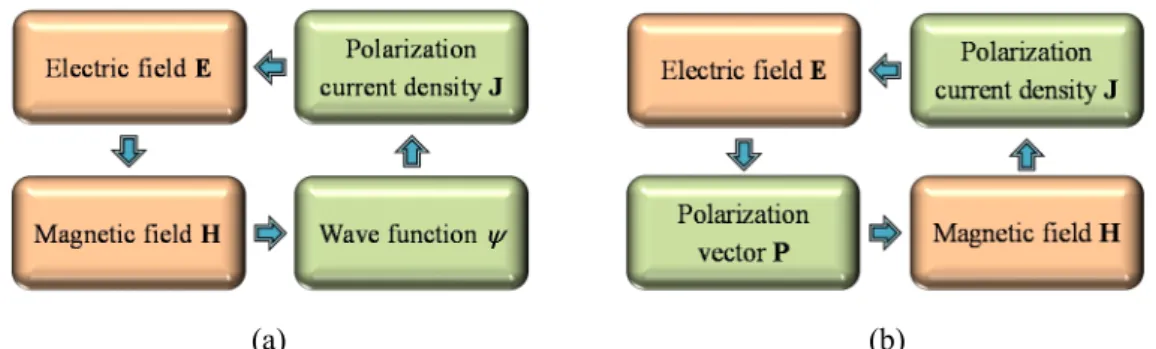
FIG. 2.2. A schematic illustration of the computational schemes for the two hybrid simulations:
Maxwell-Newton (a) and Maxwell-Schrödinger (b).
13
2.1.1 Maxwell-Schrödinger hybrid scheme for 1D-1D problems
The computational procedure to solve the Maxwell-Schrödinger hybrid scheme is schematically illustrated in Figure 2.2 (a). Maxwell’s equations for dielectric objects are given by
0 , t
E H (2.1)
0 E J,
H t (2.2)
where J represents the polarization current density defined by the time derivative of the polarization vector P. Since the electromagnetic fields have only Ey and Hz components in the present section, they can be updated by the following recursion relations based on the Maxwell FDTD method [14-16, 18-19, 36-37, 40]:
, ) ( ) 1 ( )
2 / 1 ( )
2 / 1 (
0 2
/ 1 2
/
1 E i E i
x i t
H i
Hzn zn ny yn (2.3)
, ) ( )
2 / 1 ( )
2 / 1 ( )
( )
( 1/2
0 2
/ 1 2
/ 1 0
1 n F
y n F
n z n z
n y
y t i i J i
i H i
x H i t
E i
E (2.4)
where iF, and represents the cell position of the thin film and Kronecker delta function, respectively. The edges of computational domain in the Maxwell FDTD simulation are supplemented by the Mur absorbing boundary condition [37].
The Schrödinger equation for an electron subjected to a laser field is given by 2 ,
2 2
V m q
i t E r (2.5)
where V represents the confining electrostatic potential and the so-called length gauge has been adopted to describe the interaction between the electron and the electromagnetic field [41]. Since the electron simulated here has the degree of freedom for only the y-axis, the following recursion relations based on the Schrödinger FDTD method [14-16, 18-19, 38-39] can be obtained by separating the real and imaginary parts of the Schrödinger equation:
), ( ) ( ) ( ) ( )
2 ( ) ( )
( 1/2
2 /
1 t V j qY j E i j
m j j t
j imagn j realn yn F realn
imagn (2.6)
), ( )
( ) ( ) ( )
2 ( ) ( )
( 1/2 1/2 1/2
1 t V j qY j E i j
m j j t
j realn j imagn yn F imagn
realn (2.7)
where imag and real are the imaginary and real parts of the wave function with Y denoting the discretizing y-axis. The operator j in these equations performs the following sixth-order accurate difference to simulate the second-order derivative 2/ y2 for an arbitrary function F:
, ) 3 ( ) 2 ( 5 . 13 ) 1 ( 135 ) ( 245
) 1 ( 135 ) 2 ( 5 . 13 ) 3 90 (
) 1
( 2
F F
F F
F F
F F
(2.8)
14
where and correspond to one of i, j, or k and one of x, y, or z, respectively.
We employ the following Dirichlet boundary for the Schrödinger FDTD simulation:
. 0 ) ( ) 1 ( ) 2 (
, 0 ) 3 ( ) 2 ( ) 1 (
max max
max j j
j (2.9)
This condition is well-known to induce spurious oscillations when the wave function impinges on the boundary. Therefore, we utilize sufficient wide analysis domain so as to avoid these numerical artifacts.
The polarization current density J in the Maxwell-Schrödinger scheme is defined by the following expression with the electron density N:
* d .
qN im
J (2.10)
Eq. (2.10) describes the average behaviour of the current density due to the motion of all electrons expressed by the wave function of a representative electron. The y component of (2.10) can be evaluated by
3
4
2 / 1 2
/ 1 2
/ 1 2
/ 1 2
/
1 ( ) ( ) ( ) ( ) ( ) ,
K j
realn n y
n imag imag n y
real n F
y j j j j
m y i qN
J (2.11)
where the operator y performs the following sixth-order accurate difference to simulate the first- order derivative / y for an arbitrary function F.
. ) 3 ( ) 2 ( 9 ) 1 ( 45
) 1 ( 45 ) 2 ( 9 ) 3 60 (
) 1 (
F F
F
F F
F F
(2.12) The Maxwell-Schrödinger hybrid scheme for 1D-1D problems can be operated by using Eqs.
(2.3), (2.4), (2.6), (2.7), and (2.11) recursively as illustrated in Figure 2.2 (a).
2.1.2 Maxwell-Newton hybrid scheme for 1D-1D problems
The computational procedure adopted in the Maxwell-Newton scheme is shown in Figure 2.2 (b).
The part for solving Maxwell’s equations is the same as in the Maxwell-Schrödinger schemes based on (2.3) and (2.4). The following Newton equation is employed to describe the motion of a classical electron confined by the electrostatic potential V and subjected to an external electromagnetic field:
2 ,
2
F r E
dt q
md (2.13)
, V
F (2.14)
where we assume that the electron feels no frictional force. The polarization vector P and polarization current density J in the Maxwell-Newton scheme [14-15, 40] are, respectively, defined by
15
, r
P qN (2.15)
t.
J P (2.16)
Ones can derive the following recursion relations for simulating these polarization and current density in the FDTD framework as
, ) ( ) ( )
( )
( 1/2
2 /
1 n F
y n F
y n F
y n F
y qE i F i
m t i qN
J i
J (2.17)
).
( )
( )
( 1/2
1
F n y F
n y F n
y i P i tJ i
P (2.18)
In the Maxwell-Newton scheme Eqs. (2.3), (2.4), (2.17), and (2.18) are solved recursively as displayed schematically in Figure 2.2 (b).
2.2 Computational results
The incident laser fields characterized by rather strong intensity are generated from the following electric and magnetic current sources J(ie) and J(im) with the unit function u(t)
ˆ , ) ( / exp
2 0 0
0 ) 0
( y
t
ei t t u t
x
J a
J (2.19)
ˆ , ) ( )exp
/ (
2 0 0
0 ) 0
( z
t
mi t t u t
x
J a
J (2.20)
where we have set J0, x, t, and t0 as 1000 MA/m, 0.125 nm, 1.25 fs, and 20 t fs, respectively.
The time step t is chosen to be smaller by a factor of 0.9 than tCFL, i.e., the maximum value allowed in the CFL condition [37], so as to guarantee numerical stability.
We compare the results simulated by the Maxwell-Schrödinger and Maxwell-Newton schemes for the following three electrostatic potentials Vh, Vla, and Vga :
2 , y2
Vh m h (2.21)
, 5
. 0 exp
l l l
h la
y V y
V
V (2.22)
,
4
g g
ga y
V y
V (2.23)
16
where the parameters characterizing the potentials, h , Vl, l , yl , Vg, and yg , are given as 50 Trad/s, 0.5 eV, 0.625 nm, 10 1 nm, 4.5 eV, and 25 nm, respectively. The potential energy curves for these three potentials are plotted in Figure 2.3. As displayed in this figure Vh is a single-well and harmonic potential, while Vla is almost identical to this Vh potential but is locally supplemented by a small anharmonic ‘humps’ located at around y = -6.25 nm. This hump allows the quantum electron to bifurcate every time when it impinges on the hump owing to tunnelling while does not for the classical electron. The third potential Vga is a single-well but globally anharmonic potential, which allows us to investigate a different quantum mechanical effect other than that caused by tunnelling. We have chosen the ground state of each of these electrostatic potentials as the initial wave packet in all quantum simulations.
2.2.1 Excitation by a strong electromagnetic field
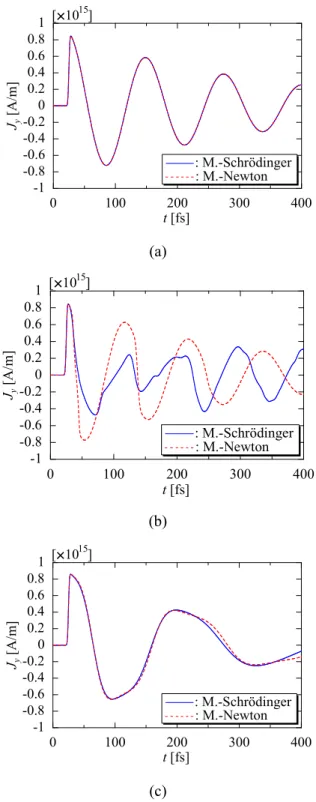
The time responses of the polarization current density J in the thin film obtained by the two hybrid simulations are represented in Figure 2.4, where the blue solid and red broken lines represent, respectively, the numerical results obtained by the Maxwell-Schrödinger and Maxwell- Newton schemes. Figure 2.4 (a) representing the results for the single and harmonic well Vh shows that both results agree excellently, indicating that the classical theory of the Maxwell-Newton scheme can be safely used for this case. On the other hand, Figure 2.4 (b), displaying the results for the locally anharmonic double-well potential Vla, shows that the polarization current densities obtained from these two schemes deviates from each other more and more strongly after the first FIG. 2.3. Spatial profile of the studied electrostatic potentials: the blue line with circles represents the harmonic potential Vh while the red and green lines denote the locally anharmonic potential Vla
and globally anharmonic potential Vga, respectively.
V[eV]
y[nm]
: Vh : Vla : Vga
-25 -20 -15 -10 -5 0 5 10 15 20 25 0
1 2 3 4 5
17
30 fs. This indicates that the Maxwell-Newton scheme is unreliable for this locally anharmonic potential. The results displayed in Figure 2.4 (c) for the single but globally anhamonic well Vga
shows a trend somewhat between (a) and (b): the polarization current density of the Maxwell- Newton scheme roughly follows that of the Maxwell-Schrödinger scheme, but there can be observed a quantitative difference between them. This indicates that the Maxwell-Newton scheme could become unreliable for quantitative calculation even when the confining potential is single but globally anharmonic well.
18 (a)
(b)
(c)
FIG. 2.4. Comparison of the time response of the polarization current density for the electrostatic potentials Vh , Vla , and Vga (See Figure 2.3). (a), (b), and (c) correspond, respectively, to the case for the electrostatic potentials Vh , Vla , and Vga. The blue solid and red broken lines represent the results obtained by the Maxwell-Schrödinger and Maxwell-Newton schemes, respectively.
0 100 200 300 400
-1 -0.8 -0.6 -0.4 -0.2 0 0.2 0.4 0.6 0.8 1
t[fs]
Jy[A/m]
: M.-Newton : M.-Schrödinger [ 10× 15]
0 100 200 300 400
-1 -0.8 -0.6 -0.4 -0.2 0 0.2 0.4 0.6 0.8
1
t[fs]
Jy[A/m]
: M.-Newton : M.-Schrödinger [ 10× 15]
0 100 200 300 400
-1 -0.8 -0.6 -0.4 -0.2 0 0.2 0.4 0.6 0.8 1
t[fs]
Jy[A/m]
: M.-Newton : M.-Schrödinger [ 10× 15]
19
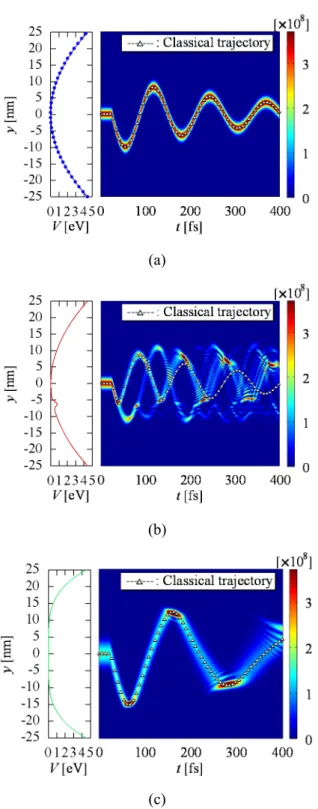
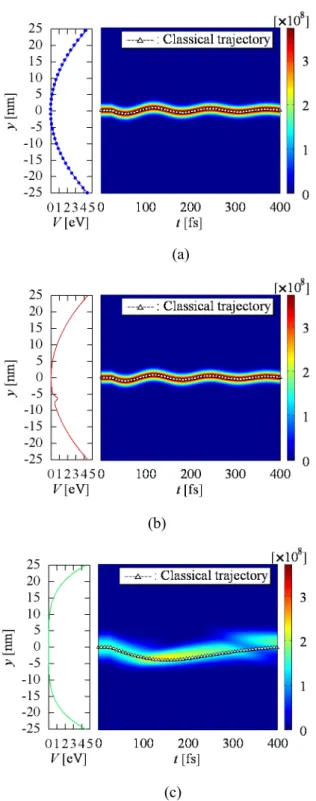
In order to rationalize the observed trends, we have investigated the dynamics of electron in the thin film, namely, the spatiotemporal propagation of the electron wave packets and the corresponding classical trajectories obtained, respectively, by the Maxwell-Schrödinger and Maxwell-Newton schemes. The results for the three electrostatic potentials Vh , Vla , and Vga are displayed in Figures 2.5 (a), (b), and (c), respectively. In the figures the thick oscillatory curve in color whose scale is displayed on the right end of each figure indicates the time-evolution of the probability density of the electron wave packet | |2 and the triangles plotted in the same figure denote the classical trajectory. On the left-hand side of each figure the potential energy curve of the corresponding electrostatic potential is also plotted. The vertical axes for both sides of the figure commonly indicate the y axis. As shown in Figure 2.5 (a) representing the results for the single and harmonic well Vh, the electron wave packet is localized at each time step keeping a Gaussian shape similar to the ground state and closely follows the corresponding classical trajectory. This excellent agreement between the quantum and classical electron dynamics results in an almost identical behaviour of the current densities obtained by these two schemes as displayed in Figure 2.4 (a). On the other hand, Figure 2.5 (b) representing the results for the double-well and locally anharmonic potential Vla shows that the electron wave packet gets fragmented into several pieces due to the tunnelling. Furthermore interference among these fragments makes the wave packet complicated even further. Since the classical dynamics could not support such fragmentation and interference, the current density obtained by the Maxwell- Newton scheme deviates largely from that obtained by the Maxwell-Schrödinger scheme as observed in Figure 2.4 (b). Figure 2.5 (c), representing the results for the globally anharmonic potential Vga, shows that the electron wave packet follows the corresponding classical trajectory in the beginning before t ~ 200 fs. For the later time t, however, the electron wave packet starts to spread gradually and a nodal structure in the probability density appears. This nodal structure reflects the fact that the electron wave packet is no more a single Gaussian distribution but is fragmented into a few components. In case for purely harmonic electrostatic potentials an initial Gaussian wave packet remains to be a Gaussian through time propagation. Therefore, the observed fragmentation is caused by global anharmonicity in the electrostatic potential, which induces dephasing of the electron wave packet. Since classical mechanics cannot account for such dephasing effects, the classical trajectory deviates from the center of the electron wave packet, which causes a difference in the polarization current density between the two schemes.
20 (a)
(b)
(c)
FIG. 2.5. Time evolution of the electron wave packet and the corresponding classical trajectory.
(a), (b), and (c) indicate, respectively, the results for the electrostatic potential Vh , Vla , and Vga . The spatial profile of the potential is displayed on the left-hand side of each figure. The thick curve in color scale represents the probability density of the electron.
21
2.2.2 Excitation by a weak electromagnetic field
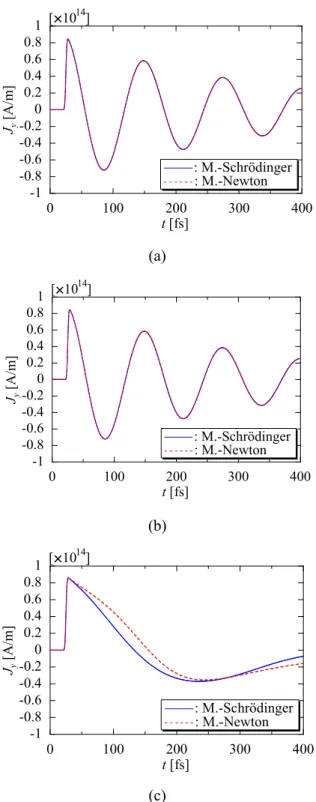
Next, we have examined a dependence of the computational results on the strength of the applied laser field. Since the applied laser field we have studied so far is rather strong, we have employed a weaker laser field here by decreasing the amplitude of the current sources 10 times smaller than that used for the simulations in Figures 2.4 and 2.5 as J0 = 100 MA/m. Figures 2.6 (a) and (b) display the resultant time responses of the polarization current densities J for the harmonic single- and locally anharmonic double-well potentials Vh and Vla . The blue solid and red broken lines represent the results obtained by the Maxwell-Schrödinger and Maxwell-Newton schemes, respectively, as for Figure 2.4. Unlike the results in Figure 2.4 the polarization current densities for not only the harmonic single-well potential Vh but also the locally anharmonic double-well potential Vla obtained by the two schemes agree very well as displayed in Figure 2.5 (a) and (b). On the other hand, Figure 2.6 (c) representing the result for the gobally anharmonic single-well potential Vga shows that the computational results by the two hybrid simulations still differs quantitatively from each other.
22 (a)
(b)
(c)
FIG. 2.6. Comparison of the time response of the polarization current density for different electrostatic potentials. (a), (b), and (c) correspond, respectively, to the cases of Vh , Vla , and Vga. The thin film is subjected to the weak electromagnetic fields excited by current sources with the amplitude J0 = 100 MA/m. See the caption to Figure 2.4 for other remarks.
0 100 200 300 400
-1 -0.8 -0.6 -0.4 -0.2 0 0.2 0.4 0.6 0.8
1
t[fs]
Jy[A/m]
: M.-Newton : M.-Schrödinger [ 10× 14]
0 100 200 300 400
-1 -0.8 -0.6 -0.4 -0.2 0 0.2 0.4 0.6 0.8 1
t[fs]
Jy[A/m]
: M.-Newton : M.-Schrödinger [ 10× 14]
0 100 200 300 400
-1 -0.8 -0.6 -0.4 -0.20 0.2 0.4 0.6 0.8
1
t[fs]
Jy[A/m]
: M.-Newton : M.-Schrödinger [ 10× 14]
23
As has been done in Figure 2.5 for the strong electromagnetic field, the time evolution of the electron wave packet and the corresponding classical trajectory for this weak laser field are displayed in Figure 2.7, where (a), (b), and (c) denote the numerical results for Vh , Vla , and Vga , respectively. It is noted that Figures 2.7 (a) and (b), representing the results for Vh and Vla , are almost identical to each other and that no fragmentation of the electron wave packet is observed for the locally anharmonic double-well case unlike the corresponding result in Figure 2.5 (b). This can be rationalized by the small strength of the laser field as follows: Since the electric field of the laser pulse is small, it could not give enough energy to the electron to reach the hump of the potential, namely local anharmonicity, for Vla. Therefore, since the potential energy curves of Vh
and Vla below this hump are exactly the same harmonic potential, their electron dynamics should naturally be identical to each other for this weak strength of the laser field. In the case of the globally anharmonic potential Vga illustrated in Figure 2.7 (c), however, the electron wave packet spreads as the time proceeds and it undergoes bifurcation after t = 300 fs. Therefore, this dephasing effect existing only in the quantum simulation causes a difference between the results obtained by the two schemes even when the laser field is sufficiently weak.
24
(a)
(b)
(c)
FIG. 2.7. Time evolution of the electron wave packet and the corresponding classical trajectory for the weak electromagnetic fields excited by current sources with the amplitude J0 = 100 MA/m. (a), (b), and (c) correspond, respectively, to the cases of the electrostatic potential Vh , Vla , and Vga . See the caption to Figure 2.5 for other remarks.
25
The present investigations show that the conventional Maxwell-Newton scheme can be applied not only to macroscopic problems as have been studied in most cases but also to microscopic problems of a nano-scale order on condition that the electrostatic confining potential for electron is purely harmonic. However, when the electrostatic potential deviates from a harmonic one even slightly, the Maxwell-Newton scheme would give unreliable results owing to quantum-mechanical tunnelling and/or anharmonicity effects. Therefore, such problems should be solved by the Maxwell-Schrödinger hybrid scheme.
2.3 Discussion
In this section we have focused on light-matter interaction by many electron systems especially with respect to the anharmonisity of the confining electrostatic potential, and investigated the interaction between laser fields and a nano-scale thin film, assumed as the surface of plasmonic devices, which is modelled by a representative electron among those. The two distinct hybrid simulations, the Maxwell-Schrödinger and the conventional Maxwell-Newton schemes, have been compared for three types of the potential structure consisted of the harmonic single-, locally anhharmonic double-, and globally anharmonic single-well. The computational results show that the two multi-physics simulations provide almost identical results for the harmonic confining potential, indicating a validity of use of the conventional Maxwell-Newton scheme for this case. In the case of the locally anharmonic double-well potential, however, the results by the Maxwell-Newton approach differ significantly from those by the Maxwell- Schrödinger approach when the tunnelling plays an important role. Finally, for the case of the globally anharmonic single-well potential, the result of the Maxwell-Newton simulation deviates from that of the Maxwell-Schrödinger simulation quantitatively owing to an effect of dephasing of the electron wave packet by the anharmonicity in the electrostatic potential. These results have clearly demonstrated that the Maxwell-Schrödinger scheme is indispensable to multi-physics simulation particularly when the tunnelling, interference and anharmonicity effects play an essential role.
26
3 Light-matter interaction: single-electron systems
A novel scheme of designing laser pulses for controlling discrete quantum states has been proposed relying on the highly-accurate Maxwell-Schrödinger hybrid simulation. A single electron confined in a quasi-one-dimensional nanoscale potential well has been used as an illustrative example and a control pulse to be modulated as transferring completely the probability density from the ground state to the first excited state has been designed by the present Maxwell- Schrödinger hybrid scheme and by the conventional one that solves the time-dependent Schrödinger equation only without accounting for feedback from the electron system to the external electromagnetic field. The resultant pulses obtained by these two methods can be different largely owing to the modification of the laser field by the locally strong radiation from the excited electron. The present study demonstrates that light control pulses designed by the conventional method may need to be rectified for practical implementation in experimentations.
3.1 Theoretical model and computational details
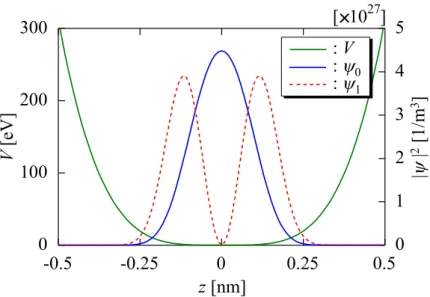
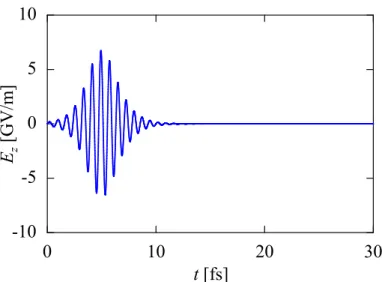
In the present study we consider a model system of an electron confined in a quasi-one- dimensional space (chosen as being parallel to the z axis) and irradiated by a pulsed laser field polarized along this z axis. The geometry and coordinates of the studied system is schematically illustrated in Figure 3.1. Since the laser field is polarized along the z axis, the initial electric and magnetic fields, E and H, have only the z and y component, respectively, i.e., E = (0, 0, Ez) and H = (0, Hy, 0) as displayed in Figure 3.1. Also the other components of electromagnetic fields, however, must be solved because those explicitly appear as soon as near field by the excited electron is generated. Therefore, the model system simulated here has the three- and one- dimensional degree of freedom for the electromagnetic fields and electron, respectively. After this subsection the formulation of Maxwell-Schrödinger hybrid scheme to solve the 3D-1D problem will be described with conventional designing scheme for a light control pulse [32].
![FIG. 3.4. The spatiotemporal propagation of the z component of the electric field E z [(a)], the polarization current density J z [(b)], and the probability density of the electron wave packet | | 2 [(c)] obtained by the Maxwell-Schrödinge](https://thumb-ap.123doks.com/thumbv2/123deta/6009824.2071563/36.892.232.659.168.732/spatiotemporal-propagation-component-electric-polarization-probability-electron-schrödinge.webp)
![FIG. 3.6. The spatiotemporal propagation of the z component of the electric field E z [(a)], the polarization current density J z [(b)], and the probability density of the electron wave packet | | 2 [(c)] obtained by the Maxwell-Schröding](https://thumb-ap.123doks.com/thumbv2/123deta/6009824.2071563/39.892.229.657.162.726/spatiotemporal-propagation-component-electric-polarization-probability-electron-schröding.webp)
![FIG. 3.7. The spatiotemporal propagation of the z component of the electric field E z [(a)], the polarization current density J z [(b)], and the probability density of the electron wave packet | | 2 [(c)] obtained by the Maxwell-Schröding](https://thumb-ap.123doks.com/thumbv2/123deta/6009824.2071563/40.892.232.660.171.734/spatiotemporal-propagation-component-electric-polarization-probability-electron-schröding.webp)
