A Retrospective Study of Canine Idiopathic Epilepsy in Referral Centers in Japan
Go TOGAWA
1, Miyoko SAITO
1, Itsuki UEBAYASHI
1, Yumi OHNISHI
2and Hinako YAMAZOE
21 Laboratory of Surgery II, School of Veterinary Medicine, Azabu University, 1-17-71 Fuchinobe Chuo-ku Sagamihara Kanagawa, 252-5201 Japan
2 Companion Animal Medical Imaging Center, 3-5-7 Hisamoto, Takatsu, Kawasaki, Kanagawa, 213-0011, Japan
Abstract: Idiopathic epilepsy (IE) is one of the most common neurologic disorder in dogs. The aim of this study was to describe the clinical data of dogs with IE in Japan and to search for predisposing factors of IE for further investigation. Medical records and clinical information of dogs diagnosed with IE at 2 referral centers between April 2013 and March 2016 were retrospectively reviewed. It was conducted according to the consensus state- ment published by International Veterinary Epilepsy Task Force. A total of 70 dogs were used with a median (range) weight of 5.15 (1.85–79.85) kg and age at initial epileptic seizure onset of 4.2 (0.3–11.8) years. Forty- four dogs were male, and 26 were female. Toy Poodles were over-represented in the present study indicating that this breed may be predisposed to IE and would be a candidate for gene study to elucidate the cause of IE in dogs.
Keywords: Canine, Idiopathic epilepsy, Retrospective study, International Veterinary Epilepsy Task Force, Toy Poodle
Introduction
Epilepsy is one of the most common chronic neurological disorder in both dogs and humans. The prevalence has been reported to be 0.6-0.75% in dogs1,2). Recently, International Veterinary Epilepsy Task Force (IVETF) was organized and series of a consensus statement on canine epilepsy were published in 20153-10). About half of the dogs with epilepsy is classified as idiopathic epilepsy (IE). IE is defined as epilepsy of predominantly genetic or presumed genetic origin and in which there are no gross neuroanatomical or neuropatho- logical abnormalities nor other relevant underlying diseases causing seizure activity4). Today, there are 3 genes reported to be associated with IE in specific breeds11-13) but the cause of IE remains unknown. A further genetic study is needed to elucidate the cause of IE. There is no cure for IE and
most of the dogs with this disease need to be medicated with antiepileptic drug (AED) for its life to prevent an epileptic seizure. Despite adequate AEDs, 20–30% of the epileptic dogs will remain inadequate seizure control14-16). Seizures have an impact on both affected animals and the owners of the animals17-19). There are several epidemiological studies on epilepsy in dogs20-23). The epidemiological distribution varies from region to region. There is only one epidemiological study from Japan on epilepsy in dogs recently reported22). Further study on IE is required to understand the disease in Japan. Therefore, the aim of this study is to describe the clinical data of dogs with IE in Japan and to search for predisposing factors of IE for further investigation.
Materials and Methods
The medical record of dogs diagnosed with IE at the Neu- rology service of the Azabu University Veterinary Teaching Corresponding author: Miyoko Saito (e-mail: [email protected])
Hospital (AUVTH) and clinical information of the dogs diagnosed with IE at Companion Animal Medical Imaging Center (CamiC) sent to Neurology service of the AUVTH between April 2013 and March 2016 were retrospectively reviewed. The diagnosis of IE was made according to the IVETF consensus statement5). Information collected included signalment (body weight, the age of initial epileptic seizure onset, sex, breed), and seizure type. According to the IVETF consensus statement4), seizure type was classified to focal epileptic seizure (FES), generalized epileptic seizure (GES) and focal epileptic seizure evolving into generalized epileptic seizure (FEvG). For analysis of breed as a risk factor for IE, the control population consisted of all dogs evaluated at the AUVTH between April 2013 and March 2016, that did not have diagnosed with IE at the Neurology service.
Further investigation was performed in dogs diagnosed at Neurology service of the AUVTH. These include the duration of the seizure, whether the dog had ever had an episode of cluster seizure (CS) or status epilepticus (SE), autonomic sign during the seizure, prodrome, post-ictal phenomenon, short-term (6 months) therapeutic outcome and QOL of the dogs and their owners. According to the IVETF consensus statement8), the dogs were evaluated their achievement of therapeutic outcome to the following 3 levels; primary goal (seizure free or seizure frequency decreased to 1/3 and seizure frequency is < 0.3 times/month), secondary goal (become cluster seizure / status epilepticus free or relatively decreased seizure frequency or decreased seizure severity) and no re- sponder (other than primary goal and secondary goal). The owners were asked to answer to the questionnaire17) at their visit to AUVTH or sent the questionnaire by mail.
The Kruskal-Wallis test was used to evaluate differences in the duration of the seizure among seizure types. Breed distributions of dogs with IE (the breed that had 5 or more dogs diagnosed with IE) were compared with breed distribu- tion of the control dogs examined at the AUVTH. P values, odds ratios (ORs) and their 95% confidence intervals (CIs) were calculated for each comparison made. P values were calculated by means of Fisher exact tests. The value of P <
0.05 was considered significant. Statistical analyses were performed using JMP®7.0.1 (SAS Institute).
Results
Twenty-eight dogs were diagnosed with IE at Neurology service of AUVTH and the clinical information of 42 dogs diagnosed with IE at CamiC was sent to Neurology service of the AUVTH. A total of 70 dogs with IE were used in this study with a median (range) weight of 5.15 (1.85–79.85) kg and age of initial epileptic seizure onset of 4.2 (0.3–11.8) years. Forty-four dogs were male (27 castrated), and 26 were female (15 spayed). The breeds included 16 Toy Poodles, 10 Chihuahuas, 6 Miniature Dachshunds, 4 each of Italian Greyhounds and mixed-breed dogs, 3 each of Cavalier King Charles Spaniels and Yorkshire Terriers, 2 each of American Cocker Spaniels, Beagles, Pekingeses, Boston Terriers, Pom- eranians and Miniature Schnauzers and 1 each of Pembroke Welsh Corgi, Cairn Terriers, Shih-Tzu, Shetland Sheep Dog, Jack Russell Terrier, Shiba, Pug, Saint Bernard, Papillon, French Bulldog, Miniature Pinscher, Wire Fox Terrier. The 4779 dogs examined at the AUVTH were included in the study as control dogs for analysis of breed as a risk factor for IE. Toy Poodles had a higher probability of having IE (P
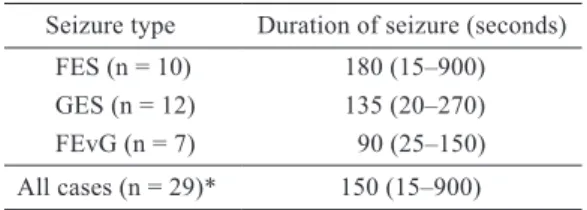
= 0.03; OR = 3.08; 95% CI, 1.24–7.64) compared with that of Chihuahuas (P = 0.80; OR = 0.44; 95% CI, 0.06–3.23) and Miniature Dachshunds (P = 0.73; OR = 1.13; 95% CI, 0.43–2.99). Twenty-one (30 %) dogs were FES, 37 (53 %) were GES and 9 (13 %) were FEvG. Two (2.7 %) dogs had both GES and FEvG and 1 (1.3 %) dog’s seizure type was unknown. The median (range) duration of the seizure was 150 (15–900) seconds. The Duration of seizure of each seizure type is summarized in Table 1. There were no significant dif- ferences in duration of the seizure between 3 seizure types (P
> 0.05). Fifty-seven percent and 39 % of the dogs had CS and
Table 1 The Duration of seizure (seconds) of each seizure type (median, range)
Seizure type Duration of seizure (seconds) FES (n = 10) 180 (15–900) GES (n = 12) 135 (20–270) FEvG (n = 7) 90 (25–150) All cases (n = 29)* 150 (15–900)
*Twenty-nine seizures were analyzed from 28 dogs because 1 dog had 2 seizure type
SE, respectively. Twenty-five percent of the dogs experienced both CS and SE. Autonomic signs were observed in 68 % of the dogs. Urination was the most frequently (50 %) observed autonomic sign. Fourteen percent and 68 % of the dogs had prodrome and post-ictal phenomenon, respectively. The CS, SE, Autonomic signs, prodrome, and post-ictal phenomenon status of each seizure type is provided in Table 2. Twenty (71%) dogs were able to evaluate its therapeutic outcome.
Sixty percent was on monotherapy whereas the remaining 40
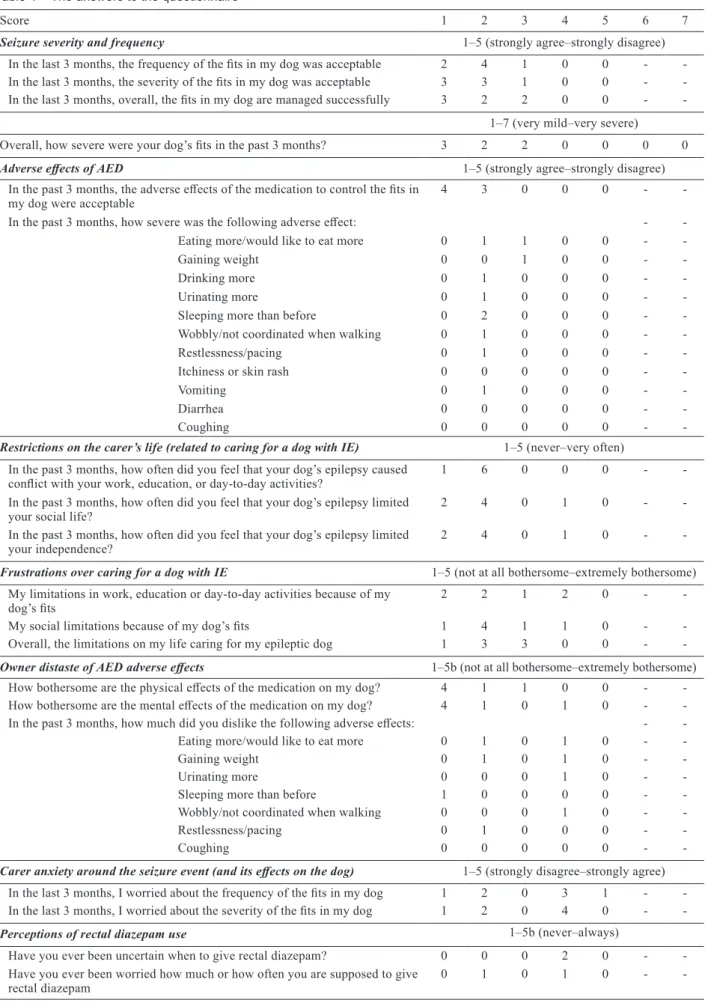
% was on two or more AEDs. Eight dogs were evaluated as the primary goal, 6 were the secondary goal and remaining 6 were no responder. The AEDs, seizure frequency prior to and after starting AED, the therapeutic outcome of each dog is provided in Table 3. Seven owners responded to the questionnaire of QOL. The answers to the questionnaire are summarized in Table 4.
Table 2 The Cluster seizure (CS), status epilepticus (SE) status, autonomic signs, prodrome and post-ictal phenomenon status of each seizure type
Seizure type (n = 10)FES GES
(n = 12) FEvG
(n = 7) All cases (n = 28)
CS 2 (20 %) 10 (83 %) 5 (71 %) 17 (57 %)
SE 4 (40 %) 5 (42 %) 2 (29 %) 11 (39 %)
CS + SE 1 (10 %) 5 (42 %) 1 (14 %) 6 (21 %)
Autonomic signs 3 (30 %) 11 (92 %) 6 (86 %) 20 (71 %)
Prodrome 1 (10 %) 3 (25 %) 0 (0 %) 4 (14 %)
Post-ictal phenomenon 4 (40 %) 9 (75 %) 6 (86%) 19 (68 %)
Table 3 The seizure type, AED, seizure frequency (times/month) prior to and after stating AED, the therapeutic outcome of each dog. The seizure frequency of the dog No.11 was not available, thus the therapeutic outcome was evaluated based on its seizure severity
Seizure frequency
Dog No. Seizure type AED Prior After Therapuetic outcome
1 GES PB 1.3 0.3 secondary goal
2 GES ZNS, LEV 4 3.8 secondary goal
3 GES PB 3.1 0 Primary goal
4 GES LEV 0.2 0 Primary goal
5 GES PB, KBr,ZNS 0.5 1 No responder
6 GES PB, KBr, ZNS, LEV 0.5 2.2 No responder
7 FES KBr, ZNS, LEV 0.3 0 Primary goal
8 FES ZNS 1 0 Primary goal
9 FES ZNS 0.2 0.2 Primary goal
10 GES PB 0 0.8 No responder
11 FES ZNS, LEV, CLP NA NA secondary goal
12 FES PB, ZNS, LEV 2 6.7 No responder
13 FEvG PB, KBr, ZNS, LEV 1.8 2.4 No responder
14 GES+FEvG ZNS 0.9 0.83 secondary goal
15 FEvG PB several times 0 Primary goal
16 FEvG ZNS 2 0.3 secondary goal
17 GES PB, KBr, ZNS, LEV 4 10 No responder
18 FEvG ZNS 1.1 0 Primary goal
19 FES ZNS 1.6 0 Primary goal
20 GES ZNS 1 1.7 secondary goal
AED: PB, phenobarbital; KBr, potassium bromide; ZNS, Zonisamide; LEV, Levetiracetam; CLP, clorazepate.
Table 4 The answers to the questionnaire17)
Score 1 2 3 4 5 6 7
Seizure severity and frequency 1–5 (strongly agree–strongly disagree)
In the last 3 months, the frequency of the fits in my dog was acceptable 2 4 1 0 0 - - In the last 3 months, the severity of the fits in my dog was acceptable 3 3 1 0 0 - - In the last 3 months, overall, the fits in my dog are managed successfully 3 2 2 0 0 - -
1–7 (very mild–very severe)
Overall, how severe were your dog’s fits in the past 3 months? 3 2 2 0 0 0 0
Adverse effects of AED 1–5 (strongly agree–strongly disagree)
In the past 3 months, the adverse effects of the medication to control the fits in
my dog were acceptable 4 3 0 0 0 - -
In the past 3 months, how severe was the following adverse effect: - -
Eating more/would like to eat more 0 1 1 0 0 - -
Gaining weight 0 0 1 0 0 - -
Drinking more 0 1 0 0 0 - -
Urinating more 0 1 0 0 0 - -
Sleeping more than before 0 2 0 0 0 - -
Wobbly/not coordinated when walking 0 1 0 0 0 - -
Restlessness/pacing 0 1 0 0 0 - -
Itchiness or skin rash 0 0 0 0 0 - -
Vomiting 0 1 0 0 0 - -
Diarrhea 0 0 0 0 0 - -
Coughing 0 0 0 0 0 - -
Restrictions on the carer’s life (related to caring for a dog with IE) 1–5 (never–very often) In the past 3 months, how often did you feel that your dog’s epilepsy caused
conflict with your work, education, or day-to-day activities? 1 6 0 0 0 - -
In the past 3 months, how often did you feel that your dog’s epilepsy limited
your social life? 2 4 0 1 0 - -
In the past 3 months, how often did you feel that your dog’s epilepsy limited
your independence? 2 4 0 1 0 - -
Frustrations over caring for a dog with IE 1–5 (not at all bothersome–extremely bothersome) My limitations in work, education or day-to-day activities because of my
dog’s fits 2 2 1 2 0 - -
My social limitations because of my dog’s fits 1 4 1 1 0 - -
Overall, the limitations on my life caring for my epileptic dog 1 3 3 0 0 - -
Owner distaste of AED adverse effects 1–5b (not at all bothersome–extremely bothersome)
How bothersome are the physical effects of the medication on my dog? 4 1 1 0 0 - -
How bothersome are the mental effects of the medication on my dog? 4 1 0 1 0 - -
In the past 3 months, how much did you dislike the following adverse effects: - -
Eating more/would like to eat more 0 1 0 1 0 - -
Gaining weight 0 1 0 1 0 - -
Urinating more 0 0 0 1 0 - -
Sleeping more than before 1 0 0 0 0 - -
Wobbly/not coordinated when walking 0 0 0 1 0 - -
Restlessness/pacing 0 1 0 0 0 - -
Coughing 0 0 0 0 0 - -
Carer anxiety around the seizure event (and its effects on the dog) 1–5 (strongly disagree–strongly agree) In the last 3 months, I worried about the frequency of the fits in my dog 1 2 0 3 1 - - In the last 3 months, I worried about the severity of the fits in my dog 1 2 0 4 0 - -
Perceptions of rectal diazepam use 1–5b (never–always)
Have you ever been uncertain when to give rectal diazepam? 0 0 0 2 0 - -
Have you ever been worried how much or how often you are supposed to give
rectal diazepam 0 1 0 1 0 - -
Discussion
Toy Poodle, Chihuahua and Miniature Dachshund were the top 3 most frequent breeds diagnosed with IE in our study.
Although these are popular breeds in Japan, the high ORs in Toy Poodles compared to other 2 breeds suggest that this breed might have a higher risk of developing IE. Several breeds were reported to be over-represented in studies of IE from various countries. These include Beagle23,24), Labrador Retriever25,26), Golden Retriever3), German Shepherd20,21) and Border Terrier20). These breeds were not over-represented in our study. This was possibly due to the difference in breed population between Western countries and Japan since the majority of our patients was small-breed dogs. One descrip- tive epidemiologic study on IE in dogs, where more than half (51.1 %) of the cases were small-breed dogs, reported a high prevalence of IE in Toy Poodles27). Therefore, Toy Poodles have a potential to be predisposed to IE and can be one of a candidate breed to investigate the association between a genetic factor and IE.
There are many studies on canine epilepsy, however, the epidemiologic study or data on IE in the literature is less com- monly available. There is a significant association between age of onset and cause of epilepsy in dogs. In the IVETF consensus statement, it is reported that age between 6 months and 6 years were more likely to be affected by IE5). One study on epilepsy from Europe reported 4.2 years old as a median age of initial seizure in 115 dogs with IE23), which is consistent with our current result. However, the median age of initial seizure was 2.5 years old in the previous report from Japan22). One possible explanation for the younger age of initial seizure in the previous report from Japan22) is that MRI and CSF analysis were required for the inclusion criteria for dogs with the onset of more than 6 years old in this study but not in the current study and study from Europe23). The criteria in the previous study from Japan22) made it difficult to recruit dogs more than 6 years old in age. The percentage of male dog (63%) diagnosed with IE was slightly higher compared with that of the female dog (37%) in our study. This was consistent with several previous reports21-25) indicating that male dogs are prone to IE.
The dog that had the episode of CS (57%) and SE (39%)
was observed in this study. In 2001, it had been reported that 19 of the 32 (59%) dogs with IE had 1 or more episodes of SE25). Dogs that had one or more episodes of SE is slightly decreased in our study compared to this previous report25). This may be due to the improvement of AEDs in the veteri- nary field in the past 20 years. Although our results are not the general population but population in the referral hospital, these data encourage the veterinarians to inform the owners about the risk of development of CS and SE in dogs with IE.
Most of the dogs with the seizure type of GES (92%) and FEvG (86%) showed autonomic signs associated with their seizures whereas only 30% of the dogs with FES had the autonomic sign. Differentiation of epileptic seizure and other episodic event are challenging in some situations. In general, it is known that autonomic signs are one of the indicators to suspect epileptic seizure and our results of generalized seizure are consistent with that. However, the differentiation of FES and other episodic event remains challenging since the autonomic sign was observed in a low population of dogs with FES (30%) in this study.
In human medicine, AEDs are selected based on the pa- tient’s seizure type. However, in dogs, there is no evidence for selecting AEDs for specific seizure type. Therefore, evaluation of efficacy for specific seizure types in dogs is required but it is difficult to perform the study in a single institution. To address this problem, IVETF advocated to use the evaluation of therapeutic outcome measure in the consensus statement in order to draw comparisons among institutions3,8). Although the aim of this current study was not only evaluation of therapeutic outcome and could not evaluate the efficacy for seizure types, we utilized the evalu- ation of therapeutic outcome measure according to the IVETF consensus statement and our data enabled to be utilized in the future investigation of evaluating AEDs’ efficacy for specific seizure type.
Seizure frequency of fewer than 0.3 times/month is reported to be the acceptable for the owners in Europe19). In our study, none of the owners answered their dog’s seizure is unacceptable or sever. This is indicating that there is a differ- ence in perception to seizure between the regions. However, seizure frequency of more than 0.3 times/month is reported as a risk factor to decrease the survival time in dogs with epi-
lepsy22). Therefore, it is important to inform it to the owners especially in Japan. The questionnaire revealed the objective data of how the owners are thinking about their dog’s seizure and what is the problem for the owners in their treatment of their epileptic dogs. Although we cannot conclude with our small sample size, it may be said that the questionnaire of QOL provides useful data for improving management of the epileptic dogs and communicate with their owners.
Conclusions
This study described the clinical data of dogs with IE in 2 referral centers in Japan. Toy Poodles were over-represented in the present study suggesting that this breed can be a good candidate for genetic investigation. Since the data acquisi- tion was performed with an accordance to IVETF consensus statement, this study will provide useful data for further investigation on IE in dogs.
Acknowledgements
We would like to thank the owners and dogs for their par- ticipation, and we gratefully acknowledge the veterinarians and staffs of CamiC for contributing to our study.
References
1) Kearsley-Fleet L, O’Neill DG, Volk HA, Church DB, Brodbelt DC. 2013. Prevalence and risk factors for canine epilepsy of unknown origin in the UK. Vet Rec.172, 338.
2) Heske L, Nodtvedt A, Jaderlund KH, Berendt M, Egenvall A. 2014 A cohort study of epilepsy among 665,000 insured dogs: incidence, mortality and survival after diagnosis. Vet J. 202, 471–476.
3) Volk HA. 2015. International Veterinary Epilepsy Task Force consensus reports on epilepsy definition, classification and terminology, affected dog breeds, diagnosis, treatment, outcome measures of therapeutic trials, neuroimaging and neuropathology in companion animals. BMC Vet Res. 11, 174.
4) Berendt M, Farquhar RG, Mandigers PJ, Pakozdy A, Bhatti SF, De Risio L, Fischer A, Long S, Matiasek K, Muñana K, Patterson EE, Penderis J, Platt S, Podell M, Potschka H, Pumarola MB, Rusbridge C, Stein VM, Tipold A, Volk HA. 2015. International veterinary epilepsy task force consensus report on epilepsy definition, classification and
terminology in companion animals. BMC Vet Res. 11, 182.
5) De Risio L, Bhatti S, Muñana K, Penderis J, Stein V, Tipold A, Berendt M, Farqhuar R, Fischer A, Long S, Mandigers PJ, Matiasek K, Packer RM, Pakozdy A, Patterson N, Platt S, Podell M, Potschka H, Batlle MP, Rusbridge C, Volk HA. 2015. International veterinary epilepsy task force consensus proposal: diagnostic approach to epilepsy in dogs. BMC Vet Res. 11, 148.
6) Hülsmeyer V, Fischer A, Mandigers PJJ, DeRisio L, Berendt M, Rusbridge C, Bhatti SFM, Pakozdy A, Patterson EE, Platt S, Packer RMA,Volk HA. 2015. International veterinary epilepsy task force’s current understanding of idiopathic epilepsy of genetic or suspected genetic origin in purebred dogs. BMC Vet Res. 11, 175.
7) Bhatti SFM, De Risio L, Muñana K, Penderis J, Stein VM, Tipold A, Berendt M, Farquhar RG, Fischer A, Long S, Löscher W, Mandigers PJJ, Matiasek K, Pakozdy A, Patterson EE, Platt S, Podell M, Potschka H, Rusbridge C, Volk HA. 2015. International veterinary epilepsy task force consensus proposal: medical treatment of canine epilepsy in Europe. BMC Vet Res. 11, 176.
8) Potschka H, Fischer A, Löscher W, Patterson N, Bhatti S, Berendt M, De Risio L, Farquhar R, Long S, Mandigers P, Matiasek K, Muñana K, Pakozdy A, Penderis J, Platt S, Podell M, Rusbridge C, Stein V, Tipold A, Volk HA. 2015.
International veterinary epilepsy task force consensus proposal: outcome of therapeutic interventions in canine and feline epilepsy. BMC Vet Res. 11, 177.
9) Rusbridge C, Long S, Jovanovik J, Milne M, Berendt M, Bhatti SF, De Risio L, Farqhuar RG, Fischer A, Matiasek K, Muñana K, Patterson EE, Pakozdy A, Penderis J, Platt S, Podell M, Potschka H, Stein VM, Tipold A, Volk HA. 2015. International veterinary epilepsy task force recommendations for a veterinary epilepsy-specific MRI protocol. BMC Vet Res. 11, 194.
10) Matiasek K, Pumarola I, Batlle M, Rosati M, Fernández- Flores F, Fischer A, Wagner E, Berendt M, Bhatti SF, De Risio L, Farquhar RG, Long S, Muñana K, Patterson EE, Pakozdy A, Penderis J, Platt S, Podell M, Potschka H, Rusbridge C, Stein VM, Tipold A, Volk HA. 2015. International veterinary epilepsy task force recommendations for systematic sampling and processing of brains from epileptic dogs and cats. BMC Vet Res. 11, 216.
11) Seppälä EH, Jokinen TS, Fukata M, Fukata Y, Webster MT, Karlsson EK, Kilpinen SK, Steffen F, Dietschi E, Leeb T, Eklund R, Zhao X, Rilstone JJ, Lindblad-Toh K, Minassian BA, Lohi H.2011. LGI2 truncation causes a remitting focal epilepsy in dogs. PLoS Genet. 7, e1002194.
12) Seppälä EH1, Koskinen LL, Gulløv CH, Jokinen P, Karlskov-Mortensen P, Bergamasco L, Baranowska
Körberg I, Cizinauskas S, Oberbauer AM, Berendt M, Fredholm M, Lohi H. 2012. Identification of a novel idiopathic epilepsy locus in Belgian Shepherd dogs. PLoS One. 7, e33549.
13) Wielaender F, Sarviaho R, James F, Hytönen MK, Cortez MA, Kluger G, Koskinen LL, Arumilli M, Kornberg M, Bathen-Noethen A, Tipold A, Rentmeister K, Bhatti SF, Hülsmeyer V, Boettcher IC, Tästensen C, Flegel T, Dietschi E, Leeb T, Matiasek K, Fischer A, Lohi H. 2017.
Generalized myoclonic epilepsy with photosensitivity in juvenile dogs caused by a defective DIRAS family GTPase 1. Proc Natl Acad Sci U S A. 114, 2669-2674.
14) Trepanier LA, Van Schoick A, Schwark WS, Carrillo J. 1998. Therapeutic serum drug concentrations in epileptic dogs treated with potassium bromide alone or in combination with other anticonvulsants: 122 cases (1992- 1996). J Am Vet Med Assoc. 213, 1449-1453.
15) Schwartz-Porsche D, Löscher W, Frey HH. 1985.
Therapeutic efficacy of phenobarbital and primidone in canine epilepsy: a comparison. J Vet Pharmacol Ther. 8, 113-119.
16) Podell M, Fenner WR. 1993. Bromide therapy in refractory canine idiopathic epilepsy. J Vet Intern Med. 7, 318-327.
17) Wessmann A, Volk HA, Parkin T, Ortega M, Anderson TJ.
2014. Evaluation of quality of life in dogs with idiopathic epilepsy. J Vet Intern Med. 28, 510-514.
18) Wessmann A, Volk HA, Packer RM, Ortega M, Anderson TJ. 2016. Quality-of-life aspects in idiopathic epilepsy in dogs. Vet Rec. 179, 229.
19) Chang Y, Mellor DJ, Anderson TJ. 2006. Idiopathic epilepsy in dogs: owners’ perspectives on management with phenobarbitone and/or potassium bromide. J Small Anim Pract. 47, 574–581.
20) Kearsley-Fleet L, O'Neill DG, Volk HA, Church DB, Brodbelt DC. 2013. Prevalence and risk factors for canine epilepsy of unknown origin in the UK. Vet Rec. 172, 338.
21) Short AD, Dunne A, Lohi H, Boulton S, Carter SD, Timofte D, Ollier WE.2011. Characteristics of epileptic episodes in UK dog breeds: an epidemiological approach. Vet Rec. 169, 48.
22) Hamamoto Y, Hasegawa D, Mizoguchi S, Yu Y, Wada M, Kuwabara T, Fujiwara-Igarashi A, Fujita M. 2016.
Retrospective epidemiological study of canine epilepsy in Japan using the International Veterinary Epilepsy Task Force classification 2015 (2003–2013): etiological distribution, risk factors, survival time, and lifespan. BMC Veterinary Research 12, 248.
23) Pákozdy A, Leschnik M, Tichy AG, Thalhammer JG. 2008.
Retrospective clinical comparison of idiopathic versus symptomatic epilepsy in 240 dogs with seizures. Acta Vet Hung. 56, 471-483.
24) Bellumori TP, Famula TR, Bannasch DL, Belanger JM, Oberbauer AM. 2013. Prevalence of inherited disorders among mixed-breed and purebred dogs: 27,254 cases (1995-2010). J Am Vet Med Assoc. 242, 1549-1555.
25) Saito M, Muñana KR, Sharp NJ, Olby NJ. 2001. Risk factors for development of status epilepticus in dogs with idiopathic epilepsy and effects of status epilepticus on outcome and survival time: 32 cases (1990-1996). J Am Vet Med Assoc. 219, 618-623.
26) Jaggy A, Bernardini M. 1998. Idiopathic epilepsy in 125 dogs:
a long-term study. Clinical and electroencephalographic findings. J Small Anim Pract 39, 23–29.
27) Grayzel S, Lefebvre S. 2011. Descriptive epidemiology of idiopathic seizures in dogs. Veterinary focus. 24, 25-27.