Acta Med. Nagasaki 44 : 24-28
Comparison between Prolonged Administration of Oral Etoposide and UFT Combined with Intravenous Cisplatin-based Chemotherapy in Postoperative Non-small Cell Lung Cancer: a Randomized Trial
Yutaka TAGAWA 1), Hiroyoshi AYABE 1), Masao TOMITA 1), Yasunori MATUZAKI 2), Koichiro SHIBATA 2), Koichi TANAKA 3), Yuzo UCHIDA 3), Mitsutoshi ICHIMANDA 4)
1) First Department of Surgery, Nagasaki University School of Medicine 2) Second Department of Surgery, Miyazaki Medical University 3) Second Department of Surgery, Oita Medical University 4) Oita City Medical Association, Almeida Memorial Hospital
Oral administration of etoposide or UFT is generally used in outpatient treatment of non-small cell lung cancer (NSCLC) after surgery in Japan. We examined the effectiveness of etoposide and UFT with relation to disease-free survival, over- all survival and toxicity in postoperative NSCLC patients. In this study, a total of 50 patients were randomized to receive either, 25mg/day of etoposide, on a 2 week cycle (Group I- 25 cases) or 300mg/day of UFT, continuous administration (Group II-25 cases), after a Mitomycin C, Cisplatin and Vindesine, intravenous (i.v.). Disease-free and overall survival were better in Group II with 20 complete cases than in Group I with 15 complete cases. Furthermore, Group II achieved bet- ter disease-free and overall survival rates than Group I with reference to stage IIIA and lymph node metastasis groups.
There were no instances of severe toxicity in either group.
Results of this study showed that prolonged oral admini- stration of 25mg/day of etoposide is ineffective compared with oral UFT in NSCLC patients after surgical treatment.
New randomized clinical trials of 50mg/day of etoposide will be necessary to determine usefulness and toxicity.
Key words: etoposide, UFT, postoperative chemotherapy
Introduction
of NSCLC patients are increasing in Japan and Asia.
Many institutes are carrying out clinical trials using new agents for advanced NSCLC. Chang et al." and Murphy et al." have reported that these agents have produced higher response rates in advanced NSCLC. However, tests of new agents are still being conducted to determine if toxicity will be a problem" At present, Cisplatin (CDDP)- based chemotherapy is still one of the most commonly used postoperative chemotherapies for recurrence pre- vention in NSCLC patients after surgical treatment.
Oral administration of anticancer drugs, if there is no severe toxicity problem, needs to be introduced in out- patient treatments to contribute to the increase of the QOL of the patient after surgical resection. Presently, two drugs, etoposide and UFT are used as oral admini- stration in postoperative chemotherapy. Although clini- cal trials of UFT alone were performed in several in- stitutes"-6', etoposide has been used in few trials follow- ing scientific protocols. To the authors' knowledge there are no reports regarding comparisons between prolonged oral administration of UFT and etoposide after surgery, although there is a report of etoposide + UFT combined with Carboplatin in advanced NSCLC'.'
The purpose of this clinical trial have shown whether or not oral administration of either etoposide or UFT has an impact on prognosis in NSCLC patient populations after surgery.
Chemotherapy has proven to be ineffective in treating non-small cell lung cancer (NSCLC), while the number
Patients and Methods Address Correspondence : Yutaka Tagawa, M.D.
School of Allied Medical Sciences, Nagasaki University 7-1 Sakamoto-1 chome Nagasaki 852-8520. Japan TEL and FAX: +81-95-849-7990 (ext. 4990)
The medical records of 50 patients who underwent thoracotomy for the treatment of NSCLC at the four collaborative institutes in Kyushu area between May,
1991 and December, 1993 were reviewed to identify patients who had undergone a curative or a relative curative operation (p-stage I, II and IIIA) according to pathological findings. Patients were assigned a patho- logical stage in accordance with the staging system of The General Rule of The Japan Lung Cancer Society (The 3rd Edition) 8'.
Eligibility criteria included : 1) Patients less than 75 years old. 2) Patients with no prior therapy and a Performance status of 0, 1 or 2. 3) Hematological ex- aminations with WBC<4000/mm3, PTL< 10000/mm3, Cr> 1.5mg, CCr<60m1/min and up to 2 times normal GOT and GPT. Patients with recent cardiac disease, in- fection and double cancers were excluded. All patients and/or families gave informed consent. The study was a randomized trial by closed envelope method.
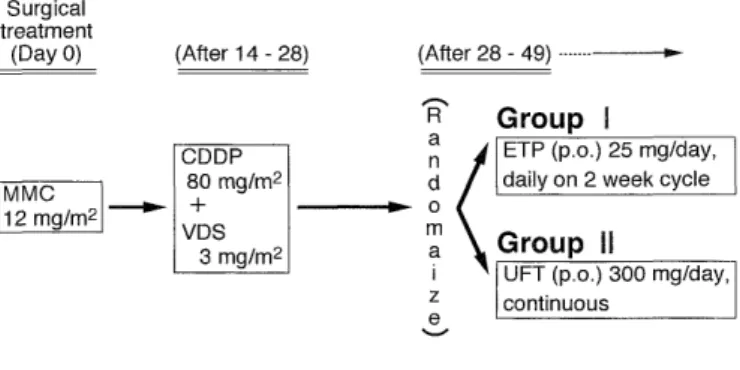
Treatment methods were administered as follows : Immediately, 12mg/m2 of Mitomycin C were adminis- tered intravenously after completion of surgical resec- tion. Next, 80mg/m2 of CDDP and 3mg/m2 of Vindesine were administered intravenously once from 2 to 4 weeks later. After a hematological examination, the patients were divided into two groups (Group I and II) by closed envelope method. From 2 to 3 weeks after administra- tion of CDDP and Vindesine, Group I received an oral dose of 25mg/day of etoposide and etoposide was given daily on 2 week cycles. Group II received daily 300mg oral doses of UFT. During treatment, hematological checks and X-rays or CT examinations were performed at 2 to 4 week intervals (Fig. 1). Oral etoposide and UFT were discontinued if the leukocyte count fell below 3000/mm3, the platelet count fell below 7000/mm3 or the liver or kidney showed signs of damage. It was also discontinued when a chief doctor diagnosed seri- ous complications or patients disapproved of the trial.
The condition of Patients were evaluated regarding disease-free survival, overall survival and toxicity. Toxic-
MMC= mitomycin C, CDDP= cisplatin, VDS= vindesine, ETP= etoposide
Fig. 1 Regimen of treatment methods in Group I (etoposide) and Group II (UFT).
ity criteria were evaluated by the Japan Society of Clini- cal Oncology of Vol. 21 in 1986. Patients who received oral doses of etoposide or UFT for more than 6 months were considered "complete cases", while those receiv- ing treatment for less than 6 months were considered
"incomplete cases"
. G-CSF did not be used in complete and incomplete cases of this study.
Differences between patient characteristics in the 2 groups were evaluated using the x2 test. Disease-free and overall survival were calculated from the random- ized data by the Kaplan-Meier method and the differ- ences between the 2 groups were analyzed by a log- rank test and generalized wilcoxon test. A p value of less than 0.05 denoted the presence of statistically sig- nificant differences.
Results
A total of 50 patients entered into this study. 15 out of 25 in Group I were complete cases, nine were incom- plete cases consisting of 5 recurrences, 1 postoperative pneumonia, 1 disapproval and 2 myelosuppression, and an ineligible case was administrated other anticancer drug. 20 out of 25 in Group II were complete cases, 3 were incomplete cases with recurrence, and 2 were in- eligible cases who were administrated other anticancer drug.
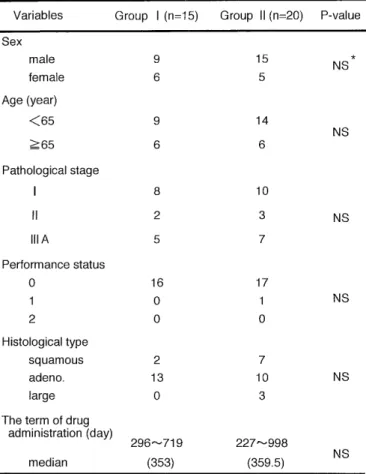
There were no differences in clinicopathological fea- tures of patient characteristics between Group I and II in complete cases (Table 1). In complete cases, the actual
1-year disease-free survival rates of Group I and II were 85.7% and 100%, respectively, while 3-year disease- free survival rates for Group 1 and 2 were 63.5% and 87.5%, respectively. Disease-free survival rates were bet- ter in the Group II than in the Group I, though rates between the two groups were not statistically signifi- cant (Fig. 2A). 1- and 3-year overall survival rates in Group I were 93.3% and 65.0%, respectively, while Group II rates were 100% and 94.1%, respectively. Again, there was no statistically significant difference in overall sur- vival rates between the two groups (Fig. 2B). Addition- ally, data were analyzed according to the classification of p-stage. In stage IIIA, disease-free and overall sur- vival rates were better in the Group II than in the Group I, with a statistically significant difference be- tween the two groups (Fig. 3). The relationship be- tween survival and the condition of lymph nodes was also analyzed between two groups. There were no sta- tistical significance for disease-free and overall sur- vival rates in non-lymph node metastasis group, while in lymph node metastasis groups, disease-free and overall survival rates were significantly better in the Group II
Table 1. Characteristics in complete cases of Group I (etoposide) and Group II (UFT)
Variables Group I (n=15) Group II (n=20) P-value Sex
male 9 15 NS *
female 6 5
Age (year)
<65 9 14
NS
65 6 6
Pathological stage
8 10
II 2 3 NS
III A 5 7
Performance status
0 16 17
1 0 1 NS
2 0 0
Histological type
squamous 2 7
adeno. 13 10 NS
large 0 3
The term of drug administration (day)
296^-719 227-998
median (353) (359.5) NS
(A) Disease-Free Survival curve
* NS : Non stastically significance
(B) Overall Survival curve
Fig. 2 Disease-free and overall survival curves for complete cases in Group I (etoposide) and Group II (UFT).
Disease-Free Survival Overall survival
Fig. 3 Disease-free and overall survival curves for complete cases in each stage (stage I: (A), stage II: (B), stage IIIA: (C) ).
Disease-Free Survival Overall Survival
Fig. 4 Disease-free and overall survival curves for complete cases with non-lymph node metastasis group (A) and lymph node metastasis group (B).
than in the Group I (Fig. 4). There were no statistical significance for T-factor, histological type and grading
between the two groups. Toxicity in 47 patients of in- complete and complete cases is given in Table 2. One incomplete patient in Group I stopped administration of etoposide because of a Grade 3 gastrointestinal symp- tom after 4 months. And, there were mild toxicities of Grade 1 and 2 in the great majority of patients in Groups I and II.
Discussion
Prolonged administration of oral etoposide combined with CDDP is sometimes used to treat advanced NSCLC patients. Willer et al.9) reported that a 37% response
rate was obtained with oral etoposide for the cycle of 21 day administration after a CDDP i.v. in advanced NSCLC.
Recently, Jeremic et al.") showed that prolonged admini- stration of oral etoposide combined with a Carboplatin i.v. produced a significantly better prognosis than that of Carboplatin alone in advanced NSCLC. Additionally, one paper reported that oral administration of etoposide decreased tumor size in a recurrent patient after surgi- cal treatment'.' Conversely, Hayasaka et al. 12) has pointed out that adjuvant postoperative chemotherapy with oral etoposide was not effective treatment for improvement
Table 2. Toxicity in all patients (n=47) in Group I (etoposide) and Group II (UFT)
Group I (n=24) Group II (n=23) Data abnormality
and Symptom Grade Total Grade Total
0 1 2 3 4 Toxicity 0 1 2 3 4 Toxicity Haematologic
Leucocyte 11 3 8 2 54.2% 14 6 2 1 39.1%
Haemoglobine 18 3 3 25.0% 20 3 13.0%
Platelet 23 1 4.2% 22 1 4.3%
Hepatic
GOT,GPT 23 1 4.2% 22 1 4.3%
Renal
Creatinine 24 0.0% 22 1 4.3%
Creatinine Crearance 23 1 4.2% 23 0.0%
Al-p 24 0.0% 22 1 4.3%
hematuria 23 1 4.2% 23 0.0%
proteinurea 22 2 8.3% 23 0.0%
Gastrointestinal
anorexia 8 4 11 1 66.7% 7 4 10 2 69.6%
nausea/vomiting 8 4 11 1 66.7% 5 2 13 3 78.3%
diarrhea 23 1 4.2% 22 1 4.3%
Others
peripheral neuropathy 23 1 4.2% 23 0.0%
fever 23 1 4.2% 23 0.0%
alopecia 23 1 4.2% 21 2 8.7%
malaise 21 3 12.5% 20 3 13.0%
Toxicity grades were evaluated by the Japan Society of Clinical Oncology of Vol. 21 in 1986.
of disease-free and overall survival, though toxicity was not severe and long term oral administration was pos- sible.
Concerning oral administration of UFT after surgical treatment, Tomita et al."' reported that groups treated with UFT alone or UFT combined with a Cisplatin and Vindesine i.v. obtained lower recurrence rates than a group which surgery was the only treatment. Particu- larly, they recognized the usefulness of UFT alone after surgery. The UFT only group produced the best results among the three in their study. In this study, the authors compared etoposide and UFT, and whether prolonged oral administration was useful in outpatients after sur- gical treatment. Results showed that oral administration of UFT gave a better prognosis than that of etoposide in complete patients group, though there was no sta- tistical significance for disease-free and overall survival rates between the two groups. Furthermore, the authors examined the relationship among prognostic factors in detail. For stage IIIA patients, the anticancer effect of UFT was superior to etoposide. This study showed the same result as the reports of Tomita et al."' and Okimoto et al."'. Additionally, for lymph node condition of a strong prognostic factor, UFT showed better effective- ness than etoposide for the lymph node metastasis groups.
However, there were several problems in this study.
The first problem was dose concentration. It was pointed out that an oral dose of 25mg/day of etoposide was not effective for NSCLC patients, because it does not provide a high enough concentration in the blood for treatment of lung cancer. Therefore, a etoposide dose of 50mg/day is needed to obtain any anticancer effect"".
However, in earlier clinical experiments, the authors couldn't use the dose of 50mg/day because of the side effects of myelosuppression and gastrointestinal dam- ages same as Uchida et al."). The second problem is the difference in administration methods. Difference between continuous (UFT) and 2 week cycle (etoposide) admini- stration is a problem. The third problem was too many incomplete patients in the etoposide group, 5 patients had local and distant metastasis in early phase after surgical resection.
In a realistic situation, authors compared oral etoposide and UFT in the dose limitations of general clinical treat- ment. The results of this study suggest that adjuvant chemotherapy of oral etoposide should not be use in NSCLC patients after surgical treatment although new clinical trials of 50mg / day will be necessarily. The authors believe that oral UFT may be a safe and effec- tive anticancer drug for outpatients after surgical treat- ment of NSCLC.
References
1) Chang AY, Kim K, Glick J, et al. Phase II study of taxol, merbarone and piroxantrone in stage IV non-small-cell lung cancer. The
Eastern Cooperative Oncology Group results. J Natl Cancer Inst
85 : 388-394, 1993
2) Murphy WK, Fossella FV, Winn RJ, et al. Phase II study of Taxol in patient with untreated advanced non-small cell lung cancer. J
Clin Oncol 85 : 384-388, 1993
3) Kourousis C, Androulakis N, Kakolyris S, et al. First-Line Treatment of Advanced Nonsmall Cell Lung Carcinoma with Docetaxel and
Vinorelbine. Cancer 83 : 2083-2089, 1998
4) Keicho N, Saijo N, Shinkai T et al. Phase II study of UFT in pa- tients with advanced non-small cell lung cancer. Jpn J Clin Oncol
16 : 143-146, 1986
5) Ichinose Y, Asoh H, Yano T et al. Phase II trial of oral UFT and cisplatin in non-small cell lung cancer. Lung Cancer 11 : 111-115,
1994
6) Wada H, Hitomi S, Teramatsu T et al. Adjuvant chemotherapy
after complete resection in non-small-cell lung cancer. J Clin Oncol 14 : 1048-1054, 1996
7) Kinoshita T, Akaogi E, Mitsui K et al. Chemotherapy with oral etoposide, UFT and carboplatin in non-small cell lung cancer. Jpn
J Cancer Chemother 21 : 891-894, 1994
8) The Japan Lung Cancer Society. General rule for clinical and patho- logical record of lung cancer. The 3rd Edition (Kanahara Publisher,
Tokyo) 1987.
9) Miller AA, Niell HB, Griffin JP. Phase II study of prolonged etoposide in combination with intravenous cisplatin in advanced non-small
cell lung cancer. Lung Cancer 12 : 59-65, 1995
10) Jeremic B, Shibamoto Y, Acimovic L et al. Prolonged administra- tion of oral etoposide alone or with intravenous carboplatin in Stage
IV non-small cell lung cancer: a randomized trial. Lung Cancer
18 : 179-188, 1997
11) Satou H, Inoue M, Yazawa T et al. A case of recurrent non-small cell lung cancer well responded to the oral etoposide therapy. Jpn
J Chest Dis 53 : 145-148, 1994
12) Hayasaka S, Kinuwaki E, Nakabayashi T et al. Early phase II study of oral administration of etoposide for 21 consecutive days in pa-
tients with non-small lung cancer. Jpn J Thoracic Diseases 33
1367-1371, 1995
13) Tomita M, Ayabe H, Kawahara K et al. A randomized controlled postoperative adjuvant chemotherapy. Trial of CDDP+VDS+UFT
and UFT alone in comparison with operation only for non-small cell lung carcinomas-Second study. Jpn Lung Cancer 34 : 297-306,
1994
14) Okimoto N, Soejima R, Teramatsu T et al. A randomized controlled postoperative adjuvant chemotherapy. Trial of CDDP+VDS+UFT
and UFT alone in comparison with operation only for non-small cell lung carcinomas-Second study. Jpn Lung Cancer 36 : 863-871,
1996
15) Numata Y, Kurita Y, Yokoyama A et al. A pilot study of chronic daily administration of oral etoposide for non-small cell lung can-
cer. Clinical Report 27 : 2255-2265, 1993
16) Katoh 0, Yamada H, Hiura K et al. Clinical pharmacology and tox- icity of low daily administration of oral etoposide in advanced
lung cancer patients. J Clin Pharmacol 31 : 1155-1160, 1991 17) Uchida T, Nakakawawaji K, Sakamoto J. Administration of oral
etoposide for one year as adjuvant chemotherapy for non-small cell
lung cancer-Side effect. Jpn J Cancer Chemother 23 : 1967-1970,
1996