On 4-fold covers over
smooth algebraic surfaces
2011
Taketo Shirane
Department of Mathematics and Information Sciences
Tokyo Metropolitan University
Contents
1 Introduction 5
1.1 Notation and Results . . . . 7
1.1.1 4-fold covers over smooth surfaces . . . . 8
1.1.2 Generic 4-fold covers . . . . 10
1.1.3 Families of Galois closure curves for plane quintic curves . 10 2 Covers of algebraic varieties 17 2.1 Covers and algebraic extensions of fields . . . . 17
2.2 Covers between smooth varieties . . . . 18
3 4-fold covers in any dimension 21 3.1 Lagrange’s method . . . . 21
3.2 4-fold covers andS4-covers . . . . 23
3.3 The branch locus of a 4-fold cover . . . . 25
4 Resolution of4-fold covers of surfaces 31 4.1 Bidouble covers . . . . 31
4.2 Resolving method for 4-fold covers . . . . 33
4.3 Ramification structure ofS4-covers . . . . 37
5 Proofs of Theorem 1.1.3and 1.1.5 41 5.1 Proof of Theorem 1.1.3 . . . . 41
5.2 Proof of Theorem 1.1.5 . . . . 44
6 Proof of the results in Section 1.1.3 57 6.1 Construction of a family of Galois closure curves . . . . 57
6.2 The branch locus∆(π) . . . . 59
6.3 The intersection theory onY . . . . 68
6.4 Proof of Theorem 1.1.10 . . . . 69
3
Chapter 1
Introduction
In this thesis, all varieties are defined over the field of complex numbers,C.We call a finite surjective morphism between normal varieties a cover. In addition, if degπ= 4, πis called a 4-fold cover. A coverπ:X →Y induces the extension of fields π∗ : C(Y) ,→ C(X), where C(X) and C(Y) are the rational function fields ofX andY,respectively. A coverπis called aGalois cover if the extension C(X)/C(Y) is a Galois extension. Given a finite groupG,we simply callπaG- cover if it is a Galois cover and Gal(C(X)/C(Y))∼=G.For a coverπ:X →Y, we denote thebranch locus ofπby ∆(π), namely
∆(π) :={P ∈Y |π∗:OY,P → OX,Q is not isomorphism for∃Q∈π−1(P)}. It is well-known that ∆(π) is an algebraic subset of pure codimension one if Y is smooth ([30]). In this case, we can regard the branch locus ∆(π) as a reduced divisor on Y. Covers have been studied from various points of view such as algebraic geometry, topology and Galois theory, which make covers interesting objects.
In algebraic geometry, we often make use of covers in order to give new varieties from well-known varieties. For example, if there is a cover over a given variety, then we obtain a new variety, which is the “bottom up” approach.
Conversely, if a finite group acts a given variety, then we obtain a new variety as the quotient, which is the “top down” approach. When we study covers for the “bottom up” construction of algebraic varieties, the following questions are fundamental.
Question 1.0.1. Suppose that a smooth varietyY is given.
(1) Given a reduced divisorB onY and a finite groupG,give a criterion for the existence ofG-cover overY whose branch locus is B.
(2) What properties doesX have for a given coverπ:X →Y? Question 1.0.1 (1) is equivalent to the following question ([5]).
5
6 CHAPTER 1. INTRODUCTION Question 1.0.2. LetY be a smooth variety,B a reduced divisor onY,andG a finite group. Give a criterion of existence of a surjective homomorphism from the fundamental group ofY \B toG:
π1(Y \B)³G
Therefore we can make use of results in covers in order to study the topology of the complements to reduced divisors on Y. For example, there are a lot of results of Zariski pairs as one of applications of covers (cf. [1], [8], [24], [25], [26]). An answer of Question 1.0.1 (1) for double covers is well-known such as:
There exists a double cover over Y whose branch locus is B if and only if OY(B) is 2-divisible in Pic(Y).
However this question for a general group (eg. the symmetric group Si of degreei≥3) seems to be difficult (cf. [25], [26]).
In this thesis, we mainly discuss Question 1.0.1 (2) for 4-fold covers over smooth surfaces. For a cover π : X → Y over a smooth surface Y, X has singularities in general. These singularities make the study ofX complicated.
To avoid this difficulty, we often investigate its resolutionX0 such as its excep- tional divisor, its numerical invariants, and so on. For a double or triple cover π:X→Y,there is a nice method of resolving singularities ofX which is called thecanonical resolution as follows:
There exists a composition of blowing-ups,σ:=σ(1)◦σ(2)◦· · ·◦σ(r):Y(r)→ Y,such that the induced cover π(r): X0 :=X(r) →Y(r) (cf. Section 4.2) is a cover between smooth surfaces. In particular,X0 is a resolution of X.We also callX0 the canonical resolution of X.
X
Y Y(1)
X(1) X(2)
Y(2) Y(r)
X(r)=:X0
σ(1) σ(2)
π π(1) π(2) π(r)
σ(3)
σ(r)
In [6], Horikawa introduced the canonical resolution for double covers. It is easy to compute various numerical invariants and the exceptional divisor of the canonical resolutionX0 for a double coverπ:X →Y.Thus this method is useful for the global or local study of double covers over smooth surfaces, and it is an effective tool to answer Question 1.0.1 (2). Hence double covers have been intensively used to study surfaces, in particular surfaces of general type (cf. [3], [6], [17] and so on).
Triple covers are also studied by many authors (cf. [2], [8], [11], [22], [23]).
Among them, Tan’s canonical resolution [22] is useful for the study of triple covers over smooth surfaces likewise Horikawa’s canonical resolution. Triple covers and the canonical resolution are also used to study the topology of the complements to plane curves (cf. [8]).
In [24], Tokunaga studied Galois covers for the symmetric group of degree 4, S4,and the alternating group of degree 4,A4,which correspond to 4-fold covers
1.1. NOTATION AND RESULTS 7 (see Chapter 2 and 3), and applied them to studying the topology of the comple- ments to plane curves. However there seem to be not so many results on 4-fold covers. The main aim of this thesis is to give a method of resolving singularities of 4-fold covers over smooth surfaces likewise the canonical resolution for double and triple covers. Unfortunately, this method is not so simple as the canonical resolution for double and triple covers (Figure 1.1.2). However, we compute the Chern numbers of our resolutions of certain 4-fold covers (Theorem 1.1.3 and 1.1.5).
As its application, we also consider “families of Galois closure curves” for plane quintic curves. In 1996, Yoshihara introduced a new notion in algebraic geometry, which is called aGalois point(see Definition 1.1.7). The motivation of Galois point seems to be based on the following fact (cf. [15, Theorem 5.3.17]).
The gonality for a smooth plane curve of degreed(see [12], [13] or [27] for the definition) is equal to d−1, and it is given by the projection from a point in the curve. In [12], [13], [27] and [28], Miura and Yoshihara have studied it in several points of view, and raised the following question.
Question 1.0.3. Let Γ be a smooth plane curve. How does the Galois closure curve ΓP at P ∈Γ (see Definition 1.1.7) varies whenP moves on Γ?
In [29], Yoshihara answered this question for smooth plane quartic curves by constructing a family of Galois closure curves, and he raised the following problem.
Problem 1.0.4. (1) Do the similar study as in [29, Theorem 2.1] in the case where Γ is a smooth curve of degree d≥5.
(2) Let Γ be a smooth plane curve of degreed≥3 andP a point inP2.For the projection πP : Γ →l consider the Galois closure curve ΓP at P.Then we will obtain similarly a smooth threefoldV and a morphismρ:V →P2, whose fiber overP is isomorphic to ΓP for a general pointP.Study the structure ofV and singular fibers of ρ.In this case, if P ∈Γ,then ρ∗(P) becomes a singular fiber. Are these singular fibers semi-stable, too?
We answer Problem 1.0.4 (1) in the cased= 5 applying our resolution for 4-fold covers (Theorem 1.1.10).
1.1 Notation and Results
Let Y be a smooth variety, and let π : X → Y be a 4-fold cover. Then, since [C(X) :C(Y)] = 4, there is an element z ofC(X) such that its minimal polynomial over C(Y) is
f :=z4+g1z2+g2z+g3,
where gi (i = 1,2,3) are elements of C(Y). Let Ke be the Galois closure of C(X)/C(Y). By [24], we obtain the diagram of the field extensions and the normalizations ofY in Figure 1.1.1 (see Section 2.1 and 3.1 for detail).
8 CHAPTER 1. INTRODUCTION
Gal(K/e C(Y)) S4 A4 D8 V4 Z4
˜
π S4-cover A4-cover D8-cover V4-cover Z4-cover ψ1 Z2-cover X1∼=Y Z2-cover X1∼=Y Z2-cover ψ2 Z3-cover Z3-cover X2∼=X1 X2∼=X1 X2∼=X1
ψ3 V4-cover V4-cover V4-cover V4-cover Z2-cover ϕ S3-cover Z3-cover Z2-cover Xe ∼=X Xe ∼=X
Table 1.1: The covers ˜π, ψi andϕ.
The possibilities of Gal(C(X)/C(Y)) are the symmetric group of degree 4, S4, the alternating group of degree 4, A4, the dihedral group of order 8, D8, the Klein group, V4={(1 2)(3 4),(1 3)(2 4),(1 4)(2 3)} ∼=Z⊕22,andZ4,where Zn := Z/nZ. In each case, the Galois groups of the Galois covers ˜π, ψi and ϕ in Figure 1.1.1 are as in Table 1.1. For a prime divisor E on Y, we say that ˜π is ramified at just ψ1 over E if E ⊂ ∆(ψ1), ψ−11(E) 6⊂ ∆(ψ2) and (ψ1◦ψ2)−1(E)6⊂∆(ψ3).We use similar terminology for other cases. We put
ΩA:={prime divisors onY over which ˜πis ramified at justψ1},
ΩB:={prime divisors onY over which ˜πis ramified at justψ1 andψ3}, ΩC:={prime divisors onY over which ˜πis ramified at justψ2}, and ΩD:={prime divisors onY over which ˜πis ramified at justψ3}.
We define reduced divisors ∆A(π), ∆B(π), ∆C(π) and ∆D(π) onY as follows:
∆A(π) := X
E∈ΩA
E; ∆B(π) := X
E∈ΩB
E;
∆C(π) := X
E∈ΩC
E; ∆D(π) := X
E∈ΩD
E.
Then we can see ∆(π) = ∆A(π) + ∆B(π) + ∆C(π) + ∆D(π) (Lemma 3.2.1 and 3.2.2).
1.1.1 4-fold covers over smooth surfaces
We consider a resolution of singularities ofX in Chapter 4. LetY be a smooth surface, and π : X → Y a 4-fold cover. Put Y(0) := Y. Let σ(i) : Y(i) →
Y
X1
X2
Xe
X π˜ ψ2
ψ3
ψ1
π ϕ
C(Y)
K1
K2
Ke
C(X) Normalization
Figure 1.1.1: The field extensions and the normalizations of Y.
1.1. NOTATION AND RESULTS 9
Y X
Y(r) X(r)
X1(r) X2(r) Xe(r)
X20
Xe0
X00
π
σ
ψ(r)2
ψ1(r) ψ(r)3 ϕ(r)
π(r)
σ2
ψ30
ϕ00
ν00 ν(r)
Xe00
σ3
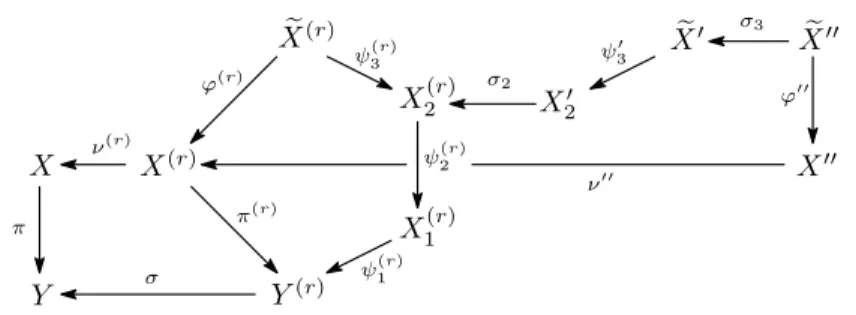
Figure 1.1.2: The resolving method of singularities ofX.
Y(i−1)be a blowing-up ofY(i−1)at a singular point of the branch locus. Since C(Y(i))∼=C(Y),we can construct the coversπ(i),π˜(i), ϕ(i)andψ(i)i overY(i)in the same way to construct ˜π. In general, it is impossible to modify the branch locus of a 4-fold cover into smooth one by blowing-ups (Example 4.2.1). To avoid this difficulty, we will show the following property.
Proposition 1.1.1. Let π:X →Y be a4-fold cover over a smooth surfaceY.
Then there is a succession of blowing-ups, σ=σ(1)◦ · · · ◦σ(r), such that (i) ∆A(π(r)) + ∆B(π(r)) + ∆C(π(r)) + ∆D(π(r))is a simple normal crossing
(SNC) divisor;
(ii) ∆A(π(r)) + ∆B(π(r)) + ∆C(π(r))is smooth, and
(iii) ifσ(r+1) is a blowing-up at a singular point of ∆D(π(r)),then the excep- tional divisor is an irreducible component of∆D(π(r+1)).
Now we define a 4-fold cover “of good type”.
Definition 1.1.2. Let π:X →Y be a 4-fold cover over a smooth surface Y.
We call π a 4-fold cover of good type if it satisfies the conditions (i), (ii) and (iii) in Proposition 1.1.1.
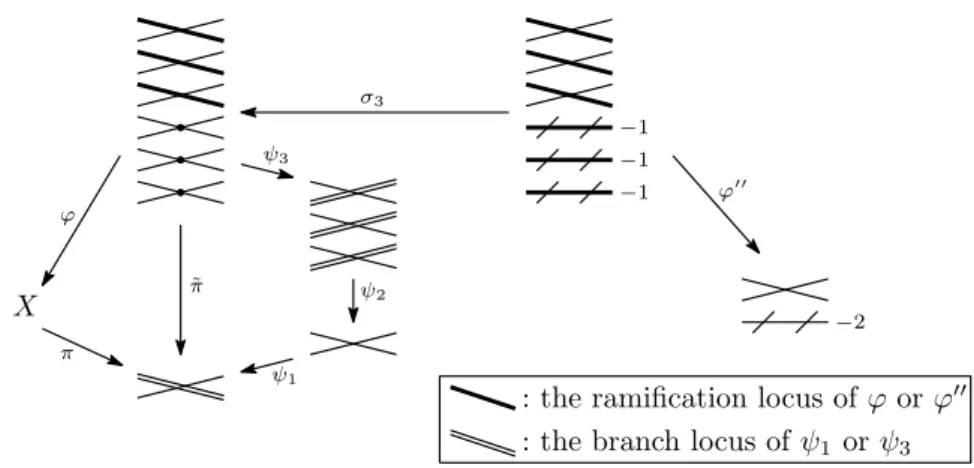
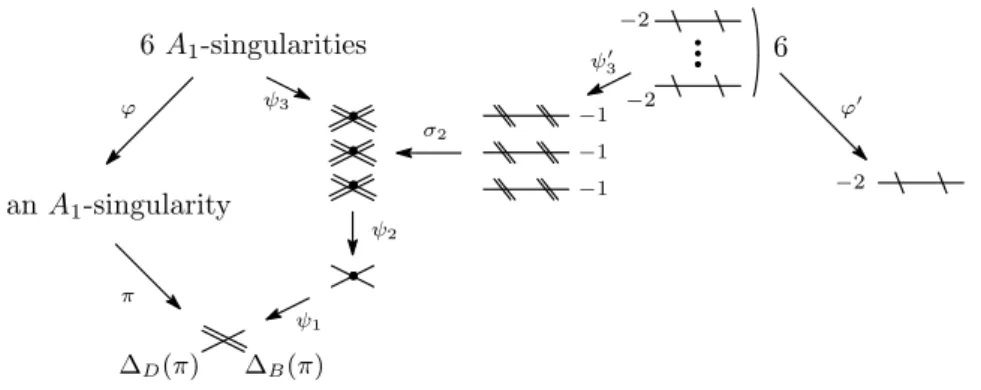
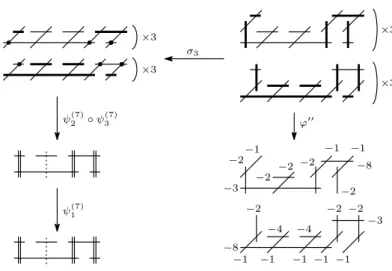
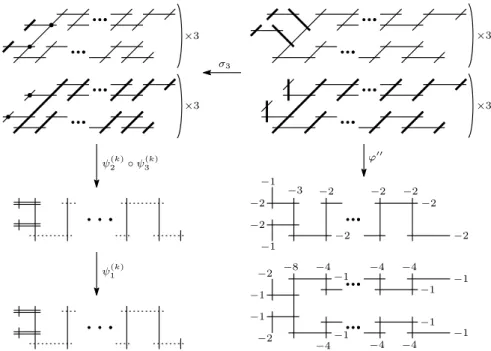
We can construct a resolution,ν :=ν00◦ν(r):X00→X,of a 4-fold coverX over a smooth surfaceY by the diagram in Figure 1.1.2. Hereσis a composition of blowing-ups such thatπ(r)is of good type,σ2andσ3are certain blowing-ups, andϕ00 is a certain quotient ofXe00(see Chapter 4).
For a 4-fold cover of good type π : X → Y, we can compute the Chern numbers of X00, c21(X00) andc2(X00),as follows.
Theorem 1.1.3. Let π:X →Y be a4-fold cover of good type. LetX00 be the
10 CHAPTER 1. INTRODUCTION resolution ofX as above. We put ∆•:= ∆•(π)for•=A, B, C, D. Then
c21(X00) = 4c21(Y) +¡
2∆A+ 6∆B+ 4∆C+ 4∆D¢ .KY +1
2∆2A+9
4∆2B+4
3∆2C+ ∆2D+ ∆A.∆D+ 3∆B.∆D, c2(X00) = 4c2(Y) + (∆A+ 3∆B+ 2∆C+ 2∆D).KY
+ ∆2A+ 3∆2B+ 2∆2C+ 2∆2D+ 2∆A.∆D+ 3∆B.∆D−3s, whereKY is a canonical divisor onY, andsis the number of nodes of ∆D.
1.1.2 Generic 4-fold covers
We introduce a notion of “generic” 4-fold covers as follows.
Definition 1.1.4. LetY be a smooth surface. A 4-fold cover π :X → Y is said to begeneric if ∆(π) = ∆A(π) (i.e. ∆B(π) = ∆C(π) = ∆D(π) = 0).
The above definition is different from the one of generic covers in Kulikov and Kulikov [9]. “Generic” in both definitions means “simple”. However, ours is based on anS4-cover ˜π, but the other is based on a generic projection. In par- ticular, ifπis a generic 4-fold cover in [9], then it is our one (see Remark 5.2.1).
We consider a generic 4-fold cover whose branch locus is a reduced curve with at worst simple singularities. Letπ:X →Y be a generic 4-fold cover as above. We denote the minimal resolution ofX byX.We introduce two integers δ1andδ2; both of them are determined by the configuration of singularities and the ramification of ˜πover them (see Section 5.2 for details).
Theorem 1.1.5. Let π:X →Y be a generic 4-fold cover whose branch locus is a reduced curve with at worst simple singularities. Then
c21(X) = 4c21(Y) + 2∆(π).KY +1
2∆(π)2−δ1−δ2, c2(X) = 4c2(Y) + ∆(π).KY +A2−3δ1−2δ2,
whereδ1andδ2are integers determined by the configuration of singularities and the ramification ofπ˜ over them (see Section 5.2 for detail).
Remark 1.1.6. If π is a generic 4-fold cover in [9], then the above formulas coincide with the formulas of [9, Corollary 4.1 and Lemma 4.4].
1.1.3 Families of Galois closure curves for plane quintic curves
Let Γ be a smooth curve of degreed(≥4) in the projective planeP2,andP a point in Γ. Consider πP : Γ→l with a center P,where l is a line not passing throughP. This projection induces the extension of fieldsπP∗ :C(l),→C(Γ) =:
K with [K :C(l)] =d−1.The structure of this extension does not depend on the choices of l,but onP. So we denote the image ofπP∗ : C(l),→K byKP. LetLP be the Galois closure of this extensionK/KP.
1.1. NOTATION AND RESULTS 11 Definition 1.1.7. Let ΓP be the nonsingular projective model ofLP. We call ΓP theGalois closure curveatP ∈Γ,and letg(P) be the genus of ΓP.We call P aGalois point for Γ ifK/KP is a Galois extension.
Remark 1.1.8. ForP ∈Γ, letl∨P be the dual line on the dual space (P2)∨ of P2 corresponding toP.We can regardπP as the map Γ3Q7→lP Q∈l∨P,where lP Qis the line onP2 passing throughP andQ ifP 6=Q, and the tangent line TP of Γ atP ifP =Q.
In the case whered= 4,Yoshihara constructed a familyρ:S→Γ satisfying that ρ∗(P) ∼= ΓP for a general point P ∈ Γ, and determined the types of its singular fibers ([29]). As its corollary, he showed that ΓQ is not isomorphic to ΓP ifQ6=P is close toP.The above study is based onS3-covers. We answer Problem 1.0.4 (1) in the case where d = 5 based on our resolution of 4-fold covers.
We assume that Γ is a smooth plane quintic curve. Let I(Γ1,Γ2;Q) the intersection number of plane curves Γ1 and Γ2 at Q.A pointP ∈Γ is said to be an inflection point of orderi (i= 1,2,3) if I(Γ, TP;P) =i+ 2. We have the fact P
Q∈Γ{I(Γ, TQ;Q)−2} = 45 (cf. [7]). Let NA =NA(P) (resp. NB, NC and ND) be the number of points in ∆A(πP) (resp. ∆B(πP), ∆C(πP) and
∆D(πP)). For example, ifP is an inflection point of order 1 and](TP∩Γ) = 3, then NA = NA+ 1 since πP(P) = TP ∈ ∆A(πP), where NA is the number of non-inflection points Q 6= P with P ∈ TQ and ](TQ∩Γ) = 4, and so on.
Applying the Riemann-Hurwitz formula to the cover πP : Γ → l∨P, we get NA+ 3NB+ 2NC+ 2ND = 18. We put Σ :={P ∈ Γ| NA <18}. Then Σ is finite (Lemma 6.1.2). Note thatGP ∼=S4ifP ∈Γ\Σ,that there exist at most one Galois point, and that the Galois point is an inflection point of order 3 (but not the converse) (see [27]).
Note that if GP ∼= D8, then NC = 0 [19, Remark 4.1]. Moreover we will show the following proposition.
Proposition 1.1.9. GP is isomorphic toA4 if and only if NA=NB = 0.
Now we state our results. We put
ΛB= ΛB(P) :={lP ∈l∨P |lP ∈∆B(πP), lP 6=TP}.
For • = B, C, D, we put k• = k•(P) := 1 if TP ∈ ∆•(πP) and k• := 0 if TP 6∈∆•(πP).We put
ni:=]{P ∈Γ|I(Γ, TP;P) =i+ 2} (i= 1,2,3),
n1,s:=]{P ∈Γ|I(Γ, TP;P) = 3, I(Γ, TP;Q)≤1 for anyQ6=P}, nb:=]{l: a bitangent line of Γ|I(Γ, l;Q)≤2 for anyQ∈Γ}, n1,b:=n1−n1,s.
Theorem 1.1.10. There exist a smooth projective minimal surface of general type S with
c21(S) = 5880−24n3,
c2(S) = 4920−90n3−18n2−36n1,b−18nb,
12 CHAPTER 1. INTRODUCTION and a morphism ρ : S → Γ such that ρ∗(P)red is a divisor with only normal crossings for anyP ∈Γ and satisfies the following properties:
(I) If P ∈Γ\Σ, thenρ∗(P)∼= ΓP andg(P) = 85.
(II) If P ∈ΣandGP ∼=S4,then g(P) = 31 + 3NA+ 2NC and ρ∗(P) =Γ +b X
lP∈ΛB
3EB,lP +kBEB+kC
X4 i=1
EC,i+kD
X6 i=1
ED,i,
where bΓ, EB,lP, EB, EC,i and ED,i are irreducible curves with the fol- lowing properties:
(i) g(bΓ) =g(P),Γb2=−18NB+ 12kB−8kC−12kD,and the number of nodes of Γb is4(NC−kC) + 6(ND−kD).
(ii) EB is a smooth curve of genus4 withE2B=−6.
(iii) EB,lP, EC,i and ED,i are (−2)-curves (i.e. smooth rational curves with the self-intersection number −2).
(iv) ρ∗(P)−Γb is smooth (i.e. EB,lP, EB, EC,i and ED,i are disjoint), Γ.Eb B,lP =bΓ.EB = 6andΓ.Eb C,i=Γ.Eb D,i= 2.
(III) If GP ∼=A4, theng(P) = 16 +NC and ρ∗(P) =Γb1+Γb2+kC
X4 i=1
EC,i+kD X6 i=1
ED,i,
whereΓbj(j= 1,2),EC,iandED,iare irreducible curves with the following properties:
(i) Γbj∼= ΓP forj= 1,2,Γb2j =−4NC−6ND, and Γb1.Γb2= 4(NC−kC) + 6(ND−kD).
(ii) EC,i andED,i are(−2)-curves.
(iii) ρ∗(P)−Γb1−bΓ2 is smooth, and bΓj.EC,i =Γbj.ED,i= 1.
(IV) If GP ∼=D8,then g(P) = 11 +NA and ρ∗(P) =Γb1+Γb2+bΓ3+ X
lP∈ΛB
3EB,lP +kBEB+kD
X6 i=1
ED,i,
whereΓbj (j= 1,2,3),EB,lP, EB andED,iare irreducible curves with the following properties:
(i) g(bΓj) =g(P),Γb2j =−6NB+ 4kB+ 4kD,bΓj.bΓj0 = 0 (j6=j0), and the number of nodes of bΓj is2(ND−kD).
1.1. NOTATION AND RESULTS 13 (ii) EB is a smooth curve of genus 4with EB2 =−6.
(iii) EB,lP,andED,i are (−2)-curves.
(iv) ρ∗(P)−P3
j=1Γbj is smooth, bΓj.EB,lP = Γbj.EB = 2 for any i, j.
bΓj.ED,i= 2 ifj≡i (mod 3)andΓbj.ED,i= 0otherwise.
(V) IfP is the Galois point (hence GP ∼=Z4 and]ΛB=NB−1), then ρ∗(P) =
X6 j=1
bΓj+
NXB−1 i=1
3EB,i+EB,
wherebΓj, EBandEB,iare irreducible curves with the following properties:
(i) g(Γbj) = 6,Γb2j =−3NB+ 2, and the number of nodes ofΓbj isND. (ii) EB is a smooth curve of genus 4with EB2 =−6.
(iii) EB,Q0 are (−2)-curves.
(iv) PNB−1
i=1 EB,i +EB is smooth, bΓj.bΓj0 = 0 (j 6= j0) and Γbj.EB,i = bΓj.EB = 1.
Example 1.1.11. (1) IfGP ∼=S4and TP ∈∆B(πP),then ρ∗(P) is described as in the following figure:
S0
∪
the blow-up at the nodes ofbΓ
EB
EB,lP
ρ∗(P)
∪
˜
π◦σ˜|ρ∗(P)
S
TP ΛB
∆A(πP) ∆C(πP) ∆D(πP)
lP∨
−1 −1
Here S0 is the blow-up ofS at the nodes ofΓ,b thick lines describe (−1)-curves, the horizontal curve describe the strict transform of Γ,b and ˜π and ˜σ are as in Section 6.1. Note that the horizontal curve is isomorphic to the Galois closure curve ΓP,that it meets transversally withEB, EB,lP and (−1)-curves, and that