Communication Course at Kansai University
著者 Kimura Mary E. O., Kimura Bert Y., Kubota Kenichi
雑誌名 情報研究 : 関西大学総合情報学部紀要
巻 41
ページ 41‑59
発行年 2014‑08‑08
URL http://hdl.handle.net/10112/8462
*1 Forum for i-Learning Creation
*2 University of Hawaii
*3 Kansai University
Design and Evaluation of English Oral Communication Course at Kansai University
Mary E. O. Kimura*1 Bert Y. Kimura*2 Kenichi Kubota*3
Abstract
Educators, linguists, and anthropologists recognize that language refl ects societal values, culture, and attitudes of the country where the language is spoken. The use of technology provides numerous activities where students can learn about the values, culture, and lifestyles of people living in other countries while practicing their English communication skills. This paper examines the use of videoconferencing between students at Kansai University and the University of Hawaii to develop language skills and increase intercultural understanding. The authors describe learning activities to prepare students for the videoconferences, examine learning styles related to the use of technology, provide observations about technology use, and discuss changes in students’ intercultural sensitiv- ity over one semester.
Keywords: second language learning, videoconference, intercultural awareness
1. Introduction
Educators acknowledge the need to include elements of cultural competency and understanding into language learning. The National Standards in Foreign Language Education Project asserts that students cannot master a language until they have also mastered the cultural contexts in which the language occurs (Peterson & Coltrane, 2003). Perception of what is communicated is affected by the language, norms, values, and behaviors in the society where the language is spoken.
The American Council on the Teaching of Foreign Languages (ACTFL, n.d.), under a three-year grant from the US Department of Education and the National Endowment for the Humanities, developed the National Standards for Foreign Language Learning: Preparing for the 21st Century, that recognized the need for students to gain knowledge and understanding of other cultures, to
make comparisons, and to develop insight into the nature of cultures.
This study was conducted with Kansai University Informatics majors enrolled in Oral Communi- cation classes. The course goal was for students to communicate effectively linguistically and culturally in English, through the use of technology. Students used synchronous communication modes such as videoconferences with Skype and Google Hangouts to strengthen their oral communi- cation skills and increase their intercultural understanding.
2. Course Description
An Oral Communications course was offered mainly to third year students at Kansai University and taught in English to improve students’ English ability to communicate orally and to increase their intercultural awareness in preparation for their fi eld work in the Philippines and Cambodia.
During 14 class sessions, students participated in activities where they were required to speak English to discuss daily activities, events in Japan and other topics of interest to people in other countries. Students practiced discussing these topics during small group, in-class discussions, at vid- eoconferences with students in Hawaii and in videotaped presentations. Students discussed and compared cultural differences and similarities between Japan and other countries.
Students used group discussions, an electronic portfolio using a secret Facebook group, video- conferences with students in Hawaii, videotaped presentations at the start and ending of the course and written refl ections to improve their English communication skills and to increase their intercul- tural understanding.
3. Goals
The goal of this course was to help students improve their English oral communication skills, their intercultural awareness, increase confi dence and provide motivation to speak English by learning how to discuss daily activities and events, during small group discussions, problem-solving exercises and class activities. Students learned to ask and answer questions commonly encountered when traveling abroad or living with host families. Students used diagrams and gestures to further illustrate what they are saying in English. Students spoke English as much as possible when in class and used appropriate nonverbal communications.
Students learned how to understand and use nonverbal and verbal communication skills to facilitate their communication in English. Students were encouraged to use facial expressions and nonverbal body language that is commonly used by English speaker. Students used communication skills learned in class to talk with students in Hawaii through the use of Google+ or Skype.
Students provided information about Japan and learned about Hawaii to increase their intercultural understanding. Students also learned how to use Google+ to upload images, share screens and use the Internet to further illustrate their ideas and clarify their discussions.
Students served as leaders to facilitate small group discussions, asked and answered questions, continued conversations and encouraged discussion in English. They learned how to use attentive listening skills and rejoinders to assist their discussions.
Students practiced good pronunciation and improved their listening skills when communicating in English. Videotapes, taken at the beginning and ending of the course, assisted students in comparing the growth of their spoken English and to view their use of nonverbal communication.
Students used a secret Facebook group as an electronic portfolio to write refl ections about what they learned in class, to make comments about how they felt about learing to speak English and to view posts that summarize what they learned in class. Videotapes of their initial introductions and fi nal discussions in English are posted in this portfolio. Students viewed refl ections about lessons and videotapes that illustrate their progress in class. Teacher’s comments and observations were provided in students’ Facebook refl ections.
4. Description of Lessons
The following describes the content of the class lessons.
Lesson 1. Introduction
Students will learn how to provide a basic introduction and discuss simple topics about themselves. They will ask and answer questions while working in pairs. A videotape of student introductions will be taken to illustrate their spoken English on the fi rst day of class.
Students will be introduced to class rules, to speak English only, to speak loudly and with confi dence. They will be encouraged to use body language commonly used by English speakers during introductions.
Lesson 2. Body Language
Students will learn about the differences between body language when speaking English and when speaking Japanese. They will practice using body language to show attentiveness and interest when speaking English. Students will use the following when speaking during small group discus- sions
➢ Face or look at the speaker
➢ Keep an open position
➢ Lean forward slightly
➢ Keep eyes on the speaker.
➢ Relax a little
➢ Respect the other person’s territory. Do not sit too close or too far from the speaker.
Lesson 3. Facial Expressions
Students will continue to use good body language and facial expressions when they ask and answer questions. Students will introduce themselves and provide interesting information about themselves. Students will be good listeners and speak with a loud, clear voice, while using their best pronunciation.
During group discussions, a leader will be selected to discuss questions about themselves, hobbies and interests, family or hometown from the handout. Students will ask further questions to encourage conversation and continue a conversation.
Students will practice facial expressions that show confi dence and understanding when speaking English. Students will smile appropriately or nod to show agreement. As much as possible students will use facial expressions and nonverbal communications to encourage others to speak and help group members relax when speaking English.
Students will learn how to add refl ections and comments to the Facebook secret group.
Lesson 4. Rejoinders
Students will work in groups and use rejoinders to raise the energy level of the conversation.
They will learn how English speakers often use rejoinders to continue the conversation and to show they are listening. They will ask questions about what the speaker is saying to make the conversa- tion interesting.
Students will practice using rejoinders to continue a conversation or learn more about others. In class, students will do their best to speak English, use good body language, smile and use rejoinders. In their refl ections, students can explain how using rejoinders and good body language affected the group discussion.
Lesson 5. Using Gestures to Communicate
Since students will only have fourteen lessons to learn how to communicate in English there will often be times when they do not know the English vocabulary needed to express their ideas. In class students will learn how to use gestures to communicate and as well as guess at meanings of gestures that others may use. They will learn about some gestures that are different from Japanese gestures.
Lesson 6. Asking My Questions
Students will learn how to ask their own questions, while using appropriate body language, rejoinders and facial expressions. They will speak in pairs for as long as they can by creating a positive atmosphere that encourages conversation. Students will try to use verbal and nonverbal skills that are often used by English speakers.
Lesson 7. My Hometown
When students travel abroad, people often want to know more about Japan. Students will be divided into groups with people from different areas of Japan and discuss the similarities and unique qualities of their hometowns. They will learn how to ask and answer questions that will provide more information and knowledge about other areas in Japan or abroad.
Lesson 8. Picture Activity
Students will learn how to use pictures or diagrams to assist their communication in English.
Students will be encouraged to draw fi gures that emphasize unique features that assist in identifying the concept they are communicating. Students will learn how to guess words from simple diagrams.
Lesson 9. Asking Questions
Students will practice giving some information about the topic they will discuss or themselves before asking questions. They will continue to maintain nonverbal communication and rejoinders to encourage discussion.
Lesson 10. Talking about Families
When traveling abroad, students are often asked about their families. The purpose of this lesson is to learn how to talk about families. Students will learn how to describe family members and talk about dream or future families. Students will use new words to describe families and talk about future dreams for job, family and spouse (husband/wife).
Students will learn about many types of families in other countries. While in some countries, it is not polite to ask about families. In other countries, people speak freely about their families and have very large families. Some people will talk about their parents’ divorce, remarriage and extended families that are formed after people divorce or when they remarry. Students can create their “ideal” family if they do not want to discuss their current family.
Lesson 11. Becoming a Good Discussion Leader
Students will use their best discussion skills and serve as group leaders. In preparation for the
videoconference with Hawaii, students will discuss life in Japan, Japanese schools and give their opinions. The goal of the discussion is to teach others about Japan. Students will look for something special or different about where they have lived that other students may not know. They will talk with students about their lives and learn new things about Japan.
Lesson 12. Videoconference Preparation
Students will practice asking and answering questions that will compare cultures within Japan and in different countries. Students can use these questions during their videoconference with Hawaii students. Class will meet in a room with Internet connection so students can familiarize themselves with the videoconferencing software and some of the diffi culties encountered when speaking over the Internet.
Lesson 13. Videoconference with Hawaii Students
Students will use the verbal and nonverbal communication skills learned in class to discuss topics relating to their daily lives, customs and traditions in Japan and interesting topics during their videoconference with Hawaii students. Students will use their best body language, pronunciation and rejoinders to communicate with Hawaii Students
Lesson 14. Final Video and Class Evaluation
Students will produce their fi nal videotape of a discussion in English using the skills learned in class. This videotape will be posted in the Facebook group with their introduction video so they can evaluate the progress made in class. Students will complete a class evaluation.
5. Course Results and Discussion
Students completed a survey about what they learned from the videoconference. The survey examined what students learned from the videoconference and how well they thought that they could communicate with students at the University of Hawaii. The survey also examined what students learned about Hawaii and how their awareness of cultural similarities and differences changed after the videoconference. The following summarizes the results of the survey.
5.1 Videoconference Results and Discussion
Students participated in a videoconference with Hawaii students. The purpose of the students was for students to use their oral communication skills to learn more about Hawaii and to teach Hawaii students about Japan.
In the survey, students explained what they enjoyed about the videoconference, areas that they found useful and liked and areas that they disliked. They explained what they learned and how they benefi tted from participating in the videoconference.
The following results refl ect student responses from the Spring 2012 and Spring 2013 classes.
5.1.1 Enjoyment and benefi ts of the videoconference
In general, students enjoyed the videoconference because it provided them with the opportunity to communicate in English with people from another country. Some students felt nervous about whether the Hawaii students could understand their English and were relieved that they could com- municate most of their ideas in English.
Table 1 Whether Students Enjoyed the Videoconference
Year Yes No
2012 12 0
2013 11 1
Reasons for enjoying the videoconference fell into two general categories of having the opportu- nity to communicate in English with foreigners and learning about people in other countries. The following table indicates the numbers of students that fell into each category.
Table 2 Reasons for Enjoying the Videoconference
2012 2013
I could speak English and communicate with foreigners 8 7
I learned about other people and cultures 3 4
Other 1 1
In the process of participating in the videoconference students learned about the daily lives of Hawaii students and how to use Google Hangouts to participate in a videoconference. Some students were apprehensive that English speakers might not understand their English. They were relieved when they could successfully communicate their ideas in English. A sample of their comments explaining why they enjoyed the videoconference is listed below.
● it’s so fun to communicate in English
● I could speak some students of Hawaii University in English.
I talked with them about hobby, study, high school memory, favorite sports ...etc
● The communication with those whom I don’t know makes me nervous usually. However, this time, I really enjoyed talking maybe because it was in-directional communication through Google hangout. And moreover, the Hawaii friends are all friendly and good at talking!
● I could talk with foreigner. This is a very precious experience to me.
● I enjoyed the videoconference very much. I knew many things about foreign culture, foreign places and so on. It was very interesting.
5.1.2 Benefi ts of the videoconference
When citing reasons why the videoconference was benefi cial, some students indicated that they understood the importance of using technology to learn more about other countries. They enjoyed watching the faces and gestures of Hawaii students and what they could learn from speaking directly with people from other countries.
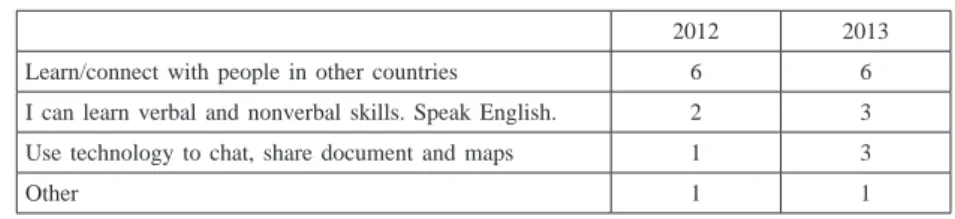
They responses, describing the benefi ts of the videoconference, fell into three general categories that are listed in Table 3. They gained a better understanding of people in other countries, used verbal and nonverbal means of communication when talking with Hawaii students and learned how to use technology to share and gain new knowledge. Table 3 summarizes their responses.
Table 3 Benefi ts of the videoconference
2012 2013
Learn/connect with people in other countries 6 6
I can learn verbal and nonverbal skills. Speak English. 2 3
Use technology to chat, share document and maps 1 3
Other 1 1
Student comments refl ect the benefi ts of using a videoconference to speak with students in Hawaii. Some realized that the videoconference provided a useful means of connecting with people in other countries. Videoconferences allowed them to learn more about other countries, people and cultures. Some comments are listed below.
● I could make Hawaiian friends
● I can connect all over the world.
● I could watch a face and character (of Hawaii students).
● They showed me a picture or a map. So i could learn much about hawaii.
● I could talk with stranger. It is good opportunity to talk in English.
5.1.3 Problems of communicating through a videoconference
Since some students were fairly new to using videoconferences, they found the slow, unstable Internet connection distracting and had diffi culty understanding what the Hawaii students were saying. They had diffi culty with the time lag involved when using the Internet and often talked at the same time as other students rather than waiting for the conversation from the Hawaii side to
fi nish.
Other students realized that they needed more questions and topics in order to continue speaking with the Hawaii students. They were unable to think of questions that they had not previously prepared. At times they couldn’t respond to questions from Hawaii students. For some students, this was embarrassing and stressful, but for others, this experience provided them with greater motivation to learn and improve their English.
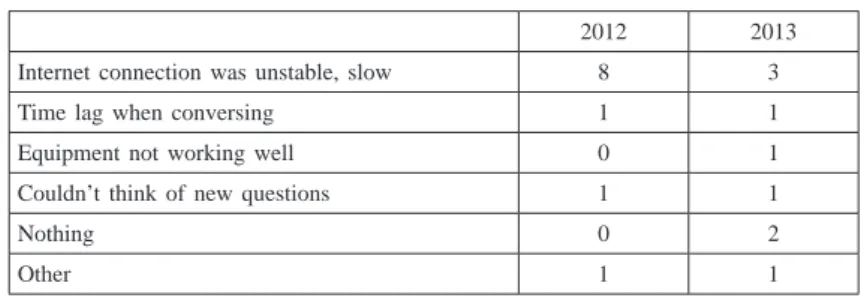
Table 4 Problems communicating through a videoconference
2012 2013
Internet connection was unstable, slow 8 3
Time lag when conversing 1 1
Equipment not working well 0 1
Couldn’t think of new questions 1 1
Nothing 0 2
Other 1 1
Most of the problems communicating through the Internet involved problems with connection and the time lag when speaking. More problems with the Internet occurred in 2012 when the connection was slower and unstable. Because students were second language speakers, they had diffi culty understanding words when speech from the Hawaii students were interrupted or couldn’t be heard clearly.
Students also noticed that speaking with someone for the fi rst time required more concentration to understand what was said. Although they practiced discussing various topics in class, some students were unprepared to answer unfamiliar questions or lacked enough topics or questions to use during the videoconference. Some student comments are listed below.
● I can’t hear voice clearly
● PC always isn’t smooth.
● Often Internet disconnects.
● Students only asked the questions they prepared. Hawaii students gave good answers but
Japanese students didn’t really react to that. Probably it was too hard to understand? I think it will be better if Japanese students talk about themselves and their opinions, too.
● Sometimes the sound was not clear. So I couldn’t listen what they were talking
● It has time lag. Sometimes we start to talk at the same time and it was diffi cult to decide which should keep talking
● We met them for the fi rst time and conversed, so I was embarrassed.
5.1.4 Reasons for liking and disliking the videoconference
Students were asked what they liked and disliked about talking with Hawaii students. Most liked talking with Hawaii in real time and communicating easily over the Internet. They realized that with Google Hangouts, they could share documents and pictures on their desktop.
However, they also realized that with real-time interactions, they had to think and speak in English quickly, otherwise their discussion could not continue smoothly. Some realized that their English communication skill was not strong enough to do so and that they had to work on improving their ability to speak English so that they can converse more comfortably with foreigners.
For other students, the videoconference was a very uncomfortable experience because they were very nervous about speaking English. This interfered with their ability to concentrate on understand- ing questions and convey their ideas and opinions. Table 5 indicated whether students liked or disliked the videoconference. Most students liked the videoconference. Their reasons for liking and disliking participating in the videoconferences are listed below the tables.
Table 5 Whether Students Liked or Disliked the Videoconference
2012 2013
Liked 11 10
Disliked 1 2
Table 6 Reasons for Liking the Videoconference
2012 2013
I can talk with and learn about foreigners in real time 4 5
I can see the faces of foreigners while I speak 2 2
It’s a convenient way to communicate 4 1
Other 1 1
Students liked being able to talk with foreigners in real time and the convenience of talking with someone in other countries. Others described videoconferences as “ a great opportunity for us to talk with people who we cannot usually talk.” Other comments regarding like the videoconference are listed below.
● If only have PC and connect the Internet, we can talk friends who live all over the world.
● It was much useful than Skype. I could get and show many information.
● We can talk whole we share the information such as document or web page.
Student who did not like the videoconference cited the following reasons:
● We couldn’t talk smoothly then. But, my talking skill was not enough. So, I want to grow up about it. I like to talk directly more.
● I was very nervous but to meet face-to-face and talk is fun because I was able to experience interacting with them.
5.1.5 Speaking more at the videoconference
Students wanted more videoconferences, so they could speak with good English speakers again.
Some stated that speaking with native English speakers was a good way to improve their English.
Students also learned more about the culture, people and places in Hawaii through the videoconfer- ence. Table 7 indicates whether students want to speak more at the videoconference.
Table 7 Whether Students Wanted to Speak More
2012 2013
Yes 12 12
No 0 0
Some students had diffi culty clearly expressing themselves in English but realized from the videoconference that they needed to practice speaking English more and improve their confi dence.
One student stated that she couldn’t speak a lot of English, but was excited by the experience.
5.1.6 How to improve the videoconference
Student suggestions to improve the videoconferences indicated that they wanted to speak longer with Hawaii students. Students rotated through six computers and talked for about 15 minutes with different students. Some felt that they would benefi t more from talking to one Hawaii student for a longer time. Others wanted to speak longer or one-to-one rather than with groups of three Japanese students.
Another suggestion was that students meet in different rooms, since meeting in the current room make it diffi cult to concentrate on their conversation because they could hear other groups talking with the Hawaii students.
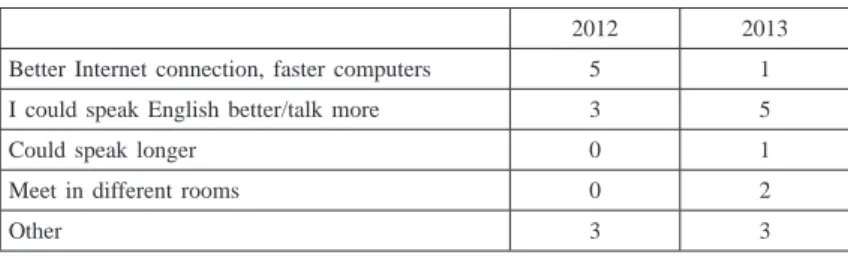
Table 8 Student Suggestions to Improve the Videoconference
2012 2013
Better Internet connection, faster computers 5 1
I could speak English better/talk more 3 5
Could speak longer 0 1
Meet in different rooms 0 2
Other 3 3
Student comments listed below indicate how the videoconferences can be improved. Some
students indicated the need to improve their English and not be shy.
● The connection is good and I have ability of English. I want to study English more.
● Our skills of speaking English are going to be better.
● PC connection will improvement and we can’t be shy.
● I think that the videoconference could be better if there should be more ICT equipments.
● Students try to talk more about themselves.
● (We could meet in a) room separately because of other members voice, sometimes I couldn’t hear the voice whose Hawaii students.
● It will be longer. I wanted to talk more with one person at least 30 minutes. 15 minutes was too short for me.
5.1.7 How students felt after the videoconference
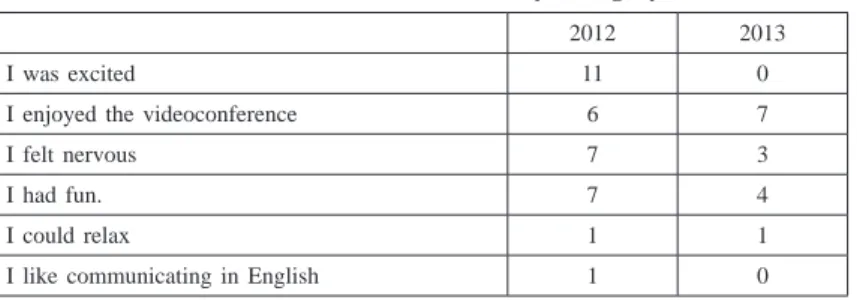
Although some students felt nervous after the videoconference, the majority felt excited and enjoyed their experience. Table 9 categorizes their comments. Some students’ comments contained more than one of these areas and were categorized more than once.
Table 9 Student Comments by Category
2012 2013
I was excited 11 0
I enjoyed the videoconference 6 7
I felt nervous 7 3
I had fun. 7 4
I could relax 1 1
I like communicating in English 1 0
In evaluating how they felt after the videoconference, some students indicated that they needed time to relax after their initial nervousness. Despite the discomfort and stress of speaking English to people they met for the fi rst time, students could ask many of their questions and enjoyed the video- conference. The following are some of their comments.
● I enjoyed the videoconference. I had fun today. I felt nervous because sometimes, I can’t
understand what American is speaking. But after 3 minutes, I was relaxed and I enjoyed conversation.
● I felt nervous because talking is not continued. But I enjoyed the videoconference. I had fun today.
● I had fun today. I have been Hawaii twice, so I had many topics I want to talk.
● I felt nervous fi rst, but I used to talk with Hawaii student. I think hearing English is very diffi cult. Hawaii students speak very fast.
● I had fun. I enjoyed today. I had many things asked.
● Everyone was very cheerful. It was very easy to speak with them. (Translated to English.)
● First, I felt a little bit nervous. But, as time goes by, I don’t feel nervous. I became be relaxed.
It was so fun.
● I enjoyed it very much. It was almost same as usual face-to-face talking for me.
● I was very enjoyed and I want to talk at the videoconference again.
● I felt very nervous. But, I enjoyed the videoconference.
● I felt very fun and hard to speak English to the other students.
5.2 Results and Discussion of Changes in Cultural Awareness
Students indicated that they learned more about the culture, traditions and lifestyle of people living in Hawaii. They stated that they increased their awareness of similarities and differences between the two countries. Some students stated if they knew more about Japan, they could teach others about their cultural and traditions. The following summarizes the results of the survey.
5.2.1 What students learned about Hawaii from participating in videoconference
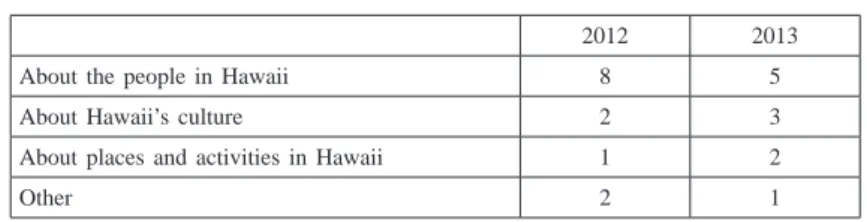
Although the purpose of the videoconference was to allow students to practice their English and the nonverbal skills that they learned, they also cited that they learned about Hawaii’s multi-cultural environment, the different cultures that co-exist in Hawaii, place of interest to visit, personalities of people living in Hawaii and personal interest of the students in Hawaii.
Table 10 What Students Learned
2012 2013
About the people in Hawaii 8 5
About Hawaii’s culture 2 3
About places and activities in Hawaii 1 2
Other 2 1
Student stated that through their conversations, they found Hawaii students were “so positive and energetic,” “so active,” “ very cheerful,” and “modest but many (have) high spirits.” They learned about the lifestyle and American school life. Other comments are listed below.
● It’s diffi cult for foreign students to get admission to go abroad in USA.
Hawaii students are very kind.
● All most students’ parents were not from in Hawaii. One of their parents who were from in Korea. Other of their parents who were from Singapore. So, the person who live in Hawaii, their parents not always are from in Hawaii. And they do many things. They are active. To
play various sports, to go travel oversea.
● I learned how beautiful nature in Hawaii. They showed me pictures where they live and they often swim in the sea. I really envy because no sea near my place.
Through the videoconference, students expanded their understanding of other cultures, people and places by speaking English. For some this increased their interest in learning more about other countries and provided motivation to improve their English. Examples of their comments are:
● I felt nervous, but I enjoyed too much!! I want to talk with foreign people more.
● I’m so excited still now. I like communicating to others in English. I’m looking forward to join videoconference sometime again.
● Fun! But I have to increase my English vocabulary.
● I had fun. Very enjoyed !!! I want to speak English with many people by the videoconference.
Please teach me vocabulary and intonation.
5.2.2 Understanding the Hawaii students
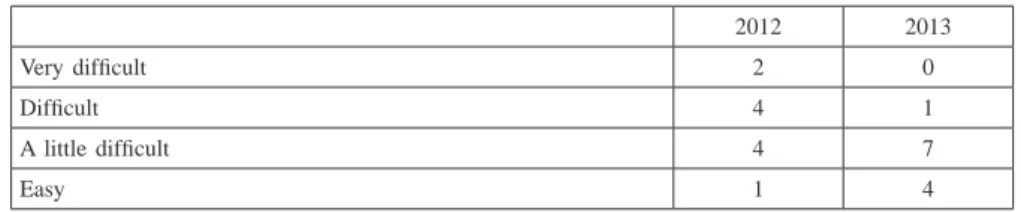
Students found the videoconference diffi cult to understand. In class, most students could converse and understand each other, but when speaking with native speakers, the Japanese students had to adjust to listening to English spoken at a faster speed, understanding words that they hadn’t studied before and talking about unfamiliar topics.
Some students were forced to resort to using nonverbal communication skills or asking for clarifi ca- tion when they didn’t understand or couldn’t communicate their thoughts clearly. Table 11 indicates the diffi culty understanding what the students in Hawaii were saying.
Table 11 Understanding Hawaii Students
2012 2013
Very diffi cult 2 0
Diffi cult 4 1
A little diffi cult 4 7
Easy 1 4
5.2.3 What students learned about Hawaii
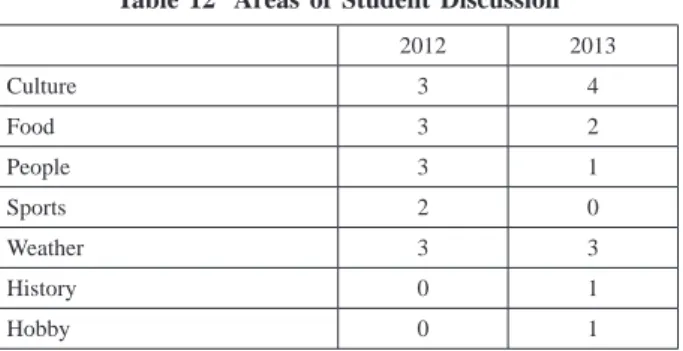
Most discussions focused on topics about the weather, hobbies, food and movie that were covered in class. However other groups discussed the different ethnicities of people living in Hawaii, the various religious groups and mixtures of cultures in Hawaii. In the process they realized that Japan didn’t have the ethnic diversity that Hawaii did. One group had a detailed discussion about
World War II and it’s implications on other countries.
Table 12 Areas of Student Discussion
2012 2013
Culture 3 4
Food 3 2
People 3 1
Sports 2 0
Weather 3 3
History 0 1
Hobby 0 1
Student comments varied in describing its complexity depending on the topic discussed in their groups. Some groups discussed topics studied in class and were limited to the weather, hobbies, foods and cultural activities. Other students had topics that were a little more diffi cult to understand but resulted in learning about new topics. Some of their comments are:
● Hawaiian culture is almost all not originally. It comes from many countries. Hawaiian culture is mixed culture.
Second Hawaiian is very kind!! They speak very slowly for us.
At the last, I should not feel shy. Be confi dent!
I should remember that when I do speech in front of many people.
● Foreigner’s talking is very fast. Second, I learned videoconference is very slowly. Third I learned we must more speak English.
● Hawaiian always keep smile in their face, so I don’t feel nervous too much!! I would like to keep smile when I talk with some friends.
Second, I learned the question is important! I have to learn many kinds of questions. Some foreign people like speak but other people don’t speak, so I must prepare many questions.
Finally, I really liked to communicate in English! It’s too fun!!! I like it! I had a good time!
Thank you!
● There are many kinds of people, religion, culture, mix!!!
● It was very enjoy today!!! Hawaii students were very friendly and we could talk a lot. This was the fi rst time that I spoke with Hawaii students. I would like to do Skype again. I think that I would also like to talk with Philippine students like this, too. (Translated to English)
● I knew Hawaiian food, locomoco and poke.
● Mix culture because many immigrant.
● I learned about modern history after the Second World War. For example, U.S.A, China, Korea, Vietnam, Europe, etc..
● In Hawaii, there is not humid like Japan. And there is very comfortable to live.
● There are so many nationalities in Hawaii. I hope Japan also receive many differences because sometimes I feel Japan is a closed country.
● The climate in Hawaii is very nice to live. The size of food is as big as other food in US.
● I learned it was diffi cult for me to continue talking. I learned foreign famous places. I learned many differences between Japan and foreign countries.
5.2.4 What students would like to teach Hawaii students about Japan
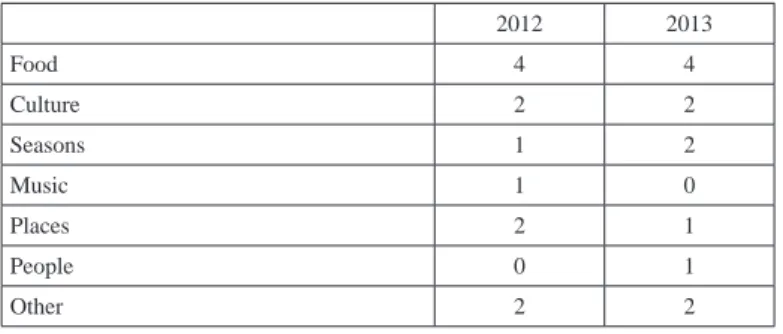
If future videoconferences were held, students indicated that they would like to discuss the following areas that are indicated in Table 13. Some found that they needed to learn more in order to teach others about Japan. Table 13 lists topics that they would like to discuss with Hawaii students.
Table 13 Topics Students want to Share with Students in Hawaii
2012 2013
Food 4 4
Culture 2 2
Seasons 1 2
Music 1 0
Places 2 1
People 0 1
Other 2 2
Student comments indicated that they wanted to teach others about beautiful places in Japan using pictures, pop culture or about various foods in Japan. Others wanted to discuss current events like problems with the nuclear power plants. Some of their comments are:
● Japanese eccentric foods.
● Japanese famous food.
● I want to tell Japanese characteristics when talking; nodding, rejoinders and gestures...
● About the beautiful places in Japan. About the delicious food in Japan. About our university life. ...etc
● I want to tell them about problem about Japan for example nuclear power plant. And I want to discuss about it with other people.
● Japan’s image.
● I tell there are many kind people in Japan.
5.3 Future videoconferences
Most students wanted more videoconferences. Some wanted to speak to native-English speakers more often to improve their communications skills. Other appreciated the opportunity to learn more about other countries and to practice using the English that they learned in class. The following indicate the number of students who would like to have more videoconferences.
Table 13 Whether Students Want More Videoconferences
2012 2013
Yes 12 11
No 0 1
Reasons for wanting more videoconferences fell into the following categories.
Table 14 Reasons for Wanting More Videoconferences
2012 2013
I want to speak with native speakers/foreigners 5 5
I enjoyed speaking/communicating in English 3 0
I want to have more confi dence/improve speaking English 1 3 I want to learn more about cultures and make friends 1 2
Other 1 1
Most students wanted to have more videoconferences to improve their English and speak with foreigners. Others indicated that their confi dence in speaking English might improve through this process. Some wanted to learn more about Hawaii by speaking with people living in Hawaii. The following shows some of their comments.
● I want to have more videoconferences because I want to know Hawaiian friends
● I want to contact to good English speaker more times.
● Very enjoyed. I think speaking English with native is best!!!
● Today, I can’t speak many English. But I received stimulus.
● I want to have more confi dence for my English.
● I want more videoconferences because I want to know about other cultures.
● Even if I’m in Osaka, I can talk to foreigner on line. In Japan, I seldom speak to a foreigner.
So it is good chance speaking English.
● I want more videoconferences because it’s good practice to speak English.
● It is needed to use it in order to collaborate with foreigners.
● I want more videoconferences because I can learn a lot of things to speak with them.
● I don’t want to have more videoconferences because once is okay I think. Or probably twice.
More videoconferences can make students used to speak English more, but they may take one opportunity for granted.
6. Conclusion
In general students found the videoconference benefi cial as a way to practice and learn more about people in other countries. Although they were nervous while communicating in English, the videoconference helped them understand areas that they needed to improve and how technology can be used to increase their English ability and learn more about other countries. Areas that need to be addressed is providing students with longer times to talk, better facilities to decrease distractions from other students speaking and ways to increase student English level before the videoconference.
The Appendix contains comments that illustrate students’ recognition of the need to improve their English communication skills and their motivation to continue studying English
Note: This research was supported by “Kyoiku Kenkyu Kodoka Sokushin Hi” in 2012 and 2013.
References
The American Council on the Teaching of Foreign Languages (ACTFL). (n.d.) The American Council on the Teaching of Foreign Languages. Retrieved June 2 from http://www.actfl .org/sites/default/fi les/pdfs/public/
StandardsforFLLexecsumm_rev.pdf, Retrieved June 2, 2014.
Peterson, E., & Coltrane, B. (2003). Culture in second language teaching. CAL Digest. Washington, DC: Center for Applied Linguistics. Retrieved June 2, 2014, from http://www.cal.org/resources/digest/0309peterson.html
Appendix
The following summarizes student comments that indicate what they learned from speaking English with Hawaii students at the videoconference. Their comments illustrate their recognition of the need to improve their English communication skills and their motivation to continue studying English.
● Rejoinder is really important because if it’s not in the videoconference it must be uneasy. Second, smiling to others make others relieved. Third, I noticed I like speaking in English again. So I’m keeping practice speaking in English from now until the day I die.Thank you for making me notice communicating in other languages is so fun.
● Google+ is very useful to talk and conference. I can explain my name by words (chat), and check where the speaker is (maps). I want to talk again. I have so many topics what I want to talk. I like Hawaii and Hawaiian people. (Of course, I also like Indonesian people!) Thank you!
● Body language is diffi cult. When I thought, “how can I say?” I should use body language. Kasy don’t know Sori, so we told it using body language. Second pronunciation is important. My name spell is YurRika. My pronunciation is diffi cult. Third, I had fun!! We love communication.
● I want to go to Hawaii when I talk with Hawaii students. ^^ I should practice hearing very hard, so I try to practice hard.
● Speaking English is very diffi cult, because I couldn’t fi nd vocabulary what I wanted to say. Second, I must prepare many questions because very time is wasteful, when I use videoconference. Third I know
about difference Japan and Hawaii.
● I could speak with English and use body language. Second, I learned Hawaiian food and Hawaiian tradition. Thirds, I learned to use Google+. I used it for the fi rst time.
● First, I learned that Hawaii people are very, very kind. People talk very slowly, so I can understand!!
Second, body language is very useful!! It is must tool for my English communication. Third, I have to learn Japanese culture. If I know more cultural topic, the conversation grow livelier. In conclusion, my English is slowly getting better.
● Videoconference is very, very diffi cult because we have time lag. I can’t hear Hawaii student talk because fast speak. I felt nervous.
I learned Hawaii culture. It is mixed many culture, so powerful culture.
The videoconference is very diffi cult. I should more study English because Mizuki will be angry.
● Hawaii students felt interested in talking with people they did not know. They were a little excited.
Anyway, they seemed to have wanted to talk a lot.
● It’s important to TRY to speak something. It’s important to have own OPINIONS.
It’s important to set the comfortable condition (audio, video etc.) when having videoconference.
● Studying English and becoming to speak English, we can talk (with) much more people.
● First I learned there are many races in Hawaii not only American. Second I learned discussion with foreigner is much fun than discussion with only Japanese because I can get unimaginable opinion. Third I learned about Hawaii food. They showed me pictures. It looked very delicious. It seemed similar to Philippines food.
● I have a little good pronunciation! The videoconference is the best way to speak English with other country people. I’d better to practice English.
● It was diffi cult to fi nd problems when we cannot connect to Hawaii friends. In videoconference, Japanese students are more talkative then usual. We needed more time to talk what we want to share.
● Enjoyed an English communication. My communication skill is not enough. Talking English is very diffi cult.