Atmospheric temperature effect on Cosmic Ray count rate observed at Syowa Station in Antarctic
C. Kato1, W. Kihara1, Y. Ko1, A. Kadokura2, R. Kataoka2, and K. Munakata1
1Shinshu University
2National Institute of Polar Research
Ground-based Cosmic Ray (CR) observations have to handle atmospheric effect, such as a change in the temperature and/or the pressure of the atmosphere, on CR count rate. Although it is known that CR muon count rate has negative correlation with upper-air temperature, it is hard to correct in a straightforward manner without knowing the temperature at every altitudes at a specific time. We report here about upper-air temperature dependences of CR muon count rate observed at Syowa station comparing with some other CR muon observatory.
CR observation at Syowa station started in Feb., 2018. CR neutron and CR muon are being observed simultaneously expecting to derive data connecting Neutron Monitor (NM) network, such as Space Ship Earth (SSE) (e.g. Bieber et.al.,2013), and Muon Detector (MD) network, Global Muon Detector Network (GMDN) (e.g. Mendonça, et.al.,2019). Because the energy of primary CRs creating CR neutron is 5 times lower than that creating CR muon, their trajectories are deflected differently when CRs traverse the Earth’s magnetic field. Therefore, simultaneous observation of the same directional component by NM and MD at the same position is possible only in polar region, where the geomagnetic field line is open to the space and the magnetic orbital deflection is minimal for both CRs monitored by NM and MD.
.
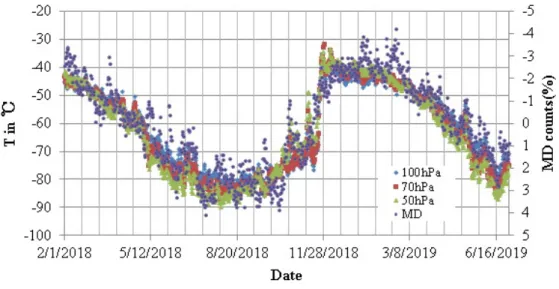
Negative correlation between high altitude temperature and CR muon count rate is confirmed by both Syowa (Figure 1) and GMDN. It is also recognized that the most highly correlated altitude with CR count rate vary with geographical latitude of the observatory. This is the first step to understand the different response of NM and MD count rate to a change in the temperature and/or the pressure of the atmosphere for connecting NM and MD network data. Additionally, the CR
observation at Syowa station starts to attain some progress in analysis of a space weather event. It will deliver new findings on space weather study by continuing observation.
References
J. W. Bieber, J. Clem, P. Evenson, R. Pyle, A. Sáiz, and D. Ruffolo, GIANT GROUND LEVEL ENHANCEMENT OF RELATIVISTIC SOLAR PROTONS ON 2005 JANUARY 20. I. SPACESHIP EARTH OBSERVATIONS, Astrophys. J., 771,92-105, 2013.
R.R.S. Mendonça, et.al., Analysis of cosmic rays' atmospheric effects and their relationships to cutoff rigidity and zenith angle using Global Muon Detector Network data, JGR, accepted, 2019 (doi: 10.1029/2019JA026651)
Figure 1. Time variation of upper-air temperatures and CR muon count rate observed at Syowa station.
Left vertical axis is for upper-air temperatures at 50(green), 70(red), and 100hPa(blue) pressure altitude, while right vertical axis is for CR muon count rate.