Improvement on Power Efficiency of MPSK by Employing Elliptical Signals Chunyi SONG, Shigeru SHIMAMOTO
Graduate School of Global Information and Telecommunication Studies, Waseda University Waseda Bldg. 29-7, 1-3-10 Nishi-Waseda, Shinjuku-Ku, Tokyo 169-0051, Japan
[email protected] shima@ waseda.jp Abstract−By replacing a circle with ellipses in constellations of
MPSK (M=2,4,8), this paper propose several modulation schemes defined as M−ary Elliptical Phase Shift Keying (M−EPSK, M=2,4,8). Both mathematical analysis and computer simulations show that M−EPSK can improve power efficiency over MPSK, and have high flexibility to make trade-offs on power efficiency and bandwidth efficiency by varying eccentricities.
Index Terms-Ellipse, eccentricity, power efficiency, flexibility I. INTRODUCTION
By sampling a constellation consisted of ellipses, we find that all samples have different envelopes, and this difference becomes larger with the increase of eccentricity. Thus, by assigning information to the samples with peak envelope and by efficiently setting offset inclination angles of ellipses, same Euclidean distance can be achieved by constellations consisted of ellipses with lower signal power, in comparison with constellations consisted of a circle. This advantage on signal power can be strengthened by increasing eccentricity.
This paper aim to propose modulation schemes that can efficiently make trade-offs between power efficiency and bandwidth efficiency by varying eccentricities.
By employing elliptical signals as transmission carriers, some modulation schemes with general name of Elliptical Modulation Schemes have been proposed and generally evaluated through computer simulations in [1]~[3]. In this paper, M−ary Elliptical Phase Shift Keying (M−EPSK, M=2,4,8) will be defined from MPSK (M=2,4,8) by replacing circles with ellipses in constellations. For both M−EPSK and MPSK in this paper, M is defined as 2, 4 and 8. For easy explanations, value of M will not be emphasized in following presentations.
Rest part of this paper is organized as follows. M−EPSK are defined mathematically and graphically in II, followed by mathematical analysis of the error probability in III. Error performance of M−EPSK at large eccentricities in bandwidth limited channel is investigated through simulations in IV.
Finally, the paper is concluded in V.
II. DEFINITIONS OF M−EPSK
In this section, definitions of M−EPSK are derived mathematically from general expression of EPSK first, and then derived graphically from constellations of MPSK.
Analysis of the signal characteristics is extended to the discussions of main works that need to be accomplished in this paper.
A. General Expression of EPSK Signals
In Elliptical Modulation Schemes, EPSK is defined based on modulation variables’ combination of offset inclination angle and phase of an elliptical signal. M−EPSK signals are generally expressed as
) )cos(
( cos 1 ) 1
( 2 2
2
j c i j r c
c
ij t
t e
a e t
s ω φ
α φ
ω + − +
−
= − , (1)
where a = semi-major axis, ec = eccentricity, ωr = revolution angular frequency of elliptical radius, ωc = carrier angular frequency, αi = offset inclination angle, φj=signal’s phase. For modulation variables of αi and φj, i=1,2,…N; j=1,2,…K. For M−EPSK, M=N×K. We set ωr and ωc to same value to achieve stable waveforms.
By employing different combinations of offset inclination angle and phase, considerable types of EPSK can be defined with different characteristics. In (1), 2−EPSK can be defined by fixing N to 1 and K to 2; by fixing both N and K to 2, 4−EPSK can be defined by employing two offset inclination angles and two phases; by fixing N to 4 and K to 2, 8−EPSK can be defined by employing four offset inclination angles and two phases. They are capable of 1-bit, 2-bit and 3-bit information transmission respectively.
B. Definitions of M−EPSK
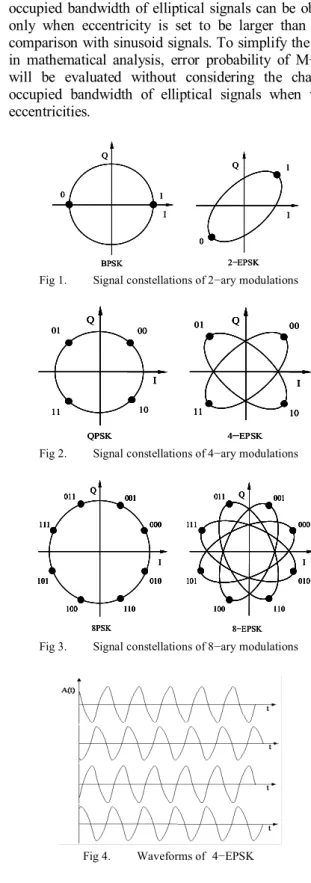
Constant-amplitude modulation can only be achieved in the case when two ellipses are made to be symmetrical with respect to Q axis in constellations. Once offset inclination angles are decided, maximum Euclidean distance can be achieved by setting phase to the value of offset inclination angle or with phase-shift of π. Constellations of M−EPSK are achieved by replacing circles in constellations of MPSK with ellipses, so M−EPSK also have characteristics of equally- partition of decision region and of Gray code bit mapping. In addition to these, constellations of M−EPSK showed in Fig.1, Fig.2 and Fig.3 achieve the maximum Euclidean distance.
Offset inclination angle in Fig.1 has been set to π/4, so as to achieve same power for I signal and Q signal, and to achieve the minimum occupied bandwidth of signals.
According to constellations of M−EPSK, combinations of offset inclination angle and phase (α,φ) can be decided, and then their signal expressions can be achieved by substituting the combinations to (1).
In Fig.1, (α,φ)=[(π/4, π/4), (π/4, 5π/4)], then 2−EPSK signals are expressed as
This research project is supported by Japanese Ministry of Science and Education Grants-in-Aid for Scientific Research, Exploratory Research NO.15656094, and by Waseda University Special Grant.
] 4 / ) 4 1 ( cos[
) , (
] 4 / ) 4 1 ( cos cos[
1 ) 1
( 2 2
2
π ω
π ω ω
⋅ + +
=
⋅ +
− +
= −
i t e
t A
i t t
e a e t s
c c
c r c
c
i
, (2) where i =0,1.
In Fig.2, (α,φ)=[(π/4, π/4), (3π/4, 3π/4), (π/4, 5π/4) (3π/4, 7π/4)], then 4−EPSK signals are expressed as
] 4 / ) 2 1 ( cos[
) , (
] 4 / ) 2 1 ( cos cos[
1 ) 1
( 2 2
2
π ω
π ω ω
⋅ + +
=
⋅ +
− +
= −
i t e
t A
i t t
e a e t s
c c
c r c
c
i
, (3) where i =0,1,2,3, and the corresponding signals are defined as S1, S2,S3 and S4.
In Fig.3, (α,φ) are defined as: (π/8, π/8), (π/8, 9π/8), (3π/8, 3π/8), (3π/8, 11π/8), (5π/8, 5π/8), (5π/8, 13π/8), (7π/8, 7π/8) and (7π/8, 15π/8), then expression of 8−EPSK signals can be achieved as
] 8 / ) 2 1 ( cos[
) , (
] 8 / ) 2 1 ( cos cos[
1 ) 1
( 2 2
2
π ω
π ω ω
⋅ + +
=
⋅ +
− +
= −
i t e
t A
i t t
e a e t s
c c
c r c
c
i
, (4) where i =0,1,2,…7.
From constellations of M−EPSK, we know 2−EPSK and 4−EPSK are constant-amplitude modulations, while 8−EPSK is a variable-amplitude modulation. Although variable- amplitude transmission might result in AM−AM and AM−PM conversions in a nonlinear system [4], in comparison with Amplitude Modulation (AM), message amplitude variations in 8−EPSK do not carry information bit, so burst noise does not affect the performance as much as AM systems.
A(t,ec) in Eq.(2)∼Eq.(4) is achieved by defining same value for offset inclination angle and phase in Eq.(1), so A(t,ec) in Eq.(2)∼Eq.(4) also include effect from variables of offset inclination angle and phase, which can also be observed from their waveforms. Fig.4 are waveforms of 4−EPSK signals at eccentricity of 0.9, from above in sequence they are S1, S2, S3
and S4 defined in (3). It shows signals generated by different ellipses have distinctive characteristics beyond phase-shift and amplitude level shift, so these signals can not be achieved from each other simply by shifting phase and amplitude level.
Therefore, M−EPSK signals are difficult to be achieved from signals of combined conventional modulations.
According to our idea behind this proposal, by sampling constellations consisted of ellipses, achieved samples have different envelopes, and this difference becomes larger with the increase of eccentricity. Thus, by assigning information to the samples with peak envelope, and by efficiently setting offset inclination angles of ellipses, same Euclidean distance can be achieved by constellations consisted of ellipses with lower signal power, in comparison with constellations consisted of a circle. This advantage on signal power can be strengthened by increasing eccentricity, at the expense of
increasing both number and power of side lobes in frequency spectrum. Based on above analysis of characteristics of elliptical signals, we decide and summarize the main works in rest of this paper as follows.
• Based on achievements in [2], obvious increase in occupied bandwidth of elliptical signals can be observed only when eccentricity is set to be larger than 0.4, in comparison with sinusoid signals. To simplify the works, in mathematical analysis, error probability of M−EPSK will be evaluated without considering the change in occupied bandwidth of elliptical signals when varying eccentricities.
0 1
Q
I
BPSK
Q
I 0
1
2−EPSK
0 1
Q
I
BPSK
0 1
0 1
Q
I Q
I
BPSK
Q
I 0
1
2−EPSK Q
I Q
I 0
1
0
1
2−EPSK
Fig 1. Signal constellations of 2−ary modulations
11
00 01
10 I Q
QPSK 4−EPSK
Q
I 01 00
11 10
11
00 01
10 I Q
QPSK 11
00 01
11 10
00 01
10 I Q
QPSK I Q
I Q
QPSK 4−EPSK
Q
I 01 00
11 10
4−EPSK Q
I 01 00
11 10
Q
I Q
I 01 00
11 10
01 00
11 10
Fig 2. Signal constellations of 4−ary modulations
8PSK I Q
100
001
110 011
101
000
010 111
100
001
110 011
101
000
010 111
I Q
8−EPSK 8PSK
I Q
100
001
110 011
101
000
010 111
8PSK I Q
100
001
110 011
101
000
010 111
I Q
100
001
110 011
101
000
010 111
I Q
I Q
100
001
110 011
101
000
010 111
100
001
110 011
101
000
010 111
100
001
110 011
101
000
010 111
100
001
110 011
101
000
010 111
I Q
8−EPSK 100
001
110 011
101
000
010 111
I Q
100
001
110 011
101
000
010 111
100
001
110 011
101
000
010 111
I Q
I Q
I Q
8−EPSK
Fig 3. Signal constellations of 8−ary modulations
Fig 4. Waveforms of 4−EPSK
• Without bandwidth limitation, results achieved from above analysis are not accurate especially when setting eccentricity to larger than 0.5. In computer simulations, error performance of M−EPSK at large eccentricities will be investigated in bandwidth limited channel.
III. MATHEMATICAL ANALYSIS OF ERROR PROBABILITY
In this section, after illustrating the relationship between correlation coefficient and error probability in constellations consisted of ellipses, we make the comparisons for M−EPSK and MPSK of required signal powers to achieve same Euclidean distance, of error probability by demonstrating coherent demodulation, without considering change of occupied bandwidth of M−EPSK signals when varying eccentricities. The signal power that can be saved by M−EPSK is also equivalently expressed as reduction of Eb/N0
by using ∆Eb/N0.
A. Correlation Coefficient and Error Performance
Mathematically, degree of similarity between two signals is expressed in terms of their correlation coefficient [5]
∫
∫
⋅=
T T
dt t s
dt t s t s
) (
) ( ) (
2 1
2 1
ρ , (5) or in terms of their Euclidean distance
ρ
⋅
⋅
− +
=
−
=
∫
2 1 2 1
2 2 1 2
2 )]
( ) ( [
E E E E
dt t s t s D
T
,
(6) where E is the mean energy over one symbol duration. When E1 = E2, (6) can be simplified to
) 1 (
2=2⋅Esymbol ⋅ −ρ
D . (7) Fig.5 shows two types of signal constellations defined for 2−ary modulations. We assume same ellipse is used in two constellations, then signals in (a) and (b) have same occupied bandwidth and same power. According to (5), (a) and (b) have same correlation coefficient, then they have same Euclidean distance according to (7). However, Fig.5 shows Euclidean distance of (a) equals to semi-minor axis, while Euclidean distance of (b) equals to semi-major axis of the ellipse, so (b) has larger Euclidean distance than (a). Thus, (b) is better
(a) Q
I 0
1
(b)
0 1
Q
I
(a) Q
I 0
1 (a) Q
I 0
1 Q
I Q
I 0
1 0
1
(b)
0 1
Q
I
(b)
0 1
Q
I
0 1
0 1
Q
I Q
I
Fig 5. Signal constellations of 2−ary modulations
power efficient than (a) although they have same correlation coefficient. Based on above analysis, we conclude that it is not the accurate method to decide error probability of Elliptical Modulations just by analyzing their correlation coefficient.
B. Comparison of Required Signal Power
Defining A as distance from constellation point to centre point of constellation in BPSK, then average signal power of BPSK is given by
A2
PBPSK = .
(8) To achieve same Euclidean distance, semi-major axis of the ellipse a should be equal to A, so required average signal power of 2−EPSK is represented by
2 2 2 2
2 EPSK ab a 1 ec A 1 ec
P− = = − = − . (9)
Defining ratio of required average signal power of 2−EPSK at various eccentricities to BPSK as k(ec), then k(ec) is calculated from (8) and (9) as
2
2 1
)
(ec P EPSK PBPSK ec
k = − = − .
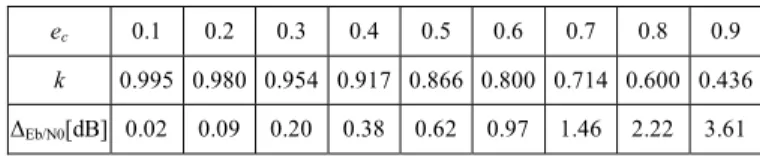
(10) By using the same method, ratio of required average signal power of 4−EPSK to QPSK and 8−EPSK to 8PSK are derived and shown to be same with (10). k(ec) at typical eccentricities and the corresponding ∆Eb/N0 are then calculated and summarized in Table I.
Results in Table I show that same Euclidean distance can be achieved by M−EPSK with lower signal power, in comparison with MPSK. The signal power that can be saved and corresponding ∆Eb/N0 are directly proportional to eccentricity, without considering increase in occupied bandwidth of M−EPSK signals when increasing eccentricity.
Since increase of occupied bandwidth becomes substantial only when eccentricity is larger than 0.4, we will give further evaluations for M−EPSK at large eccentricities in simulations.
C. Demodulations
As for comparison, BPSK and QPSK are viewed as phase modulations here. Then error probability of M−EPSK by using coherent demodulation is investigated along with comparison to MPSK. We assume carrier signals of all modulation schemes have same average power, and assume optimum coherent detection with perfect carrier tracking, frequency tracking and symbol synchronization [6].
TABLE I. REDUCTION IN REQUIED SIGNAL POWER AND IN REQUIRED RATIO OF BIT-ENERGY-TO-NOISE-POWER-SPECTRAL-DENSITY
ec 0.1 0.2 0.3 0.4 0.5 0.6 0.7 0.8 0.9
k 0.995 0.980 0.954 0.917 0.866 0.800 0.714 0.600 0.436
∆Eb/N0[dB] 0.02 0.09 0.20 0.38 0.62 0.97 1.46 2.22 3.61
For easy explanations, coherent detection of 4−EPSK signals is demonstrated as an instance.
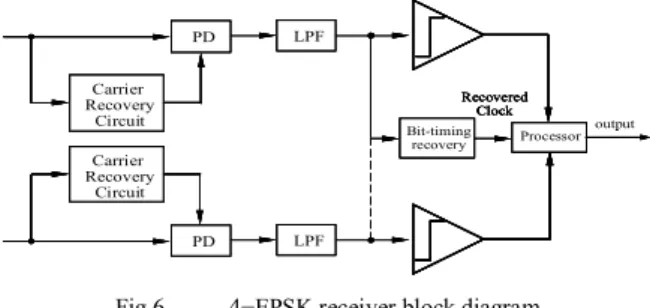
Fig.6 is the supposed receiver for 4−EPSK [7], carrier recovery system performs recovery of carrier frequency, and generates one input to Phase Detector. Suppose the carrier recovery system in [8] is used, then the modified Voltage- Controlled Oscillator (VCO) in Fig.7 generates input as
e t t
s e c
c c c
input ω cosω
1 cos 1
2 2 2
−
= − , (11) where ωc is the recovered angular frequency of carriers.
From [9], the function that VCO performs can be summarized as: decides the carrier frequency according to input voltage, and then generates a sinusoid signal based on the recovered frequency. Instead of generating a sinusoid signal, the modified VCO is supposed to generate a signal showed in (11) by employing DSP. Generation of the signal by using DSP can be referred to [2].
According to [10], output of Phase Detector I can be expressed as multiplication of received signal and (11)
) 2 2 cos(
cos 1 2 cos 1 ) cos(
) 1 cos(
cos ) 1
cos cos(
1 1
2 2 2 2 2
2 0
i c i
c i c
c c
c c i c r c
c
t a a
t t
a
e t t t e
t e a e V
θ ω θ
ω θ ω
ω ω θ
ω ω
+ +
=
× +
=
−
× −
− +
= −
, (12) where θi is the phase of transmitted data.
A low-pass filter is used to attenuate the second harmonic term so that the result is
a i
V cosθ
2 1
0 = . (13) In QPSK, dc voltage output of Phase Detector I is presented by
A i
V0 = 21 cosθ , (14) where A can be referred to (8).
Once obtaining the demodulated data, bit-timing recovery can be accomplished by using the same method with QPSK.
Detailed descriptions on synchronization and solution to timing jitter can be referred to [6], [11] and [12].
PD
Carrier Recovery
Circuit
LPF
PD Carrier Recovery
Circuit
LPF
Recovered Clock Bit-timing
recovery Processor output PD
Carrier Recovery
Circuit
LPF
PD Carrier Recovery
Circuit
LPF
Recovered Clock Bit-timing
recovery Processor PD
Carrier Recovery
Circuit PD LPF
Carrier Recovery
Circuit
LPF
PD Carrier Recovery
Circuit
PD LPF Carrier Recovery
Circuit
LPF
Recovered Clock Bit-timing
recovery Processor Recovered
Clock Bit-timing
recovery Processor Bit-timing
recovery Processor outputoutput
Fig 6. 4−EPSK receiver block diagram
e t t e
c c
c
c ω cosω
1 cos 1
2 2 2
−
− ) cos cos(
1 1
2 2 2
i c r c
c t
t e
a e ω θ
ω +
−
−
VCO Modified
Recovered Carrier Loop filter
H(s)
e t t e
c c
c
c ω cosω
1 cos 1
2 2 2
−
− t
e t e
c c
c
c ω cosω
1 cos 1
2 2 2
−
− ) cos cos(
1 1
2 2 2
i c r c
c t
t e
a e ω θ
ω +
−
− cos( )
cos 1
1
2 2 2
i c r c
c t
t e
a e ω θ
ω +
−
−
VCO Modified
VCO Modified
Recovered Carrier Recovered
Carrier Loop filter
H(s) Loop filter
H(s)
Fig 7. Modified phase-locked loop operation
M−EPSK and MPSK have same average signal power, then from (8) and (9) we have
4 2
2 2 2 2
1 1 1
c c BPSK
EPSK
A e a
A e a P P
= −
⇒
=
−
⇒
=
−
.
(15) Value of a at typical eccentricities are calculated by using (15) and summarized in Table II.
The dc voltage output V0 in (13) is directly proportional to semi-major axis a, a is directly proportional to eccentricity, so V0 is directly proportional to eccentricity. Consequently, error probability is inversely proportional to eccentricity.
Semi-major axis a is larger than A, so (13) is larger than (14), and 4−EPSK has smaller error probability than QPSK.
Furthermore, the advantage achieved by 4−EPSK over QPSK can be strengthened by increasing eccentricity.
Same conclusions can be achieved for another two comparison pairs of M−EPSK and MPSK.
IV. COMPUTER SIMULATIONS
M−EPSK have shown better power efficiency than MPSK in above analysis, without considering the increase in occupied channel bandwidth that is required by M−EPSK transmission. This increase of channel bandwidth is equivalent to increase of noise power, and it becomes substantial at large eccentricities. Thus, advantages achieved from theory analysis have been magnified especially at large eccentricities.
In this section, we aim to achieve efficient performance for M−EPSK at large eccentricities in bandwidth limited channel, and to calculate the improvement of Eb/N0 over MPSK.
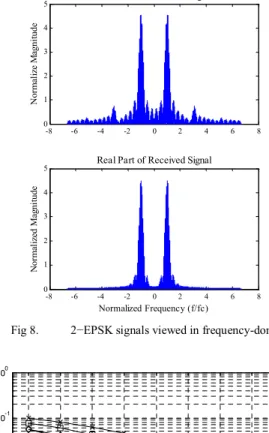
Bandwidth limited channel is achieved by using band pass elliptic filters in transmitter and receiver owing to its characteristics [13] [14]. Filter design parameters are defined in Table III, then transfer function order of the BPF filter can be achieved from above filter design parameters according to either [15] or [16]. As an instance, effect of designed filter to 2−EPSK signals in frequency-domain has been observed in Fig.8, where eccentricity of the signals is set to 0.8.
TABLE II. VALUES OF SEMI-MAJOR AXIS AT TYPICAL ECCENTRICITIES
ec 0.1 0.2 0.3 0.4 0.5 0.6 0.7 0.8 0.9
a 1.00A 1.01A 1.02A 1.04A 1.07A 1.11A 1.18A 1.29A 1.51A
Relationship of CNR and Eb/N0 is expressed as
CNR=Eb N0+10logk−10logBnT . (16) In simulations, for MPSK, a paired Root Raised Cosine
filters with roll-off factor of 0.5 are used and thus BnT=1.
While for M−EPSK, BnT=1.17 for 2−EPSK and 4−EPSK and BnT=1.19 for 8−EPSK, then noise power is calculated from Eb/N0 by using (16). Consequently in simulations, bandwidth efficiency of 4−EPSK (2−EPSK) is decreased to be 85.3% of QPSK (BPSK), and bandwidth efficiency of 8−EPSK is decreased to be 83.9% of 8PSK.
In simulations, eccentricity is varied from 0.5 to 0.9, with unit increase of 0.1. And we assume optimum coherent detection with perfect carrier tracking, frequency tracking and symbol synchronization.
In Fig.9, since 2−EPSK has undistinguishable performance with 4−EPSK, achieved results of 4−EPSK are used for both schemes. Simulation results show that 4−EPSK (2−EPSK) outperform QPSK (BPSK) when eccentricity is set to larger than 0.5 (but almost undistinguishable at 0.6), and 8−EPSK outperforms 8PSK when eccentricity is set to larger than 0.6.
In comparison with QPSK (BPSK), 4−EPSK (2−EPSK) has improved Eb/N0 about 0.6dB, 1.3dB and 2.5dB at eccentricity of 0.7, 0.8 and 0.9 respectively. In comparison with 8PSK, 8−EPSK has improved Eb/N0 around 0.5dB, 1.2dB and 2.3dB at eccentricity of 0.7, 0.8 and 0.9 respectively. In comparison with results in Table I, improvement of power efficiency achieved by M−EPSK over MPSK have been substantially degraded mainly due to following two changes in simulations.
First, increase of system noise equivalent bandwidth caused
TABLE III. SIMULATION PARAMETERS
Transmission rate 256 [k symbol/s]
Carrier frequency fc=768 [kHz]
Elliptic Filter initialization (2−EPSK & 4−EPSK) Cut-off frequency fc1=648[kHz], fc2=948[kHz]
Passband edge frequency fa1=628[kHz], fa2=968[kHz]
Passband ripple 3 dB
stopband attenuation 61.5 dB Sampling frequency fs=30.72 [MHz]
order 8 Elliptic Filter initialization (8−EPSK)
Cut-off frequency fc1=648[kHz], fc2=953[kHz]
Passband edge frequency fa1=623[kHz], fa2=978[kHz]
Passband ripple 3 dB
stopband attenuation 52 dB
Sampling frequency fs=30.72 [MHz]
order 8
-8 -6 -4 -2 0 2 4 6 8
0 1 2 3 4
5 Real Part of Modulated Signal
Normalize Magnitude
-8 -6 -4 -2 0 2 4 6 8
0 1 2 3 4
5 Real Part of Received Signal
Normalized Frequency (f/fc)
Normalized Magnitude
Fig 8. 2−EPSK signals viewed in frequency-domain
1 2 3 4 5 6 7 8 9
10-5 10-4 10-3 10-2 10-1 100
Eb/N0 [dB]
BER
8PSK 8-EPSK~ec=0.8 8-EPSK~ec=0.9 BPSK(QPSK) 2-EPSK(4-EPSK)~ec=0.8 2-EPSK(4-EPSK)~ec=0.9
Fig 9. BER performancecomparison among MPSK and M−EPSK at larger eccentricities, under AWGN
by receiver filter. Second, signal power loss caused by attenuation of side lobes. Simulation results also show that the error performance is directly proportional to eccentricity within investigated eccentricities. In addition, 8−EPSK is a variable-amplitude modulation, which might slightly degrade the performance.
V. CONCLUSIONS
M−EPSK are defined from MPSK by replacing a circle with ellipses in constellations. Same Euclidean distance can be achieved by M−EPSK with lower signal power in comparison with MPSK. Thus, M−EPSK can reduce required signal power and have better power efficiency than MPSK.
Furthermore, the advantage of power efficiency achieved by
M−EPSK can be strengthened by increasing eccentricity of elliptical carriers, at the expense of increasing occupied bandwidth of signals. This provides M−EPSK with flexibility in implementations, to make trade-offs on power efficiency and bandwidth efficiency by varying eccentricities.
The simulation results are achieved by assuming perfect carrier recovery. However, attenuation of side lobes will cause waveform distortions. Therefore, carrier recovery needs more discussions for M−EPSK at large eccentricities.
REFERENCES
[1] S.Shimamoto, “Proposal of new modulation scheme employing elliptical circle”. Wireless Communications and Networking Conference, 2003. WCNC 2003, IEEE. Vol.1 Page(s):223 - 226 [2] Chunyi Song, S.Shimamoto, “Evaluations of Elliptical Modulation
Scheme”. Wireless Communications and Networking Conference, 2004. WCNC 2004, IEEE. Vol.2, Page(s):1176 - 1181
[3] Chunyi Song, S.Shimamoto, “Proposal and Evaluation of 8−ary Elliptical Phase Shift Keying,” IEEE International Conference on Communications 2005. ICC 2005. IEEE. Vol.1, Page(s):598 – 602 [4] Alister Burr, “The Effect of Non-linear Systems,” in Modulation and
Coding for Wireless Communications, Prentice Hall, 2001, pp51-pp55.
[5] B.P.Lathi, “Signal Comparison: Correlation” in Modern Digital and Analog Communication System, Oxford University Press, Oxford, 1998, pp35-pp40.
[6] B. Sklar, “Receiver Synchronization,” in Digital Communications − Fundamentals and Applications (Second Edition), pp603-pp643, Prentice Hall PTR, 2002.
[7] Paul H. Yang, “QPSK Demodulation,” in Electronic Communication Techniques (Fourth Edition), Prentice Hall, 1999, pp703-pp705.
[8] Paul H. Yang, “Carrier Recovery,” in Electronic Communication Techniques (Fourth Edition), Prentice Hall, 1999, pp705-pp706.
[9] B.P.Lathi, “Phase Locked Loop,” in Modern Digital and Analog Communication System, Oxford University Press, Oxford, 1998, pp184-pp186.
[10] Paul H. Yang, “The Phase Detector,” in Electronic Communication Techniques (Fourth Edition), Prentice Hall, 1999, pp383-pp385.
[11] B.P.Lathi, “Timing Extraction,” in Modern Digital and Analog Communication System, Oxford University Press, Oxford, 1998, pp328-pp329.
[12] Paul H. Yang, “Bit Timing Recovery,” in Electronic Communication Techniques (Fourth Edition), Prentice Hall, 1999, pp706-pp708.
[13] Niroslav D.Lutovac, Dejan V.Tosic, Brian L.Evans, “Elliptic Functions,” in Filter Design for Signal Processing − Using MATLAB and Mathematica, pp503-pp568, Prentice Hall, 2001.
[14] Niroslav D.Lutovac, Dejan V.Tosic, Brian L.Evans, “Advanced Digital Filter Design Algorithms,” in Filter Design for Signal Processing − Using MATLAB and Mathematica, pp470-pp493, Prentice Hall, 2001 [15] Theodore S. Rappaport, “Pulse Shaping Techniques,” in Wireless
Communications − Principles and Practice (Second Edition), Prentice Hall, 2004, pp282-pp291.
[16] Niroslav D.Lutovac, Dejan V.Tosic, Brian L.Evans, “Transfer Function Order,” in Filter Design for Signal Processing − Using MATLAB and Mathematica, pp475-pp477, Prentice Hall, 2001.
[17] “Classical IIR Filter Design Using Analog Prototyping,” in MATLAB Signal Processing Toolbox (Version 6), from 2-7 to 2-9, The Mathworks, Natick, MA.