On the Wild Rice, Oryza longistaminata CHEV.
et ROEHR., Collected in Ethiopia
著者
KATAYAMA Tadao C.
journal or
publication title
南海研紀要
volume
8
number
2
page range
157-169
URL
http://hdl.handle.net/10232/15697
On the Wild Rice,
Oryza longistaminata
Chev. et Roehr., Collected in Ethiopia
Tadao C. KATAYAMA*
Abstract
One strain of wild rice was found at Gondar Region, Fogera Plain, Ethiopia, and those seeds were delivered to the present author. In this paper, the records on identification and morphological characters of those seeds were reported.
Twenty-four characters of the unhusked and husked grains and 27 mutual relationships between the respective 2 characters were calculated. In the former, length, width and thickness of the unhusked grains were found to be 8.86 mm, 2.73 mm and 1.75 mm in average values, respectively. Those of the husked grains were found to be 6.11 mm, 2.15 mm and 1.38 mm in average values, respectively. In the latter, 16, 1, 3 and 7 character-combinations showed significances at the 0.1 %, 1 % and 5% levels and no significance even at 5% level, respectively. Based on the data obtained, the strain of wild rice was detected to be Oryza
longistaminata CHEV. et ROEHR.
In comparison with the data obtained in the present and the previous studies using materials from other African countries, the following facts were ascertained.
The present strain would be located in the position as relatively longer length,
wider width and thicker thickness of this species of perennial wild rice, Oryza longistaminata in African countries and the relatives of Asian countries. Moreover, it was concluded that the present strain had a short history after migrating here from another site.
Key words: Wild rice, O. longistaminata, Ethiopia, Ecotypic differentiation.
Introduction
Due to the great importance of rice as food stuff, a large amount of work Experimental Farm. Faculty of Agriculture, Kagoshima University, Japan 890
on rice from different viewpoints has been reported. However, on many points more extensive investigations are required in order to solve the interesting but highly complex problem of its origin and the history of transformations from a wild state into the cultivated crop plant of our time. The research done on
this problem by a wide range of workers will contribute to the improvement
of rice in the future.
Distribution and taxonomical reports on various Oryza species in African
countries have been published by many workers (BEZANQON, 1982; CHANG, 1971 ;
IRAT-ORSTOM, 1978; KATAYAMA, 1987; STEELE et al., 1977). Though Africa has been considered to be one of the most important distribution areas of wild rice in the world, accumulation of complete data on these aspect is far from
being perfect.
Incidentally, one strain of wild rice of Ethiopia was delivered
to the present author.
Information on wild rice in Ethiopia is very rare.
In
the present paper, the records of identification and morphological characters were briefly reported. Some consideration on situation of this strain in the whole of African countries was also discussed. These data might be of assistance to research on the origin and genetic analyses of rice.
Acknowledgement: The author is most grateful to Mr. S. YAMAMOTO, who delivered him the materials to accomplish his task.
Materials and Methods
Plants were found in Gondar Region, Debretabor District, Fogera Sub-District,
Fogera Plain, about 12°20'N, 37°30'E, Ethiopia. Seeds were collected by the member
of Ministry of Agriculture on December 11, 1982, and were delivered via Mr. S. YAMAMOTO to Kagoshima University, and were used for morphological investigation.
Thirty grains were used for the measurement. Measurements were done for length, width and thickness of the unhusked and the husked grains at the largest points of the respective characters. Calculations were done for determining the ratios of length to width, of length to thickness, and of width to thickness, for comparative values on morphological characters of unhusked and husked grains. Moreover, the following characters of the unhusked and the husked grains were
illustrated by the area ( = length x width) and volume (^length x width x thickness)
for both the unhusked and the husked grains, and the area and volume quotients
(=ratio of value of husked to value of unhusked grains).
The correlations between practical values of unhusked and husked grains and the linear regression between them were also calculated in the whole character-combinations measured by comparing them.
To make clear the relations between the present and other strains collected in other African countries, comparison was made using the data in the present and the previous paper (KATAYAMA, 1987) on the characters of the unhusked grains.
Results and Discussion
1. Practical values
Unhusked grain (Character Nos. 1 to 6)
The results are given in the first column of Table I. Grains showed the following characteristics; 8.0mm to 9.8mm long, 2.2mm to 3.1 mm wide, 1.6 mm
Table 1. Morphological characters of the unhusked and the husked grains
Character No. Average and its standard deviations
Range
Max. Min. Dif.
Length 1 8.86+0.55 mm 9.80- 8.00 1.80 "S Width 2 2.73 +0.24 mm 3.10- 2.20 0.90
g Thickness
3 1.75+0.11 mm 1.95- 1.55 0.40 -c Length/Width 4 3.26 + 0.16 3.68- 3.02 0.68 D Length/Thickness 5 5.07+0.21 5.47- 4.77 0.70 Width/Thickness 6 1.56+0.11 1.74- 1.29 0.45 Length 11 6.11+0.43 mm 6.90- 5.20 1.70 •a Width 12 2.15+0.28 mm 2.70- 1.70 1.00 M Thickness 13 1.38+0.11 mm 1.60- 1.15 0.45| Length/Width
Length/Thickness 14 2.87+0.26 3.37- 2.44 0.93 15 4.43+0.26 4.82- 3.97 0.85 Width/Thickness 16 1.55+0.15 1.92- 1.24 0.68 c Length 21 0.69+0.06 0.80- 0.60 0.20§ Width
22 0.79+0.08 0.92- 0.63 0.29 eg Thickness 23 0.79+0.06 0.90- 0.68 0.22| Length/Width
24 0.88+0.08 1.10- 0.77 0.33 ° Length/Thickness 25 0.88+0.06 0.97- 0.77 0.20 Width/Thickness 26 1.00 + 0.12 1.25- 0.79 0.46| Unhusked ,Arfa
-s Volume 31 32 24.30 + 3.49 mm2 42.78 + 8.23 mm3 30.07- 58.64-17.82 30.29 12.25 28.35 >. ljHuskedi a Area,. , <$j Volume 33 13.20 + 2.43 mm2 18.09- 9.01 9.08 34 18.43+4.43 mm3 28.04- 10.36 17.68 ft r\ *• . Area 52 Quotient ,, ,45
Volume
35 0.55+0.08 0.70- 0.38 0.32 36 0.43+0.08 0.59- 0.26 0.33 Quotient; Husked/UnhuskedL(Sh UNHUSKED GRAINS
Length2.2 2.4 2.6 2.8 3.0 Width
(mm)
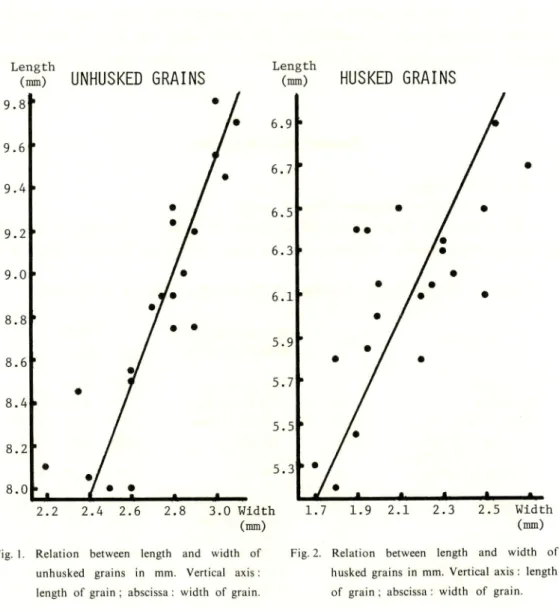
Fig. 1. Relation between length and width of Fig. 2. Relation between length and width of unhusked grains in mm. Vertical axis : husked grains in mm. Vertical axis : length length of grain ; abscissa : width of grain. of grain ; abscissa : width of grain.
HUSKED GRAINS
to 2.0 mm thick, 3.0 to 3.7 in ratio of length to width, 4.8 to 5.5 in ratio of length to thickness and 1.3 to 1.7 in ratio of width to thickness. Fig. 1 shows relationship between length and width of the unhusked grains in mm.
Husked grain (Character Nos. 11 to 16)
The results are given in the second column of Table 1. Grains showed the following characteristics; 5.2mm to 6.9mm long, 1.7mm to 2.7mm wide, 1.2mm to 1.6 mm thick, 2.4 to 3.4 in ratio of length to width, 4.0 to 4.8 in ratio of length to thickness, 1.2 to 1.9 in ratio of width to thickness. Fig. 2 shows the relationship between length and width of the husked grains in mm.
Comparison (Character Nos. 21 to 26)
The results are given in the third column of Table 1. Grains showed the following characteristics; 0.6 to 0.8 in length, 0.6 to 0.9 in width, 0.7 to 0.9 in
thickness, 0.8 to 1.1 in ratio of length to width, 0.8 to 1.0 in ratio of length to thickness, 0.8 to 1.3 in ratio of width to thickness.
Comparative studies of data obtained in the previous characters have been looked upon as one of the most important characters for ecotypic differentiations in view of evolution. This character means biologically or agronomically the "grain fullness" in its capacity (KATAYAMA and KURODA, 1974). In evolutional and agronomical viewpoints, it may be said that the larger is the ratio of husked to unhusked grains in the respective characters, the more advanced is the evolutional state of the respective strains. Values of length, width and thickness in wild rice species were clearly found to be smaller than those of cultivated rice species (KATAYAMA, 1978).
Averages and ranges of variation became larger in order of length, thickness and width of grains. In other words, grain length showed the lowest value but was most stable in view of the "grain fullness", and was not affected by any environmental conditions. On the contrary, grain width showed the highest value but was unstable in view of the grain fullness. And grain thickness showed intermediate value both in the practical value and its stability. Such tendencies were found to be the same in cultivated rice strain (KATAYAMA, 1978), and wild rice species (KATAYAMA, 1984, 1986; KATAYAMA and KURODA, 1974). Then, the order found in length, thickness and width in view of practical values and variation ranges are constant in the genus Oryza, regradless of the species
status.
Area and Volume (Character Nos. 31 to 36)
The results are given in the fourth column of Table 1. Grains showed the following characteristics; 17.8mm2 to 30.1mm2 in area of unhusked grain, 30.3 mm3 to 58.6 mm3 in volume of unhusked grain, 9.0 mm2 to 18.1mm2 in area of husked-grain, 10.4mm3 to 28.03 mm3 in volume of husked grain, 0.4 to 0.7 in quotient of areas and 0.3 to 0.6 in quotient of volumes.
The ear of rice plants have an ability of net photosynthesis. The maximum rate of net photosynthesis per one exposed surface have been fixed as 1-2 mg C02/dm2 (100 spikelets/h, TSUNO et al, 1975). Grain volume has been looked
upon as an end product. The studies on surface and volume of grain were regarded as important characters in view of strain differentiation. So, these characters were employed here as a new method. However, these could not be fully explained at the present, and further studies on this character should be soon performed.
2. Relations between the respective 2 characters
Unhusked grain (Character-combinations 1 & 2 to 5 & 6)
To make clear the 3 relationships between length and width, length and thickness, width and thickness, as well as 3 components, /. e., ratios of length to width (abbreviated as L/W in Table 2) and of length to thickness (L/T),
Table 2. Correlation coefficient and linear regression of the former character (Y) on the latter character (X) for 27 character-combinations
Character-Nos. Correlation Linear
combination coefficient regression
Length and Width 1& 2 0.8718*** Y = 0.383X-0.663
Length and Thickness 1& 3 0.7832*** Y = 0.152X + 0.403 c/3 Width and Thickness 2& 3 0.5991*** Y = 0.265X + 1.027
43 L/W and L/T 4& 5 -0.3881* Y = -0.496X + 6.679
o L/W and W/T 4& 6 -0.8573*** Y = -0.603X +3.525 L/T and W/T 5& 6 0.8037*** Y = 0.443X-0.682 Length and Width 11& 12 0.7213*** Y = 0.458X-0.649
"O Length and Thickness 11&13 0.6820*** Y = 0.168X+0.358
Width and Thickness 12& 13 0.6191*** Y = 0.240X+0.867
C/3
L/W and L/T 14 & 15 0.1762
-L/W and W/T 14&16 -0.8014*** Y = -0.478X +2.925 L/T and W/T 15& 16 0.4398* Y = 0.264X+0.383
Length and Width 21&22 0.4741** Y = 0.642X+0.344
c Length and Thickness 21&23 0.6044*** Y = 0.645X+ 0.338
.2 Width and Thickness 22&23 0.0847
-o 3 L/W and L/T 24&25 -0.0329 -o L/W and W/T 24&26 -0.7970*** Y = -1.128X-1.994 L/T and W/T 25&26 0.6218*** Y = 1.224X-0.073 £ Length 1 & 11 0.3294 -o en Width 2&12 0.6841*** Y = 0.783X + 0.011 Thickness 3&13 0.4431* Y = 0.444X + 0.605 a L/W 4& 14 0.2523 -o U L/T 5&15 0.1008 -W/T 6&16 0.1428 -_o Area 31&33 0.6546*** Y = 0.457X + 2.109 c3 Volume 32&34 0.7038*** Y = 0.379X + 2.212 oC Quotient 35&36 0.9325*** Y = 0.944X-0.079
L/W; Length/Width, L/T; Length/Thickness, W/T; Width/Thickness, Area; length x width, Volume; length x width x thickness, Quotient; Husked/Unhusked d. f. =28
significant at 0.1 %, 1 % and 5 % levels, respectively
of length to width (L/W) and of width to thickness (W/T), of length to thickness (L/T) and of width to thickness (W/T), correlation coefficients and linear regressions between them were calculated, and are shown in the first column of Table 2. Five and 1 character-combinations showed significances at 0.1 % and 5% levels, respectively. In other words, the whole of the character-combinations showed significant level. The whole relations (=6) are shown in Figs. 1,3,4,7,8 and 9. For example, from the data obtained in character-combination 1 and 2 (Fig.
2.2
UNHUSKED GRAINS
L
HUSKED GRAINS
5 1.2 1.3 1.4 1.5 2.7 6 • / • 2.5 • • /• 2.3 i • » • 2.1 * • • V • 1.9 i • • • • 1.7 • • 1.2 1.3 1.4 1.5
Figs. 3. to 6. Relations between the 2 characters in the unhusked and the husked grains in mm. Figs. 3 and 4: unhusked grains; Figs. 5 and 6 : husked grains; Figs. 3 and 5: length (L) and thickness (T); Figs. 4 and 6: width (W) and thickness (T).
l/w UNHUSKED GRAINS L/W 3.3 3.1 2.9 HUSKED GRAINS 3.6 3.4 3.2 3.0 L/W 3.6 3.4 3.2 3.0 5.4 1.3 10 • • 2.7 • • • 2.5 I t I 5.0 5.2 5.4 L/T 4.0 4.2 4.4 4.6 4.8 L/T 1.5 1.7 W/T 4.8 • / • 12 4.6 -• -• • • • • 4.4 * /• • • 4.2 •
•7
•
4.0 * • ^ ^ ^ ^ 1.4 1.6 1.8 W/TFigs. 7 to 12. Relations between the 2 characters in the unhusked and the husked grains. Figs. 7, 8 and
9: unhusked grains; Figs. 10, II and 12: husked grains; Figs. 7 and 10: L/W and L/T; Figs. 8 and II : L/W and W/T; Figs. 9 and 12: L/T and W/T.
1), it may be said that the longer is the length of the unhusked grain, the wider is the width of the unhusked grain. Linear regression shows that the length becomes 0.383 mm longer, when the width becomes wider by 1 degree.
This tendency was also found to be true for cultivated strains collected in the several areas of the world.
Husked grain (Character-combinations 11 & 12 to 15 & 16)
The 6 character-combinations of the husked grains as the same those of the unhusked grains were calculated, and are shown in the second column of Table 2. Four, 1 and 1 character-combinations showed significances at 0.1 % and 5 % levels and no significance even at 5 % level, respectively. The whole relations (=6) are shown in Figs. 2, 5, 6, 10, 11 and 12. For example, from the data obtained in character-combination II and 12 (Fig. 2), it may be said that the longer is the length of the husked grain, the wider is the width of the husked grain. Linear regression shows that the length becomes 0.458 mm longer, when the width becomes wider by 1 degree.
This tendency was also found to be quite the same as that of the unhusked grain, and that of the cultivated strain collected in the several tropical and sub tropical areas.
In comparison of the data obtained in unhusked and the husked grains, the following facts could be said. Four character-combinations, ('. e., length and width (Figs. 1 and 2), length and thickness (Figs. 3 and 5), width and thickness (Figs. 5 and 6) and L/W and W/T (Figs. 8 and 11), were significant at 0.1 % level, and were constant both in the unhusked and husked grains. One character-combination, i.e., L/T and W/T (Figs. 9 and 12), showed significances at 0.1 % and 5 % levels. On the contrary, the remaining one character-combination, i. e., L/W and L/T (Figs. 7 and 10), showed significance at 5 % level and no significance even at 5 % level.
In the whole, 11/12 character-combinations, i.e., 91.7% of the whole showed significances. In the previous data concerning the wild rice species, 5/12 and 3/12 character-combinations, i.e., 41.7% and 25.0%, showed significances in O.
sativa var. spontanea of Indonesia (KATAYAMA, 1984) and O. officinalis of
Indonesia (KATAYAMA, 1986), respectively. It may be concluded that the present materials showed more significant correlations and stable status.
Quotient (Character-combinations 21 & 22 to 25 & 26)
The 6 character-combinations of the quotients as the same those of the unhusked and husked grains were calculated, and are shown in the third column of Table 2. Three, 1 and 2 character-combinations showed significances at 0.1 % and 1 % levels and no significance even at 5 % level, respectively. For example, from the data obtained in character-combination 21 and 22, it may be said that the larger is the quotient of length, the larger is the quotient of width. Linear regression shows that the quotient of length becomes 0.642 larger, when the quotient of
width becomes larger by 1 degree.
This tendency was also found to be quite the same as that of the unhusked and husked grains, and that of the cultivated strains collected in the several tropical and sub-tropical areas.
In comparison with the data obtained in the unhusked, husked and quotient, the following facts could be said. Four character-combinations, /. e., length and width, length and thickness, L/W and W/T, and L/T and W/T, were significant and were constant in the 3 columns. It is assumed that these character-combinations are looked upon as the stable status in view of the genetic background. The remaining 2 character-combinations, /. e., width and thickness, and L/W and L/T, were thought to be of relatively unstable status.
Comparison (Character-combinations 1 & 11 to 6 & 16)
To make clear the relations between the unhusked and husked grains in view of the six characters, correlation coefficients and linear regressions between them were calculated, and are shown in the fourth column of Table 2. One, 1 and 4 characters showed significances at 0.1% and 5% levels and no significance even at 5 % level, repectively.
In general, it was already ascertained that almost all of these character-combinations in these columns, and almost of the materials belonging to the genus
Oryza, including the cultivated rice (KATAYAMA, 1976, 1978, and others) and
wild rice (KATAYAMA, 1984, and others), showed high significances. So, it might be said that the low significances found in the present and the previous (KATAYAMA, 1986) materials were looked upon as peculiar tendency and as a clear specificity of the materials.
Ratio (Character-combinations 31 & 33 to 35 & 36)
To make clear the relations between the unhusked and husked grains with regard to area and volume, correlation coefficients and linear regressions between them were calculated, and are shown in the last column of Table 2. All of them showed significances at 0.1 % level. For example, from the data obtained in character combination 31 and 33, it may be said that the wider is the area of unhusked grain, the wider is the area of husked grain. Linear regression shows that the area of unhusked grain becomes 0.457 mm2 wider, when the area of husked grain becomes wider by 1 degree.
3. Comparison with the data obtained in the present and the previous
materials
To make clear the status of this material and the relations between the present material and other strains previously collected in other countries, comparison was made.
1) In comparison with the present and the previous data concerned on African countries (KATAYAMA, 1987) in view of strain differentiation of O. longistaminata
Table 3. Six morphological characters of unhusked grains of Oryza longi staminata collected in 6 African countries ; illustrated by average values of the respective groups. Data of the former 5 countries were cited from the previous paper (Katayama, 1987), and of the last country were cited from Table 1 of the present paper
Country Length (mm) Width (mm) Thickness (mm) L/W L/T W/T Madagascar 8.80 2.42 1.61 3.65 5.46 1.50 Tanzania 9.05 2.58 1.79 3.50 5.07 1.45 Kenya 8.59 2.63 1.65 3.27 5.23 1.61 Nigeria 8.77 2.49 1.69 3.54 5.21 1.48 Senegal 8.76 2.43 1.62 3.63 5.44 1.51 Ethiopia 8.86 2.73 1.75 3.26 5.07 1.56
(Table 3), the following facts were ascertained, i] Value of width showed the largest one (=2.73 mm) in the whole countries, ii] Values of length, thickness and ratio of width to thickness showed the second ones in the whole countries, iii] Values of ratios of length to width and of length to thickness showed the smallest ones in the whole countries, iv] According to the tripartite classification (MATSUO, 1952), almost grains of the present material belonged to C type, long type and indica type. This tendency was found to be the same as in cases of
West Java and Kalimantan (KATAYAMA, 1963). On the other hand, almost grains of East Java belonged to B type, large type and javanica type (KATAYAMA, 1984). v] In comparison with these results obtained here, the present material should be located in the position relatively longer length, wider width and thicker thickness of wild rice in the Oryza longistaminata and its relatives.
Standard deviations, /'. e., intra-population's variations, of 3 characters were ascertained as follows; length (0.39 in Madagascar, 0.46 in Tanzania, 0.17 in Kenya, 0.64 in Nigeria, 0.44 in Senegal and 0.55 in the present material), width (0.12, 0.07, 0.09, 0.20, 0.17 and 0.24 in the same order) and thickness (0.05, 0.09, 0.10, 0.10, 0.11 and 0.11). Values of width and thickness of the present material showed the largest one in the whole countries. Value of length showed the second one in the whole countries. In general, the strain having large and small standard deviations are said to be located in genetically unstable and stable statuses, respectively. So, the present strain is located to the former one. It is thought that the present strain was looked upon as having a short history after migrating here from another locality.
2) In the whole data shown in Table 2, 16 (=59.3% of the whole character-combinations), 1 ( = 3.7%), 3 ( = 11.1 %) and 7 ( = 25.9%) character-combinations showed significances at 0.1 %, 1 % and 5 % levels and no significance even at
5% level, respectively. In other words, 20 (=74.1 % of the whole) character-combinations showed significances.
In the previous data, 1 ( = 3.7%), 2 (=7.4%), 2 ( = 7.4%) and 22 (=81.5 %) character-combinations showed significances at 0.1 %, 1 % and 5 % levels and no significance even at 5 % level, respectively, in the case of O. officinalis WALL., collected at Tembilahan, Sumatra, Indonesia (KATAYAMA, 1986). On the other hand, 13 ( = 48.2 %), 3 (=11.1 %) and 11 ( = 40.7 %) character-combinations showed significances at 0.1 % and 1 % levels and no significance even at 5 % level, respectively, in the case of O. sativa var. spontanea ROSCHEV., collected at Babat, East Java, Indonesia (KATAYAMA, 1984).
In comparison of data obtained in 3 sites, 20 (=74.1 %), 5 ( = 18.5%) and 16 ( = 59.3 %) character-combinations showed significances in the present, Sumatra and East Java, respectively. These differences mean the species- and locality-specificities.
References
BEZANCON, G. 1982. Synthese sur le prospections de riz realisees en Afrique
par l'ORSTOM et 1TRAT. ORSTOM-IRAT, pp. 13.
CHANG, T. T. 1971. The origin, evolution, cultivation, dissemination, and diversification of Asian and African rice. Euphytica, 25 : 425-441.
IRAT-ORSTOM 1978. Exploration and collection of African rices. Collection missions in Cameroon, Ivory Coast, Mali, Senegal and Tchad. IRAT-ORSTOM, pp. 64.
KATAYAMA, T. C. 1963. Wild Oryza species of the Philippines, New Guinea, Borneo and Java. Seiken Ziho, 15: 35-46.
KATAYAMA, T. C. 1976. Grain morphology of cultivated rice, "Pelita" in Ambon, Indonesia. Mem. Fac. Agr. Kagoshima Univ., 12: 41-45.
KATAYAMA, T. C. 1978. Diallel cross experiment among Sikkimese varieties, indica and japonica testers of rice, Oryza sativa L. VI. Comparison of unhusked and husked grains. Mem. Fac. Agr. Kagoshima Univ., 14: 1-31.
KATAYAMA, T. C. 1984. On the wild rice, Oryza sativa var. spontanea ROSCHEV., collected at Babat, East Java, Indonesia. Mem. Kagoshima Univ. Res. Center S. Pac, 5 : 31-41.
KATAYAMA, T. C. 1986. On the wild rice, Oryza officinalis WALL., collected at Tembilahan, Sumatra, Indonesia. Mem. Kagoshima Univ. Res. Center S. Pac,
7 : 53-64.
KATAYAMA, T. C. 1987. Preliminary consideration on distribution and some morphological characters of wild rice in African countries. Kagoshima Univ. Res. Center S. Pac, Occasional Papers, 10: 1-23.
KATAYAMA, T. C. and KURODA, T. 1974. Distributions and some morphological characters of the wild rice in the Ganga Plains (PART II). Pre. Rep. Tottori Univ. Sci. Survey, 1971, 2: 19-70.
MATSUO, T. 1952. Genecological studies on the cultivated rice (in Japanese with English Summary). Bull. Nat. Inst. Agr. Sci. Series D, 3: 1-111.
STEELE, W. M. and SHARMA, S. D. 1977. Organization of African rice exploration, conservation and assessment. Meeting on African Rice Species. IRAT-ORSTOM, 87-90.
TSUNO, Y., SATO, T., MIYAMOTO, H. and HARADA, H. 1975. Studies on COz
uptake and C02 evolution in each part of crop plants. II. Photosynthetic activity in the leaf sheath and ear of rice plant (in Japanese with English Summary). Proc Crop Sci. Soc, Japan, 44: 287-292.