Slip Motion of a Projectile Striking a Water
Surface I
著者
FUJITA Chikao
journal or
publication title
鹿児島大学水産学部紀要=Memoirs of Faculty of
Fisheries Kagoshima University
volume
9
page range
30-36
別言語のタイトル
投射物体の水面における滑りの研究I
30
Slip Motion of a Projectile Striking a Water Surface, I
Tikao HuzitaAbstract
A survey of the photographs taken with both a 35 mm camera and an 8 mm cine camera, reveals that there are two kinds of slip motion. (1) After striking the water surface, the projectile slides along the water surface sending up a spray, and after a while it falls down. (2) After striking the water surface, the trajectory of the projectile in the air seems to be extended into the water. And an instant later the course in the water curves upwards, and the projectile reaches the surface but it does not fly off the water. So, the projectile moves along just beneath the surface for some time and then falls down.
In the former case, the major axis of the projectile does not coincide with the tangent of trajectory of the projectile but is horizontal or close to the horizontal. And in the latter case, the major axis of the projectile coincides with the tangent of the trajectory. So, this case is considered to be the critical case of the ricochet.
1. Introduction
The studies of ricochet motion of a bullet, a sphere and a harpoon were carried
out by Isobe(", by Ramsauer'2' and by Hirata(3) respectively.
And the force of impact
of a projectile striking a water surface at a right angle'4' or an arbitrary angle'5' has been reported. The motion of a projectile with head-cone or a harpoon was also investigated by the author'8' (" (s'.The projectile ricochets if its incident angle is smaller than the critical incident angle. The ricochet motion was analyzed<7) introducing the following non-dimensional coefficients: coefficient of retardation ex=\. —(z;2cos a2/vi cos a,), coefficient of ricochet
e!l = Vzsma2/vismah and coefficient of slip es=s2/d (Fig. 1). The critical incident angle between ricochet and swimming for any projectiles obtained from the experiment is considered to be the critical angle coresponding to the critical conditions ex=0, ev = 1. Therefore, if these conditions are satisfied, it is expected that the motion which resembles the slip of a projectile striking the smooth wall will appear.
In the present paper the author's intention is to make clear the slip motion which will appear at the critical incident angle between ricochet and swimming.
Fig. 1. Symbols used in ex, e,j and es.
2. Experiment and Result
1) To investigate the slip on the water surface, four types of projectiles, each apex angle of which measures 180°, 90°, 60° or 30°, are projected horizontally with the velocity of 4.6~4.9m/sec on the water surface. The dimensions of the projectile are as follows—diameter : 15 mm, full length : about 62 mm, weight: about 28 g, tail: 4 plates. The course of the projectile is intermittently illuminated with an intensely bright
mm: mmfc<Dfcmz#»zm*)<Dm3c. i 31 multi-stroboscope newly devised for this experiment and then the projectile in motion, in the air and in the water, is photographed simultaneously with both a 35 mm camera
and an 8 mm cine camera.
2) A survey of the photographs reveals that there are two kinds of slip motion. One of them is the following: after striking the water surface, the projectile slides along the water surface sending up a spray. Then it falls down as shown in Fig. 2. Another is the following: after striking the water surface, the trajectory of the projec tile in the air seems to be extended into the water. And an instant later the course in the water curves upwards, and the projectile reaches the surface but it does not fly off the water. So, the projectile in the water moves along just beneath the surface for some time and then falls down (Fig. 3).
Projectile
Fig. 2. Slip motion : the major axis of a prjectile does not coincide with the tangent of the trajectory.
—• Projectile
5Iip-J
-SlipFig. 3. Slip motion: the major axis of a projectile coincides with the tangent of the trajectory.
In the former case, the major axis of the projectile that slides well like an aqua
plane, does not coincide with the tangent of trajectory of the projectile but is horizon
tal or is close to the horizontal.
This motion is similar to the gliding of a seaplane.
And in the latter case, the major axis of the projectile coincides with the tangent
of the trajectory. So, this case is considered to be the critical case of the ricochet.
Therefore, the author summarizes the data obtained from the photographs in which
the major axis of the projectile coincides with the trajectory, and reports in the present
paper the results for the projectile with an apex of 60°.The results for 180°-, 90°-, and 30c-projectiles will be reported in the next paper.
3) The photograph (Experiment No. 02-35, incident angle 7.3°, incident velocity
4.6m/sec) taken with a 35mm camera does not obviously show that the projectile
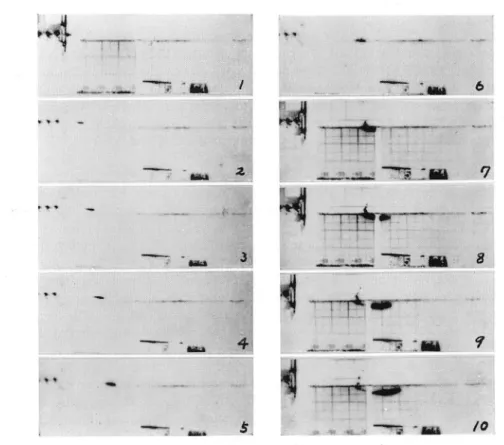
ricochets (Fig. 4), but the consecutive photographs (Fig. 5) taken with an 8 mm cine
camera show the projectile in ricochet motion. The coefficients obtained from theconsecutive photographs of the projectile are ^=0.6, ey=0.9.
Now, by definition of ricochet coefficient, the case ex=0 seems intuitively to be
the boundary between ricochet and swimming. Unexpectedly enough, according to the
experiments^ 1 seems to be the boundary between the two motions. The photograph
(Experiment No. 02-35) is suitable to observe the transition stage from ricochet to
swimming.
4)
Next, in the photograph (Experiment No. 03-27, incident angle 8.0°, incident
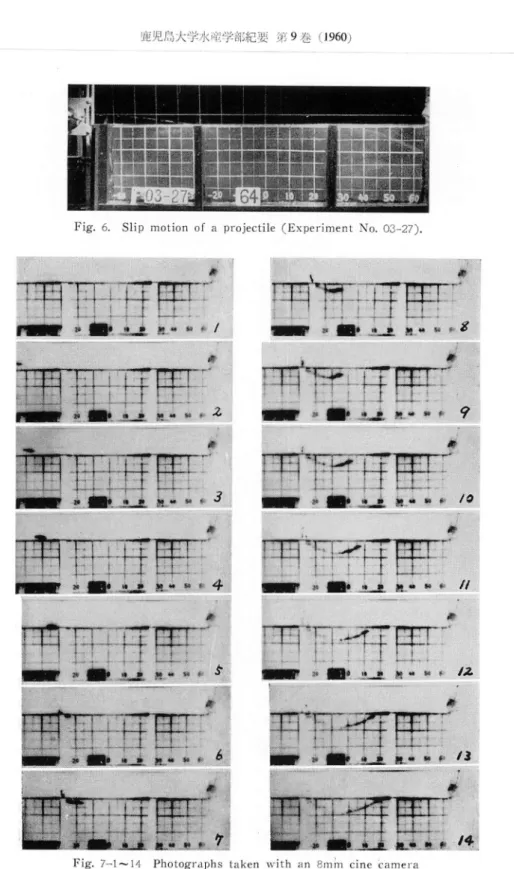
velocity 4.8 m/sec) we can see the slip of the projectile under the water surface (Fig.
6). The projectile projected from a spring gun strikes a water surface, and sends up
a spray at the water surface, its path being continued for a while as if its path in the
air is extended into the water.
Then, the projectile is wholly submerged in the water
and at this stage, the air mass follows, especially in the wake of the projectile.
As the
projectile moves on,- t£te air mass is divided into small bubbles, but its greater bulk
32
.♦»
m^±^^m^me,m ®9i= (i960)
Fig. 4-1 . Ricochet motion of a projectile
(Experiment No. 02-35). _1 2_
—l_i_
-l_6
'^18,9
'———— ———^7^14 9n"^^*- ~B^TToTT^13
2'2223
cm 60 50 40 30 20 10 0 10 20 30Fig. 4-2. Path of the projectile in the air and in the water (Expeirment No. 02-35). Mi '' '
*
, t • " 1 • Mk
8
4
"-""tf ' feu
f
m *> -m_-s ^ »Fig. 5—1 —10. Photographs taken with an 8 mm cine camera (Experiment No. 02-35).
mi :^%{McD-m\icts»zffiio(D(mi i 33
i ™*w
:•" / i**Jfe*^^
"***5 *HI
^'
; 1 - 5 -—» 2£ • /3 ~ 74 23HI
I
r 1 .v4IRW..-•~..^T.-i """""'11 ..I HI
1 :W^* >-*f.S
—I
w,
*4
lb
1 -___,
-2f
1 | ,}• "ISR^*'' "~~
' J
mjfrr"
'?.
,&„».^tl:h . •**
Fig. 5—11 —28. Photographs taken with an 8 mm cine camera (Experiment No. 02-35).
34 ffiSS^Tkit^SMBll $9& 'I960;
Fig. 6. Slip motion of a projectile (Experiment No. 03-27).
8.** ** * /
—^^^^ -| {T pjS|j | r'
ryH
» m » ** ** , 2.Tm
L_£rrr-wr.
i» «• ."• «• v- I i 1 — r -! 1HTH". ;T
L j—1„!
••rf»-r-r —I—4 * » H • _ m | t 1~"|.:ji4TT.,4-4-]Hir
EH
i ;» .••* * » »..*• « » ' H P ft Hi* *-* •*.." i IFig. 7—1 —14- Photographs taken with an 8mm cine camera (Experiment No. 03-27).
, T
,t.Jl B. mSTX'ptl I
4-4 II'' r
*-* » - • * 94 J
.« i » <• » •> /O *f-f
_ _ 8m ~
// fr •*••" ['"™-4"'—"*-#• * »
t ..2_JL «." p II i i*T< /4mm :mimt&/kwi^i-3»z,fn^&mfc i •___*- :< ___|> *__S S8 ** ** '*
2"
H0P £i_T"
' i
I 1
|» » *» w » s« *r.TTTSr
fy*w r r -^htt
-__, .>« pf^
TTX"
m 11
SOT ill "p» HMf • "V" "P -ZOE "111-171-4
*'
«F •; .ft1
HT '" 19'
«**• 26 29 ** •2? 30 *r-rrr.-iTT-Er:
_*L
pp./.®.
Fig. 7-15~32. Photographs taken with an 8 mm cine camera
(Experiment No. 03-27).
J2
.r..,.'.^.;.'|.
36 ffij&g*¥*&¥»eK * 9 * (i960)
remains undivided.
After a while, the direction of the projectile is changed to the horizontal and then upwards. The projectile, then, reaches the water surface, but it does not fly off the water into the air. And so, the projectile rushes along just beneath the water surface, with part of its head-cone appearing above the water surface and ruffling the water. The projectile, finally, directs its head downwards and then falls to the bottom. Al though the some bubbles ascend vertically from the beginning of the under-water course until the falling-down course, the projectile is still accompanied with the great bulk of air at the beginning of the falling-down course.
But at the beginning of the falling-down course, the air mass is rapidly seperated from the projectile.
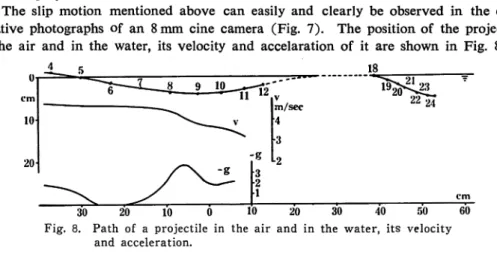
The slip motion mentioned above can easily and clearly be observed in the con secutive photographs of an 8 mm cine camera (Fig. 7). The position of the projectile in the air and in the water, its velocity and accelaration of it are shown in Fig. 8.
4 * 18
30 20 10 0 10 20 30 40 50 60
Fig. 8. Path of a projectile in the air and in the water, its velocity
and acceleration.
The author wishes to express his sincere thanks to Professor S. Tomotika of Kyoto University for his incessant encouragement and to Professor T. Maekawa of Hiroshima University for his valuable suggections. His thanks are also due to Messrs. M. Nagai, T. Maekawa and S. Namikawa for the trial manufacture of an intensely bright multi-stroboscope. This work was partly financed by the research grant of the Ministry of
Education.
Literature
(1) Isobe, T.: J. Ord. Soc. Japan, 36 (1942), 237; 36 (1943), 387.
(2) Ramsauer, C: Ann. d. Phys., 84 (1927), 721.
(3) Hirata, M.: Sci. Rep. of Whales Res. Inst., No. 6 (1951), 199. (4) ShiflFman, M. and Spencer, D. C.: Comm. Pure App. Math..
4 (1951), 379.
(5) Trilling, L.: J. Appl. Phys., 21 (1950), 161.
(6) Huzita, T.: J. Sci. Hiroshima Univ., 19 (1955), 137, 151 (7) Huzita, T.: J. Phys. Soc. Japan, 12 (1957), 208. (8) Huzita, T.: Proc. 8th NCTAM (1958).