Requirements of Prawn, Penaeus japonicus, for
Essential Fatty Acids
著者
KANAZAWA Akio, TESHIMA Shin-ichi, ENDO Minoru
journal or
publication title
鹿児島大学水産学部紀要=Memoirs of Faculty of
Fisheries Kagoshima University
volume
28
page range
27-33
別言語のタイトル
クルマエビにおける必須脂肪酸要求量
Vol. 28 pp. 27-33 (1979)
Requirements of Prawn, Penaeus japonicus,
for Essential Fatty Acids
Akio Kanazawa, Shin-ichi Teshimaand Minoru Endo*
Abstract
Feeding trials using purified diets were carried out to estimate the requirements of prawn, Penaeus japonicus, for essential fatty acids (EFA) such as linoleic acid (18: 2 o)6), linolenic acid (18: 3o>3), eicosapentaenoic acid (20: 5o>3), and
docosa-hexaenoic acid (22: 6o>3). For 18: 2 o> 6 and 18: 3&>3, the optimum weight gain was attained on diets containing 1.0# of either 18: 2 o> 6 or 18: 3 co 3. However, the
weight gain on diets containing 18: 2 co 6 or 18: 3 co 3 was inferior even at the opti mum levels to that on the diets containing lower levels of 20: 5 o> 3 or 22: 6&>3.
This indicated that 18: 2 co 6 and 18: 3 &> 3 are not as effective EFA for the prawn
as 20: 5o>3 and 22: 6o>3. For 20: 5o>3 and 22: 6o>3, the optimum weight gain was attained on the diets containing 1 % of either 20: 5 co 3 or 22: 6o>3.
Recent advances in nutritional studies on lipids for aquatic animals have de
monstrated the unique aspects of essential fatty acids (EFA) requirements in the rainbow trout, Salmo gairdnerii, the carp, Cyprinus carpio, the eel, Anguilla
japonica, the red sea bream, Chrysophrys major, the turbot, Scophthalmus maximus, the
yellow tail, Seriola quinqueradiata, the black sea bream, Acanthopagurus schlegelii,
the opaleye, Girella punctata, etc.
The nutritive values of dietary lipids from the
viewpoint of EFA in fresh-water and marine fish have
been reviewed by
Takeuchi" and by Yone2), respectively.
As for crustaceans, we have also shown that the prawn, Penaeus japonicus, re
quires EFA such as linoleic acid (18: 2a>6)34>, linolenic acid (18: 3o>3)3-4), eicosa
pentaenoic acid (20: 5o>3)5), and docosahexaenoic acid
(22: 6o>3)6> for normal
growth, suggesting that 20: 5o>3 and 22: 6co3 probably exert a higher EFA acti
vity than 18: 2co6 and 18: 3o>3. In the present study, we intend to estimate the
requirements of the prawn, P. japonicus, for 18: 2co6, 18: 3o>3, 20: 5o>3, and 22:
6 0)3.Materials and Methods
The specimens of the prawn, P. japonicus, were obtained from the Mitsui-Nohrin Kaiyosangyo Co. and maintained on a commercial diet until use. Oleic acid (18: lco9), 18: 2 co 6, and 18: 3o>3 were purchased from Sigma Chemicals,
28 Mem. Fac. Fish., Kagoshima Univ. Vol. 28 (1979)
and 20: 5o>3 and 22: 6o>3 were prepared from the squid liver oil by the same
method as described previously7). The purities of 18: lo>9, 18: 2o>6, 18: 3o>3, 20: 5 o)3, and 22: 6o)3 were 99, 98, 99, 90, and 94^, respectively, determined by
gas-liquid chromatography (GLC) on 10^ DEGS8).
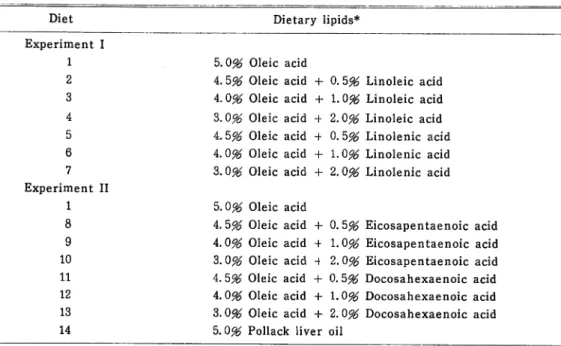
In Experiment I, 7 groups of the prawns (each group, 15 prawns), 0. 65g in average body weight, were maintained on the diets 1-7 (Table 1). In Experi ment II, 8 groups of the prawns (each group, 30 prawns), 0.15g in average body
weight, were maintained on the diets 1 and 7-14 (Table 1).
The composition
of the basal diet (lipid-free) was the same as reported previously".
Each group
of prawns was reared in an aquarium (30 liters) for 50 days by the similar me
thods to those reported previously".
Table 1. Composition of dietary lipids in Experiment I and Experiment II
Diet Dietary lipids*
Experiment I
1 5.0$ Oleic acid
2 4. 5$ Oleic acid + 0. 5$ Linoleic acid 3 4.0$ Oleic acid + 1.0$ Linoleic acid 4 3.0$ Oleic acid -f 2.0$ Linoleic acid 5 4.5$ Oleic acid -f 0.5$ Linolenic acid 6 4.0$ Oleic acid + 1.0$ Linolenic acid 7 3.0$ Oleic acid + 2.0$ Linolenic acid
Experiment II
1 5.0$ Oleic acid
8 4.5$ Oleic acid + 0.5$ Eicosapentaenoic acid 9 4.0$ Oleic acid + 1.0$ Eicosapentaenoic acid 10 3.0$ Oleic acid -4 2.0$ Eicosapentaenoic acid
11 4.5$ Oleic acid + 0.5$ Docosahexaenoic acid
12 4.0$ Oleic acid + 1.0$ Docosahexaenoic acid 13 3.0$ Oleic acid + 2.0$ Docosahexaenoic acid
14 5.0$ Pollack liver oil
* Fatty acids except oleic acid were added to the diets as a form of methylester.
The body weight and survival rate were measured every 10 days and at the end of feeding trials. After the feeding trials, lipids were extracted with chlo-roform-methanol-water10) from the whole body of the prawns, and the content
of lipids, neutral lipids (NL), and polar lipids (PL) were determined as described
previouslyn).
Also, the fatty acid composition of NL and PL was analyzed by
GLC on 10 96 DEGS8).Results
II.
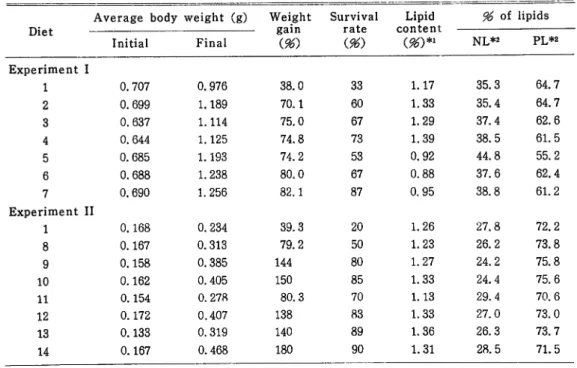
Experiment I was planned to estimate the requirements of 18: 2 co 6 and 18:
3 0)3. In Experiment I, the weight gain of prawns reached a maximum in the
groups receiving either 1.0 96 18: 2o)6 or 1.0 96 18: 3o>3. Elevation of 18: 2o>6
or 18: 3o>3 levels from 1.0 to 2.0^ did not result in the improvement of weight gain. The groups of prawns receiving 1.0 and 2.0^ levels of either 18: 2o)6or 18: 3o)3 gave a high survival rate as compared with those receiving the diets containing no EFA and 0.5^ levels of 18: 2 oj 6 or 18: 3 co 3. These results indi
cate that optimum levels of dietary 18: 2 oj 6 or 18: 3 co 3 for the prawn, P. japo
nicus, are about 196, respectively, under the experimental conditions adopted.
However, the weight gain of prawns on the diets containing \.0% 18: 2o>6 or
\.0% 18: 3o)3 was clearly inferior to that on the diets containing 0. 5 and \.0% levels of 20: 5 co 3 or 22: 6 co 3 (see Experiment II). These results imply that 18:
2co6 and 18: 3co3 are not as effective EFA as 20: 5co3 and 22: 6co3 for the
prawn, P. japonicus.
Although the prawn has been shown to convert 18: 3 co 3 to
20: 5 co 3 and 22: 6o)312), the bioconversion does not seem to proceed rapidly enough to satisfy the requirements of 20: 5o)3 and 22: 6 a) 3.
Experiment II was conducted to estimate the requirements of 20: 5o)3 and 22:
6o>3. The weight gain of prawns reached a maximum in the groups receiving
either 1. 0 % 20: 5 co 3 or 1. 0 % 22: 6 co 3. Elevation of 20: 5 co 3 or 22: 6 co 3 levels
Table 2. Results of the feeding trials and the lipid content of prawn after
feeding trials
Average body weight (g) Weight
gain (%) Survival rate {96) Lipid content (96)*1 $ of lipids Diet Initial Final NL*2 PL*2 Experiment I 1 0.707 0.976 38.0 33 1.17 35.3 64.7 2 0.699 1.189 70.1 60 1.33 35.4 64.7 3 0.637 1.114 75.0 67 1.29 37.4 62.6 4 0.644 1.125 74.8 73 1.39 38.5 61.5 5 0.685 1.193 74.2 53 0.92 44.8 55.2 6 0.688 1.238 80.0 67 0.88 37.6 62.4 7 0.690 1.256 82.1 87 0.95 38.8 61.2 Experiment II 1 0.168 0.234 39.3 20 1.26 27.8 72.2 8 0.167 0.313 79.2 50 1.23 26.2 73.8 9 0.158 0.385 144 80 1.27 24.2 75.8 10 0.162 0.405 150 85 1.33 24.4 75.6 11 0.154 0.278 80.3 70 1.13 29.4 70.6 12 0.172 0.407 138 83 1.33 27.0 73.0 13 0.133 0.319 140 89 1.36 26.3 73.7 14 0.167 0.468 180 90 1.31 28.5 71.5 *i $ of fresh prawn
30 Mem. Fac. Fish., Kagoshima Univ. Vol. 28 (1979)
from 1.0 to 2.0 % gave no further improvement of weight gain. The survival
rates of prawns receiving 1.0 and 2.0^ levels of either 20: 5o)3 or 22: 6co3
were high and almost comparable to that of prawns receiving 5 % pollack liver oil as lipid sources. These results indicate that optimum levels of dietary 20: 5o)3 or 22: 6co3 for the prawn, P. japonicus, are about \%, respectively.
The lipid content of prawn bodies did not vary markedly with the dietary
levels of EFA such as 18: 2o)6, 18: 3co3, 20: 5co3, or 22: 6co3, although it seemed
to be slightly low in the prawns fed the diets containing 18: 3o)3. Also, the ratio of NL to PL was slightly lower in the prawns receiving either 20: 5o)3 or 22: 6 co 3 than in the prawns receiving 18: 2 co 6 or 18: 3 co 3. Tables 3 and 4 show the effect of dietary levels of EFA on the composition of main fatty acids in NL and PL fractions from the prawn. The addition of 18: 2o)6 increased the pro portion of 18: 2 co 6 in both PL and NL and 20: 4 co 6 in PL, but not that of o)3 HUFA (highly unsaturated fatty acids) such as 20: 5o)3 and 22: 6 co 3 in PL and NL. The addition of 18: 3o)3 also elevated the proportion of 18: 3o)3 in both PL and NL and 22: 6 co 3 in PL. The increment of 18: 2o)6 and 18: 3o)3 propor tions in the prawn bodies induced by supplementation with the respective fatty acids was proportional to the increment in dietary levels of 18: 2co6 and 18: 3o>
3. Also, the addition of 20: 5o)3 or 22: 6co3 resulted in the elevation of o>3
Table 3. Effect of dietary levels of EFA on the percentage composition of main fatty acids in polar lipids from the whole body of prawn
Fatty acid anc1 $ Composition
dietary level
16: 0 18: 0 18: lo>9 18: 2a> 6 18: 3a>3 20: 4a> 6 20: 5a>3 22: 6&>3
Experiment I EFA-free*1 12.9 5.7 48.3 3.2 0.1 0.2 10.5 2.5 0.5$ 14.1 7.1 47.9 3.8 0.1 2.6 9.5 2.6 18: 2o>6 1.0$ 14.9 6.2 44.3 7.1 0.1 3.1 8.3 2.3 2.0$ 12.4 6.2 40.7 13.8 0.4 4.0 8.0 1.6 0.5$ 13.0 4.5 33.7 2.7 1.0 4.1 13.0 11.9 18: 3o>3 1.0$ 13.3 4.7 32.7 2.5 2.7 2.6 12.1 11.1 2.0$ 12.1 3.4 35.5 2.5 6.1 3.6 12.0 11.6 Fxperiment I][ EFA-free*1 15.3 7.1 48.8 1.7 £*2 2.6 5.0 2.6 0.5$ 14.3 7.1 42.8 t 0.1 3.0 11.4 5.3 20: 5a)3 1.0$ 13.7 4.6 39.4 t 0.1 3.6 15.3 5.3 2.0$ 10.6 5.3 39.3 0.3 0.3 3.7 16.6 7.9 0.5$ 12.6 5.4 37.0 t 0.1 4.0 11.0 8.6 22: 6w3 1.0$ 13.7 3.9 40.8 t 0.2 2.4 10.7 12.8 2.0$ 9.6 3.5 40.4 0.2 0.1 2.6 10.7 19.7
** Diet contained 5$ 18: 1&>9 as a lipid source *2 Less than 0.1 $
Table 4. Effect of dietary levels of fatty acids in neutral lipids
EFA on the percentage from the whole body of
composition of
prawn
main
Fatty acid anc1 $ Composition
dietary level
16: 0 18: 0 18: lco9 18: 2o)6 18: 3co3 20: Aco 6 20: 5o> 3 22: 6o>3
Experiment I EFA-free*1 14.1 6.0 30.9 0.5 0.6 5.0 7.7 2.5 0.5$ 14.8 8.6 25.0 1.5 0.1 6.3 7.6 2.2 18: 2g>6 1.0$ 10.2 8.9 17.5 4.5 0.2 5.8 8.1 3.2 2.0$ 8.2 8.3 19.3 5.3 0.2 5.2 8.0 2.5 0.5$ 11.4 8.1 18.8 3.1 2.1 9.0 9.4 2.7 18: ScoS 1.0$ 11.6 6.0 22.3 2.6 6.1 6.6 9.7 3.2 2.0$ 12.0 6.5 24.9 1.2 9.7 9.5 9.9 2.5 Experiment 11[ EFA-free*1 16.3 7.3 45.6 4.0 0.5 t*2 3.3 1.6 0.5$ 13.4 7.2 45.1 2.2 0.7 t 11.0 3.4 20: 5g>3 1.0$ 10.8 6.9 45.7 2.4 t t 15.1 2.9 2.0$ 10.3 8.3 42.9 3.3 0.4 0.1 14.8 2.7 0.5$ 10.7 5.3 45.3 3.1 0.7 0.1 8.2 6.5 22: 6o>3 1.0$ 14.4 5.1 40.3 3.3 0.7 t 6.0 6.6 2.0$ 8.6 6.0 39.4 1.6 t t 8.9 15.3
*2 Diet contained 5$ 18: lo>9 as a lipid source *2 Less than 0.1 $
HUFA such as 20: 5o)3 and 22: 6 co 3 in both PL and NL.
Discussion
There are several reports on the requirements of EFA for fish. Yu and
Sinnhuber13> have shown that 1 % 18: 2 co 6 attained the best weight gain for
the rainbow trout. Also, the optimum levels of 18: 3co3 for the rainbow trout
have been reported to be 1 % and 0. 86-1. 66 % in the diets by Castell et al.u> and by Watanabe et al.15), respectively. In the case of rainbow trout13), how
ever, the addition of 18: 3 co 3 to a diet rich in 18: 2o)6 has been found to reduce the weight gain due to the competitive inhibition between 18: 2o)6 and 18: 3o)3 as also observed in the chicken16) and rat1720), whereas the simultaneous supple
mentation of both 18: 2o)6 and 18: 3o)3 has been reported to exert an additive
effect for the growth of carp21> and eel*. The best weight gain was attained
when the diets contained both 1 % 18: 2 o> 6 and 1 % 18: 3 co 3 for the carp21) and
both 0.5^ 18: 2co6 and 0.5^ 18: 3o)3 for the eel21>. The optimum levels of 18
: 2 o)6 and 18: 3o)3 for the prawn, P. japonicus, determined in the present study
* S. Arm, T. Watanabe, T. Takeuchi, and Y. Shinma : the Autumn Meeting of Japanese Society of Scientific Fisheries, p. 92 (1975).
32 Mem. Fac. Fish., Kagoshima Univ. Vol. 28 (1979)
are similar to those of 18: 2co6 and 18: 3o>3 for the rainbow trout1415>. How ever, a marked difference was perceived between the prawn and the rainbow
trout with respect to the growth enhancing effects of 18: 2co6 and 18: 3o>3. The
weight gain of the prawn on the diets containing 18: 2 co 6 or 18: 3o)3 was in ferior even at the optimum levels to that on the diets containing lower levels
of 20: 5o)3 or 22: 6o>3, differing from the rainbow trout14~15) and also the carp21>.
On the other hand, neither 18: 2o>6 nor 18: 3o)3 has been shown to exert an
EFA efficiency for the red sea bream22_24), the black sea bream*1*, and the
opal-eye*1*. In the red sea bream25)*2), the best weight gain and feed conversion have been attained on diets containing 0.5 96 co3 HUFA or 0.5^ 20: 5o)3. Ge
nerally, o)3 HUFA such as 20: 5o)3 and 22: 6co3 are more effective as EFA than
18: 2 0)6 and 18: 3o)3 not only for the red sea bream but also for other fish. Yu and Sinnhuber26> have reported that the EFA efficiency of 1% 22: 6o)3
was almost equal to that of 1 % 18: 3 co 3 for the rainbow trout. Later, Takeuchi and Watanabe27' demonstrated that not only 0.5% 20: 5o)3 but also 0.5% 22:
6 o)3 gave a higher weight gain in the rainbow trout than \.0% 18: 3o)3, indica ting the additive effect between 20: 5o)3 and 22: 6co3 in the promotion of grow th. They have further shown that the supplementary effect of 0.5^ co 3 HUFA
for the carp slightly exceeded that of 1.0^ 18: 3o)321). In the present study,
the requirements of the prawn, P. japonicus, for 20: 5o)3 and 22: 6o)3 were estimated to be about 1 % in the diet. This value was high as compared with the requirements of 20: 5o)3, 22: 6co3, or o)3 HUFA which had been reported for
the rainbow trout, the carp, and the red sea bream. Since the requirements of
EFA seem to vary with the levels and types of dietary lipids28-29*, the estimated requirements of 20: 5o)3 and 22: 6o)3 for the prawn, P. japonicus, should be
evaluated in this light.
References
1) Takeuchi T.: in "Fish Culture and Dietary Lipids" (ed. by Japan. Soc. Sci. Fish.), Suisangaku Series No. 22, Koseisha Koseikaku, Tokyo, 1978, pp. 23-42 (in Japanese).
2) Yone Y.: in "Fish Culture and Dietary Lipids" (ed. by Japan. Soc. Sci. Fish.), Suisan gaku Series No. 22, Koseisha Koseikaku, Tokyo, 1978, pp. 43-59 (in Japanese).
3) Kanazawa A., S. Tokiwa, M. Kayama, and M. Hirata: Bull. Japan. Soc. Sci. Fish., 43, 1111-1114 (1977).
4) Kanazawa A., S. Teshima, S. Tokiwa, and H. J. Ceccaldi: Oceanol. Acta, 2, 41-47 (1979).
5) Kanazawa A., S. Teshima, M. Endo, and M. Kayama: Mem. Fac. Fish., Kagoshima Univ., 27, 35-40 (1978).
6) Kanazawa A., S. Teshima, S. Tokiwa, M. Kayama, and M. Hirata: Bull. Japan. Soc. *l K. Yamada and Y. Yone: the Spring Meeting of Japanese Society of Scientific
Fisheries, p. 190 (1977).
*2 H. Nakayama and Y. Yone: the Spring Meeting of Japanese Society of Scientific Fisheries, p. 189 (1977).
Sci. Fish., 45, 1151-1153 (1979).
7) Teshima S., A. Kanazawa, and S. Tokiwa: Bull Japan. Soc. Sci. Fish., 44, 927 (1978). 8) Teshima S., A. Kanazawa, and H. Okamoto: Mem. Fac. Fish. Kagoshima Univ., 25,
41-46 (1976).
9) Kanazawa A., S. Teshima, and S. Tokiwa: Bull. Japan. Soc. ScL Fish., 43, 849-856 (1977).
10) Bligh E. G. and W. J. Dyer: Can. J. Biochem. Physiol., 37, 911-917 (1959). 11) Teshima S. and A. Kanazawa: Bull. Japan. Soc. Sci. Fish., 42, 1129-1135 (1976). 12) Kanazawa A., S. Teshima, and K. Ono: Comp. Biochem. Physiol., 63B, 295-298 (1979). 13) Yu T. C. and R. 0. Sinnhuber: Lipids, 10, 63-66 (1975).
14) Castell J. D., R. 0. Sinnhuber, J. H. Waler, and D. J. Lee: /. Nutr., 102, 77-86 (1972).
15) Watanabe T., C. Ogino, Y. Koshiishi, and T. Matsunaga: Bull. Japan. Soc. Sci. Fish., 40, 493-499 (1974).
16) Century B. and M. K. Horwitt: Arch. Biochem. Biophy., 104, 416-422 (1964). 17) Mohrhauer H. and R. T. Holman: /. Lipid Res., 4, 34-35 (1963).
18) Mohrhauer H. and R. T. Holman: /. Nutr., 81, 67-74 (1963).
19) Rahm J. J. and R. T. Holman: /. Nutr., 84, 15-19 (1964).
20) Garcia R. T. and R. T. Holman: /. Am. Oil Chem. Soc, 42, 1137-1141 (1965). 21) Takeuchi T. and T. Watanabe: Bull. Japan. Soc. Sci. Fish., 43, 541-551 (1977). 22) Yone Y. and M. Fujii: Bull. Japan. Soc. Sci. Fish., 41, 73-77 (1975).
23) Yone Y. and M. Fujii: Bull. Japan. Soc. Sci. Fish., 41, 79-86 (1975). 24) Fujii M. and Y. Yone: Bull. Japan. Soc. Sci. Fish., 42, 583-588 (1976).
25) Fujii M., H. Nakayama, and Y. Yone: Rep. Fish. Res. Lab. Kyushu Univ., 3, 65-86 (1976).
26) Yu T. C. and R. O. Sinnhuber: Lipids, 7, 450-454 (1972).
27) Takeuchi T. and T. Watanabe: Bull. Japan. Sco. Sci. Fish., 43. 947-953 (1977). 28) Yu T. C. and R. O. Sinnhuber: Aquaculture, 8, 309-317 (1976).