ファジィ微分方程式の解の吸引性について
大阪大学大学院工学研究科応用物理学専攻 齋藤誠慈(Seiji Saito)
GraduateSchoolof Engineering, Osaka University
E-mail:[email protected]
Keywords : FuzzyNumbers;FuzzyDifferential Equations; Attractivity Set; Couple Parametric
Representation;
1Introduction
There are many fruitful results on the
representations of fuzzy numbers, differentials
and integrals of fuzzy functions (see, e.g.,
in Goetschel-Voxman $[8, 9]$, Dubois-Prade [3,
4, 5, 6], Puri-Ralescue [13], Furukawa [7],
Kaleva $[10, 11]$ etc). They establish
funda-mental results concerning differentials, inte
grals and fuzzy differential equations of fuzzy
functionswhichmap $\mathrm{R}$to aset of fuzzy
num-bers. By usingthe results it seems to be
dif-ficultto aPPlyall the practical and significant
problems. In this studying we introduce the
couple parametric representation [2]$)$
cor-responding tothe representationof fuzzy
num-bers due toGoetschel-Voxmansothatitiseasy
to solve fuzzy differentialequations.
In Buckley [1], Kaleva$[10, 11]$, Park [12] and
Song [16], various types of conditions for the
existence and uniqueness ofsolutions to fuzzy
differentialequations. By thecouple
represen-tation some kinds of differential and integral
of fuzzy functions can be easily treated in an
analogous waywith thereal analysisaswellas
some tyPe of fuzzy differential equations
can
be solved without difficulty.
In Section 2we denote afuzzy number $x$
by$(a, b)$, where$a,b$areendpointsof at-cut set
of the membership function $\mu_{x}$
.
Wegive somekind of metric spacewhich includes the set of
fuzzy numbers as well as prove the continuity
of$a$,$b$
.
In Section3we give definitions ofdiffer-entialandintegral of fuzzy functionsand
suffi-cient conditions for fuzzy functions to be
differ-entiableorintegrable. InSection4wegetbasic
results of existence and uniqueness ofsolutions
for fuzzydifferentialequations byaPPlying the
contraction principle. In Section 5we treat
afuzzy differential equation $x’=p(t)x,\mathrm{w}\mathrm{h}\mathrm{e}\mathrm{r}\mathrm{e}$
$p(t)$ is afuzzy valued function, and we
calcu-late the the exponential function $e^{x}$, where $x$
is afuzzy number. In the section weshow the
attractivityset,where all thesolutionsare
aP-proaching to the zero as the time increasing
the infinity
数理解析研究所講究録 1216 巻 2001 年 255-265
2Parametric
Representa-
We introduce the following parametricreP-tion
of Fuzzy Numbers
resentationof$\mu\in F_{\mathrm{b}}^{st}$,Inorder to introduceametric spacewhich
includes the set of fuzzy numbers,
we
definethe following set.
$a(\alpha)$ $=$ $\min L_{\alpha}(\mu)$,
$b(\alpha)$ $=$ $\max L_{\alpha}(\mu)$
$.11\cdot \mathrm{w}111\epsilon$$\infty\cup\cdot$
for$0<\alpha\leq 1$ and
$X=\{x=(a, b)\in C(I)\mathrm{x}C(I)\}$
$r$ ’ $\backslash$
where $I=[0,1]$and$C(I)$ isthe setof
continu-ous
functions from I to R. Denote ametric by$d(x,y)= \sup_{\alpha\in I}(|a(\alpha)-c(\alpha)|+|b(\alpha)-d(\alpha)|)$
for$x=(a,b),y=(c,d)\in X$
.
Then the metricspace $(X,d)$ is complete.
Definition 1Consider
a
set fuzzy numberswith bounded supports
as
follows:
$F_{\mathrm{b}}^{\iota t}=$
{
$\mu:\mathrm{R}arrow I$ satisfying $(i)-(iv)$below.}
(i) There exist
a
unique $m\in \mathrm{R}$ such that$\mu(m)=1$;
(ii) The set sum(\mu )=d({\mbox{\boldmath $\xi$}\in R: $\mu(\xi)>0\}$)
is bounded in$\mathrm{R}$;
(iii) One
of
the following conditionsholds;(a)$\mu$ is strictly$f.i$fuzzy convex, $i.e.$,
$\mu(c\xi_{1}+(1-c)\xi_{2})>\mathrm{m}$$\dot{\mathrm{m}}[\mu(\xi_{1}),\mu(\xi_{2})]$
for
$\xi_{1},\xi_{2}\in \mathrm{R}$, $0<c<1$;(b)$\mu(m)=1$ and$\mu(\xi)=0$
for
$\xi\neq m$;(iv) $\mu$ is uppersemi-continuous
on
R.Remark 1The above condition (iiia) is
stronger than
one
inthe usualcase.
Itfollows
that$\mu(\xi)$ is strictly increasing in$( \in(-\infty,m)$
and strictly decreasing in $\xi\in(m, \infty)$
.
Thiscondition plays
an
importantrole in $\theta\iota e$ proofof
Theorem 1.$L_{\alpha}(\mu)$ $=$ $\{\xi\in \mathrm{R}:\mu(\xi)\geq\alpha\}$,
$a(0)$ $=$ $\min cl(sfu_{fl}(\mu))$,
$b(0)$ $=$ $\max d(suw(\mu))$
.
SeeFigure 1.
Remark 2 fi}$\eta m$ the extension principle
of
Zadeh, it
follows
that$\mu_{x+y}(\xi)$
$=\epsilon^{\max_{=}\min_{\xi_{1}+\xi_{2}\cdot=1,2}(\mu:(\xi)))}.$
:
$= \max\{\alpha\in I:\xi=\xi_{1}+\xi_{2},\xi:\in L_{\alpha}(\mu_{i})\}$
$= \max\{\alpha\in I:\xi\in[a(\alpha)+c(\alpha),b(\alpha)+d(\alpha)]\}$,
where $\mu_{1}$,$\mu 2$
are
membershipfunctions of
$x$,$y$,respectively. Thus
we
get$x+y=(a+c, b+d)$.
The following theorem is abasic result.
Theorem 1Denote $\mu=(a,b)\in F_{\mathrm{b}}^{st}$, where
$a,b$ : $Iarrow \mathrm{R}$
.
The followingprvperties(i)-(iii)hold:
(i) a,b
are
continuouson
Ij(ii) $\max a(\alpha)=a(1)=m$ and $\min b(\alpha)=$
$b(1)=m_{j}$
(iii)
One
of
thefollow
$.ng$statements holds;(a)$a$ is strictly increasingand$b$is strictly
decreasing with$a(\alpha)<b(\alpha)$;
(b)$a(\alpha)=b(\alpha)=m$
for
$0<\alpha<1$.
Conversely, under the above conditions (i)
$-(iii)$,
if
we denote$\mu(\xi)=\sup\{\alpha\in I$:$a(\alpha)\leq\xi\leq b(\alpha)\}$
then$\mu\in F_{\mathrm{b}}^{st}$
.
Moreoveritfollows
thatR$\subset F_{\mathrm{b}}^{st}$and that$F_{\mathrm{b}}^{st}$ is a closed convex cone inX.
In the following examplewe illustrate
tyPi-cal three typesof fuzzy numbers.
Example 1Consider the following $L-R$
fuzzynumber$x\in F_{\mathrm{b}}^{st}$ withamembership
func-tion as
follows:
$\mu_{x}(\xi)=\{$
$L( \frac{m-\xi}{\iota})_{+}$
for
$\xi\leq m$ $R( \frac{\xi-m}{r})_{+}$for
$\xi>m$where$m\in \mathrm{R}$,$l>0$,$r>0$
.
$L$,$R$ are intomaP-pings
defined
on $\mathrm{R}^{+}=[0, \infty)$.
Let $L(\xi)_{+}=$$\max(L(\xi), 0)$ etc. We identify $\mu_{x}$ with $x=$
$(a, b)$ Then we have $a(\alpha)=m-L^{-1}(\alpha)l$ and
$b(\alpha)=m+R^{-1}(\alpha)r$ provided that $L^{-1}$ and
$R^{-1}$ eist.
Let $L(\xi)=-c_{1}\xi+1$, where $c_{1}>0$
.
Weillustrate the following cases $(a)-(c)$
.
(i) Let $R(\xi)=-\mathrm{c}2\mathrm{f}+1$, where $c_{2}>0$
.
Then$c_{2}l(b-m)=c_{1}r(m-a)$
.
(ii) Let$R(\xi)=-c_{2}\sqrt{\xi}+1$, where$c_{2}>0$
.
Then$c_{2}l(b-m)^{2}=c_{1}r^{2}(m-a)$
.
(ii) Let$R(\xi)=-c_{2}\xi^{2}+1$, where$c_{2}>0$
.
Then $c_{2}^{2}l^{2}(b-m)=c_{1}^{2}r(a-m)^{2}$.
See Figure 2.
3Differential
and Integral
of
Fuzzy
Valued
Func-tions
Let
an
interval $J\subset \mathrm{R}$.
We callafunction$x$ : $Jarrow F_{\mathrm{b}}^{st}$ to be afuzzy valued function.
Denote
$x(t)$ $=$ $(a(t),b(t))$
$=$ $\{(a(t, \alpha), b(t, \alpha))^{T}\in \mathrm{R}^{2}$:$\alpha\in I\}$
.
We definethe continuietyand
differentiabil-ityof fuzzy valued function asfollows:
Definition 2A fuzzy valued
function
$x$ : $Jarrow$$F_{\mathrm{b}}^{st}$ is continuous at$t\in J$
if
$\lim_{harrow 0}d(x(t+h), x(t))=0$
.
Denote the set
of
all the continuousfunctions
$x:Jarrow F_{\mathrm{b}}^{st}$ by$C(J)$
.
Let the
function
$x:Jarrow F_{\mathrm{b}}^{st}$ by$x(t)$ $=$ $\{(a(t, \alpha), b(t, \alpha))^{T}\in \mathrm{R}^{2} : \alpha\in I\}$
$=$ $(a(t, \cdot), b(t, \cdot))=x(t$,$\cdot$$)$
for
$t$ $\in$ J. Thefunction
$x$ isdif-ferentiable
at $t$ $\in$ $J$if for
any $\alpha$ $\in$I there eist $\frac{\partial a}{\partial t}(t, \alpha)$,$\frac{\partial b}{\partial t}(t,\alpha)$ such that $\frac{\partial a}{\partial t}(t, \alpha)\leq\frac{\partial b}{\partial t}(t, \alpha)$ and $\mu(t, \cdot)\in F_{\mathrm{b}}^{st}$, where
$\mu(t,\xi)=\sup\{\alpha\in I$ : $\frac{\partial a}{\partial t}(t, \alpha)$ $\leq\xi$ $\leq$ $\frac{\partial b}{\partial t}(t, \alpha)\}$
.
Thefunction
$x$ isdifferentiable
on$J$
if
$x$ isdifferentiable
at any $t\in$ J.De-note $\frac{dx}{dt}(t)=x^{l}(t)=(\frac{\partial a}{\partial t}(t, \cdot), \frac{\partial b}{\partial t}(t, \cdot))$ and it
is called to be the derivative
of
$x(t)$.
We define an integral of an $F_{\mathrm{b}}^{st}-$ valued
function x.
Definition 3Let x : J $arrow \mathcal{F}_{\mathrm{b}}^{\epsilon t}$ be $x(t, \cdot)=$ ball by B $=$
{x
$\in F_{\mathrm{b}}^{st}$:$d(x, 0)\leq 1\}$.
Define$(a(t,$.),$b(t, \cdot))$
for
t $\in$ J. Thefunction
x is rB $=${rx
$\in F_{\mathrm{b}}^{st}$: x$\in B\}$ for r $>0$.
called to be integrable over $[t_{1}, t2]$, since $a$,$b$ Assumption (A) Let$r>0$ and
ore
Riemann integrableover
$[t_{1}, t_{2}]$.
Then we$B(x_{0}, r)=x0+rB$
.
define
the integralasfollows:
The following conditions (i) and (ii) are
satis-$\int_{t_{1}}^{t_{2}}x(s, \cdot)ds$
fied.
$=$ $\{(\int_{t_{1}}^{t_{2}}a(s, \alpha)ds, \int_{t_{1}}^{t_{2}}b(s, \alpha)ds)^{T}\in \mathrm{R}^{2} : \alpha\in I\}.(\mathrm{i})$ It follows that $f(t, x)$ $\in$
$F_{\mathrm{b}}^{st}$ for any
$(t, x)\in J_{\mathrm{c}}\mathrm{x}B(x_{0}, r)$, i.e., for any $x=$
Remark 3Let $x(t)=(a(t,$.),$b(t, \cdot))$ $\in F_{\mathrm{b}}^{st}$
$\{(a(\alpha), b(\alpha)) : \alpha\in I\}\in F_{\mathrm{b}}^{st}$,$t\in J_{c}$ the
for
$t\in J$.
following properties$(\mathrm{a})-(\mathrm{c})$ hold for$t\in J$:
(%)
If
$x$ isdifferentiate
at$t$,we
get theinte-gralover $[t_{1}, t2]\subset J$
as
follows:
$\int_{t_{1}}^{t_{2}}x(s, \cdot)ds=x(t2, \cdot)-x(t1’, \cdot)$
.
(ii)
If
$x(t)\in F_{\mathrm{b}}^{st}$ is integrableover
$[t_{1},t_{2}]$,then
we
have$\int_{t_{1}}^{t_{2}}x(s, \cdot)ds\in F_{\mathrm{b}}^{\epsilon t}$.
And alsowe
have$d( \int_{t_{1}}^{t_{2}}x(s, \cdot)ds,0)\leq\int_{t_{1}}^{t_{2}}d(x(s, \cdot), a)ds$,
4Fuzzy
Differential
Equa-tion I
Consider
an
initial value problem ofadif-ferential equation in the metric space$X$
as
fol-lows:
$x(t)=f(t,x)’$, $x(t\mathrm{o})=x0$ (N)
where $t0\in \mathrm{R},x0\in F_{\mathrm{b}}^{\epsilon t}$
.
Let $f$ : $J_{c}\cross Xarrow X$,where $J_{\mathrm{c}}=[t_{0},t0+c],c>0$
.
We call theequationof(N)tobe afuzzydifferentialequa
tion if $f(t, x)$ is afuzzyvalued function
on a
subset of $J_{\mathrm{c}}\mathrm{x}X$
.
Moreoverwe
assume
thatthe following assumption. Denote the unit
(a) $f_{\dot{1}}(t, (a(\alpha),b(\alpha)),$$\alpha)$,$i$ $=$ 1, 2, are
contiunous in $\alpha$;
(b) For each $t\in J$ there exists aunique
value $M(t)\in \mathrm{R}$such that
$\max_{\alpha}f_{1}(t, (a(\alpha), b(\alpha)),$$\alpha)$
$=f1(t, (a(1), b(1))$,$1)=M(t)$;
$\min_{\alpha}f_{2}(t, (a(\alpha), b(\alpha)),$ $\alpha)$
$=f_{2}(t, (a(1), b(1))$,$1)=M(t)$;
(c) One of the following statements
holds;
(a) $f_{1}(t, (a(\alpha),b(\alpha)),\alpha)$ is
strictly increasing in at and
$f_{2}(t, (a(\alpha), b(\alpha))$,$\alpha)$ is strictly
decreasingin $\alpha$;
(b) $f_{1}(t, (a(\alpha), b(\alpha))$,ci) $=$
$f_{2}(t, (a(\alpha), b(\alpha))$,$\alpha)$ for$0<\alpha<1$
.
(ii) Function $f(t,x)$ is continuous on $(t,x)\in$
$J_{\mathrm{c}}\mathrm{x}B(x_{0},r)$
.
In the
same
way in the theory ofordinarydifferential equations
we
give the followingdef-initionof solutions for initial value problems of
fuzzy differentialequation
Definition 4Let $J_{1}$ be an intemal in R and Example 2Considerthe
follow
ing problemof
$t_{0}\in J_{1}$. Afunction
$x$ : $J_{1}arrow F_{\mathrm{b}}^{st}$ is asolu-tion
of
(N) on $J_{1},ifx$satisfies
the followingconditions $(i)-(iii)$
.
(i) $x(t_{0})=x_{0;}$
(ii) $x(t)\in F_{\mathrm{b}}^{st}$
for
$t\in J_{1}$;(Hi) There exists $x’(t)$ and $x^{t}(t)=f(t, x(t))$
for
$t\in J_{1}$.By aPPlying the contraction principleweget
the following theorem.
Theorem 2Suppose that the following
condi-tions (i) and (ii) are
satisfied
underAssump-tion (A) :
(i) $f$ is bounded, $i.e.$, there eists an $M>0$
such that
$d(f(t, x),0)\leq M$
for
$(t, x)\in J_{c}\mathrm{x}B(x_{0}, r)$;(ii) $f$ is Lipschitzian in$x,i.e.$, there eists an
$L>0$ such that
$d(f(t,x)$,$f(t, y))\leq Ld(x,y)$
for
$(t, x)$,$(t, y)\in J_{c}\mathrm{x}B(x_{0}, r)$.
Then there eists a unique solution$x$
for
(N)such that
$x(t)=x_{0}+ \int_{t_{\mathrm{O}}}^{t}f(s, x(s, \cdot))ds$
$for$$t\in J_{\rho}=[t_{0},t_{0}+\rho]$, where$\rho=\min(c, r/M)$
.
We illustrate theabovetheoremby aPPlying
it to the following example.
fuzzy
differential
equation$x^{l}=p(t)x+q(t)$, $x(t_{0})=x0$ (E)
$t\in \mathrm{R}$,$x_{0},x(t)\in F_{\mathrm{b}}^{st}$
.
Functions$p,q$ : $\mathrm{R}arrow \mathrm{R}$are continuous.
Let$f(t, x)=p(t)x+q(t)$and$p(t)\geq 0$
.
Since$d(f(t, x)$,0) $\leq$ $p(t)d(x, \mathrm{O})+|q(t)|$,
$f(t, x)$ $\in$ $f(t,y)+p(t)d(x, y)B$,
itfollowsthat$f$isboundedand Lipschitzian in
$x$
.
Prom Theorem 2we haveauniquesolutionof (E) suchthat
$x(t)=e^{\int_{\iota_{\mathrm{O}}}^{t}p(s)ds}x_{0}+ \int_{t_{\mathrm{O}}}^{t}e^{\int_{l}^{t}p(r)dr}q(s)ds$
for$t\in \mathrm{R}$
.
Let $p$ : $\mathrm{R}$ $arrow$ $(-\infty,0]$ and
$x(t)$ $=$ $(x_{1}(t), x_{2}(t))$
.
Then we have$x_{1}(t)’=p(t)x_{2}(t)+q(t)$,$x_{2}^{J}=p(t)x_{1}(t)+q(t)$,
by denoting $x0=(a0, b_{0})$, so $x_{1}(t, \alpha)$ and
$x_{2}(t, \alpha)$ satisfy
$(\begin{array}{l}x_{1}(t,\alpha)x_{2}(t,\alpha)\end{array})=\Phi(t, \alpha)$ $(\begin{array}{l}a_{0}(t,\alpha)b_{0}(t,\alpha)\end{array})$
$+ \Phi(t, \alpha)\int_{t_{\mathrm{O}}}^{t}\Phi^{-1}(s, \alpha)$ $(\begin{array}{ll}q(s \alpha)q(s,\alpha) \end{array})$ $ds$,
where $\Phi(\cdot$,$\cdot$$)$ isafundamental matrix of
$\frac{d}{dt}(x_{1}(t, \alpha),$$x_{2}(t, \alpha))^{T}$
$=(p(t, \alpha)x_{2}(t, \alpha),p(t, \alpha)x_{1}(t, \alpha))^{T}$
$,\mathrm{i}.\mathrm{e}.$,
$\Phi(t, \alpha)$ $=$ $(\begin{array}{ll}\phi_{11}(t,\alpha) \phi_{12}(t,\alpha)\phi_{21}(t,\alpha) \phi_{22}(t,\alpha)\end{array})$
$e^{\int_{t_{\mathrm{O}}}^{t}p(s,\alpha)ds}+e^{-\int i_{0}^{p(s,\alpha)ds}}$ $\phi_{11}(t, \alpha)$ $=$
2
$e \mathrm{o}-e\int_{t}^{t}p(s,\alpha)ds-\int_{\iota_{0}}^{t}p(s,\alpha)ds$ $\phi_{12}(t,\alpha)$ $=$ 2 $e^{\int_{t}^{t}p(\epsilon,\alpha)d\epsilon}\mathrm{o}-e^{-\int_{c_{0}}^{t}p(s,\alpha)ds}$ $\phi_{21}(t,\alpha)$ $=$ 2 $e \mathrm{o}+e\int_{t}^{t}p(s,\alpha)d\epsilon-\int_{\iota_{0}}^{t}p(s,\alpha)ds$ $\phi_{22}(t,\alpha)$ $=$ 2 for t $\geq t_{0},\alpha\in I$
.
5Fuzzy
Differential
Equa-$\mathrm{t}\mathrm{i}\dot{\mathrm{o}}\mathrm{n}$
II
We considerthe exponentialfunction$e^{x}=$
$\sum_{\dot{|}=0}^{\infty}\frac{xx^{l}}{\vec{|}\Gamma}$, where $x\in Fi^{t}$, inthe similar to the
real analysis.
Let $x=(a, b)$, then $\alpha$-cut sets of
mem-bership function $\mu_{x}$ is $L_{\alpha}(\mu_{x})=[a(\alpha),b(\alpha)]$for $\alpha\in I$
.
We calculate $x^{:},i=2,3$,$\cdots$, inthe following
cases
$(a)-(c)$.
By the extensionprincipleofZadeh, it follows that
$\mu_{x}$‘$(\xi)$
$=$ $\max$ $\min(\mu(\xi_{\mathrm{j}}))$
$\epsilon=\mathrm{n}_{f}\epsilon_{J}1\leq \mathrm{j}\leq$
:
$=$ $\max\{\alpha\in I: \langle =\Pi_{j}\xi_{j},\xi_{j}\in L_{\alpha}(\mu_{x})\}$
.
When i $=2$,
we
find the followingrelations,(a) If$0\leq a(\alpha)\leq b(\alpha)$,then
we
get$L_{\alpha}(\mu_{xx^{2}})=[a(\alpha)^{2},b(\alpha)^{2}]$,
Thus$x^{2}=(a^{2},b^{2})\in F_{\mathrm{b}}^{\iota t}$
.
(b) If$a(\alpha)\leq b(\alpha)\leq 0$,then
we
have$L_{\alpha}(\mu_{x}\mathrm{a})=[b(\alpha)^{2},a(\alpha)^{2}]$,
th$\mathrm{u}\epsilon$ $x^{2}=(b^{2},a^{2})\in F_{\mathrm{b}}^{\iota t}$
.
(c) If$a(\alpha)\leq 0\leq b(\alpha)$, thenitfollows that
$L_{\alpha}(\mu_{x^{2}})=[a(\alpha)b(\alpha), c(\alpha)]$
where $c( \alpha)=\max(a(\alpha)^{2}, b(\alpha)^{2})$
.
With-out loss of generalitywe denote$\mu_{x}$ bythe
membership function in Examplel. De
note
$L^{-1}(\alpha+h)$ $=$ $L^{-1}(\alpha)+\Delta_{1}$,
$R^{-1}(\alpha+h)$ $=$ $R^{-1}(\alpha)+\Delta_{2}$,
where $\Delta_{1}<0$,$\Delta_{2}<0$ for $h>0$
.
Then wehave $a(\alpha+h)b(\alpha+h)-a(\alpha)b(\alpha)$ $=$ $a(\alpha)\Delta_{2}r-b(\alpha)\Delta_{1}l-\Delta_{1}\Delta_{2}lr>0$. Since $a(\alpha+h)$ $=$ $a(\alpha)-\Delta_{1}l<0$, $b(\alpha+h)$ $=$ $b(\alpha)-\Delta_{2}r>0$, then
we
have $(a(\alpha)-\Delta_{1}l)\Delta_{2}r>0$, $(b(\alpha)-\Delta_{2}r)\Delta_{1}l<0$.
Thus ab is increasing in$\alpha$and in thesame
way $c$ is decreasing. And $x^{2}=$ (ab, c) $\in$
$F_{\mathrm{b}}^{\epsilon t}$
.
From the above discussion
we
give thefol-lowing definition.
Definition
5Define
$e^{x}= \sum_{\dot{|}=0}^{\infty}\frac{x^{\dot{l}}}{\dot{\iota}!}\in F_{\mathrm{b}}^{\epsilon t}$
for
x$\in F_{\mathrm{b}}^{\iota t}$.
The followingtheorem shows the
represen-tation of$e^{x}$ for
x
$\in F_{\mathrm{b}}^{\epsilon t}$.
Theorem 3Let$x=(a, b)\in F_{\mathrm{b}}^{\epsilon t}$
.
Thenwegetthefollowing representation
of
the fuzzynum-bet$e^{x}$
as
follows:
(i)
If
$0\leq a(\alpha)\leq b(\alpha)$, then we have (i) Let$p_{1}(t, \alpha)\geq 0$ on $\mathrm{R}\cross I$ and an initial$e^{x}=(e^{a}, e^{b})$
$=\{(e^{a(\alpha)}, e^{b(\alpha)})^{T}\in \mathrm{R}^{2} : \alpha\in I\}$
.
(ii)
If
$a(\alpha)\leq b(\alpha)\leq 0$, then we get$e^{x}= \frac{e^{a}+e^{b}}{2}+(-\frac{e^{-a}-e^{-b}}{2}, \frac{e^{-a}-e^{-b}}{2})$
.
In somecasethe following property holds.
condition$x_{0}=(a0, \mathrm{b})$
.
Then the solution$x=(x_{1},x_{2})$
of
$(E_{0})$ is described by$x(t,\alpha)=(e^{\int_{\tau}^{\mathrm{t}}p_{1}(s,\alpha)d\epsilon}a(\alpha), e^{\int_{\tau}^{t}\mathrm{P}2(s,\alpha)d\epsilon}b(\alpha))$
as long as $x_{1}$($t$,ce) $\geq 0$
for
$t\in J_{1},\alpha\in$$I$, where $J_{1}$ is an interval in $[\tau, \infty)$ and
$x(\tau)=(a(\alpha), b(\alpha))$
.
Itfollows
thatTheorem 4Let $x=(a,b)\in F_{\mathrm{b}}^{st}$ and $y=$
$(c, d)\in F_{\mathrm{b}}^{st}$ with $a(\alpha)\geq 0$ and$c(\alpha)\geq 0$
for
$at\in I$
.
then we have$x(t,\alpha)=(e^{\int_{\tau}^{t}p_{2}(s,\alpha)ds}a(\alpha), e^{\int_{\tau}^{t}p_{2}(s,\alpha)ds}b(\alpha))$
as longas$x_{1}(t, \alpha)\leq 0\leq x_{2}(t, \alpha)$ and that
$e^{x}e^{y}=e^{x+y}$
.
$x(t, \alpha)=(e^{\int_{\tau}^{t}p_{2}(\epsilon,\alpha)ds}a(\alpha), e^{\int_{\tau}^{t}p_{1}(s,\alpha)ds}b(\alpha))$Example 3Consider behaviors
of
solutionsof
the following problemof
afuzzydifferential
equation
$x=p(t)x$, $x(t_{0})=x0$ (Eo)
where $t\in \mathrm{R}$,$x_{0}$ and $x(t)\in F_{\mathrm{b}}^{st}$
.
Function$p(t)=(p_{1} (t, \cdot),p_{2}(t, \cdot))$ : $\mathrm{R}arrow F_{\mathrm{b}}^{st}$ is
contin-uous.
Remark4Let $T(x)=p(t)x$
.
Itfollows
that$T$ is non-linear.
In analyzing the ordinary differential
equa-tion $x$
’
$=$ $a(t)x+\mathrm{b}(\mathrm{a})$, where $a$,$b$ : $\mathrm{R}arrow \mathrm{R}$ are continuous, the condition that
$\lim_{tarrow\infty}\int^{t}a(s)ds=0$plays an important role in
showingthe propertythat $\lim_{tarrow\infty}x(t)=0$
.
Conserning fuzzy differetial equation $(E_{0})$, we
getanextensionresultofasymptoticbehaviors
of ordinary lineardifferentialequations aswell
as weobservealittledifferent resultasfollows.
Theorem 5Consider Problem $(E_{0})$
.
Thefol-louting cases (i) and (ii) hold:
as long as $x_{2}(t, \alpha)\leq 0$
for
t$\in J_{1},\alpha\in I$.
(ii) Let $p_{2}(t, \alpha)\leq 0$ on $\mathrm{R}\mathrm{x}$ I. As long as
$x_{1}(t, \alpha)\geq 0$ or$x_{2}(t, \alpha)\leq 0$
for
$t\geq\tau$,$\alpha\in$$I$, it
follows
that$d(x(\tau, \cdot)$,$0)e^{\int_{\tau}^{t}p_{1}(s,\cdot)ds}$
$\leq d(x(t, \cdot),$ $0)$
$\leq d(x(\tau, \cdot),0)e^{\int_{\tau}^{t}p_{2}(s,\cdot)ds}$
where $\tau\geq t_{0},t\geq\tau,\alpha\in I$
.
As long as$x_{1}(t, \alpha)\leq 0\leq x_{2}(t, \alpha)$
for
$t\geq\tau$,a $\in I$, itfollows
that$d(x(\tau, \cdot)$,$0)e^{-\int_{\tau}^{t}p_{2}(\epsilon,\cdot)ds}$
$\leq d(x(t, \cdot),$$0)$
$\leq d(x(\tau, \cdot)$,$0)e^{-\int_{\tau}^{t}p_{1}(*,\cdot)ds}$
$t\geq\tau$,$\alpha\in I$
.
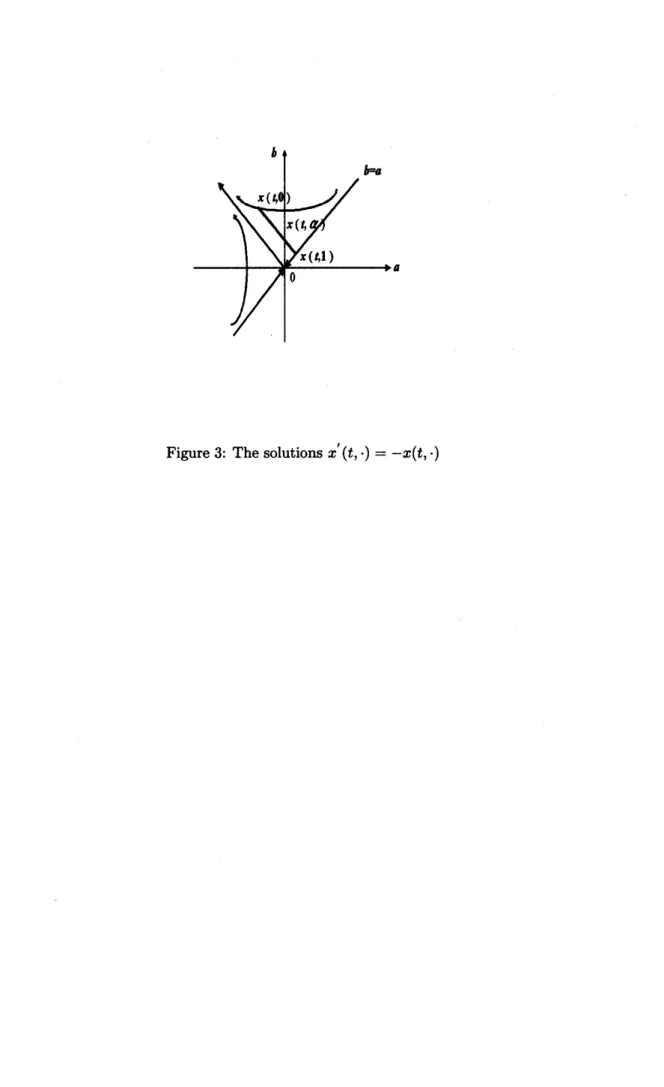
Example 4Consider Problem $(E_{0})$ with
$x(t_{0})$ $=$ $(a_{0},b_{0})$ $\in$ $F_{\mathrm{b}}^{st}$
.
Suppose that$\lim_{tarrow\infty}\int_{t\mathrm{o}}^{t}p_{2}(t, \alpha)=-\infty$
for
$t_{0}\in \mathrm{R}$,$\alpha\in I$.
Seikkala [15] calculates the solution in case
that $p(t)\equiv-1$
.
SeeFigure3.In the following theorem
we
showanattrac-tivity set $A^{E_{0}}(t_{0})$ of$(E_{0})$ at
to
$\cdot$ Here
$A^{E_{0}}(t_{0})$
is asubset of$F_{\mathrm{b}}^{st}$ as follows:
Definition
6If
$x0\in A^{E_{0}}$(to), then all thes0-lutions$x$
of
$(E_{0})$passingthrough$(t_{0}, x_{0})\in \mathrm{R}\mathrm{x}$$F_{\mathrm{b}}^{\epsilon t}$
satisfies
$\lim_{tarrow\infty}d$($x$($t$,ci),$0$) $=0$
for
$at\in I$.
It is clear that $x_{0}=0\in A^{E_{0}}(t_{0})$ for any
$t0\in \mathrm{R}$
.
In thecase
that$p_{1}(t, \alpha)\equiv \mathrm{p}\mathrm{i}(\mathrm{t},\mathrm{a})\leq 0$and $t \lim_{arrow\infty}\int_{\iota_{\mathrm{o}}}^{t}p_{1}(s,\alpha)ds=-\infty$ for $t_{0}\in \mathrm{R},\alpha\in$
$I$, it followsthat $A^{E_{0}}(t_{0})=\mathrm{R}$ for$t_{0}\in \mathrm{R}$
.
When $p_{1}(t, \alpha)$
I
$p_{2}(t, \alpha)$,we
have thefol-lowing theorem.
Theorem 6Consider Problem $(E_{0})$ with
$p_{1}(t)$
I
$P2(t)$.
Let$p_{2}(t,\alpha)\leq 0$on
$\mathrm{R}\mathrm{x}$ I and$\lim_{tarrow\infty}\int_{t_{0}}^{t}p_{2}(s, \cdot)ds=-\infty$
for
$t\mathit{0}\in \mathrm{R}$.
Thenwe
have$A\ (t_{0})=\{\mathrm{O}\in \mathrm{R}\}$for
any$t_{0}\in \mathrm{R}$.
Theabove theorem isprovedin [14]. Consider
the following problem
$x=P_{m}(t)x’$, $x(t\mathrm{o})=x0$ $(P_{m})$
$P_{m}$ : $\mathrm{R}arrow F_{\mathrm{b}}^{\epsilon t}$suchthat$P_{m}=(-m-q_{1},$$-m+$
$q_{2})$satisfying
$m:\mathrm{R}\mathrm{x}Iarrow \mathrm{R}$,$m(t, \alpha)\geq 0$,
q: : RxI$arrow \mathrm{R}$,
where $q(t, \alpha)=\max(q_{1}(t, \alpha),$$q_{2}(t, \alpha))$
.
Thenfor
any solution x $=(x_{1},x_{2})$of
$(P_{m})$ itfol-lows that
$\lim_{tarrow\infty}|x_{1}(t, \alpha)+\mathrm{P}2(\mathrm{t}, \alpha)|=0$
for
$\alpha\in I$.
References
[1] J. Buckley, T. Feuring, Fuzzy Differential
Equations, Fuzzy Sets and Systems 110
(2000) , 4354.
[2] M. Chen,S. Saito, H. Ishii,Representation
of Fuzzy Numbers and Fuzzy Differential
Equations (to be submitted to Fuzzy Sets
and Systems).
[3] D. Dubois, H. Prade, Operationson Fuzzy
Numbers, Internat. J. of Systems9(1978),
613626.
[4] D. Dubois, H. Prade, Towards Fuzzy
Dif-ferential Calculus Part I:Integration of
Fuzzy Mappings, Fuzzy Sets and Systems
8(1982), 1-17
[5] D. Dubois, H. Prade, Towards Fuzzy
Dif-ferential Calculus Part II :Integration of
Fuzzy Intervals, FuzzySets and Systems 8
(1982), 105-116.
$0\leq q*\cdot(t, \alpha)\leq m(t, \alpha),$i$=1,$2. [6] D. Dubois, H. Prade, Towards Fuzzy
Dif-Theorem 7Suppose that
for
$\alpha\in I$,$t0\in \mathrm{R}$ ferential Calculus PartIII: Differentiation,$\lim_{tarrow\infty}\int_{t_{0}}^{t}m(s, \alpha)ds=\infty$
FuzzySets and Systems8 (1982), 225-233.
$\lim_{tarrow\infty}e^{-\int_{t_{0}}^{t}m(s,\alpha)ds}\int_{t_{\mathrm{O}}}^{t}q(s, \alpha)e^{\int_{t_{\mathrm{O}}}(2m(r,\alpha)+q(r,\alpha))dr}.ds_{\mathrm{o}\mathrm{f}}[7]\mathrm{N}$
.
$\mathrm{E}\mathrm{h}\mathrm{z}\mathrm{z}\mathrm{y}\mathrm{O}\mathrm{p}\mathrm{t}\mathrm{i}\mathrm{m}\mathrm{i}\mathrm{z}\mathrm{a}\mathrm{t}\mathrm{i}\mathrm{o}\mathrm{n}(\mathrm{i}\mathrm{n}\mathrm{J}\mathrm{a}\mathrm{p}\mathrm{a}\mathrm{n}\mathrm{e}\mathrm{s}\mathrm{e})\mathrm{F}\mathrm{u}\mathrm{r}\mathrm{u}\mathrm{b}\mathrm{w}\mathrm{a},\mathrm{M}\mathrm{a}\mathrm{t}\mathrm{h}\mathrm{e}\mathrm{m}\mathrm{a}\mathrm{t}\mathrm{i}\mathrm{c}\mathrm{a}\mathrm{l}\mathrm{M}\mathrm{e}\mathrm{t}\mathrm{h}\mathrm{o}\mathrm{d}\mathrm{s}$
$=0$ Morikita Pub., Tokyo, Japan, 1999
[8] $\mathrm{J}\mathrm{r}$.R. Goetschel, W. Voxman, Topological
Properties of Fuzzy Numbers, Fuzzy Sets
and Systems9(1983), 87-99.
[9] Jr.R. Goetschel, W. Voxman, Elementary
Fuzzy Calculus, FuzzySetsand Systems18
(1986), 31-43.
[10] 0. Kaleva, Fuzzy Differential Equations,
FuzzySets and Systems 24(1987),301-317.
[11] 0.Kaleva,TheCauchy ProblemforFuzzy
DifferentialEquation, Fuzzy Setsand Sys
tems 35 (1990), 389-396.
[12] $\mathrm{J}.\mathrm{Y}$. Park, $\mathrm{H}.\mathrm{K}$
.
Han, Fuzzy DifferentialEquations, Fuzzy Sets and Systems 110
(2000), 69-77.
[13] $\mathrm{M}.\mathrm{L}$
.
Puri, $\mathrm{D}.\mathrm{A}$.
Ralescu, Differential ofFuzzy Functions, J. Math. Anal. Appl. 91
(1983), 552-558.
[14] S. Saito,H. Ishii,On Behviors of Solutions
for Fuzzy Differential Equations (to be
sub-mitted to EuropeanJournalof Operational
Research).
[15] S. Seikkala, On Fuzzy Initial Problems,
Fuzzy Sets and Systems 24 (1987),
319-330.
[16] S. Song, C.Wu, Existenceand Uniqueness
of Solutions to Cauchy Problem of Fuzzy
DifferentialEquations, FuzzySetsand
Sys-tems 110 (2000) , 55-67
$\xi$
Figure 1: Fuzzy number$\mu=(a,$b)
Figure2: Fuzzy numbers$\mu=(a,b)$ inthe followingcases(a)-(c)
(i) $c_{2}l(b-m)=c\mathrm{i}r(m$-a) (ii) $c_{2}l(b-m)^{2}=c_{1}r^{2}(m-a)$ (iii) $\not\in l^{2}(b-m)=c_{1}^{2}r(a-m)^{2}$
Figure 3: The solutions$x’(t, \cdot)=-x(t,$$\cdot)$