
Japan Advanced Institute of Science and Technology
JAIST Repository
https://dspace.jaist.ac.jp/Title Systems for Integrating and Creating Knowledge
Author(s) Nakamori, Yoshiteru; Andrzej, P. Wierzbicki Citation
Issue Date 2005-11
Type Conference Paper
Text version publisher
URL http://hdl.handle.net/10119/3918
Rights ⓒ2005 JAIST Press
Description
The original publication is available at JAIST Press http://www.jaist.ac.jp/library/jaist-press/index.html, IFSR 2005 : Proceedings of the First World Congress of the International
Federation for Systems Research : The New Roles of Systems Sciences For a Knowledge-based Society : Nov. 14-17, 2128, Kobe, Japan, Symposium 6, Session 3 : Vision of Knowledge Civilization Integrating Knowledge
Systems for Integrating and Creating Knowledge
Yoshiteru Nakamori 1 and Andrzej P. Wierzbicki 1, 21 COE Program: Technology Creation Based on Knowledge Science,
School of Knowledge Science, Japan Advanced Institute of Science and Technology 1-1 Asahidai, Nomi, Ishikawa 923-1292, Japan
2 NIT (National Institute of Telecommunications)
Szachowa 1, 04-894 Warsaw, Poland) [email protected]; [email protected] ABSTRACT
This paper presents the I5 System or the Knowledge Pentagram System for knowledge integration and
creation and its relation to the new concept of the
Creative Space. The five ontological elements of Pentagram System are Intelligence, Involvement, Imagination, Intervention, Integration correspond to five
diverse dimensions of the Creative Space. We discuss the meanings and functions of these dimensions in knowledge integration and creation. We also discuss the relation of the I5 System to Far East philosophy and to Shinayakana Systems Approach. Shinayakana means soft and hard
together – elastic like a willow and sharp as a sword, implying a synthesis between soft and hard systemic approaches.
However, there are also other dimensions of Creative
Space, not included in the Knowledge Pentagram. The
concept of the Creative Space can be used to represent spirals of diverse processes of knowledge creation – beside SECI Spiral of organizational knowledge creation, also ARME Spiral of revolutionary knowledge creation,
DCCV Spiral of brainstorming processes, three spirals of
normal academic knowledge creation: Hermeneutic EAIR
Spiral, Experimental EEIS Spiral, Intersubjective EDIS Spiral, and others. All these representation help in a better
understanding of knowledge creation processes and in constructing software for creativity support systems. Keywords: knowledge integration, knowledge creation, systems approach, processes and spirals of knowledge creation.
1. INTRODUCTION: THE SECI SPIRAL, THE
CREATIVE SPACE AND THE
KNOWLEDGE PENTAGRAM We have shown in [1] how we can fruitfully generalize the SECI Spiral from [2] by adding more nodes in the basic dimensions of the spiral, thus obtaining the concept of Creative Space; this is illustrated in Fig. 1 and 2. Essentially, the epistemological dimension of SECI Spiral
is enriched by splitting tacit knowledge into its two specific parts: emotive knowledge and intuitive
knowledge, and the other dimension (called ontological in
[2] and more precisely social in [1]) is enriched by adding the third level of humanity heritage to the levels of
individual and group. This way, a three-by-three matrix is
distinguished, indicating nine nodes of Creative Space shown by ovals in Fig. 2; there are also diverse transitions between these nodes (called in [2] knowledge
conversions).
While, for example, the nodes of individual emotions and
individual intuition just show more specifically which
parts constitute individual tacit knowledge, the consideration of the three nodes of humanity emotive,
intuitive, and rational heritage is a very important
addition to SECI Spiral: every process of knowledge creation is in fact based on humanity intellectual heritage, called the third world by Popper [3] but including rational, intuitive and emotive parts.
Fig. 2. The basic dimensions of Creative Space [1] In this way new descriptions of creative processes can be obtained. For example, while the four nodes in the lower right-hand corner of Fig. 2 represent the known SECI
Spiral, the four nodes in the upper left-hand corner of Fig.
2 represent another theory of knowledge creation, the
Theory of Regress of Motycka [4], describing the
processes of basic knowledge creation in time of a scientific revolution, such as during the creation of quantum theory; this theory can be also represented as a spiral which consists of transitions Abstraction – Regress
– Mythologization –Empathisation, hence ARME Spiral;
for more detailed description and analysis, see [1] and [5]. However, the Creative Space has certainly more dimensions than just the epistemological and social dimensions used in Fig. 1 and 2. This is stressed, for example, by Nakamori’s I5 System (or Knowledge Pentagram System)– see [6]; its five ontological elements
are Intelligence, Involvement, Imagination, Intervention, and Integration and they might correspond actually to five diverse dimensions of Creative Space; thus, they stress the need to move freely between more dimensions of this space.
These five ontological elements were originally interpreted as nodes, as illustrated in Fig. 3. Because the
I5 System is intended as a synthesis of systemic
approaches, Integration is, in a sense, its final dimension (in Fig. 3 all arrows converge to Integration interpreted as
a node; links without arrows denote the possibility of impact in both directions). The beginning node is
Intervention, where problems or issues perceived by the
individual or the group motivate their further analysis and the entire creative process. The node Intelligence corresponds to various types of knowledge, the node
Involvement represents social aspects. The creative
aspects are represented mostly in the node Imagination.
Fig. 3. The I5 or Knowledge Pentagram System
Observe, however, that the node Intelligence – together with all existing scientific knowledge – corresponds roughly to the basic epistemological dimension (Emotive
– Intuitive – Rational knowledge) of Creative Space. The
node Involvement stresses the social motivation and corresponds roughly to the basic social dimension (Individual – Group – Humanity Heritage) of the Creative
Space. When analyzing these dimensions we have found
that binary logic is inadequate and even rough, three-valued logic barely sufficient for a detailed analysis. For example, it is not only necessary to distinguish between the knowledge on the level of individual, group and humanity heritage; it is also important to distinguish motivation related to the interests of the individual, the group and humanity. While an organization operating in the commercial market rightly stresses the interests of the group of people employed by it (or of its shareholders), educational research activity at universities might be best
promoted when stressing the individual interests of students and young researchers; on the other hand, the interests of humanity must be protected when facing the prospect of privatization of basic knowledge.
Knowledge and technology creation are essentially very complex processes; all models of creative processes are just simplifications, necessary for a better understanding but far from fully representing reality.
However, other nodes presented in Fig. 3 indicate the need to consider other dimensions of Creative Space, and additional dimensions result in additional complexity. The dimension Imagination seems to be an essential element of only individual intuition. All creative processes can be related, on the other hand, to three levels of Imagination:
Routine – Diversity – Fantasy; we shall discuss the
importance of this distinction in the next section.
The dimension Intervention is difficult to consider separately in Oriental philosophy and culture, with their concepts of unity of mind and body and unity of man and nature: the will to do something is not considered as a separate phenomenon, it is simply a part of being, and being should be such as not to destroy the unity of man and nature. In a culture seeking consensus and harmony, such an explanation and such principles are sufficient. Occidental or Western culture pays more attention to the problems related to human intervention and will. Western culture has a long history of philosophic debate of the issues of will and freedom of intervention. The seminal points of this debate start just after the Enlightenment era, in German pre-romanticism, first with the concept of self-realization, then in the Kritik der praktischen Vernunft (I. Kant [8]) with its radical concept of freedom: a man is free in a radical, transcendental sense, self-determining not as a natural being, but as pure moral will:
2. DIMENSIONS OF IMAGINATION,
INTERVENTION, AND INTEGRATION IN
CREATIVE SPACE
We start with the dimension Imagination. We utilize imagination in diverse degrees depending on the character of a creative process. The lowest level is Routine – that involves imagination, but in a standard, well-trained fashion. We are able to use imagination more strongly, to involve an element of Diversity – but we must be motivated to do this by professional pride, pure curiosity, monetary rewards etc. Finally, we have also the highest level of imagination, which might be called Fantasy. The 20th Century tradition of not speaking about metaphysics
(started by Wittgenstein [7]) relegated fantasy to the arts and the emotions. However, fantasy is an essential element of any highly creative process, including the construction of technological devices and systems (see Fig. 4).
This unity of self-determination, moral life, autonomy and freedom, expressed best by Kant’s statement the starlight sky over me and the moral
law in me, was exhilarating for his contemporaries
and still remains a powerful motivation for the representatives of Western culture.
The concept of will, of freedom to act and intervene, has been for many centuries and still remains one of the central ideas of Western or Occidental culture. Concerning any creative activity, it is clear that the role of motivation, of the will to create new ideas, objects of art, technological devices, etc. is a central condition of success. Without Drive, Determination, Dedication no creative process will be completed (see Fig. 5).
Fig. 4. Levels of dimension Imagination
Here we encounter a difficulty in the graphic representation of Creative Space: to represent its three or more dimensions on paper, on a two-dimensional plane, might be difficult. As we well know, it is possible to represent three-dimensional objects, while for the representation of four-dimensional objects there are only some inadequate tricks. Consider the possibility of three-dimensional representation of Creative Space, in which, say, the additional dimension Imagination would be indicated by three layers of nodes of the space. Already this representation is would be too complex and such an idea serves only to illustrate an obvious conclusion:
Fig. 5. Levels of dimension Intervention
By Drive we understand here the basic fact that creativity
is one of the most fundamental components of self-realization of man. Determination is the concentrated
Nietzschean will to overcome obstacles in realizing the creative process. Dedication is a conviction that completing a creative process is right in terms of Kantian transcendental moral law.
The dimension of Integration in the original I5
System (see Fig. 3) is a node intended to represent
the final stage, the systemic synthesis of the creative process. Thus, in this stage we should use all systemic knowledge; applying systemic concepts to newly created knowledge is certainly the only explicit, rational knowledge tool that can be used in order to achieve integration. Thus, any teaching of creative abilities must include a strong component of systems science (see Fig. 6).
Fig. 6. Levels of dimension Integration
The apparently simplest is Specialized Integration, when the task consists of integrating several elements of knowledge in some specialized field. But even this task can be very difficult as, for example, the task of integrating knowledge about the diverse functions of contemporary computer networks. It becomes more complex when its character is Interdisciplinary, as in the case of the analysis of environmental policy models. However, the contemporary trends of globalization result today in new, even more complex challenges related to
Intercultural Integration, as in the case of integration of
diverse theories of knowledge and technology creation. In fact, the Intercultural Integration of knowledge might be considered a defining feature of a new interpretation of systems science.
3. PENTAGRAMSYSTEM, SHINAYAKANA SYSTEMS APPROACH AND CRITICAL SYSTEMS
THINKING
In summary, the knowledge creation system called
Knowledge Pentagram System or I5 System is comprised
of five elements – dimensions, nodes or subsystems: 1. Intervention: Taking action on a problem situation
which has not been dealt with before. First we ask: what kind of knowledge is necessary to solve the new problem? Then the following three subsystems are called on to collect that knowledge.
2. Intelligence: Raises our capability to understand and learn things. The necessary data and information are collected, scientifically analyzed, and then a model is built to achieve simulation and optimization. 3. Imagination: Creating our own ideas on new or
existing things. Complex phenomena are simulated based on partial information, by exploiting information technology.
4. Involvement: Raising the interest and passion of
ourselves and other people. Sponsoring conferences and gathering people's opinions using techniques like interview surveys.
5. Integration: Integrating heterogeneous types of knowledge so they are tightly related. Validating the reliability and correctness of the output from the above three subsystems.
We can interpret these elements variously – either as nodes, or dimensions of Creative Space, or subsystems. In the last interpretation, while the 1-st and the 5-th subsystems are, in a sense, autonomous, the 2nd, 3rd and 4th subsystems are dependent on others; it is generally difficult for them to complete their missions themselves, and thus we can interpret them as a lower level system with similar structure to the overall system.
Even if I5 System stresses that the creative process begins
in the Intervention dimension or subsystem and ends in the Integration dimension or subsystem, it gives no prescription how to move in between. There is no algorithmic recipe how to move between these ontological nodes or dimensions: all transitions are equally advisable, according to individual needs. This is true to the Shinayakana Systems Approach tradition that is in a sense further developed by the I5 System. Thus, for a
better understanding of I5 System it is useful to comment
also on Shinayakana Systems Approach.
Shinayakana is a systemic approach developed by
Sawaragi and Nakamori for several years prior to its publication [9]. The approach proposes a synthesis, an integration of hard and soft systemic methods, integration from the perspective of Japanese philosophy and culture. In Shinayakana Systems Approach, Sawaragi and Nakamori tried to resolve the controversy between hard and soft systems traditions by using Far East philosophy: both hard and soft sides are necessary, we must use them in harmony and seeking consensus. Most important is the principle of openness to diverse soft systems approaches while preserving the strength and variety of hard systems approaches, the principle of being hard and soft at the same time.
In fact, Shinayakana means both soft and hard – elastic like a willow and sharp as a sword. Because of their synthesis of soft systems thinking with Oriental philosophy, the authors of Shinayakana Systems
Approach did not formulate any spirals, any algorithmic
processes, only a general description of principles – although both authors are also specialists in hard systems practice and could propose algorithmic processes. The I5 or Pentagram System of Nakamori is in fact a
continuation of Shinayakana Systems Approach with slightly more algorithmic tendency – although, as we already observed, I5 System gives no precise prescription
how to move between ontological nodes or dimensions, true to the Shinayakana tradition.
On the other hand, Shinayakana and Pentagram System give a different way to the synthesis of soft and hard systemic approaches than Critical Systems Methodology
(CSM) or Critical Systems Thinking, see, e.g., [10]. CSM
tries to broaden the approach of Soft Systems
Methodology (SSM) [11], but preserves the assumption of
the superiority of soft systemic approaches made by
SSM.1 Shinayakana and Pentagram System treat both hard
and soft systemic approaches as equally important, following Far Eastern philosophical principles of harmony, integration and methodological simplicity.
4. FURTHER DIMENSIONS OF CREATIVE SPACE 4.1 Basic versus Applied Research
The dyad of hard versus soft systems approaches does not stress another dyad of much relevance for modern science: that of basic versus applied research. We should stress that technology and applied research is not, as
some theoreticians suggest, just an application of basic research results, it is just the opposite: seeking solution of relevant practical problems, even if basic research did not yet supply sufficient results. Basic and theoretical
research is extremely important, but it is often motivated by applied research; and applied research is often more difficult and certainly more onerous than basic research – because it is aimed at the solution of practical problems with all complications resulting from this fact.
On the other hand, if universities did not conduct basic research, the quality of education would deteriorate even further. The value of basic research is thus not that it produces shaking results; it is known that world-shaking results are produced rarely and in unexpected places, such as the Swiss patent office. The value of basic research is that it keeps up the quality of university education. But uncontested concentration on basic research results in producing graduates who can perform only abstract or quasi-abstract functions, who are not prepared for practical tasks. Students should be also educated in practical tasks, including industrial internships; uniting basic and applied research. We shall call this dimension of creative processes Abstraction
dimension and consider its three levels: Applied, Basic, United (see Fig. 7).
Fig. 7. Levels of dimension Abstraction 4.2 Constructivist versus Objectivist View of Reality The postmodern critique is only one of several trends towards the end of 20th century that deny the concept of
objectivity. In postmodernist thinking, there is no objectivity; the question of veridicality, of truth is futile and should be replaced by critical reflectiveness – that is actually equivalent to purely subjective, though critical, selection by the individual – and intersubjective discussion. Stronger grounds for abandoning the concept of objectivity were given before postmodernism in the
constructivist vision of reality. After V.W. Quine showed
[13] that logical empiricism is illogical in its foundation, that all human knowledge is a human construction touching reality only at its edges, the turn to constructivism in epistemology was inevitable. Radical constructivism, limited to the biological vision of
evolution, see, e.g., [14], [15], [16], went much further
and maintained that the concept of truth is unnecessary, since all functions of the mind can be explained by eigen-behavior. But the perspective of civilization evolution, as opposed to biological evolution, leads to opposite conclusions:
Objectivity and truth are necessary not as absolute concepts, but as useful ideals, conditions of human evolutionary cooperation and of the development of science and technology.
Consider, between various advancements of the industrial civilization era, electricity. It is clear that without electricity we would not have today’s informational and knowledge civilization. The development of electrical networks required objective knowledge, shared by many people constructing such networks, although this knowledge needed not to be absolute nor absolutely true, approximate but reasonably objective knowledge sufficed. Thus, we have three levels of the dimension Objectivity (see Fig. 8):
1The assumption of superiority of soft over hard is very clearly
made in [11] and repeated in [10], although it is inconsistent with the conclusions of SSM that advise to give equal attention to different Weltanschaungen. Since soft and hard correspond to distinct Weltanschaungen (moreover, they even belong to different cultures, see [1], [12]), they should be treated equally, if SSM wants to be internally consistent.
We agree that knowledge is power, whether in times of geographic discoveries or of electrification, and that claims of objectivity might be used politically. However, any civilization device – print, electrification etc. – also can be and has been used politically, while without reasonable objectivity we cannot advance technology and civilization. We also agree that technology might be used wrongly, even to enslave people; but historically, so was iron used, and nobody could reasonably wrong iron for that fact.
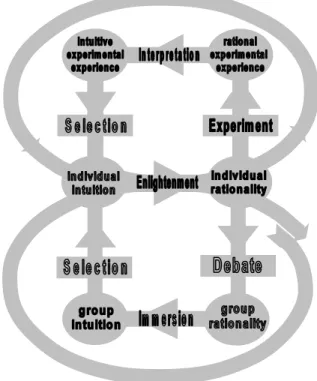
In the Creative Space, we can discern two spirals related to the opposition Intersubjectivity – Objectivity. Both rely on the transition Enlightenment (illumination, aha, eureka, simply having a bigger or smaller idea) between individual intuition and individual rationality. But the one related to Objectivity, called EEIS Spiral
(Enlightenment-Experiment-Interpretation-Selection) assumes that the
verification of a new idea occurs through Experiment, followed by Interpretation of raw experimental data and intuitive Selection of new ideas resulting from interpreted data. The EEIS Spiral is an elementary process in normal (in the sense of T. Kuhn [17]) knowledge creation in research institutions.
Fig. 9. The Double EDIS-EEIS Spiral of itersubjective and objective knowledge creation and verification Equally elementary and frequent in normal knowledge creation processes is the spiral related to Intersubjectivity, called EDIS Spiral
(Enlightenment-Debate-Immersion-Selection), with verification of a new idea occurring
through Debate, followed by Immersion of the results of the discussion in group intuition (possibly and profitably resulting in a second Debate, which we call the principle
of Double Debate) and again an individual, intuitive Selection of the results of debating for the generation of
new ideas.
Both EDIS and EEIS Spiral can be represented together as in Fig. 9. By combining them, we can actually achieve a synthesis of intersubjective and objective knowledge creation and verification, which might be a direction to take for a contemporary social science.
4.3 Hermeneutic Reflection and Triple Helix
of Normal Knowledge Creation
However, the seven dimensions of Creative Space described above are not exhaustive. As an example, we consider here (very briefly, for much more detailed analysis see [18]) the dimension Reflection, with three levels: Basic, Integrated, Critical (see Fig. 10):
Fig. 10. The levels of dimension Reflection The Reflection level Basic represents typical human reflection, used by any responsible researcher. Further levels of Reflection are related to the hermeneutic circle – see [18]. Without describing it in detail, we only note here that hermeneutics, though not usually discussed in relation to intuition, relies on holistic reflection about tradition and thus involves both emotions (myths, ideology, etc.) and intuition (based on accumulated professional experience and internalized knowledge). The hermeneutic circle describes the relation of a researcher – a knowing subject – to the object of her/his study represented by historical or literary texts, objects of art, etc. In this relation, the researcher must immerse her/himself in the time and culture represented by the objects of the study and use empathic reflection based on the traditions of her/his discipline. However, there are two types of this hermeneutic, empathic reflection. One is
Critical: the researcher must remain critical even while
empathically immersing her/himself in the objects of study. Another is Integrated: the researcher must become united with the objects of her/his study, must feel for them, be integrated with them. This type of integration corresponds actually to the development of intuition, of forming hermeneutic horizon [19], a kind of intuitive perspective of perceiving the object of study.
Thus, we can close the hermeneutic circle by
individual intuition. Therefore, we propose to
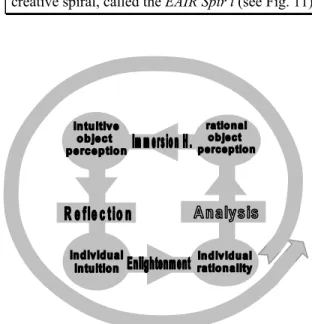
represent the hermeneutic circle as another creative spiral, called the EAIR Spir l (see Fig. 11):
Fig. 11. The hermeneutic EAIR Spiral Fig. 11. The hermeneutic EAIR Spiral
In this spiral, we consider four nodes: individual intuition,
individual rationality, rational object perception and intuitive object perception. The transition Analysis might
be treated as an initial and very important one: it means actually searching the entire rational heritage of humanity for materials relevant to a given object of study, using libraries, archives, www, scientific conferences etc. for a never fully complete but as adequate as possible Analysis and a rational perception of this object. However, this perception is not sufficient for a full understanding. The researcher must immerse this perception in an intuitive understanding of tradition, to attain an intuitive perception of the objects of study. This transition, indicated by
Immersion H (Hermeneutic Immersion), might be one of
two types: Critical (of the object of study) or Integrated (with the object of study). This immersion helps to achieve a deep Reflection, enriching individual intuition and leading to Enlightenment – new ideas about the object of study. There is a danger in becoming too Integrated: though it helps to achieve an empathic reflection, it might hinder criticism. Therefore, a methodological advice is to switch between Integrated and Critical, in order to achieve a truly deep Reflection.
In this spiral, we consider four nodes: individual intuition,
individual rationality, rational object perception and intuitive object perception. The transition Analysis might
be treated as an initial and very important one: it means actually searching the entire rational heritage of humanity for materials relevant to a given object of study, using libraries, archives, www, scientific conferences etc. for a never fully complete but as adequate as possible Analysis and a rational perception of this object. However, this perception is not sufficient for a full understanding. The researcher must immerse this perception in an intuitive understanding of tradition, to attain an intuitive perception of the objects of study. This transition, indicated by
Immersion H (Hermeneutic Immersion), might be one of
two types: Critical (of the object of study) or Integrated (with the object of study). This immersion helps to achieve a deep Reflection, enriching individual intuition and leading to Enlightenment – new ideas about the object of study. There is a danger in becoming too Integrated: though it helps to achieve an empathic reflection, it might hinder criticism. Therefore, a methodological advice is to switch between Integrated and Critical, in order to achieve a truly deep Reflection.
Though originally devised as a tool of humanistic studies, the hermeneutic circle – or rather Hermeneutic EAIR
Spiral – can be recommended for a deep study of any type,
including technology development. Therefore, if we reflect on the normal processes of academic knowledge creation – such as happen in any discipline at universities
and in research institutes, between rarely occurring periods of revolutionary knowledge creation – we conclude that most typically they use three spirals, perhaps in the following order:
Though originally devised as a tool of humanistic studies, the hermeneutic circle – or rather Hermeneutic EAIR
Spiral – can be recommended for a deep study of any type,
including technology development. Therefore, if we reflect on the normal processes of academic knowledge creation – such as happen in any discipline at universities
and in research institutes, between rarely occurring periods of revolutionary knowledge creation – we conclude that most typically they use three spirals, perhaps in the following order:
1) The Hermeneutic EAIR Spiral – of searching 1) The Hermeneutic EAIR Spiral – of searching through rational heritage of humanity and reflecting on the object of study;
2) The Experimental EEIS Spiral – of verification and objectification of ideas through experiments; 3) The Intersubjective EDIS Spiral – of debating on ideas obtained from other spirals or through any other source of Enlightenment.
These three spirals can be represented together as a Triple Helix of Normal Knowledge Creation, shown in Fig. 12.
The purpose of such illustration is to stress how the three spirals of normal knowledge creation are actually intertwined, inseparable, although naturally in diverse disciplines one or another spiral might be more or less important.
Fig. 12. Triple Helix of normal knowledge creation Triangles in the Triple Helix indicate a selection of a future path after Enlightenment, a switch between spirals; while having an idea might result from sources in any of the three spirals, the idea can also be used in any other spiral. We use here a different convention than in the illustrations of Creative Space: stages or transitions, not nodes, are indicated here by small circles. Clearly, the
Triple Helix might be repeated as many times as
necessary. The usefulness of such a representation is only illustrative: it might help, for example, the dean of a faculty to reflect whether all transitions in the Triple Helix are supported well enough at his institution.
4.4 Cross-Cultural and Organizational Knowledge Creation
Finally, we should stress some other aspects or dimensions in Creative Space that are very important in applications of creativity theory. These aspects are related to two dimensions: cross-cultural and organizational. In a sense, they are both organizational aspects: the
cross-cultural refers to diverse cross-cultural perceptions of how a
knowledge creation process should be organized, while
organizational refers more to organizational learning
processes and to the problem of activating knowledge dispersed in an organization.
We underline here some aspects actually stressed by one of the very first contemporary micro-theories of knowledge creation, by The Knowledge Creating
Organization [2]. The particular knowledge conversions
or transitions in the SECI Spiral (see Fig. 1) express the cross-cultural experience of knowledge creation in global market-oriented organizations, but the order and character of these transitions
(Socialization-Externalization-Combination-Internalization) has a distinctly Oriental,
even specifically Japanese origin. This is stressed also in [20]. On the other hand, the transitions in the OPEC
Spiral (Objectives-Process-Expansion-Closure) of S. Gasson, see [21], [1], have a more Occidental, but also cross-cultural, purposeful character: they start by defining objectives and goals and end with a summary of achieved results. Both these processes are motivated by the interests of market-oriented organizations, both are different from normal knowledge creation processes (occurring mostly in academia, but also in industrial research laboratories) modeled by the three spirals of
Triple Helix that are motivated more by the interests of an
individual researcher.
For a good understanding of similarities and differences between different types of organizations, it might be useful to reflect further on a comparison of these different spirals and processes. Many research questions arise then that might go beyond the scope of this paper. For example: we have shown that such seemingly opposite aspects as intersubjectivity and objectivity can be integrated by combining two EDIS and EEIS Spirals into the Double EDISEIS Spiral. Can we similarly combine the SECI and OPEC Spirals into a double spiral? Can we combine, say, the SECI Spiral with Triple Helix Spirals in order to overcome the differences between academia and market-oriented organizations, to enable a better cooperation between them?
There exists, however, another cross-cultural approach to knowledge creation, actually not often used in universities, sometimes used at research institutes but mostly found in market-oriented organizations, though it was originally
used in a different purpose-oriented organization, NASA. This is brainstorming, introduced by A.F. Osborn [22], now a traditional process of generating new ideas by a group devoted to a given purpose or to solving a problem. The essence of brainstorming consists of promoting
diversity of generated ideas (by prohibiting criticism,
accepting the wildest ideas, etc.) in the first expanding
phase and of organizing integration of the ideas listed
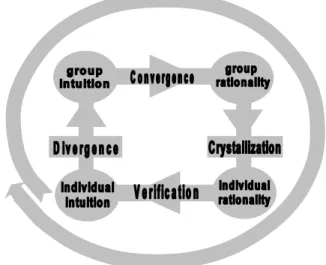
from the first phase in the second contracting phase. However, diverse methods of organizing this process can be found in the broad literature of this field. An important contribution to the field of brainstorming comes from S. Kunifuji, see [23]. Kunifuji rightly argues that a creative process involving brainstorming should include at least four phases, which we can identify with following transitions: Divergence, Convergence, Crystallization,
Verification and represent also as a Brainstorming DCCV Spiral (see Fig. 13):
Fig. 13. Brainstorming DCCV Spiral
Although the DCCV Spiral is in some sense very similar to the SECI Spiral – it goes in the same direction through practically the same nodes – it is, however, essentially different: it describes much older process, the transition
Divergence is quite different than Socialization, and the
transitions Convergence and Crystallization are also somewhat different than Externalization and Combination. There are, however, some useful analogies resulting from such a comparison: for example, when interpreting
Externalization as a transition similar to Convergence, we
can use for Externalization many existing computer tools designed for supporting Convergence (see Fig. 14).
This conclusion can be generalized: the analogies resulting from such abstract analysis of diverse creative processes can stimulate the development of computer software to support creativity, see [1]. The purely organizational dimension of Creative Space represents other concerns: harnessing the power of
knowledge networks of distributed knowledge in organizations, see, e.g., [23] in order to activate distributed knowledge. This is a challenging problem, also
addressed from a somewhat different perspective by other researchers [24], [22].
Fig. 15. The levels of dimension Organizational Keen and Sheffield [23] justly stress that another, organizational dimension should take into account three different types of knowledge, represented in Fig. 15:
Accountable, Discretionary and Autonomous. Accountable means knowledge related to public identity,
in a sense a contribution to rational heritage.
Discretionary means private, individual rational
knowledge; Autonomous is interpreted as a part of private identity, probably closely related to individual tacit knowledge, individual intuition and emotions.
4.5. Summary of Dimensions of Creative Space
Creative Space is a network-like model of relevant nodes
and possible transitions between those nodes; sequences of such transitions form knowledge creation processes. Particularly interesting are sequences forming loops that we call creative spirals or spiral models of creative
processes.
As discussed here, Creative Space has at least ten dimensions: epistemological (Intelligence), social (Involvement), creative (Imagination), motivational (Intervention), systemic (Integration), abstractive (Abstraction), veridical (Objectivity), hermeneutic (Reflection), cross-cultural, organizational. The levels
along these ten dimensions are summarized in Table 1 that stresses the complexity of possible knowledge creation processes.
We could thus consider at least 310 = 59,049 nodes and
59,049x59,048 = 3,486,725,352 possible transitions in the
Creative Space; these numbers illustrate only that creative
processes can be extremely diversified and the spiral models of them presented here are only rough models or ideal approximations.
Dimension of Creative Space Level 1 Level 2 Level 3
Epistemological (Intelligence) Rationality Intuition Emotion Social (Involvement) Individual Group Humanity heritage
Imagination Routine Diversity Fantasy
Intervention Drive Dedication Determination
Systemic (Integration) Specialized Interdisciplinary Intercultural
Abstraction Applied Basic United
Objectivity Subjective Intersubjective Objective
Hermeneutic (Reflection) Basic Integrated Critical
Cross-cultural Oriental Occidental Brainstorming
Organizational Accountable Discretionary Autonomous
5. CONCLUSIONS
Instead of conclusions, we list the spirals of knowledge creation and other knowledge creation processes identified and discussed due to the concept of Creative
Space:
1) Three spirals of organizational knowledge creation, typical for market-oriented organizations: Oriental SECI Spiral (Nonaka and Takeuchi), Occidental OPEC Spiral (Gasson), and Brainstorming DCCV Spiral (Kunifuji); 2) Three spirals of normal academic knowledge creation, typical for normal scientific activities at universities and research institutes: Hermeneutic
EAIR Spiral, Experimental EEIS Spiral, Intersubjective EDIS Spiral; these spirals can be
represented together in the Triple Helix of Normal
Knowledge Creation, all proposed in this book;
3) One spiral of revolutionary scientific creation processes: ARME Spiral (Motycka);
4) Two general systemic models of knowledge creation and integration: Shinayakana Systems
Approach (Sawaragi and Nakamori) and I5 (Pentagram) System (Nakamori).
Reflection on all these models and spirals helps us to understand the diversity and heterogeneity of knowledge creation processes – including technology creation and even artistic creation. The great challenge, however, is to use these reflection to help in the construction of computer software to support creativity, of Creative
Environments, in a sense similar to the concept of Ba
[24].
REFERENCES
[1] Wierzbicki A.P., Nakamori Y. 2005 Creative Space:
Models of Creative Processes for Knowledge Civilization Age. Springer, Heidelberg (in print)
[2] Nonaka I., Takeuchi H. 1995: The Knowledge-Creating
Company. How Japanese Companies Create the Dynamics of Innovation. Oxford University Press, New
York
[3] Popper K.R. 1972: Objective knowledge. Oxford University Press, Oxford
[4] Motycka A. 1998: Nauka a nieświadomość (Science and
Unconscious, in Polish). Leopoldinum, Wrocław
[5] Wierzbicki A.P. and Nakamori Y.: Knowledge Creation and Integration: Creative Space and Creative Environments.
Proc. of the 38th Hawaii International Conference on System Sciences (HICSS-38), IEEE Computer Society,
Hawaii, January 3-6, 2005.
[6] Nakamori Y.: Systems Methodology and Mathematical Models for Knowledge Management, Journal of Systems
Science and Systems Engineering, Vol.12, No.1, pp.49-72,
March 2003.
[7] Wittgenstein L (1922) Tractatus logico-philosophicus. Cambridge, UK
[8] Kant I.: (1788) Kritik der praktischen Vernunft (1911, E.Wende&Co, Warsaw)
[9] Nakamori Y., Sawaragi Y.: (1990) Shinayakana systems approach in environmental management. Proceedings of
11th World Congress of International Federation of
Automatic Control, Tallin. Pergamon Press, Vol. 5 pp.
511-516
[10] Jackson M.C. 2000: Systems approaches to management. Kluwer Academic – Plenum Publishers, New York [11] Checkland P.B. 1985: From optimizing to learning: a
development of systems thinking for the 1990s. Journal of
the Operational Research Society 36:757-767
[12] Wierzbicki A.P. 2005: Technology and Change: The Role of Technology in Knowledge Civilization. Proceedings of
the First World Congress of International Federation of Systems Research, Kobe
[13] Quine W.V. (1953) Two dogmas of empiricism. In Benacerraf P., Putnam H. (eds) Philosophy of mathematics, Prentice-Hall, Englewood Cliffs, 1964
[14] Maturana H. 1980: Biology of cognition. In Maturana H, Varela F (eds) Autopoiesis and cognition. Reidel, Dordrecht
[15] von Foester H. 1973: On constructing a reality. In Preiser E. (ed) Environmental systems research, Dowden, Hutchingson & Ross, Stroudberg
[16] Knorr-Cetina K. 1981: The manufacture of knowledge. An
essay on the constructivist and contextual nature of science. Pergamon Press, Oxford
[17] Kuhn T.S. 1962: The structure of scientific revolutions. Chicago University Press, Chicago (2nd ed., 1970)
[18] Gadamer H-G. 1960: Warheit und Methode. Grundzüge
einer philosophishen Hermeneutik. J.B.C. Mohr (Siebeck),
Tübingen
[19] Król Z. 2005: Plato and the foundations of modern
mathematics (in Polish, Platon i podstawy matematyki współczesnej). Wydawnictwo Rolewski, Nowa Wieś
[20] Umemoto K. 2004: Knowledge Management in Technology Creating Laboratories. Proceedings of JAIST Forum 2004: Technology creation based on knowledge science, JAIST, Nomi, pp 47-48
[21] Gasson S. 2004: The management of distributed organizational knowledge. In Sprague RJ (ed)
Proceedings of the 37 Hawaii International Conference on Systems Sciences (HICSS 37). IEEE Computer Society
Press, Los Alamitos, Ca
[22] Osborn A.F. 1957: Applied imagination. Scribner, New York
[23] Qureshi S., Keen P. 2005: How to overcome the knowledge paradox: activate knowledge identity, not just organize information. Sprague RJ (ed) Proceedings of the
38th Hawaii International Conference on System Sciences
(HICSS 38) IEEE Computer Society Press, Los Alamitos,
Ca
[24] Von Krough G., Ichijo K., Nonaka I. (2000) Enabling knowledge creation. Oxford University Press, Oxford
![Fig. 1. The SECI Spiral (Nonaka and Takeuchi [2])](https://thumb-ap.123doks.com/thumbv2/123deta/6114566.1077709/2.918.493.822.711.985/fig-seci-spiral-nonaka-takeuchi.webp)
![Fig. 2. The basic dimensions of Creative Space [1]](https://thumb-ap.123doks.com/thumbv2/123deta/6114566.1077709/3.918.87.444.140.507/fig-basic-dimensions-creative-space.webp)
![Fig. 15. The levels of dimension Organizational Keen and Sheffield [23] justly stress that another, organizational dimension should take into account three different types of knowledge, represented in Fig](https://thumb-ap.123doks.com/thumbv2/123deta/6114566.1077709/10.918.92.822.686.985/dimension-organizational-sheffield-organizational-dimension-different-knowledge-represented.webp)
