The
Generalized Fermat-Steiner
Problem with Free Ends 東北大学 大学院理学研究科市川洋祐 (Yosuke ICHIKAWA) Mathematical Institute, Tohoku University 九州大学・大学院数理学研究院井古田亮 (Ryo IKOTA) Faculty ofMathematics, Kyushu University 東北大学・大学院理学研究科柳田英二 (Eiji YANAGIDA) Mathematical Institute, Tohoku University1
Introduction
Let $G=$ ($e_{1}$,e2, $\ldots$, $e_{n}$) be
a
conneted graph such that the degree of its verticesare
all 3 except for the end points. In other words, $G$ is a network with triple junctions.
For
a
given region $\mathrm{n}\subset \mathbb{R}^{2}$,a
set of line segment $\Gamma_{G}$ is called admissible for $G$ if $\Gamma_{G}$ isisomorphic to $G$ and all the end points of $\Gamma_{G}$
are
on
an.
Figure 1: An example of$\Gamma_{G}$.
We assign
a
positive number $\sigma_{i}$ to each edge $e_{i}$, which represents “surface energy.”Denote by $Yi$ $(i=1,2, \ldots, n)$ component segments of $\Gamma_{i}$ which correspond to $e_{i}$. In
132
Problem P. Find
an admissible
$\Gamma_{G}$ for $G$ that minimizes(1) $E[ \Gamma_{G}]=\sum_{i=1}^{n}\sigma_{i}|\gamma_{i}|$,
where $|\gamma_{i}|$ denote the lengths of )$i$.
This problem arises in grain boundary motions of anealing pure metal. Critical
points of$E[\Gamma_{G}]$ represent stationarystatesof
a
curvature-drivenmotion, which modelsthe grain boundary motions. A curvature-driven motion with
a
triple junction hasbeen introduced by Mullins [6]. Later, the motion
was
derived
formally by Bronsard and Reitich [1]as
the singular limit ofa
vector-valuedAllen-Cahn
equation. Bronsard and Reitich [1] alsoshowed
short-time existence of the motion. Let $\Gamma_{i}(t)(i=1,2,3)$represent
curves
at time $t$ $>0$contained
ina tw0-dimensional
bounded region $\Omega$with
smoothboundary
an.
Suppose $\Gamma_{i}(t)(i=1,2,3)$ meet atone
point $m(t)$.
Theevolvinginterface that
we
consider is subject to the following laws:(M1) The normal velocity ofthe interface is given by its
curvature.
(M2) At the triple junction$m(t)$, thecontact angle $\theta_{k}$ between$\Gamma_{i}(t)$ and $\Gamma_{j}(t)$ isgiven
by Young’s law, where $(i,j, k)=$ (1,2, 3), (2,3,1), (3, 1, 2). That is, for positive
constants $\sigma_{1}$, $\sigma_{2}$, $\sigma_{3}$,
$\frac{\sin\theta_{1}}{\sigma_{1}}=\frac{\sin\theta_{2}}{\sigma_{2}}=\frac{\sin\theta_{3}}{\sigma_{3}}$,
where $0<\theta_{k}<\pi$ and $\theta_{1}+\theta_{2}+\theta_{3}=2\pi.$
(M3) At the other end of each curve, $\Gamma_{i}(t)$ touches
an
at the right angle.The interfaces have Energy $E(t)$, which decreases
as
time goes: $E(t)=\sigma_{1}|\Gamma_{1}(t)|+\sigma_{2}|\Gamma_{2}(t)|+\sigma_{3}|\Gamma_{3}(t)|$,where $|$Ti(t)$|(i=1,2, 3)$
mean
the lengths ofcurves
$\Gamma_{i}(t)$. Stationary interfaces ofthemotion canbe viewedas critical points of theenergy. In this connection Sternbergand
Ziemer [7] have proved the existence of local minimizers of the energy in clover-like
regions. Here
we
remark that stationaryinterfaces consist of straight line segments.On
the other hand, Ikota and Yanagida [4] have studied stabilities of stationaryinterfaces ofthe motion (M1) (M3) by linearizing corresponding equations around the
stationary interfaces. They linearized the equations formally and analyzed the
result-ing elliptic operator rigorously. Later they have extended their results to stationary
interfaces of binary-tree type with
more
thanone
triple junctions[5]. The resultsare
Theorem 1.1. Let$\Gamma=\{\gamma_{i}\}$ be a stationary
interface
that is homeomorphic to a binarytree. Denote by $L_{i}$ the length
of
$\mathrm{y}_{i}$.Define
a characteristic index D by$D= \sum_{\gamma_{i}\in\Gamma}\sigma_{i}L_{i}\cross\prod_{\gamma_{i}\in B}h_{i}+\sum_{\gamma_{i}\in B}\{\sigma_{i}\prod_{\gamma_{j}\in B\backslash \{\gamma_{i}\}}h_{j}\}$,
where $h_{i}$ denotes the curvature
of
an
at the pointof
contact with $\gamma_{i}\in B$. (Note that$h_{i}$ is taken to be nonpositive
if
$\Omega$ is convex.)(i) The unstable dimension $N_{\mathrm{u}}$ is given by
$N_{\mathrm{U}}=\{$
$m-$ $1$
for
$(-1)^{m}D<0,$$m$
for
$(-1)^{m}D>0,$where$m=\#\{h_{i}<0\}$.
(ii) The stationary
interface
is degenerate ($\mathrm{i}.\mathrm{e}.$, there exists azero
eigenvalue)if
andonly
if
$D=0.$We remark that the index $D$ is independent ofthe topology of$\Gamma$
Although Ikota and Yanagida have established
a
stability criterion assuming thetheexistence of stationary interfaces, it has not beenknown whether given regions have
stationary interfaces in general. The existence problem can be regarded
as a
variationof the
Fermat-Steiner
problem[2].In [4] and [5], stabilities ofstationary states have been studied
on
the assumptionof the existence of stationary states.
In the present study
we
show that stationary states do exisit forconvex
Q.Our
problem
can
be regardedas
avariant oftheFermat-Steiner problem,though thetreat-ments
are
quite different.The
Fermar-Steiner
problem is describedas
follows: fora
given triangle AABC,find
a
point $P$ that minimizes thesum
of lengths$|PA|+|PB|+|PC|$ .
This problem
was
proposed by Fermat to Torricelli. Afterwards Steiner considered thesame
problem and gave a systematic solution. In [2] Gueron and Tessler solved theweighted Fermat-Steiner problem. They also gave an interesting historical survey of
the problem.
134
Theorem 1.2. Suppose $\Omega$ is
convex.
Let$n$ be a positive integer and $G$ a binary tree
with $n$ triple junctions. Then there eists at least one critical
interface
of
$E$ which isadmissible
for
$G$.2
Outline of
Proof
Before proceedingwith Problem$\mathrm{P}$,
we
consider the two phase separation problem withno
triple junctionsas an
illustration. Let $\Omega$ bea
convex
domain in $\mathbb{R}^{2}$.
Suppose twopoints $P_{1}$ and $P_{2}$
are
on
the boundaryan.
We seeka
critical interfaceof
$E(P_{1}P_{2})=$$|P_{1}P21$ the length
of a
line segment $P_{1}P_{2}$.
A simple calculation shows that $P_{1}P_{2}$ is critical if and only if $P_{1}P_{2}$ intersects with
an
at the right angle. Thus allwe
have to do is to find $P_{1}P_{2}$ such that $P_{1}P_{2}$are
orthogonal to
an
at both $P_{1}$ and $P_{2}$.
We parameterize $\partial\Omega$ by
an arc
length parameter $s:s\mapsto P(s)=(x(s), y(s))\in\partial\Omega$.
By$\tau(s)$
we
denotethetangentialvectortoOC
at$P(s)$, thatis$\tau(s)=(\partial/\partial s)(x(s), y(s))$.
For any point $P_{1}=P_{1}(s_{1})\in$
an
,we can
choose $s=s_{2}$so
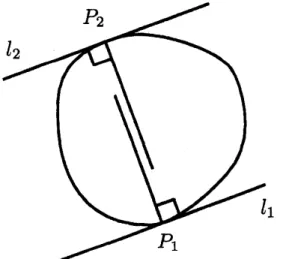
that $\tau(s_{2})$ is parallel to $\tau(s_{1})$.Figure 2: Lines $l_{1}$ and
12
are rotated alongan.
Then
we move
$s_{1}$ and observe variations of the distance $d(l_{1}, l_{2})$, where$l_{\mathrm{i}}$
are
tan-gential lines to
an
at $P(s_{i})(i=1,2)$.
Wecan
easilysee
that the distance $d(l_{1}, l_{2})$is critical if and only if $P_{1}P_{2}$ intersects with
an
orthogonally. Since $d(l_{1}, l_{2})$ hasa
maximum (and
a
minimum), the energy $E(P_{1}P_{2})$ hasa
critical interface.Now
we
turnour
attention to ProblemP. We considerthecase
where $G$hasa
singleby induction. We can easily verify that $\Gamma_{G}=(\gamma_{1}, )_{2},$$\gamma_{3})$ is critical if and only if the
following two conditions are satisfied:
1. $\angle("/i, r_{j})$ $=\theta_{k}$ $(i,j, k)=(1,2, 3)$ , (2,3, 1), (3, 1,2).
2. $\gamma_{i}[perp]\partial\Omega$ $(i=1,2,3)$.
Let $\nu(s_{i})$ be the unit normal to
ac
at $P(s_{i})$ pointinginside Q. Likewise in the analysisof the two phase problem,
we can
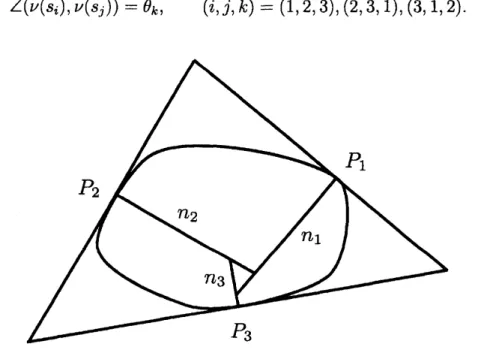
choose $s_{2}$ and $s_{3}$ for $s_{1}$ such that$\angle(\nu(s_{i}), \mathrm{v}(8\mathrm{j}))$ $=\theta_{k}$, $(i,\dot{\mathrm{y}}, k)=(1,2,3)$, (2, 3, 1), (3, 1, 2).
Figure 3: Lines $n_{1}$, $n_{2}$, $n_{3}$ are rotated.
Let $\mathcal{T}$ be the triangle composed of
$l_{1}$, $l_{2}$, $l_{3}$, where $l_{i}$
are
again the tangential linesat $P_{i}=P(s_{i})$, and$T(s)$ the
area
of$\mathcal{T}$ Denote by$n_{i}$ thenormal lineto
ac
at $P_{i}$. Thenwe can
prove thatni, $n_{2}$, $n_{3}$ meet atone
pointif andonlyif$dT/ds$ $=0.$ This indicatesthat the $n_{i}$ $(i= 1,2, 3)$ make
a
critical $\Gamma_{G}$.3
Concluding
Remarks
If $\Omega$ is not convex, the approach
we
took in the previous section does not work ingeneral. We illustrate it in the two phase problem.
Let $a$, $b$ be positive constants. We introduce two graphs in $\mathbb{R}^{2}$:
$y=g_{1}(x)=(x-a)^{3}$,
136
Suppose
an
is represented by $g_{1}(x)$ and $\mathrm{g}2(x)$ locally. We parameterize the two partsas $(\xi, (\xi-a)^{3})$ and $(-\xi_{\mathrm{I}}-4^{3}+b)$ respectively. Here
4
runsover
some interval $(-\delta, \delta)$.Then the distance between $l_{1}$ and $l_{2}$
are
given by$d(l_{1}, l_{2})=(4\xi^{3}+3a\xi^{2}+b)/\sqrt{9\xi^{4}+1}$.
Straightforward calculation shows that
$\mathrm{z}$ $1(l_{1}, l_{2})|_{\xi=0}=0.$
However the two normal lines at $4=0$ do not coincide.
$y$ $=g_{2}(x)$
$-a)^{3}$
Figure 4: The critical lines of the distance $d(l_{1}, l_{2})$ do not
coincide.
References
[1] L. Bronsard and F. Reitich. On three-phase boundary motion and the singular
limit of
a
vector-valued Ginzburg-Landau equation. Arch. Rat.
Mech.,124:355-379,
1993.
[2] S. Gueron and R. Tessler, The
Fermat-Steiner
problem. Amer. Math. Monthly,109(5):443-451, 2002.
[4] R. Ikota and E. Yanagida. A stability criterion for stationary
curves
to thecurvature-driven motion with a triple junction.
Differential
Integral Equations,16(6)) 2003.
[5] R. Ikota and E. Yanagida. Stability of Stationary Interfaces of Binary-Tree Type,
to appear in Calc. Var. Parital
Differential
Equations.[6] W. W. Mullins. TwO-dimensional motion of idealized grain boundaries. J. Appl.
Phys., 27(8):900-904, 1956.
[7] P. Sternberg and W. P. Ziemer. Local minimizers of