1
点穴あきトーラスから
2
点穴あきトーラスヘ
和田昌昭
(Masaaki Wada)
奈良女子大学理学部情報科学科
Department
of Information
and Computer
Sciences
Nara
Women’s University
1
1
点穴あきトーラス群
1
点穴あきトーラス群とは2
元$A,$$B$ によって生成される $PSL$(2,C)
の部分群であって交換子 $[A, B]$ が放物的となるものである. 交換子の (一意的な) 平方根を $K$で表すことにす
る. よって $[A, B]=K^{2}$てある. この論文中ては記号= は $PSL$(2, C) における等号, すな
わち符号を除く等号を意味するものとする.
$\mathrm{J}\emptyset \mathrm{r}\mathrm{g}\mathrm{e}\mathrm{n}\mathrm{s}\mathrm{e}\mathrm{n}[\mathrm{J}\emptyset \mathrm{r}03]$ に従い
1
点穴あきトーラス (クライン) 群をフックス型1
点穴あきトーラス群の変形として考察することにしよう.
([ASWYOO,
ASWY03] も見よ) $\mathrm{J}\emptyset \mathrm{r}\mathrm{g}\mathrm{e}\mathrm{n}\mathrm{s}\mathrm{e}\mathrm{n}$ の理論におけるキーコンセプトの一つは複素確率であるが, ここては
2
点穴あきトーラス群の 場合に拡張できるような仕方で複素確率の説明をしよう. コンピュータ・プログラムOPTi
$.[\mathrm{W}\mathrm{a}\mathrm{d}]$ は内部的には複素確率に基づいて作られている.
図1:
フックス型1
点穴あきトーラス群. ます最初に1
点穴あきトーラス群は常に位数2
の対称性を持つことに注意しよう. (図2
参照)命題 LL すべての
1
点穴あきトーラス群$G=\langle A, B\rangle$ に対し, 指数2の拡張$G’=\langle P, Q, R\rangle$てあって$RQP=K$ をみたすインボリューション$P,$ $Q,$$R$て生成されるものをが存在する
.
これを証明するために, 次のよく知られた補題を用いる.
補題 L2. $A,$$B\in PSL$(2,C) は $\mathrm{C}\mathrm{U}$
{\otimes }
において固定点を共有しないとする. このとき71
図
2:
$RQP=K$ をみたすインボリューション$P,$ $Q,$$R$実際,
$Q=AB-BA$
(を $Q\in SL$(2,$\mathrm{C}$)) となるように正規化したもの) とすればよい.幾何的には$Q$ は$A$ と $B$ の軸の共通垂線に関する \pi -回転である. 命題
1.1
の証明. 補題1.2
によって, インボリューション $Q$ であって, $QAQ=A_{:}^{-1}$ かつ $QBQ=B^{-1}$ をみたすものがある. このとき $R=AQ,$$P$=BQ
とおけば, $R^{2}=AQAQ$$=1$ かつ $P^{2}=BQBQ$ $=1$ である. インボリューション $P,$ $Q,$$R$は $A=RQ$,
$B=PQ$,
$[A, B]=$RQPQQRQP
$=K^{2}$,
をみたし, したがって $RQP=K$ がなりたつ. 口 逆に, もし $P,$ $Q,$$R$ を $RQP=K$ が放物的となるようなインボリューションとすると, $A,$$B$ を $A$ $:=$ $RQ=KP$ $B$ $:=$ $PQ=K^{-1}R$ によって定義すれば $[A, B]=K^{2}$ がなりたつ. すなわち1
点穴あきトーラス群の研究は, 本質的には (2,2, 2,
op)-オービフオ ルド群の研究と同じものてある. (図3
参照)図
3: 1
点穴あきトーラスと $(2, 2, 2,$$\otimes)$-オービフォルド.さて, 係数について拘束条件$RQP=K$ を求めてみよう. $PSL$(2, C) における共役によっ
て次のように仮定することがてきる.
$P$ $=$ $(\begin{array}{ll}1 z_{0}0 1\end{array})(\begin{array}{ll}0 -x^{-1}x 0\end{array})(01$
屋
$Q$ $=$ $(\begin{array}{ll}1 z_{1}0 1\end{array})(\begin{array}{ll}0 -y^{-1}y 0\end{array})(01$
屋
$R$ $=$ $(\begin{array}{ll}1 z_{2}0 1\end{array})(\begin{array}{ll}0 -z^{-1}z 0\end{array})(01$
屋
$K$ $=$ $(\begin{array}{ll}1 10 1\end{array})$
条件を係数に関して書き下すために, 次のパラメータを導入すると便利である.
$a_{0}=z_{1}-z_{0}$
,
$a_{1}=z_{2}-z_{1}$,
$a_{2}=z_{0}+1-z_{2}$.
この
3
つ組($a_{0},$$a_{1}$,
a2) は$a_{0}+a_{1}+$a2 $=1$,
をみたし, 複素確率と呼ばれる. 条件 $RQP=K$は
$a_{0}xy=z$, $a_{1}yz=x$
,
$a_{2}zx=y$となる. 従って
$a0= \frac{z}{xy}$
,
$a_{1}= \frac{x}{yz}$,
$a_{2}= \frac{y}{zx}$,およひ
$x^{2}= \frac{1}{a_{2}a_{0}}$
,
$y^{2}= \frac{1}{a_{0}a_{1}}$,
$z^{2}= \frac{1}{a_{1}a_{2}}$を得る. 図4 はインボリューション$P,$$Q,$$R$ と複素確率の関係を示している. 等式$a0+a_{1}+a_{2}=$
$1$から Markoff等式
73
が導かれる.
$\mathrm{t}\mathrm{r}A=\mathrm{t}\mathrm{r}KP=x$
,
$\mathrm{t}$rAB
$=\mathrm{t}\mathrm{r}KQ=y$, $\mathrm{t}$r
$B=\mathrm{t}\mathrm{r}K^{-1}R=-z$であり, 普通は
Markoff
等式はトレース恒等式の帰結とみなされることに注意しよう.
図4:
インボリューション $P,$ $Q,$$R$ と複素確率2
2
点穴あきトーラス群
2
点穴あきトーラス群は PSL(2,C) の2
元$A,$ $B$ と2
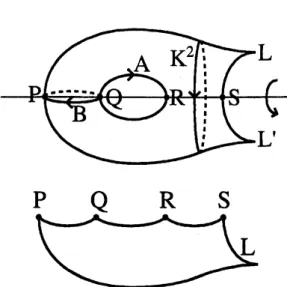
つの放物的元$L,$ $L’$で $[A, B]=L’L$ をみたすものによって生成される. このような群を対応するフックス群の変形として研究し たい. (図5
参照) 図5:
フックス型2
点穴あきトーラス群 定理2.1.
フックス群の連続変形て得られるすべての2
点穴あきトーラス群$G=\langle A, B, L, L’\rangle$ に対し, 指数2 の拡張$G’=\langle P, Q, R, S\rangle$ であって $SRQP=L$ をみたす4
つのインボリュ– ション$P,$ $Q,$ $R,$$S$ によって生成されるものが存在する. (図 6参照)Proof.
命題1J と同じ証明によってインボリューション $P,$ $Q,$$R$ であって $[A, B]=K^{2}$図
6: 2
点穴あきトーラスと (2,2, 2, 2, \infty )-
オービフォルドをみたすものがあることがわかる. ここで$K=RQP$ である. (図
7
参照)図
7:
$RQP=K$ をみたすインボリューション $P,$$Q,$$R$ここて次の補題が必要てある.
補題
2.2.
$L,$$L’\in PSL$(2, C) は $\mathrm{C}\mathrm{U}${\otimes }
において共通の固定点をもたないとする.もし $L$
と $L’$ が互いに共役ならば, それらはインボリューションによって共役となる.
$P\varpi of$
.
ます$L$ と $L’$が放物型としよう. 一般性を失うことなく次のように仮定してよい.$L=(\begin{array}{ll}1 \mathrm{l}0 1\end{array})$
,
かつ $L’=ALA^{-1}$ ただし $A=(\begin{array}{ll}a bc d\end{array})$$A$ を
$S=AT=(\begin{array}{ll}a bc d\end{array})(\begin{array}{ll}1 t0 1\end{array})=(\begin{array}{lll}a b +tac d +tc\end{array})$
で置き換えても依然として$SLS^{-1}=ATLT^{-1}A^{-1}=ALA^{-1}=L’$ がなりたつ. $c\neq 0$ なの
て$t$ を調整して $\mathrm{t}\mathrm{r}S=0$ とすることがてきる. すると $S$ はインボリューションてある.
他の場合の証明も同様にてきるが, この論文では必要ないのて, 読者の練習問題に残して
75
この補題によってインボリューション $S$で$SLS=L’$ をみたすものが得られる. よって $K^{2}=[A, B]=L’L=SLSL$ である. フックス群の場合には, ロクソドロミツク元の平方根は一意的なので, これから$RQP=K=SL$
が導かれる. また連続性によりこの関係式はフックス型2
点穴あきトーラス群の連続変形に ついても成り立つ. したがって $SRQP=L$ がなりたつ. 定理2.1
の証明終. 口 条件 $SRQP=L$ を係数に関して求めてみよう. 共役の後次のように仮定できる.$P$ $=$ $(\begin{array}{ll}1 z_{0}0 1\end{array})(\begin{array}{ll}0 -x_{0}^{-1}x_{0} 0\end{array})(\begin{array}{ll}1 -z_{0}0 1\end{array})$
$Q$ $=$ $(\begin{array}{ll}1 z_{1}0 1\end{array})$
屋
$-x_{1}^{-1}0)(\begin{array}{ll}1 -z_{1}0 1\end{array})$$R$ $=$ $(\begin{array}{ll}1 z_{2}0 1\end{array})(\begin{array}{ll}0 -x_{2}^{-1}x_{2} 0\end{array})(01$
屋
$S$ $=$ $(\begin{array}{ll}1 z_{3}0 1\end{array})(\begin{array}{ll}0 -x_{3}^{-1}x_{3} 0\end{array})(01$
屋
$L$ $=$ $(\begin{array}{ll}1 10 1\end{array})$以前と同様「複素確率」 を用いるのが便利である
:
$a_{0}=z_{1}-z\mathrm{O},$ $a_{1}=z_{2}-z\mathrm{b}$ $a_{2}=z_{3}-z2,$ $a_{3}=z_{0}+$
1-z3.
ここては複素確率は
4
つ組$(a_{0}, a_{1}, a_{2}, a_{3})$ であって $a_{0}+a_{1}+a_{2}+a_{3}=1$ をみたすものである. すると条件 $SRQP=L$ は次に帰着する. $a_{0}a_{1}x_{1}^{2}=a_{2}a_{3}x_{3}^{2}$ $=$ $1+ \frac{x_{1}x_{3}}{x_{0}x_{2}}$ $a_{1}a_{2}x_{2}^{2}=a_{3}a_{0}x_{0}^{2}$ $=$ $1+ \frac{x_{0}x_{2}}{x_{1}x_{3}}$
2
点穴あきトーラス群のモジュライ空間は4
次元なのて, 群を指定するためには複素確率以 外にもう一つパラメータを導入する必要がある. 我々は $t=\underline{x_{0}x_{2}}$ $x_{1}x_{3}$$x_{0}^{2}$ $=$ $\frac{1+t}{a_{3}a_{0}}$ $x_{1}^{2}$ $=$ $\frac{1+t^{-1}}{a_{0}a_{1}}$ $x_{2}^{2}$ $=$ $\underline{1+t}$ $a_{1}a_{2}$ $x_{3}^{2}$ $=$ $\frac{1+t^{-1}}{a_{2}a_{3}}$
.
$x_{0},$ $x_{1},$ $x_{2},$ $x_{3}$ から複素確率を求めることも可能てあるが, それほど簡単ではない. 最後に1
点穴あきトーラス群と2
点穴あきトーラス群を研究するための枠組みの比較表を もってこの論文を閉じることにしよう.Once-punctured
Torus
Twice-punct$\underline{\mathrm{u}\mathrm{r}\mathrm{e}}$d
Torus
Quotient orbifold
-$(2, 2, 2, \infty)$ $—–(2, 2,2,\underline{2}, \infty-)$
$a0+a_{1}+a_{2}+a_{3}=1$
Com’plex probability
$a0+a_{1}+a_{2}=1$and $t$
—-nace
$x^{2}+y^{2}+z^{\overline{2}}=x\prime yz---$ $x0,$ $x1,$ $x2,$$x3$ ..
?$\mathrm{c}\mathrm{o}\mathrm{m}$
binatori
$\mathrm{a}$\sim descriptionFo
$\mathrm{r}$d
region?7.?
$(\mathrm{J}\emptyset \mathrm{r}\mathrm{g}\mathrm{e}\mathrm{n}\mathrm{s}\mathrm{e}\mathrm{n})$
Limit set
relatively easy to draw
—–???
Bers
slice
Maskit slice
Slices
$??$?Earle slice
Rfleyslice
1
点穴あき群はある種のしっかりとした構造を持ち比較的好ましい振舞いをするのに対 し,2
点穴あきトーラス群ははるかにワイルドな振舞いをし, 一般的な擬フックス群て起き る現象を見せると考えられる. ここで紹介した枠組みは,2
点穴あきトーラス群より複雑な 群に拡張することはてきないが, この枠組みによって一般的な擬フックス群に関する様々な 知見が得られることを期待している.参考文献
[ASWYOO] H. Akiyoshi, M.
Sakuma,M. Wada and Y. Yamashita
(2000).A way from
punctured
torus groups to two
bridge knotgroups,
InGeometry and
Topology (Proceedingof
Workshop inPure Mathemahcs
19)Pure Math.
${\rm Res}$.
Assoc.,
The Korean
Academic
Council,
pp.
145-173.
[ASWY03] H.
Akiyoshi,
M.Sakuma, M. Wada and Y. Yamashita
(2003). $\mathrm{J}\emptyset \mathrm{r}\mathrm{g}\mathrm{e}\mathrm{n}\mathrm{s}\mathrm{e}\mathrm{n}$’spicture
of
puncturedtorus
groups
and its
refinement. In Kleinian Groups and
Hyperbolic $S$
-Manifolds
(Lond.Math.
Soc.
$Lec$.
Notes
299),Cambridge Univ.
77
[J$r03] T. J$rgensen (2003).
On
pairs ofonce-punctured tori. In
Kleinian Groups andHyperbolic
3-Manifolds
(Lond.Math. Soc.
$Lec$.Notes
299), CambridgeUniv.
Press,