Imaginary-Time Path
Integrals
for Three Magnetic
Relativistic Schrodinger Operators
*By
Takashi ICHINOSE
**Abstract
After brief introduction to path integral, we consider the problem with three magnetic relativistic Schr\"odingeroperatorscorrespondingtotheclassical relativistic Hamiltonian symbol with magneticvector
andelectric scalar potentials. We discuss their difference in general and their coincidence in thecaseof constant magneticfields, aswellaswhether theyarecovariant undergaugetransformation. Thenresults
are
surveyedonpath integral representations for theirrespective imaginary-timerelativistic Schr\"odinger equations, i.e. heat equations, bymeans
ofthe probability path spacemeasure
coming from the L\’evyprocessconcemed.
Contents
\S 1. Introduction
\S 2. Brief IntroductiontoPath Integral
\S 2.1. Whatispathintegral?
\S 2.2. How to Make ItMathematics?
\S 3. Three Magnetic Relativistic Schr\"odinger Operators
\S 4. Gauge Covariancefor Magnetic Relativistic Schr\"odinger Operators
\S 5. Imaginary-TimePath IntegralsforMagnetic Relativistic Schr\"odinger Operators
\S 6. Feynman and Dirac
References
2010Mathematics SubjectClassification(s): 81QlO;35S05;60J65;60J75;47D50;81S40;58D30.
Key Words: Feynman pathintegral;pathintegral;imaginary-timepath integtral; Feynman-Kacformula; relativistic
Schrodingeroperator;Feynman-Kac-It\^oformula;L\’evyprocess.
*basedontwotalks atRIMS Joint IntroductoryWorkshoponFeynman Path Integral andMicrolocalAnaysis, June 21-June24,2011.
\S 1.
IntroductionIn these notes,
we
consider the quantum Hamiltonian corresponding to the classicalrela-tivistic Hamiltonian symbol
(1.1) $\sqrt{(\xi-A(x))^{2}+m^{2}}+V(x)$, $(\xi,x)\in R^{d}\cross R^{d}$
for
a
spinless particle withmass
$m$, which is thesum
of the kineticenergy
term involvingmagnetic vector potential$A(x)$ and the potential
energy
term ofelectric scalar potential $V(x)$.
There
are
intheliteraturethree kinds ofquantumrelativistic Hamiltoniansdependingon
how toquantizethe kinetic
energy
term $\sqrt{(\xi-A(x))^{2}+m^{2}}$.
Wecallthem the relativistic Schrodingeropemtors. We observe their difference in general, and next discuss their coincidence when
the vector potential $A(x)$ is linear in $x$, in particular, in the
case
ofconstant magnetic fields,as
wellas
handle whether theyare
gauge-covariant. Then,on
this occasion,we
would like tomake
survey,
which might be ofsome
interest,on
the resultson
path integral representationsfor theirrespective imaginary-time unitary groups, i.e. real-time semigroups, by
means
of theprobability path
space
measure
coming from the L\’evyprocess
concemed. It will be ofsome
interest to collect them in
one
place to observe how they look like and different, though allthe three
are
essentially connected with the L\’evyprocess.
Finally,an
anecdote is referred tobetweenFeynmanand Dirac conceming the subject.
Weknow that the authentic operator in relativisticquantummechanics isthe Diracoperator
for
a
spinning particle withmass
$m$, which isthe first-ordersystem ofpartial differentialoper-atorscorrespondingtothe symbol $\sum_{j=1}^{3}\alpha_{j}(\xi_{j}-A_{j}(x))+m\alpha_{4}+V(x)$, where $\alpha:=(\alpha_{1},\alpha_{2},\alpha 3,\alpha_{4})$
are
the four$4\cross 4$-Diracmatrices. Themagneticrelativistic Schr\"odingeroperatorwithoutscalarpotential$(V=0)$is consideredtobethe positive kinetic
energy
partoftheDirac operator. Forthe path integral forthe Dirac equation in space-dimension $d=1$ and in real time, i.e. in the
Minkowski space-time of two dimensions,
we
refer to [I82], [I84], [ITa84], [ITa88], [ITa87]withits survey[I93],and [BCSS85], [CSS86], [Z88], [Z89].
Thedescription ofthses notesis ofexpositarycharacter,beginning with
a
briefintroductiontoFeynman path integral.
\S 2. BriefIntroductionto Path Integral
\S 2.1. Whatispath integral?
Itis
a
fabulous technique invented by Richard P. Feynmaninhis Princeton 1942thesis (see[F05]$)$and his 1948
paper
[F48]togivealtemative formulation of quantum mechanics. Itslikehas
never
been madebeforeor
since. Infact,because of universality of its idea ithasnow come
hehimselfwrote,”suggested by
some
ofDirac’sremarks ([D33],[D35], [D45])concemingtherelation of classicalactionto quantummechanics.” Itis
a
specialkindoffunctional
integmllike$\int e^{(i/\hslash)S(X)}\mathcal{D}[X]$
on space
of paths$X:[0,t]\ni s\mapsto X(s)\in R^{d}$ with respect toa
‘measure’ $\mathcal{D}[X]$on
thespace
ofthese paths, where$S(X)$isintegralofthe Lagrangian$L(X),$ $S(X)= \int_{0}^{t}L(X(s))ds$,called action.
Consider the nonrelativistic Schr\"odinger equation for
one
particle withmass
$m$:
(2.1) $i \hslash\frac{\partial}{\partial t}\psi(t,x)=[-\frac{\hslash^{2}}{2m}\Delta+V(x)]\psi(t,x)$,
$t>s$, $x\in R^{d}$,
where$\hslash=h/(2\pi)$($h>0$:Planck’sconstant). The solutionis expressedas
$\psi(t,x)=\int K(t,x;s,y)f(y)dy$
with integral kemel$K(t,x;s,y)$, called
fimdamental
solutionor
propagator.Feynmanwritesdown thisimportant quantity$K(t,x;s,y)$
as an
‘integral’(2.2) $K(t,x;s,y)= \int e^{iS(X)/\hslash}\mathcal{D}[X]$,
where$S(X)$ in
our
presentcase
isgivenby(2.3) $S(X)=l^{t}[ \frac{m}{2}\dot{X}(\tau)^{2}-V(X(\tau))]d\tau$, $\dot{X}(\tau)=\frac{d}{d\tau}X(\tau)$.
Here $\mathcal{D}[X]$ standsforauniform ’measure’, ifit exists,on thespaceofpaths
$X(\cdot)$starting from
position $y$ at time $s$ to
arnve
at position $x$ at time $t$, formally, to be given by the product ofcontinously-manynumbers of the Lebesgue
measures
$dX(\tau)$on
$R^{d}$ for each individual$\tau$
:
$\mathcal{D}[X]$ $:=$ ‘constant”$\cross\prod_{s\leq\tau\leq t}dX(\tau)$,
where the “constant” should be something like $\prod_{s\leq\tau\leq t}\frac{m^{1/2}}{(2\pi i\hslash d\tau)^{1/2}}$, if
one
dares totry to writeit, wondering what it
means
atall. The right-hand side of(2.2) is whatis calledFeynman pathintegmlor,nowadays simply, path integml.
Toexplain this, Feynmanput thefollowingTwo Postulates which tum out tobe equivalent
toget theaboveexpression (2.2)for$K(t,x;s,y)$
.
(i) $K(t,x;s,y)$ is the total probabilty amplitude for the event that the particle starts from
for theeventthat it does this motion along each individual path $X(\cdot),$ $K(t,x;s,y)$
is
thesum
ofthe$\varphi[X]$
over
allthese paths$X(\cdot)$:
(2.4) $K(t,x;s,y)= \sum\varphi[X]x:X(s)=y,X(t)=x$
.
(ii) The contnibution $\varphi[X]$ from each $X(\cdot)$ to the total probabilty amplitude $K(t,x;s,y)$ is
givenby
(2.5) $\varphi[X]=Ce^{iS(X)/\hslash}$,
where$C$is
a
constantindependent of path$X(\cdot)$.
Thesetwopostulates
can
be paraphrased:In quantum mechanics there rules Principle of Democracy that each individual path $X(\cdot)$
contributes to the total probabilty amplitude $K(t,x;s,y)$ with equal weight (absolute value in
mathematics)and itspersonanlityisexpressed byitsphase(argumentinmathematics).
Inthis respect,inclassical mechanicsthere does not mle Principle of Democracy, because
the particle takes the particularpath betweentwospace-time points$(s,y)$and$(t,y)$which makes
the action $S(X)$ stationary, called classical tmjectory. It is the path determined by
Euler-Lagrangeequationor,inthe present case,Newton’s equationofmotion: $mX(\tau)=-\nabla V(X(\tau))$
.
Themostcharacteristic feature of these postulates lies inequation(2.5),which
says
that theamplitude$\varphi[X]$ ispropotional tothephase $e^{iS(X)/\hslash}$
.
The phrase ”propotional to”is that whichFeynman determinedto substitute for what Dirac had meant by the phrase ”analogous to” in
[D33,D35], [D45]far before Feynman, byshowingafterhis
own
analysis and deliberation thatindeed thisexponentialfunctioncould be used in this
manner
directly(see Preface of[FH65]).In \S 6 we shall comebacktothis subjecteagain.
\S 2.2. HowtoMakeIt Mathematics?
Here
we
refer,among
others,onlyto twomethods;one
isbyfinite-dimensionalapproxima-tion,and the other byimaginary-timepath integral. Infact,itisbythefirstmethodthat Feynman
himselfconfirmed his idea of path integral. He calculated $K(t,x;s,y)$ by time-sliced
approxi-mation, makingpartition of the time interval $[s,t]:s=t_{0}<t_{1}<\cdots<t_{n}=t,$ $(t_{k}-t_{k-1}=t/n)$,
$x_{k}$ $:=X(t_{k}),$ $x0=X(0)=y,$$x_{n}=X(t)=x$,
as
thelimit of$K_{n}(t,x;s,y):= \frac{\int_{(R)}\exp[\frac{it}{\hslash n}\sum_{k=0}^{n-1}(\frac{1}{2}(\frac{x_{k+1}-x_{k}}{t/n})^{2}-V(x_{k}))].dx_{1}\cdots dx_{n-1}}{\int(R^{d})^{n-1}\exp[\frac{it}{\hslash n}\sum_{k=0}^{n-1}\frac{1}{2}(\frac{x_{k+1}-x_{k}}{t/n})^{2}]dx_{1}\cdot\cdot dx_{n-1}}$
as
$narrow\infty$,toascertainittosatisfy theSchr\"odingerequation(2.1).Now
we come
tothesecondmethod,which the presentnotewillbe mainly concemed with.lm
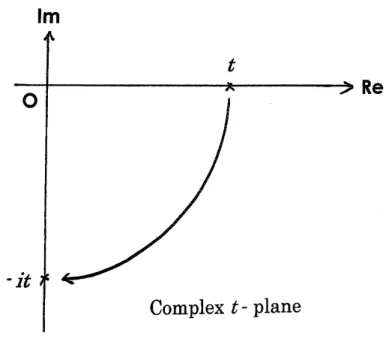
Figure 1. Fromrealtime$t$toimaginary$time-it$
a
heuristic path integral(2.6) $\psi(t,x)=\int_{R^{d}}K(t,x;s,y)\psi(s,y)dy=\int_{\{X:X(t)=x\}}e^{iS(X)/\hslash}\psi(s,X(s))\mathcal{D}[X]$.
Next,
one
should know that$\mathcal{D}[X]$itself doesnotin general existin this situationas
a
countablyadditive
measure.
Thereforewe
cannot go further. But if we rotate in complex t-plane by$-90^{0}:tarrow-it$ (real time $t$ to imaginary time -it), i.e. if
we
go fromour
Minkowskispace-time to Euclidian space-time (see Figure 1), the situation changes. Before actually doing it,
for simplify put$\hslash=1$ and$s=0$
.
Thenour
(real-time) Schr\"odingerequation (2.1)goes
totheimaginary-time Schr\"odingerequation, i.e. heatequation [formallyputting$u(t,x):=\psi(-it,x)$]
(2.7) $\frac{\partial}{\partial t}u(t,x)=[\frac{1}{2m}\Delta-V(x)]u(t,x)$, $t>0$, $x\in R^{d}$
.
Simultaneously, theaction$S(X)$ in(2.3) changestointegralof theHamiltonian, and
so
$iS(X)$ totime integral of the$Hamiltonian-\int_{0}^{t}[\frac{1}{2m}\dot{X}(\tau)^{2}+V(X(\tau))]d\tau$
.
Then$K(t,x;0,y)$changesto(2.8) $K^{E}(t,x;0,y)= \int_{\{X;X(0)=y,X(t)=x\}}e^{-\int_{0}^{t}[\frac{1}{2m}X(\tau)^{2}+V(X_{0}(\tau))]d\tau}\mathcal{D}[X]$,
where the superscript $E$” is attributed to ”Euclideian”, and $K^{E}(t,x;0,y)$ should become the
fomula,
we
put here$X_{0}(\tau)$ $:=X(t-\tau),$ $0\leq\tau\leq t$, to transform paths$X(\cdot)$ topaths $X_{0}(\cdot)$ andthen getfrom(2.8)
(2.9) $K^{E}(t,x;0,y)= \int_{\{X:X_{0}(0)=x,\eta(t)=y\}}e^{-\int_{0^{[}\varpi^{\dot{\eta}(\tau)^{2}+V(\eta(\tau))]d\tau}}^{t1}}\mathcal{D}[X_{0}]$,
so
thatthe solution of(2.6) should begivenby the following pathintegral(2.10) $u(t,x)= \int_{R^{d}}K^{E}(t,x;0,y)g(y)dy=\int_{\{X:X_{0}(0)=x\}}e$
‘$\int_{0\pi 0\mathfrak{v}_{g(X_{0}(t))\mathcal{D}[X_{0}]}}^{t1}[\dot{X}(\tau)^{2}+V(X(\tau))]d\tau$
.
Remarkable is that N. Wiener, already around 1923, had constructed
a
countably additivemeasure
$\mu_{x}(X_{0})$,for each$x\in R^{d}$,on
thespace
$C_{x};=C_{x}([0,\infty)arrow R^{d})$ of thecontinuouspaths(Bmwnian motions) $B:[0,\infty)arrow R^{d}$ startingffom$B(O)=x$at time$t=0$. This$\mu_{x}(\cdot)$iscalled
Wienermeasure,which is
a
probabilitymeasure
on
$C_{0}$withcharacteristicfunction$\exp[-t\frac{\xi^{2}}{2m}]=\int_{C_{X}([0,\infty)arrow R^{d})}e^{iB(t)\xi}d\mu_{x}(B)$
.
Around 1947, MarkKac, who had been at Comell University
as
Feynman and seemedtohaveheard his lecture, used the Wiener
measure
torepresentthe solution$u(t,x)$of theCauchyproblemof the heatequation(2.6)withinitial data$u(O,x)=f(x)$
as
a
genuine functional integral(2.11) $u(t,x)= \int K^{E}(t,x;0,y)f(y)dy=\int_{C_{x}([0,\infty)arrow R^{d})}e^{-\int_{0}^{t}V(B(s))ds}f(B(t))d\mu_{x}(B)$.
This is the Feynman-Kac
formula
[K66,80] alreadymentioned above. Thus, identify the path$X_{0}(\cdot)$ appearing
on
the right-hand side of$(2.9)/(2.10)$with the continuouspath$B(\cdot)$ in$C_{x}$, thentheWiener
measure
$\mu_{x}(\cdot)$ tums out tobe constructed from the factor“$e^{-\int_{0R^{B(\tau)^{2}d\tau}}^{t1}}\mathcal{D}[B]$”
on
theright-hand side of$(2.9)/(2.10)$
.
\S 3. Three MagneticRelativisticSchr\"odingerOperators
Weconsiderthequantized operator$H:=H_{A}+V$correspondingtothe classical Hamiltonian
(3.1) $\sqrt{(\xi-A(x))^{2}+m^{2}}+V(x)$, $(\xi,x)\in R^{d}\cross R^{d}$,
for
a
relativistic particle ofmass
$m$ under magnetic vectorpotential $A(x)$ and electric scalarpotential $V(x)$
.
This $H$ is used fora
spinless particle in electromagnetic fields in the situationwhere
we
may
ignore quantum-field theoretic effect like particlescreation and annihilation butshould take relativistic effectintoconsideration.
Inthisnote,
we
pay attentionto thefollowingthree quantizedoperators$H^{(1)},$ $H^{(2)}$ and$H^{(3)}$correspondingtotheclassicalrelativisticHamiltonian symbol (3.1). Their difference is inhow
todefine the firstterm
on
theright,$H_{A}$,correspondingtothe symbol $\sqrt{(\xi-A(x))^{2}+m^{2}}$.
For simplicity, it isassumed here and throughoutthis notethat$A(x)$ is smooth and $V(x)$ is
Definition3.1. The first $H^{(1)}$ $:=H_{A}^{(1)}+V$ is defined with
the first term
on
the right$H_{A}^{(1)}$being the Weyl pseudo-differential operator through mid-pointprescription (e.g. [ITa86, I89,
I95]$)$
:
$(H_{A}^{(1)}f)(x):= \frac{1}{(2\pi)^{d}}\int\int_{R^{d}\cross R^{d}}e^{i(x-y)\cdot\xi\sqrt{(\xi-A(\frac{x+y}{2}))^{2}+m^{2}}f(\mathcal{Y})d_{\mathcal{Y}}d\xi}$
(3.2) $= \frac{1}{(2\pi)^{d}}\int\int_{R^{d}\cross R^{d}}e^{i(x-y)\cdot(\xi+A(\frac{x+y}{2}))}\sqrt{\xi^{2}+m^{2}}f(y)dyd\xi$
Definition
3.2.
The second $H^{(2)}$ $:=H_{A}^{(2)}+V$ is defined withterm$H_{A}^{(2)}$ being the
pseudo-differential operatormodified by Iftimie$-M\dot{a}ntoiu$-Purice$[IfMP07],$ $[IfMP08],$ $[IfMP10]$:
(3.3) $(H_{A}^{(2)}f)(x):= \frac{1}{(2\pi)^{d}}\int\int_{R^{d}\cross R^{d}}e^{i(x-y)\cdot(\xi+\int_{0}^{1}A((1-\theta)x+\theta y)d\theta)}\sqrt{\xi^{2}+m^{2}}f(y)dyd\xi$.
Here the integralsin (3.2), (3.3)
on
the right-hand sideare
oscillatory integrals with$f$beinga
functionin$C_{0}^{\infty}(R^{d})$or
in$S(R^{d})$.
Definition3.3. The third $H^{(3)}$ $:=H_{A}^{(3)}+V$ is defined with term$H_{A}^{(3)}$ being the
square
rootof the nonnegative selfadjointoperator$(-i\nabla-A(x))^{2}+m^{2}$
:
(3.4) $H_{A}^{(3)}:=\sqrt{(-i\nabla-A(x))^{2}+m^{2}}+V(x)$.
This$H_{A}^{(3)}$ does not seemto bedefined
as a
pseudo-differential operator corresponding toa
certain tractablesymbol. So long
as
itis defined through Fourierandinverse-Fouriertansforms,thecandiadte of its symbolwill notbe $\sqrt{(\xi-A(x))^{2}+m^{2}}$.
The last $H^{(3)}$ is used, for instance, to
study “stability of matter” in relativistic quantum
mechanics inE. Lieband R. $Se\ddot{m}nger$[LSei10].
Needles to say,
we can
show these three relativistic Schr\"odinger operators $H^{(1)},$ $H^{(2)}$ and$H^{(3)}$ define selfadjoint operators in $L^{2}(R^{d})$, which
are
bounded from below and, in general,
different from
one
another. Infactfurther, thethree magnetic relativistic Schr\"odingeroperators$H_{A}^{(1)},$$H_{A}^{(2)}$ and$H_{A}^{(3)}$
are
bounded from below by the samelowerbound$m$
.
Thiswas
shown for$H_{A}^{(1)}$ in [I89] with the aid ofits expression (5.5)in \S 5 instead of(3.2) andsimilarly
can
be for
$H_{A}^{(2)}$ withtheaidof(5.15)instead of(3.3), whileitis trivial for$H_{A}^{(3)}$
.
\S 4. GaugeCovariancefor Magnetic Relativistic Schrodinger Operators
Among these threemagneticrelativistic Schr\"odingeroperators$H_{A}^{(1)},$$H_{A}^{(2)}$ and$H_{A}^{(3)}$,the Weyl
quantized
one
like$H_{A}^{(1)}$ (in general, the Weyl pseudo-differential operator) is compatible wellwith path integral. But it is pity that, for general vector potential $A(x)$ it is in general not
covariantunder
gauge
transformation,namely, thereexistsa
real-valued function$\varphi(x)$for whichHowever, $H_{A}^{(2)}$ (and
so
$H^{(2)}$)and$H_{A}^{(3)}$ (andso
$H^{(3)}$)are
gauge-covariant, though these threeare
notequalingeneral. Letus
observe these factsinthe following.First, why$H_{A}^{(3)}=\sqrt{(-i\nabla-A(x))^{2}+m^{2}}$ is
gauge-covariant
is because the selfadjointoper-ator $(-i\nabla-A(x))^{2}+m^{2}$ inside $\sqrt{}$
is
gauge-covariant. Next,as
in the followingproposition,
it is
easy
to show that the modified$H_{A}^{(2)}$ is gauge-covariant. This propertywas
emphasized in$[IMP07],$ $[IfMP08],$ $[IfMP10]$ incontrastto$H_{A}^{(1)}$
.
Proposition
4.1.
$\mathscr{A}_{A}^{2)}$ iscovariantunder gaugetransformation, $i.e$.
itfollowss
for
any$\varphi\in$$S(R^{d})$that$H_{A+\nabla\varphi}^{(2)}=e^{i\varphi}H_{A}^{(2)}e^{-i\varphi}$
.
Therefore,so
is$H^{(2)}$.
Theproof is duetothe
mean
value theorem.Theorem
4.2.
$IfA(x)$is linear in$x,$ $i.e$.
$\iota fA(x)=A\cdot x$with$A$beingany$d\cross d$real symmetricconstantmatrix, then$H_{A}^{(1)},$$H_{A}^{(2)}$and$H_{A}^{(3)}$coincide. Inparticular, this holds
for uniform
magneticfieldsfor
$d=3$.
Proof is omitted.
\S 5. Imaginary-TimePathIntegrals forMagneticRelativistic Schrodinger Operators
Now, let $H$ be
one
of the magnetic relativistic Schr\"odinger operators $H^{(1)},$ $H^{(2)},$ $H^{(3)}$ inDefinitions 3.1, 3.2, 3.3. In the
same
wayas
in the nonrelativistic case, start ffom (real-time)relativistic Schr\"odingerequation $i \frac{\partial}{\partial t}\psi(t,x)=H\psi(t,x)$
.
Rotateit by-90’ from real time $t$ toimaginary$time-it$in complex t-plane,
we
amive
attheimaginary-time
relativistic Schr\"odingerequation,
“heatequation” for$H-m$[formallyputting$u(t,x):=\psi(-it,x)$]: (5.1) $\{\begin{array}{ll}\frac{\partial}{\partial t}u(t,x)=-[H-m]u(t,x), t>0,u(O,x)=g(x), x\in R^{d}.\end{array}$Thesemigroup$u(t,x)=(e^{-t[H-m]}g)(x)$givesthesolution of this Cauchyproblem. We want
to deal with path integral representation foreach $e^{-[H^{(j)}-m]}g(j=1,2,3)$
.
The relevant pathintegral isconnectedwith theLe$vy$pmcess $[IkW81,89; Ap09]$
on
thespace$D_{x}:=D_{x}([0, \infty)arrow$ $R^{d})$of the “c\‘adlagpaths”,i.e. right-continuous paths$X:[0,\infty)arrow R^{d}$ having left-handlimits,and with$X(O)=x$
.
The associated pathspace
measure
isa
probabilitymeasure
$\lambda_{x}$, for each$x\in R^{d}$,
on
$D_{x}([0,\infty)arrow R^{d})$ whosecharacteristic function is givenby(5.2) $e^{-t[\sqrt{\xi^{2}+m^{2}}-m]}= \int_{D_{X}([0,\infty)arrow R^{d})}e^{i(X(t)-x)\cdot\xi}d\lambda_{x}(X)$, $t\geq 0$, $\xi\in R^{d}$
.
We
are
going to starton
task of representing the semigroup $e^{-t[H-m]}g$ by path integral.heuristically in the present relativistic
case
(cf.[I93,pp.
26-29, \S 5]), tocompare
it with thenonrelativistic
case
$(2.9)/(2.10)$, which together with $(2.2)/(2.6)$ is called configumtion spacepath integml. Though taking the
same
procedureas
beforeto findit,we
tum outto leamittobegivenby phasespacepath integml.
However, to
see
it,as
the generalcase
for$H$is dependenton
whichof the threerelativis-tic Schr\"odinger operators is dealt with,
so we
do only with thecase
$H_{0}$ $:=\sqrt{-\Delta+m^{2}}+V(x)$withoutvectorpotential$A(x)$
.
Thenwe
havefor the solution of(5.1)with$H_{0}$ inplaceof$H$$u(t,x)=(e^{-t[H_{0}-m]}g)(x)$
(5.3) $= \int\int 0_{X(0)=x\}}^{t}$ .
Here$D[P]\mathcal{D}[X]$ $:= \prod_{0\leq\tau\leq t}\frac{dP(\tau)dX(\tau)}{(2\pi)^{d}}$ is
a
‘measure’on
the spaceofthephasespacepaths(i.e.momentum andpositionpaths) $(P,X);[0,t]\ni s\mapsto(P(s),X(s))\in R^{d}\cross R^{d}$ with$X(O)=x$ and,
foreach fixed$\tau,$ $dP(\tau)dX(\tau)$is the Lebesgue
measure on
$R^{2d}=R^{d}\cross R^{d}$.
Itwill tum outthatthe
measure
$\lambda_{x}(\cdot)$istobeconstmcted from the factor$( \int_{\{P:arbitary\}}e^{-\int_{0}^{t}\{iP(s)dX(s)+[\sqrt{P(s)^{2}+m^{2}}-m]ds\}}\mathcal{D}[P])\mathcal{D}[X]$”
on
theright-hand side of(5.3),so
thatwe
havea
correctfunctional integralrepresentaion quitesimilar to the nonrelativistic
case
(2.11):(5.4) $u(t,x)=(e^{-t[H_{0}-m]}g)(x)= \int_{D_{x}([0,\infty)arrow R^{d})}e^{-\int_{0}^{t}V(X(s))ds}g(X(t))d\lambda(X)$
.
Nowwe
tum tocome
tothe situationinvolving also thevectorpotential$A(x)$.
(1)First consider the
case
for the Weyl pseudo-differential operator$H^{(1)}=H_{A}^{(1)}+V$ inDef-inition 3.1. The part$H_{A}^{(1)}$
can
berewrittenas
the integral operator:$([H_{A}^{(1)}-m]f)(X)=- \int_{|y|>0}\tau$ .
$=- \lim_{r\downarrow 0}\int_{|y|\geq r}[e^{-iy\cdot A(x+\not\in)}f(x+y)-f(x)]n(dy)$
(5.5) $=-$
p.v.
$\int|y|>0^{[e^{-iy\cdot A(x+^{y})}}zf(x+y)-f(x)]n(dy)$.
Here$n(dy)=n(y)dy$is
an
m-dependentmeasure on
$R^{d}\backslash \{0\}$,calledL\’evymeasurewith density$n(dy)$
appears
in
the L\’evy-Khinchinformula:
(5.7) $\sqrt{\xi^{2}+m^{2}}-m=-\int_{|y|>0}[e^{iy\cdot\xi}-1-i\xi\cdot yI_{\{|y|<1\}}]n(dy)=-\lim_{rarrow 0+}\int_{|z|\geq r}[e^{iz\cdot\xi}-1]n(dz)$
.
Pmofof
(5.5). By the L\’evy-Khinchinformula(5.7),$(H_{A}^{(1)}f)(x)=(2 \pi)^{-d}\int\int e^{i(x-y)\cdot(\xi+At^{x}\not\simeq^{+}))(m-\lim_{rarrow 0+}\int_{|z|\geq r}[e^{iz\cdot\xi}-1]n(dz))f(y)dyd\xi}$
$=(2 \pi)^{-d}[m\int\int e^{i(x-y)\cdot\xi}e^{i(x-y)\cdot A(^{X}\not\simeq^{+})}dyd\xi$
$- \lim_{rarrow 0+}\int\int\int_{|z|\geq r}(e^{i(x-y+z)\cdot\xi}-e^{i(x-y)\cdot\xi})n(dz)e^{i(x-y)\cdot At^{X}\not\simeq^{+})}f(y)dyd\xi]$
$=m \int\delta(x-y)e^{i(x-y)\cdot At^{x}\not\simeq^{+})}f(y)dy$
$- \lim_{rarrow 0+}\int\int_{|z|\geq r}(\delta(x-y+z)-\delta(x-y))n(dz)e^{i(x-y)\cdot A(^{X}\not\simeq^{+})}f(y)dy$
$=mf(x)- \lim_{rarrow 0+}\int\int_{|z|\geq r}(e^{-iz\cdot A(x+\xi)}f(x+z)-f(x))n(dz)$
.
$\square$
Torepresent$e^{-t[H^{(1)}-m]}g$ by path integral,
we
needsome
further notations from L\’evypro-cess.
For each path$X(\cdot),$ $N_{X}$(dsdy)denotesthecounting
measure on
$[0,\infty)\cross(R^{d}\backslash \{0\})$to countthe number ofdiscontinuiiesof$X(\cdot)$,i.e.
(5.8) $N_{X}((t,t’]\cross U):=\#\{s\in(t,t’];0\neq X(s)-X(s-)\in U\}$,
where$0<t<t’$and$U\subset R^{d}\backslash \{0\}$is
a
Borel set. Itsatisfies$\int_{D_{X}}N_{X}(dsdy)d\lambda_{x}(X)=dsn(dy)$.
Put$\overline{N}_{X}(dsdy)$ $:=N_{X}(dsdy)-dsn(dy)$,which
may
be thought ofas a
renormalization of$N_{X}(dsdy)$.
Then
any
path$X\in D_{x}([0,\infty)arrow R^{d})$can
beexpressedwith$N_{x}(\cdot)$and$\overline{N}_{X}(\cdot)$as
(5.9) $X(t)=x+ \int_{0}^{t+}\int_{|y|\geq 1}yN_{X}(dsdy)+\int_{0}^{t+}\int_{0<|y|<1}y\overline{N}_{X}(dsdy)$
.
Now
we
havethe following path integralrepresentation for$e^{-t[H^{(1)}-m]}g$.
Theorem
5.1
([ITa86], [I95]).$S^{(1)}(t,X)=i \int^{t+}\int A(X(s-)+\frac{y}{2})\cdot yN_{X}(dsdy)+i\int^{t+}\int A(X(s-)+\frac{y}{2})\cdot y\overline{N}_{X}$(dsdy)
(5.10) $+i \int_{0}^{t}ds$
p.v.
$\int_{0<|y|<1}A(X(s)+\frac{y}{2})\cdot yn(dy)+\int_{0}^{t}V(X(s))ds$.Pmof.
We onlygivea
sketch. Put(5.11) $(T(t)g)(x):= \int_{R^{d}}e^{-iA(^{x}\not\simeq^{+})\cdot(y-x)-V(X}\not\simeq^{+})t$ ,
where$k_{0}(t,x-y)$ istheintegral kemel of$e^{-t(\sqrt{-\Delta+m^{2}}-m)}$. Then
we
can
rewriteitas
$(T(t)g)(x)= \int_{D_{x}}e^{-iA(\frac{x+X(t)}{2})\cdot(X(t)-x)-V(\frac{x+X(t)}{2})t}g(X(t))d\lambda_{x}(X)$
withpartitionof$[0,t]:0=t_{0}<t_{1}<\cdots<t_{n}=t,$ $t_{j}-t_{j-1}=t/n$,
(5.12) $S_{n}(x0, \cdots,x_{n}):=i\sum_{j=1}^{n}A(\frac{x_{j-1}+x_{j}}{2})\cdot(x_{j}-x_{j-1})+\sum_{j=1}^{n}V(\frac{x_{j-1}+x_{j}}{2})\frac{t}{n}$,
where$x_{j}=X(t_{j})(j=0,1,2, \ldots,n);x=x_{0}=X(t_{0}),$ $y=x_{n}=X(t_{n})\equiv X(t)$
.
Substitute these$n+1$ pointsof path$x_{j}=X(t_{j})$into$S_{n}(x_{0}, \cdots,x_{n})$to get
$S_{n}(X):=S_{n}(X(t_{0}), \cdots,X(t_{n}))$ $=i \sum_{j=1}^{n}A(\frac{X(t_{j-1})+X(t_{j})}{2})\cdot(X(t_{j})-X(t_{j-1}))+\sum_{j=1}^{n}V(\frac{X(t_{j-1})+X(t_{j})}{2})\frac{t}{n}$ Then $n$times $= \int_{D_{x}}e^{-S_{n}(X)}g(X(t))d\lambda_{x}(X)$. We
can
showProposition
5.2.
$T(t/n)^{n}garrow e^{-t[H^{(1)}-m]}g$ in $L^{2}(R^{d})$, $narrow\infty$.
Proofisomitted.
Now
we are
ina
positiontocomplete the proof of Theorem5.1.
By Proposition 5.2,we
see
theleft-hand side of(5.13) converges to$e^{-t[H^{(1)}-m]}g$
as
$narrow\infty$.
On theother hand,we see
by$It\hat{o}$’s formula [$see*)$ below] that theright-hand side
converges
to$\int_{D_{x}}e^{-S(X)}g(X(t))d\lambda_{x}(X)$ by
$*)$
Forinstance,in $t_{j-1}\leq s<t_{j}$,
we
havebyIt\^o’s formula,$A( \frac{X(t_{j-1})+X(t_{j})}{2})\cdot(X(t_{j})-X(t_{j-1}))$
$= \int_{t_{j}-1}^{t_{j}+}\int_{|y|>0}[A(\frac{X(s-)+X(t_{j-1})+yl_{|y|\geq 1}(y)}{2})\cdot(X(s-)-X(t_{j-1})+yI_{|y|\geq 1}(y))$
$-A( \frac{X(s-)+X(t_{j-1})}{2})\cdot(X(s-)-X(t_{j-1}))]N_{X}(dsdy)$ $+ \int_{t_{j}-1}^{t_{j}+}\int_{|y|>0}[A(\frac{X(s-)+X(t_{j-1})+yI_{|y|<1}(y)}{2})\cdot(X(s-)-X(t_{j-1})+yI_{|y|<1}(y))$ $-A( \frac{X(s-)+X(t_{j-1})}{2})\cdot(X(s-)-X(t_{j-1}))]\overline{N}(dsdy)$ $+ \int_{t_{j}-1}^{t_{j}}\int_{|y|>0}[A(\frac{X(s)+X(t_{j-1})+yI_{|y|<1}(y)}{2})\cdot(X(s)-X(t_{j-1})+yI_{|y|<1}(y))$ $-A( \frac{X(s)+X(t_{j-1})}{2})\cdot(X(s)-X(t_{j-1}))$ $-I_{|y|<1}(y) \{(\frac{1}{2}(y\cdot\nabla)A)(\frac{X(s)+X(t_{j-1}}{2})\cdot(X(s)-X(t_{j-1}))$
$+y \cdot A(\frac{X(s)+X(t_{j-1})}{2})\}]dsn(dy)$.
(2) Next
we
come
to thecase
for the pseudo-differential operator modified byIftimie-Mantoiu-Purice: $H^{(2)}:=H_{A}^{(2)}+V$ in Definition 3.2. By exactly the
same
argumentas
usedtoshow (5.5),
we can
showthat$([H_{A}^{(2)}-m]f)(x)=- \int_{|y|>0}[e^{-iy\cdot\int_{0}^{1}A(x+\theta y)d\theta}f(x+y)-f(x)$
$-I_{\{|y|<1\}}y\cdot(\nabla-iA(x))f(x)]n(dy)$
$=- \lim_{r\downarrow 0}\int_{|y|\geq r}[e^{-iy\cdot\int_{0}^{1}A(x+\theta y)d\theta}f(x+y)-f(x)]n(dy)$
(5.13) $=-$p.v.$\int_{|y|>0}[e^{-iy\cdot\int_{0^{1}}A(x+\theta y)d\theta}f(x+y)-f(x)]n(dy)$.
Theorem
5.3.
$[ImP07, IfMP08, IfMP10]$$(e^{-t[H^{(2)}-m]}g)(x)= \int_{D_{X}([0,\infty)arrow R^{d})}e^{-S^{(2)}(t,X)}g(X(t))d\lambda_{x}(X)$,
$S^{(2)}(t,X)=i \int_{0}^{t+}\int_{|y|\geq 1}(\int_{0}^{1}A(X(s-)+\theta y)\cdot yd\theta)N_{X}(dsdy)$
$+i \int_{0}^{t+}\int_{0<|y|<1}(\int_{0}^{1}A(X(s-)+\theta y)\cdot yd\theta)\overline{N}_{X}(dsdy)$
(5.14) $+i \int_{0}^{t}ds$p.v.$\int_{0<|y|<1}(\int_{0}^{1}A(X(s)+\theta y)\cdot yd\theta)n(dy)+\int_{0}^{t}V(X(s))ds$.
The proof of Theorem5.3 will be done in exactly the
same
wayas
that ofTheorem 5.1.(3)Finally,
we
considerthecase
forthe operatordefined, inDefinition 3.3, with thesquare
rootof
a
nonnegative selfadjointoperator,$H^{(3)}$ $:=H_{A}^{(3)}+V$.
On the
one
hand,we can
determine by functional analysis, namely, by theory of fractionalpowers
(e.g. [Y68,Chap.IX,11,pp.259-261])$e^{-t[H_{A}^{(3)}-m]}$fromthe nonnegative selfadjoint
op-erator$S:=(-i\nabla-A(x))^{2}+m^{2}=:2mH_{A}^{NR}+m^{2}$ where$H_{A}^{NR}$ stands for the magnetic
nonrela-tivisticSchr\"odingeroperator $\frac{1}{2m}(-i\nabla-A(x))^{2}$without scalar potential. Indeed,
we
have$e^{-t[H_{A}^{(3)}-m]}g=\{\begin{array}{ll}e^{mt}\int_{0}^{\infty}f_{t}(\lambda)e^{-\lambda S}gd\lambda, t>0,0, t=0\end{array}$
(5.15) $f_{t}(\lambda)=\{\begin{array}{ll}(2\pi i)^{-1}\int_{\sigma-i\infty}^{\sigma+i\infty}e^{z\lambda-tz^{1/2}}dz, \lambda\geq 0,0, \lambda<0 (\sigma>0).\end{array}$
Here
we
quickly insert the $Feynman-Kac$-It\^oformula
(e.g. [S05]) for the magneticnon-relativistic Schr\"odingeroperator$H^{NR}$ $:=H_{A}^{NR}+V$$:= \frac{1}{2m}(-i\nabla-A(x))^{2}+V(x)(m>0)$,a
more
generalformula than the Feynman-Kac formula(2.11):
(5.16) $(e^{-tH^{NR}}g)(x)$
$= \int_{C_{x}([0,\infty)arrow R^{d})}e0z^{i}g(B(t))d\mu_{x}(B)$
$\equiv\int_{C_{x}(l0,\infty)arrow R^{d})^{e^{-[i\int_{0}^{t}A(B(s))odB(s)+\int_{0}^{t}V(B(s))ds]}}}g(B(t))d\mu_{x}(B)$.
This
can
providea
kindof pathintegral representationfor$e^{-t[H_{A}^{(3)}-m]}g$with theWienermeasure,by substituting the$Feynman-Kac$-It\^o formula(5.17) for$V=0$with$t=2m\lambda$into$e^{-t(S-m^{2})}j=$
$e^{-2m\lambda H_{A}^{NR}}$
in the integrand of equation(5.16) for$e^{-t[H_{A}^{(3)}-m]}g$
.
Then, to represent$e^{-t[H^{(3)}-m]}g$for$V\neq 0$,
we
might applytheTrotter-Kato product formula(5.17) $e^{-t[H^{(3)}-m]}= s-\lim_{narrow\infty}(e^{-(t/n)[H_{A}^{(3)}-m]}e^{-(t/n)V})^{n}$,
tothesum$H^{(3)}-m=(H_{A}^{(3)}-m)+V$ to
express
the semigroup$e^{-t[H^{(3)}-m]}$ as a“limit”, whereconvergence
ofthe right-hand side usually takes place in strongsense as
indicated, butnow
even, in operator norm, by therecent resultson
operatornorm
convergence [ITOI], [ITTZOI] (cf. [IT04], [IT06]). However itisnotclear whether this procedure couldfurther yielda
pathintegralrepresentation for$e^{-t[H^{(3)}-m]}g$
.
On the other hand, it does not
seem
possible to represent $e^{-t[H^{(3)I}-m]}g$ by path integralthrough directly applyingL\’evyprocess,
as we saw
inthecases
for$e^{-t(H^{(1)}-m)}g$and$e^{-t(H^{(2)}-m)}g$,because$H_{A}^{(3)}$ doesnot
seem
tobe explicitly expressed bya
pseudo-differentialoperatorofa
cer-taintractable symbol. It
was
in this situation thattheproblem of path integral representationfor$e^{-t[H^{(3)\mathfrak{l}}-m]}g$
was
studied first by DeAngelis-Servaand Rinaldi $[AnSe90, AnRSe91]$ with
use
not onlyforthemagnetic relativisticSchr\"odinger operator$H_{A}^{(3)}$ butalso for Bemstein functions
of the magnetic nonrelativisticSchr\"odinger operator
even
with spin. To proceed, letus
explainaboutsubordination.
Let$B^{1}(t)$be theone-dimensional standard Brownianmotionbeing
a
functionin$C_{0}([0,\infty)arrow$R$)$ with$B^{1}(0)=0$,
so
that $e^{-t_{T}^{\mathcal{E}^{2}}}= \int_{C_{0}([0,\infty)arrow R)}e^{i\xi B^{1}(t)}d\mu_{0}^{1}(B^{1})$ with$\mu_{0}^{1}$ theWienermeasure on
$C_{0}([0,\infty)arrow R)$
.
Put(5.18) $T(t)$ $:= \inf\{s>0 ; B^{1}(s)+\sqrt{m}s=\sqrt{m}t\}$, $t\geq 0$
.
Then $T(t)$ is
a
monotone, non-decreasing functionon
$[0,\infty)$ with $T(O)=0$, belonging to$D_{0}([0, oo)arrow R)$ and
so
becominga
one-dimensionalL\’evyprocess, calledsubordinator. Let $v0$bethe associated probability
measure on
$D_{0}([0,\infty)arrow R)$.
Proposition
5.4.
(e.g. [Ap09, p.54,Example 1.3.21])(5.19) $e^{-t[\sqrt{2m\sigma+m^{2}}-m]}= \int_{D_{0}([0,\infty)arrow R)}e^{-T(t)\sigma}dv_{0}(T)$, $\sigma\geq 0$.
Thisproposition implies that thechacteristic functionof the
measure
$v_{0}$ is givenby$e^{-t\phi(p)}= \int_{D_{0}([0,\infty)arrow R)}e^{iT(t)\rho}dv_{0}(T)$, $\rho\in R$,
$\phi(p)=(\frac{m}{2})^{1/2}\frac{\sqrt{m^{2}+\rho^{2}}-m}{(\sqrt{m^{2}+\rho^{2}}+m)^{1/2}+\sqrt{2}m^{1/2}}-\frac{(2m)^{1/2}\rho}{(\sqrt{m^{2}+\rho^{2}}+m)^{1/2}}i$
.
To
see
this,first analytically extend$\sqrt{2m\sigma+m^{2}}$tothe right-half complex plane$z:=\sigma+i\rho,$ $\sigma>$$0,\rho\in R$, and then
we
have $\phi(p)=\lim_{crarrow+0}\sqrt{2m(\sigma+i\rho)+m^{2}}-m$, of which the right-handside is calculated
as
above.We
are
ina
position togivea
pathintegralrepresentationfor$e^{-t[H^{(3)}-m]}g$.
Theorem
5.5.
$[AnSe90,$$AnRSe91$;HIL09$]$$(e^{-t[H^{(3)l}-m]}g)(x)= \int\int_{C_{X}([0,\infty)arrow R^{d})}e^{-S^{(3)}(t,B,T)}g(B(T(t)))d\mu_{X}(B)dv_{0}(T)\cross D_{0}([0,\infty)arrow R)$’
$S^{(3)}(t,B, T)=i \int_{0}^{T(t)}A(B(s))dB(s)+\frac{i}{2}\int_{0}^{T(t)}divA(B(s))ds+\int_{0}^{t}V(B(T(s)))ds$,
(5.20) $\equiv i\int_{0}^{T(t)}A(B(s))\circ dB(s)+\int_{0}^{t}V(B(T(s)))ds$,
where$\mu_{x}$ isthe Wiener
measure
on$C_{x}([0,\infty)arrow R^{d})$.
Proofof
Theorem5.5. (Sketch) Weuse
Proposition 5.4and the$Feynman-Kac$-It\^oformulaoperator$H_{A}^{NR}$ ,
we
have$H_{A}^{NR}= \int_{Spec(H_{A}^{NR})}\sigma dE(\sigma)$
.
Then for$f,$$g\in L^{2}(R^{d})$$\{f,e^{-t[H_{A}^{(3)}-m]}g\}=\int_{Spec(H_{A}^{NR})}e^{-t[\sqrt{2m\sigma+m^{2}}-m]}\{f,dE(\sigma)g\}$ ,
where $\{\cdot,$$\cdot\}$ standsfor the innerproductof the Hilbert
space
$L^{2}(R^{2})$.
By Propositopn 5.4 and
again by SpectralTheorem,
$\{f,e^{-t[H_{A}^{(3)}-m]}g\}=\int_{Spec(H_{A}^{NR})}\int_{D_{0}([0,\infty)arrow R)}e^{-T(t)\sigma}dv_{0}(T)\langle f,dE(\sigma)g\}$
$= \int_{D_{0}([0,\infty)arrow R)}\langle f,e^{-T(t)H_{A}^{NR}}g\rangle dvo(T)$
.
Applyingthe$Feynman-Kac$-It\^oformula(5.17) (with$V=0$)to$e^{-T(t)H_{A}^{NR}}g$ontheright,
we
have$\langle f,e^{-t[H_{A}^{(3)}-m]}g\rangle$
$= \int D_{0([0,\infty)arrow R)^{v0}}d(T)\int_{R^{d}}dx\overline{f(B(0))}\int_{C_{X}([0,\infty)arrow R^{d})}e^{-i\int_{0^{T(t)}}A(\beta(s))\circ dB(s)}g(B(T(t)))d\mu_{x}(B)$
$= \int_{R^{d}}d_{X}\overline{f(x)}\int\int_{\cross D_{0}([0,\infty)arrow R)}C_{x}(l0,\infty)arrow R^{d})^{e^{-i\int_{0^{T(t)}}A(B(s))\circ dB(s)}}g(B(T(t)))d\mu_{x}(B)d|nu_{0}(T)$ ,
wherenote$B(O)=x$
.
Thisproves theassertionwhen$V=0$.
When $V\neq 0$, with partition of $[0,t]:0=t_{0}<t_{1}<\cdots<t_{n}=t,$ $t_{j}-t_{j-1}=t/n$,
we
can
express
$e^{-t[H^{(3)}-m]}g=e^{-t[(H_{A}^{(3)}-m)+V]}$ bytheTrotter-Kato formula(5.18). Rewritetheproductof these $n$ operators by path integral with respect to the product oftwoprobability
measures
$vo(T)\cdot\mu_{x}(B)$ and note that$T(O)=T(t_{0})=0,$ $B(O)=B(T(t_{0}))=x$,then
we
have $\{f, (e^{-(t/n)[H_{A}^{(3)}-m]}e^{-(t/n)V})^{n}g\}$$= \int_{R^{d}}dx\int_{D_{0}([0,\infty)arrow R)}dv_{0}(T)\int_{C_{x}([0,\infty)arrow R^{d})}\overline{f(B(0))}$
$\cross e^{-i\Sigma_{j=1}^{n}\int_{\tau t_{j-1})}^{T(t_{j})}A(B(s))\circ dB(s)_{e^{-\Sigma_{j=1}^{n}V(B(T(t_{j}))\frac{t}{n}}}}tg(B(t_{n}))d\mu_{x}(B)$
. Wesee,
as
$narrow\infty$,that theleft-hand sideconvergesto $\langle f,e^{-t[H_{A}^{(3)}-m]}g\rangle$,andtheright-handside
also
converges
tothe goal formula by the Lebesguetheorem,as
integral by$dx\cdot v_{0}(T)\cdot\mu_{x}(B)$.
Hence
or
similarlywe can
alsoget(5.21). $\square$Finally,
as summary,
we
will collect the three path integralrepresentation formulas inThe-orems
5.1, 5.3, 5.5, below,so as
tobe able toeasilysee
x-dependence. To do so, make change ofspace,
probablitymeasure
and paths by translation:$D_{x}arrow D_{0},$ $\lambda_{x}arrow\Lambda_{0},$$X(s)arrow X(s)+x,$ $B(s)arrow B(s)+x,$ $B(T(s))arrow B(T(s))+x$, then
(5.10): $(e^{-\prime[H^{(1)}-m]}g)(x)= \int_{D_{0}([0,\infty)arrow R^{d})}e^{-S^{(1)}(t,X)}g(X(t)+x)dA_{0}(X)$,
$S^{(1)}(t,X)=i \int_{0}^{t+}\int_{|y|\geq 1}A(X(s-)+x+\frac{y}{2})\cdot yN_{X}$(dsdy)
$+i \int_{0}^{t+}\int_{0<|y|<1}A(X(s-)+x+\frac{y}{2})\cdot y\overline{N}_{X}(dsdy)$
$+i \int_{0}^{t}dsp.v.\int_{0<|y|<1}A(X(s)+x+\frac{y}{2})\cdot yn(dy)$
$+ \int_{0}^{t}V(X(s)+x)ds$;
(5.15): $(e^{-t[H^{(2)}-m]}g)(x)= \int_{D_{0}([0,\infty)arrow R^{d})}e^{-S^{(2)}(t,X)}g(X(t)+x)dA_{0}(X)$,
$S^{(2)}(t,X)=i \int_{0}^{t+}\int_{|y|\geq 1}(\int_{0}^{1}A(X(s-)+x+\theta y)\cdot yd\theta)N_{X}(dsdy)$
$+i \int_{0}^{t+}\int_{0<|y|<1}(\int_{0}^{1}A(X(s-)+x+\theta y)\cdot yd\theta)\tilde{N}_{X}(dsdy)$
$+i \int_{0}^{t}dsp.v.\int_{0<|y|<1}(\int_{0}^{1}A(X(s)+x+\theta y)\cdot yd\theta)n(dy)$
$+ \int_{0}^{t}V(X(s)+x)ds$;
(5.21): $(e^{-t[H^{(3)\mathfrak{l}}-m]}g)(x)= \int\int_{\cross D_{0}([0,\infty)arrow R)}C_{0}([0,\infty)arrow R^{d})e^{-S^{(3)}(t,B,T)}g(B(T(t))+x)d\mu_{0}(B)dv_{0}(T)$,
$S^{(3)}(t,B, T)=i \int_{0^{A(B(s)+x)\cdot dB(s)}}^{T(t)}+\frac{i}{2}\int_{0^{d}}^{T(t)}ivA(B(s)+x)ds$
$+ \int_{0}^{t}V(B(T(s))+x)ds$,
$\equiv i\int_{0}^{T(t)}A(B(s)+x)\circ dB(s)+\int_{0}^{t}V(B(T(s))+x)ds$
\S 6. Feynman andDirac
Finally, I would liketoclose thesnotes towrite somethingaboutFeynman and Dirac.
In \S 1,
we
observed Feynman’sTwo Postulatesequivalentto“path integral”. Inthem, equation(2.5) saying that $\varphi[X]$ is “proportional to” $e^{S(X)/\hslash}$ is the pivotal point. As he himselfwrote
([D33, D35], [D45])”, though. For what Dirac had criptically remarked
as
”analogous to”there,Feynmanbelievedtobe abletosubstitute”proportional to”(see Preface of[FH65]).
There has recently been published
a
book entitled The Strangest Man: The HiddenLife
of
Paul Dimc, Quantum Genius, by Graham Farmelo [Faber and Faber Ltd, London, 2009;paperback ed. 2010]. This volume describes indetail the life of Dirac from his birthto death
with much favor and affection. From it I have leamed something novel which lets
me
thinkagain about how it
was
when Feynman had met Dirac, and how Feynman had been thinkingafterwards.
*Time: September
1946
*Place: Conference
on
’The Future of NuclearScience’, Princeton‘s Graduate College.Feynman
was
Chairmantointroduce Diractothe audience. Thefollowing 12linesare
citedfrom this book by GrahamFarmelo,Chap. 24,
p.
333.FeynmandescribedinhispmblemtoDimc and
came
tocrunch:FEYNMAN.$\cdot$ Didyou know
that they
were
pmpotional ?DIRAC:Are they ?
FEYNMAN: Yes they
are.
DIRAC: That’s interesting.
Dirac thengotupand walkedaway. Feynman subsequentlybecame
famousfor
his versionof
quantum mechanics but thought the creditwas
undeserved. Themore
closely he lookedatthe ’little paper‘, the
more
herealizedthathehaddone nothingnew. Helatersaid, repeatedly,‘Idon’tknow what all
thefu
ssis about–Dirac did it allbefore
me.’[Intervie$w$withFreeman Dyson,27June2005. Dysonnoted thatFeynmanmade
thepointrepeatedly.]
References
[Ap09] Applebaum, D., Levyprocesses andStochastic Calculus, 2nd Ed., Cambridge University Press2009.
[BCSS85] Blanchard,Ph., Combe, Ph., Sirugue,M. and Simgue-CollinM.,Pathintegralrepresentation
for the solution of the Dirac equation inpresence ofanextemalelectromagnetic field,Path integmls
from
meVto MeV(Bielefeld, 1985), Bielefeld Encount. Phys. Math., VII, World Sci.Singapore1986,pp. 396-413.[CSS86] Combe, Ph.,Sirugue,M. and Simgue-CollinM.,Pointprocessesand quantumphysics: some
recent developments and results, VIIIth Imemational Congress on Mathematical Physics
(Marseille, 1986),WorldSci.Singapore 1987,pp. 421-430.
[AnRSe91] DeAngelis, G. F., Rinaldi A. and Serva, M., Imaginary-time pathintegral forarelativistic
spin-(1/2)particleinamagnetic field,Europhys. Lett. 14(1991),95-100.
[AnSe90] DeAngelis, G. F. andServa, M.,On the relativistic Feynman-Kac-Itoformula,J. Phys. A23
(1990),965-968.
6A72(1933).
[D35] –, The Principles
of
Quantum Mechanics, The Clarendon Press, Oxford, 1935, 2ndEd.,Sec.33.
[D45] –, On the analogy between classical and quantum mechanics, Rev. Mod. Phys. 17
(1945), 195-199.
[F48] Feynman, R. P., Space-time approach to non-relativistic quantum mechanics, Rev. Mod.
Phys.,20(1948),367-387.
[F05] Feynman’s Thesis–ANewApproachtoQuantum Theory,(Brown, L. M.,ed.), WorldSci.
2005,(includingFeynman‘sThesistogether with[F48], [D33]).
[FH65] Feynman, R. P. and Hibbs, A. P., Quantum Mechanics and Path Integmls, McGraw-Hill,
1965; AlsoEmendeded. byDaniel F. Styer, DoverPublications, Inc.Meneola, NewYork,
2005.
[HIL09] F.Hiroshima,T.Ichinose andJ.L\’orinczi : Pathintegral representationfor Schr\"odinger
oper-atorswithBemsteinfunctions of the Laplacian,Preprint2009.
[I82] T. Ichinose: Pathintegral fortheDirac equation intwospace-timedimensions, Pmc. Japan
Academy58A(1982),290-293.
[I84] T. Ichinose: Path integralforahyperbolic system of the firstorder,Duke Math. J51(1984),
1-36.
[I89] T. Ichinose: Essential selfadjointness of the Weyl quantized relativistic Hamiltonian, Ann. Inst. H. Poincare, Phys. Theor51 (1989),265-298.
[I93] T. Ichinose: Path integral for the Dirac equation, Sugaku Expositions, Amer. Math. Soc. 6
(1993), 15-31.
[I95] T. Ichinose: Some resultsonthe relativistic Hamiltonian: Selfadjointnessandimaginary-time
pathintegral,
Differential
Equations and MathematicalPhysics, pp. 102-116,Intemational Press,Boston 1995.[ITOI] T. Ichinose and Hideo Tamura: Thenormconvergenceof theTrotter-Katoproduct formula
with error bound, Commun. Math. Phys. 217 (2001), 489-502; Erratum Commun. Math.
Phys. 254(2005),No.1,255.
[IT04] T. Ichinose and Hideo Tamura: Sharp
error
boundonnorm
convergenceof exponential prod-uct formulaandapproximationtokemels ofSchr\"odingersemigroups, Comm. PartialDiffer-ential Equations29(2004),Nos. 11/12, 1905-1918.
[IT06] T. Ichinose and Hideo Tamura: Exponential product approximation to integral kemel of Schr\"odinger semigroup and to heat kemel ofDirichlet Laplacian, J Reine Angew Math.
592(2006), 157-188.
$[IT\Gamma Z01]$ T. Ichinose, HideoTamura, Hiroshi Tamura and V A.Zagrebnov: Note onthepaper “The
nolmconvergence of the Trotter-Kato product formulawitherrorbound”byIchinose and
Tamura,Comnun. Math. Phys. 221(2001),499-510.
[ITa84] T. Ichinose and HiroshiTamura: Propagation ofa Dirac particle-Apathintegral approach,
J. Math. Phys.25(1984), 1810-1819.
[ITa86] T. Ichinose and Hiroshi Tamura: Imaginary-timepathintegralforarelativistic spinless par-ticle inanelectromagnetic field,Commun. Math. Phys. 105(1986),239-257.
[ITa87] T. Ichinose and Hiroshi Tamura: Path integral approach torelativistic quantummechanics
-Two-dimensional Dirac equation, Supplement
of
Progressof
Theoretical Physics No.92(1987), 144-175.
[ITa88] T. Ichinose and HiroshiTamura: The Zitterbewegung ofaDiracparticle in two-dimensional space-time, J Math. Phys. 29(1988), 103-109.
Math. Sci.KyotoUniv. 43(2007),585-623.
[IfMP08] V. Iftimie, M. Mtintoiu and R. Purice: Estimating the number ofnegative eigenvalues of
a relativistic Hamiltonian with regular magnetic field, Topics in appliedmathematics and
mathematicalphysics,97-129, Ed. Acad. Rom\^ane,Bucharest,2008.
[IfMP10] V.Iftimie,M.$M\dot{a}ntoiu$andR. Purice:Unicity of theintegrateddensity of states forrelativistic
Schr\"odingeroperatorswithregular magnetic fields and singularelectricpotentials, Integml Equations OpemtorTheory7(2010), 215-246.
[IkW81,89] N. Ikeda and S.Watanabe: Stochastic
Differential
EquationsandDiffusion
Processes,North-HollandMathematicalLibrary, 24, North-Holland Publishing Co., Amsterdam; Kodansha, Ltd., Tokyo, 1981, 2nd ed. 1989.
[K66,80] M. Kac: Wienerand integrationinfunctionspaces,Bull. Amer. Math. Soc.72,PartII(1966),
pp.52-68; Integration inFunctionSpaces andSome
of
ItsApplications, LezioniFemiane, AccademiaNazionale delLincei ScuolaNorm.Sup.Pisa 1980.[LSei10] E. H. Lieb and R. Seiringer: The Stability
of
Matter in QuantumMechanics, CambridgeUniversityPress2010.
[S05] B. Simon:FunctionalIntegmtionand QuantumPhysics,2nded.,AMS Chelsea Publishing,
Providence, RI,2005.
[Y68] K. Yosida: Functionalanalysis, Springer-VerlagNew YorkInc.,NewYork,2nded. 1968.
[Z88] T. Zastawniak: Pathintegralsforthe telegrapher’s andDiracequations; the analytic family of
measures
and theunderlyingPoissonprocess,Bull. Polish Acad.Sci.M血論.36(1988),no.5-6,341-356(1989).
[Z89] T. Zastawniak: Pathintegralsfor the Dirac equation–some recent developmentsin math-ematical theory, StochasticAnalysis,PathIntegmtionandDynamics(Warwick, 1987),