The Design, Implementation and Efficacy of an
Online Virtual Exchange Program: Transitioning
from an Overseas Exchange to a Virtual
Exchange with a Partner University in the Age
of COVID-19
著者
MERES Richard, WATABE Yuki
journal or
publication title
BULLETIN OF THE INSTITUTE FOR EXCELLENCE IN
HIGHER EDUCATION TOHOKU UNIVERSITY
volume
7
page range
67-77
year
2021-03
1. Montana Faculty-Led Program Background
Tohoku University (TU) and the University of Montana (UM) signed a Memorandum of Agreement in 2016 paving the way for the two universities to build academic and cultural ties. The Maureen and Mike Mansfield Center, an academic unit of UM whose mission is to enhance relations between the United States and Asia was and continues to be the main avenue of contact between the two universities.
In 2016 a small contingent of UM journalism students visited TU on a short-term exchange. That exchange was followed by another group of UM
students to Sendai in March 2018. Through these two visits, it became clear that students of UM and TU shared common interests in their love of nature and the environment. In March 2018 design began for the first Montana Faculty-Led Program, a two-credit short-term study abroad program with a central theme of environmental issues.
Finally, in September 2018 TU sent its first group of students to UM on the inaugural Montana Faculty-Led Program. Students were able to use English and immerse themselves into Montanan culture to explore environmental issues both on campus at UM
【特集・報告】
The Design, Implementation and Efficacy of an Online Virtual
Exchange Program:
Transitioning from an Overseas Exchange to a Virtual Exchange
with a Partner University in the Age of COVID-19
リチャード メレス
1)*, 渡 部 由 紀
1) 1 )東北大学高度教養教育・学生支援機構 *)連絡先:〒980-8576 仙台市青葉区川内41 東北大学高度教養教育・学生支援機構 [email protected] Since 2008, Tohoku University (TU) has been providing students with opportunities for short-term overseas cultural exchanges and English language learning through programs such as the Study Abroad Program (SAP) and the Faculty-Led Program (FLP). Unfortunately, the health risks and travel restrictions posed by the COVID-19 pandemic have made such programs impossible to implement in 2020. One such program, the Montana Faculty-Led Program (Montana FLP) was redesigned to transition from an overseas program to a virtual exchange. The goal of the transition was threefold: to provide TU students with a safe alternative to an overseas program, retain as much of the original content of the overseas program as possible to provide them with a relatively similar experience, and continue to foster the relationship between TU and the University of Montana (UM) during the uncertain times. The program was successfully implemented from September 1st to September 15th, 2020 with twenty TU students in participation. This report recounts the processes of design and implementation and assesses the efficacy of the virtual exchange program, aiming to provide other short-term study abroad program managers facing similar circumstances with information which may be helpful in implementing their own virtual exchanges in the future. Pre- and post-program student self-assessments were conducted to determine the program’s effect on three categories of competence (command of English language, intercultural competence, and personal initiative) which indicated improvement in all three categories. Additionally, several post-program surveys and a post-program orientation were conducted to measure student satisfaction indicating high levels of overall program satisfaction. Finally, several points of consideration for improvements to the virtual exchange experience are introduced for future versions of the Montana Virtual Exchange Program should such programs once again become necessary.リチャード メレス,渡部 由紀・The Design, Implementation and Efficacy of an Online Virtual Exchange Program
and in nature at places such as Glacier National Park and the Flathead Lake Biological Center. That program was followed by the second Montana FLP in September 2019. At that time, a homestay experience was added to the program.
2. COVID-19 Disruption
In December 2019 TU and the Maureen and Mike Mansfield Center were in the early stages of planning a third Montana FLP exchange scheduled for September 2020. Plans were abruptly cancelled on March 25th, 2020 when it became clear the uncertainty of the COVID-19 pandemic would make international travel unlikely for a September 2020 overseas program. Communication between the two universities continued despite the circumstances, and in May 2020 program representatives of TU and UM concluded that they would like to continue their connection through a virtual version of the Montana FLP.
In an email to TU from May 16th, 2020 Deena Mansour, Executive Director of the Maureen and Mike Mansfield Center wrote regarding a virtual exchange, “It would cost some funding in staff time, but it would be relatively low cost and high impact, and demonstrate continued engagement at a time of crisis.” The following several weeks were spent crafting a first draft of a virtual version of the Montana Faculty-Led Program.
3. New Program Design
The largest obstacle in designing the virtual version of the overseas program was finding ways to include as much of the original content into the online version. For the last two years, TU students on the Montana FLP were able to visit America, experience campus life, interact with peers of UM, study with UM professors, meet with experts in the fields of climate and the environment, explore nature, and even enjoy a homestay experience with local
Montana families.
From the outset of design, it was decided that the past program’s three themes would remain the same. • Develop cultural competencies and a sense of global citizenship in youth through collaborative exploration of respective cultures and societies. • Explore environmental issues in the context of a
globalized society, drawing comparisons between Japan and the U.S.
• Develop, refine, and demonstrate youth leadership by engaging in dialogue, collaboration, negotiation, and project development.
Director Mansour wrote regarding the two universities’ efforts to create a virtual program faithful to the mission of the original programs, “The Tohoku University - Mansfield Center relationship is critical to our mandate to foster globally-minded leaders of integrity based on the traditional emphasis of our activities with Japan. As we realized that there would be a global disruption in international educational exchanges, our teams restructured the program so that we could continue our mission centered on the University of Montana’s expertise in natural resources and global environmental issues. As a result, we collaborated with a number of partners across campus to re-frame a person-to-person exchange into a virtual exchange. Such partners include UM Online, the College of Humanities and Sciences, the College of Forestry, the Climate Change Studies program, and the English Language Institute.”
The result of the design efforts was a one credit virtual program that incorporated not only the program themes, but also many of the elements unique to the Montana short-term study abroad program. While physically interacting with UM students and doing fieldwork in nature was not included in the virtual design, similar experiences were added. Several opportunities for real-time, peer to peer interactions with University of Montana
students were included. Welcome and closing ceremonies were built into the design. Student final presentations were required. Real-time lessons with UM professors and students were planned. On-demand materials relating to lesson content, specifically nature and environment were inserted into the design. Additionally, a virtual homestay was included, intended to allow TU students to be virtually hosted by local Montana families on the weekends of the program.
4. Program Promotion and Funding
Once the program design was completed, the process of promoting the program began. The goal was to recruit the same number of participants (twenty) as the overseas versions. It was unclear whether there would be interest in a virtual overseas exchange. Taking this concern into consideration, UM’s Mansfield Center and TU’s Global Learning Center collaborated to secure funding for the program to reduce student costs.
Furthermore, the Mansfield Center was able to secure 4,500 USD from the Japanese government via the Japan Consulate in Seattle, Washington. Executive Director Deena Mansour wrote regarding the funding, “Based on the legacy of Ambassador Mike Mansfield, the Maureen and Mike Mansfield Center has long been considered the primary entry point for Japan-Montana engagement -- and indeed for the Rocky Mountain West -- by the Government of Japan. Consul General Yamada recently singled out the Center as a ‘unique asset for the academic and cultural exchanges between Japan and Montana....I expect the Center's importance will only grow in the U.S., and for Japan, and our office will continue to explore areas of partnership to address the common challenges that we face.’ Because of the close relationship between Tohoku University and the Mansfield Center, Tohoku University’s demonstrated commitment to excellence in global
education, and the Consulate’s demonstrated support for educational exchanges, we were pleased to suggest this innovative virtual exchange for funding. This is the first time that the Consulate has facilitated funding for a virtual exchange. It is clear that this funding is designed to support the ongoing close ties between our two universities: ties that are unbreakable in the face of a global pandemic.”
As a result of the three avenues of financial assistance, the final cost for each student was 10,000 JPY.
5. Application Process
The application process went from June 26th to July 20th, 2020. Applicants were required to create two short English essays. The first essay asked students to explain their reasons for wanting to join the program. The second essay asked students what they hoped to learn from the program and how they would like to apply the program experience to their futures.
The written responses of successful candidates were expected to exhibit high levels of three categories of competence: English language ability, intercultural understanding, and personal initiative. These competencies are the same indicators used in the application process for the overseas version of the program. The combination of English language ability, intercultural understanding, and a high degree of personal initiative are important factors in students’ successful participation and completion of an international program. Ultimately, more than twenty applicants submitted applications, and twenty students were selected to participate.
6. Student Make-Up
Of the twenty participants, there were eleven 1st year students, six 2nd year students, two 3rd year students, and one 4th year student. The participantsリチャード メレス,渡部 由紀・The Design, Implementation and Efficacy of an Online Virtual Exchange Program
represented eight different faculties: Engineering (5), Agriculture (3), Arts and Letters (3), Economics (2), Law (2), Pharmacy (2), Science (2), and Education (1). Regarding overseas experience, 16 students have had experience in participating in some kind of study abroad program including school excursions. Two students have traveled overseas, and two students have not had any overseas experience. Nineteen out of 20 students expressed an interest in studying abroad during college.
7. Program Implementation
A pre-program orientation was held on August 19th, 2020. It was conducted virtually (via Zoom) and was the first opportunity for TU students to meet UM and TU program staff. The orientation introduced the program schedule, confirmed student expectations, and included icebreaking activities. Students also were asked to fill out surveys regarding their program expectations.
Table 1 shows the program schedule, which ran from September 1st to September 15th, 2020.
The program consisted of a combination of synchronous and asynchronous learning. All virtual sessions began at 09:00 (18:00 in Montana).
The virtual sessions were conducted using Zoom and lasted from one to two hours for a total of 20.5 hours of synchronous learning. The real-time sessions
included lectures, discussions, peer-to-peer i n t e r a c t i o n s w i t h U M s t u d e n t s , a n d f i n a l presentations. The asynchronous learning consisted of on-demand materials. For homework, students were expected to access reading files, videos, and websites to prepare for the synchronous sessions. The total asynchronous learning time was 20 hours for a total of 40.5 hours of synchronous and asynchronous learning. All virtual session descriptions and class materials were provided via the Moodle learning management system. TU students were provided UM online accounts which were identical to the accounts used by UM students. TU students were encouraged to explore UM Online and experience online learning from UM’s perspective.
Both Saturdays during the program, students were hosted by local Montana families and invited into their homes for a virtual homestay.
All students had final presentations on the last two days of the program. Students presented in English on various topics such as global environmental issues, citizen diplomacy, and cultural differences.
Various virtual events were incorporated throughout the program such as opening and closing ceremonies, two virtual birthday celebrations for TU participants who had birthdays during the program, and several lively cultural discussions with UM students.
A post-program orientation was held on September 17th, 2020. It was an opportunity to discuss the successes and failures of the program and to fill out post-program surveys.
8. Pre- and Post-Program Self-assessment on
Three Categories of Competence
Program participants were asked to self-assess 27 items regarding three categories of competence: Command of English Language, Intercultural Competence, and Personal Initiative. The self-year students, six 2nd year students, two 3rd year
students, and one 4th year student. The participants
represented eight different faculties: Engineering (5), Agriculture (3), Arts and Letters (3), Economics (2), Law (2), Pharmacy (2), Science (2), and Education (1). Regarding overseas experience, 16 students have had experience in participating in some kind of study abroad program including school excursions. Two students have traveled overseas, and two students have not had any overseas experience. Nineteen out of 20 students expressed an interest in studying abroad during college.
7. Program Implementation
A pre-program orientation was held on August 19th,
2020. It was conducted virtually (via Zoom) and was the first opportunity for TU students to meet UM and TU program staff. The orientation introduced the program schedule, confirmed student expectations, and included icebreaking activities. Students also were asked to fill out surveys regarding their program expectations.
Table 1 shows the program schedule, which ran from September 1st to September 15th, 2020.
Table 1. Program Schedule
The program consisted of a combination of synchronous and asynchronous learning. All virtual sessions began at 09:00 (18:00 in Montana).
The virtual sessions were conducted using Zoom
and lasted from one to two hours for a total of 20.5 hours of synchronous learning. The real-time sessions included lectures, discussions, peer-to-peer interactions with UM students, and final presentations.
The asynchronous learning consisted of on-demand materials. For homework, students were expected to access reading files, videos, and websites to prepare for the synchronous sessions. The total asynchronous learning time was 20 hours for a total of 40.5 hours of synchronous and asynchronous learning.
All virtual session descriptions and class materials were provided via the Moodle learning management system. TU students were provided UM online accounts which were identical to the accounts used by UM students. TU students were encouraged to explore UM Online and experience online learning from UM’s perspective.
Both Saturdays during the program, students were hosted by local Montana families and invited into their homes for a virtual homestay.
All students had final presentations on the last two days of the program. Students presented in English on various topics such as global environmental issues, citizen diplomacy, and cultural differences.
Various virtual events were incorporated throughout the program such as opening and closing ceremonies, two virtual birthday celebrations for TU participants who had birthdays during the program, and several lively cultural discussions with UM students.
A post-program orientation was held on September 17th, 2020. It was an opportunity to discuss the
successes and failures of the program and to fill out post-program surveys.
8. Pre- and Post-Program Self-assessment on
Three Categories of Competence
Program participants were asked to self-assess 27 items regarding three categories of competence: Command of English Language, Intercultural Mon 9/1 Welcome, Introductions, and Program Orientation
Wed 9/2 Workshop on U.S. Society and Culture with Dr. Nathan Domitrovich
Thu 9/3 English Language Institute (ELI) Workshop 1 with Program Chair Jeanie Castillo
Fri 9/4 Peer-to-peer Discussion with UM Students Studying Japanese with Dr. Brian Dowdle
Sat 9/5 Virtual Homestay #1
Sun 9/6 Presentation Framework with Dr. Nicky Phear
Mon 9/7 Environmental Issues with Dr. Nicky Phear
Tue 9/8 Cultural Exchange Part 1 with UM students with Dr. Michihiro Ama
Wed 9/9 Global Leadership Initiative Exchange Part 1 with UM students with Mansfield Center
Director Deena Mansour
Thu 9/10 Cultural Exchange Part 2 with UM students with Dr. Michihiro Ama
Fri 9/11 Global Leadership Initiative Exchange Part 2 with UM students with Mansfield Center
Director Deena Mansour
Sat 9/12 Virtual Homestay #2
Sun 9/13 English Language Institute (ELI) Workshop 2 with Program Chair Jeanie Castillo Mon 9/14 Student Final Presentations Part 1
Tue 9/15 Student Final Presentations Part 2 and Closing Ceremony
assessment tool was developed by the Global Learning Center, Tohoku University to evaluate student learning outcomes of their short-term study abroad programs.
Before starting the program and after its conclusion, students were asked to evaluate 13 skills for Command of the English Language, five skills/ behavior/attitude for Intercultural Competence, and nine skills/behavior/attitude of Personal Initiative on a five-point Likert-type scale with 1 = Very Poor, 2 = Poor, 3 = Fair, 4 = Good, and 5 = Excellent. The means and standard deviations of 27 indicators from the pre- and post-program self-assessment questionnaires were compared. A Wilcoxon signed-rank test was also performed to compare pre- and post-program self-assessment scores.
In examining pre-program self-assessment, the means for three categories were Intercultural Competence, 3.48, Personal Initiative, 3.29, and Command of English Language, 2.98 in descending order (Table 2). In terms of post-program self-assessment, the means for three categories were Intercultural Competence, 3.95, Personal Initiative, 3.71, and Command of English Language, 3.53 in descending order (Table 2). The students evaluated their intercultural competence most highly before and after the program. They evaluated their English language commands the least; however, they perceived that their English language commands were improved most in examining the difference in means between pre- and post-program self-assessment scores for three categories. The difference in the means for three categories was Command of English Language, 0.55, Intercultural Competence, 0.47, and Personal Initiative, 0.42 (Table 2). Furthermore, in the pre-program self-assessment regarding Command of English Language, out of 13 indicators, the means of six indicators were below 3.0, while only two means were below 3.0 in the post-program self-assessment (Table 3).
A Wilcoxon signed-ranks test was also conducted. The results from Table 2 showed that overall student scores in three categories of competence in total have a statistically significant difference between the median value level Likert scale degree of self-assessment for the post-program and pre-program surveys (Command of English Language: z = -3.719, p = 0.000, with large effect size (r = 0.83), Intercultural Competence, z = -3.452, p = 0.000, with a large effect size (r = 0.79), Personal Initiative: z = -3.734, p = 0.000, with a large effect size (r = 0.84)).
Each indicator of the three categories was further examined. Results comparing pre-/post-program Competence, and Personal Initiative. The
self-assessment tool was developed by the Global Learning Center, Tohoku University to evaluate student learning outcomes of their short-term study abroad programs.
Before starting the program and after its conclusion, students were asked to evaluate 13 skills for Command of the English Language, five skills/behavior/attitude for Intercultural Competence, and nine skills/behavior/attitude of Personal Initiative on a five-point Likert-type scale with 1 = Very Poor, 2 = Poor, 3 = Fair, 4 = Good, and 5 = Excellent. The means and standard deviations of 27 indicators from the pre- and post-program self-assessment questionnaires were compared. A Wilcoxon signed-rank test was also performed to compare pre- and post-program self-assessment scores.
In examining pre-program self-assessment, the means for three categories were Intercultural Competence, 3.48, Personal Initiative, 3.29, and Command of English Language, 2.98 in descending order (Table 2). In terms of post-program self-assessment, the means for three categories were Intercultural Competence, 3.95, Personal Initiative, 3.71, and Command of English Language, 3.53 in descending order (Table 2). The students evaluated their intercultural competence most highly before and after the program. They evaluated their English language commands the least; however, they perceived that their English language commands were improved most in examining the difference in means between pre- and post-program self-assessment scores for three categories. The difference in the means for three categories was Command of English Language, 0.55, Intercultural Competence, 0.47, and Personal Initiative, 0.42 (Table 2). Furthermore, in the pre-program self-assessment regarding Command of English Language, out of 13 indicators, the means of six indicators were below 3.0, while only two means were below 3.0 in the post-program self-assessment
(Table 3).
A Wilcoxon signed-ranks test was also conducted. The results from Table 2 showed that overall student scores in three categories of competence in total have a statistically significant difference between the median value level Likert scale degree of self-assessment for the post-program and pre-program surveys (Command of English Language: z = -3.719, p = 0.000, with large effect size (r = 0.83), Intercultural Competence, z = -3.452, p = 0.000, with a large effect size (r = 0.79), Personal Initiative: z = -3.734, p = 0.000, with a large effect size (r = 0.84)).
Table 2. Descriptive statistics and results of Wilcoxson analysis: Pre- and post-program self-assessment on three categories of competence
Table 3. Descriptive statistics and results of Wilcoxson analysis: Pre- and post-program self-assessment on 13 indicators of Command of English Language
Each indicator of the three categories was further examined. Results comparing pre-/post-program
self-Paired difference
(post-pre) z r
A command of English language 20 2.98 (0.84) 3.53 (0.86) 0.55 -3.719 0.000 * 0.83 Intercultural competence 20 3.48 (0.83) 3.95 (0.72) 0.47 -3.542 0.000 * 0.79 Personal initiative 20 3.29 (0.90) 3.71 (0.82) 0.42 -3.734 0.000 * 0.84 *p<0.05
Mean (SD)
Pre-score Post-score p
Three Categries of Cometence n
Wilcoxon signed-ranks Paired difference (post-pre) z r Foreign language communication skills 20 3.00 (0.86) 4.00 (0.86) 1.00 -3.70 0.000 * 0.83 Writing Regular 20 3.70 (0.80) 4.20 (0.70) 0.50 -2.33 0.020 * 0.52 Writing Academic 20 2.35 (0.75) 2.90 (0.97) 0.55 -3.32 0.001 * 0.74 Reading Regular 20 3.25 (0.85) 3.35 (0.88) 0.10 -0.71 0.480 0.16 Reading Academic 20 2.60 (0.68) 2.95 (0.83) 0.35 -1.94 0.052 0.43 Skills to grasp a situation 20 2.90 (1.07) 3.45 (1.00) 0.55 -2.65 0.008 * 0.59
Listening with guessing 20 2.55 (0.89) 3.20 (1.01) 0.65 -3.13 0.002 * 0.70
Listening with questioning 20 3.35 (0.88) 3.65 (0.81) 0.30 -1.90 0.058 0.42 Skills to deliver a message 20 3.30 (0.73) 3.75 (0.79) 0.45 -2.31 0.021 * 0.52
Explanation skills 20 2.45 (0.69) 3.10 (0.79) 0.65 -3.13 0.002 * 0.70
Skills to put together a
consensus 20 3.05 (0.94) 3.40 (0.99) 0.35 -2.33 0.020 * 0.52
Presentation skills 20 2.60 (0.88) 3.80 (0.77) 1.20 -3.74 0.000 * 0.84
Relationship building skills 20 3.60 (0.88) 4.15 (0.81) 0.55 -2.81 0.005 * 0.63 *p<0.05
Pre-score Post-score p
Indicator n
Mean (SD) Wilcoxon signed-ranks
Table 2. Descriptive statistics and results of Wilcoxson analysis: Pre- and post-program self-assessment on three categories of competence
Competence, and Personal Initiative. The self-assessment tool was developed by the Global Learning Center, Tohoku University to evaluate student learning outcomes of their short-term study abroad programs.
Before starting the program and after its conclusion, students were asked to evaluate 13 skills for Command of the English Language, five skills/behavior/attitude for Intercultural Competence, and nine skills/behavior/attitude of Personal Initiative on a five-point Likert-type scale with 1 = Very Poor, 2 = Poor, 3 = Fair, 4 = Good, and 5 = Excellent. The means and standard deviations of 27 indicators from the pre- and post-program self-assessment questionnaires were compared. A Wilcoxon signed-rank test was also performed to compare pre- and post-program self-assessment scores.
In examining pre-program self-assessment, the means for three categories were Intercultural Competence, 3.48, Personal Initiative, 3.29, and Command of English Language, 2.98 in descending order (Table 2). In terms of post-program self-assessment, the means for three categories were Intercultural Competence, 3.95, Personal Initiative, 3.71, and Command of English Language, 3.53 in descending order (Table 2). The students evaluated their intercultural competence most highly before and after the program. They evaluated their English language commands the least; however, they perceived that their English language commands were improved most in examining the difference in means between pre- and post-program self-assessment scores for three categories. The difference in the means for three categories was Command of English Language, 0.55, Intercultural Competence, 0.47, and Personal Initiative, 0.42 (Table 2). Furthermore, in the pre-program self-assessment regarding Command of English Language, out of 13 indicators, the means of six indicators were below 3.0, while only two means were below 3.0 in the post-program self-assessment
(Table 3).
A Wilcoxon signed-ranks test was also conducted. The results from Table 2 showed that overall student scores in three categories of competence in total have a statistically significant difference between the median value level Likert scale degree of self-assessment for the post-program and pre-program surveys (Command of English Language: z = -3.719, p = 0.000, with large effect size (r = 0.83), Intercultural Competence, z = -3.452, p = 0.000, with a large effect size (r = 0.79), Personal Initiative: z = -3.734, p = 0.000, with a large effect size (r = 0.84)).
Table 2. Descriptive statistics and results of Wilcoxson analysis: Pre- and post-program self-assessment on three categories of competence
Table 3. Descriptive statistics and results of Wilcoxson analysis: Pre- and post-program self-assessment on 13 indicators of Command of English Language
Each indicator of the three categories was further examined. Results comparing pre-/post-program
self-Paired difference
(post-pre) z r
A command of English language 20 2.98 (0.84) 3.53 (0.86) 0.55 -3.719 0.000 * 0.83 Intercultural competence 20 3.48 (0.83) 3.95 (0.72) 0.47 -3.542 0.000 * 0.79 Personal initiative 20 3.29 (0.90) 3.71 (0.82) 0.42 -3.734 0.000 * 0.84 *p<0.05
Mean (SD)
Pre-score Post-score p
Three Categries of Cometence n
Wilcoxon signed-ranks Paired difference (post-pre) z r Foreign language communication skills 20 3.00 (0.86) 4.00 (0.86) 1.00 -3.70 0.000 * 0.83 Writing Regular 20 3.70 (0.80) 4.20 (0.70) 0.50 -2.33 0.020 * 0.52 Writing Academic 20 2.35 (0.75) 2.90 (0.97) 0.55 -3.32 0.001 * 0.74 Reading Regular 20 3.25 (0.85) 3.35 (0.88) 0.10 -0.71 0.480 0.16 Reading Academic 20 2.60 (0.68) 2.95 (0.83) 0.35 -1.94 0.052 0.43 Skills to grasp a situation 20 2.90 (1.07) 3.45 (1.00) 0.55 -2.65 0.008 * 0.59
Listening with guessing 20 2.55 (0.89) 3.20 (1.01) 0.65 -3.13 0.002 * 0.70
Listening with questioning 20 3.35 (0.88) 3.65 (0.81) 0.30 -1.90 0.058 0.42 Skills to deliver a message 20 3.30 (0.73) 3.75 (0.79) 0.45 -2.31 0.021 * 0.52
Explanation skills 20 2.45 (0.69) 3.10 (0.79) 0.65 -3.13 0.002 * 0.70
Skills to put together a
consensus 20 3.05 (0.94) 3.40 (0.99) 0.35 -2.33 0.020 * 0.52
Presentation skills 20 2.60 (0.88) 3.80 (0.77) 1.20 -3.74 0.000 * 0.84
Relationship building skills 20 3.60 (0.88) 4.15 (0.81) 0.55 -2.81 0.005 * 0.63 *p<0.05
Pre-score Post-score p
Indicator n
Mean (SD) Wilcoxon signed-ranks
Table 3. Descriptive statistics and results of Wilcoxson analysis: Pre- and post-program self-assessment on 13 indicators of Command of English Language
リチャード メレス,渡部 由紀・The Design, Implementation and Efficacy of an Online Virtual Exchange Program
assessment scores for the category of Command of English Language revealed an increase for all 13 indicators and a statistically significant increase in ten of the 13 indicators (Table 3). The program participants perceived the most improvement in speaking skills such as Presentation Skills, z = -3.74, p = 0.000, with a large effect size (r =.84), Foreign Language Communication Skills, z = -3.70, p = 0.000, with a large effect size (r =.83), and Explanation Skills, z = -3.13, p = 0.002, with a large effect size (r =.70).
Results comparing pre-/post-program self-assessment scores for the category of Intercultural Competence revealed an increase for all five indicators and a statistically significant increase in all five indicators (Table 4). The program participants perceived the most improvement in skills to Explain Own Culture, z = -3.46, p = 0.001, with a large effect size (r =.78), and attitude toward Diversity and Inclusion, z = -3.16, p = 0.002, with a large effect size (r =.71).
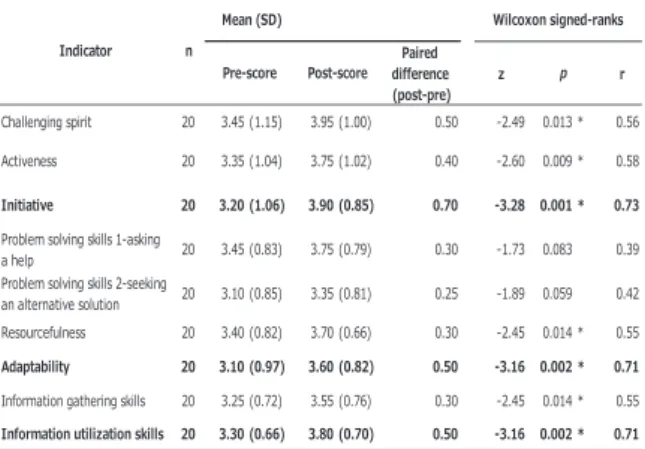
Results comparing pre-/post-program self-assessment scores for the category of Personal Initiative revealed an increase for all nine indicators and a statistically significant increase in seven of nine indicators (Table 5). The program participants perceived the most improvement in Initiative referring to behavior to initiate a conversation and ask a question in English, z = -3.28, p = 0.001, with a
large effect size (r =.73), Information Utilization Skills, z = -3.16, p = 0.002, with a large effect size (r =.71), and Adaptability to difficult situations and unfamiliar environments, z = -3.16, p = 0.002, with a large effect size (r =.71).
9. Other Program Feedback
In addition to the pre- and post-program self-assessment on three categories of competence, students were able to provide feedback through other means.
9.1. Post-Program Orientation Session via Zoom During the post-program orientation which took place two days after the completion of the program, students were given the opportunity to voice their opinions to TU staff and each other regarding their virtual program experience. In groups of four, students listed up their assessments of the advantages and disadvantages of the program. Advantages: - It was very convenient to be able to participate from their home. - The cost of an online program was much lower than the cost of an overseas program.
- Students could enjoy learning about the assessment scores for the category of Command of
English Language revealed an increase for all 13 indicators and a statistically significant increase in ten of the 13 indicators (Table 3). The program participants perceived the most improvement in speaking skills such as Presentation Skills, z = -3.74, p = 0.000, with a large effect size (r =.84), Foreign
Language Communication Skills, z = -3.70, p = 0.000,
with a large effect size (r =.83), and Explanation Skills, z = −3.13, p = 0.002, with a large effect size (r =.70). Results comparing pre-/post-program self-assessment scores for the category of Intercultural Competence revealed an increase for all five indicators and a statistically significant increase in all five indicators (Table 4). The program participants perceived the most improvement in skills to Explain
Own Culture, z = -3.46, p = 0.001, with a large effect
size (r =.78), and attitude toward Diversity and
Inclusion, z = -3.16, p = 0.002, with a large effect size
(r =.71).
Table 4. Descriptive statistics and results of Wilcoxson analysis: Pre- and post-program self-assessment on five indicators of Intercultural Competence
Results comparing pre-/post-program self-assessment scores for the category of Personal Initiative revealed an increase for all nine indicators and a statistically significant increase in seven of nine indicators (Table 5). The program participants perceived the most improvement in Initiative referring to behavior to initiate a conversation and ask a question in English, z = -3.28, p = 0.001, with a large
effect size (r =.73), Information Utilization Skills, z = -3.16, p = 0.002, with a large effect size (r =.71), and
Adaptability to difficult situations and unfamiliar
environments, z = -3.16, p = 0.002, with a large effect size (r =.71).
Table 5. Descriptive statistics and results of Wilcoxson analysis: Pre- and post-program self-assessment on nine indicators of Personal Initiative
9. Other Program Feedback
In addition to the pre- and post-program self-assessment on three categories of competence, students were able to provide feedback through other means.
9.1. Post-Program Orientation Session via Zoom
During the post-program orientation which took place two days after the completion of the program, students were given the opportunity voice their opinions to TU staff and each other regarding their virtual program experience. In groups of four, students listed up their assessments of the advantages and disadvantages of the program.
Advantages:
- It was very convenient to be able to participate from their home.
- The cost of an online program was much lower than the cost of an overseas program.
- Students could enjoy learning about the Paired
difference
(post-pre) z r
Understanding other cultures 20 3.50 (0.95) 4.00 (0.73) 0.50 -2.89 0.004 * 0.65 Understanding own culture 20 3.60 (0.82) 4.10 (0.64) 0.50 -2.89 0.004 * 0.65
Explaining own culture 20 2.65 (0.81) 3.25 (0.85) 0.60 -3.46 0.001 * 0.78
Diversity and inclusion 20 3.90 (0.72) 4.40 (0.60) 0.50 -3.16 0.002 * 0.71 Ethics and discipline 20 3.75 (0.85) 4.00 (0.79) 0.25 -2.24 0.025 * 0.50 *p<0.05 Indicator n Mean (SD) Pre-score Post-score p Wilcoxon signed-ranks Paired difference (post-pre) z r Challenging spirit 20 3.45 (1.15) 3.95 (1.00) 0.50 -2.49 0.013 * 0.56 Activeness 20 3.35 (1.04) 3.75 (1.02) 0.40 -2.60 0.009 * 0.58 Initiative 20 3.20 (1.06) 3.90 (0.85) 0.70 -3.28 0.001 * 0.73
Problem solving skills 1-asking
a help 20 3.45 (0.83) 3.75 (0.79) 0.30 -1.73 0.083 0.39 Problem solving skills 2-seeking
an alternative solution 20 3.10 (0.85) 3.35 (0.81) 0.25 -1.89 0.059 0.42 Resourcefulness 20 3.40 (0.82) 3.70 (0.66) 0.30 -2.45 0.014 * 0.55
Adaptability 20 3.10 (0.97) 3.60 (0.82) 0.50 -3.16 0.002 * 0.71
Information gathering skills 20 3.25 (0.72) 3.55 (0.76) 0.30 -2.45 0.014 * 0.55
Information utilization skills 20 3.30 (0.66) 3.80 (0.70) 0.50 -3.16 0.002 * 0.71
*p<0.05
Indicator n
Pre-score Post-score p
Mean (SD) Wilcoxon signed-ranks
Table 4. Descriptive statistics and results of Wilcoxson analysis: Pre- and post-program self-assessment on five indicators of Intercultural Competence
assessment scores for the category of Command of English Language revealed an increase for all 13 indicators and a statistically significant increase in ten of the 13 indicators (Table 3). The program participants perceived the most improvement in speaking skills such as Presentation Skills, z = -3.74, p = 0.000, with a large effect size (r =.84), Foreign
Language Communication Skills, z = -3.70, p = 0.000,
with a large effect size (r =.83), and Explanation Skills, z = −3.13, p = 0.002, with a large effect size (r =.70). Results comparing pre-/post-program self-assessment scores for the category of Intercultural Competence revealed an increase for all five indicators and a statistically significant increase in all five indicators (Table 4). The program participants perceived the most improvement in skills to Explain
Own Culture, z = -3.46, p = 0.001, with a large effect
size (r =.78), and attitude toward Diversity and
Inclusion, z = -3.16, p = 0.002, with a large effect size
(r =.71).
Table 4. Descriptive statistics and results of Wilcoxson analysis: Pre- and post-program self-assessment on five indicators of Intercultural Competence
Results comparing pre-/post-program self-assessment scores for the category of Personal Initiative revealed an increase for all nine indicators and a statistically significant increase in seven of nine indicators (Table 5). The program participants perceived the most improvement in Initiative referring to behavior to initiate a conversation and ask a question in English, z = -3.28, p = 0.001, with a large
effect size (r =.73), Information Utilization Skills, z = -3.16, p = 0.002, with a large effect size (r =.71), and
Adaptability to difficult situations and unfamiliar
environments, z = -3.16, p = 0.002, with a large effect size (r =.71).
Table 5. Descriptive statistics and results of Wilcoxson analysis: Pre- and post-program self-assessment on nine indicators of Personal Initiative
9. Other Program Feedback
In addition to the pre- and post-program self-assessment on three categories of competence, students were able to provide feedback through other means.
9.1. Post-Program Orientation Session via Zoom
During the post-program orientation which took place two days after the completion of the program, students were given the opportunity voice their opinions to TU staff and each other regarding their virtual program experience. In groups of four, students listed up their assessments of the advantages and disadvantages of the program.
Advantages:
- It was very convenient to be able to participate from their home.
- The cost of an online program was much lower than the cost of an overseas program.
- Students could enjoy learning about the Paired
difference
(post-pre) z r
Understanding other cultures 20 3.50 (0.95) 4.00 (0.73) 0.50 -2.89 0.004 * 0.65 Understanding own culture 20 3.60 (0.82) 4.10 (0.64) 0.50 -2.89 0.004 * 0.65
Explaining own culture 20 2.65 (0.81) 3.25 (0.85) 0.60 -3.46 0.001 * 0.78
Diversity and inclusion 20 3.90 (0.72) 4.40 (0.60) 0.50 -3.16 0.002 * 0.71 Ethics and discipline 20 3.75 (0.85) 4.00 (0.79) 0.25 -2.24 0.025 * 0.50 *p<0.05 Indicator n Mean (SD) Pre-score Post-score p Wilcoxon signed-ranks Paired difference (post-pre) z r Challenging spirit 20 3.45 (1.15) 3.95 (1.00) 0.50 -2.49 0.013 * 0.56 Activeness 20 3.35 (1.04) 3.75 (1.02) 0.40 -2.60 0.009 * 0.58 Initiative 20 3.20 (1.06) 3.90 (0.85) 0.70 -3.28 0.001 * 0.73
Problem solving skills 1-asking
a help 20 3.45 (0.83) 3.75 (0.79) 0.30 -1.73 0.083 0.39 Problem solving skills 2-seeking
an alternative solution 20 3.10 (0.85) 3.35 (0.81) 0.25 -1.89 0.059 0.42 Resourcefulness 20 3.40 (0.82) 3.70 (0.66) 0.30 -2.45 0.014 * 0.55
Adaptability 20 3.10 (0.97) 3.60 (0.82) 0.50 -3.16 0.002 * 0.71
Information gathering skills 20 3.25 (0.72) 3.55 (0.76) 0.30 -2.45 0.014 * 0.55
Information utilization skills 20 3.30 (0.66) 3.80 (0.70) 0.50 -3.16 0.002 * 0.71
*p<0.05
Indicator n
Pre-score Post-score p
Mean (SD) Wilcoxon signed-ranks
Table 5. Descriptive statistics and results of Wilcoxson analysis: Pre- and post-program self-assessment on nine indicators of Personal Initiative
environment from different perspectives because their virtual classmates were from a wide variety of faculties.
- They could get to know a lot about American culture not only by meeting in small groups with UM students and discussing issues, but by being able to go into those students’ dorms and homes virtually and noticing the cultural differences. - Several students expressed they were able to say
their opinions more confidently in the virtual format. One student explained that he did not feel his English significantly improved during the two weeks, but certainly he was able to overcome his fear of expressing himself in English.
- Students generally enjoyed the virtual homestay experience which allowed them to experience culture, play online games together, and extend their relationship beyond the allotted time through the exchange of Line and Instagram accounts.
Disadvantages:
- Students had no control over the network connections and sometimes poor connections made virtual learning difficult.
- Time was limited and it was sometimes hard to have enough time to speak and say their opinions. - The online homework assignments were
sometimes heavy yet not always used during the virtual lessons.
- It was difficult to develop a deep relationship with UM students because time was limited. - At times instructors and UM students spoke
quickly making comprehension difficult.
9.2. Supplemental Post-Program Survey from TU An additional, voluntary English language, paper-based survey was conducted with questions relating to their satisfaction with the virtual program’s online experience. Their written English responses
regarding their satisfaction levels were categorized as positive, neutral, or negative. Fourteen of the 20 participants responded to the following six questions.
Question #1: Do you feel you received enough
individual attention from the University of Montana teachers and staff?
Response: 14 of 14 respondents answered yes. Examples (positive):
- I sent emails about the program, then they answered quickly.
- professor provided me with advice about my pronunciation.
- Anne (Program Manager) cared about me after I spoke something in front of every participants. She sent me the private message on Zoom chat.
- they personally gave me useful information for my final presentation.
- Ms. Anne (Program Manager) gave me some advice about speaking in front of people individually!
Question
#2: Do you feel you had enough peer-to-peer communication time with University of Montana students?
Response: Of the 14 respondents 9 answered yes, 3
were neutral and 2 answered no.
Examples (positive):
- I could talk about not only environmental and social issues but our hobbies and majors.
- I came to be connected with one Montana student. - I could make relationship with them even though
we connected with each other online.
Examples (neutral):
- Yes, but sometimes I wanted to talk with them more.
- Yes, but I would have liked to interact with them more.
Examples (negative):
リチャード メレス,渡部 由紀・The Design, Implementation and Efficacy of an Online Virtual Exchange Program
students.
- I didn’t think it was enough. I wanted to talk with them and make some friends.
Question #3: Do you feel the cost of 10,000 yen was
appropriate?
Response: All 14 respondents agreed the cost was
appropriate or too low.
Example (positive):
- It is so reasonable that I could join this program without concerning cost.
- It was too low rather than appropriate.
- I think it is appropriate for us, Tohoku University students. I have heard it costs much to take a class and get a credit at American Universities.
- Under coronavirus pandemic, many students, including me, had little money, so if the cost of this program was higher, they might not have taken this program.
Question #4: Do you plan to apply for the 2021
Montana Program if it is an overseas program and not virtual?
Response: Of the 14 respondents 11 answered yes, 1
answered no and 2 were unsure.
Examples (positive):
- I want to see beautiful views surrounded nature and visit my host family.
- I want to visit Montana offline.
- I want to feel nature in Montana next year.
- I think there are many things that can only be learned locally. In addition, I want to meet my host family!
Example (negative):
- no, I’d like to visit there personally and I want to apply for the other programs.
Question #5: Please explain what you enjoyed most
about this program. What do you think were the benefits of this program?
Examples (most enjoyable):
- I really enjoyed this program, for example discussion with UM students, host family conversation, and presentation.
- What I enjoyed most was virtual homestays. - I am especially interested in environmental
problems. Thinking about them from global perspectives was a precious opportunity for me. - Talking with Montana students and my host
families was most interesting.
- To talk with UM students was really interesting and I got new perspectives.
Examples (benefits):
- I believe it was easy to apply this program thanks to financial support. Also people who cannot go abroad because of other reasons can participate in the virtual class.
- The benefit of this program is to compare environmental issues in Japan to that in the US. - I think talking with homestay family was most
benefit for me.
- It gave me the opportunity to think about my identity.
Question #6: Please explain what you enjoyed least
about this program. What do you think needs improvement in the future?
Examples (least enjoyable):
- Discussion with UM students studying Japanese culture and civilization was what I enjoyed least. I couldn’t understand what the UM student said well due to the bad connection.
- I am not satisfied with Exchange with Japanese Studies Student. I hope we have a little more time.
- I thought the class time was too shorter and I wanted to interact with the participants more. - Virtual home stay was not so interesting.
Examples (needs improvement):
opportunities to make deep relationship with foreign students.
- I think the time to communicate with people in Montana was not enough.
- It may be okay to extend the class time a little longer.
- I wanted to see powerpoint slides after the classes. - I wanted to pursue a solution to the issues
addressed in this program.
9.3. Post-Program Survey from UM
The Maureen and Mike Mansfield Center in cooperation with the Japan Consulate in Seattle, Washington conducted their own post-program survey. Students were asked about the overall impact of the program.
When asked, Did the program leave a memorable impression on you? 100% of the 18 respondents answered strongly yes (14) or yes (4).
When asked, Did the program help to deepen your understanding toward the U.S.? 17 of the 18 respondents answered strongly yes (11) or yes (6). One respondent answered no opinion.
When asked, Did this program inspire you to take action related to the U.S., e.g., considering a visit to the U.S., studying in the U.S., joining a cultural exchange, doing research on the U.S., or on the theme you learned through the program? 100% of the 18 respondents answered strongly yes (11) or yes (7).
10. Evaluation of Program Efficacy
The efficacy of the virtual program can be measured in terms of student competency and student satisfaction outcomes.
Student Competency
It is clear from the analyses of the pre- and post-program self-assessments that student levels increased regarding their command of the English language, intercultural competence, and personal initiative. The results show that students regard
their participation in the two-week program as beneficial to all three categories of competence. All 27 indicators listed on the self-evaluations showed levels of improvement.
Command of English Language:
Students reported improvements in all four English skills (reading, writing, listening, speaking) with the most significant improvements being skills related to speaking. Presentation skills were reported as having the highest growth. Presentation framework and presentation preparation lessons were built into the p r o g r a m d e s i g n a n d s t u d e n t s m a d e f i n a l presentations on the last two days of the program. Students received group instruction on how to improve speaking skills and build confidence in delivering speeches in English. Additionally, students received individual instruction in the form of written feedback on delivery, content, and pronunciation of their presentations.
Communication skills were reported as having shown the second greatest levels of English language improvement. Throughout the program students were given opportunities to work in groups with UM students to discuss lesson content. These peer-to-peer experiences included discussions of global leadership, public diplomacy, global environmental issues, and cultural differences. In addition to group communication with Montana peers, TU students had ample opportunities to express their thoughts and opinions in English to each other and to the instructors throughout the lectures.
Intercultural Competence:
The students’ self-evaluation of intercultural competence was the highest of the three categories in both the pre- and post-program self-assessments. These competencies include the understanding of other cultures, understanding their own culture, and explaining their own culture. Students reported their greatest improvement in their ability to explain their own culture. As representatives of their culture, TU
リチャード メレス,渡部 由紀・The Design, Implementation and Efficacy of an Online Virtual Exchange Program
students had many opportunities for self-exploration while interacting with UM students and staff by describing, discussing, and answering questions about themselves and about Japan.
Personal Initiative:
The results of the students’ self-evaluations indicated improvements in their ability to take personal initiative. Their self-assessment scores for indicators such as initiative, challenging spirit, adaptability, and information utilization skills all showed significant improvements. Throughout the program students displayed goal-oriented actions such as initiating conversations, asking questions, and volunteering for leadership roles. Students were able to adapt quickly to the virtual learning environment and UM’s online network. Student Satisfaction All three avenues of post-program feedback (Program Orientation Session, Supplemental Post-Program Survey from TU, Post-Post-Program Survey from UM) indicated modest to high levels of overall student satisfaction with the program.
Satisfaction with program cost:
Students collectively agreed the low cost of the program was appealing. Some students indicated it was a motivating factor for application.
Satisfaction with program content:
Students expressed satisfaction with the variety of program content, including theme-related content on the environment, culture-related content such as virtual homestays, and final student presentations. Satisfaction with learning environment:
Students expressed appreciation for the availability of a virtual overseas experience during the C O V I D - 1 9 p a n d e m i c . T h e y a l s o i n d i c a t e d appreciation for the convenience of learning from home. In general, students were comfortable with the Zoom, Moodle, UM Online, and on-demand formats.
Satisfaction with communication:
Students indicated appreciation for opportunities to connect with peers from UM. In addition, most students agreed the virtual homestay experience was beneficial and memorable. Several students expressed a desire for continued communication with Montana students and host families.
Satisfaction with individual attention:
Students signified high levels of satisfaction with the amount and depth of teacher-to-student individual communication. Individual attention came in the form of private email messages, private comments during Zoom breakout sessions, and individual, detailed feedback on presentation preparation.
Satisfaction with program outcome:
Students collectively agreed that the program left a lasting impression on them, and most indicated the program deepened their understanding of foreign culture and increased their desire to further explore foreign culture. Most students indicated a desire to join the 2021 overseas Montana program if feasible.
11. Points for Consideration
The post-program surveys also exposed some areas of the virtual program in need of improvement. Students on an overseas exchange are fully immersed into the foreign culture twenty-four hours each day. Students on the Montana Virtual Exchange P r o g r a m w e r e p a r t i c i p a t i n g i n r e a l - t i m e communication only one to two hours per day. The total number of hours for synchronous learning was 20.5 hours for the two-week program. Many students expressed a desire for longer and more frequent real-time sessions. Adding more synchronous hours of learning to a future Montana virtual program would likely increase the costs from the host institution but should be considered.
There were several students who indicated a desire for more peer-to-peer interactions. There were numerous communication sessions built into the
program that allowed students to break into small groups with UM students. However, several TU students felt the amount of communication time was not sufficient for them to build deep relationships with their partners. A virtual “buddy” that allows one TU student to communicate with one UM student for the duration of the program is a consideration for a future Montana virtual program.
The home networks of some students were occasionally unstable and unreliable leading to a challenging virtual learning environment. The host institution was able to maintain a stable connection throughout the program, but there were times when TU students or UM students, who also participated virtually, were disconnected. Future virtual program promotion and pre-program orientations should encourage participants to insure a strong home network environment before committing to the program.
The greatest alure of an overseas Montana program is the natural beauty of the state. In past programs TU students were able to explore Glacier National Park, participate in fieldwork at the Flathead Lake Biological Center, and go camping. It was impossible to recreate these experiences. Students had access to on-demand materials including videos, reading materials, and links to webpages that demonstrated Montana’s nature, but these experiences were less authentic and less personal than an actual visit to Montana. A future Montana virtual exchange should try to find ways to make the experience more authentic and personal. One TU student mentioned that his host family gave him a real-time tour of the town by videocasting from the host family’s car. This experience was moving and left a lasting impression. A similar experience of a real-time, interactive trip into Montana’s nature should be considered.
12. Summary
The COVID-19 pandemic has drastically changed the university social experience. University is a time of personal growth for students allowing them to build relationships, socialize, and build life skills. These life skills also include global skills such as international collaboration and communication. Unfortunately, the challenges posed by the COVID-19 pandemic have made it difficult for university students to pursue these global life skills due, in part, to the cancellation of overseas programs.
The Montana Virtual Exchange Program was meant to provide students with the opportunity to fill the gap of international partnership left by the pandemic. It hoped to provide students with a safe and beneficial alternative to an overseas program. During the two-week virtual experience, TU students were able to build English language skills, improve intercultural competence and strengthen personal initiative, all important global skills.
Importantly, this virtual program was able to keep the connection between TU and UM moving forward. TU students together with students of UM could continue to build relationships, share culture, and work together globally despite the obstacles created by COVID-19. While a virtual program cannot fully replicate the overseas experience, it can keep the learning and the personal growth of university students moving forward.