English Conversation Preparatory Lessons for the 20
thShoin
High School Overseas Study Tour in New Zealand –
Implementation and Analysis
Polona Fras Shoin English Language Teaching Center
During summer vacation Shoin High School offers an overseas study tour to stu-dents interested in foreign languages and cultures. The stustu-dents are encouraged to participate in a variety of lessons to prepare them for the actual trip. This paper will outline the implementation of preparatory lessons in English conversation for the 20th overseas study tour in New Zealand. It will also report the results of the
stu-dents’ evaluations of these lessons.
Introduction
Shoin High School has been offering overseas study tours to its students for many years. For the first 17 years the students visited Australia, but in 2013 the destination changed to New Zealand. In the initial years the junior and senior high school study tours were conducted separately, but were later combined into one tour. As of 2013, third year junior high school students and second and third year senior high school students are eligible for the study tour (Wada, 2014).
Before the actual study tour the students have to participate in a variety of preparatory lessons. The majority of lessons focus on English conversation, but there are also some lessons about the country’s culture and music as well as a simulation of airplane travel and immigration (offered off-campus). The on-site study tour lasts for 2 weeks and is held through the end of July and beginning of August. The stu-dents stay at a host family’s house, take classes at Shoin High School’s sister school and experience everyday life. After returning to Japan the students make a presenta-tion about the study tour in English (Wada, 2014).
English conversation lessons for the 20th
overseas study tour
The preparatory lessons in English conversation were conducted from April to July 2015 by Shoin English Language Teaching Center (hereafter ELTC). The preparatory lessons consisted of four 50-minute guided lessons (taught by an ELTC assistant English teacher), “free talk” (English conversation with a native En-glish speaker) and an interview.
In the guided lessons the students learned some useful expressions and how to describe things. They also learned how to introduce themselves and their families as well as other practical language through practising model conversations about travelling and homestays. Each lesson followed the same pattern. First, the teacher explained the theme for the lesson and modelled what the students had to do. The students were then given worksheets, useful vocabulary and expressions lists. They then did the required activities, which included writing and memorizing a short speech, getting information from other students and writing then practising a short skit. This was followed by a short presentation (speech, skit) in front of the class. If there was enough time, the students played a game to practise the new vocabulary.
The “free talk” with a native English speaker usually lasted about 20 min-utes per session. The students were encouraged to talk about topics connected to their study tour, but they were free to discuss any topics they wanted as long as they only used English.
The interview was conducted two weeks before departure. The students were asked questions about Japan and Japanese culture and evaluated based on their attitude and English level.
Students’ evaluation of the lessons
At the end of the program the students were asked to fill out a question-naire about the preparatory lessons in English conversation. They were asked wheth-er they found: the content of the lessons easy to undwheth-erstand, the amount of lessons to be sufficient, the content of the lessons useful to them in New Zealand, the handouts easy to understand, the handouts to be useful, the teacher’s speaking speed to be appropriate, the teacher’s pronunciation easy to understand, their English to have improved as a result of their participation in the study tour and whether they want to continue studying English. All of these questions were multiple choice questions. They were also asked to write how they studied on their own and to write any addi-tional comments about the lessons. These questions were open-ended.
The total number of students was 25 (8 junior high school students, 17 se-nior high school students). The response rate was 100%. The students’ responses are displayed in figures 1-4.
Figure 4. Students’ response: questions about students’ English.
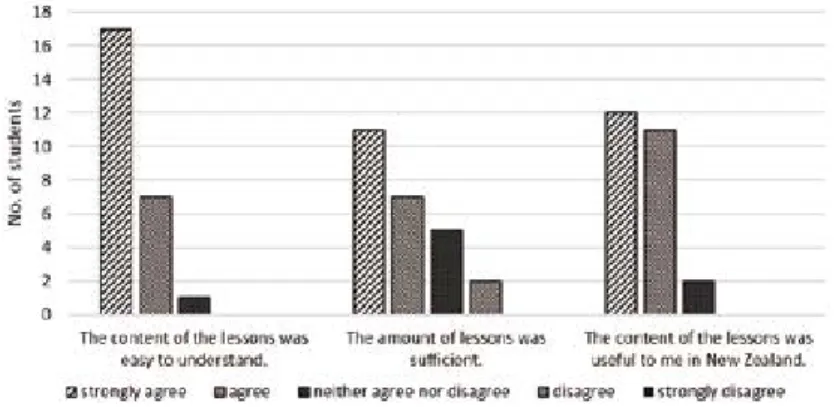
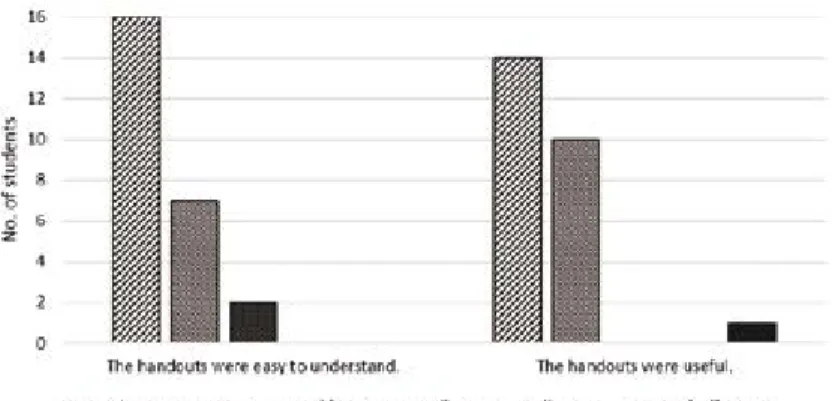
The students’ response to the lessons was very positive. The majority of the students said the content of the lessons was useful (92%) and easy to understand (96%) (Figure 1). Most of the students (72%) also felt that the amount of lessons was sufficient (Figure 1). The handouts were also rated very positively as the major-ity of the students said they were useful (96%) and easy to understand (92%) (Figure 2). The students did not appear to have problems understanding the teacher. All of the students felt the teacher’s pronunciation was easy to understand and most of them (76%) said the teacher’s speaking speed was just right (Figure 3). All students want to continue studying English and the majority of the students (96%) think their English has improved as a result of their participation in the study tour (Figure 4).
When asked about how they studied on their own, the most common stu-dents’ responses were:
• they participated in “free talk” lessons at ELTC, • they memorized useful vocabulary and expressions, • they read books about studying abroad,
• they watched English movies.
Some of the most common additional comments about the lessons were: • they wish they had memorized more vocabulary and expressions before going
to New Zealand,
• they wish they had practised English conversation more, • they wish they had practised their listening skills more,
• they wish the lessons had a unit on useful expressions in case of an emergency.
Conclusion
The preparatory lessons in English conversation seem to have been suc-cessful. The students’ response to them has been extremely positive and the lessons really seem to have prepared them well for the study tour in New Zealand. However, as the students have also figured out by themselves, participating only in preparatory lessons offered by the school is not enough. Many students regret not studying more on their own. While it might be possible to include more vocabulary practice into guided lessons (especially adding a unit on expressions used in case of an emergen-cy), the limited number of lessons and the size of the group would make it difficult to retain “free talk” and listening practice. It might therefore be a good idea to intro-duce “self-study stamp cards” to encourage students to practise on their own.
References
Wada, Y. (2014). Shoin chuugakkou koutougakkou dai 18 kai kaigaikenshuu hou-koku [Report of the 18th
Shoin Junior High School and Senior High School Over-seas Study Tour]. Shoin ELTC Forum, 3, 43 – 46.