China since the New Period
journal or
publication title
関西学院大学先端社会研究所紀要 = Annual review
of the institute for advanced social research
number
14
page range
1-20
year
2017-03-31
!!!!!!!!!!!!!!!!!!!!!!!!!!!!!!!!!!!!!!!!!!!!!!!!!!!!!!!!!!!!!!!!!!!!!!!!!!!!!!!!!!!!!!!!!!!!!!!!!!!!!!!!!!!!!!!!!!!!!!!!!!!!!!!!!!!!!!!!!!!!!!!!!!!!!!!!!!!!!!!!!!!!!!!!!!!!!!!!!!!!!!!!!!!!!!!!!!!!!!!!!!!!!!!!!!!!!!!!!!!!!!!!!!!!!!!!!!!!!!!!!!!!!!!!!!!!!!!!!!!!!!!!
" 論 文 "
Abstract
Since the new period, the art anthropology in China has built its own academic basis from scratch through translating and introducing western art anthropology writings, and further developed into the localization of empirical studies in the process of digestion and absorption. This paper analyzes the development course of art anthropology in China since the new period. It divides this academic course into the academic preparation stage from the late 1970s to the mid-1990s, the academic initial stage from the mid-1990s to the founding of China Society for Anthropologies of Art in 2006 as well as the steady development stage since the establishment of the Society. The study sums up the achievements and the shortcomings of each period and discusses the points for further research.
Key words : art anthropology, text, field, course, China
1. Introduction : Origin of the Study
In contemporary Chinese academic circle, art anthropology has become a prominent subject so that more and more scholars are conducting artistic research in the help of anthropological theories and research methods. Meanwhile a large number of related academic writings and papers have emerged, which has attracted the general concern of the academic circle. The primary reason for this trend lies in the scientific nature of its research method. It advocates looking downward to discover materials in daily life and conduct empirical research closed to the context of real life. In addition, in contemporary Chinese society, there are diverse links between art and society, and economy and culture so that the explanation and demonstration of anthropology are needed. As academic development needs timely summary, this paper tries to sort out the development course of art anthropology in China since the new period. What are the basic development status and characteristics of each stage? What are the issues that need further reflection? Which path should be followed in future development? These are the questions the author tries to answer in this paper.
──────────────
*PhD and Assistant Research Fellow at the Institute of Art Anthropology, Chinese National Academy of Art.
1)The new period means the stage since the Third Plenary Session of the 11th Central Committee of the Chinese Communist Party in December 1978, which brought about important political and economic changes as well as new opportunities and development path for the cultural endeavors in China.
The Development Course of Art Anthropology in China since the New Period
1)2. Academic Preparation Stage : Academic Research from “Text” to “Text”
The period from the late 1970s to the mid-1990s can be regarded as the academic preparation period of art anthropology in China. Upon the completion of the Cultural Revolution, which lasted for ten years, academic research began to recover. The development of the basic national policy of reform and opening up brought new opportunities for culture and art in China. Since the academic circles were eager to get rid of stagnation, they began to learn from the West. Right at that time, art anthropology was introduced to China when a large number of translated books on western art anthropology were published. Centering primitive art thesis, a research fever of art anthropology arose in China. They focused on the origin and occurrence of art only for the theoretical analysis and interpretation of pure text. This academic tradition lasted for a long time. The empirical studies with anthropology theories and field method didn’t show up until the mid-1990s.
2.1 Introduction to the Concept of Art Anthropology
Academic research began to recover in the 1980s when the academic environment was gradually relaxed. At that time, professionals in various fields were actively creating new disciplines and exploring new methods. Under such a cultural background, art anthropology was introduced. Jin Dacheng, the first person to introduce this concept into the Literature Research Institute of the Chinese Academy of Social Sciences, was admitted to the Institute as a graduate student in 1984 under the instruction of the famous scholar Qian Zhongwen. The concept of art anthropology was first discovered, translated, introduced and utilized in China by him. For this reason, the author conducted an exclusive interview of him. “At that time, the Institute set up a special ‘research room for new discipline’. The so-called creation of new discipline meant that the original knowledge of literature was obsolete and must be renewed by new human sciences, including natural sciences. I found The Anthropology of Art by Robert Layton in 1985 in a reference to a foreign-language periodical in Capital Library. Later I got the book and decided to translate it. I began to work in the Institute after graduation so that I organized a group of translators to translate the book and published it in 1991” (Jin Dacheng, personal communication, 2017). Through Jin’s description, we have a better understanding of how the concept of art anthropology came into China. Under the instruction of Qian Zhongwen, he completed his master’s thesis namely Art Anthropology : The Theoretical Basis of Cultural
Criticism, which is the first degree thesis specifically in the name of “art anthropology”. Its
discussion focuses on “the origin and the center of art anthropology,” “the artistic concept of anthropology” and “the critical principles of anthropology―the critical methods of cultural restoration”.
2.2 Translation, Introduction of Foreign Articles and Books and Their Influence
The economic globalization was accelerating while China had an unprecedentedly active contact with foreign countries in economic, political, cultural and other aspects. The selective translation and introduction of the latest results of anthropology and ethnology benefited China in understanding the status quo and development trend of foreign anthropology and ethnology and promoting their development in China (Jiang, 2009). According to the author’s incomplete statistics, during this period, a number of publishing houses published translated books related art anthropology, including Primitive Art by Franz Boas (1989), The Beginnings of Art by Ernst Grosse (1984), The Way of the Masks and The Savage Mind by Claude Levi-Strauss (1987, 1992), The Golden Bough by James George Frazer (1987), The Anthropology of Art by Robert Layton (1990) and so on.
Since the new period, due to the rise of the “cultural studies” he need of discipline construction and development, there was the climax of translation and publication of foreign art anthropology books by Chinese scholars, which provided reference books and theoretical tools for the scholars and students engaged in art anthropology. Since research on contemporary art anthropology in China was in its infancy, the translation and introduction of western art anthropology works not only created the context of exchange and dialogue for domestic scholars and foreign scholars but also set up good foundation for the discipline and theoretical construction of localization of art anthropology in China.
2.3 Art Anthropology Studies on Primitive Art Thesis
During this period, scholars mainly conducted research centering “primitive art” for the origin of art and artistic phylogeny. On the other hand, influenced by the trend of western theory of evolution, western scholars concentrated on the origin of nation, state, art and so on. Since art anthropology in China originated from the learning and imitation of the West, it was naturally difficult to get rid of this stereotype ; on the other hand, the “aesthetics popularity” in the 1980s exerted unprecedented influence so that the ideological circle attempted to escape from the imprisonment of the “Cultural Revolution” with its help and pursue the liberation from reason to sensibility. Aesthetics research was based on abstract and reasoning thought, whose ultimate academic goal was exploring the nature or origin of beauty. One of the most important objects of aesthetics is art, so the study of the origin and essence of art had naturally become its main interest. Therefore, the study of primitive art became an effective way to achieve its academic interest and the popularity of art research occurred.
The research works of the academia mainly relied on aesthetics and art through finding literatures related to primitive art from history, anthropology and archeology or ethnography
materials. These works emphasized on purely textual research with abstract philosophical speculation and logical deduction. They were classified as art anthropological research mainly because of their use of a large number of anthropological or ethnographic materials. But from the methodological perspective, these studies did not actually go through the fieldwork process, hence could only be considered as “desk fieldwork.” As these works produced knowledge from text to text, they were not art anthropology in disciplinary sense. However, when the primitive art research works of this period was put into the history of the academic development of art anthropology in China, they introduced a large number of western anthropological, art and archaeological data and provided a good academic accumulation for the subsequent study of art anthropology. From this perspective, their academic significance of was prominent. For example, The Origin of Art and Primitive Cultural Studies : Reflections on Aesthetic Problems by Zhu Di, The Occurrence of Art by Deng Fuxing, Primitive Art by Gong Tianfuand Zhang Yasha, Chinese Primitive Art by Liu Xicheng, Chinese Primitive Artistic Spirit by Zhang Xiaoling, Art Anthropology by Yi Zhongtian and Aesthetics Experience Theory by Wang Yichuan made great contribution.
The writings of this period showed that the primitive art the Chinese scholars studied was after the late Old Stone Age. The common characteristics of their studies were : Firstly, there was a change from one-way introduction of foreign materials to the knowledge and study of Chinese multi-ethnic culture and art aided by art anthropology. Secondly, there were a large number of history, anthropology and archaeology or ethnography materials while there was no fieldwork in the academic sense. They tried to make a conversation with the ancients in historical literature and information so as to explore the origin and nature of art as their ultimate academic goal. To a certain extent, their methods were similar to the way of the western anthropologists on the “rocking chair” in Classical Era, who cited a large number of anthropological, archaeological and ethnographic data in Classical Era to carry out the primitive art research. With these data, they speculated the past history of art. This academic paradigm even exerts influence today. In later studies, there were also studies on the occurrence of aesthetics and artistic spirit, which promoted the development of primitive art study. Thirdly, micro-research of specific issues was extended to interdisciplinary integrated research.
The results of these researches laid a good foundation for the development of art anthropology in China and expanded the development idea of academic research. But regardless of positive results, we should also reflect on the limitations and problems. These studies could not get rid of the problems of traditional study on aesthetic art theory. They often applied a theoretical pre-position and deducted premise and argument from conclusion so that the ethnographic data they used was “fragmented” and “instrumented” in a certain extent (Zhang, 2010 a). The specific
time and space background was obscured only to be manipulated by the writers. They tended to obtain clues or evidence from the historical documents and ethnographic materials in order to carry out social and cultural restoration of certain artistic phenomena. Therefore, it was only an archaeological interpretation to the appearance, significance and function of art as well as a general cultural interpretation to the ‘class’ response at a broad sense with the blurred time, space and people features (Hong, 2006). Compared with the studies at real academic sense based on art anthropology theory and field investigation, there was still a long way to go for this research method to develop from ideal academic idea to realistic academic practice.
3. Academic Initial Stage : A Shift from “Text” to “Field”
The period from the mid-1990s to the establishment of the China Society for Anthropologies of Art in 2006 can be regarded as the academic initial stage of Chinese art anthropology research. The academic shift from “text” to “field” is the most important feature. Some scholars began to go deep into the field so that the studies of folk art with the use of anthropological theory and method resulted in a number of research achievements based on field. But their studies were mostly “individual combats” in their own areas while few scholars defined their own research as art anthropological research, so they were only in small scale. Among the social science projects at national and provincial level, there was a number of projects related to art anthropology so that art anthropology received due attention. Concerning discipline construction and talent cultivation, some universities and research institutes began to set up art anthropology courses and receive graduate students. With the development of academic research and the growing numbers of talents, they expected to have an academic platform and to form an academic community for the academic communication and dialogue and the promotion of the academic research of art anthropology in China. The establishment of the China Association of Art Anthropology in 1999 was a response to the needs of the discipline. It became a symbol for the academic association of art anthropology in China.
3.1 Art Anthropology with Field Study
During this period, scholars were not satisfied with the traditional art research which with an empty-style focused on theory rather than evidence as well as on method rather than material. They emphasized on re-understanding art to return to the real world (externalized) and specific cultural context (internalized), escaping from the narrow study of pure text and placing it into the culture of its occurrence―to interpret art in the life as a whole, to find real materials when upholding the concept that “art is the life practice of realistic individual” and to try to be closed to real life. With the help of the field investigation method of art anthropology, an interpretation way to the specific context was found to jump out of the spiritual world of artist, and to
develop towards group art and aesthetics so that an interpretation targeting interpersonal interaction in real life and the shift to general public from elitism could be realized. Academic changes of such occurred in researchers with different discipline backgrounds, forming research groups of different directions, namely, aesthetic orientation, anthropology orientation, art orientation and folklore orientation. Of course, these four research directions were not entirely separated but shared many things in common.
For studies with aesthetic orientation, the most prominent feature was to solve the problem of aesthetics research as its ultimate aim. At this period, the studies of aesthetic anthropologist were prominent as a sub-discipline of aesthetics. But different from traditional aesthetic research, they focused on empirical research and studied aesthetic and artistic phenomena by field investigation. For example, the aesthetic anthropology group represented by Wang Jie achieved a series of research results concerning the culture study of humanistic connotation and aesthetics in Lijiang River, the observation study of Nanning International Folk Songs Festival and the cultural study of the Zhuang nationality in black based on the field investigation of national culture of the Guangxi region. The achievements included Aesthetic Illusions and
Aesthetic Anthropology (Wang, 2002 a), Theory and Practice of Aesthetic Anthropology (Qin,
2002 a), Harmony of Heaven and Human and Reconstruction of Humanity : Aesthetic
Anthropology Study of Cultural Connotation and Social Development in Lijiang River (Qin,
2005 b), The Consciousness of Searching for Mother : Aesthetic Anthropology Investigation of
Nanning International Folk Songs Festival (Wang, 2004 b) and so on.
Art anthropological studies with anthropological orientation were inclined to treat art as cultural phenomenon. With good anthropology foundation and solid field investigation skills, they completed a number of outstanding art field ethnographies. For example, the Jingdezhen folk kiln and its ceramic cultural research by Fang Lili went deeper than ceramic art itself to reveal the social and economic background of the full revival of the folk kiln as well as the production and reproduction mechanism of ceramic product by folk kiln through in-depth and careful fieldwork. (Zhou, 2009 a) The study paid comprehensive attention to the complexity of social relation centering ceramic production and consumption in social market economy in modern and contemporary society. (Zhou, 2010 b) The results can be found in two books namely Jingdezhen
Folk Kiln (Fang, 2002 a) and Tradition and Change : Field Study of Old and New Folk Kiln in Jingdezhen (Fang, 2000 b). The study on theatrical troupe in Taizhou by Fu Jin (2001) was
finished after eight years continuous field track of Taizhou folk opera. It described in detail the history, the present situation, the internal composition, the way of life of performer, the economic operation mode as well as its unique performance and form in order to objectively analyze its existing way and internal structure as well as to reveal the important significance of
theatrical troupe for the continuation of folk opera. In addition, the art anthropology studies led by He Ming, the field study of Shaman of Mongol nationality led by Se Yin, Yuehu : Field
Investigation and Historical Track by Qiao Jian et al. (1999) and Mexrep in the View of An Anthropologist by Aidiya Mohammad (2006) were among the other representative works.
Art anthropology research with folklore orientation was good at presenting the interaction between folk art and rural society by starting with folk art especially art in rural society (Zhang, 2006 : 6). For example, the research on villager art of Luzhongsi Village by Zhang Shishan2)
studied the cultural logic of villager art and village life from the dual perspective of art and folklore, focusing on the performance, repetition and inheritance of the artistic text in rural society by villagers as well as its significance in the process. Through specific case study and research, he focused on revealing the structural significance of folk art activities in rural cultural space as well as observing its survival, circulation and evolution trend. Zhou Xing’s folk art research3)and so on were among the other representative works.
Art anthropology research with art orientation was mainly carried out by scholars with the background of art discipline, who with their knowledge of art itself, conducted research through learning from anthropological theory and research methods. Compared with the first three schools, their interpretation of art was more in-depth. For example, in the study of Yuehu of Shanxi by Xiang Yang (2001), field investigation was carried out to cover both the characteristics in the form of music and the interdisciplinary “connection”―an in-depth study of the group from the perspective of historical anthropology. In addition, music anthropology research by Luo Qin and Xue Yibing, opera anthropology research by Rong Shicheng (2003), investigation and research of religious sacrificial dance in Qinghai by Ma Shengde and Cao Yali (2005) and so on were the classics in this field.
Although the focuses of these trends of art anthropology were not the same, they tried to excavate into the living materials of real life―free from the old style of focusing only on the art itself, put art into a specific cultural context of time and space for study, show a complete picture of art, and carry out the disciplinary matrix of anthropology from the perspective of methodology.
3.2 Project Approval Related to Art Anthropology
Art anthropology related projects at national and provincial level flourished, becoming an
──────────────
2)For details, refer to Zhang Shishan’s Cultural Interpretation of Rural Folk Art : Investigation of Luzhongsi Village. 3)For details, refer to Zhou Xing’s How Anthropologists View Folk Art.
important point of the beginning of art anthropology research. It indicates that research in the field of art anthropology has got enough attention while the legitimacy of the discipline has been further confirmed. The projects mainly include : The Protection, Exploitation and Utilization of Western Human Resources4), Basic Database of Northwestern Human Resource
and Environment5), Pursuit of Localization Modernity : An Introduction to Chinese Art
Anthropology6), Art Anthropology and Modern China7), Discipline Construction of Chinese
Contemporary Anthropology and Aesthetics8), Exploration on Theoretical Approaches and
Subject Construction of Chinese Art Anthropology9), Anthropology Research on the Art of
Zhuang Nationality10), and Series Research on Aesthetic Anthropology11). They are primarily
related to the general basic theory, discipline construction and case study of art anthropology. The Protection, Exploitation and Utilization of Western Human Resources set up by the Ministry of Culture in 2001 and the Basic Database of Northwestern Human Resource and Environment set up by the Ministry of Science and Technology in 2002 are worth special attention because they involved the largest number of people for the longest hour, and were characterized as the most comprehensive ones. Led by Chinese National Academy of Arts, over one hundred scholars from Peking University, Tsinghua University and several universities and research institutes in Northwest participated there. Fei Xiaotong was the general academic advisor of the projects. Under the guidance of research method of art anthropology, outstanding achievements came out in seven years. Basic Database of Northwestern Human Resource and Environment was organized to obtain a clear understanding of the background, focusing on data collection and reorganization and presenting them in the form of multimedia database. The result of it was presented in the way of multimedia database. Based on case study through field investigation, information collection and reorganization, The Protection, Exploitation and Utilization of Western Human Resources was aimed at establishing a set of theories for
──────────────
4)In 2001, the key point project of National Social Science Foundation under the major state project of The Eleven Five-Year Plan on National Art Disciplinary hosted by Fang Lili from Chinese National Academy of Arts was set up.
5)In 2002, the project of the Ministry of Science and Technology hosted by Fang Lili from Chinese National Academy of Arts was set up.
6)In 2002, the project of the National Social Science Foundation hosted by Professor Zheng Yuanzhe from Fudan University was set up.
7)In 2002, it was financed by the China Talent Fund of the United Front Work Department of CPC Central Committee and hosted by Professor Zheng Yuanzhe from Fudan University.
8)In 1999, it was financed by the first Young Teachers Award of the Ministry of Education and hosted by Professor Zheng Yuanzhe from Fudan University.
9)In 2005, it was among the Ministry of Education of Humanities and Social Science Projects hosted by Professor He Ming from Yunnan University.
10)In 2005, it was among Ministry of Education of Humanities and Social Science Projects hosted by Professor He Ming from Yunnan University.
11)In 1998, the project “Series Research on Aesthetic Anthropology” hosted by Wang Jie from Guangxi Normal University was approved by the Education Department of Guangxi Zhuang Autonomous Region.
protection, development and utilization.
Driven by these projects, a large number of exemplary classic academic models such as The
Roots of Art : Introduction to the Science of Art Origins by Zheng Yuanzhe, Translations of Culture and Art Anthropology edited by Zheng Yuanzhe and Collection of Aesthetics and Art Anthropology by Zheng Yuanzhe, Heritage, Practice and Experience by Fang Lili, From Heritage to Resources : A Research Report on Human Resources in Western China edited by
Fang Lili and Life Changes of People in Longjiazhai Village : Research on Suojia Eco-museum by Fang Lili et al. emerged. They are indispensable classics in the history of art anthropology in China.
3.3 Conscious Academic Union
As an interdisciplinary subject, art anthropology is open to scholars with various academic backgrounds. Interdisciplinary integration is an approach to solve difficulties and answer questions as well as a means to achieve goals which cannot be reached in single method (Totosy, 1999 : 71). As Clifford Geertz puts it, “it is a consensus of intellectual group formed by scholars with various disciplinary backgrounds. Or they are divided into different disciplinary but converge towards the same center of a circle with different central angles” (Geertz, 2004 : 27). Scholars of art anthropology in western countries were mostly anthropologists, whereas Chinese scholars were mainly aestheticians, anthropologists, folklorists and other art researchers. Hence, research on art anthropology in China enjoyed a diversified development and formed research groups with distinctive characteristics. However, with the deepening of research, “individual combat” gradually showed its limitation. So with the expectation of a platform for academic communication and an academic community, scholars moved towards an academic union consciously.
Initiated by Zheng Yuanzhe, China Association of Art Anthropology was founded in Nanning in 1999. Its’ aim was to “pursue the modernity of Chinese art theory and aesthetic spirit based on the localization of art anthropology resources, reconsider and sum up art practice and art concepts of all nationalities in China with insights of human art, globalization and openness, merge micro description of nature and macro regularity, improve and optimize the discipline knowledge paradigm and ideological system of art anthropology in modern China in order to provide strong theory of knowledge and charming theory resources for the modernity pursuit of other disciplines and to contribute to the ability of dialogue with the world of humanistic and social science in China in the 21 st Century” (Yin, 2000). The establishment of the association objectively reflects the considerable academic and social recognition of art anthropology in China. It also indicates that the discipline developed rapidly, showing an inestimable academic
prospect. But it is regrettable that neither academic conferences nor any series academic seminars related was held since its establishment. The one which plays the role as a real platform for academic communication and dialogue is China Society for Anthropologies of Art founded in 2006.
4. Steady Development Stage : Towards the Localization of Academic Norms and the Globalization of Academic Research
The establishment of China Society for Anthropologies of Art in 2006 is a sign which means that art anthropology in China enters into a steady development stage. As an international platform has been set up, the practice of art anthropology in China is deepened through communication with academics all over the world. More and more scholars have participated in the field of art anthropology, which strongly promotes development of academic research in depth. The research results from the theory and practice of localization have been increased in a large numbers, academic norms have been strengthened and the level of research has been greatly improved. Discipline construction and personnel training have been developed rapidly, a number of domestic colleges and universities have begun to recruit graduate students and doctoral students for art anthropology. With the deepening of the research on art anthropology in China, urban field art and overseas art ethnography have entered the field of art anthropology and become new research nodes in academic development.
4.1 The Establishment of China Society for Anthropologies of Art and Its Research
As the research on art anthropology in China developed in depth, the academic community needed a larger and higher level platform for international communication. In addition, with the strength of disciplines of anthropology, art and so forth as well as the active advocacy and help from Fei Xiaotong, the establishment of China Society for Anthropologies of Art was approved finally. On December 23, 2006, the establishment conference of the society and the seminar was held in Chinese National Academy of Arts. Approved by the Ministry of Civil Affairs, the society is directly administrated by the Ministry of Culture at the national level. Fang Lili acted as the first president of the society. The establishment of the society is an important milestone in the development of art anthropology in China. Its’ future development and research will be closely related to Fei Xiaotong’s thought of “culture awareness.” The members of the society have increased from over 100 people at the very beginning to more than 900 people now. The society has built a specialized website, which greatly enhances its academic influence. The society is an interdisciplinary academic organization. With the pursuit of a common academic goal, art scholars from different disciplines have been organically integrated, learning from each other and sharing opinions at the same academic platform. Academic norms have been
strengthened gradually while the construction and development of the discipline have entered into a new period. The society has become one of the influential academic organizations in the field of humanities and social sciences in China.
Since the establishment of the society, there have been six academic seminars with collected papers published12). The society holds an open mind and welcomes scholars from all disciplines
to the seminar including renowned scholars of art anthropology in the international academic community. It not only discusses China’s social problems but also the common problems of the international community through bilateral interaction and exchanging platform. Its’ academic seminars follow closely the pulse of the times and pay attention to contemporary social problems. Each seminar has a clear theme and specific sections13). From those in the past six
seminars, the discussion has been gradually deepened from the macro study concerning the development and construction of art anthropology, basic theory and research methods to the micro discussion such as research and protection of intangible cultural heritage, production and reproduction of art works, the inheritance of folk art and contemporary social development and so on.
The society is an open platform for academic exchange and dialogue with an international vision. Well-known scholars from international academic circles are invited to come to the
──────────────
12)Four collected papers have been published including Theory and Field of Art Anthropology Vol. I & II, Protection
and Fieldwork of Intangible Cultural Heritage, Craftsmanship Inheritance and Modern Social Development : From the Perspective of Art Anthropology and Intangible Cultural Heritage and Art Anthropology Vol. I & II
while other two are under preparation.
13)For the first time in 2006, taking “the significance of the establishment of China Society for Anthropologies of Art, the theory and method of art anthropology” as the theme, the meeting was divided into sections including Theoretical Paradigm Construction, Opera Form Function, Handcraftsmanship Creation, Musical Performance Significance, Folk Art Value and Art industry Civilization. Taking “fieldwork method in intangible cultural heritage protection” as the theme, the second meeting in 2007 was divided into sections including forging ahead into the future and focusing on “tracking,” classified methodology, new tools and new ideas as well as the current state and reflection of intangible cultural heritage protection. Taking “craftsmanship inheritance and social development” as the theme, the third meeting in 2008 was divided into sections including traditional handcraft and modern discourse, survival strategy of craftsmen or inheritor, art anthropology and body techniques, ethnic minority culture and changes, traditional handicraft and the cultural structure of rural society, protection of craftsmanship in the intangible cultural heritage, interdisciplinary study and the vision of art anthropology as well as modern film and television and art anthropology. Taking “intangible cultural heritage and art anthropology” as the theme, the fourth meeting in 2010 was divided into sections including theoretical study of intangible cultural heritage protection, method of intangible cultural heritage protection and inheritance mode, theoretical study of art anthropology as well as fieldwork and case study of art anthropology. Taking “live heritage of art and cultural sharing” as the theme, the fifth meeting in 2011 was divided into sections including theoretical study of art anthropology, theoretical and case study of intangible cultural heritage, formative arts research as well as performing arts and folklore. Taking “intangible cultural heritage protection of ethnic minority areas and art anthropology research” as the theme, the sixth meeting in 2012 was divided into sections including theoretical study of art anthropology, theoretical and case study of intangible cultural heritage, formative arts research, performing arts research as well folk art research.
annual meeting. Most of them are outstanding scholars in the field of art anthropology or related areas with high reputation in the international academic community like British scholar Robert Layton, Dutch scholar Wilfried van Damme, Japanese scholar Yutaka Suga and Masahiro Ogino and so on. Some scholars also study Chinese folk art. For example, Layton studied the cultural inheritance of cotton spinning and woodcut picture in Shandong province. With the in-depth field investigation and qualitative and quantitative analysis, his paper analyzes the internal motivation of the spreading, inheritance and change of cotton spinning and woodcut picture in Shandong area under the modern social context. It has set an example for field ethnographic research of art anthropology. When Yutaka Suga studied on the protection and tourism development of the ancient town of Jiangnan area, he pointed out that tourism development formed a “trend of ancient town”14) and revealed that this process generated a
“chimera” phenomenon of culture. Taking folk art as cultural resources, he illustrated the “technique” to utilize culture. These studies have played an important role in promoting the research among the Chinese academic circles.
The “research and protection of intangible cultural heritage” has been one of the hot issues in Chinese art anthropology. In 2003, China initiated a large-scale intangible heritage conservation project. China’s Catalogue of Intangible Cultural Heritage is mainly classified by art. More than 80 percent are art-intangible cultural heritages featuring active protection and inheritance. Art anthropology provides theoretical and methodological support for the research and protection of art-intangible cultural heritage. During protection, if we separate them from its’ cultural soil for survival as well as protect and study them as a relatively independent art form, we can get only an artistic body without cultural significance, which is against the aim of overall protection. Art anthropology focuses on the survival, development and changes of art in specific cultural and social context. Based on field investigation as a scientific methodology, it focuses on not only the form of art but also the meaning, value and culture behind it, which is precisely what the intangible cultural heritage research and protection needs. Naturally, many scholars have engaged in intangible cultural heritage protection and research with the theory and method of art anthropology. Therefore, in the previous meetings of the society, this topic became a very active section so that a large number of fresh field cases emerged. As a result, the use of art anthropology theory and methodology gradually became scholars’ choice on their initiative. For example, intangible cultural heritage research and protection was a hot section for each annual meeting. The one in 2010 even had a special discussion on “intangible cultural heritage and art
──────────────
14)Refer to Yutaka Suga’s explanation on the trend of ancient town in his speech in the 2012 annual meeting of China Society for Anthropologies of Art. It means that it is not only a preservation and protection of the cultural “genetic gene” already existing within region, during the process of being manipulated ; the culture also intermixes with the external multi-cultural “genetic gene” and forms a complex cultural space.
anthropology.”15)
Of course, since the establishment of the society, there have been a large number of art anthropology achievements. Due to the limitation of length, it is difficult to have a specific classification and description in this study. But the author finds that their common features include : the themes of the study are close to those of the times with the attention to contemporary social problem ; regarding research method, more attention has been paid to anthropological field investigation method with expansion in breadth and depth, preference to comparative study and comprehensive approach ; in theoretical construction, scholars have focused on the creation of localization theory and experience as well as timely reflection and summary.
4.2 Discipline Construction and Talent Cultivation
Along with the academic development of art anthropology in China, the domestic academic circle increasingly appeals to strengthen the construction of the discipline and talent cultivation. Concerning localization writing of theory, translation and introduction of foreign works, there has been a number of books entitled art anthropology directly or named related to it, such as
New Theory of Art Anthropology by Wang Jianmin (2008), Anthropology of Art by Wang
Shenghua and Bian Jia (2010), Art Anthropology Series (published ones : The Arts in the
Marketized Performance, The Arts in Rituals and The Arts in the Fields) edited by He Ming, China Anthropology of Art : A Basic Reader edited by Zhou Xing (2009 a) and Anthropology of Art by Fang Lili and Li Xiujian (2013). The translation and introduction of foreign works
include Art Anthropology Translated Series (Guangxi Normal University Press) edited by Wang Jianmin, Evolution in Art : As Illustrated by The Life-histories of Designs by Alfred C. Haddon (2010), The Anthropology of Art by Robert Layton (1990), The Traffic in Culture : Refiguring
Art and Anthropology edited by George E. Marcus and Fred R. Myers (2010), Making Modernism : Picasso and The Creation of The Market for Twentieth Century Art by Michael
C. Fitzgerald (2010) and so on. Compared with the translation and introduction of foreign academic writings, classical academic papers are more helpful for the development of Chinese art anthropology. Since 2013, the National Art by Culture and Art Research Institute of Guangxi Zhuang Autonomous Region opened the “Overseas Insight” column, which was chaired by Li Xiujian, and devoted to the translation and introduction of foreign classic anthropological papers. More than ten classic articles have been translated including “The Objects of Art History and Anthropology” in Anthropologies of Art edited by Mariet Westermann, “A History of Discipline and Reflection on Contemporary Practice” in The
──────────────
15)For detailed catalogue and contents, refer to the conference proceedings of the annual meeting of China Society for Anthropologies of Art.
Anthropology of Art : A Reader edited by Howard Morphy and Morgan Perkins, “Introduction
to Aesthetic Anthropology” in Beauty in Context : Towards an Anthropological Approach to
Aesthetics by Wilfried Van Damme, Grosse’s article in 1891―Anthropology and Art : Readings in Cross-Cultural Aesthetics, Wilfried van Damme’s interpretation of the article Ernst Grosse and the “Ethnological Method” in Art Theory, Alfred Gail’s classic paper The Technology of Enchantment and the Enchantment of Technology, Art and Anthropology by
Alfred Gell and so on. These works have provided theoretical support to the discipline construction.
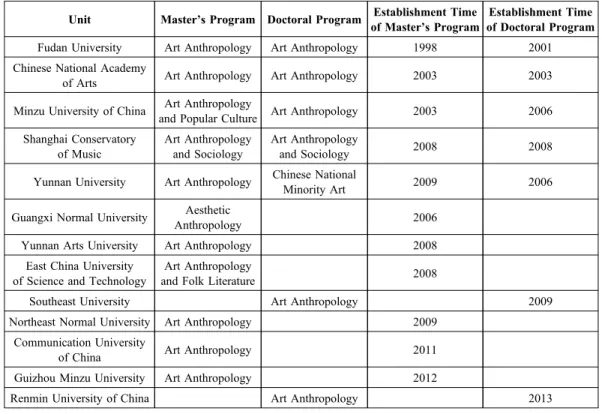
Concerning talent cultivation, since Zheng Yuanzhe from Fudan University set up the first master’s program of art anthropology in 1998, many universities and research institutions have set up related master’s and doctoral programs. After entering the new century, the research team of art anthropology keeps growing and the academic achievements have been magnificent. Thus, the discipline construction and talent cultivation of art anthropology have opened a new historical page. According to the author’s incomplete statistics, 14 universities or research institutes in mainland China recruit master’s and doctoral students related to art anthropology as shown in the Table 1.
Table 1 Academic Unit of Art Anthropology in Mainland China Unit Master’s Program Doctoral Program Establishment Time
of Master’s Program
Establishment Time of Doctoral Program
Fudan University Art Anthropology Art Anthropology 1998 2001 Chinese National Academy
of Arts Art Anthropology Art Anthropology 2003 2003 Minzu University of China and Popular CultureArt Anthropology Art Anthropology 2003 2006
Shanghai Conservatory of Music Art Anthropology and Sociology Art Anthropology and Sociology 2008 2008
Yunnan University Art Anthropology Chinese NationalMinority Art 2009 2006
Guangxi Normal University Aesthetic
Anthropology 2006
Yunnan Arts University Art Anthropology 2008 East China University
of Science and Technology
Art Anthropology
and Folk Literature 2008
Southeast University Art Anthropology 2009
Northeast Normal University Art Anthropology 2009 Communication University
of China Art Anthropology 2011
Guizhou Minzu University Art Anthropology 2012
These master’s and doctoral programs are distributed in the secondary disciplines such as art, ethnology, anthropology, Chinese minority art, theory of literature and art and music. Many disciplines are able to set up research direction of art anthropology, which also confirms the strong fusion ability of this discipline. Therefore, the interdisciplinary study of art is not just a slogan and appeal but a fact and a system. It has a profound and significant importance to Chinese humanities and social sciences in the 21st Century (Zheng, 2007). The fact that of late many universities or research institutes are recruiting master’s and doctoral students of art anthropology and opening related theoretical courses, not only provides talent guarantee for the Chinese art anthropology research but also promotes the discipline construction and research on art.
4.3 Points for Further Research
4.3.1 Urban Field Art
The research method of fieldwork is the foundation of Chinese art anthropology. The field in the anthropological context usually refers to the investigation and research of folk art. With the acceleration of China’s urbanization, the field is no longer limited to folk art in rural area but extended to modern art in city. The artist field in urban area becomes a new vision of art anthropology in China. Anthropology should not be limited to focus on marginal and vulnerable groups but pay attention to the mainstream society and to strengthening its’ application in order to obtain more room for development (Xu and Wang, 2006). Beijing’s 798 Art District, Songzhuang Art District, Shanghai’s Moganshan Art District, Shenzhen’s Dafen Oil Painting Village and so on have aroused wide attention of the international community. The emergence of these art areas shows that with the changing context of the times, art gathers in its’ unique way in urban area showing the unique charm of contemporary art. So what are the reasons for this cultural and artistic phenomenon? To answer this question, not only the perspective of art but also the angle of anthropology and in-depth urban field investigation are needed. Therefore, the future development of art anthropology should have a broader vision, covering not only folk and ethnic minority art but also urban modern art as well as the interaction and penetration between these different types. The future field investigation of art anthropology would not only happen in rural areas but also in urban areas and every corner with artist group because it should base on the overall human art (Fang and Li, 2013 : 310). For example, “Jingdezhen Folk Kiln and Ceramic Culture Complex Study” by Fang Lili, “The Comparative Study between Beijing 798 Art District and Songzhuang Art District”16) hosted by her as well as,
“Field Study of Shanghai City Music” by Luo Qin can be deemed as a model for this area (Luo
──────────────
16)“The Comparative Study between Beijing 798 Art District and Songzhuang Art District” was approved by the National Research Center of Contemporary Art of the Ministry of Culture in 2013.
et al., 2009 b).
4.3.2 Overseas Art Ethnography
With the rapid development of China’s economy and comprehensive national strength, foreign ethnic art research has become possible, which is the requirement of internationalization of art anthropology and the development in depth. Of course, in the past century, art research in China did not break this bottleneck through. Studies on art in the past were narrowly limited to “China”―national art, and art of Western, European and American countries, Islamic cultural circle, Indian and Buddhist cultural circle, Africa, Southeast Asia, Oceania and the rest of the world where many rich cultural and artistic resources were set aside. This was contrary to China’s position as a great socialist country with an open mind (Li, 1997 : 323). Therefore, it is an important academic aim for art anthropology in China to get rid of the inherent limitation in research, pay attention to the art of global ethnic groups, regions and cultural circles and extend the vision of art study to all over the world to promote the mutual understanding, communication and integration of the whole human art. Concerning the current situation in China, although a few scholars have gone abroad17)to engage in cross-border ethnic art research
and exotic art field study, however, there is no in scale and in-depth field study of the overseas art ethnography. Therefore, it is an important academic direction for the future development of art anthropology in China to go abroad for the study of the overseas art ethnography.
5. Conclusions
By analyzing the development course of art anthropology in China, this study finds that the pace of its’ development and expansion is amazing and the achievements are obvious to all. Since the new period, the study of art anthropology in China has entered into independent research from translation and introduction of foreign articles and then transferred from independent research into the construction of discipline system. It is a transformation process from the emerging state of research consciousness to the initial scale of discipline construction which was mainly brought by the expansion of discipline as well as the adjustment and perfection of academic paradigm and method due to the change of the academic thoughts and concepts. This is the natural process of maturity of the discipline (Luo et al., 2009 a). To sum up, the translation and introduction of western art anthropology articles and studies of primitive art made a good academic preparation for the development of art anthropology in China. In terms of research method, there is a change from the pure text research through finding
──────────────
17)For example, in Research Forum : Musical Cultures of Ethnic Groups Straddling the Border between China and its’ Neighbors hosted by Central Conservatory of Music, there are a number of series academic papers. The achievements also include the field investigation and research of Chinese opera in Malaysia and Singapore by Kang Hailing, the Study on Peking Opera factor in the facial makeups of KA Show of Canadian Cirque du Soleil by An Lizhe and so on.
archaeological and ethnographic literature as materials to the empirical study of vivid life materials through field investigation. The ethnographic text and the record of the fieldwork have also changed from the detailed description of the artistic form with the explanation of the social and cultural background to the detailed record of the whole activity process according to its’ temporal and spatial order (cultural performance) with substantial attention to the life experience of the art behavioral agent (Zhang, 2009 a). Regarding the discipline construction and talent cultivation, art anthropology writings of the localization theory and practice have emerged. Many universities and research institutions in China have opened art anthropology and enrolled master’s and doctoral students. For academic organization building, the establishment of China Association of Art Anthropology is a symbol for the conscious academic association of scholars while the founding of China Society for Anthropologies of Art is a milestone for the development of discipline construction. At this learning and dialogue platform with international vision, scholars have made significant improvement in research and theory. A large number of achievements in the research of localization art anthropology theory and field practice have emerged. Scholars have become more aware of the use of art anthropology method in art research. And, urban art fieldwork and overseas art ethnography will be the direction for future study.
Throughout more than 30 years development of art anthropology in China, a series of theoretical and field research achievements have been made but it is undeniable that the study of art anthropology in China is still in the initial stage of academic construction. There are still weaknesses in academic translation and introduction, deepening of fieldwork, discipline construction, talent cultivation and localization theory construction. Despite the achievements, some issues are worth mentioning. The following points are raised for further discussion : Firstly, the translation and introduction of academic classics still need to be strengthened. Art anthropology has a history of more than one hundred years in the West so that there are a huge number of academic research groups. The translation and introduction of western art anthropology works have played a pivotal role in the establishment of art anthropology in China. Although there have been translated publications of books such as Evolution in Art : As
Illustrated by the Life-histories of Designs by Alfred C. Haddon (2010), The Andaman Islanders by Alfred Radcliffe-Brown (2005) and The Traffic in Culture : Refiguring Art and Anthropology edited by George E. Marcus and Fred R. Myers (2010), there are still some
classic western books on art anthropology pending to be translated such as Art as Culture : An
Introduction to the Anthropology of Art by Evelyn Payne Hatcher, Art and Agency : An Anthropological Theory by Alfred Gell, The Anthropology of Art : A Reader edited by Howard
Culture : Lectures on Art Anthropology by the Japanese scholar Nakajima and The Anthropology of Art by Shinichi Nakazawa. Therefore, more attention need be paid to
translation and introduction of art anthropology articles.
Secondly, the depth and breadth of fieldwork need to be further extended. Fieldwork is the foundation of art anthropology research in China. The depth and breadth of field ethnography determine the longitudinal development depth of the discipline. In recent years, a large number of case studies of art anthropology from the field emerged in China. Each annual meeting witnessed nearly a hundred papers in this topic. In terms of depth, they are only field study skimming the surface, focusing on the enumeration of cases and figures and lacking depth. It is difficult to obtain a clear understanding and convincing result. In-depth field research with long-term participation and observation is still rare. In long-terms of breadth, its’ horizon needs to be expanded to the ethnic minority communities instead of the Han society alone as well as to modern urban area instead of rural area alone. In addition, it is an urgent need to study cultural and social changes and various new artistic practices in the contemporary China, selection and protection of artistic tangible and intangible cultural heritage, a variety of regional, ethnic minorities, the public and cross-border mobile artistic interaction and exchange, artistic creation in support of national identity and so on through detailed fieldwork by art anthropologists― only through which the development can meet the pace of art anthropology in China.
Finally, discipline construction and talent cultivation need to be strengthened further. Art anthropology in China has enjoyed a development of more than 30 years while higher-level talent cultivation above master’s level has a history of more than 10 years. Publications like
China Anthropology of Art : A Reader by Zhouxing and Anthropology of Art by Fang Lili and
Li Xiujian can be used as basic reading and teaching materials of art anthropology. Regardless of these, there is still no theoretical work to support the discipline and high-quality teaching material compared with the speed of discipline construction and talent cultivation. Therefore, there is an urgent need for teaching materials of art anthropology complied by related scholars in China (in the anthropology and art circle) to satisfy teachings at different levels. Books of localization theory and experience of art anthropology also have to be supplemented.
In the future study of art anthropology, we need to make more efforts in the academic research and discipline construction, do more fieldworks with in-depth theory and wide vision, make more achievements and strive to enhance the academic state of art anthropology. We also need to improve the quality of high-level talent cultivation and consolidate the foundation of art anthropology. Last but not least, we need to realize both the achievements and hardship of its’ development as well.
Acknowledgement
This study is the stage achievement of “Theoretical Trends and Field Methods of Art Anthropology in China” (13 DA 01) financed by the Culture, Art and Sciences Research Fund of the Ministry of Culture, China.
References
Boas, Franz. 1989. Primitive Art. Hui Jin (trans). Shanghai Literature and Art Publishing Group.
de Zepetnek, Steven T. 1999. Legitimizing the Study of Literature. Ruiqi Ma (trans). Peking University Press. Fang, Lili and Xiujian Li. 2013. Anthropology of Art. Joint Publishing.
Fang, Lili, 2002 a. Jingdezhen Folk Kiln. People’s Fine Arts Publishing House.
Fang, Lili. 2000 b. Tradition and Change : Field Study of Old and New Folk Kiln in Jingdezhen. Jiangxi People’s Publishing House.
Fitzgerald, Michael C. 2010. Making Modernism : Picasso and The Creation of The Market for Twentieth Century Art. Fan Ran (trans). Guangxi Normal University Press.
Frazer, James G. 1987. The Golden Bough. Yuxin Xu et al. (trans). China Folk Art Publishing House.
Fu, Jin. 2001. Strength of Grass Roots : Field Investigation and Research of Theatrical Troupe of Taizhou. Guangxi People’s Publishing House.
Geertz, Clifford. 2004. Local Knowledge : Further Essays in Interpretive Anthropology. Longhai Wang and Jiaxuan Zhang (trans). Central Compilation & Translation Press.
Grosse, Ernst. 1984. The Beginnings of Art. Muhui Cai (trans). The Commercial Press.
Haddon, Alfred C. 2010. Evolution in Art : As Illustrated by the Life-histories of Designs. Aga Zuoshi (trans). Guangxi Normal University Press.
Hong, Ying. 2006. “A Review of Chinese Art Anthropology.” Academics 6.
Jiang, Deshun. 2009. “Characteristics of the Translation and Introduction of Anthropological Ethnology in the New Period (II).” In China Ethnic News (6thed.).
Layton, Robert. 1990. The Anthropology of Art. Jin Dacheng et al. (trans). Culture and Art Publishing. Levi-Strauss, Claude. 1987. The Savage Mind. Youzheng Li (trans). The Commercial Press.
Levi-Strauss, Claude. 1992. The Way of the Masks. Zhi Han trans. Shanghai Literature and Art Publishing Group. Li, Xinfeng ed. 1997. New Horizon of Foreign Modern Art Theory. Guangxi Education Publishing House.
Luo, Qin et al. 2009 a. “Reflections and Blueprints : Chinese Practice and Experience of Ethnomusicology (I).” The Art
of Music (Journal of the Shanghai Conservatory of Music) 1.
Luo, Qin et al. 2009 b. “Reflections and Blueprints : Chinese Practice and Experience of Ethnomusicology (II).” The
Art of Music (Journal of the Shanghai Conservatory of Music) 2.
Ma, Shengde and Yali Cao. 2005. Dance of People and God : Investigation and Research of the Qinghai Religious
Sacrificial Dance. Culture and Art Publishing House.
Marcus, George E. and Fred R. Myers ed. 2010. The Traffic in Culture : Refiguring Art and Anthropology. Aga Zuoshi and Yongjia Liang (trans). Guangxi Normal University Press.
Muhammad, Aidiya. 2006. Mexrep in the View of An Anthropologist. The Ethnic Publishing House.
Qiao, Jian ; Guanwen Liu and Tiansheng Li. 1999. Yuehu : Field Investigation and Historical Track. Jiangxi People’s Publishing House.
Qin, Deqing ed. 2005 b. Harmony of Heaven and Human and Reconstruction of Humanity : Aesthetic Anthropology
Study of Cultural Connotation and Social Development in Lijiang River. Guangxi Normal University Press.
Radcliffe-Brown, Alfred. 2005. The Andaman Islanders. Yue Liang (trans). Guangxi Normal University Press. Rong, Shicheng. 2003. Drama Anthropology Study : Ritual, Theatre and Community. Guangxi Normal University
Press.
Wang, Jianmin. 2008. New Theory of Art Anthropology. The Ethnic Publishing House.
Wang, Jie ed. 2004 b. The Consciousness of Searching for Mother : Aesthetic Anthropology Investigation of Nanning
International Folk Songs Festival. Guangxi Normal University Press.
Wang, Jie. 2002 a. Aesthetic Illusions and Aesthetic Anthropology. Guangxi Normal University Press. Wang, Shenghua and Bian Jia. 2010. Art Anthropology Series. Yunnan University Press.
Wang, Yongjian and Dacheng Jin. 2017. “Into the Anthropology of Art & Discussion of Academic Trends of Thoughts of 1980s : Interview Record of Jin Dacheng.” Journal of Guizhou University (Art Edition) 1.
Xiang, Yang. 2001. Study of Yuehu of Feudal China in Shanxi. Cultural Relics Press.
Xu, Jieshun and Qingren Wang. 2006. “Anthropology and Chinese Studies : An Interview with Anthropologists (41).”
Journal of Guangxi University for Nationalities (Philosophy and Social Science Edition) 5.
Yin, Ming. 2000. “Art Anthropology in China : Localization and Modernity.” National Arts Biomonthly 1.
Zhang, Shishan. 2006. Cultural Interpretation of Rural Folk Art : Investigation of Luzhongsi Village. Shandong People’s Publishing House.
Zhang, Xiaogang. 2009 a. Interdisciplinary Research : Art Theory of China in the 20thCentury. Xuelin Press.
Zhang, Xiaogang. 2010 a. “Study and Dimension of Art Phylogeny”, P. 211 in Art Anthropology in the 20thCentury in
China : From Academic Enlightenment, Method Practice to Interdisciplinary Integration (Vol.5-1). Xuelin Press.
Zheng, Yuanzhe. 2007. “Art Anthropology in China : History, Ideology, Fact and Method.” Journal of Hangzhou
Normal University (Social Sciences Edition) 6.
Zhou, Xing ed. 2011. China Anthropology of Art : A Basic Reader. Xueyuan Press.
Zhou, Xing. 2009 a. “Anthropology of Art and Its Possibility in China.” Journal of Guangxi University for Nationalities
(Philosophy and Social Science Edition) 1.