
トップページ - 横浜国立大学学術情報リポジトリ
89
0
0
全文
(2) I. by the following peoples. to whom I wish to express my hearty thanks: Dr . K . BABA. Dr . T. FUJIKAWA. Dr . I . FUJIYAMA. Dr . T. HABE.Miss Y . HANAOKA (the present name: Mrs. Y . IMADA).Dr . G. IMADATE. Dr . K . ISHIKAWA. Dr . K . KANEKO.Dr . R . KANO. Dr . Y . KITAZAWA.Miss S. KOMIYA(the present name: S. AOKI). Dr . J . KUGOH.Dr . Y . KUROSAWA. Dr . K . MORIKAWA. MI . S. NAKATAMARI. MI . J . OHNISHI. MI . K . OKUDA.Dr . H . OKUYAMA. MI . M . SHIBA.MI . T. TAKAHASHI. MI . M . TSURUHARA. Dr . S . UENOand . My gratitude is also indebted to Dr . T. FUJIKAWA Dr . T . YAMAZAKI for her translation of the descriptions written in Russian language. and to Mr . Y . YAMAMOTO,Mr . K . SUZUKIand Mr . N . OHKUBO for their copying of several important paper which I the assistant in our laboratory. protected me from a did not have . Mr . H . HARADA. great deal of miscellaneous buisinesses; without his help. the present work would not be able to appear .. List of Species Described Family Phthiracaride PERTY.1841 .................................................................. 7 Genus Phthiracarus PERTY.1839 .................................................................. 9 Ph . japonicus AOKI. 1958 ........................................................................ 10 Ph . clemens AOKI. 1963 .......................................................................... 12 Ph . clemens clemens AOKI. 1963 ............................................................ 13 Ph . clemens k~ushuensissubsp. n .......................................................... 16 Genus Paraphthiracarus gen . n ................................................................... 16 P . lanatus (FEIDERe t SUCIU.1957) ............................................................ 17 P . australis s p. n ..................................................................................... 19 P. gibber sp. n ........................................................................................ 21 Genus Metaphthiracarus gen. n ................................................................... 23 M . bacillatus sp..................................................................................... 23 Genus Calyptophthiracarus gen. n ............................................................. 25 C. mitratus s p. n..................................................................................... 26 Genus Neophthiracarus BALOGHe t CSISZ~R. 1963 .......................................... 28 N . cornasus s p. n ..................................................................................... 28 Genus Hoplophthiracarus JACOT.1933 ......................................................... 30 H . pawidus (BERLESE.1913) ..................................................................... 31 H . kugohi AOKI. 1959 .............................................................................. 33 H . ishikawai sp. n .................................................................................. 36 H . foweolatus sp. n .................................................................................. 38 Genus Hoplophorella BERLESE.1923 ............................................................ 40 H . cucullata (EWING.1909) ........................................................................ 40 H . jloridae JACOT.1933 ........................................................................... 42 H . spiniger s p. n ..................................................................................... 44 H . cristata sp. n ..................................................................................... 46 Genus Atropacarus EWING.1917 .................................................................. 48.
(3) A. striculus (C. L. KOCH,1836) ............... ... ......... ......... ......... .................. A. striculus (C. L. KOCH,1836) var. clavatus var. n. .............................. Family Oribotritiidae GRANDJEAN, 1954 ............ ......... ............ ... ......... ... ......... Genus Oribotritia JACOT,1925 ........................... ......... .......................,...... ... 0. fennica FORSSLUND e t MARKEL,1963 ................................................... 0. tokukoae AOKI, 1973 ............... ..... . ... . . . . .. . .. .. . ... . .. . .. .. . . . . . .. . .. ... .. . .. . . . . .. . ... 0. chichijimensis sp. n. ..... . ... . .. ... .. . .. . . .. ... ... .. . . . . . .. . .. ... .. . .. . . .. . .. . .. ... .. . . . . . . . . .. Genus Indotritia JACOT,1929 . .. .. . ... . .. ........ . .. . . .. . .. .. . .. . . .. . .. ... .. . .. . . .. . .. . .. . .. ... .. . I. javensis (SELLNICK, 1923) ... . .. ... .. . . .. . .. .. . .. . . .. . .. .. . . . . . .. . .. ... .. . . . . . .. . .. . .. . .. ... ... Genus Austrotritia SELLNICK, 1959 ... ...... ... ... ... ...... . .. . .. ... ... .. . . .. .. . .. . .. . .. . .. . ...... A. unicarinata sp. n. ... ... . .. ........ . .. . . .. ... .. . . . . . .. ..... . . . . . .. . .. .. . .. . ... . .. . .. ... ......... A. ishigakiensis sp. n. ...... ......... ...... ............ ......... ...... ...... ........ . ...... ......... A. dentata sp. n. ............ ......... ... .... ..... ...... ......... ... ...... ...... ... .. . ... ... ... ....... Genus Mesotritia FORSSLUND in FORSSLUND e t MARKEL,1963 ........................ M. spinosa sp. n. ............ ...... . .. . ..... ... ... ... ......... ... ... ............ ..................... M. okuyamai sp. n. ...... ...... ...... ...... . . . . . . . ..... .. . . .. .. . . . . ... . .. ...... . .. . . ..... .. . .. ... ... Genus Maerkelotritia HAMMER, 1967 . . . . . . . . . . . . . . . . . . . . . . . . . . . . . . . . . . . . . . . ......... . . . . . . . . , . . . M. kishidai (AOKI, 1958) .. . .. .. . . . . . . . . . . . . . . . . . . . . . . . . . . . . . . . . .. .. . . . . . . . . . . . . . . . . . . . . . . . .....,... Genus Protoribotritia JACOT,1938 ... ... ... ......... ...... ......... ........................ ...... P. ensifer AOKI, 1969 ... .... .. . .. . . .. .. . .. ...... ...................-....................... . . . .. . ... Explanation of the Code Numbers (JA-numbers) for Collecting Data JA9 : North side of Ustukushigahara, Nagano-ken, C. Japan, 16-X-1956, J. AOKI,from litter under a conifer forest. JA28: Kogesawa of Mt. Takao, Hachioji-shi, Tokyo, C. Japan, 29-IV-1957, J. AOKI, from litter. JA29: The same as above. JA40 : Near the top of Mt. Shirouma-Yari, Nagano-ken, C. Japan, 17-VIII-1957, J. AOKI, from moss and litter under Pinus purnila. JA46 : Karenuma in Nikko, Tochigi-ken, C. Japan, 22-X-1957, J. AOKI, from litter under a conifer forest. JA51: Kosaka-machi and Ogiwara-cho in Masuda-gun, Gifu-ken, C. Japan, 12-XI-1957, R. KANO(J. AOKI),from litter. JA63 : Iwakiri, Miyazaki-ken, S. Japan, 6-11-1958, J. KUGOH(J. AOKI),from moss and litter layer. JA106: Yumoto in Nikko, Tochigi-ken, C. Japan, 6-VI-1958, K. :KANEKO(J. AOKI), from litter. JA107: Otashirogahara in Nikko, Tochigi-ken, C. Japan, 6-VI-1958, K. KANEKO(J. AOKI),from litter. JA140: West side of Mt. Taro, Nikko, Tochigi-ken, 11-X-1958, J. AOKI,from moss. JA142 : Kotoku in Nikko, Tochigi-ken, 13-X-1958, J. AOKI,from moss..
(4) I I. JA143 : Yudaki Fall in Nikko, Tochigi-ken, C. Japan, 17-X-1958, R. KANO,from litter. JA152 : Mihama-cho, Minami-muro-gun, Mie-ken, C. Japan, 8-1-1959, J. KUGOH(J. AOKI), from litter. JA154 : Kotoku in Nikko, Tochigi-ken, 1-IV-1959, J. AOKI, from litter. JA191 : Aushirui-gawa, Nemuro-shicho, Hokkaido, N. Japan, 15-VI-1959, K. KANEKO (J. AOKI). JA464-8: T h e Imperial Palace in Tokyo, C. Japan, 21-IV-1963, J. AOKI, from litter. JA575 : Asama-Bokujo in Karuizawa, Gumma-ken, C. Japan, 29-VIII-1965, J. AOKI. JA582: Mt. Izugatake in Chichibu, Saitama-ken, C. Japan, 5-IX-1965, J. AOKI, from litter. JA591-592 : Soma-san of Mt. Haruna, Gumma-ken, C. Japan, 10-XI-1965, J. AOKI,from a rotten wood. JA594 : Soma-san of Mt. Haruna, Gumma-ken, C. Japan, 9-XI-1965, J. AOKI,from fallen cones of AZnus hirsuta var. sibirica. JA595: Soma-san of Mt. Haruna, Gumma-ken, C. Japan, 9-XI-1965, J. AOKI, from fresh fallen leaves. IA595 : Soma-san of Mt. Haruna, Gumma-ken, C. Japan, 9-XI-1965, J. AOKI,from fresh fallen leaves. JA597: Soma-san of Mt. Haruna, Gumma-ken, C. Japan, 9-XI-1965, J. AOKI, from fermentation layer of soil. JA606: Otashirogahara in Nikko, Tochigi-ken, C. Japan, 6-VIII-1961, J. AOKI, from surface layer (0-5 cm) of grassland soil. JA610: Kotoku in Nikko, Tochigi-ken, C. Iapan, 7-VIII-1961, J. AOKI, from surface layer (0-5 cm) of soil under Quercus mongolica var. grosseserrata forest. JA772 : Kusatsu, Gumma-ken, C. Japan, 17-VIII-1967, J. AOKI,from litter of deciduous trees. JA792: Top of Mt. Higashitate, Shiga-kogen, Nagano-ken, C. Japan, 23-X-1967, J. AOKI, from litter under a conifer forest. JA970 : Ebijima Island, N of Tsushima, Nagasaki-ken, W. Japan, 25-VIII-1968, I. FUJIYAMA (J. AOKI),from surface layer of soil under a beach forest. JA973 : Ohmasu in Kami-tsushima-cho, Tsushima Is., W. Japan, 16-X-1968, J. AOKI, from litter. JA975: NE of Ohmasu in Kami-tsushima-cho, Tsushima Is., W. Japan, 16-X-1968, J. AOKI, from litter. JA984 : Mt. Mitake, Kamiagata-cho, Tsushima Is., W. Japan, 18-X-1968, J. AOKI,from moss. JA992: Mt. Ohkora in Gaya, Shimoagata-gun, Tsushima Is., W. Japan, 22-X-1968, J. AOKI, from litter under a mixed forest. JA993: Mt. Mokkoku in Tsutsu, Tsushima Is., W. Japan, 23-X-1968, J. AOKI, from litter under a laurel forest. JA1071: Sasuna in Kamiagata-cho, Tsushima Is., W. Japan, 1-VIII-1968, T . YAMAZAKI (J. AOKI), from moss growing near a stream..
(5) JA1090 : Sunosaki in Tateyama-shi, Chiba-ken, C. Japan, 17-XI-1968, S. KOMIYA,from surface layer of grassland soil. JA1107 : Hirayu in Kamitakara-mura, Gifu-ken, C. Japan, 22-VII-1967, K. KUROSA(J. AOKI), from a nest of the ant, Lasius niger. JA1131 : Shiori Pass, Kita-uonuma-gun, Niigata-ken, C. Japan, 10-X-1965, K. BABA, from litter. JA1171: Mt. Takamori in Tobishima Island, northern Japan, 25-VI-1969, Y. KUROSAWA (J. AOKI), from organic layer of soil under a shrine forest. JA1191 : Near Fuji-fuketsu Cave, west side of Mt. Fuji, Yamanashi-ken, C. Japan, 6IX-1969, S. UENO(J. AOKI),from moss and litter under a forest of Abies veitchii and Tsuga diverszyolia. JA1208: Mt. Daisen, Tottori-ken, western Japan, 14-X-1968, M. SHIBA,from litter. (J. AOKI), JA1245 : Amagi Pass in Izu, Shizuoka-ken, C. Japan, 21-IV-1970, Y. HANAOKA from litter. JA1292 : Aokigahara, Mt. Fuji, Yamanashi-ken, C. Japan, 22-VI-1970, J. AOKI, from surface layer (0-5 cm) of forest soil. JA1325 : Sphagnum moor of Tanohara in Shiga Heights, Nagano-ken, C. Japan, 21V-1970, J. AOKI, from plant detritus in water. JA1364 : Top of Mt. Poroshiri, Hidaka, Hokkaido, N. Japan, 26-VII-1971, J. AOKI,from litter of Pinus pumila. JA1365 : Kita Cirque of Mt. Poroshiri, Hidaka, Hokkaido, 25-VII-1971, J. AOKI, from litter of Pinus pumila and Sasa. JA1366 : Nanatsu-numa of Mt. Poroshiri, Hidaka, Hokkaido, N. Japan, 26-VII-1971, J. AOKI, from litter of Pinus pumila. JA1368: Poroshiri-sanso a t the foot of Mt. Poroshiri, Hidaka, Hokkaido, N. Japan, 30-VIII-1971, J. AOKI, from forest litter. JA1370 : Kurokawa-mura, Niigata-ken, C. Japan, 28-VII-1965, K. BABA,from litter. JA1387 : Mt. Daisen, Tottori-ken, western Japan, 28-IX-1969, K. KUROSAWA, from litter under a rotten wood. JA1524 : Sumiyoshi, Iriomote Island, S. Japan, 30-XI-1972, J. AOKI (S. NAKATAMARI), from litter of Casuarina litorea. JA1551 : Yoon, Ishigaki Island, S. Japan, 6-XII-1972, J. AOKI, from litter. JA1632 : Otanomosu-no-taira, Shiga Heights, Nagano-ken, C. Japan, 30-VII-1971, J. AOKI, from litter under a forest of Abies mariesii and Tsuga diversifolia. JA1647 : Sengen Shrine-Nakanochaya, Mt. Fuji, C. Japan, 28-V-1974, J. AOKI, from surface soil (0-5 cm) under Pinus thunbergii forest. JA1689: Nagamine Sunny Park, Yaku Island, S. Japan, 11-XI-1974, J. AOKI, from litter of a laurel forest. JA1693 : Mt. Okina-dake, Yaku Island, S. Japan, 13-XI-1974, J. AOKI, from litter of Miscanthus, Sasa and Rhododendron. JA1710 : Anboh, Yaku Island, S. Japan, 15-XI-1974, J. AOKI,from litter under a coastal forest.. ? ..
(6) I. large Ficus microcarpa tree. JA2022 : Near Choei-so, Kitazawa Pass, Yamanashi-ken, C. Japan, 6-VI-1975, J. AOKI, from litter. JA2115 : Meiji-jingu Shrine, Tokyo, C. Japan, 1-XI-1975, J. AOKI,from forest litter. JA2120 : Fukiage-gyoen, Tokyo, C. Japan, 21-V-1975, Prince MASAHITO (G. IMADAT~), from litter of Cyclobalanopsis. JA2121: The same as above. JA2180 : Otanomosu-no-taira, Shiga Heights, Nagano-ken, C. Japan, 20-X-1967, M. SHIBA, from forest litter. JA2190: Kurokawa-mura, Niigata-ken, C. Japan, 5-11-1973, K. BABA,from litter. JA2192 : Tanbara-cho, Shuso-gun, Ehime-ken, SW. Japan, 13-IV-1968, K. OKUDA. JA2195 : Near Poroshiri-sanso a t the foot of Mt. Poroshiri, Hidaka, Hokkaido, N. Japan, 27-VII-1971, J. AOKI,from forest litter. JA2196 : Kita Cirque of Mt. Poroshiri, Hidaka, Hokkaido, N. Japan, 26-VII-1971, J. AOKI,from forest litter. JA2216 : Tsuchigoya, Mt. Ishizuchi, Ehime-ken, SW. Japan, 6-VIII-1969, K. MORIKAWA, from litter of Abies hornolepis. JA2217: Below Tsuchigoya, Mt. Ishizuchi, Ehime-ken, SW. Japan, 6-VIII-1969, K. MORIKAWA, from litter of Fagus crenata. JA2219 : Panorama-dai, Mt. Ishizuchi, Ehime-ken, SW. Japan, 6-VIII-1969, K. MORIKAWA, from litter of Sciadopitys verticillata and Rhododendron keiskei. JA2221 : Mt. Omogo, Ehime-ken, SW. Japan, 7-VIII-1969, K. MORIKAWA, from litter of Fagus crenata. JA2226 : Mt. Tengu-dake near Mt. Ishizuchi, Ehime-ken, SW. Japan, 8-VIII-1969, K. MORIKAWA, from litter and moss under a forest of Abies veitchii. JA2227 : Ninokusari-Sannokusari of Mt. Ishizuchi, Ehime-ken, S.W. Japan, 8-VIIIfrom litter of Ahies veichii and Sasa. 1969, K. MORIKAWA, JA2230 : Joju-sha, Mt. Ishizuchi, Ehime-ken, SW. Japan, 9-VIII-1969, K. MORIKAWA from litter of Fagus crenata and Sasa. JA2235: Kotoku of Nikko, Tochigi-ken, 15-VII-1976, J. AOKI, H. HARADA, I. OSHIO and Y. NOGUCHI, from a lichen. JA2236: The same as above, but from fallen cones. JA2237: The same as above, but from fallen twigs. JA2238: The same as above, but from moss growing on the ground. JA2239: The same as above, but from moss growing on rotten woods. JA2240: The same as above, but from soil under a rotten wood. JA2241: The same as above, but from fresh fallen leaves. JA2243: The same as above, but from a fungus. JA2244 : The same as above, but from surface layer (0-5 cm) of soil. JA2290 : Sarobetsu, Hokkaido, N. Japan, 14-VII-1966, T. FUJIKAWA. JA2291 : Shonai-no-genya, Sarobetsu, Hokkaido, N. Japan, 13-VII-1966, T. FUJIKAWA.
(7) JA2293 : Miyake Island, C. Japan, 30-IV-1977, T. TAKAHASHI. JA2294: Top of Mt. Yu, Miyake Island, C. Japan, 1-V-1977, T. TAKAHASI-11. Family PHTHIRACARIDAE PERTY,1841 [Irekodani Ka] Diagnosis. (1) Body armadillo-like. (2) Genital and anal apertures wide, being contiguous without ventral plate around them. Elementary chaetotaxy. ntg : (10 10) (22 + 22); g : (4 4) (10 + 10); an : (1+ 1) (4 $4); ad : (1 l), (3 3)- (5 +5). Monodactyle. Distribution. Cosmopolitic. Remarks. RAMSAY(1966) created the genus Notophthiracarus, which is closely related to the genus Hoplophthiracarus, but is distinguishable from the latter by the reduction of two posterior pairs of adanal setae (adl and ad,). However, this condition has well been known also in the genus Phthiracarus. For examples, Phthiracarus laevigatus (C. L. KOCH,1841), Ph. piger (SCOPOLI,1763), Ph. italicus (OUDEMANS, 1906), Ph. lentulus (C. L. KOCH,1841) and many other species have vestigial adanal setae, adl and ad,. Of course, we know many species with complete 3 pairs of adanal setae, too, such as Ph. ~nontanusP~REZ-IRIGO, 1969, Pfz. lanatus FEIDERe t S u c ~ u ,1957, Ph. anoymum GRANDJEAN, 1933, etc. On the assumption that RAMSAY'S (1966) separation of his genus Notophthiracarus from Hoplophthiracarus is reasonable and "the reduction of adanal setae" is considered an important character of generic rank, the large genus Phthiracarus may be divided into two groups almost of equal size. Be,cause the type species, Ph. laevigatus (C. L. KOCH,1841), shows the reduction of adanal setae, a new genus Paraphthiracarus is established here for the members with complete 3 pairs of adanal setae.. -. +. +. +. -. +. -. Table 1. A new classification of the family Phthiracaridae. Comparison between the former and the new arrangements of the genera included.. I Neophthiracarus. Neophthiracarus insignis Neophthiracarus shiptoni. -. Neophthiracarus neotrichus Protophthiracarus chilensis. -. Protophthiracarus I. Metaphthiracarus I. Phthiracarus Parapht hiracarus. I. Phthiracarus -. --. -. --. -. -. - --. I. -. Hoplophthiracarus. -. -. -. Hoplophthiracarus. 1 Atropacarus -. - -. Steganacarus. -. -.
(8) BALOGH & C S I S Z ~(1963) R found an interesting species which had neotrichies on notogaster as well as on ano-adanal plates and created for it the genus Neophthiracarus (the type species: N. insignis). Later, the second and the third members were added to the genus, N. shiptoni SHEALS e t MACFARLANE, 1966 and N. neotrichus WALLWORK, 1966, both of which have 6 parirs of ano-adanal setae, while the type species has 9 pairs. In 1967, BALOGH & MAHUNKA created another genus Notophthiracarus. But, this generic name has been preoccupied by Notophthiracarus RAMSAY, 1966 and BALOGH (1972) proposed a new name Protophthiracarus for their Notophthiracarus. According to BALOGH & MAHUNKA (1967), main difference separating Protophthiracarus (= Notophthiracarus BALOGHe t MAHUNKA, nec RAMSAY) from Neophthiracarus is less number of adanal setae (6-7 pairs compared with 9 pairs of Neophthiracarus). However, the other species with 6 pairs of adanal setae, such as shiptoni and neotrichus, were placed in the genus Neophthiracarus by their authors. This treatment seems to be reasonable, because difference in "the number" of neotrichial setae is generally not so important. The difference to justify the establishment of the genus Protophthiracarus is rather in that it has erect interlamellar setae. Thus, one among the three species of Neophthiracarus, N. neotrichus WALLWORK, 1966, should be placed in the genus Protophthiracarus, because N. neotrichus has erect and thick interlamellar setae. These two genera show neotrichy both in ano-adanal region and on notogaster. But, a species'found from Japan shows neotrichy only on notogaster. Though the treatment of such a species is a difficult problem, a new genus Metaphthiracarus is proposed here provisionally. The classification and arrangement of the genera in the family Phthiracaridae are newly summarized in Table 1. Key to the genera of the family Phthiracaridae (*genus unknown from Japan) 1. Neotrichy present ..........................................................................................2 Neotrichy absent ............................................................................................. 5. 2. Neotrichy both on notogaster and ano-adanal region ....................................... 3 - Neotrichy only on notogaster ........................................................................ 4 3. Interlamellar setae erect and distinctly longer or thicker than lemellar setae ................................................... *Protophthiracarus BALOGHe t MAHUNKA, 1967 - Interlamellar setae decumbent and not so different in shape from lamellar setae ............................................................Neophthiracarus BALOGHe t CSISZAR,1963 4. Interlamellar setae erect; notogaster with anterior hood.. .Calyptophthiracarus ged. n. - Interlamellar setae decumbent; notogaster without anterior hood ..................... ................................................................................... .Metaphthiracarus gen. n. 5. Interlamellar setae erect and distinctly longer or thicker than lamellar setae ... 6 - Interlamellar setae decumbent and not so different in shape from lamellar setae.. . 7. 6. Two posterior pairs of adanal setae reduced, very minute or only their insertion pores visible. ..................................................... *Notophthiracarus RAMSAY, 1966 - Two posterior pairs of adanal setae not reduced, 3 pairs of adanal setae well.
(9) developed ............................................................ Hoplophthiracarus JACOT,1933 7. Two pairs of anal setae .................................................................................8 - Three pairs of anal setae; 2 pairs of adanal setae ...Hoplophorella BERLESE, 1923 - Four pairs of anal setae; 1 pair of adanal setae ........................................ 9. 8. Two posterior pairs of adanal setae reduced, very minute or only their setal pores visible .............................................................. .Phthiracarus PERTY,1841 - Two posterior pairs of adanal setae not reduced, 3 pairs of adanal setae being well developed .............................................................. Paraphthiracarus gen. n. 9. More than 15 pairs of notogastral setae ........................ Atropacarus EWING,1917 - Less than 16 pairs of notogastral setae ...........................................................10 10. Dorsal ridge present on notogaster .................................Tropacarus EWING,1917 - Dorsal ridge absent on notogaster ..............................Steganacarus EWING, 1917 Genus Phthiracarus PERTY,1839 [Irekodani Zoku] PERTY, 1839, column 847; 1841, p. 874; V A N ZACHVATKINA et al., 1975, p. 369; AOKI,1977, p. 185.. Phthiracarus. DER. HAMMEN, 1959, p. 47; BULANOVA-. Diagnosis. (1) Ano-adanal plates with 5 pairs of setae, 2 anal and 3 adanal, including vestigials. (2) Two posterior pairs of adanal setae (adl and ad2) reduced, very minute or vestigial. (3) Body surface nearly smooth, only finely punctured. (4) Interlamellar setae decumbent and not so different in shape from lamellar setae. (5) Notogastral chaetotaxy unideficient. Elementary chaetotaxy. ntg: (15+ 15); g: (7 +7) (9 + 9); ag: (0 +0) or (1+ 1); an: (2 2); ad: (1 1). Monodactyle. Type-species. Hoplophora laevigata C. L. KOCH,1841. Distribution. Cosmopolitan. Remarks. By the establishment of a new genus Paraphthiracarus a number of members of the genus Phthiracarus should be removed from this genus. At least, the following. +. -. +. species are retained in the genus Phthiracarus s. str., showing vestigial ad1 and adz: Phthiracaruspiger (SCOPOLI, 1763); Ph. crenophilus WILLMANN, 1951; Ph. italicus (OUDEMANS, 1900); Ph. lentulus (C. K. KOCH,1841); Ph. dubinini FEIDERe t SUCIU,1958; Ph. nitens. (NICOLET, 1855); Ph. pallidus FEIDERe t S u c ~ u ,1958; Ph. jacoti FEIDERe t SUCIU,1958; Ph. globosus (C. L. KOCH,1841) and Ph. sellnicki FEIDER e t SUCIU,1957. Only 2 species, Ph. japonicus and Ph. clemens, have hitherto been recorded from Japan. These species are widely distributed in the mainlands of Japan except Hokkaido. Key to the Japanese species of the genus Phthiracarus. 1. Sensillus broadly lanceolate, resembling in shape "a flame of candle" ............... ........................................................................ Ph. japonicus AOKI,1958 - Sensillus narrowly lanceolete, resembling "a slender knife" ...Ph. clemens AOKI,1963.
(10) Phthiracarus japonicus AOKI, 1958 [Yamato-irekodani] (Fig. 1) Phthiracarus japonicus AOKI,1958, p. 171, fig. 1; 1965, p. 229, figs. 13 12D-E; 1977, p. 185, fig. 6; BULANOVA-ZACHVATKINA et aL., 1975, p. 368. Phthiracarus anonymum: FEIDER et Suc~u,1957, p. 24, pl. 1, figs. 1-7. Diagnosis. (1) Sensillus short, the widest part of sensillar head occurs a little distally of the mid-distance along its length and tip of sensillus not sharply pointed. (2) Anterior notogastral setae (cl and c2) well separated from the posterior margin of collor. (3) Notogastral setae often winding near base. Measurement. Notogaster (L) 370 (551) 690 p, notogaster (H) 258 (403) 500 p, aspis (L) 210 (295) 345 p, notogastral setae 50-105 p. Elementary c h a e t o t a ~ ~ntg: . (15 + 15); g: (9+ 9); ag: (1+ 1); an: (2 2); ad: (3 3). Monodactyle. Description. ASPIS: Lateral carina weak and fine, never reaching lateral margin of aspis. Lateral rim complete, progressively attenuating toward the anterior direction. Median ridge absent. Four pairs of prodorsal setae all thin and fine, their relative length : il>le>ro+ex; il and le lying close to the surface of aspis; these setae are weakly winding. Sensillus short, resembling in shape "a flame of candle", but the tip is not sharply pointed; its widest part occurs a little distally of the mid-distance along the length. Opening of bothridium in lateral view covered in its posterodorsal half.NOTOGASTER : Dorsal side rather strongly arched, the ratio lengthlheight of notogaster being 1.28-1.43 (average 1.36). Surface nearly smooth, very finely and densely punctured. Fifteen pairs of notogastral setae thin and fine, their RLN being 10-17.5, mostly weakly winding on the portion near their insertions; setae cl and c, inserted behind the collor of notogaster, being well separated from its posterior margin; seta c3 inserted usually on this margin. Positions of vestigial setae (fi and f,) and lyrifissures (ia, im and ip) as shown in Fig. 1.-GENITO-ANAL REGION: Genital setae arranged in 2 longitudinal rows : 4 relatively long setae in the outer row and 5 short setae in the inner row (The number of genital setae in the original description was incorrect). Aggenital seta inserted near the corner of anterior appendage of genital plate. Among 5 setae on ano-adanal plate 2 setae (adl and ad,) are vestigial (In the original description, these setae were erroneously described and figured, as if they existed); setae an1 and an, longer than ad, ; distance ad,-ad, longer than adl-ad,; anl-an, nearly equal to, or slightly shorter than, adl-ad,; ad, located a t a level between an1 and an,, usually closer to anl than to an,; adl--ad, arranged in an almost straight line; ad, inserted nearly on the middle point along the width of anal plate. Type-locality. Utsukushigahara, Nagano-ken, Central Japan. Collecting data. JA40 (10 exs.), JA107 (5 exs.), JA142 (1 ex.), JA582 (11 exs.), JA592 (1 ex.), JA594 (24 exs.), JA595 (4 exs.), JA610 (1 ex.), JA591 (5 exs.), JA792 (6 exs.),. +. +.
(11) Fig. 1. Phthiracarusjaponicus AOKI,1958.-A: Genital and anal plates. B: Lateral. C: Claw. D: Ventral. E: Ano-adanal plate in lateral view. F: Sensilli in various aspects. G: Bothridium, sensillus and exobothridial seta. H. Collor region of notogaster with setae cl, c, and c3..
(12) JA1090 (1 ex.), JA1131 (4 exs.), JA1208 (2 exs.), JA1245 (1 ex.), JA1370 (20 exs.), JA2022 (11 exs.), JA2180 (3 exs.), JA2216 (1 ex.), JA2217 (4 exs.), JA2221 (1 ex.). Distribution. Japan (Tochigi-ken, Gumma-ken, Saitama-ken, Chiba-ken, Niigata-ken, Nagano-ken, Yamanashi-ken, Shizuoka-ken, Tottori-ken, Ehime-ken). Remarks. Among the phthiracarid mites Ph. japonicus belongs to the group of species, the classification of which is most difficult. In the shape of sensilli, Ph. japonicus is closely resembling Ph. piger (SCOPOLI,1763), Ph. nitens (NICOLET,1855), Ph. laevigatus (C. L. KOCH,1841), Ph. crenophilus WILLMANN, 1951, and Ph. pallidus FEIDER e t SUCIU,1958. Among them, Ph. piger seems to be most closely related to Ph. japonicus. The figures of its sensilli drawn by FEIDERe t S u c ~ u(1957), WILLMANN (1931) and BULANOVA-ZACHVATKINA et al. (1975) much resembles those of Ph. japonicus, but the distal hyaline part appers to be smaller compared with that of Ph. japonicus; according to FEIDERe t S u c ~ u(1957), anterior notogastral seta cl is more remote from notogastral collor than in Ph. japonicus and notogaster has an weak angle near seta cr as in Ph. laevigatus; median ridge of aspis is present, which is absent in Ph. japonicus. Ph. laevigatus is especially similar to Ph. japonicus in its small and thin notogastral setae and their position; but the characteristic angle near seta cl of notogaster can not be seen in Ph. japonicus and the sensilli are more pointed a t apex. Both Ph. nitens and Ph. laevigatus are considerably larger in body size than Ph. japonicus. Another species, Ph. crenophilus and Ph. pallidus, are distinguishable from Ph. japonicus by their setae cl which are situated on, or very close to, the posterior margin of notogastral collor. In 1957, FEIDERe t S u c ~ uredescribed Ph. anonymum GRANDJEAN, 1933 on their material collected in Rumania. The Rumanian specimens, however, are apparently not real Ph. anonymum, because they show vestigial condition of adanal setae and seta c1 situated well behind the notogastral collor. The real anoymum has distinct 5 pairs of setae on anoadanal plates (adl and ad2 not vestigial) and setae cl inserted on the notogastral collor (GRANDJEAN, 1933; 1934). The "anonymurn" of FEIDER et Sucru (1957) must rather be considered as conspecific with the Japanese species, Ph. japonicus.. Phthiracarus clemens AOKI,1963. Phthiracarus clemens AOKI,1963, p. 218, figs. 1-4; BULANOVA-ZACHVATKINA et al., 1975, 138, fig. 925.. p.. 369,. pl.. Diagnosis. (1) Sensillus elongate lanceolate. (2) Anterior notogastral seta cl widely separated from the anterior margin of notogaster, the distance between them distinctly longer than the length of cl. (3) Median notogastral setae bending toward anterior direction. (4) Lateral carina long and distinct.. Key to the subspecies of Ph. clemens. 1. Aspis with inconspicuous median ridge, which is almost of the same height.
(13) throughout its length; il and le distinctly shorter than 112 the length of aspis .......................................................................... P h clemens clemens AOKI, 1963 - Aspis with a distinct, arched median ridge; il and le nearly 112 as long as aspis .......................................................................P h clemens kyushuensis subsp. n.. ~hthiracarusclemens clemens AOKI, 1963 [Tsurugi-irekodani] (Fig. 2) Phthiracarus clemens AOKI, 1963, 138, fig. 925.. p.. 218, figs. 1-4, BLJLANOVA-ZACHVATKINA et al., 1975,. p.. 369,. pl.. Diagnosis. (1) Median ridge of aspis low and almost of the same height throughout its length. (2) Prodorsal setae il, le and ex not greatly different in length. (3) il and le distinctly shorter than 112 length of aspis. (4) Sensillus shows its greatest width rather proximally. Measurement. Notogaster (L) 580-820 p, notogaster (H) 465-650 p, aspis (L) 340-390 p. Elementary chaetotaxy. ntg: (15+ 15); g: (9+9); ag: (1+ 1); an: (2+2); ad: (1+ 1). Monodactyle. Description. ASPIS: Lateral carina long and distinct. Median ridge of aspis inconspicuous, long and very low, never forming a distinct protrusion in lateral view. Dorsal part of aspis shows in lateral view an weak uneveness on the posterior part. Prodorsal setae il, le and ex long and thin, among which il is the longest; il and le winding on the basal portion. Sensillus lanceolate, but not sharply pointed a t tip, the greatest width occuring posteriorly along its exposed portion. Posterodorsal half of bothridial opening covered by eyelid.-NOTOGASTER:Highly arched and the anterior part fairly steeply sloping, but without angulation; the anterior border in lateral view slightly turned up. Fifteen pairs of notogastral setae short and fine; setae of the median series (cl, dl, el, h1 and ps,) mostly strongly curved toward anterior direction; among the anteriormost setae, cl more distant from the anterior margin than c2, the distance being far longer than the length of seta cl; seta c, nearly on the posterior REGION:Nine pairs of genital setae arranged margin of notogastral c0110r.-GENITO-ANAL in 2 longitudinal rows, 4 longer setae in the outer row and 5 shorter ones in the inner row; among these shorter setae the anteriormost 2 pairs inserted on the anterior appendage of genital plates, though it is very difficult to detect them. The anterior margin of the appendage turned ventrally to form a sharp edge. Anoadanal plate has 3 setae and 2 insertion pores, i.e. adl and ad2 are vestigial; distance ad2-ad, nearly equal to one another; adl, ad, and ad, arranged in an almost straight line. Type-locaZizy. Tokyo, Central Japan. Collecting data. JA28 (3 exs.), JA29 (2 exs.), JA51 (1 ex.), JA106 (4 exs.), JA152 (1 ex.), JA464-468 (6 ex.), JA592 (1 ex.), JA2120-2121 (9 exs.). Distribution. Japan (Tochigi-ken, Gumma-ken, Tokyo, Gifu-ken, Mie-ken, Yaku Is..
(14) Fig. 2. Phthiracarus clemens clemens AOKI,1963.-A: Gehital and anal plates. D: Aspis.. Sensilli.. B: Lateral.. C:. Remarks. The figures of Phthiracarus clemens in the original description (AOKI, 1963) were not correct in the number and position of setae in genito-anal region: the setal formula of genital setae should be corrected as 4-5 (4 in the outer and 5 in the inner row) (Fig. 2C); more important mistake was made in the observation of adanal setae: in the Abb. 1 (p. 219, AOKI,1963) adl and adz were drawn as they exist, but re-examination of the type material and many topotypes revealed that they are vestigial as in Fig. 2C. After this correction, Ph. clemens is easily distinguishable from Ph. parabothricus FEIDERe t SUCIU,1957, which I (1963) considered most similar to Ph..
(15) Fig. 3. Phthzracarus clemens kyushuensis subsp. n.-A: Lateral. ano-adanal plates. C: Sensilli. D: Aspis. E: Ventral.. B:. Genital and. clemens. The present species is rather closely resembling Ph. globosus (C. K. KOCH,. 1841), Ph. ligneus WILLMANN,1931, Ph. lentulus (C. L. KOCH, 1841) and Ph. sellnicki FEIDER e t S u c ~ u 1957. , The shape of sensillus of Ph. globosus is most similar to that of Ph. clemens, but the notogaster is more strongly arched and notogastral setae are longer in Ph. globosus than in Ph. clemens. The sensilli of the latter 3 European.
(16) species have more long, attenuating tip, which is never seen in Ph. clemens. The notogastral setae of Ph. clemens are considered to be characteristic; they are very fine, short and mostly strongly curled toward anterior direction; the seta cl is inserted in the position more remote from notogastral collor than c2 is. These characters are usuful to separate Ph. clemens from all the 4 Europen species in comparison.. Phthiracarus clemens kyushuensis subsp. n.. (Fig. 3) (1) Median ridge of aspis distinct, becoming higher anteriorly. (2) Prodorsal setae il and le far longer than ex. (3) Setae i Z and le nearly 112 the length of aspis. (4) Sensillus shows its greatest width rather in the mid-portion. Measurement. Notogaster ( L ) 450-610 p, notogaster (H) 322-445 P, aspis (L) 260-323~. Elementary chaetotaxy. ntg: (15+ 15); g: (9+9); ag: (I+ 1); an: (2+2); ad: (1+ 1). Monodactyle. Type-series. HOLOTYPE (NSMT-Ac 9085, in spirit): Kitagawa-mura, Miyazaki-ken, South Japan, 21-VI-1958, J. KUGOH(J. AOKI), from litter (JAIOg).-PARATOPOTYPES (1 ex. in spirit and 11 exs. on slides): the same data as holotype. Distribution. S. Japan (Miyazaki-ken). Remarks. The subspecies, Ph. clemens kyushuensis, which is distributed in the southern part of Japan, is easily distinguishable from the nominate subspecies of Central Japan by its higher median ridge of aspis. The other features are very similar between them, except difference in the relative length of prodorsal as well as notogastral setae and in the body size. Diagnosis.. Genus Paraphthiracarus gen. n. [Chika-irekodani Zoku] Diagnosis. (1) Ano-adanal plates with 5 pairs of setae, 2 anal and 3 adanal. (2) Three adanal setae complete, all distinctly developed. (3) Body sarface nearly smooth,. only finely punctured. (4) Interlamellar setae decumbent and not so different in shape from lamellar setae. (5) Notogastral chaetotaxy unideficient. Elementary chaetotaxy. ntg: (15+ 15); g: (7+7) or (9+9); ag: (0+0) or (I+ 1); an: (2 2); ad: (3 3). Monodactyle. Type-species. Phthiracarus lanatus FEIDERe t SUCIU,1957. Distribution. Cosmopolitan. Remarks. As mentioned previously, the phthiracarid mites with complete 3 pairs of adanal setae are removed from the genus Phthiracarus and placed in the genus Paraphthiracarus. At least, the following species no doubt become members of Paraphthiracarus : Phthiracarus parabothrichus FEIDERe t SUCIU,1957; Ph. baloghi FEIDERe t. +. +.
(17) SUCIU,1957; Ph. montanus P ~ R E Z - I ~ ~1969; I G o ,Ph. pellucidus RAMSAY, 1966; Ph. anonymum GRANDJEAN, 1933. In addition, Ph. borealis (TRXGARDH,1910), Ph. ligneus WILLMANN, 1931, Ph. torosus WILLMANN, 1939 and Ph. peristomaticus WILLMANN, 1951, may also be included in the genus Paraphthiracarus. Key to the Japanese species of the genus Paraphthiracarus 1. Notogastral setae very long; sensillus clavate ...P. lanatus FEIDERe t SUCIU,1957 ....................................... 2 2. Aspis longitudinally striated ................................................... P australis sp. n. - Aspis without striation ............................................................... P gibber sp. n.. - Notogastral setae short and fine; sensillus lanceolate. Paraphthiracarus lanatus (FEIDERe t SUCIU,1957), comb. n.. (Fig. 4) Phthiracarus lanatus FEIDER et SUCIU, 1957, p. 26, 1975, p. 369, pl. 138, fig. 926.. pl.. 3, figs. 17-25; BULANOVA-ZACHVATKINA et al.,. Diagnosis. (1) Adanal setae longer than anal ones. (2) Sensillus short and clavate. (3) Notogastral setae long, the longest setae attaining half the length of notogaster. (4) Seta c, distinctly shorter than the remaining notogastral setae. (5) Lateral carina on aspis very weak and short. Measurement. Notogaster (L) 415-565 p, notogaster (H) 300-390 p, aspis (L) 240283 p. Elementary chaetotaxy. ntg: (15+ 15); g: (9+9); ag: ( l + 1); an: (2+2); ad: (3+3). Monodactyle. Description. ASPIS: Lateral carina very weakly developed, short and curved, extending above bothridium like an eyebrow. No distinct median ridge is developed. Interlamellar setae long, lying close to the surface of aspis; seta le reaching, or extending beyond, setal insertion of rostra1 seta. Exobothridial seta short, 113-114 as le. Sensillus has a short pedicel and thick, clavate head. Bothridium halfly covered by a right-angled scale.-NOTOGASTER:Strongly arched posteriorly and rather flat anteriorly. Notogastral setae long and rather strong, bending on their proximal part toward anterior direction; setae c,, cp, el, hl and psi especially long, attaining 215-112 length of notogster (RLN=42-52); RLN of most of the remaining setae 24-34; seta C, distinctly shorter and thinner than the others, less than 113 the length of seta c, its RLN being 13-15; seta cl, c, and c, located close to the anterior margin of notogaster and almost equally distant from the margin; c, situated behind the posterior margin of ~01Ior.-GENITO-ANAL REGION:Genital plate bears 9 setae: 4 setae in the outer row and 5 in the inner row. Aggenital seta exists near the outer corner of accessory plate. Ano-adanal plate provided with 5 long setae; anal setae about half the length.
(18) Fig. 4. Paraphthiracarus lanatus (FEIDER et Sucru, 1957).-A: Lateral. in various spects. C: Aspis. D: Genito-anal aperture.. B: Sensilli. of anal plate; adanal setae distinctly longer than anals, about as long as genital plate. Type-locality. Rumania. Collecting data. JA610 (1 ex.), JA2235 (17 ex.), JA2236 (29 ex.), JA2237 (10 ex.),.
(19) JA2238 (10 ex.), JA2239 (5 ex.), JA2240 (3 ex.), JA2241 (6 ex.), JA2243 (1 ex.), JA2244 (1 ex.). Distribution. Rumania and Japan (Tochigi-ken). Remarks. The specimens from Japan are mostly well in accord with the original description of Ph. lanatus by FEIDER& SUCIU(1957). According to their figure (pl. 3, fig. 21), the species bears only 14 pairs of notogastral setae, lacking in setae c,. But, these setae are supposed to be overlooked by them, because c, are far shorter and thinner than the remaining setae. Very inconspicuous lateral carina on aspis must also be overlooked by them. The notogastral setae of the Rumanian form appear to be not so strongly bending as those of the Japanese form.. Paraphthiracarus australis sp. n.. (Fig. 5) (1) Anal setae distinctly longer than adanal setae. (2) Sensillus spindle-shaped, being swollen a t the middle part and pointed a t tip. (3) Notogaster strongly arched and the anterior part steeply sloping down. (4) Aspis has a swelling posteriorly and fine longitudinal wrinkles on the median part. (5) Bothridial scale situated posteriorly and hardly covering opening of bothridium. Measurement. Notogaster (L) 440-602 p, notogaster (H) 350-458 p, aspis (L) 250-320~~ aspis (W) 185-210 p, genito-anal region (L) 320 p, exposed part of sensillus (L) 40-50 p. Elementary chaetotaxy. ntg: (15+ 15); g: (9f9); ag: (1 1); an: (2+2); ad: (34-3). Monodactyle. Description. ASPIS: Lateral carina nearly straight. Median ridge inconspicuous. A swelling exists on the posterior part of aspis. Longitudinal wrinkles running on the median part of aspis. Interlamellar setae a little longer and thicker than lamellar setae; exobothridial seta shorter than le. Sensillus spindle-shaped, the greatest width occurs in the mid-distance along the exposed part of sensillus; the tip of the organ sharply pointed. Bothridial scale rectangular and situated behind bothridial opening, hardly covering the latter.-NOTOGASTER: Strongly arched, especially in the anterior part, so that the part is steeply sloping down toward the anterior direction; the anterior margin only slightly turning up. Lengthlheight of notogaster 1.31. Notogastral setae fine, weakly winding and not curving anteriorly; seta c, separated from the anterior margin of notogaster as distant as its setal length; c, located on the posterior REGION:Genital plate bears 9 setae arranged in 2 margin of c0110r.-GENITO-ANAL rows, 4 in the outer row and 5 in the inner row; 2 of the inner row situated on the anterior appendage of genital plate; a small aggenital seta located near the outer corner of the appendage. Ano-adanal plate bears 5 setae; 2 anal setae longer than adanal setae; adl and ad2 the shortest; 3 adanal setae arranged in a straight line; distance adl-ad2 longer than ad2-ad, or anl-an2. Diagnosis.. +.
(20) Fig. 5. Paraphthiracarus australis sp. n.----A: plates. C: Sensilli. D: Aspis.. Lateral.. B:. Genital and ano-adanal. (MSMT-Ac 9090, on slide): At the top of Mt. Omoto-dake, Type-series. HOLOTYPE Ishigaki Island, South Japan, 6-XII-1972, from litter, J. AOKI (JA~~~O).--PARATYPES: 5 exs. Sonai, Iriomote Island, S. Japan, 26-XI-1972, S. NAKATAMARI & J. AOKI,from litter,.
(21) (JA1528); 10 exs. Shirahama, Iriomote Island, S. Japan, 30-XI-1972, J. AOKIfrom litter (JA1530); 1 ex. Shirahama, Iriomote Is., S. Japan, 27-XI-1972, J. AOKI,from litter (JA1532). Remarks. Paraphthiracarus australis resembles Paraphthiracarus parabothrichus (FEIDER e t SUCIU, 1957) comb. n., but the latter species has more slender sensilli and notogastral 1933) comb. setae c, situated far backward. Paraphthiracarus anonymum (GRANDJEAN, n. shows longitudinal striation on the anterior part of aspis, but not on the whole part as in P. australis, and the notogaster not so strongly convex as that of P. australis.. Paraphthiracarus gibber sp. n.. (Fig. 6) Diagnosis. (1) Anterior part of notogaster, behind collor, strongly swelling. (2) Sensillus lanceolate and pointed a t tip, the greater middle portion showing the same thickness. (3) Palpal femur as long as the combined length of 2 terminal segments. (4) Lateral carina of aspis distinct. (5) Anal setae slightly longer than adanal setae. Measurement. Notogaster (L) 595-710 p, aspis (L) 325-360 ,u. Elementary chaetotaxy. ntg: (15 15); g: (9t- 9); ag: (0 + 0); an: (2f 2); ad: (3+3). Monodac- tyle. Description. ASPIS: Lateral carina thin, but distinct. A weak median ridge developed on the anterior part of aspis. Four pairs of prodorsal setae all thin; seta il a little longer than le and more than twice as long as ro or ex. Sensillus has a lanceolate head, which is of nearly the same thickness along the middle portion; tip of sensillus rather sharply pointed; eccentric core of sensillus has a dark-colored inner N NOTOG NO TOG ASTER: Anterior part of notogaster strongly swollen to give us an impression of "humpback" (hence the name "gibber"); this swelling does not continue to collor, which is discernible as a flat zone, especially in lateral view; behind this swelling, the dorsum of notgaster becomes rather flat. Fifteen pairs of notgastral setae thin and weak; setae cl and cz almost equally distant from the anterior margin of collor; c, situated on the posterior margin of collor; insertion pores of vestigial setae f l and f z located anterior REGION:Anterior margin (not appendage) of genital plate thickened to /Z~.-GENITO-ANAL and its median end is observed as a rounded swelling in lateral view. Among 9 genital setae, 7 situated on the plate and 2 on the anterior appendage of the plate. Anoadanal plate bears 5 setae; they are not greatly different in length from one another, though an1 and an2 a little longer than the remainder; distance anl-anz nearly equal to adl-an,; ad2-ad, a little longer than adl-adz. (NSMT-Ac 9091, in spirit): Mt. Yuwan-dake, Amami-OType-series. HOLOTYPE shima, S. Japan, 8-1-1973, H. SUZUKI, from litter and soil ( J A ~ ~ ~ ~ ) . - P A R A T O P O T Y P E S :. +. 4 exs. the same data as ~ O ~ O ~ Y P ~ . - P A R A T 1 Y ex. P E STanbara-cho, : Shuso-gun, Ehime-. ken, 13-IV-1968, K. OKUDA (JA2192); 2 exs. the upper basin of Nakama-gawa River,.
(22) Fig. 6. Paraphthiracarus gibber sp. n.-A:. Sensilli. B: Lateral. C: Gena, rutellurn and palp. D: Bothridurn and its vicinity in lateral view. E: Ano-adanal plate in lateral view. F: Aspis. G: Genital and ano-adanal plates..
(23) Iriomote Island, 5-XII-1972, S. NAKATAMARI & J. AOKI,from litter (JA1544). Other collecting data. 3 exs. Yuyaguchi, Shuso-gun, Ehime-ken, S. Japan, 28-VI1968, K. ISHIKAWA (JA1270). Distribution. S. Japan (Ehime-ken, Amami-Ohshima, Iriomote Is.) Remarks. The lanceolate sensilli of P. gibber resemble those of Ph. pallidus FEIDERe t S u c ~ u ,1958, Ph. nitens (NICOLET,1855) and P. australis sp. n., but the greater part of the head is of equal thickness. This tendency appears more distinctly in the sensilli of P. borealis (TRXGARDH, 1910); this species was described from Sarekgebirge of Sweden and it is almost impossible that P. borealis is conspecific with P. gibber which was collected from one of the southern islands locating near the subtropical region of Japan. However, it is difficult to mention distinct difference between these H'S two species, because alomost no information can be obtained from T R ~ G ~ R Doriginal description on notogaster and on genito-anal region. The only features distinguishing P. borealis from P. gibber are as follows: 1) the palpal femur longer than the combined length of terminal two segments and 2) the absense of any carina on aspis. The characteristic shape of the notogaster of Ph. gibber resembles that of P. parabothrichus FEIDERe t SUCIU,1957, or P. ligneus WILLMANN, 1931, but the sensilli of these species are far more slender than in P. gibber. Genus Metaphthiracarus gen. n. [Oh-irekodani Zoku] Diagnosis. (1) Notogastral neotrichy present. (2) Adanal neotrichy absent. (3) Ano-adanal plates with 5 setae, 2 anal and 3 adanal in position. (4) Sensillus long, without swollen part. (5) Interlamellar setae decumbent, similar in shape and size to lamellar setae. (6) Body surface smooth. Eleme?ztary chaetotaxy. ntg: (18+ 18); g: (9+9); ag: (0+0); an: (2+2); ad: (3f3). Monodactyle. Type-species. Metaphthiracarus bacillatus sp. n. Distribution. Japan. Remarks. The genus Metaphthiracarus is very similar to the genus Paraphthiracarus except in notogastral neotrichy. The neotrichy, however, does not exist in ano-adanal region and the geunus Metaphthiracarus is separable from Neophthiracarus as well as from Protophthiracarus which show neotrichy both on notogaster and on ano-adanal plates. A single species is known for the present time.. Metaphthiracarus bacillatus sp. n.. (Fig. 7) Measurement. Notogaster (L) 980-1210 p, notogaster (H) 683-880 p, aspis (L) 465550 p. RLN (from 4 exs.)-Prodorsal setae: ro 7 (8) 9; le 10 (12) 14, Z i 14 (15) 16;.
(24) Fig. 7. Metaphthiracarus bacillatus sp. n.-A: C:. Sensillus.. D:. Genito-anal region. B: Genital plate in lateral view. E: Lateral.. Aspis.. notogastral setae: cl 24 (28) 30, c2 41 (46) 49, c3 12 (15) 16, cp 37 (41) 44, dl 30 (31) 31, d2 30 (34) 39, el 36 (39) 44, e2 36 (39) 46, hl 40 (41) 43, h2 33 (36) 39, h3 26 (30) 34, psi 34 (35) 36, psz 28 (30) 32, ps, 27 (29) 33, ps, 25 (27) 30; neotrichial setae: nl 38 (42) 48,.
(25) n2 39 (43) 48, n, 38 (41) 44. Elementary chaetotaxy. ntg: (17f 17) or (IS+ 18); g: (9+9); ag: (1 1); an: (2+2); ad: (3 3). Monodactyle. Description. ASPIS: Lateral carina very fine, but rather long. A low median ridge exists on the anterior half of aspis. Prodorsal setae fine and decumbent; interlamellar setae about 113 as long as aspis; le a little shorter than il; r o curved inward and downward; exobothridial seta straight and somewhat shorter than ro. Sensillus slender, nearly of equal thickness throughout its length, being only slightly thickened on the middle part; its exposed portion about as long as le; the tip pointed and bears a hyaline capsule. A trapezoidal scale located posterior to bothridial 0pening.-NO~O~ASTER: An weak swelling found just behind the anterior margin. Notogastral setae long, being very slightly sigmoid, but having no special tendency to bend toward a definite direction. The number of the setae mostly 18 pairs (17 pairs in one specimen) with addition of 3 pairs of neotrichial setae to the ordinal number, 15 pairs; the three pairs of neotrichial setae appear around setal pore f l as shown in Fig. 7E with the provisional notation nl-n3; setae n, do not appear in the case that only 2 pairs of neotrichial setae exist. Setae c2 the longest among notogastral setae, about as long as aspis; cp, hl and 3 pairs of neotrichial setae are the next longest ones; c, distinctly shorter than any other notogastral seta; the other relations in length of setae: c2> CP> cl >c3; el e2>d1= d2; hl >h2>h,; psi >ps2 Gps, >PS~.-GENITO-ANAL REGION:Nine pairs of genital setae are present, 4 pairs in the outer row and 5 pairs in the inner row; 3 pairs among the latters inserted on the anterior appendages. Adanal setae distinctly longer than anal setae; a t least, ad2 and ad, about twice as long as an'. Distance adlad2 slightly shorter than ad2-ad,; ad2 inserted a t a level between an1 and an2. Type-series. HOLOTYPE (NSMT-Ac 9094, in spirit): Tanbara-cho, Shuso-gun, Ehimeken, S. Japan, 13-IV-1968, K. ORUDA(JA2192).-PARATOPOTYPES: 3 exs. the same data as ~ O ~ O ~ ~ ~ ~ . - P A R A7Texs. Y P EOmogo-kei, S: Ehime-ken, S.Japan, 11-IV-1967, J. AOKI, from from litter (JA727); 2 exs. Mt. Daisen, Tottori-ken, Japan, 28-IX-1969, K. KUROSA, litter under a rotten wood (JA1387); 5 exs. Mt. Kiyosumi, Chiba-ken, C. Japan, X-1962, Y. KITAZAWA, from A,-layer of soil (JA446); 3 exs. Mt. Nasu-dake, Tochigi-ken, C. Japan, 12-VIII-1965, J. AOKI,from litter (JA567). Distribution. Japan (Tochigi-ken, Chiba-ken, Tottori-ken, Ehime-ken).. +. +. +. Genus Calyptophthiracarus gen. n. [Zukin-irekodani Zoku] Diagnosis. (1) Anterodorsal part of notogaster strongly projecting forward, forming a hood over aspis. (2) Notogastral neotrichy present. neotrichy absent. (4) Interlamellar setae erect, distinctly longer and thicker than lamellar setae. (5) Setae il and le inserted close together. (6) Notogastral setae c2 and c, inserted close together..
(26) +. Elementary chaetotaxy. ntg: (16+ 16); g: (9+9); ag: (1 1); an: (2+2); ad: (3i-3). Monodactyle. Type-species. Calyptophthiracarus mitratus sp. n. Distribution. Japan. Remarks. In having a neotrichy restricted on notogaster, Calyptophthiracarus resembles Metaphthiracarus, but differs from the latter in the strong and erect interlamellar setae. From the genera with erect interlamellar setae, Hoplophthiracarus and Notophthiracarus, the present new genus differs in having a neotrichy on notogaster. But, the most peculiar features of Calyptophthiracarus are the hood-like anterior projection of notogaster and the characteristic position of il and le as well as c2 and c,, which are situated close together, respectively. Similar hood-like projection is also found in the genus Tropacarus.. Calyptophthiracarus mitratus sp. n.. (Fig. 8) Measurement. Notogaster (L) 780-910 ,u, notogaster (H) 430-560 ,u, aspis (L) 350-380,~. RLN of prodorsal setae: r o 8-9, le 13, il 37-44: RLN of notogastral setae: cl 41-46, c2 49-51, c3 46, cp 41-47, dl 37-44, d2 43-49, el 40-41, e2 38-42, hi 38-46, hz 37-39, h, 31-35, PSI 38-41, ps2 28-33, ps, 22-28, ps, 18-23, n 43-46. Elementary chaetotaxy. ntg: (16+ 16); g: (9+9); ag: (I+ 1); an: (2f2); ad: (3+3). Monodactyle. Description. ASPIS: Lateral carina short and weak. No distinct median ridge. Rostra1 seta weakly roughened and strongly curved inward. Lamellar seta as thin as ro, but without barbation and about 1 . 5 ~as long as ro. Interlamellar seta thick, long (3 x as long as le), erect, distinctly barbed, sigmoid near base and curled a t tip; il and le inserted close together anteromedially of bothridium. Exobothridial seta fine and short, shorter than ro. Sensillus setiform, weakly sigmoid near base, being thickest a t the middle portion; a t least, apical half of the organ bearing a hyaline capsule of rather irregular margin. Scale of bothridium not conspicuous, with a small dent posteriorly in dorsal v i e w . - N o ~ o c ~ s ~Anterodorsal ~~: part strongly protruding to form a hood-like projection covering the posterior half of aspis. Notogastral setae long and sparsely barbed; setae cl inserted almost on the anterior margin of hood-like projection; setae c2 and c, inserted very close together; setae of c-series not so different in length from one another, though c2 a little longer than the others; relative length of other notogastral setae: d2>dl; h, >he >h,; psi >ps, >ps, >ps,. Neotrichial setae REGION:Nine pairs of genital belong to the group of the longest setae.-GENITO-ANAL setae arranged in 2 rows, 4 pairs in the outer row and 5 pairs in the inner row; among the latter 5 pairs, 3 pairs are inserted on the anterior appengade. Ano-adanal plates bearing 2 anal and 3 adanal setae; the order in length of adanal setae: ads>.
(27) Fig. 8. Caly$tophthiracarus mitratus sp. n.-A: Lateral. B: Sensillus. C: Genital and ano-adanal plates. D: Aspis and anterior part of notogaster in lateral view. E: Anterior half of chelicera. F: Aspis. G: Genital plate in in lateral view..
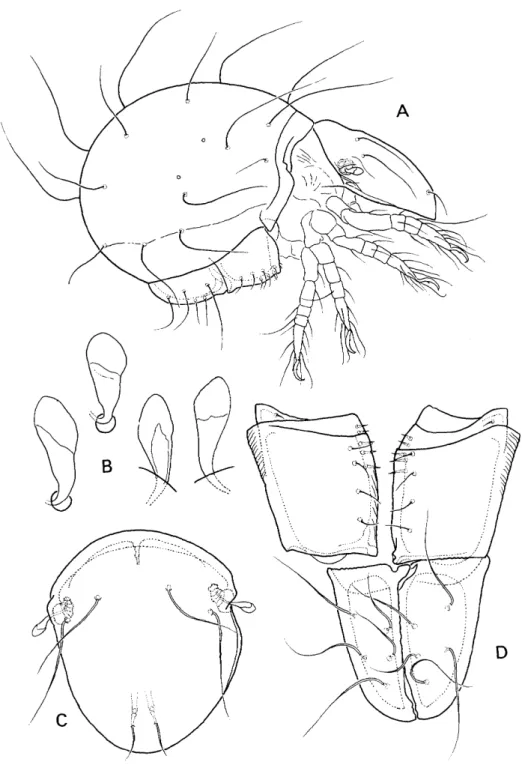
(28) ad,>ad,; anal setae shorter than half the length of adz. In lateral view, the upper part of ano-adanal plates with fine striation.-MOUTH PARTS: Chelicera bears minute prickles on each side: 18-20 prickles below seta cha and behind chb on the paraxial side (Fig. 8E) and 15-18 prickles behind the proximal part of movable digit on the antiaxial side. Palp 3-segmented; palpal chaetotaxy: 2-2-7. (NSMT-Ac 9097, in spirit): Omogo Valley, Ehime-ken, Japan, Type-series. HOLOTYPE 11-IV-1967, J. AOKI,from litter (JA~~~).-PARATOPOTYPES: 2 exs. the same data as ~ O ~ O ~ ~ ~ ~ . - P A R A1Tex. Y PMt. E SYuwan-dake, : Amami-Ohshima Is., S. Japan, 8-1-1973, H. SUZUKI, from litter and soil (JA2198); 3 exs. Anboh Forest Path, Yaku Island, S. Japan, 14-XI-1974, J. AOKI,from litter (JA1704); 4 exs. Mt. Mitake, Tsushima Is., W. Japan, 18-X-1968, J. AOKI,from litter (JA983, 985). Distribution. Japan (Ehime-ken, Tshushima Is., Yaku Is., Amami-Ohshima Is.). Genus Neophthiracarus BALOGH e t CSISZ AR, 1963 [Kebuka-irekodani Zoku] I. Neophthiracarus BALOGHet Cs~szli~, 1963, p. 467; S H E A& L ~MACFARLANE, 1966, p. 236.. Diagnosis. (1) Notogastral neotrichy present. (2) Adanal neotrichy present. (3) Interlamellar setae decumbent, not so different in length and shape from lamellar setae. (4) Body surface smooth. Elementary chaetotaxy. Body setae: ntg: (17 + 17), (20-20) or (50- f50-); g: (9+ 9), (9+8) or (9+ 10); ag: ( I + 1) or (2+ 1); an: (2+2) or (5+5); ad: (4+4). Type-species. Neophthiracarus insignis BALOGH e t CSISZ AR, 1963. Distribution. S. Argentine, Tierra del Fuego and Japan. et Remarks. After the establishment of the genus Neophthiracarus by BALOGH C S I S Z ~(1963) R with the type species N.insignis, SHEALS & MACFARLANE (1966) added to the genus the second species, N. shiptoni, which has more notogastral setae and less anal setae compared with the type species. In the same year, WALLWORK (1966) described Neophthiracarus neotrichus from Campbell Island. This species, however, has thick and erect interlamellar setae and should be considered a member of the genus Protophthiracarus BALOGH, 1972.. Neophthiracarus comosus sp. n.. (Fig. 9) Diagnosis. (1) Notogaster shows a strong neotrichy, bearing a t least 100 long notogastral setae. (2) Sensillus slender baciliform, without a swollen head. (3) Anoadanal plates with 2 anal and adanal setae. Measurement. Notogaster (L) 1060-1180 p, aspis (L) 510-545 p, notogastral setae (L).
(29) Fig. 9. Neophthiracarus comosus sp. n.-A: Genital plate in lateral view. plate in lateral view. C: Genitoanal region. D: Lateral.. B:. Genital. 350-470 p.. el em an tar^. Body setae: ntg: (110), (140) or (150); g: (9+8) or (9+9); ag: (1+1) or (lf2); an: (2f2); ad: (4+4). Leg setae: I (1-4-4-5-18); I1 (1-2-3-3-12); chaetotaxy..
(30) I11 (2-2-2-2-11); IV (3-2-1-2-10). Soledinions: I (2-1-21, I1 (1-1-2); I11 (1-1-2); IV(0-1-1). Description. ASIPS: All the prodorsal setae thin and smooth; il somewhat longer than le, r o ex; il and le inserted neary on the level of bothridia, le being a little anteriorly of il. Sensillus elongate baciliform, almost of the same thickness throughout its length, becoming slightly thinner toward the base; the tip pointed and bears a hyaline capsule. A trapezoidal scale exists behind opening of bothridium.-NOTOGASTER:An extreme neotrichy is developed on notogaster, especially on the anterior as well as on the posterior part; the total number of notogastral setae examined in 3 specimens are about 110, 140 and 150, respectively; neotrichial setae appear in the greatest number in the region of c-series setae and next in that of ps- and h-series setae, while they seem to be absent in the region of d- and e-series setae; the setae on notogaster long (RLN=33--42) and very weakly and sparsely barbed; most of the setae strongly curved near their insertions.-GENITO-ANAL REGION: Genital plates bear the normal number of setae, i.e. 9 pairs, though reduction of one seta on one side was observed in a specimen. Ano-adanal plates provided with 2 pairs of anal and 3 pairs of adanal setae; adl-ad4 almost of equal in length, a little longer than twice the length of anal setae. (NSMT-Ac 9100, in spirit): Hatchozaka, Mt. Ishizuchi, EhimeType-series. HOLOTYPE ken, Japan, 8-VIII-1969, K. MORIKAWA, from litter ( J A ~ ~ ~ ~ ) . - P A R A T O P O T1Y ex. P Ethe S: T YMt. P E :Higashi-akashi, Ehime-ken, Japan, 27same data a's ~ o ~ o ~ ~ ~ ~ . - - P A R1Aex. X-1968, M. TSURUHARA (JA1265). Distribution. Japan (Ehime-ken). e t CSISZLR,1963, Remarks. Two known species of the genus, N. insignis BALOGH and N. shiptoni SHEALS e t MACFARLANE, 1966, are easily distinguishable from N. comosus by their clavate sensilli and not so strongly developed neotrichy on notogaster (total numbers of notogastral setae are only 17 pairs and 20 pairs, respectively). Genus Hoplophthiracarus J ACOT,1933 [Tachige-irekodani Zoku] Hoplophthiracarus JACOT,1933, p. 239; V A N DER HAMMEN, 1959, p. 46; 1963, p. 307; BULANOVAZACHVATKINA, et al., 1975, p. 372; AOKI,1977, p. 185. Diagnosis. (1) Interlamellar setae erect, conspicuous, far longer and thicker than lamellar setae. (2) Ano-adanal plate with 5 setae: 2 anal and 3 adanal. (3) Notogaster roughly punctate, though not so conspicuously. (4) Anal setae inserted on the median edge of ano-adanal plates. Elementary chaetotaxy. ntg: (15+ 15); g: (7 7) -(9+ 9); an: (2 4- 2); ad: (3 3). Monodactyle. Type-species. Hoploderma histricinum BERLESE, 1908. Distribution. Europe, USSR, America, Nepal Himalaya, Tongatapu Island and Japan.. +. +. Key to the Japanese species of the genus Hoplophthiracarus 1. Notogastral setae strongly curved toward anterior direction; seta c, distinctly.
(31) -. 2.. -. 3.. -. shorter and thinner than c,; sensillus clavate and strongly sigmoid; length of 1913) notogaster 271-380 p ....................................................H . pavidus (BERLESE, Notogastral setae weakly curved or nearly straight; seta c , equal to, or somewhat longer than, c2.......................................................................................... 2 Sensillus without a swollen head; aspis with median ridge; seta hl longer than ad,; rostral seta almost equal to, or somewhat shorter than, lamellar seta; length of notogaster 800-950 p ......................................................... H ishikawai sp. n. Sensillus with a more or less swollen head; aspis without distinct median ridge; seta hl shorter than ad,; rostra1 seta longer than lamellar seta ........................ 3 Sensillus weakly swollen a t tip; foveolation on body surface not so conspicuous; aspis rather flat; notogastral setae moderately long (RLN 13-21); length of notogaster 440-592 .................................................................. H . kugohi AOKI, 1959 Sensillus distinctly swollen a t tip; foveolation on body surface very clear; aspis strongly convex; notogastral setae short (RLN 8-14); length of notogaster 370490 p.. .................................................................................... .H. foveolatus sp. n.. Hoplophthiracarus pavidus (BERLESE, 1913). (Fig. 10) HopLoderma pavidum BERLESE, 1913, p. 103, pl. 8, fig. 101. 1920, p. 36; 1928, p. 40; WILLMANN, 1931, p. p. 101, fig. 350; VAN Phthiracarus panidus: SELLNICK, DER HAMMEN, 1959, p. 49. 1963, p. 307, figs. 1-8; BULANOVA-ZACHVATKINA et al., HopLophthiracarus pawidus: VAN DER HAMMEN, 1975, p. 372, pl. 139, fig. 938a; FEIDER et CALUGAR, 1969, p. 77, fig. 6. Diagnosis. (1) Notogastral setae strongly curving toward anterior direction. (2) Seta c, distinctly shorter and thinner than c2. (3) Sensillus with a distinct oval head and a long sigmoid peduncle. (4) Lateral carina rather long, but never reaching rostrum. (5) Notogastral lappet inconspicuous. (6) No median ridge on aspis. Measurement. Notogaster (L) 271-380 p, notogaster (H) 162-240 p, aspis (L) 148-210. Elementary chaetotaxy. ntg: (15+ 15); g: (9+9); ag: (1 1); an: (2+2); ad: (3+3). Monodactyle. Description. ASPIS: Lateral carina curving above bothridium, almost straight in the remaining portion, comparatively long, but never reaching rostrum. Lateral rim. +. rather broad, becoming suddenly narrow anteriorly below the anterior end of lateral carina. No median ridge is present. A short, but distinct, curved line arising from the margin of aspis and running toward the median direction. Interlamellar seta thick and erect, weakly bending posteriad a t tip; it is roughened on the anterior 314. Lamellar seta minute. Rostra1 seta directed forward, almost straight or slightly bending downward, more than twice as long as le. Exobothridial seta thinner, but nearly as long as r o and longer than le. Sensillus clavate, having a rounded oval head and.
(32) Fig. 10. Hoplophthiracarus pavidus (BERLESE,1913).-A: Lateral. B: Sensilli. C: Genital and ano-adanal plates. D: Notogastral seta. E: Anterior view of body. F: Setae hl and vestigial setae fiin dorsal view of notogaster..
(33) thin, long peduncle, which is sigmoid in the proximal portion. Foveolae sometimes Lateroventral margin of notogaster shows a distinct found on ~SP~S.-NOTOGASTER: angulation on the middle part. Lappet is poorly developed, without distinct posterior angulation, so that the anterolateral margin of notogaster almost smoothly continuous backward. There are 15 pairs of notogastral setae and 2 pairs of vestiges; the setae rather strong, mostly curving to the front direction, weakly roughened on their distal half and not sharply pointed a t tip; their RLN (relative length to notogaster): 10-18 (average: 13.6); the longest setae (hi) nearly similar in length to interlamellar setae ad2. Vestige f, situated close to hi, but difficult to detect in lateral view of animal; f 2 located in the area of a triangle e2h2h,,being closer to h2 or h, than to e2. Lyrifissure ia situated in the vicinity of c ~posteromedially , of the seta; im located between cp and h,. The surface of notogaster shows very indistinct foveolation, which is only - A N A LGenital plate bears 9 setae; visible in strongly inclined ~ ~ ~ ~ ~ . - G E N I T OREGION: the posterior 4 comparatively long and arranged with wider interspaces; the anterior 5 minute, especially the anteriormost 2 are difficultto detect, because they are inserted on the anterior face of genital aperture. One small aggenital seta situated on the lateroanterior corner of the aperture. Anal plate with a strong anterior lock. Two anal setae situated close together on the median margin of the plate. Adanal seta adl inserted near the median margin, while ad2 and ad, distant from it; ad, shorter than adl or ad2, and subequal in length to an,. Foveolation on genital and anal plates more distinct than that on notogaster. Type-locality. Tiarno, Trentino, N. Italy. Collecting data. JA1171 (3 exs.), JA1325 (2 exs). Distribution. Italy, Netherlands, Rumania and Japan (Tobishima Island and Naganoken). Remarks. The Japanese material is mostly well in accord with the redescription and figures of H. pavidus by VAN DER HAMMEN (1963). Some differences are, however, found in the following points: (1) Lyrifissures ia and im equally distant from cp in the Enropean form, while ia is far closer to cp than im is in the Japanese one. (2) VAN DER HAMMEN (1963) stated "hi is situated slightly in front of f,,whilst it is behind it in P. anonymurn", but in the Japanese form hi situated slightly in front or behind f l (in the two Japanese specimens examined the situation is as shown in Fig. 10F). Among the Japanese specimens, those collected from Tobishima Island are f a r smaller in body size (length of notogaster 271-272 p) compared with the mainland form of Japan and the European form.. Hoplophthiracarus kugohi AOKI, 1959 [Kugoh-irekodani] (Fig. 11) Hoplophthiracarus kugohi AOKI,1959, p. 17, fig. 12; 1977, p. 185, fig. 5.. Diagnosis.. (1) Sensillus with an weakly swollen, elongate head.. (2) Lateral.
(34) I. carina on aspis very long, reaching the tip of rostrum. (3) Adanal seta ad2 longer than the longest notogastral seta hl. (4) Notogastral setae moderately long, slightly curved and weakly barbed. Measurement. Notogaster (L) 550-630 p, notogaster (H) 340-450 p, aspis (L) 270-320 ,u. Elementary chaetotaxy. ntg: (15+ 15); g: (9+9); ag: ( I + 1); an: (2+2); ad: (3f3). Monodactyle. Description. ASPIS: Lateral carina extraordinally long, arising from above bothridium, running almost parallel with lateral margin of aspis on the distal half, reaching the tip of aspis. Interlamellar seta long and thick, barbed on its distal half. Lamellar seta short and smooth, about 115 as long as il. Rostra1 seta somewhat longer than Le, bending downward. Sensillus slender, weakly winding near base, with an elongate, irregularly shaped, hyaline head. Longitudinal striation found behind il and le, on the posterior part of aspis. Exobothridial seta r n i n u t e - - N o ~ o ~ ~ sNotogastral ~~~: setae similar to il, thick and barbed on their distal half, slightly bending toward anterior direction; setae cl and c, nearly equally distant from the anterior margin of notogaster; c, a little longer than c2. Notogastral surface foveolate except on co1lor.GENITO-ANAL REGION:Nine pairs of genital setae preset; 4 pairs among them situated somewhat distant from the inner margin of genital plate, 2 pairs close to the margin and 3 pairs on the anterior appendage of genital plates. Ano-adanl plates with 5 pairs of setae; anl and an2 inserted on the inner edge of the plate, being subequal in length and in thickness to ad,; adanal setae adl and ad2 distinctly thicker and longer than the setae mentioned above; adz longer than the longest notogastral seta hl. All the setae weakly roughened. Type-locality. Miyazaki, S. Japan. Collecting data. JA63 (2 exs.), JA1307 (1 ex.), JA1715 (3 exs.), JA2115 (5 exs.), JA2192 (1 ex.). Distribution. Japan (Tokyo, Ehime-ken, Miyazaki-ken, Ogasawara Islands, Yaku Island. Remarks. Some corrections should be made in my original description and figures (AOKI,1959) of H. kugohi : (1) I mentioned in the description "Die Seitenkente der Aspis ist breit, nach vorn aber plotzlich verengert.", but in fact the lateral rim of aspis (=die Seitenkante) is narrow as usual; this mistake was caused by my misconception of lateral carina as inner margin of the lateral rim. (2) I described also that the genital plates have 6 pairs of setae, but the species has 3 more pairs of setae on the anterior appendages of genital plates. (3) From the description and figure (Abb. 12-D) it seemed that anl, an2 and adl were equally close to the inner margin of anoadanal plate, but close examination revealed that anl and an2 were inserted on the very edge of the plate, while the insertion pore of ad1 is slightly removed from the margin as shown in Fig. 11E. (4) The correct position of notogastral setae could not be seen in the original figure (Abb. 12-A) which was drawn after the specimen in somewhat inclined condition; the lateral view of body have been redrawn here after anoter specimen in the right position (Fig. 11A)..
(35) Fig. 11. Hoplophthiracarus kugohi AOKI,1959.-A: Lateral. B: Interlamellar and lamellar setae in lateral view. C: Rostra1 seta. D: Sensilli. E: Ano-adanal plate.. Hoplophthiracarus siamensis AOKI,1965, which was described from Thailand is considered here a subspecies of H . kugohi and will be treated hereafter Hoplophthiracarus kugohi siamensis AOKI,1959, comb. n. The subspecies is different from the nominate subspecies H. kugohi kugohi A O K I ,1959, in the shorter notogastral setae (RLN 13-19), the shorter interlamellar setae (RLN 16-20), the adanal setae ad2 only slightly longer than hl, and the smaller body size (length of notogaster 341-490~). "Hoploph-.
(36) thiracarus siamensis" reported by HAMMER (1972) from Tahiti may be the same subspecies.. Hoplophthiracarus ishikawai sp. n.. (Fig. 12) Diagnosis. (1) Sensillus without swollen part on apex. (2) Median ridge exists on aspis. (3) Aspis rather flat. (4) Adanal setae ad2 shorter than the longest notogastral setae hi. (5) Seta c, a little longer than c2. (6) Rostral seta somewhat shorter than lamellar seta. (7) Aspis narrow, about 1 . 5 ~as long as wide. Measurement. Notogaster (L) 800-950 p, notogaster (H) 540-570 p, aspis (L) 370445 p. Elementary chaetotaxy. ntg: (15+ 15); g: (9+9); ag: (0+0); an: (2+2), ad: (3+3). Monodactyle. Description. ASPIS: Aspis rather flat and narrow (1.45 x as long as wide), with a low, but distinct median ridge. Lateral carina never reaching the rim of aspis. Rostral seta nearly straight and short, a little shorter than lamellar seta. Lamellar seta comparatively long and thick, almost as the distance between le and il. Interlamellar seta long and thick, 4.0-4.8~ as long as le, barbed a t least on its apical 213, directed dorsoanteriad and inserted on aspis a t an angle of about 45". Sensillus almost of equal thickness throughout its length, without swollen head apically; a distinct barbation found on its apical 113. Exobothridial seta very minute and almost invisible. -NOTOGASTER:Convexity of notogaster weak, especially on the posterior part. Fifteen pairs of notogastral setae moderately long, nearly straight, sparsely barbed along their apical 213 and pointed a t tip, but not sharply; RLN of the setae 15-27 (average 20.3); seta c, a little longer than c2; hi and psl the longest and ps, the shortest; distance h,ps, subequal to ps,-ps,. Foveolation on the notogastral surface rather fine and well visible only in inclined aspects.-GENITO-ANAL REGION: Nine pairs of genital setae have normal position. Anal and adanal setae weakly barbed. Adanal seta ad2 longer than the longest notogastral setae hi and psi; ad, 113 as long as ad2. Type-series. HOLOTYPE (NSMT-Ac 4351, on slide): Yuyaguchi, Shuso-gun, Ehimeken, Japan, 28-VI-1968, K. ISHIKAWA, from litter ( J A ~ ~ ~ ~ ) . - P A R A T O P O T Y 7 Pexs. ES: the same data as holotype. Distribution. Japan (Ehime-ken). (ASSOC. Etymology. The species ishikawai was named after Dr. Kazuo ISHIKAWA Prof. in Matsuyama Shinonome Junior College) who kindly offered the author a good series of oribatid specimens including the present new species. Remarks. H. ishikawai is superficially resembles H. kugohi AOKI, 1959, but distinguishable from the latter by the larger body size, the presence of median ridge on aspis, the setiform sensilli and the adanal setae ad2 shorter than the longest noto-.
(37) Fig. 12. Hoplophthiracarus ishikawai sp. n.-A: Lateral. B: Aspis. C: Genital and ano-adanal plates. D: Lamellar seta. E: Rostra1 seta. F: Sensillus. G: Notogastral seta hl. , has also setiform sensilli, but the organ is gastral setae. H. nepalensis S H E A L S 1965, attenuating toward the tip, the adanal setae ad2 longer than the longest notogastral setae and the body size is smaller (the length of notogaster 330p-500 p)..
図


+7


関連したドキュメント
H ernández , Positive and free boundary solutions to singular nonlinear elliptic problems with absorption; An overview and open problems, in: Proceedings of the Variational
Keywords: Convex order ; Fréchet distribution ; Median ; Mittag-Leffler distribution ; Mittag- Leffler function ; Stable distribution ; Stochastic order.. AMS MSC 2010: Primary 60E05
Likewise we show that any decomposition of the complete graph into strongly regular graphs of (negative) Latin square type is an amorphic association scheme.. We study strongly
In Section 3, we show that the clique- width is unbounded in any superfactorial class of graphs, and in Section 4, we prove that the clique-width is bounded in any hereditary
Inside this class, we identify a new subclass of Liouvillian integrable systems, under suitable conditions such Liouvillian integrable systems can have at most one limit cycle, and
[5] G. Janelidze, Satellites and Galois Extensions of Commutative Rings, Ph. Janelidze, Computation of Kan extensions by means of injective objects and functors Ext C n in
静岡大学 静岡キャンパス 静岡大学 浜松キャンパス 静岡県立大学 静岡県立大学短期大学部 東海大学 清水キャンパス
Amount of Remuneration, etc. The Company does not pay to Directors who concurrently serve as Executive Officer the remuneration paid to Directors. Therefore, “Number of Persons”
