The Thai Sala: A Community of Practice that Supports Motivation to Study Thai
journal or
publication title
Global communication studies = グローバル・コ ミュニケーション研究
number 8
page range 49‑81
year 2019‑03
URL http://id.nii.ac.jp/1092/00001609/
asKUIS 著作権ポリシーを参照のこと
The Thai Sala: A Community of Practice that Supports Motivation to Study Thai
Pornsri W
RIGHTThe Thai Sala at MULC does more than symbolize the university’s commitment to the study of foreign languages. In fact, by providing a comfortable place for students to spend time before, between and after class, it plays a key role in how students form relationships with each other, with exchange students and with teachers; in how they study and practice the language and reinforce their learning; and in how they adopt and maintain a healthy identity as a “Thai Major.” Hence, the Sala plays a key role in the creation and maintenance of the Community of Practice (CoP) (Wenger, 2009) that Thai major students belong to.
Furthermore, through their engagement in this CoP, they do many of the things associated with generating and maintaining motivation to learn Thai. This paper reports on how students use the Sala and shows how the activities they engage in help to shape and maintain their CoP.
It also discusses the concept of a CoP and shows how the CoP can be understood in relation to recent theories on motivation.
Keywords: Multilingual Communication Center (MULC), Thai language learning, Community of Practice, Thai Sala, motivation
1. Introduction
Kanda University of International Studies (KUIS) is a rare
Japanese university that offers a range of languages as majors
instead of as elective subjects or a second foreign language. In
addition to the English Department and International Communications
Department, KUIS has a Spanish and Portuguese Department and
an Asian Languages Department, which offers Chinese and Korean
as majors, and Thai, Indonesian, and Vietnamese as double majors
with English. At KUIS, the study of foreign languages is rigorous
and professionally oriented. Looking at Thai as an example,
students majoring in Thai complete their four years of study ready to use the language in their professional lives.
A symbol of the commitment to the study of foreign languages at KUIS is the Multilingual Communication Center (MULC), which is dedicated to supporting and celebrating the study of those seven foreign languages other than English. In addition to providing space for students to do homework, meet friends or rest between classes, it functions as a resource center that supports foreign language studies with a library, multi-media resources, and a café.
Furthermore, it is a striking and unique environment that was designed to stimulate the imagination of visitors dreaming of a trip to the country of their studies. MULC’s main hall is divided into eight areas that represent one of the seven foreign languages — Thai, Vietnamese, Korean, Indonesian, Chinese, Spanish and Brazilian- Portuguese — and one more area for international languages. Each area was designed to evoke a connection to the local culture of the country where the language is spoken. The Korean area, for example, was built to look like a traditional Korean country house, with a tile roof, garden fence and large slabs of rock on the fl oor.
The Thai area features a Sala, an open pavilion seen throughout the country that serves as a meeting hall, resting place or shelter from sun or rain. The Sala was built in Thailand by a specialist in traditional Thai architecture and is one of only two such structures to exist in Japan. To the university community, MULC is a space designed to support students by allowing them to feel transported to the country of their studies. On the other hand, there may be another important role that MULC plays in the life of students who study foreign languages. It can anchor their community of practice (Wenger, 2009) and in the case of the community of students studying Thai, it most certainly has.
This research was carried out in the fi rst instance to examine and
analyze the role played by MULC in the academic life of
students — especially students majoring in Thai language. The questions this research sought to answer related to who uses the Thai Sala, how they use it, and how much time they spend there.
In addition to describing the movements of students and others in and out of the Thai area of MULC, the paper discusses how a healthy community of practice can play a role in the motivation of students to persist in learning a second language. Implications for language learning and further research will be discussed.
2. Background 2.1. Motivation
Apart from a few students who happen to have a Thai parent, the
Thai majors at KUIS begin their studies with no prior learning of
the language. Indeed, few fi rst-year students can articulate why
they chose to study Thai in the fi rst place. Yet most graduate with
enough profi ciency in Thai to allow initiating and maintaining
relationships with native Thai speakers or even getting hired for
positions in which spoken Thai is a job requirement. However,
getting to that point requires four years of rigorous study. In the
fi rst two years, the program requires a copious amount of vocabulary
memorization (350 words in the fi rst semester), grammar practice,
listening comprehension, and learning to read and write with the
Thai writing system. As students acquire profi ciency, they write
and practice dialogues, engage in interviews, prepare and deliver
presentations, and, eventually, take elective courses such as Thai
debate and folktales. Suffi ce it to say that in a challenging program,
in which the expectations are high, learning can become as tedious
as it is often fun and exciting. Hence, motivation is a key factor in
a Thai major student’s success. As discussed in Dörnyei and
Ushioda (2011), the motivation to learn must not only to be
generated but also sustained, extended or “protected.”
2.2. The L2 Motivational Self System
As noted by Dörnyei and Ushioda (2011), the complex nature of motivation has led to a wide range of research perspectives, theories and classroom practices. Nevertheless, they say that most researchers and practitioners would agree that motivation involves both direction and magnitude, having to do with choice (why people decide to do something), persistence (how long they are willing to sustain the activity) and effort (how hard they are going to pursue it). One approach to the study of motivation in language learning is Dörnyei’s (2009) L2 Motivational Self System. Dörnyei’s (2009) system draws on psychological research — e.g. Higgins’ (1987) Self Discrepancy Theory (referenced in Dörnyei (2009)) — into
“possible selves,” which posits that being able to imagine one’s future self is a powerful motivator of behavior. In that sense, the discrepancy between one’s current situation and one’s goals and aspirations for the future may generate the drive to learn new skills and knowledge. However, according to Dornyei (2009), the character of motivation will differ, depending on whether one’s imagined future self as a language speaker is formed from internal aspirations or external stimuli, such as a sense of obligation.
Dörnyei’s (2009) L2 Motivational Self System is made up of three components:
1) Ideal L2 Self, the L2 speaker one feels one would like to become.
2) Ought-to L2 Self, the future L2 speaker one feels obligated to become.
3) L2 Learning Experience, the impact of the teacher, the curriculum, the peer group, and the experience of success.
A wide range of studies reported on in Dornyei and Ushioda
(2011) have validated the effect on motivation in being able to
imagine an ideal future self as well as the gap that separates the present from the ideal future. According to Dörnyei (2009), this system is particularly explanatory in that it treats motivation as temporal (i.e. changing over time) and process-driven (affected by the learner’s experiences). The theory of the Ideal L2 Self aligns well with other motivational paradigms, such as “Integrative vs.
Instrumental” motivation (Gardner and Lambert, 1972) or Intrinsic vs. Extrinsic motivation (Deci and Ryan, 1985) in that the Ideal L2 self can be driven by intrinsic affective factors such as curiosity, intellectual pleasure, or fi tting in, or extrinsic ones such as the desire to get a promotion and be transferred overseas. According to Suzuki (2011) the Ought-to Self is also an effective motivator that works by creating an imagined future of discomfort that must be avoided, such as the shame of not passing a university entrance exam. Suzuki (2011) pointed out that research on less-motivated students has rarely been carried out in the context of Dornyei’s system, asking whether the concept of the Ideal L2 Self is even valid for those with low motivation. Similarly, Fukawa (2015;
2018) noted that Freshman students in particular might not have a clear vision of their futures, and further pointed out the complexity of the Ideal L2 Self system in that students are often subject to classroom activities they consider demotivating. She found that demotivation can be caused by students speaking L1 excessively in class, unsuccessful collaborative activities, excessive amounts of homework, and lack of perceived relevance and suggested increasing relevance and encouraging more L2 spoken in class as ways to impact the Ideal L2 Self positively. Similarly, Suzuki (2011) found that having the chance to speak with native speakers is a way to motivate students, especially those with low motivation or an unformed Ideal L2 Self.
Even if research on low motivation in light of the Ideal Self
System is scant, Dörnyei (2001) and Dörnyei and Ushioda (2011)
discuss at length that because motivation is a dynamic quality, not only past learning experiences but present ones infl uence the L2 Self. Indeed, Dörnyei (2001) provides a long list of practical methods for creating, generating, maintaining and protecting motivation. However, as these methods are directed at teachers and their classrooms, we might ask whether the environment that exists outside the classroom but within the learning institution, i.e. the community of practice, can also have an effect on motivation — in particular within the paradigm of the Ideal L2 Self.
2.3. Communities of Practice
A brochure on the MULC suggests visitors can “experience the sensation of being an exchange student while learning foreign languages and cultures in [a] unique space.” However, the Thai Sala may play a more important role in the learning experience of Thai major students — as a central location for the community of practice of Thai major students. According to Wenger-Trayner &
Wenger-Trayner (2015:1), a Community of Practice (CoP) is a group “of people who share a concern or a passion for something they do and learn how to do it better as they interact regularly.”
While the concept seems simple, the writings by Lave and Wenger (1991), and, later, Wenger (1998), opened up a new way to understand and frame learning, especially in the fi elds of corporate and industrial training, professional education, and increasingly, tertiary education as well. According to Hoadly (2012), a community of practice is “a community that shares practices.” Practice is what a community of people spend their time doing together and comprises the “shared historical and social resources, frameworks, and perspectives that can sustain mutual engagement in action.”
According to Wenger-Trayner & Wenger-Trayner (2015), there are
three required components for any community of practice to be
recognized. The fi rst is the domain. A domain of shared interest
could be coaching little league baseball, selling real estate, assembling electronic parts, performing in an orchestra or studying the Thai language. The second component is the community. In the case of Thai studies at KUIS, the community consists of the students, but it also includes exchange students from Thailand, the Thai language lecturers and professors, a Thai music teacher and student members of the Thai music and dance clubs. The third component is the practice. “Members of a community of practice are practitioners. They develop a shared repertoire of resources:
experiences, stories, tools, ways of addressing recurring problems — in short a shared practice” (Wenger-Trayner &
Wenger-Trayner (2015:2). In the case of the community that studies Thai at KUIS, their shared repertoire would include the linguistic knowledge and communication skills acquired in and out of class from teachers, but it would also include the tips, recommendations and suggestions that students share among each other and the competencies developed through vicariously observing what happens to their peers and colleagues.
In essence, the ideas surrounding CoP demonstrate that learning
is embedded in cultural practices (Hoadly, 2012), and that the
group interactions that occur outside the formal setting of the
classroom or training seminar — among peers, seniors, mentors —
has as much or more effect on the acquisition of knowledge as what
takes place inside classrooms. In other words, what is learned
casually, tacitly and vicariously by observing and interacting with
peers creates changes in both the group as well as the individuals
participating in the group. Wenger (1998) suggests that the deep
infl uence of CoPs in our lives requires that we rethink how learning
occurs — be it within individuals or in communities and
organizations. Research on CoPs also has implications for how
practitioners and teachers might design for better learning.
3. Method
The author examined data collected and compiled by the MULC staff in their reports on utilization of the center (A. Kawano, personal communication, July 2018) as well as their reports on the results of student questionnaires carried out in 2017 (MULC
利用に 関するアンケート(
2017年度) MULC riy
ōni kansuru an
kēto (2017 nendo)). In order to collect data on the use of the center, the staff walk through the facility every 90 minutes of every day, counting the number of students in each area and monitoring the activities.
In addition to using the data collected by MULC, the author prepared her own questionnaire to gather more specifi c data from all Thai students on how they use the Thai Sala. It was distributed at the end of Spring semester, 2018. Out of a total of 91 students enrolled in the Thai major, 84 responded.
4. MULC
In operation since 2009, The Multilingual Communication Center (MULC) is referred to as a “pseudo-study abroad” space within the university, where students may get a taste of what it is like to be an exchange student. Foreign exchange students and foreign teachers are encouraged (or required) to spend time at MULC and create opportunities to converse with Japanese students. Throughout the year, MULC hosts as many as 65 activities and events related to the cultures of the seven foreign languages. For example, the Brazilian-Portuguese area celebrates the Festa Junina; the Spanish area puts on a Christmas event; and the Vietnamese area hosts the Parasite-Killing festival. In addition, there is Alphabet Day (Hangul Day) in the Korean area, Kartini Day in the Indonesian area, Gyoza making in the Chinese area, and the celebration of Songkran (Water Festival) in the Thai area.
Foreign fi lms are screened in Crystal Hall, and other celebrations
include Halloween and Wafuku (yukata wearing) Day. These
events allow students studying foreign languages to form bonds with each other, to explore and gain understanding with the culture they are studying and to experience cultural traditions of other languages and countries.
4.1. Student participation at MULC
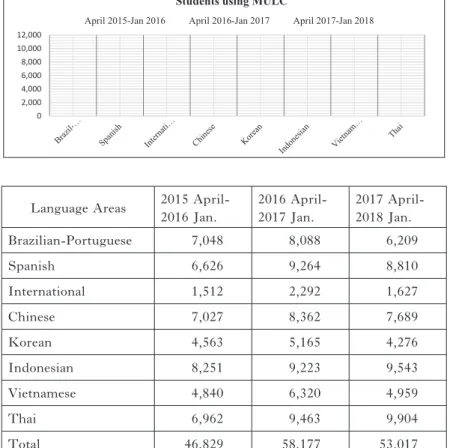
Language Areas 2015 April- 2016 Jan.
2016 April- 2017 Jan.
2017 April- 2018 Jan.
Brazilian-Portuguese 7,048 8,088 6,209
Spanish 6,626 9,264 8,810
International 1,512 2,292 1,627
Chinese 7,027 8,362 7,689
Korean 4,563 5,165 4,276
Indonesian 8,251 9,223 9,543
Vietnamese 4,840 6,320 4,959
Thai 6,962 9,463 9,904
Total 46,829 58,177 53,017
Figure 1 and 2: Yearly attendance in the eight areas
0 2,000 4,000 6,000 8,000 10,000 12,000
Students using MULC
April 2015-Jan 2016 April 2016-Jan 2017 April 2017-Jan 2018
(A. Kawano, personal communication, July 2018)
Figures 1 and 2 show the number of students using MULC — as a total number and broken down by language area — over the three years from April 2015 to January 2018. While the numbers for every area increased in 2016/17 over 2015/16, the numbers decreased for every language except Thai and Indonesian in 2017/18. One factor may have been the opening of the new KUIS 8, where the Self-Access Learning Center (SALC) is located, in 2018.
Students who study English have their classes and use English materials in KUIS 8. Additionally, it was mentioned in the MULC evaluation 2017 report that Wi-Fi in MULC was too weak and the internet signal was bad. Nevertheless, it should be noted that of all seven languages, Thai majors were the participants with the highest rate of attendance at MULC in the years from 2016–2018.
4.2. Native teachers and exchange students
Teachers who are native speakers and exchange students are required to spend hours working in their respective areas in order to communicate with students and serve as cultural emissaries.
Figure 3 shows the number of native teachers and exchange students in 2018.
Area Native teachers Exchange students
Brazilian-Portuguese 2 4
Spanish 3 7
Chinese 2 13
Korean 1 8
Indonesian 1 5
Vietnamese 2 5
Thai 2 4
Total 13 46
Figure 3: Number of native speakers at MULC
(A. Kawano, personal communication, July 2018)
There are thirteen native teachers and forty-six exchange students. In general, native teachers will be on duty for three 90-minute sessions per week. Exchange students also work three 90-minute shifts. However, due to high demand from students during lunchtime, the Chinese, Korean and Thai areas increased the number of paid hours for exchange students during the lunch hour.
4.3. Peak time
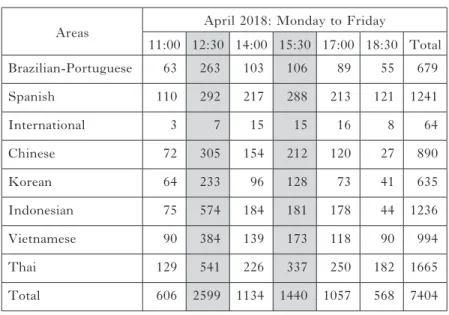
From Mondays through Fridays, a MULC staff member will count the number of students in each language area every 90 minutes between 11:00 and 18:30. Figure 4 shows the number of students using MULC throughout the day in the month of April 2018.
Areas April 2018: Monday to Friday
11:00 12:30 14:00 15:30 17:00 18:30 Total Brazilian-Portuguese 63 263 103 106 89 55 679
Spanish 110 292 217 288 213 121 1241
International 3 7 15 15 16 8 64
Chinese 72 305 154 212 120 27 890
Korean 64 233 96 128 73 41 635
Indonesian 75 574 184 181 178 44 1236
Vietnamese 90 384 139 173 118 90 994
Thai 129 541 226 337 250 182 1665
Total 606 2599 1134 1440 1057 568 7404
Figure 4: Total utilization of MULC in April 2018 by time of day
(A. Kawano, personal communication, July 2018)
It can be seen that MULC is most popular during lunchtime; in April, 2,599 students attended during the 12:30 period. Another peak time occurs around 15:30; 1,440 students attended during this period in April. The most popular area during lunch time was the Indonesian area (574 students), followed by the Thai area (541 students). The most popular area around 15:30 was the Thai area (337 students), followed by the Spanish area (288 students).
5. Participation in the Thai Area (Sala) 5.1. Frequency of attendance at the Sala
In 2018, a total of ninety-one students majored in Thai, with 28 students in the fi rst and second years, 17 in the third year and 18 in the fourth year. At the end of the First Semester, the survey on students’ use of the Sala was distributed to 84 students (92% of all Thai majors). 26 fi rst- and second-year students, 15 third-year students, and 17 fourth-year students responded.
As shown in Figure 5, out of 84 respondents, 40% came 2–3 times a week, 37% came every day, 12% rarely came, 11% came once a week and none never came. Looking at each class, a majority of fi rst-year students (58%) came to the Sala every day. 38% came to
Figure 5: Frequency of use of the Thai Sala
15
12
0
4
10 10
6 8
0
3
1
5
1 1
8
0
0 0 0 0
0 5 10 15 20
1st year 2nd year 3rd year 4th year
How often students came to Sala
Everyday 2-3 times once a week rarely none
the Sala 2–3 times a week. Only 4% rarely came and no student came once a week or never. As for second-year students, 46% came every day, 38% came 2–3 times a week, and 12% came once a week.
Only 4% rarely came, and no student never came. Among third- year students, none of them came every day. 40% came 2–3 times a week, 7% came once a week, 53% rarely came, and none never came.
Finally, among fourth-year students, 24% came every day, 47%
came 2–3 times a week, and 29% came once a week. None of the fourth-year students rarely or never came. Hence, while fi rst and second-year students are the most frequent users of the Sala, 46%
of third year and 100% of fourth-year students show up once a week or more. This shows that the Sala is an extremely popular spot on campus for Thai major students to spend time between or after classes. It also shows that students of different years regularly spend unstructured time together.
5.2. Thai Native Teachers
Two native Thai teachers spend time regularly at the Thai area.
Indeed, one of them uses the Thai area as his offi ce and is available to students for eight 90-minute periods per week. Since his offi ce is there, students can see him often, even when he is not on duty.
Another native teacher (the author) is required to offer 90 minutes of chat time twice a week but usually spends more time in the area.
On the same two days, another part-time teacher usually spends time between classes at the Thai area. The reason that so many students spend time in the Thai area may be because they can talk with these three native teachers (as well as four exchange students).
According to MULC guidelines, Thai language professors who are
native speakers of Japanese are not permitted to maintain offi ce
hours at MULC as students may feel constrained in using Thai.
5.3. Thai exchange students
Four native Thai exchange students, one from Chiangmai University and three from Burapha University, spend time regularly at the Sala. Every day, one student is on duty at lunchtime and two in the evening. During the times when exchange students are on duty, the others tend to spend their free time there as well even though they are not required to do so. Hence, it is easy for Thai major students to meet and communicate with native Thais.
To encourage interpersonal communication in the Thai language, a list of topics for students to choose from is placed on each table.
The choices are:
• ask for help with homework
• have a conversation
• look at a picture book together
• watch a movie or surf the internet together
• make handicrafts
• play language games such as card matching or UNO 5.4. Peak day of the week
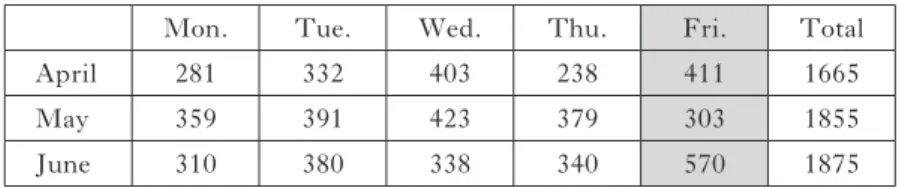
Figure 6 shows the total number of students attending the Sala in April, May and June, broken down by day of the week. In April and June, Friday was the day of the month drawing the highest
Mon. Tue. Wed. Thu. Fri. Total
April 281 332 403 238 411 1665
May 359 391 423 379 303 1855
June 310 380 338 340 570 1875
Figure 6: Utilization of Thai Sala, April–June 2018 by day of the week
(A. Kawano, personal communication, July 2018)
attendance. The decrease in Friday attendance in May was perhaps related to one Friday falling during the Golden Week holiday, when students are on vacation.
The reason for the high numbers on Fridays may be explained by the students’ class schedules. There were two classes for second- year students during Third Period (13:10–14:40) and two classes for fi rst-year students during Fifth Period (16:30–18:00). Therefore, between the Third and Fifth periods, the Sala attracted students who had just fi nished a class as well as others waiting for a class to begin. While waiting, they could review their lessons, fi nish homework or do a vocabulary test with teachers. There were seven native Thais at the Sala on Fridays: the two native teachers who teach Third and Fifth periods, one native teacher who has an offi ce in the Sala area and four Thai exchange students.
5.5. Peak time of day
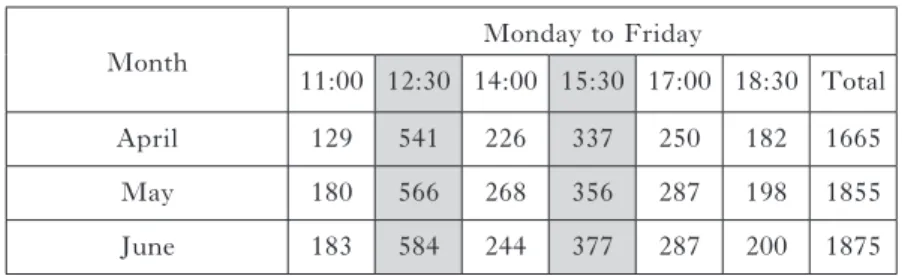
Figure 7 shows the total number of students in the Thai area for the months of April, May and June 2018, broken down by time of day. It shows that attendance was highest at lunch time, when students would come to eat lunch and talk with their friends, exchange students and native teachers. The second-highest time was at 15:30.
Month
Monday to Friday
11:00 12:30 14:00 15:30 17:00 18:30 Total
April 129 541 226 337 250 182 1665
May 180 566 268 356 287 198 1855
June 183 584 244 377 287 200 1875
Figure 7: Utilization of Thai Sala, April–June 2018 by time of day
(A. Kawano, personal communication, July 2018)
5.6. Amount of time spent at the Sala
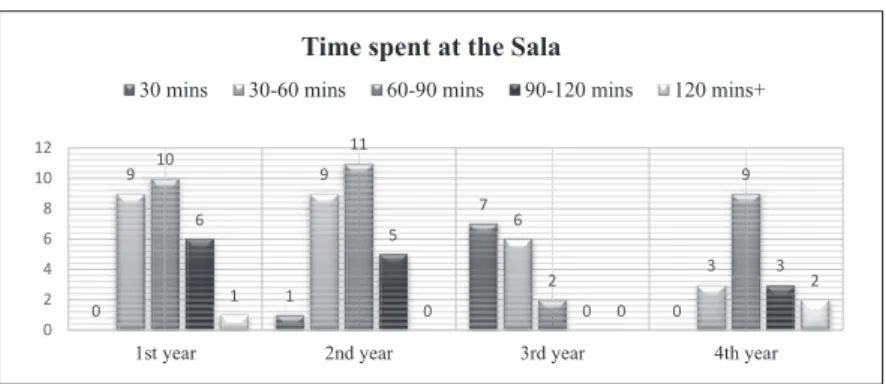
The questionnaire distributed by the author looked at how long students would typically stay at the Sala. In Figure 8, it can be seen that 38% of students would spend 60–90 minutes at the Sala. 32%
reported spending 30–60 minutes and 17%, 90–120 minutes.
9% reported staying only 30 minutes at a time, while 4% stayed over 120 minutes. The questionnaire also looked at differences among students in different years of study. Among fi rst-year students, 35% reported spending 30–60 minutes per visit, while 38% spent 60–90 minutes, 23% spent 90–120 minutes and 4% spent more than 120 minutes. None of the fi rst-year students spent less than 30 minutes at the Sala. The time spent by second-year students resembled that of the fi rst-year students, but 4% came to the Sala for only 30–60 minutes and none more than 120 minutes.
As for third-year students, 47% of them stayed for less than 30 minutes, 40% came for 30–60 minutes and 13% came 60–90 minutes. None of them stayed longer than 90 minutes. A majority (53%) of fourth-year students would spend 60–90 minutes at the Sala while 18% of them stayed 30–60 minutes, 18% stayed 90–120 minutes and 11% stayed more than 120 minutes. None of the
Figure 8: The length of time spent at Sala
0 1
7
0
9 9
6
3
10 11
2
9
6 5
0
3
1 0 0
2 0
2 4 6 8 10 12
1st year 2nd year 3rd year 4th year
Time spent at the Sala
30 mins 30-60 mins 60-90 mins 90-120 mins 120 mins+
fourth-year students stayed for less than 30 minutes at a time. In addition to coming to the Sala regularly, students spent a great deal of time in each visit. Clearly, the Sala is a place to hang out, a place to spend time when one has nowhere else to go.
5.7. Thai cultural events at the Sala
Besides serving as a place to spend time at lunch or between classes, the Sala at the Thai area hosts special events several times a year. Most of the events are held during the 60-minute lunch period, allowing most students to participate. The main events are:
1) Welcome Party. To celebrate the arrival of new fi rst-year as well as exchange students, the Welcome Party is held in the middle of April. First-year students introduce themselves in Thai, using their new Thai nickname. The Thai music and dance clubs put on a performance to introduce fi rst-year students to the clubs and share their own enthusiasm for Thai culture. Thai green curry is served, which some new students may be tasting for the fi rst time. Second-, third- and fourth- year students also introduce themselves to the freshmen.
2) Songkran. Held in April, the Thai water festival celebrates the
traditional Thai New Year, even though today Songkran is
more concerned with bringing families together. Students can
pour a water offering onto the hands of their teachers as well
as onto seven Buddha images that represent the days of the
week. Teachers and students wish each other well, and later on
the students will dab powder on each other’s faces rather than
splash water around as people do in Thailand. Finally,
everyone eats lunch together. Of all the special events,
Songkran attracts the most participants. In recent years, the
university’s President has also participated, and students get to
pour water on his hands, too. Some students from other
language majors also join in.
3) Wai khruu (Respect for Teacher Day). Held in June, Students present teachers with fl ower baskets and ask them for blessings.
This ceremony also helps students to experience and become better acquainted with Thai ways of showing respect to elders.
4) Loy Krathong. In November, Loy Kratong is held to thank the river god and ask for forgiveness for polluting the waters.
Students will make fl ower baskets and fl oat them in a small pool. Students also decorate the Sala and participate in a Miss Loy Krathong beauty contest and play games. Thai food also helps create a Thai atmosphere.
5) Goodbye party. Held in January, this party is a chance to thank and bid farewell to the native Thai exchange students who are returning home. The Thai major students from each school year give the exchange students cards and presents.
Figure 9 shows the attendance at special events by the number of students in each school year. Because the survey was distributed at the end of July, fi rst-year students (who started university in April) were able to participate in just two events. The special events at the Sala attract large numbers of the Thai major students and offer them a chance to work together and learn more about Thai culture.
Events 1st year 2nd year 3rd year 4th year Total %
Welcome party 28 22 13 11 74 88%
Songkran 25 25 15 14 79 94%
Wai khruu ― 22 12 13 47 56%
Loy Krathong ― 21 11 16 48 57%
Goodbye party ― 15 12 12 39 46%
Figure 9: Number of students attending Thai events
They work as a team in decorating the space and later cleaning up.
Senior students tend to take on the roles of emcees for the events and help publicize the events as well.
5.8. Reasons for using Sala
In order to learn more about why students come to the Thai area, the survey prepared by the author asked students to rank eight reasons for coming to the Thai area, as follows:
• talk to native teachers
• talk to exchange students
• talk with friends
• use computer and internet
• use books, CDs or DVDs
• do homework and self-study
• eat lunch
• take part in events such as Songkran, Loy Krathong etc.
(Points were awarded as follows: 1
stchoice=8 points, 2
ndchoice=7 points, 3
rdchoice=6 points, 4
thchoice=5 points, 5
thchoice=4 points, 6
thchoice=3 points, 7
thchoice=2 points and 8
thchoice=1 point.)
Figure 10: Reasons for using the Sala
Talk to naƟve teacher , 434, 17%
Talk to exchange students , 469, 18%
Talk with friends , 507, Use computer, 131, 5% 20%
Use books , 107, 4%
Do homework , 376, 14%
Eat lunch, 388, 15%
Take part in the event , 178, 7%
REASONS FOR USING THE SALA
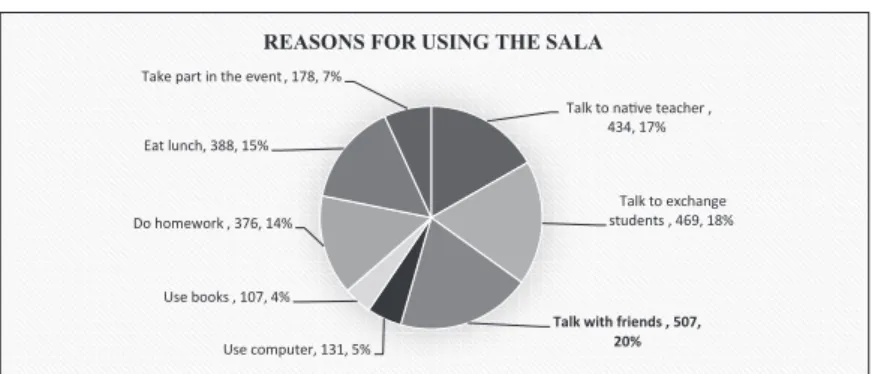
Among eighty-four students, talking with friends was the most important reason to come to Sala, talking with exchange students was second most-important, and talking to native teachers came in third. Eating lunch and doing homework and self-study were the fourth and fi fth reasons, respectively. The lowest ranking reasons were taking part in events, using computer and internet and using books, CDs and DVDs.
Looking at each class, it was found that the top three reasons for the fi rst-year students to come to the Sala were talking with exchange students, talking with friends, and doing homework, respectively. Among second-year students, talking with Thai native teachers and talking with exchange students were ranked equally popular, followed by talking with friends. The top reasons for third- and fourth-year students were talking with friends, eating lunch, and talking with exchange students, respectively.
5.9. Reasons for talking to Thai persons
Because Thai majors receive a lot of homework, the students need help from Thai natives. Some examples of weekly assignments that fi rst- and second-year students must complete include:
• have a conversation with a Thai person
• take a pronunciation test with teachers
• translate an article into Thai
• write Thai words and paragraphs
• write conversation dialogs
• prepare presentations in Thai and get feedback or assistance from native Thais
As mentioned above, the survey showed that the second and
third most-popular reasons, respectively, for coming to the Sala
were talking with exchange students and with Thai native teachers.
The survey also looked at why students wish to talk with native Thais at the Sala by asking them to rank the following from 1 to 6:
• You were assigned to talk with Thai persons as homework.
• You want to have Thai friends.
• You want to learn more about Thailand.
• You want them to help with homework.
• An exchange student asked you to help them with their homework.
• An exchange student started a conversation with you.
(1=6 points, 2=5 points, 3=4 points, 4=3 points, 5=2 points, 6=1 point).
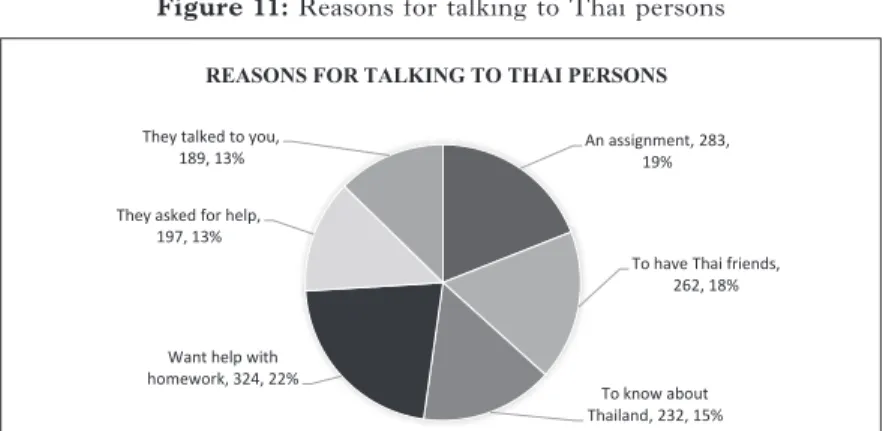
Figure 11 shows that the most important reason (22%) for students to talk to Thai persons was to ask for help with their homework. The second most important reason (19%) was being assigned by a teacher to talk with a Thai person. It should be noted that all fi rst- and second- year students are assigned to speak with a Thai person 12 times in a semester, and third-year students are
Figure 11: Reasons for talking to Thai persons
An assignment, 283, 19%
To have Thai friends, 262, 18%
To know about , 232, 15%
homework, 324, 22%
They asked for help, 197, 13%
They talked to you, 189, 13%
REASONS FOR TALKING TO THAI PERSONS
Want help with
Thailand
also assigned to interview a Thai person. The third reason for talking with Thais at the Sala (18%) was to have Thai friends, the fourth (15%) was to learn more about Thailand, the fi fth (13%) was that exchange students asked for help with homework, and the sixth (13%) was that a Thai person started a conversation with the student.
Divided by school year it was found that, for fi rst-year students, the top reason was to get help with homework, followed by carrying out a teacher’s assignment and wanting to have Thai friends, respectively. For second-year students, the top reason was carrying out a teacher’s assignment, followed by wanting help with homework and wanting to have Thai friends, respectively. For third-year students, the top reason was carrying out an assignment from a teacher, followed by helping a Thai person with their homework and asking for help with their own homework, respectively. For fourth-year students, the top reason was seeking help with homework, followed by the Thai person started a conversation and wanting to learn more about Thailand, respectively. It will be seen later that homework and other tasks that required students to participate at the Sala were devised specifi cally to encourage more participation at the Sala, which then also had the effect of creating a productive CoP.
5.10. Part of the group
When a new class enters the university, the students are given
nicknames according to a particular theme, which adds to their
group’s identity. For example, the current fi rst-year students have
nicknames related to water, while the second-year nickname theme
is rice, the third-year theme is heroes/heroines in Thai folktales,
and the fourth-year theme is fi sh. At the Sala, all Thai major
students do many things together, such as eating lunch, doing
homework, practicing their presentations, preparing for events,
playing games, and receiving or providing tutoring. As such
activities play an important role in the CoP that students belong to, the survey also sought to fi nd out whether the students believed that the Sala plays a role in creating group solidarity.
Figure 12 shows that 38% of all Thai major students strongly agreed that the Sala helped them feel they belonged to the group, while 49% agreed, and 13% were neutral. No one disagreed or strongly disagreed. In other words, 87% of Thai major students felt they belonged to the group while 13% were unsure. Looking at the differences by year, the fi rst-, second- and fourth-year students appear to feel more strongly connected to the group than the third- year students. In contrast, 76% of fourth-year students agreed strongly.
5.11. Motivation to learn
While spending time at the Sala, students see their friends studying, engaging in vocabulary and conversation practice or doing homework. They practice speaking Thai and talk to each other about their classes. Senior students help out and give advice to their juniors. For this reason, the survey asked, “Does seeing your friends or other students study motivate you to study?” The results can be seen in Figure 13.
Figure12: Does the Sala make you feel you are part of a group?
9 7
3
15 16 13
6 4
2 3
6
0
0 0 0 0 0 0 0 0
0 5 10 15 20
1st year 2nd year 3rd year 4th year
The Sala makes you feel part of the group
strongly agree agree neutral disagree strongly disagree
45% of students strongly agreed with the question, 38% agreed and 17% were neutral. None of the students disagreed or strongly disagreed. The most-highly motivated group may be the fourth- year students as 88% of them agreed or agreed strongly. They were followed by third-year students at 86%; second-years at 85% and fi rst-years at 77%. How spending time at the Sala may be a factor in increasing motivation to study will be discussed in a later section.
5.12. MULC or KUIS 8
The questionnaire showed that the Thai major students from fi rst through fourth years felt more comfortable being at MULC than at the facilities at the KUIS 8 building (see Figure 14). 81% of them preferred MULC while 7% preferred KUIS 8 and 12% of them expressed no preference.
Figure 13: Does seeing friends study increase motivation to learn?
10 12
6
10
10 10
7 5
6 4
2 2
0 0 0 0 0 0 0 0
0 5 10 15
1st year 2nd year 3rd year 4th year
Motivation to learn
strongly agree agree neural disagree strongly disagree
Figure 14: The place where students feel comfortable
24
19
9
16
0
4 2
2 3 4 0
1 0
5 10 15 20 25 30
1st year 2nd year 3rd year 4th year
Where do I feel more comfortable?
MULC KUIS 8 no different
By year, 94% of fourth-year students felt more comfortable at MULC, followed by fi rst-year students (92%); second-year students (73%) and third-year students (60%).
6. Discussion: The Thai Sala as a Community of Practice In a CoP, the community, according to Lave and Wenger (1991), is a group in which learners, as participants and community members, can acquire skills and knowledge from one another while participating in activities together. The data reported on here show that students spend much time at the Sala working on tasks assigned by teachers as well as simply hanging out and cultivating friendships. To better understand the role played by the Sala in the CoP of Thai majors, it’s worth examining how communities cohere, how individuals become members of a CoP, and whether administrators can infl uence a CoP’s development and maintenance.
According to Wenger (1998) three aspects of a community bring coherence to its practice: mutual engagement, a joint enterprise, and a shared repertoire. Mutual engagement is how members of the community engage in their practice together. At the Sala, language learning is less an individual struggle than a group endeavor as students do homework, quiz each other, and prepare special tasks together. Learning also occurs vicariously as when fi rst-year students can observe the interactions taking place around them among upper class members and between upper class members and Thai exchange students. When students participate in cultural events, they deepen their relationships through mutual engagement.
The joint enterprise is that of producing Thai major graduates who can speak Thai effectively. Participating in the joint enterprise and getting bound up in the successes and failures of fellow students is an important component in forming an identity as a Thai major.
Regarding shared repertoire, that would mainly be the Thai
language, which is strongly encouraged at the Sala. In addition to
the language itself, shared repertoire can include new items of meaning, for as Wenger (1998:82) notes, “over time, the joint pursuit of an enterprise creates resources for negotiating meaning.”
Hence, shared repertoire would also include the Thai nicknames given to the Thai majors, as well as such Thai cultural behaviors as showing respect to their teachers every time they see them with a wai gesture. The shared repertoire of the second language and of Thai cultural behaviors has a profound effect on shaping the identities of Thai major students.
As a CoP develops, it takes on an identity that extends to the individual members. An important part of developing an identity as a member of the CoP is the process of joining the community as a new member. Lave and Wenger (1991) refer to this as Legitimate Peripheral Participation, which is the process by which newcomers gradually become included in the practice of the community. At the Sala, this is fi rst marked by a ceremony, in which new members are given a new name that will be used throughout their four years of study. First-year students are also expected to play an important role in organizing and carrying out a fall festival called Hamakaze sai. Additionally, fi rst- and second-year students are frequently given assignments that must be carried out at the Sala. By being required to participate at the Sala for assigned tasks, these younger students get used to being among the larger group of Thai major students. They also get to observe the sorts of tasks and assignments the older students work on, and thus gain an understanding of what to expect in future years.
According to Wenger (1998), a CoP is a natural feature of human social activity that will inevitably form wherever a group is engaged in a collective task; nevertheless, he also believes that social infrastructures that foster learning can, and should, be designed.
Cambridge, Kaplan and Suter (2005) suggest that administrators
can facilitate more effective CoPs by defi ning the activities,
communication, interactions, learning, knowledge sharing, collaboration and roles they believe should exist in the CoP. Soon after the Sala opened, policies were enacted that encouraged students to go to the Sala regularly and interact with others. For example, fi rst and second-year students are required to have regular conversations with the exchange students at the Thai Sala. Some teachers also arrange to give some of their regular tests at the Sala.
When students gather to take vocabulary tests at the Sala, the feeling of engagement and joint enterprise is palpable as students actively try to memorize their word lists while their peers are taking the test. Finally, because some of the instruments of the Thai Music Club and all costumes of the Thai Dance Club are stored at the Sala, these groups often use the Sala for rehearsals, and their routines then add another layer to the unique identity of the entire CoP.
6.1. The CoP and Motivation
As a CoP, the Thai majors at KUIS pursue a joint enterprise through mutual engagement and with a shared repertoire. It may be asked, however, whether these activities encourage or boost the motivation to study Thai. While motivation was not specifi cally researched in this study, one question on the questionnaire did ask,
“Does seeing your friends study increase your motivation to learn?”
With 45% strongly agreeing and 38% agreeing with the statement,
it would seem that many of the students do fi nd motivating the way
that the CoP helps to affi rm their studies by allowing them to see,
regularly, that others are involved in the same endeavors. Dörnyei
(2001) delineates a list of strategies and techniques based on
research that teachers can use to improve motivation in language
classes. It is remarkable that in a healthy CoP, many of these
strategies appear to exist without any particular actions on the part
of teachers.
The fi rst set of Dörnyei’s (2001: 137) Motivational Strategies are for creating the basic motivational conditions. They include:
• Take the student’s learning very seriously.
• Develop a personal relationship with your students.
• Promote the development of group cohesiveness.
• Formulate group norms explicitly, and have them discussed and accepted by learners.
Merely by spending time at the Sala, students will appreciate how seriously learning is taken by most of the members of the CoP.
Every day, students will see other students taking vocabulary tests, studying in groups and pairs, and developing and practicing presentations. The atmosphere is relaxed (because it is not a class) yet serious (because students use their time at the Sala to accomplish their assigned tasks). Because Thai language faculty members also spend regular hours at the Sala, they develop relationships in ways they cannot during class time. The Sala promotes a sense of group cohesiveness among a diverse group of individuals that includes students of every year as well as Thai exchange students. As soon as they enter the Thai area, visitors may sense that this is a group with an identity that stands out from the others in the MULC.
Another set of motivational strategies described by Dörnyei (2001: 139) are for generating initial motivation.
• Promote the learners’ language-related values by presenting peer role models
• Raise the learners’ intrinsic interest in the L2 learning process.
• Promote the students’ awareness of the instrumental values associated with the knowledge of the L2.
• Help create realistic learner beliefs.
Because students spend time regularly at the Sala, they see what their peers are up to. By seeing better-motivated students in action, low-motivated students may learn that success in the language class is not simply a matter of being more gifted than others. Younger students also pick up important information about the 3
rd-year study abroad programs from older students and exchange students.
As for increasing awareness of instrumental values, younger students learn about job hunting from older students, and from time to time, graduates of the program visit and describe their experiences, which may infl uence the goals of students in the program.
Another set of Dörnyei’s (2001:141) strategies are concerned with
“maintaining and protecting motivation.”
• Provide learners with regular experiences of success.
• Increase student motivation by promoting cooperation among the learners.
• I ncrease student motivation by actively promoting learner autonomy.
• Increase the students’ self-motivating capacity.
The Sala is a place to go between classes, but students can manage their time as they wish. They can focus on homework or choose to play games, watch Thai movies, or socialize. By working on homework or studying for tests together, students may experience more success on their tests. Anxiety may be reduced by seeing peers — especially the successful or more senior peers — in action.
Lower class members learn what to expect and what is expected of
them through conversations with or by observing their seniors at
work. As for autonomy, at the Sala, students have many choices
about what to do, whether to play games, engage in conversations
with exchange students or work on homework.
There are two more motivating strategies that come to mind that are not included on Dörnyei’s (2001) list:
• Provide learners with opportunities to communicate with native speakers
• Provide learners with opportunities to experience the target culture
Suzuki (2011) as well as Fukawa (2018) suggested that giving students more opportunities to communicate in the L2 with both native and non-native speakers will have a positive effect on improving their Ideal L2 Selves. At the Sala, students can interact in Thai with Thai exchange students, faculty and peers. The Sala is used often to introduce Thai culture through the celebration of cultural events and festivals several times in the year. These events provide much opportunity for mutual engagement, and they foster pride in students who get to express their identities as Thai major students.
7. Call for Future Research
The research described in this paper examined how students and others use the Thai area (the Sala) at the MULC at KUIS.
However, as dedicated research on identifying, categorizing or
measuring the motivation of Thai major students in relation to their
CoP or their activities at the Sala has not yet been carried out,
much of what has been written about the effect of the CoP on
motivation is speculative and/or anecdotal. Therefore, either
quantitative studies (detailed questionnaires or correlational
studies) or qualitative studies (diary studies, interviews, focus
groups) as described in Dörnyei and Ushioda (2011) would be a
reasonable next step in determining the specifi c effects of the CoP
as well as the Sala on the motivation of Thai major students.
8. Conclusion
The Sala at the MULC is much more than a space designed to look “Thai;” rather, it functions as the locus in the CoP of Thai major students. Thai Students use the Sala as their meeting point from the day they enter the university until the day they graduate.
With the Sala, language learning and L2 communication extends beyond the classroom as students are able to participate in Thai cultural events, prepare for class, work on assignments, meet up with friends, talk to native speakers and teachers and more. When graduates of the program return for a visit, they head for the Sala because it is there they will meet old friends or former teachers.
The research found that in the year from April 2017, to January 2018, 9,904 students used the Sala, which was the highest attendance among all of MULC’s eight areas. These numbers stayed high even though, since the opening of the new KUIS 8, student attendance in other areas has been decreasing. The most popular day to attend the Sala was Friday, and the most popular times of day occurred during the lunch period at 12:30 as well as 4
thperiod at 15:30. Most students attended 2–3 times a week and stayed for 60–90 minutes. Students reported that their main purpose for attending the Sala was to talk with friends, exchange students, native teachers, eat lunch, and do homework, respectively.
The reasons for talking with a Thai person was to ask for help with
homework, to carry out tasks assigned by a teacher, build
relationships with Thai people, or to learn more about Thailand,
respectively. Students said that spending time at the Sala helped
them to feel a sense of belonging to group of Thai majors, that they
felt comfortable being at Sala, and that they were motivated to
study harder by seeing their friends study. It is speculated that in
pursuing a joint enterprise (producing Thai-speaking graduates),
through mutual engagement and with a shared repertoire of language and other symbols, the students, exchange students and teachers are engaged in a well-functioning community of practice (Wenger, 1998) and that the effect of this may be to improve motivation by helping students develop better Ideal L2 Selves (Dörnyei, 2009). While additional research is needed to validate these speculations, this investigation strongly suggests that by designing not only a central facility but also policies and methods for using it can be effective in encouraging students to develop a CoP that will help students achieve their academic and social goals.
References
Cambridge, D., S. Kaplan & V. Suter (2005) Community of practice design guide: A step-by-step for designing & cultivating communities of practice in higher education, United States Agency for International Development, pp. 1–8. Retrieved from: https://transitiepraktijk.nl/fi les/
Community%20of%20practice%20guide.pdf
Deci, E. L. and R. M. Ryan (1985) Intrinsic Motivation and Self- Determination in Human Behavior. New York: Plenum.
Dörnyei, Z. (2001) Motivational Strategies in the Classroom. Cambridge:
Cambridge University Press.
Dörnyei, Z. (2009) The L2 motivational self system. In Dörnyei, Z. and E.
Ushioda (eds.), Motivation, Language Identity and the L2 Self (pp. 9–42).
Bristol: Multilingual Matters.
Dörnyei, Z. and E. Ushioda (2011) Teaching and Researching Motivation.
(2nd edition). Harlow: Pearson Education Ltd.
Fukawa, T. (2018) Exploring Thai/English double major students’
motivation and demotivation. Studies in Linguistics and Language Teaching, 28, pp. 31–56. Kanda University of International Studies.
Fukawa, T. (2015) Multilingual learners’ motivation toward learning L2 and L3. Studies in Linguistics and Language Teaching, 28, pp. 51–74.
Kanda University of International Studies.
Gardner, R. C. & W. E. Lambert (1972) Attitudes and Motivation in Second Language Learning. MA: Newbury House.
Hoadley, C. (2012) What is a community of practice and how can we
support it? In Jonassen, D. & S. Lund (eds.), Theoretical foundations of learning environments (2nd edn.) (pp. 286–300). New York: Routledge.
Kanda Gaigo Daigaku Tagengo Comyunikēshon sentā (2018) MULC Riyō ni kansuru ankēto (2017 nendo). Kanda Gaigo Daigaku Tagengo Comyunikēshon sentā
Lave, J. & E. Wenger (1991) Situated Learning. Cambridge: Cambridge University Press.
Suzuki, M. (2011) Ideal L2 selves of Japanese English learners at different motivational Level. The bulletin of the Graduate School, Soka University, 33, pp. 329–351. Retrieved from https://www.soka.ac.jp/fi les/ja/20170429_002309.
Wenger, E. (1998) Communities of Practice: Learning, Meaning, and Identity.
Cambridge: Cambridge University Press.
Wenger-Trayner, E. & B. Wenger-Trayner (2015) Communities of practice a brief introduction. Retrieved from http://wenger-trayner.com/wp-content/
uploads/2015/04/07-Brief-introduction to communities-of-practice.pdf