E-mail Based Updates Delivery in Unidirectional Content Synchronization among Learning
Management Systems Over Limited Bandwidth Environment
Royyana M. Ijtihadie
∗†, Yoshifumi Chisaki
∗, Tsuyoshi Usagawa
∗∗
Graduate School of Science and Technology Kumamoto University, Japan
Bekti Cahyo Hidayanto
†, Achmad Affandi
††
Institut Teknologi Sepuluh Nopember Surabaya, Indonesia
Abstract—As the usage of Learning Management System
(LMS) becomes popular in academic institution, demands for sharing learning content among them are getting higher. Such a way could be an alternative way of resource sharing in order to reduce the cost and effort instead of building a high quality material of e-learning content by themselves. Despite the leverage of Internet has been massive, not all places covered by sufficient infrastructure. Some parts of developing country, for example, eastern part of Indonesia, are still suffering unstable connection, availability, frequent disconnection and limited bandwidth. In addition, e-mail technology has been used widely as one of the popular communication tool. Also, its capability of transporting different types of digital content message across multiple and separated network makes it sufficient to be employed in such lim- ited network. This paper discusses the concept and architecture of e-mail based delivery for distributing updates between LMSs in terms of content synchronization among LMSs over limited bandwidth network. A running example on how the system works is described and shows that this system managed to synchronize course content between LMSs by means of e-mail system.
Index Terms—Electronic learning, Courseware, Educational
technology, Electronic mail, Narrow band.
I. I
NTRODUCTIONWhile the usage of Moodle[1] as Learning Management System (LMS) becomes popular in academic institution, de- mands for sharing learning content among them are getting higher. Such a way could be an alternative way of resource sharing in order to reduce the cost and effort instead of building a high quality material of e-learning content by themselves. Despite the leverage of Internet has been massive, not all places are covered by sufficient infrastructure. Some parts of developing country, for example, eastern part of Indonesia, are still suffering unstable connection, availability, frequent disconnection and limited bandwidth.
Given such concerns, continuous direct access remote LMS may fail at times which could disrupt learning activities. To address such problems, one of the efficient ways is to let users to access similar content in local LMS (local copy) instead of accessing it directly to remote LMS. In order to make the both contents in remote and local identical, both sides need to be synchronized. This means whenever modifications occur at
remote LMS’s content, the local LMS’s content should follow.
However, as the contents grow bigger, the larger amount of data needs to be delivered which will take sufficient amount of time in a limited bandwidth link. To deal with, several efforts has been carried out by synchronizing local copy of content with remote origin content in unidirectional way by sending differential parts of learning contents whenever modifications take place [2][3][4].
Recently, despite the popularity of instant messaging appli- cations, e-mail system is still widely used either for formal cor- respondence or casual communication. The e-mail system has a capability of transporting message across multiple networks;
an e-mail can be transported between mail servers located in separate or firewall-ed network by means of mail relaying [5].
Even, the users side is not necessarily had their own mail server. Such capability allows to retrieve a mail message on demand based on network condition. This capability is very useful to implement the message passing over a narrow band network or a dial-up networking using mobile phone or PSTN line. Because of those advantages, a usage of e-mail system is very attractive as a media for delivering content.
This paper discusses the concept and architecture of e- mail based delivery for distributing updates between LMSs in terms of content synchronization among LMSs over limited bandwidth network. Section 2 describes some related and pre- vious works regarding this research. Section 3 describes brief overview about e-mail system. Section 4 describes concept and methods as well as implementation. Section 5 describes the screen-shot of running example, and finally, conclusions.
II. R
ELATEDW
ORKFirst idea of synchronization among Moodle LMS has been discussed in [3], and has been implemented in [4][6] while e-mail system architecture for content synchronization was introduced in [7]. Two-way message exchange between Master LMS and Slave LMS was employed to determine the updates.
However, this way is not efficient because an extra message
containing Slave LMS information needs to be sent first to
Master LMS to retrieve the updates. In the other hand, the
updates might be empty if the Master LMS finds out that the content is already identical. Current work tries to reduce such overheads by sending the updates from Master LMS in one way only. Instead of sending a request e-mail, Slave LMS only needs to check whether new updates exists in its mailbox. Should content update exists, Slave LMS can proceed to synchronization process. Furthermore, this work also tries to provide a web user interface to help course author and teacher to announce and do the synchronization, respectively.
III. E-
MAILS
YSTEMThis section describes basic overview about e-mail service.
Basically, e-mail is transported in plain text form [5]. The communicating mail servers interact by exchanging short commands which are so-called SMTP (simple mail transfer protocol). SMTP requires reliable channel of transport protocol (TCP) to deliver message even though other transports are possible [5].
SMTP provides mail-relaying, capability of transporting mail across multiple networks even though the intended re- cipient mail servers are located separately (no direct route).
In this way, an e-mail message may pass through a number of intermediate relays or gateways to reach the ultimate recipients.
SMTP client is responsible to send e-mail message to one or more SMTP servers and gives reports on its result. E- mail sender interact with SMTP client through an application called MUA (Mail user agent) whereas both SMTP clients and SMTP servers is called Mail Transfer Agent (MTA).
Destination SMTP server is identified by e-mail address [8]
which will be the final destination of an e-mail message.
Commonly, destination users can access their mailbox either directly or using application that implements POP [9] or IMAP [10] protocol. SMTP allows plain text message only to be transported. In order to be able to carry various types of digital content, usage of MIME (Multipurpose Internet Mail Exten- sions) specification [11] has been taken into consideration.
MIME allows various types of digital object to be transformed into plain text by particular encoding method therefore it can be transported over SMTP.
IV. C
ONCEPT ANDM
ETHODSA. Unidirectional Synchronization between Learning Manage- ment Systems
This section describes the concept of unidirectional syn- chronization. Consider that LMS represents Moodle Learning Management System. Also, the terms Master LMS and Slave LMS are used for distinguishing entities involved. Either side will be the course content provider (Master LMS) while the other end are Slave LMSs, which are expected to have sim- ilar content with Master LMS. Unidirectional term indicates direction the content towards to.
During academic year, as a result of teaching process, the course authors and teachers at the Master LMS may make some changes in their content. Such modifications usually come at small part rather than large part. For example, create
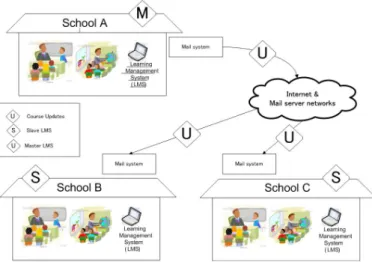
Fig. 1. Interactions among schools
certain groups of quiz questions, reviewing and revising last term questions, making new quiz, adding reference book links, etc. Modifications is announced to respective Slave LMSs by sending the differential updates.
At the other end (Slave LMSs), teachers who use the syn- chronized course as their course material may check whether modifications have taken place by checking the assigned e- mail address’s mailbox. Should the message containing up- dates exist, teachers can carry out synchronization process by executing a button in the Slave LMS web user interface.
Figure 1 illustrates the synchronization among LMSs in three schools (A,B,C). School A behaves as a Master LMS which shares the course to group of Slave LMSs (School B and C). When the modification has been made at School A, the updates will be sent through e-mail system immediately after the author announced. A notification will appear at the receiving end of respective course when the updates reach the Slave LMS’s mailbox. Update arrival might be vary between School B and C which depends on network condition and availability, for example, some schools with dial-up connection may check the mailbox periodically rather than continuously.
B. Differential Synchronization
Differential synchronization is employed to address the bandwidth concern and the growing content size. Synchroniza- tion process will not deal with the whole latest version of the content. Instead, only the changed parts are taken into account.
Because of dissimilar structure among tables within LMS’s database, normalized form so-called synchronization table is necessary. The changed parts are the relative complement between the latest synchronization table’s set of hashes and versions with the previously saved one [12], and later being sent to Slave LMSs by means of e-mail infrastructure.
C. Implementation
This subsection describes the components of the system.
LMS term refers to Moodle, the open source Learning Man-
agement System. Moodle is chosen due to its modularity and
Fig. 2. Components of synchronization
open source. In essence, Master LMS and Slave LMS com- municate in order to maintain the consistency of replicas of both sides by exchanging partial information through several components as a regard of optimistic replication [13]. Figure 2 shows the general architecture and interactions among the components.
Master LMS is responsible for providing course updates whenever modifications take place. The replicas are actually the latest version of course content in normalized form so- called synchronization table which is generated by Course Packer. In short, Course Packer transforms a raw Moodle’s table into synchronization table. Later, Moodle synchronizer will determine the updates, and send them to Slave LMS’s assigned mail address through specified MTA.
Slave LMS takes place as the passive side of such synchro- nization scheme. The assigned e-mail address’s mailbox will receive updates coming from Master LMS. Slave synchronizer is responsible for both check the updates on mailbox and applying them into the respective LMS. After the particular message containing updates is retrieved, Slave synchronizer will store it in the synchronization table and mark it in order to avoid further retrieval in the future. Up until this point, the teacher at Slave LMS will be notified whether the new updates has been arrived, furthermore it is teacher’s decision whether to apply the updates or not. More detailed diagram of relationship between e-mail system and synchronization components is shown in Fig 3.
V. R
UNNING EXAMPLEThis section describes a running example scenario to show the functionality of the system. This section comprises several parts to show for each step of operation. Before going further, consider about the case of synchronization between School A and School B which acts as a Master LMS and Slave LMS respectively. School B has provided e-mail address to hold all the updates that will come while School A has already set the B’s email address as one of its Slave LMS. The objective is to synchronize course content of School A into School B.
(a)
(b)
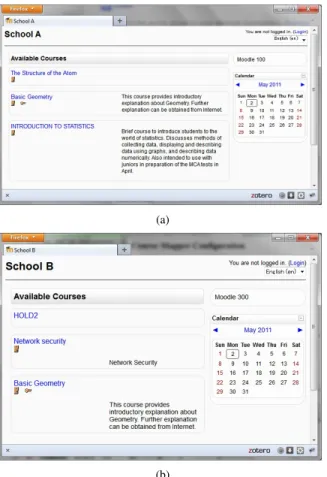
Fig. 4. Screenshot of School A and School B before synchronization: (a) course list of School A; (b) course list of School B
A. Initial condition
Firstly, School A will have several courses, and, one of those courses will be regularly sent to the Slave LMS (Introduction to Geometry). At the beginning, School B does not have such course. Please notice, that course named HOLD1 and HOLD2 are meant to be the temporary empty holder for the synchro- nization. Each particular course will have its own holder in Slave LMS which remains throughout the synchronization.
Figure 5 shows the screenshot of both School A and School B before synchronization.
B. First time updates
Master synchronizer configuration display as shown in Fig 5(a) provides options of which courses are meant to be provided. To make it ready for synchronization, particular course needs to be turned on in this configuration. After clicking apply, the preferred courses will be processed as shown in Fig 5(b).
C. First time synchronization, at School B
Before synchronization takes place, a course map needs
to be assigned. Such map describes map between remote
course and local course id which is used for holding up
the synchronized content. To check if e-mail updates already
arrived, the user/teacher at School B needs to click the ”Check
Fig. 3. Detailed diagram of components
(a)
(b)
Fig. 5. The process of sending updates: (a) Master synchronizer; (b) Progress during sending updates
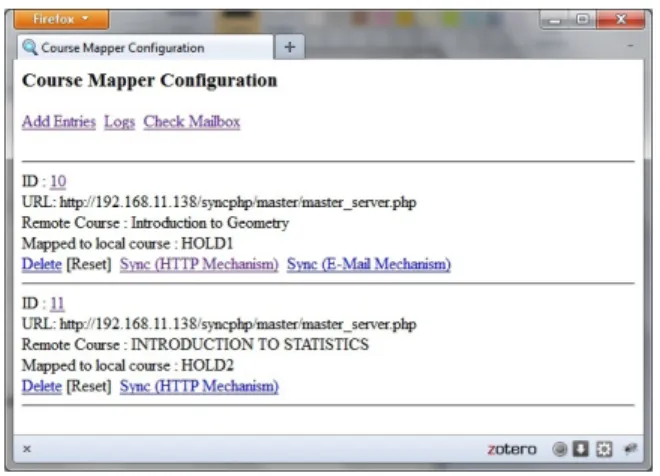
Fig. 6. Course mapper after particular updates arrive
Mailbox” link. Should the updates exist, the link ”Sync (E- Mail mechanism)” will be shown at respective course id.
Figure 6 shows the display after mailbox has been checked and ready for course ”Introduction to Geometry” to be syn- chronized through e-mail. Figure 7 shows some parts of the e-mail content. To apply the updates into the actual course, the user/teacher needs to click ”Sync (E-Mail mechanism)” link.
Fig. 7. E-mail content of updates for course ”Introduction to Geometry”
Fig. 8. Course list at School B after synchronization
Afterwards, the respective course content will updated with the latest change as shown in Fig 8. Up to this point, a cycle of synchronization process has completed.
D. Modification takes place at School A, course description and title are changed
Modification may happen in School A as a course provider
due to the process of reviewing and correction. In this sub-
section, changing course description and course title is carried
out to show the result of differential synchronization. After
getting through the same process as above, the e-mail updates
are sent. School B receives the updates and apply it to the
(a)
(b)
Fig. 9. Screenshot of School A and School B after the last synchronization:
(a) course list of School A; (b) course list of School B
Fig. 10. E-mail size comparison between the first synchronization and the last synchronization
respective course. The result of such process can be seen at Fig 9. The course title at School A has changed to ”Basic Geometry” while School B have the similar change after performing synchronization. Figure 10 shows the list of e-mail updates received in School B mailbox viewed using Mozilla Thunderbird [14]. First e-mail reflects to the process described in subsection B. The e-mail size is quite large since it is the first synchronization process. However, in the second e-mail
as a result of process described in subsection D, e-mail size is very small since the modification only take a small part.
VI. C
ONCLUSION ANDF
UTUREW
ORKSIn this paper, a new architecture of e-mail based course syn- chronization system between distributed learning management systems is presented. The objective is met when distributed learning management systems provide the same courses and their courses and contents are the result of synchronization performed by means of the differential content delivery us- ing e-mail system. In the examined prototype system, the synchronization of contents between only two learning man- agement systems, from server to client, is examined using e-mail system. As future works, the proposed architecture would be expanded to multiple clients environment. Also, data compression algorithm is necessary to be implemented in order to reduce the size of differential content while delivering.
R
EFERENCES[1] Moodle website. http://www.moodle.org, accessed April 2011.
[2] J. Watanabe, T. Ishimura, Y. Chisaki, T. Usagawa, Technical Report of IEICE, ET2008-70, pp. 77-80 (2008.12.13) (In Japanese).
[3] Tsuyoshi Usagawa, Achmad Affandi, Bekti Cahyo Hidayanto, Meita Rumbayan, Toshiro Ishimura, Yoshifumi Chisaki. Dynamic Synchro- nization of Learning Contents among Distributed Moodle Systems, In Proceeding of the 25th Annual Conference of JSET, e2a-245-06, pp.
1011-1012, 2009.
[4] Achmad Affandi, Arif Firmansyah, Bekti Cahyo Hidayanto, Toshiro Ishimura,Yoshifumi Chisaki, Tsuyoshi Usagawa. Performance of unidi- rectional LMS synchronization in various network capacity. In Proceeding of The Asian Conference on Education 2009, pp. 1241-1246, 2009.
[5] Klensin, J., Simple Mail Transfer Protocol, RFC 5321, October. 2008.
[6] Kazuyoshi Sonoda,Toshiro Ishimura, Bekti Cahyo Hidayanto, Achmad Affandi, Yoshifumi Chisaki, Tsuyoshi Usagawa. Synchronization of Multiple Learning Management Systems in order to share the learning contents over band limited network, In Proceeding of the 3rd International Student Conference on Advanced Science and Technology (ICAST), pp.
205-206, 2009.
[7] Royyana Muslim Ijtihadie, Bekti Cahyo Hidayanto, Achmad Affandi, Yoshifumi Chisaki, Tsuyoshi Usagawa. Using E-mail System For De- livering Unidirectional Synchronization Among Learning Management Systems in Limited Bandwidth Environment, Proc. The 6th International Conference on Information and Communication Technology and Systems, pp.3.7–3.11, 2010.09
[8] P. Resnick. Internet Message Format, RFC 5322, October. 2008.
[9] Myers, J.,Rose, M., Post Office Protocol version 3, RFC 1939, May.
1996.
[10] Crispin, M., Internet Message Access Protocol - Version 4rev1, RFC 3501, March. 2003.
[11] Borenstein, N., Freed, N., Multipurpose Internet Mail Extension (MIME) part one: Format of Internet Message Bodies, RFC 2045, November. 1996.
[12] Royyana M. Ijtihadie, Achmad Affandi, Bekti Cahyo Hidayanto, Yoshi- fumi Chisaki, Tsuyoshi Usagawa. Using Hash Based Method for Effi- cient Delivery in Content Synchronization among Learning Management Systems Over Limited Bandwidth Network. In Proceeding of the 5th International Student Conference on Advanced Science and Technology (ICAST), Kumamoto, pp. 259-260, 2010.
[13] Yasushi Saito, Marc Shapiro. Optimistic replication. ACM Computing Surveys Volume 37 Issue 1, pp. 42-81, 2005.
[14] Thunderbird, Mozilla Messaging. http://www.mozillamessaging.com/en- US/thunderbird/. accessed April 2011.