Uptake of Cycloalkanes and Bicyclic Aromatic Compounds by Ion‑Exchange Resins from Aqueous Solutions
journal or
publication title
Analytical Sciences
volume 21
number 12
page range 1541‑1544
year 2005‑12
URL http://hdl.handle.net/2298/11011
doi: 10.2116/analsci.21.1537
2005 © The Japan Society for Analytical Chemistry
Notes
Uptake of Cycloalkanes and Bicyclic Aromatic Compounds by Ion-Exchange Resins from Aqueous Solutions
Isao Sanemasa,1" Megumi Izuno, and Yuka Fujn
Department of Science, Faculty of Science, Kumamoto University, Kurokami 2-39-1, Kumamoto 860-8555, Japan
The uptakes of cycloalkanes (C5 - C«) and bicyclic aromatic compounds (naphthalene, biphenyl, and azulene) by both strong acid cation (Dowex 50W-X4 and X8) and strong base anion (Dowex 1-X4 and X8) exchange resins have been studied in aqueous solutions at 25°C; their distribution constants (K) have been determined. The relationship between the octanol-water partition coefficient and the resin affinity for solutes has been analyzed. The K values of three aromatic compounds were found to be much higher than expected from the octanol-water partition coefficients. This is probably due to the n interaction of aromatic rings with the resin matrix. Microscopic observations revealed that azulene molecules are uniformly distributed inside a resin particle.
(Received July 1, 2005; Accepted October 11, 2005)
It is well known that organic weak electrolytes and organic ions of various types are taken up by ion-exchange resins via adsorption or absorption in an aqueous medium.1-2 There have been, however, few studies on nonpolar nonelectrolytes, probably because of their high volatility and low solubility in water. Nevertheless, such solutes are useful to shed light on the inherent interactions between a nonpolar molecule and the resin matrix in an aqueous phase.
We recently studied the uptake of alkanes and alcohols by ion-exchange resins and demonstrated that the hydrophobic interaction plays an important role.3 The present uptake work is concerned with cycloalkanes (C5 - C8) and bicyclic aromatic compounds (naphthalene, biphenyl, and azulene). Some workers have reported that aromatic species interact more strongly with the resin matrix than aliphatic ions containing an identical number of carbon atoms.45 On the contrary, chromatographic studies suggest that the 7i-electron interaction with the resin matrix is less important than the hydrophobic interaction.6
This study was undertaken to compare the affinity of cycloalkanes for resins with that of alkanes, to provide insight into the uptake mechanism, and to elucidate whether n-n interactions between aromatic solutes and the resin matrix contribute to solute uptake by the resin. The results obtained in this work help us to understand the characteristic behaviors of ion-exchange resins toward nonpolar nonelectrolytes in an aqueous medium.
Experimental
MaterialsThe ion-exchange resins used in this study, Dowex 50W and Dowex 1, and their conditionings were described previously.3 Solutes, except for azulene studied here, were of analytical
f To whom correspondence should be addressed.
E-mail: [email protected]
grade commercially available from Wako Pure Chemical Co., and were used as received. Azulene was supplied by Dr.
Shigeru Kikuchi (an organic chemist) of Kumamoto University.
Deionized distilled water was used throughout the experiments.
Measurements of solute uptake by resins
As described in a previous paper,3 a vapor-circulation technique was used to prepare aqueous solutions saturated with each solute at 25°C. The vapor was circulated in a closed system for a prescribed time to reach equilibrium: 10 min for cycloalkanes, 3 h for naphthalene, biphenyl, and azulene.
After equilibrium had been reached, the aqueous solution containing resin particles was transferred to a centrifuge tube of 10 cm3 capacity. The supernatant was removed, and a 2 to 5 cm3 portion of a suitable extracting solvent was added. Then, the stoppered centrifuge tube was vigorously hand-shaken, and finally centrifuged for 10 min at 3000 r.p.m. This extraction was repeated successively three times, and each extract was combined to determine the solute amount.
The content of the centrifuge tube after successive extractions was transferred to a sintered glass filter and the recovered resin particles were washed with water by suction. The glass filter with resin was dried at 80°C and weighed.
As an extracting solvent, cyclohexane was used for cycloheptane and three aromatic compounds, and octane was employed for the other three cycloalkanes. In the cases of aromatic compounds, a 5 cm3 portion of ethanol was added before the extraction with cyclohexane (extractions of these solutes were incomplete in the absence of ethanol). Internal standards used to determine cycloalkanes were as follows:
cyclohexane for cyclopentane, hexane for cyclohexane and cyclooctane, and cyclooctane for cycloheptane.
For measuring of cycloalkanes, the extract was applied to a Shimadzu GC 14B gas chromatograph: an SE-30 column and FID were used. For aromatic compounds, UV absorption measurements were made on a Hitachi U-2800 spectrophotometer using quartz cells of 10-mm path length at 274.4 (naphthalene), 246.8 (biphenyl), and 341.6 nm (azulene).
ANALYTICAL SCIENCES DECEMBER 2005, VOL. 21
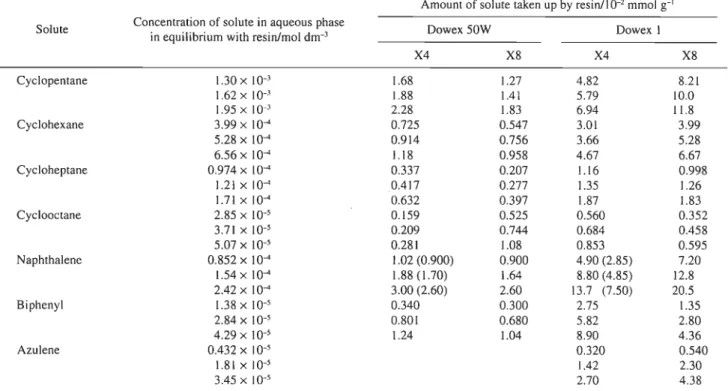
Table 1 Experimental data for the uptake of cycloalkanes and bicyclic aromatic compounds by ion-exchange resins of 100 - 200 mesha at 25°C
Amount of solute taken up by resin/10"2 mmol g~
Solute Concentration of solute in aqueous phase
in equilibrium with resin/mol dm"3 Dowex 50W X4
1.68 1.88 2.28 0.725 0.914 1.18 0.337 0.417 0.632 0.159 0.209 0.281 1.02(0.900) 1.88(1.70) 3.00 (2.60) 0.340 0.801 1.24
X8 1.27 1.41 1.83 0.547 0.756 0.958 0.207 0.277 0.397 0.525 0.744 1.08 0.900 1.64 2.60 0.300 0.680 1.04
Dowex 1 X4 4.82 5.79 6.94 3.01 3.66 4.67 1.16 1.35 1.87 0.560 0.684 0.853 4.90 (2.85) 8.80 (4.85) 13.7 (7.50)
2.75 5.82 8.90 0.320 1.42 2.70
X8 8.21 10.0 11.8 3.99 5.28 6.67 0.998
1.26 1.83 0.352 0.458 0.595 7.20 12.8 20.5 1.35 2.80 4.36 0.540 2.30 4.38 Cyclopentane
Cyclohexane
Cycloheptane
Cyclooctane
Naphthalene
Biphenyl
Azulene
1.30 x lO"3 1.62 x lO"3 1.95 x 10⁻³ 3.99 x 10J 5.28 x l(y 6.56 x 10⁻¹ 0.974 x I0-1 1.21 x 10-"
1.71 x iO-4 2.85 x 10"5 3.71 xlO"3 5.07 x lO"5 0.852 x 10^
1.54 x 10⁻¹ 2.42 x 10^
1.38 x lO"5 2.84 x lO"5 4.29 x 10"5 0.432 x 10-' 1.81 x JO"5 3.45 x I0"5
a. Data for the resin of 200 - 400 mesh are shown in parentheses.
Fig. 1 Micrographs (magnification 60 times) of resin particles (Dowex 1-X4, 20 - 50 mesh) before the uptake run (a), after contact with azulene in aqueous solution (b), its vertical sectional view (c), after being allowed to stand to the vapor of azulene (d), after contact with an anionic dye (Acid Red I) in aqueous solution (e), and its vertical sectional view (f).
The concentrations of cycloalkanes and azulene in saturated aqueous solutions were measured in this study, while the solubility data on the other aromatic compounds were taken from our previous study.7
We have also studied phenanthrene and anthracene, though it took a very long time for these solutes to reach equilibrium;
aqueous solutions can be saturated in 6 h for phenanthrene and in 20 h for anthracene, while it takes several days in the presence of resins. The present vapor-circulation technique is unsuitable for such a long-time circulation. In the case of azulene, its uptake to cation-exchange resins cannot be measured, because, in these cation exchangers, azulene molecules are rapidly changed to azulenium ion (dark green color) to a considerable extent.
Results and Discussion
The amount of solute taken up by resins, expressed in mmol per gram of dry resin, is summarized in Table 1 together with the solute concentration in equilibrium with the resin in mol dm"3.
The amount of solute taken up by the resin was found to be directly proportional to the solute concentration in the aqueous solution, as demonstrated in a previous study.3
Azulene, an isomer of naphthalene, is convenient for visual observations. We examined resin particles (Dowex I-X4, 20 - 50 mesh) before and after uptake runs by a microscope (Fig. 1).
The aqueous solution saturated with azulene was light blue, and resin particles before the run (a) gradually turned deep blue during contact with a saturated azulene aqueous solution for 3 h (b). A vertical sectional view (c) shows that the particle is uniform in color. Another sectional view (d), on the other hand, indicates that the blue color does not extend to an internal zone of the resin particle, which was prepared under conditions that the resin had been placed in a sealed bottle together with
Table 2 Distribution constant of solutes by ion-exchange resins at 25 °C
Solute
Cyclopentane Cyclohexane Cycloheptane Cyclooctane Naphthalene Biphenyl Azulene
logW
3.00 3.44 3.91 4.45 3.30 4.06 3.20
Dowex 50W X4 11.9 17.8 36.0 55.8 123(108)
286 X8 9.26 14.4 22.8 20.4 107 241
£Vml g"1 Dowex 1 X4 36.0 71.3 112 178 568(312) 2.07 x 10³
784
X8 61.6
101 105 120 843 1.01 xlO3 1.27 xlO3
bo o
a. The distribution constant is defined as follows: K = (the amount of solute taken up by the resin in mmol/g of dry resin)/(the solute concentration in the aqueous solution in mmol/ml). Data for the resin of 200 - 400 mesh are shown in parentheses.
b. Octanol-water partition coefficient (Ref. 10).
azulene particles separately in space for 5 days. The differences in these sectional views suggest that azulene molecules are taken up by the resin via partition in the aqueous medium, while they are adsorbed on the resin surface in the gaseous phase.
Figure 1 shows two additional micrographs observed for a C.I.
Acid Red 1. This anionic dye is considered to adsorb on the anionic exchanger by ion-exchange. The resin turned deep red as soon as it was added to a dilute (ca. 10~5 M) aqueous dye solution (e), and its vertical sectional view (f) bears a resemblance to the micrograph (d).
It is noteworthy that the diffusion of a cationic dye (Rhodamine B) in a cation-exchange resin particle is very slow,8 while that of azulene is relatively fast. This may be due not only to the difference in the solute migration process in the resin phase, ion-exchange or partition, but also to the difference in the solute molecular size. In fact, we have observed in this work that phenanthrene and anthracene migrate very slowly in the resin phase.
It should be noted that the amount of naphthalene taken up by the resin is smaller for the small size resin (200-400 mesh) than for the larger one (100 - 200 mesh). This observation may also support that the uptake mechanism is governed by partition rather than adsorption, because the smaller size resin is favorable for adsorption.9
For the sake of comparing the relative affinity values of the resin toward each solute, we used a distribution constant (AT), defined in a previous paper,3 as follows:
„_ (the amount of solute taken up by the resin in mmol/g of dry resin)
~~ (the solute concentration in the aqueous solution in mmol/ml)
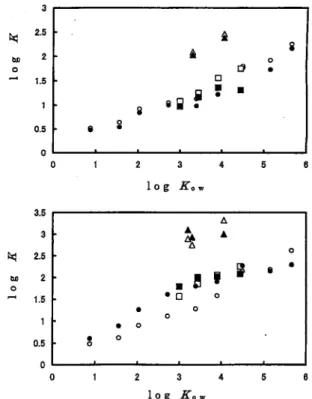
The K value corresponds to the slope of a straight line of the related data given in Table 1, and is a hypothetical solute amount (mmol/g of dry resin) at an aqueous solute concentration of 1 M. The results are listed in Table 2 together with the octanol-water partition coefficient (Ko*) taken from the literature.10 The logarithmic relationship between the K and KOw values is plotted in Fig. 2, where our previous data on alkanes (Cs - C9) and alcohols (C4 - C7)3 are illustrated by relatively small circles for a comparison. It can be seen at a glance that the plots of cycloalkanes are in the range of those of alkanes.
The amount of cycloalkanes taken up by the resin increases with the ring size, and their K values are consistent with their
3 2.5 2 1.6 1 0.5 0
• s
8 9
y a
■
8
o
a •
m
Fig. 2 Relationships between log K and log Kov/ for cation exchange resins (upper) and anion exchange resins (lower). The solid marks indicate the data for 8% cross-linked resins. Our previous data for alkanes and alcohols are indicated by small circles, while cycloalkanes are indicated by squares, and aromatic compounds by triangles.
own Kov/ values. That is, a hydrophobic interaction plays an important role in the uptake of these saturated aliphatic compounds by the ion-exchange resins used in this work. Some data have been reported that support a hydrophobic interaction.3'5*611'12 Of these, selective coefficients of amino acids toward a strong cation exchanger11 and those of chlorophenols toward a strong anion exchanger12 have been related to Kow.
Table 2 and Fig. 2 show that the uptakes of naphthalene, biphenyl, and azulene are promoted to considerable extents.
This seems to suggest that compounds with aromatic rings interact with the aromatic n systems of the resin matrix. It has been pointed out that free electrons at the carbon-carbon double bond interact with the aromatic % systems of the resin matrix.5 The present results support this tc-tc interaction.
Ion-exchange resins swell in an aqueous solution owing to the presence of functional groups. Nonpolar nonelectrolytes brought within the resin phase interact with a hydrophobic styrene-divinylbenzene copolymer matrix. The affinity of the resin for nonpolar solutes is influenced not only by the solute- matrix interaction, but also by the functional group of the resin.
The N(CHs)3+ group exhibits a salting-in effect, while the SO3"
group shows a salting-out effect inside the resin phase.3*6 This is probably the reason that the affinity of an anion exchanger is greater than that of a cation exchanger for nonpolar nonelectrolytes.
It is generally said that the amount of solutes absorbed or adsorbed by ion-exchange resins decreases with increasing cross-linking of the resin.2-13 Our present and previous data,3 however, have revealed that this is only true for the cation exchanger. For the anion exchanger, the X8 type uptakes more n-alkanes of C number up to 7 and more cycloalkanes up to 6
ANALYTICAL SCIENCES DECEMBER 2005, VOL. 21
than does the X4 type. The solute molecular size seems to be another factor that affects the relative affinity of the anion exchanger.
Acknowledgements
The authors are thankful to Dr. Shigeru Kikuchi of Kumamoto University for his presentation of azulene.
References
1. C. W. Davies and G. G. Thomas, J. Chem. Soc, 1951, 2624.
2. D. Reichenberg and W. F. Wall, J. Chem. Soc, 1956, 3364.
3. I. Sanemasa, M. Nakahara, and J.-Z. Zheng, Anal. Sci., 2003,19, 949.
4. R. L. Gustafson and J. A. Lino, Ind. Eng. Chem. Prod. Res.
Develop., 1968, 7, 116.
5. G. E. Janauer and I. M. Turner, J. Phys. Chem., 1969, 73, 2194.
6. L. M. Jahangir, L. Olsson, and O. Samuelson, Talanta, 1975, 22, 973.
7. I. Sanemasa, K. Ishibashi, M. Kumamaru, and T. Deguchi, Bull. Chem. Soc. Jpn., 1989, 62, 2908.
8. H.-B. Kim, M. Hayashi, K. Nakatani, N. Kitamura, K.
Sasaki, J. Hotta, and H. Masuhara, Anal. Chem., 1996, 68, 409.
9. B. Tamamushi and K. Tamaki, Trans. Faraday Soc, 1959, 55, 1013.
10. M. H. Abraham, H. S. Chadha, G. W. Whiting, and R. C.
Mitchell, J. Pharm. Sci., 1994, 83, 1085.
11. T. Kawakita, T. Ogura, M. Saeki, and H. Hayasaki, Agric.
Biol. Chem., 1990, 54, 1.
12. P. Li and A. K. Sengupta, Environ. Sci. Technoi, 1998, 32, 3756.
13. J. Gregory and M. J. Semmens, J. Chem. Soc., Faraday Trans. 1,1972, 68, 1045.