熊本大学学術リポジトリ
Uptake of Alkanes and Alcohols by Ion‑Exchange Resins in Aqueous Solution
journal or
publication title
Analytical Sciences
volume 19
number 6
page range 949‑951
year 2003‑06
URL http://hdl.handle.net/2298/11010
doi: 10.2116/analsci.19.949
ANALYTICAL SCIENCES JUNE 2003, VOL. 19 2003 © The Japan Society for Analytical Chemistry
949
Notes Uptake of Alkanes and Alcohols by Ion-Exchange Resins in Aqueous Solution
Isao Sanemasa,1" Misuzu Nakahara, and Jin-Zi Zheng
Department ofEnvironmental Science, Faculty of Science, Kumamoto University, Kurokami 2-39-1, Kumamoto 860-8555, Japan
Uptake of alkane (C5 - C9) and alcohol (C4 - C7) solutes by both strong acid cation exchange resins and strong base anion exchange resins in aqueous medium has been studied. The amount of solute taken up by resins is directly proportional to the solute concentration equilibrium with resins. Hydrophobic interaction between the solute and the resin matrix appears to play an important role in the uptake phenomenon.
(Received February 21,2003; Accepted April 22, 2003)
Ion-exchange resins have been widely used to take ions up in solutions by functional groups on the resin matrix. Many investigators, on the other hand, have studied the sorption of uncharged molecules by ion-exchange resins for a long time.
The work by Davis and Thomas was the first to report that weak acids and bases were taken up by ion-exchange resins by a process of molecular adsorption.1 They observed that polar substituents reduced the solute transfer from aqueous to resin phase. Peterson and Jeffers reported that a strong base anion exchanger adsorbed some aliphatic acids at higher concentrations to an extent even beyond the ion-exchange capacity.2 Reichenberg and Wall studied the sorption of some organic acids and alcohols by strong acid cation-exchange resins and reported that the sorption was true and uniform absorption, and was not confined to the surface of the resin particles.3 It was also reported by Davies and Owen that aliphatic and phenylacetic acids were retained in greater amounts than hydrochloric acid.4 The difference was ascribed to the molecular sorption. They also reported that the molecular sorption became important with increasing molecular weight.
Tamamushi and Tamaki, who studied the adsorption of long- chain electrolytes such as cationic detergents on cation- exchange resins, reported that the adsorption of the lower homologues was chiefly of the ion-exchange type, whereas that of higher ones was a superposition of the ion-exchange type and the van der Waals adsorption type.5 The latter adsorption type in aqueous environment is usually referred to as hydrophobic interaction. Gregory and Semmens, who studied sorption of carboxylate ions by strong base anion exchangers, pointed out that hydrophobic interaction between the resin matrix and the hydrocarbon chains of the carboxylates was responsible for the increased affinity of longer chain solutes.6 Such hydrophobic interaction has been pointed out by many other workers.710
The importance of hydrophobic interaction in aqueous solution between ion exchangers and solutes with alkyl chain has been thus well realized. This is, however, derived based on using solutes that are more or less polar by nature such as organic acids and anions or aliphatic alcohols. The presence of such polar functional groups makes it difficult to evaluate the net hydrophobic interaction between a non-electrolyte molecule and the resin matrix. In the present work, we have used alkanes
f To whom correspondence should be addressed.
E-mail: [email protected]
with C5 to C9 as solutes. The data of alcohols with C4 to C7 are additionally evaluated for the sake of comparison. There have been reported so far no data on the uptake of alkanes by ion- exchange resins.
Experimental
Materials
The strong acid cation-exchange resin Dowex 50W and the strong base anion-exchange resin Dowex 1 were used: these were supplied as micro-beads of 100-200 mesh and as wt% of divinylbenzene of 4(X4) and 8(X8). Conditionings of these resins were carried out in the usual manner.11 The cation exchanger of the H+ form and the anion exchanger of the Cl~
form were air-dried, and then stored in stoppered bottles.
The other reagents used were of analytical grade commercially available from Wako Pure Chemical Co., and were used as received. Deionized distilled water was used throughout the experiments.
Measurements of alkane uptake by resins
An aqueous solution saturated with each alkane was prepared at 25°C by a vapor-circulation technique previously described;12 a graduated cylinder used in the previous device was removed in the present study. A 10 cm3 portion of liquid alkane was placed in a cylindrical separatory funnel (2.8 cm i.d. x 25 cm) and an 100 cm3 of water was placed in another separatory funnel (6.5 cm i.d., 600 cm3 capacity). The two funnels were connected together with a Viton diaphragm air pump. The alkane vapor generated by bubbling air was dispersed via a glass capillary through the aqueous solution, to which ion- exchange resin particles of 2 to 10 g were added in advance.
The vapor was circulated in a closed system for 1 h, a time found to be sufficient for the resin to reach equilibrium.
The aqueous solution containing resin particles was
withdrawn from the funnel to a centrifuge tube of 10 cm3
capacity. The supernatant was removed; a 5 cm3 portion of
cyclohexane containing a known amount of w-xylene as an
internal standard was added; then the stoppered centrifuge tube
was vigorously hand-shaken, and finally centrifuged for 10 min
at 4000 r.p.m. In the cases of heptane and 2,3-dimetylpentane,
cyclooctane was used as an extractant, and o-xylene as an
internal standard. The extract was applied to a Shimadzu GC-
950 ANALYTICAL SCIENCES JUNE 2003, VOL. 19
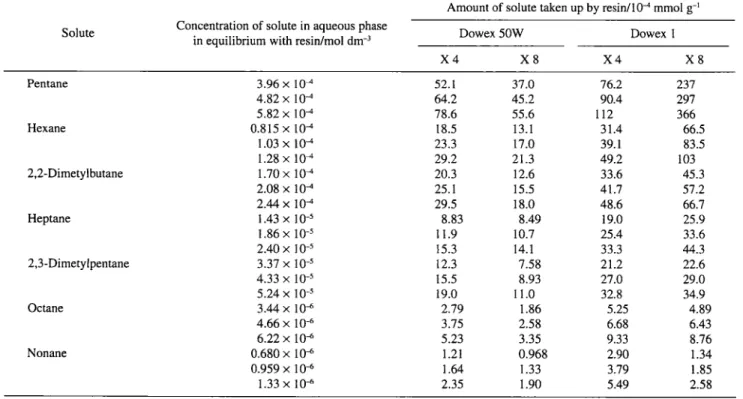
Table 1 Experimental data for the uptake of alkanes by ion-exchange resins at 25 °C
Amount of solute taken up by resin/10"4 mmol g"1 Solute Concentration of solute in aqueous phase
in equilibrium with resin/mol dm"3 Dowex X4 52.1 64.2 78.6 18.5 23.3 29.2 20.3 25.1 29.5 8.83 11.9 15.3 12.3 15.5 19.0 2.79 3.75 5.23 1.21 1.64 2.35
50W X8 37.0 45.2 55.6 13.1 17.0 21.3 12.6 15.5 18.0 8.49 10.7 14.1 7.58 8.93 11.0
1.86 2.58 3.35 0.968 1.33 1.90
Dowex X4 76.2 90.4 112
31.4 39.1 49.2 33.6 41.7 48.6 19.0 25.4 33.3 21.2 27.0 32.8 5.25 6.68 9.33 2.90 3.79 5.49
1
X8 237 297 366 66.5 83.5 103
45.3 57.2 66.7 25.9 33.6 44.3 22.6 29.0 34.9 4.89 6.43 8.76 1.34 1.85 2.58 Pentane
Hexane
2,2-Dimetylbutane
Heptane
2,3-Dimetylpentane
Octane
Nonane
3.96x10^
4.82 xlO"4 5.82 xlO"4 0.815x10^
1.03x10^
1.28x10^
1.70 xlO"4 2.08 x 10^
2.44x10^
1.43 xlO"5 1.86 xlO"5 2.40 xlO"5 3.37 xlO"5 4.33 x lO"5 5.24 xlO-5 3.44 xlO"6 4.66 xlO"6 6.22 x 10⁻⁶ 0.680 x lO"6 0.959 xlO"6 1.33 xlO-6
14B gas chromatograph: an SE-30 column and an FID were used. The concentration of each alkane in the saturated aqueous solution was not determined in this work; the data were taken from the literature.1314
The content of the centrifuge tube was transferred to a sintered glass filter and the resin particles recovered were washed with water by suction. The glass filter with resin was dried at 80°C and weighed.
Measurements of alcohol uptake by resins
Headspace GC measurements were made in the same manner as described in our previous paper.15 In the present case, five days were needed for the resin to reach equilibrium.
Results and Discussion
Aqueous solutions saturated with each alkane were prepared at 25°C, while the temperature of liquid alkane was held constant at 15, 20, or 25°C. The solute concentration in the aqueous solution shown in Table 1 was estimated from vapor pressure at each temperature of the liquid alkane. We have demonstrated in the previous work that Henry's law holds for the solubility of normal alkanes of C5 to C9 in water.12 The amount of solute taken up by ion-exchange resins expressed in mmol per g of dry resin is summarized in Table 1. For each alkane, the amount of the solute taken up by the resin was found to be directly proportional to the solute concentration in the aqueous solution.
The sorption-desorption process was found to be in equilibrium between the aqueous and the resin phases from preliminary experiments. As was demonstrated in the previous paper,16 aqueous solutions can be saturated with solute vapor by the vapor-circulation technique from either lower or higher temperature of the solute phase.
For the sake of comparison of relative affinity of the resin toward each alkane, we use a distribution constant K defined as follows:
K = (the amount of solute taken up by the resin in mmol/g of dry resin)/(the solute concentration in the aqueous solution in mmol/ml).
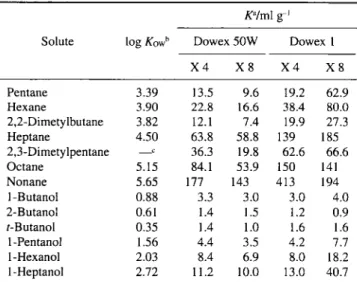
The K value corresponds to the slope of a straight line of the related data shown in Table 1. The results are listed in Table 2, which involves the K values of alcohols evaluated based on the data (the data are omitted in this paper). It can be seen from Table 2 that 1) K increases with alkyl chain length; 2) K of branched isomers (including 2-butanol) are considerably lower than those of straight-chain isomers; 3) K of anion exchanger is larger than that of cation exchanger; 4) K of alcohol is appreciably lower than that of alkane of the same C number;
and 5) # is larger for the X8 type anion exchanger than for the X4 type, while it is somewhat larger for the X4 type cation exchanger than for the X8 type.
As was pointed out by Davies and Owen, the uptake of organic solutes by anion exchangers is generally greater than that by cation exchangers.4 They attributed this to the much greater proportion of carbon in the former: hydrophobic interaction works more strongly for anion exchanger than for cation exchanger. We, however, have an alternative idea: the SO3" group may exhibit a stronger salting-out effect inside the resin than the N(CH3)3+ group does.
It has been observed that the uptake of organic ions and
alcohols increases more or less, in general, as cross-linking is
reduced. This is not the case for the present work on anion
exchanger. For anion exchangers, Gregory and Semmens have
presented an idea that, as cross-link density is decreased, ion
exchange preferences diminish (hydrophobic interaction
increases), since the interior of the resin becomes more like the
exterior aqueous phase.6 For cation exchangers, on the other
hand, Reichenberg and Wall explained, based on the salting-out
effect, that at higher degrees of cross-linking, salting-out effects
predominate.3 We try here to make a tentative explanation to
understand our present results: as cross-linking increases,
salting-out increases inside the cation exchanger with the SO3-
group, while salting-in increases inside the anion exchanger
ANALYTICAL SCIENCES JUNE 2003, VOL. 19 951
Table 2 Distribution constant of alkanes and alcohols by ion- exchange resins at 25°C
Solute
Pentane Hexane
2,2-Dimetylbutane Heptane
2,3-Dimetylpentane Octane
Nonane 1-Butanol 2-Butanol r-Butanol 1-Pentanol 1-Hexanol 1 -Heptanol
log Kowb
3.39 3.90 3.82 4.50
c
5.15 5.65 0.88 0.61 0.35 1.56 2.03 2.72
Dowex X4
13.5 22.8 12.1 63.8 36.3 84.1 177
3.3 1.4 1.4 4.4 8.4 11.2
K»/m\ g-1 50W
X8 9.6 16.6 7.4 58.8 19.8 53.9 143
3.0 1.5 1.0 3.5 6.9 10.0
Dowex 1 X4
19.2 38.4 19.9 139
62.6 150 413 3.0 1.2 1.6 4.2 8.0 13.0
X8 62.9 80.0 27.3 185
66.6 141 194 4.0 0.9 1.6 7.7 18.2 40.7 a. The distribution constant is defined as follows: K = (the amount of solute taken up by the resin in mmol/g of dry resin)/(the solute concentration in the aqueous solution in mmol/ml).
b. Octanol-water partition coefficient.
c. The data were not available.
with the N(CH3)3+ group. Quaternary ammonium ions are known to exhibit salting-in effect.17
Many investigators have suggested that ion-exchange resins take up many organic ions in aqueous environment by a process of molecular adsorption: hydrophobic interaction plays an important role. From this point of view, the relationship between the K value and the octanol-water partition coefficient, A^ow, which has been taken as an indication of a relative hydrophobicity of solutes, is plotted. The plots are shown in Figs. 1 and 2, where the data on branched isomers including 2- butanol are omitted. The #ow values are taken from the literature.18 A logarithm of K is found to be roughly proportional to log £ow and no distinct boundaries are observed between «-alkane and n-alcohol for either cation or anion exchangers. These facts observed in the present work indicate that hydrophobic interaction plays an important role in the uptake of organic solutes by ion-exchange resins. The plots of branched isomers are found to deviate to a great extent from the plots shown in Figs. 1 and 2. This may be ascribed to the steric hindrance: the cross-linking structure of the resin may reduce penetration of branched solutes through the resin.
References
1. C. W. Davies and G. G. Thomas, /. Chem. Soc, 1951, 2624.
2. S. Peterson and R. W. Jeffers, J. Am. Chem. Soc, 1952, 74, 1605.
3. D. Reichenberg and W. F. Wall, /. Chem. Soc, 1956, 3364.
4. C. W. Davies and B. D. R. Owen, J. Chem. Soc, 1956, 1681.
5. B. Tamamushi and K. Tamaki, Trans. Faraday Soc, 1959, 55, 1013.
6. J. Gregory and M. J. Semmens, J. Chem. Soc, Faraday Trans. 1,1972, 68, 1045.
7. G. E. Janauer and I. M. Turner, J. Phys. Chem., 1969, 73, 2194.
8. S. A. Maki, J. Wagsa, and N. D. Danielson, Anal. Chem.,
2.5
2.0
1.5
1.0
0.5
0
-
-
ij-Alcoho
-o
- 8 '
1
♦
8
o o
1
o
o
• •
ja-Alkane
0 12 3 4 5 6
log JTow
Fig. 1 Relationships between log K and log #ow for n-alkane and rt-alcohol. Cation exchange-resin: Dowex 50WX4 (o) and X8 (•).
2.5
2.0
1.5
1.0
0.5
0
-/z-Alcohol <-
■
■ D
■ □
- D
I i
■
□
■
■
a
□
>
1 i
D