熊本大学学術リポジトリ
Uptake of Benzene and Alkylbenzenes by Cation‑
and Anion‑Exchange Resins from Aqueous Solutions
journal or
publication title
Analytical sciences
volume 22
number 6
page range 899‑901
year 2006‑06
URL http://hdl.handle.net/2298/10916
doi: 10.2116/analsci.22.899
ANALYTICAL SCIENCES JUNE 2006, VOL. 22 2006 © The Japan Society for Analytical Chemistry
899
Notes Uptake of Benzene and Alkylbenzenes by Cation- and Anion-Exchange Resins from Aqueous Solutions
Isao Sanemasa
Department ofScience, Faculty ofScience, Kutnamoto University, Kurokami 2-39-1, Kumamoto 860-8555, Japan
Uptakes of benzene and 12 alkylbenzenes (from toluene to tt-pentylbenzene including xylene and trimethylbenzene isomers) by both strong acid cation (Dowex 50W-X4 and X8) and strong base anion (Dowex 1-X4 and X8) exchange resins have been studied in aqueous solutions at 25°C; their distribution constants (AT) have been determined. The relationship between the octanol-water partition coefficient (K<m) and the resin affinity for solutes has been analyzed. The K values of benzene and alkylbenzenes were larger than the K values of aliphatic hydrocarbons expected from the Kim values. While the K value was increased with the alkyl chain length, no further increase in the K value was observed for w-butylbenzene and /i-pentylbenzene.
(Received January 26,2006; Accepted April 11,2006)
We recently studied the uptake of alkanes and alcohols1 and cycloalkanes and bicyclic aromatic compounds2 by ion- exchange resins from aqueous solutions and demonstrated that the uptake is governed by partition rather than adsorption. We showed that the hydrophobic interaction plays an important role and that the n interaction of aromatic rings with the resin matrix contributes to solute uptake by the resin. This paper deals with benzene and alkylbenzenes. These substances have been chosen because they have both aliphatic and aromatic characteristics.
The octanol-water partition coefficient (/f()W), which is a measure of hydrophobicity, varies over a wide range for alkylbenzenes, and hence, it is convenient to compare the Km, values and the solute distribution constant (K). The present work is also concerned with benzene. Studying this basic substance is important to understand the uptake mechanism of ion-exchange resins. Chromatographic studies have revealed that anion-exchange resins hold cyclohexane much more strongly than benzene, which makes one conclude that it- electron interactions with the resin matrix are less important than the hydrophobic interaction.3
Experimental
Materials
The ion-exchange resins used in this study, Dowex 50W and Dowex 1, and their conditionings were described previously.1 Cation and anion exchangers are in the H+ and the Cl" form, respectively. Solutes were of analytical grade commercially available from Wako Pure Chemicals and Tokyo Kasei Kogyo, and were used as received. Deionized distilled water was used throughout the experiments.
Measurements ofsolute uptake by resins
As described in a previous paper,1 a vapor-circulation technique was used to prepare aqueous solutions saturated with E-mail: [email protected]
each solute at 25°C. The vapor was circulated in a closed system for a prescribed time to reach equilibrium: 30 min for the solutes used here. While it takes a quite short time (ca. 2 min) in the absence of resins to prepare aqueous solutions saturated with the solutes used in this work,4 a longer time is necessary to reach equilibrium in the presence of resins.
After equilibrium had been reached, the aqueous solution containing resin particles was transferred to a centrifuge tube of 10 ml capacity. The supernatant was removed, and a 5 ml portion of cyclohexane and a few milliliters of ethanol were added. Then, the stoppered centrifuge tube was vigorously hand-shaken, and finally centrifuged for 10 min at 3000 rpm.
The cyclohexane phase was studied with a Hitachi U-2800 spectrophotometer using quartz cells of 10-mm path length.
The content of the centrifuge tube after extraction with cyclohexane was transferred to a sintered glass filter. Next, the recovered resin particles were washed with water by suction.
The glass filter with resin was dried at 80°C and weighed. All operations were repeated three times, the results being reproducible within about ±10%.
In addition to the vapor-circulation technique, another technique was applied for the uptake of benzene by cation exchangers. This technique uses simple glass test tubes of ca.
45 ml capacity, each with a glass stopper. Each test tube was filled almost to the top with an aqueous benzene solution of suitable concentration; these test tubes were immersed in a bath thermostated at 25°C for 30 min, and then a few milliliters of the solution were taken out of the tube. Next, a known amount of dry resin (usually 1 to 2 g) was added to the solution in the test tube, and each tube was immersed in the same bath for another 30 min with occasional shaking. Finally, another few milliliters of the solution were taken out. Each aqueous benzene solution taken out of the tube was transferred to a glass test tube with a stopper, in which a 5 ml portion of cyclohexane had already been placed (the volume of aqueous solution was estimated by measuring the weight). The material was then extracted with cyclohexane; the resulting material was used for UV measurements. Since the volume of the aqueous phase in the presence of resin could be taken into account, the amount of
— 13 —
900 ANALYTICAL SCIENCES JUNE 2006, VOL. 22
Table 1 Distribution constant of solutes by ion-exchange resins at 25"C
Solute
Ren/ene Toluene Elhylhenzene f»-Xylene /w-Xylene /j-Xylene
>i-Propylbenzene 1,2,3-Trimethylhenzene 1.3,5-Trimethylbenzene 1,2.4-Trimethylbenzene lsopropylbenzene 7i-Bulylbenzene n-Penthylbenzene
log Kow*
2.13 2.73 3.15 3.12 3.20 3.15 3.72 3.66 3.59 3.56 3.66 4.38 4.90
Solute concentration range in equilibrium with rcsin/M
3.60 x 10■'- 1.99 x 10 •' 2.34 x IO'-5.27x 10 ' 9.08 x 10 A- 1.34 x 10-' 6.40x 10-*- l.60x 10 ' 6.84 x 10⁻¹- 1.45 x 10 ' 8.97 x I04- 1.31 x 10' 1.20x IO"'-4.2Ox 10' 3.56 x I0j|-5.I5x 10' 1.44 x I0^-4.00x 10 4 2.05 x 10-'-4.36x lO^1 2.50 x I0-»-5.10x lO4 1.16 x 10^-2.55 x I0-4 1.65 x 10s- l.20x I0-1
Dowex X4
II 19 29 31 34 32 55 50 72 60 40 57 50
50W
X8 7.5 13 23 23 27 25 42 38 55 47 33 55 36
KVmlg' Dowex X4 32 66
1.2 x I02 1.8 x IO:
1.8 x IO:
1.5 x I02 3.2 x I02 2.4 x I02 3.5 x I02 3.0 x IO:
2.2 x 10' 4.3 x I02 3.8 x I02
1 X8 54
1.3 x 10² 2.4 x IO:
3.1 x 10- 2.6 x |():
2.5 x \0- 8.3 x I02 4.2 x 10J 5.9 x 10- 5.5 x IO:
4.3x ll):
7.3 x IO:
4.3 x 1():
a. The distribution constant is defined as follows: K = (the amount of solute taken up by the resin in mmo!/g of dry resin)/(the solute concentration in the aqueous solution in mmol/ml). b. Octanol-water partition coefficient (Ref. 9).
(a)
1X8
1X4 0.8
0.6 0.4 0.2
0
0 0.00S 0.01 0.015 0.02
Concentration of bonaooc in qiiugous solution/M 0.25
0 0.005 001 0015 0.02
Concentration ofbenzene in aqueous solution / M
Fig. 1 The amount of benzene taken up by anion exchange resins (a) and cation exchange resins (b) against the concentration of benzene in aqueous solution in equilibrium with resins. The open symbols indicate the data obtained by an indirect method described in the text.
solute taken up by the resin could be determined. Thus, this technique is an indirect method.
Results and Discussion
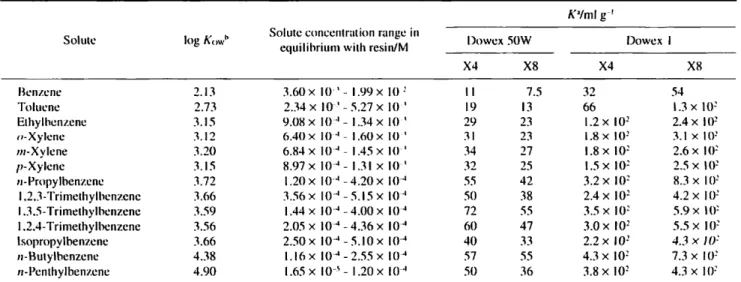
As demonstrated in our previous studies,1-2 the amount of solute taken up by the resin was found to be directly proportional to the solute concentration in the aqueous solution. Typical results are shown in Fig. I (a) for the anion exchangers using benzene
as a solute. The concentration range of each solute measured in equilibrium with resins is listed in Table 1. From the slope of a straight line, we estimated the distribution constant (K). a measure of the relative affinity of the resin toward each solute.
The distribution constant is defined as follows:
K = (the amount of solute taken up by the resin in mmol/g of dry resin)/(the solute concentration in the aqueous solution in mmol/ml).
The K value corresponds to the hypothetical solute amount (mmol/g of dry resin) at an aqueous solute concentration of I M. The results are given in Table I together with some log K,}W values taken from the literature/
The logarithmic relationships between the K and Km values are plotted by squares in Fig. 2, where, for the sake of comparison, our previous data on alkanes (Cs-O) and alcohols (C4-C7)1 and cycloalkanes (Gs-Ck)2 are illustrated by relatively small circles and our data on bicyclic aromatic compounds (naphthalene, biphenyl, and azulene)2 by relatively small triangles. Some uptake characteristics can be seen from Table I and Fig. 2 for benzene and alkylbenzenes.
The K values are higher than the values for aliphatic hydrocarbons expected from the AC«v values, particularly for anion exchangers. This suggests that the 7C-electron interaction of the benzene ring with the resin matrix (slyrcne- divinylbenzene copolymer) is present. The K values increase with KIVK values, that is, a hydrophobic interaction plays an important role. In this study, we have chosen /i-butylbenzene and /i-pentylbenzene with an expectation that their K values might be comparable to or exceed those of bicyclic aromatic hydrocarbons, because the Ktm values of alkylbenzenes increase with the alkyl-chain length. Their K values, however, did not extend beyond the n-propylbenzene value. The reason is not clear in the present stage, but longer functional groups such as butyl and penthyl may hinder the n interaction of the benzene ring with the resin matrix.
We can see from Table 1 that no appreciable differences in the K values are observed among three xylene isomers. On the other hand, as for trimethylbenzenes, when their K^ values are taken into account, the 1,3,5-isomer exhibits considerably higher affinity than the 1,2,3-isomer to both cation and anion exchangers.
A comparison of the present results with those from our previous study2 shows that the affinity of benzene to both cation
— 14 —
ANALYTICAL SCIENCES JUNE 2006, VOL. 22 901
Table 2 The amount of benzene taken up by 50W-X4 at 25°C determined by an indirect method Concentration of benzene in aqueous solution/IO"1 M
In the absence of resin In the presence of resin
Initial First step equilibrium
Second step equilibrium
Difference in concentration of benzene between first and second steps/10"2 M
Volume of water in the presence of resin/ml
Weight of dried resin/g
Amount of benzene taken
up by resin/
mmol g"1
0.524 0.744 0.972 1.20 1.65
0.504 0.710 0.911 1.15 1.55
0.360 0.511 0.666 0.818 1.09
0.144 0.199 0.245 0.332 0.46
43.4 44.0 44.0 44.8 45.0
1.646 1.606 1.614 1.703 1.678
0.038 0.054 0.067 0.087 0.12
Fig. 2 Relationships between log K and log Km, for cation exchange resins (upper) and anion exchange resins (lower). The solid symbols indicate the data for 8% cross-linked resins. Our previous data on alcohols, alkanes, and cycloalkanes are indicated by small circles, and the data on bicyclic aromatic compounds by small triangles, while data on benzene and alkylbenzenes are indicated by squares.
can be seen from Table 2, the initial concentration decreases even in the absence of resin, and the decreased proportion differs from container to container. The amount of benzene taken up by the resin was estimated indirectly by multiplying the volume of water in the presence of resin by the difference in concentration of benzene between the first and the second equilibrium steps. Under the present conditions, the weight of resin, 1 to 2 g, added to the solution gave a relatively good reproducibility. The indirect method was also applied to the 50W-X8 resin.
As shown in Fig. l(b), the plot for 50W-X4 exhibits a slightly upward curvature (/?2 = 0.9979 for a quadratic curve). This quadratic behavior seems to suggest that benzene molecules partly form dimers within the 50W-X4 cation exchange resin swollen with water. Some workers have speculated, based on vapor pressure6-7 and calorimetric8 measurements, that a small fraction of benzene molecules exists as dimers. On the other hand, some have claimed that Henry's law constant does not vary significantly, and hence, an appreciable dimerization does not occur.9 In this paper, we have estimated the K value based on a straight line (R2 = 0.9961), because we have no other evidence to support the dimerization of benzene in the 50W-X4 cation exchange resin phase.
Acknowledgements
The author is thankful to Miss Kuniko Nagatomo for her help in experiments conducted at the beginning of this study.
and anion exchangers is about a half that of cyclohexane. Based on the KIWI value, however, k interactions of the benzene ring with anion exchange resins appear to work appreciably. On the other hand, such interactions seem not to work effectively for cation exchangers. This difference probably results from the hydrophilic nature of the SOr group of the cation exchanger, while the NtCH^V group of the anion exchanger exhibits the hydrophobic nature.
The amount of benzene taken up by the 50W-X4 resin plotted vs. the benzene concentration in water in equilibrium with the resin gave a slightly upward curve, as shown in Fig. l(b). We next applied another technique, which we call an indirect method, to the cation exchangers: 50W-X4 and 50W-X8.
This indirect method consists of two steps: the first is an equilibrium step of the aqueous benzene solution in a stoppered- glass test tube in the absence of resin, and the second is a successive equilibrium step of the solute with resin. The former step is essential, because benzene molecules dissolved in water are adsorbed on the glass surface to a considerable extent. As
References
1. I. Sanemasa, M. Nakahara, and J.-Z. Zheng, Anal. ScL, 2003, 19, 949.
2. I. Sanemasa, M. Izuno, and Y. Fujii, Anal. ScL, 2005, 21, 1541.
3. L. M. Jahangir, L. Olsson, and O. Samuelson, Talanta, 1975, 22, 973.
4. I. Sanemasa, M. Araki, T. Deguchi, and H. Nagai, Bull.
Chem. Soc. Jpn., 1982,55, 1054.
5. M. H. Abraham, H. S. Chadha, G. W. Whiting, and R. C.
Mitchell, J. Pharm. ScL, 1994, 83, 1085.
6. E. E. Tucker and S. D. Christian, J. Phys. Chem., 1979, 83, Aid.
7. E. E. Tucker, E. H. Lane, and S. D. Christian, J. Solution Chem., 1981, 10, 1.
8. D. H. I. Wadso, D. J. Wasserman, C. H. Robert, and S. J.
Gill, J. Phys. Chem., 1988, 92,3623.
9. W. J. Green and H. S. Frank, J. Solution Chem., 1979,8, 187.
— 15 —