Lanka: a taxonomic research summary and updated checklist
Author Ratnayake Kaluarachchige Sriyani Dias, Benoit Gue?nard, Shahid Ali Akbar, Evan P. Economo, Warnakulasuriyage Sudesh Udayakantha, Aijaz Ahmad Wachkoo
journal or
publication title
ZooKeys
volume 967
page range 1‑142
year 2020‑09‑14
Publisher Pensoft Publishers
Rights (C) Ratnayake Dias et al.
Author's flag publisher
URL http://id.nii.ac.jp/1394/00001571/
doi: info:doi/10.3897/zookeys.967.54432
Creative Commons Attribution 4.0 International(https://creativecommons.org/licenses/by/4.0/)
The Ants (Hymenoptera, Formicidae) of Sri Lanka: a taxonomic research summary and updated checklist
Ratnayake Kaluarachchige Sriyani Dias
1, Benoit Guénard
2, Shahid Ali Akbar
3, Evan P. Economo
4, Warnakulasuriyage Sudesh Udayakantha
1,
Aijaz Ahmad Wachkoo
51 Department of Zoology and Environmental Management, University of Kelaniya, Sri Lanka 2 School of Biological Sciences, The University of Hong Kong, Hong Kong SAR, China 3 Central Institute of Temperate Horticulture, Srinagar, Jammu and Kashmir, 191132, India 4 Biodiversity and Biocomplexity Unit, Okinawa Institute of Science and Technology Graduate University, Onna, Okinawa, Japan 5 Department of Zoology, Government Degree College, Shopian, Jammu and Kashmir, 190006, India
Corresponding author:
Aijaz Ahmad Wachkoo ([email protected])
Academic editor:
Marek Borowiec | Received 18 May 2020 | Accepted 16 July 2020 | Published 14 September 2020
http://zoobank.org/61FBCC3D-10F3-496E-B26E-2483F5A508CDCitation:
Dias RKS, Guénard B, Akbar SA, Economo EP, Udayakantha WS, Wachkoo AA (2020) The Ants (Hymenoptera, Formicidae) of Sri Lanka: a taxonomic research summary and updated checklist. ZooKeys 967: 1–142.
https://doi.org/10.3897/zookeys.967.54432
Abstract
An updated checklist of the ants (Hymenoptera: Formicidae) of Sri Lanka is presented. These include representatives of eleven of the 17 known extant subfamilies with 341 valid ant species in 79 genera. Lio- ponera longitarsus Mayr, 1879 is reported as a new species country record for Sri Lanka. Notes about type localities, depositories, and relevant references to each species record are given. Accounts of the dubious and some undetermined species from Sri Lanka are also provided. 82 species (24%) are endemic whereas 18 species that are non-native to Sri Lanka are recorded. The list provides a synthesis of the regional taxo- nomical work carried out to date and will serve as a baseline for future studies on the ant fauna of this biodiversity hotspot.
Keywords
Ants, checklist, endemism, Formicidae, Sri Lanka
https://zookeys.pensoft.net
Copyright Ratnayake Dias et al. This is an open access article distributed under the terms of the Creative Commons Attribution License (CC BY 4.0), which permits unrestricted use, distribution, and reproduction in any medium, provided the original author and source are credited.
Launched to accelerate biodiversity research
Table of contents
Introduction ... 2
Materials and methods ... 4
Data sources ... 4
Arrangement ... 4
Results and discussion ... 5
Endemic species ... 8
Non-native species ... 11
Misidentifications and dubious/erroneous records ... 11
Checklist ... 15
Acknowledgements ... 120
References ... 120
Supplementary material 1 ... 141
Supplementary material 2 ... 142
Introduction
Sri Lanka is an island country located in the Indian Ocean, with latitudes ranging from 5°55'N to 9°51'N and longitudes from 79°41'E to 81°53'E. The country has a length of 432 km (268 miles) and a maximum width of 224 km (139 miles), with an area of 65,610 km
2. Three distinct tropical climatic zones are prevalent in the region, the ‘wet’, ‘dry’, and ‘intermediate zones’ based on seasonal precipitation distribution.
These regions receive more than 2,500 mm; less than 1,750 mm, and between 1,750 to 2,500 mm of rain respectively with average annual temperature ranging from 28 °C to 31 °C (Karunaweera et al. 2014).
The island is part of the same shallow continental shelf as India, and is only sepa- rated by an inlet of the Bay of Bengal known as the Palk Strait (Pathirana 1980; So- masekaram 1997). This 40 to 85 mile-wide and approximately 85 miles-long strait separates southeastern India and northern Sri Lanka (Vaz 2000). Historically, with high faunal affinities observed across the Palk Strait, the concept of Ceylonese or Lankan biogeographic region was conceived (Wallace 1876; Chandran 1997). More recently, both areas were considered together as the Western Ghats – Sri Lanka biodiversity hot- spot, representing a single seasonal wet region in the whole of South Asia (Myers 1988;
Mittermeier et al. 2004). This region on the basis of three factors: high numbers of en- demics and endemic species/area ratios for both plants and vertebrates, and habitat loss is considered as one of the main hotspots of the world (Myers et al. 2000). Despite sev- eral extended periods of land connection during the past 500,000 years, Sri Lanka has maintained a fauna that is largely distinct from that of the Indian mainland (Bossuyt et al. 2004). Unfortunately, this pattern has been tested for only a limited number of taxa in plants, vertebrates, or invertebrates, due to the limitation of data available. The proportion of endemic species in plants is ~ 25%, vertebrates ~ 30%, and invertebrates
~ 43% in the groups studied in depth (Bossuyt et al. 2004; Gunawardene et al. 2007;
Gunatilleke et al. 2008). Such variation in endemism and its understanding at finest possible scales will help to develop conservation management programs for the entire region (Gunawardene et al. 2007; Dad et al. 2019).
Sri Lanka is known for its remarkable biodiversity and considered to be one of the richest countries in the Asian region in terms of species concentration with regard to mam- mals, reptiles, amphibians, fish, and flowering plants (NARESA 1991). The highest spe- cies diversity is recorded among the flowering plants (3771 species), followed in decreasing order by the fungi (~ 2260), bryophytes (788), freshwater algae (~ 560) and ferns (314) (Gunatilleke et al. 2008). Among animals, the diversity of vertebrates is well known in comparison to that of invertebrates, where only a few groups have been studied in depth (Gunatilleke et al. 2008). With rapidly decreasing forest cover (Mattsson et al. 2012) more and more species are increasingly threatened; with to this date 27% of birds, 66% of amphibians, 56% of mammals, 49% of freshwater fish, 59% of reptiles, and 44% of flowering plants classified as threatened under the IUCN Red List categories (MOE 2012;
CBD 2020). The limited number of trained taxonomists, lack of initiative to explore the biodiversity and the loss of primary forest cover are currently the biggest drawbacks in the conservation of biodiversity in Sri Lanka (Bawa et al. 2007). In particular, knowledge on the entomofauna of Sri Lanka is particularly limited, with comprehensive species check- lists only available for a handful of taxonomic groups: such as bees, butterflies and Odo- nata (Karunaratne et al. 2012; van der Poorten 2012; van der Poorten and Conniff 2012).
Over the past 170 years, the exploration of the ant fauna of Sri Lanka has received sporadic attention and has, since its origin and for long, been dominated by European and later American scientists. Studies of Sri Lankan ants, or including specimens from the country, include in approximate chronological order, were conducted by F. Smith (1853, 1858), Roger (1860–63), Mayr (1862, 1865, 1866, 1868, 1879, 1897), Motschoulsky (1863), Emery (1887a, d, 1893a, b, c, d, 1895a, 1896, 1897b, 1901, 1911, 1912, 1922, 1925), Forel (1892a, b, c, 1893a, b, 1894, 1895a, b, 1900a, b, 1901a, 1902a, b, c, 1903a, b, c, 1904a, 1907a, b, 1908, 1909, 1911a, b, c, e, 1912a, c, d, 1913a, b), Wheeler (1919b, 1942), Karavaiev (1925a, b, c, 1926, 1929, 1933, 1935), Santschi (1928), Donisthorpe (1931, 1941, 1942a, b, c), Menozzi (1935), Chapman and Capco (1951), Brown (1954, 1958–59, 1975, 1978), Wilson et al. (1956), Gregg (1957), Wilson (1958a, b, 1964), Walker (1859–60), Bolton (1974a, b, 1975–77, 1980, 1982, 1987, 1992, 1995, 2000, 2007), Baroni Urbani (1975, 1977a, b), Moffett (1985–86), Baroni Urbani and De An- drade (1994, 2006–07), Rigato (1994), Dorow and Kohout (1995), Way and Bolton (1997), Rickson and Rickson (1998), Schödl (1998), Ward (2001), Seifert (2003), Alpert (2013), Lattke and Delsinne (2016), Seifert et al. (2017) and others. Bingham (1903) was the first author to summarize the ants of Sri Lanka (Ceylon) recording 135 species in 52 genera under five subfamilies within his checklist of ants also including India and Burma.
In recent decades, Sri Lankan authors have contributed to the taxonomic and eco- logical study of ants including: Dias (2002, 2006a, 2014), Gunawardene et al. (2008, 2010, 2012), Dias and Kosgamage (2012), Dias and Rajapaksa (2016), Dias et al.
(2012, 2018) and Yamane and Dias (2016). The information available on ants in Sri
Lanka is, however, mainly restricted to a few districts and largely confined to the ‘wet
zone’. It is thus highly likely that other climatic zones, which have received less atten-
tion, may contribute significantly to the overall regional ant fauna, with possibilities of many new discoveries once properly surveyed.
It should also be noted that several exotic ant species with rampant effect on native mesofauna but mostly undocumented and unappreciated are established in Sri Lanka (Dias et al. 2018). To date, there is no updated and annotated checklist of Sri Lankan ants available and therefore, the objective of the present study is to provide a compre- hensive checklist of Sri Lankan ant species, and to highlight gaps where additional faunistic surveys and research are needed to fully understand the diversity of this group in the region.
Materials and methods Data sources
The checklist is primarily based on available literature and few museum records. Most of the names of described species presented are in accordance with the most recent clas- sification following Bolton (2020). Important references to species records are provided.
Species records are presented in function of their mention of examined material within the published publication (primary literature records; e.g., specimen of Techn- omyrmex albipes examined by Bolton and published in Bolton 2007), repetition of known records from other publication (secondary literature records; only the record of a previous publication is being referred to within addition of new material examined), or on the basis of specimens examined here (material examined), inclusive of speci- mens available on AntWeb (AntWeb records).
Images of type specimens and other AntWeb records are available online on Ant- Web and are accessible using the unique ANIC, ANTWEB, CASENT, FMNHINS, FOCOL, MCZ or SAM-HYM-C identifying specimen code.
References to a particular record are arranged according to their presence in pri- mary and secondary literature records.
Arrangement
Genera and species names are arranged in alphabetical order after being arranged by subfamily. Original descriptions plus local references are listed for all species. The acro- nyms used for collections are listed below:
ANIC Australian National Insect Collection, Canberra, Australia CAS California Academy of Sciences, California, U.S.A.
DEIC Deutsches Entomologisches Institut, Müncheberg, Germany FMNH Field Museum of Natural History, Chicago
HNHM Hungarian Natural History Museum, Budapest, Hungary
MCZ Museum of Comparative Zoology, Cambridge, Massachusetts, U.S.A.
MHNG Muséum d’Histoire Naturelle, Geneva, Switzerland
MNHAH Museum of Nature and Human Activities Hyogo (Hyogo, Japan) MNHN Muséum national d’Histoire naturelle, Paris, France
MSNG Museo Civico di Storia Naturale “Giacomo Doria”, Genova, Italy MVMA Museum Victoria Melbourne, Australia
MZH Finnish Museum of Natural History, Helsinki, Finland MZLS Museo Zoologico La Specola, Florence, Italy
NHMB Naturhistorisches Museum, Basel, Switzerland NHMUK Natural History Museum, London, United Kingdom NHMW Naturhistorisches Museum, Wien, Austria
OUMNH University Museum of Natural History, Oxford, U.K.
PUAC Punjabi University Patiala Ant Collection, Punjab, India SIZK Schmalhausen Institute of Zoology, Kyiv, Ukraine SMNG Senckenberg Museum für Naturkunde Görlitz, Görlitz SKYC Seiki Yamane Collection
UNK Unknown depository of type material
ZEMK Department of Zoology and Environmental Management, University of Kelaniya, Sri Lanka
ZMHB Museum für Naturkunde der Humboldt-Universität, Berlin, Germany ZMUC Zoological Museum, University of Copenhagen, Copenhagen, Denmark ZMUK Zoologisches Museum, Universität Kiel, Germany
ZSM Zoologische Staatssammlung München, Munich, Germany
Results and discussion
The checklist includes 341 valid species/subspecies belonging to 79 genera under eleven subfamilies, representing ca. 2.2% of the global ant diversity (Janicki et al. 2016; Gué- nard et al. 2017; Bolton 2020). The eleven subfamilies recorded include; Amblyoponi- nae; Aneuretinae; Dolichoderinae; Dorylinae; Ectatomminae; Formicinae; Leptanilli- nae; Myrmicinae; Ponerinae; Proceratiinae; Pseudomyrmecinae with details on species and genus level richness presented in Table 1. The most diverse genera are Camponotus (41 species and subspecies), Polyrhachis (34), Pheidole (27), Crematogaster (21), Tetramo- rium (16), Carebara (12) and Leptogenys (11). Three subfamilies; Formicinae; Myrmici- nae, and Ponerinae, together represent more than 86% to the regional ant diversity with more than 40% of species richness found within the Myrmicinae subfamily alone.
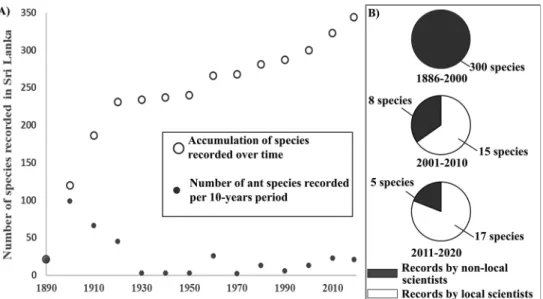
The exploration of the Sri Lankan ant fauna and descriptions of species has, howev- er, been relatively limited during the past few decades. For instance, more than a century ago, by 1920, 66.8% of the diversity currently known had already been recorded (Fig. 1).
This number increased slowly for 80 years with the addition of 69 newly recorded spe- cies (19.9% of the total fauna); and slightly faster in the most recent 20 years with an addition of 46 species (12.7%) mainly through the work of local scientists (Fig. 1A, B).
The taxonomic work still required on Sri Lankan ants is likely to be important due to the
Table 1. Diversity of subfamilies, genera, and species known from Sri Lanka.
Subfamily Genus Species (subspecies)
Amblyoponinae (3 genera, 3 species) Myopopone 1
Prionopelta 1
Stigmatomma 1
Aneuretinae (1 genus, 1 species) Aneuretus 1
Dolichoderinae (6 genera, 13 species &
1 subspecies)
Chronoxenus 1
Dolichoderus 2 (1)
Iridomyrmex 1
Ochetellus 1
Tapinoma 3
Technomyrmex 5
Dorylinae (6 genera, 19 species) Aenictus 7
Dorylus 2
Lioponera 2
Ooceraea 4
Parasyscia 3
Syscia 1
Ectatomminae (1 genus, 2 species) Gnamptogenys 2
Formicinae (13 genera, 81 species & 21
subspecies) Acropyga 2
Anoplolepis 1
Camponotus 28 (13)
Colobopsis 2
Lepisiota 6 (1)
Myrmoteras 1
Nylanderia 6 (1)
Oecophylla 1
Paratrechina 1
Plagiolepis 3
Polyrhachis 28 (6)
Prenolepis 1
Pseudolasius 1
Leptanillinae (3 genera, 3 species) Leptanilla 1
Protanilla 1
Yavnella 1
Myrmicinae (29 genera, 126 species &
12 subspecies)
Acanthomyrmex 1
Anillomyrma 1
Aphaenogaster 1
Calyptomyrmex 3
Cardiocondyla 5
Carebara 11 (1)
Cataulacus 4
Crematogaster 16 (5)
Dilobocondyla 1
Erromyrma 1
Lophomyrmex 3
Meranoplus 5
Metapone 1
Monomorium 6
Subfamily Genus Species (subspecies) Myrmicinae (29 genera, 126 species &
12 subspecies)
Myrmecina 1
Myrmicaria 2
Paratopula 1
Pheidole 22 (5)
Pristomyrmex 2
Recurvidris 2
Rhopalomastix 2
Solenopsis 2
Stereomyrmex 1
Strumigenys 6
Syllophopsis 1
Tetramorium 16
Trichomyrmex 7 (1)
Tyrannomyrmex 1
Vollenhovia 1
Ponerinae (15 genera, 47 species & 7
subspecies) Anochetus 8
Bothroponera 3
Brachyponera 3
Centromyrmex 1 (1)
Cryptopone 1
Diacamma 4 (2)
Harpegnathos 1 (2)
Hypoponera 8
Leptogenys 10 (1)
Mesoponera 1
Myopias 1
Odontomachus 1
Parvaponera 1
Platythyrea 2
Pseudoneoponera 2 (1)
Proceratiinae (1 genus, 1 species) Discothyrea 1
Pseudomyrmecinae (1 genus, 4 species) Tetraponera 4
high number of species and subspecies recorded more than a century ago, at a time when species descriptions were sometimes incomplete or species boundaries poorly defined, later leading to potential misidentifications (see Table 4). As a result, work on regional exploration and the use of new sampling are both needed, as shown by the paucity of certain diverse genera (e.g., Colobopsis, Myrmecina, Stigmatomma, Strumigenys), while taxonomic revisions of specimens for the region based on newly collected material to confirm past identifications or to help in the descriptions of new species should help in providing a more complete overview of the diversity of the Sri Lankan myrmecofauna.
Of the three traditionally distinct climatic zones in Sri Lanka: ‘dry’ (~ 40669 km
2),
‘intermediate’ (~ 9670 km
2) and the ‘wet zone’ (~ 15267 km
2), most of the ant surveys
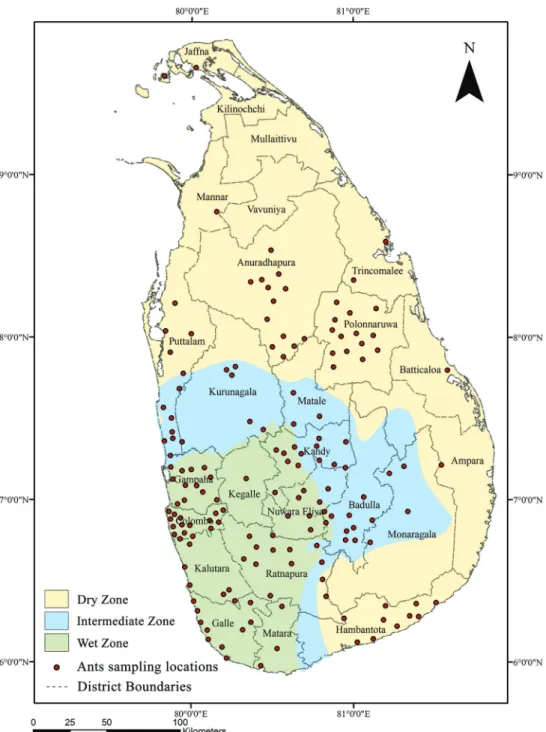
and species occurrence have been reported from the ‘wet zone’ areas, which include
some of the well protected and intact forest regions of the country (Fig. 2; Suppl. ma-
terial 2). The ‘wet zone’ supports the greatest diversity (231 species), followed by the
‘dry’ (113 species), and the ‘intermediate zone’ (71 species). It should be noted that most of the northern and eastern regions of the country, located in the dry zone, have received limited sampling coverage, and that future surveys should focus on these re- gions. Sixty-four species recorded from Sri Lanka could not be assigned to any zone as they lack precise location information within the country underlying, here again, the paucity of surveys since the time of their original recording in Sri Lanka and the need for future and further research in the various regions of the country.
Endemic species
Sri Lanka is known to have diverse vegetation types and a distinctive fauna character- ized by a high degree of endemicity (Gunawardene et al. 2007; Gunatilleke et al. 2008).
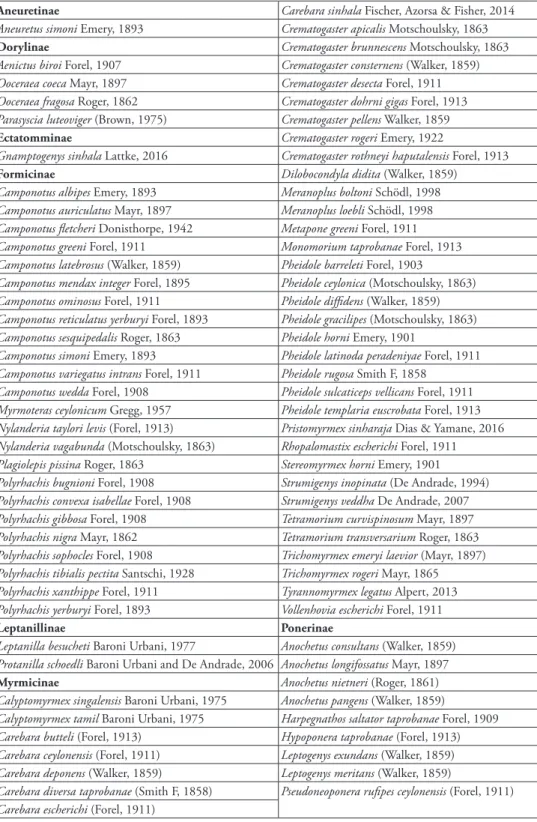
Of the 341 ant species/subspecies present in Sri Lanka, only 82 species (24%) are con- sidered as endemic (Table 2). Thanks to recent global compilation and regional work on ant distribution, the number of species identified as endemic species to Sri Lanka has greatly increased in comparison of previous work in which only 33 species (17% of 194 species) had been identified (Dias et al. 2012). It should be noted, nonetheless, that the current level of endemism retrieved in ants is relatively low in comparison of flower- ing plants (28%), odonates (48%), reptiles (59%), land snails (83%), and amphibians (85%) (Gunawardene et al. 2007; Gunatilleke et al. 2008; MOE 2012). Potentially, a similar pattern of high species richness and endemism might be likely for ants, but fur- ther comprehensive surveys in addition to thorough taxonomic work are first needed to
Figure 1. A Rate of species recording in Sri Lanka per decade from 1886 to 2020, and B number of
species recorded in Sri Lanka per period in function of the origins of the authors contributing to these
discoveries. The last two decades are shown separately as they present a change in species discovery (two
species are not included as time of discovery is unknown).
fully depict this pattern. However, the current legal framework for biodiversity conser- vation allowing the export of specimens outside Sri Lanka is very restrictive and might represent a serious limitation to the completion of the taxonomic work that could be
Figure 2. Map of Sri Lanka with ant sampling localities in different zones.
Table 2. List of the 82 endemic ants in Sri Lanka.
Aneuretinae Carebara sinhala Fischer, Azorsa & Fisher, 2014 Aneuretus simoni Emery, 1893 Crematogaster apicalis Motschoulsky, 1863
Dorylinae Crematogaster brunnescens Motschoulsky, 1863
Aenictus biroi Forel, 1907 Crematogaster consternens (Walker, 1859) Ooceraea coeca Mayr, 1897 Crematogaster desecta Forel, 1911 Ooceraea fragosa Roger, 1862 Crematogaster dohrni gigas Forel, 1913 Parasyscia luteoviger (Brown, 1975) Crematogaster pellens Walker, 1859
Ectatomminae Crematogaster rogeri Emery, 1922
Gnamptogenys sinhala Lattke, 2016 Crematogaster rothneyi haputalensis Forel, 1913
Formicinae Dilobocondyla didita (Walker, 1859)
Camponotus albipes Emery, 1893 Meranoplus boltoni Schödl, 1998 Camponotus auriculatus Mayr, 1897 Meranoplus loebli Schödl, 1998 Camponotus fletcheri Donisthorpe, 1942 Metapone greeni Forel, 1911 Camponotus greeni Forel, 1911 Monomorium taprobanae Forel, 1913 Camponotus latebrosus (Walker, 1859) Pheidole barreleti Forel, 1903
Camponotus mendax integer Forel, 1895 Pheidole ceylonica (Motschoulsky, 1863) Camponotus ominosus Forel, 1911 Pheidole diffidens (Walker, 1859) Camponotus reticulatus yerburyi Forel, 1893 Pheidole gracilipes (Motschoulsky, 1863) Camponotus sesquipedalis Roger, 1863 Pheidole horni Emery, 1901
Camponotus simoni Emery, 1893 Pheidole latinoda peradeniyae Forel, 1911 Camponotus variegatus intrans Forel, 1911 Pheidole rugosa Smith F, 1858
Camponotus wedda Forel, 1908 Pheidole sulcaticeps vellicans Forel, 1911 Myrmoteras ceylonicum Gregg, 1957 Pheidole templaria euscrobata Forel, 1913 Nylanderia taylori levis (Forel, 1913) Pristomyrmex sinharaja Dias & Yamane, 2016 Nylanderia vagabunda (Motschoulsky, 1863) Rhopalomastix escherichi Forel, 1911 Plagiolepis pissina Roger, 1863 Stereomyrmex horni Emery, 1901 Polyrhachis bugnioni Forel, 1908 Strumigenys inopinata (De Andrade, 1994) Polyrhachis convexa isabellae Forel, 1908 Strumigenys veddha De Andrade, 2007 Polyrhachis gibbosa Forel, 1908 Tetramorium curvispinosum Mayr, 1897 Polyrhachis nigra Mayr, 1862 Tetramorium transversarium Roger, 1863 Polyrhachis sophocles Forel, 1908 Trichomyrmex emeryi laevior (Mayr, 1897) Polyrhachis tibialis pectita Santschi, 1928 Trichomyrmex rogeri Mayr, 1865 Polyrhachis xanthippe Forel, 1911 Tyrannomyrmex legatus Alpert, 2013 Polyrhachis yerburyi Forel, 1893 Vollenhovia escherichi Forel, 1911
Leptanillinae Ponerinae
Leptanilla besucheti Baroni Urbani, 1977 Anochetus consultans (Walker, 1859) Protanilla schoedli Baroni Urbani and De Andrade, 2006 Anochetus longifossatus Mayr, 1897
Myrmicinae Anochetus nietneri (Roger, 1861)
Calyptomyrmex singalensis Baroni Urbani, 1975 Anochetus pangens (Walker, 1859)
Calyptomyrmex tamil Baroni Urbani, 1975 Harpegnathos saltator taprobanae Forel, 1909 Carebara butteli (Forel, 1913) Hypoponera taprobanae (Forel, 1913) Carebara ceylonensis (Forel, 1911) Leptogenys exundans (Walker, 1859) Carebara deponens (Walker, 1859) Leptogenys meritans (Walker, 1859)
Carebara diversa taprobanae (Smith F, 1858) Pseudoneoponera rufipes ceylonensis (Forel, 1911)
Carebara escherichi (Forel, 1911)
undertaken within the country. Moreover, with ongoing landscape modification in the region, many species have been driven to critical status (Somaweera et al. 2015; Perera et al. 2017; Karawita et al. 2018), therefore, urgent, large-scale, and sustained efforts to monitor, characterize, and conserve the ant fauna of Sri Lanka is critical.
Non-native species
The current list of introduced and established species in Sri Lanka includes 18 species large- ly dominated by the Myrmicinae (13) and completed by the Ponerinae (3) and Formicinae (2) subfamilies (Table 3). The ecological impacts of non-native and invasive ant species with rampant effect on native mesofauna have not been studied in Sri Lanka, but the well-known effects of some of these species in other regions of the world (Wittman 2014), including within Asia (Wong et al. 2020), may hint towards similar outcomes. Therefore, more efforts should be directed to evaluate the distribution, ecology, and various impacts of non-native species. Potential threat of non-native species on native species, particularly endemics should be evaluated to safeguard the native ant fauna. Finally, the limited efforts in the study of Sri Lankan ants suggests that more non-native species could be discovered in future studies, or through biogeographic studies aiming at determining more precisely the native from the introduced ranges of species widespread within Asia and beyond.
Misidentifications and dubious/erroneous records
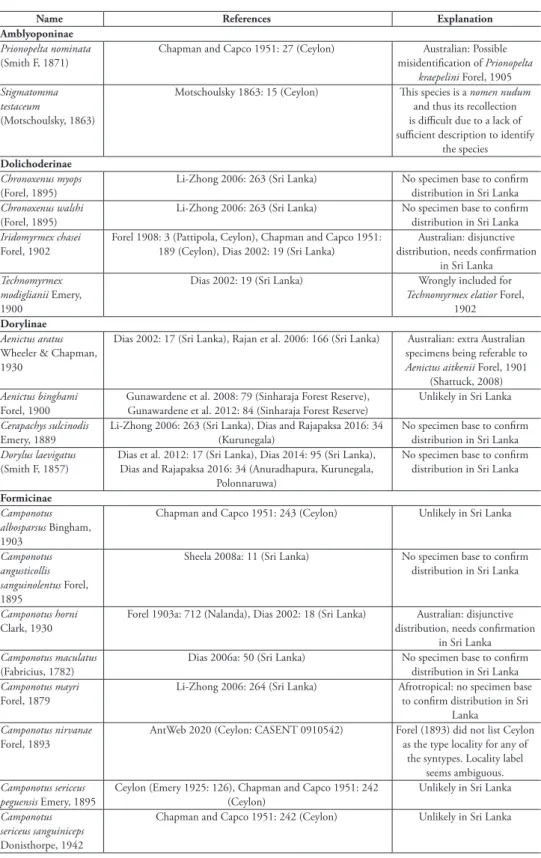
To correct the errors cited in earlier literature so as to reduce the taxonomic confusion by eliminating misinformation associated with Sri Lankan ants, 58 ant taxa previously reported from the country are here marked as dubious based on either erroneous data in terms of misidentifications, misspellings, erroneous locality, or potential occurrence.
A brief explanation is provided about their dubious status (Table 4).
Table 3. List of non-native ants in Sri Lanka. Species with an asterisk * are considered as invasive in other regions of the world.
Formicinae (2 species) Myrmicinae (13 species) Ponerinae (3 species) Nylanderia vividula Cardiocondyla emeryi Hypoponera punctatissima Paratrechina longicornis Monomorium monomorium Hypoponera ragusai
Monomorium pharaonis Leptogenys falcigera Monomorium subopacum
Pheidole megacephala*
Solenopsis geminata Strumigenys emmae Strumigenys membranifera
Syllophopsis australica Tetramorium bicarinatum
Tetramorium pacificum Tetramorium simillimum
Tetramorium tonganum
Table 4. Dubious/unverified records of ants in Sri Lanka.
Name References Explanation
Amblyoponinae Prionopelta nominata
(Smith F, 1871) Chapman and Capco 1951: 27 (Ceylon) Australian: Possible misidentification of Prionopelta
kraepelini Forel, 1905 Stigmatomma
testaceum
(Motschoulsky, 1863)
Motschoulsky 1863: 15 (Ceylon) This species is a nomen nudum and thus its recollection is difficult due to a lack of sufficient description to identify
the species
DolichoderinaeChronoxenus myops
(Forel, 1895) Li-Zhong 2006: 263 (Sri Lanka) No specimen base to confirm
distribution in Sri Lanka
Chronoxenus walshi(Forel, 1895)
Li-Zhong 2006: 263 (Sri Lanka) No specimen base to confirm distribution in Sri Lanka
Iridomyrmex chaseiForel, 1902 Forel 1908: 3 (Pattipola, Ceylon), Chapman and Capco 1951:
189 (Ceylon), Dias 2002: 19 (Sri Lanka) Australian: disjunctive distribution, needs confirmation
in Sri Lanka
Technomyrmexmodiglianii Emery,
1900
Dias 2002: 19 (Sri Lanka) Wrongly included for
Technomyrmex elatior Forel,1902
DorylinaeAenictus aratus
Wheeler & Chapman, 1930
Dias 2002: 17 (Sri Lanka), Rajan et al. 2006: 166 (Sri Lanka) Australian: extra Australian specimens being referable to
Aenictus aitkenii Forel, 1901(Shattuck, 2008)
Aenictus binghamiForel, 1900 Gunawardene et al. 2008: 79 (Sinharaja Forest Reserve),
Gunawardene et al. 2012: 84 (Sinharaja Forest Reserve) Unlikely in Sri Lanka
Cerapachys sulcinodisEmery, 1889
Li-Zhong 2006: 263 (Sri Lanka), Dias and Rajapaksa 2016: 34 (Kurunegala)
No specimen base to confirm distribution in Sri Lanka
Dorylus laevigatus(Smith F, 1857) Dias et al. 2012: 17 (Sri Lanka), Dias 2014: 95 (Sri Lanka), Dias and Rajapaksa 2016: 34 (Anuradhapura, Kurunegala,
Polonnaruwa)
No specimen base to confirm distribution in Sri Lanka
FormicinaeCamponotus albosparsus Bingham,
1903
Chapman and Capco 1951: 243 (Ceylon) Unlikely in Sri Lanka
Camponotus angusticollis sanguinolentus Forel,
1895
Sheela 2008a: 11 (Sri Lanka) No specimen base to confirm distribution in Sri Lanka
Camponotus horni
Clark, 1930 Forel 1903a: 712 (Nalanda), Dias 2002: 18 (Sri Lanka) Australian: disjunctive distribution, needs confirmation
in Sri Lanka
Camponotus maculatus(Fabricius, 1782) Dias 2006a: 50 (Sri Lanka) No specimen base to confirm
distribution in Sri Lanka
Camponotus mayriForel, 1879 Li-Zhong 2006: 264 (Sri Lanka) Afrotropical: no specimen base
to confirm distribution in Sri Lanka
Camponotus nirvanae
Forel, 1893
AntWeb 2020 (Ceylon: CASENT 0910542) Forel (1893) did not list Ceylon as the type locality for any of
the syntypes. Locality label seems ambiguous.
Camponotus sericeus
peguensis Emery, 1895
Ceylon (Emery 1925: 126), Chapman and Capco 1951: 242
(Ceylon) Unlikely in Sri Lanka
Camponotus sericeus sanguiniceps
Donisthorpe, 1942
Chapman and Capco 1951: 242 (Ceylon) Unlikely in Sri Lanka
Name References Explanation Echinopla striata
aciculata (Smith F,
1858)
Chapman and Capco 1951: 284 (Ceylon) Unlikely in Sri Lanka
Formica fuscicauda
Motschoulsky, 1863 Motschoulsky 1863: 12 (Ceylon), Emery 1925: 270 (Ceylon)
Incertae sedis in genus,unidentifiable
Formica subpiceaMotschoulsky, 1863
Motschoulsky 1863: 12 (Ceylon), Emery 1925: 270 (Ceylon)
Incertae sedis in genus,unidentifiable
Lepisiota modesta(Forel, 1894)
Dias and Kosgamage 2012: 61 (Anuradhapura, Polonnaruwa) No specimen base to confirm distribution in Sri Lanka
Myrmoteras binghamiiForel, 1893 Dias 2006a: 50 (Sri Lanka), Gunawardene et al. 2008: 80 (Sinharaja Forest Reserve), Gunawardene et al. 2012: 84
(Sinharaja Forest Reserve)
Needs confirmation in Sri Lanka (Bui et al. 2013)
Paraparatrechinaminutula (Forel,
1901)
Gunawardene et al. 2012: 83 (Sinharaja Forest Reserve) Australian: disjunctive distribution, needs confirmation
in Sri Lanka
Polyrhachis bellicosaSmith F, 1859 Dias and Rajapaksa 2016: 35 (Anuradhapura, Colombo, Galle,
Gampaha, Polonnaruwa, Ratnapura) No specimen base to confirm distribution in Sri Lanka
Polyrhachis cingulaDonisthorpe, 1947 AntWeb 2020 (Ceylon, Peradeniya: CASENT 0912101) This is a misidentification.
Clearly the two specimens on Antweb do not show the same species and the individual from
New Guinea is a type.
Polyrhachis hippomanes
Smith F, 1861 Dias 2002: 19 (Sri Lanka) Wrongly included for Polyrhachis
hippomanes ceylonensis Emery,
1893
Polyrhachis moesta
Emery, 1887 Li-Zhong 2006: 271 (Sri Lanka) No specimen base to confirm
distribution in Sri Lanka
Polyrhachis spinigeraMayr, 1879
Emery 1893a: 254 (Kandy) Probably a misidentification of
Polyrhachis lacteipennis Smith F,1858. Emery (1901) listed P.
lacteipennis as a denizen of Sri
Lanka, without any reference to
P. spinigera Mayr, 1879 Polyrhachis ypsilon
Emery, 1887 Forel 1893a: 31 (Ceylon), Emery 1925: 182 (Ceylon) Needs confirmation in Sri Lanka (record absent in Kohout
2014)
Pseudolasius familiaris(Smith F, 1860) Gunawardene et al. 2008: 80 (Sinharaja Forest Reserve),
Gunawardene et al. 2012: 84 (Sinharaja Forest Reserve) Distribution in Sri Lanka seems far remote from the known distribution of this species in
Asia
MyrmicinaeCarebara affinis
spinosior (Forel, 1911)
Forel 1913b: 662 (Nalanda) Probably a misidentification.
Needs further confirmation in Sri Lanka
Cardiocondyla nudaMayr, 1866 Kugler 1984: 11 (Ceylon), Mathew and Tiwari 2000: 306 (Sri Lanka), Dias 2002: 18 (Sri Lanka), Tiwari et al. 2003: 492 (Sri Lanka); Dias 2006a: 51 (Sri Lanka), Ghosh et al. 2006:
386 (Sri Lanka), Li-Zhong 2006: 265 (Sri Lanka), Rajan et al.
2006: 174 (Sri Lanka), Gunawardene et al. 2008: 81 (Sinharaja Forest Reserve), Amarasinghe 2010: 12 (Nawalapitiya), Dias
et al. 2012: 15 (Sri Lanka), Dias and Kosgamage 2012: 62 (Hathamuna, Somawathiya Sanctuary), Dias 2014: 164 (Sri Lanka), Dias and Ruchirani 2014: 88 (Kuluna Kanda Proposed
Forest Reserve), Dias and Rajapaksa 2016: 35 (Anuradhapura, Polonnaruwa), Dias and Udayakantha 2016b: 5 (Indikada Mukalana Forest Reserve), Udayakantha and Dias 2018: 72
(Indikada Mukalana Forest Reserve)
Misidentification of
Cardiocondyla kagutsuchiTerayama, 1999 (Seifert, 2003)
Crematogaster politula
Forel, 1902 Dias et al. 2012: 15 (Sri Lanka), Dias and Rajapaksa 2016: 35
(Puttalam) No specimen base to confirm
distribution in Sri Lanka
Name References Explanation Crematogaster treubi
Emery, 1896 Dias 2002: 18 (Sri Lanka), Hosoishi and Ogata 2009: 62 (Sri
Lanka) No specimen base to confirm
distribution in Sri Lanka
Lophomyrmexambiguus Rigato,
1994
Sheela and Ghosh 2008 (Sri Lanka) No specimen base to confirm distribution in Sri Lanka
Monomorium chinenseSantschi, 1925
Li-Zhong 2006: 268 (Sri Lanka) No specimen base to confirm distribution in Sri Lanka
Monomoriumsalomonis (Linnaeus,
1758)
Magretti 1884: 540 (Ceylon) Needs confirmation of distribution in Oriental region
Myrmecina curtisiDonisthorpe, 1949 Gunawardene et al. 2008: 81 (Sinharaja Forest Reserve) Australian: possible misidentification of Myrmecina
striata Emery, 1889 Myrmica obscurata
Motschoulsky, 1863
Motschoulsky 1863: 16 (Ceylon)
Incertae sedis in genus,unidentifiable
Myrmica pilinodisMotschoulsky, 1863 Motschoulsky 1863: 16 (Ceylon)
Incertae sedis in genus,unidentifiable
Pheidole templariaForel, 1902 Dias 2002: 17 (Sri Lanka), Dias 2006a: 52 (Sri Lanka), Dias et
al. 2012: 16 (Sri Lanka) Wrongly included for Pheidole
templaria euscrobata Forel, 1913 Rogeria sp.Gunawardene et al. 2008: 75 (Sinharaja Forest Reserve),
Gunawardene et al. 2010: 558 (Sinharaja Forest Reserve) Probably a misidentification.
The genus is known only from the Nearctic, Neotropical, and
Oceanian realms
Strumigenys lewisiCameron, 1886 Forel 1903a: 707 (Ceylon), Emery 1897a: 574 (Ceylon) Unlikely in Sri Lanka
Tetramorium flavipesEmery, 1893 Chapman and Capco 1951: 180 (Ceylon) Unlikely in Sri Lanka
Tetramorium guineense (Bernard,
1953)
Forel 1911a: 225 (Seenigoda), Dias, 2002: 18 (Sri Lanka). Should be Tetramorium
bicarinatum (Nylander, 1846)(Bolton, 1977)
Tetramoriumnodiferum (Emery,
1901)
Emery 1912: 104 (Ceylon). Afrotropical: disjunctive distribution, needs confirmation
in Sri Lanka
Trichomyrmex emeryi(Mayr, 1895) Dias 2002: 18 (Sri Lanka). Wrongly included for
Trichomyrmex emeryi laevior
(Mayr, 1897)
PonerinaeDiacamma geometricum (Smith F,
1857)
Li-Zhong 2006: 266 (Sri Lanka) No specimen base to confirm distribution in Sri Lanka.
Reported so far from SE Asia only (Laciny et al. 2015)
Diacamma rugosumcelebense Emery, 1887
Emery 1897b: 156 (Ceylon), Forel 1900b: 319 (Ceylon) Probably a misidentification.
Needs confirmation of distribution in Sri Lanka
Diacamma vagans(Smith F, 1860) Emery 1887d: 440 (Pointe de Galle), Mukherji and Ribeiro 1925: 205 (Ceylon), Chapman and Capco 1951: 59 (Ceylon),
Ali 1991: 3 (Sri Lanka), Tiwari 1999: 25 (Sri Lanka)
Could be a different species (Laciny et al. 2015)
Hypoponera truncata(Smith F, 1860) Gunawardene et al. 2008: 83 (Sinharaja Forest Reserve) Personal communication Barry Bolton 2 July 2012
Odontomachushaematodus (Linnaeus,
1758)
Emery 1893a: 243 (Kandy, Colombo, Nuwara Eliya), Emery 1901: 113 (Ceylon), Emery 1911: 114 (Ceylon), Forel 1900a: 58
(Ceylon), Forel 1908: 2 (Puwakpitiya, Galle), Forel 1911a: 215 (Ceylon), Viehmeyer 1912: 18 (Ceylon), Karavaiev 1926: 417 (Kandy), Chapman and Capco 1951: 43 (Ceylon), Ali 1991: 4 (Sri Lanka), Tiwari 1999: 21 (Sri Lanka), Mathew and Tiwari 2000: 289 (Sri Lanka), Dias 2002: 19 (Sri Lanka), Tiwari et al.
2003: 474 (Sri Lanka), Amarasinghe 2010: 12 (Nawalapitiya).
Should be Odontomachus
simillimus Smith F, 1858Checklist
AMBLYOPONINAE Myopopone: 1 species
Myopopone castanea (Smith F, 1860)
Amblyopone castaneus Smith F, 1860a: 105. Type locality (TL): [Bac.] Bacan, Maluku Utara: Indonesia [Syntype: OUMNH]. [Images of CASENT 0901371 syntype worker examined].
Distribution. Wet and Dry Zones; Primary literature records: Kottawa (Emery 1893a:
240), Ceylon (Forel 1900a: 54), Peradeniya (Forel 1913a: 5), Trincomalee (Don- isthorpe 1942a: 30), Sinharaja Forest Reserve (Gunawardene et al. 2008: 79); Second- ary literature records: Ceylon (Bingham 1903: 34), Ceylon (Emery 1911: 26), Ceylon (Wheeler 1919a: 50), Ceylon (Wheeler and Chapman 1925: 57), Ceylon (Chapman and Capco 1951: 23), Ceylon (Brown 1960: 173), Sri Lanka (Dias 2002: 19), Sri Lanka (Dias 2006a: 52), Sri Lanka (Xu and He 2011: 234), Sri Lanka (Dias et al.
2012: 18); AntWeb records: Hantana, Kandy: ANIC 32-026167, CASENT 0102523, CASENT 0104580, CASENT 0104581, CASENT 0752184 (AntWeb 2020).
Prionopelta: 1 species
Prionopelta kraepelini Forel, 1905
Prionopelta kraepelini Forel, 1905: 3. TL: Tjompea, near Bogor, Java: Indonesia [Syn- type: MHNG].
Distribution. Wet Zone; Primary literature records: Pompekelle, Ratnapura (Dias et al. 2018: 452).
Name References Explanation
Odontomachus monticola Emery,
1892
Li-Zhong 2006: 269 (Sri Lanka). No specimen base to confirm distribution in Sri Lanka
Odontoponeratransversa (Smith F,
1857)
Li-Zhong 2006: 269 (Sri Lanka). No specimen base to confirm distribution in Sri Lanka
PseudomyrmecinaeTetraponera aitkenii