Automobile Sector: Case study of two Japanese automakers
経済学研究科経済学専攻博士後期課程在学 シュレスタ サハデブ SHRESTHA SHAHADAVE
Abstract
This research assesses the role that Japanese Foreign Direct Investment (FDI) has played in the development of the Indian automobile industry. The research is based on secondary data, acquired from various related sources.
This research has taken Maruti Suzuki India Limited, a joint venture between Suzuki Motor Corporation and government of India and Toyota Kirloskar Motor Private Limited, joint venture between Toyota Motor Corporation and Kirloskar group, as case studies.
Keywords: Foreign Direct Investment, Automobile Industry, India, Japan
1. Introduction
Foreign Direct Investment (FDI) has played the role of catalyst in the development of many developing countries including India. After liberalization on 1990s, Indian economy has expanded with fast speed. With the implementation of foreign direct investment friendly policies, many of its economic sectors has received enormous amount investment from Multinational Enterprises (MNEs) and thus seen huge stretch.
One of these sectors which has benefitted from the participation of FDI is automobile sector.
Since liberalization, lots of investment from biggest automakers has entered in India. Almost all the major international auto makers are present in India now. It also shows the attractiveness of Indian market. However, it was not always same. Before 90s Indian market was heavily regulated by government. So there were little foreign investment activities in Indian market.
Japan is one of the major investors in Indian automobile industry among other countries.
Even in the regulated period Japanese automakers were active in India either as technical collaboration or minor partner in joint venture. So Japanese automakers were active in India for long time and have been playing important role in the development of the Indian automobile
industry.
2. Literature Review
There has been lot of literature written about the effect and impact of FDI on host countries.
A lot of authors have said that foreign investment has a positive effect on the economic efficiency and growth of the developing countries. It has been argued that an increase in manufactured trade between developing (labor surplus) and developed (labor scarce) countries is likely to result in an increase in employment in the former (Sanjay Lall 2002). The FDI aspect of globalization offers substantial employment benefits to the countries that are able to attract, retain and leverage it (Sanjay Lall 2002).
FDI brings huge advantages (new capital, technology, managerial expertise, and access to foreign markets) with little or no downside (Bajpai & Sachs 2000).
Foreign investment helps increasing domestic investment through forward and backward linkages. For instance, the production of one domestic industry can be the raw material for another foreign firm and vice versa. In this way the foreign firms generate demand for the domestic industry. Foreign owned projects also forces the local firms to improve upon their technology and standards of quality of the product in order to compete with the former.
It triggers technology spillovers, assists human capital formation, contributes to international trade integration and particularly exports, helps create a more competitive business environment, enhances enterprise development, increases total factor productivity, and more generally, improves the efficiency of resource use (OECD 2002).
The role of FDI is considered much larger than just providing investment; it is also a considered as a pool of several types of resources such as composite capital, knowhow and technology.
However, there are not only positive impacts of FDI. UNCTAD (1999) asserts that the systematic aim of MNEs is not to reduce the imbalance of host countries. As far as training is concerned, local economies cannot rely on MNEs to upgrade the skill level of their human capital.
It is the government’s responsibility, through public education, for example, to train local employees so that MNEs are then more likely to invest in a country with higher skills.
According to Borensztein et al (1998), the effect of FDI on economic growth is dependent on the level of human capital available in the host economy. There is a strong positive interaction between FDI and the level of educational attainment.
Experiences show that effects of FDI don’t have hard and fast rules. Whether it will be
fruitful to the host country largely depends on how much the host country is ready to utilize the opportunity FDI provides. Developing countries need to be aware of the potential risks and costs that FDI can abuse and carefully evaluate them rather than take the potential benefits for granted.
3. Indian Automobile Industry
The Indian Automobile Industry is one of the fastest developing industries in India. The automobile sector comprises of all vehicles, including 2-3 wheelers, passenger cars and multi-utility vehicles, light and heavy commercial vehicles, and the allied engineering sector comprises largely of the auto components sector. The dominant products of the industry are two wheelers with a market share of over 77% and passenger cars with a market share of about 15%.
Commercial vehicles with 4% and three wheelers share about 3% of the market between them in fiscal year 2012-13. The industry has attained a turnover of USD 58,583 million (SIAM 2014).
Fig. 1: Indian Automobile Production, Exports, and Sales trend (number of units)
Source: Society of Indian Automobile Manufacturers (SIAM)
1. Before Liberalization
In the 1950s, the policy of government of India (GOI) was to develop domestic auto industry.
So they tend to protect the industry from foreign competition. For that GOI introduced rules and regulations that prevented the participation of FDI.
Hindustan Motors (HM: Ambassador) and Premier Automobile (PAL: Fiat) were only two
companies who were producing cars. These makers produced cars which were expensive and very few rich people could afford these cars in those days. So market was small and consequently, little incentives for other entrepreneurs to enter the industry. And as it was protected by law, domestic automakers didn’t face any serious challenge.
This scenario continued for almost 30 years. So growth was relatively slow in the 1950s and 1960s. In the 1980s, a partial liberalization was gradually implemented. In 1981, the central government formed a joint venture with Suzuki Motors (Maruti Udyog). The car by Maruti was affordable, small in size and ideal for Indian roads as well as reasonable in price for a family.
Suzuki's advance in India induced the establishment of joint ventures between local Indian manufacturers and Japanese parts manufacturers.
Japanese involvement in the automobile industry brought significant changes to the structure of the passenger car market, including utility vehicles. As a result of Suzuki’s collaboration with MUL, two of India’s longstanding leading producers, Hindustan Motors (HM) and Premier Automobiles (PAL), witnessed significant declines in their market shares. In 1970 HM and PAL had market shares of 51% and 26% respectively; by 1990-91 they stood at 13.9%and 23.7% respectively.
2. After Liberalization
Indian automobile sector started its new journey in 1991 with liberalization of Indian economy. However, liberalization came a bit later in auto sector. Licensing in automotive sector was abolished in 1993. Up to 51% of FDI was allowed in automobile sector which resulted in the surge of increase in FDI in this sector. Many big automakers entered the Indian market during this period. GM, Ford, Mercedes Benz, Honda, Fiat, Toyota, Skoda are big names which entered the Indian auto industry. General Motors started joint venture with Hindustan motors. And Fiat with Premier Automobiles, Ford with Mahindra & Mahindra, Toyota with Kirloskar Group, Volkswagen with Eicher Group, started joint venture.
This increase in the investment activities furthered the development process of the industry.
Deregulation continued in the industry and subsequently government opened up the auto industry for 100% FDI through automatic route in 2002. Since then, a lot of changes have taken place in this sector. Almost all the major international players in automobile sector have entered India. According to the Society of Indian Automobile Manufacturers (SIAM), annual vehicle sales are projected to increase to 4 million by 2015.
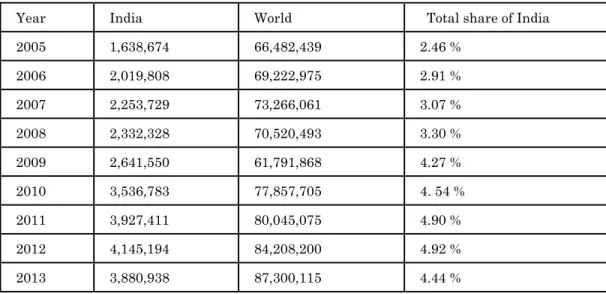
Table 1: Share of Indian Automobile in World Scenario (production in units)
Year India World Total share of India
2005 1,638,674 66,482,439 2.46 %
2006 2,019,808 69,222,975 2.91 %
2007 2,253,729 73,266,061 3.07 %
2008 2,332,328 70,520,493 3.30 %
2009 2,641,550 61,791,868 4.27 %
2010 3,536,783 77,857,705 4. 54 %
2011 3,927,411 80,045,075 4.90 %
2012 4,145,194 84,208,200 4.92 %
2013 3,880,938 87,300,115 4.44 %
Source: OICA (International Organization of Motor Vehicle Manufacturers)
In 2006, government published Automotive Mission Plan 2006-2016 which projected the turnover of the automobile industry, would increase to $145 billion by 2016 from the $35 billion (in the time of publishing plan), accounting for 10 per cent of the GDP.
“To emerge as the destination of choice in the world for design and manufacture of automobiles and auto components with output reaching a level of US$ 145 billion
accounting for more than 10% of the GDP and providing additional employment to 25 million people by 2016.” --Automotive Mission Plan
In the present time, the domestic passenger car market is dominated by Maruti Suzuki, Hyundai Motors and Tata Motors. In particular, Maruti Suzuki has dominated with more than 50% of the passenger car market share.
4. Japanese Investment in India
Japan had been one of the top ten investors in India since 1990. Japan is 4th biggest investor in India with cumulative FDI of US$ 15.97 billion in the period from April 2000 to January 2014.
Drugs & Pharmaceuticals sector receive biggest chunk of investment from japan with 28 percent of total investment. Automobile sector is second with 16 percent.
Top sectors that attracted FDI equity inflows (from April 2000 to February 2014), from Japan, are:
Drugs & Pharmaceuticals (28%) Automobile Industry (16%) Services Sector (15%) Metallurgical Industries (9%) Electrical Equipment (4%)
Source: DIPP (2014)
According to a study conducted by JBIC (Japanese Bank for International Cooperation) in 2008, India has become the most favored investment destination for long term Japanese investment.
1. India -Japan Economic Partnership Agreement
The signing of Japan-India Economic Partnership Agreement (EPA), in February 2011, marked a significant step towards strengthening the economic relationship of the two. The agreement aims 97% tariff reduction on Japanese exports and 90% duty abolition from Indian exports to be gradually realized over a 10-year period. It lights up the prospects for the exportation of auto parts, steel products, electronics, etc. and liberalize the investment conditions benefiting both Indian and Japanese companies.
2. ODA from Japan
One of the important aspects of India Japan economic relationship is official development assistance (ODA) that India receives from Japan. Japan started to provide ODA to India since 1958. Japan hopes to enhance its political and economic relationship with India, the largest democratic nation in the world. Japan also believes that steady development of India is a key to maintaining stability in Asia, and improving the economic condition of the poor. Japan provides grant aid to India mainly in the field of improvement of basic human needs, especially in the area of medical services.
5. Japanese Automakers in India
The automobile industry is a key industry to Indian economy, which has seen lots of FDI activity. It has played a major role in driving India into the global economy. The industry has also become a major stakeholder in India-Japanese relations. Various Japanese joint ventures have
been at the forefront of this transformation. In particular, in 1981, the Indian government set up Maruti Udyog Limited in collaboration with Suzuki Motor Company, the first major investment activity by Japanese Multinational Corporation.
An analysis of sector wise FDI inflows from Japan to India shows that the automobile sector has received the second most FDI during the period 2000-2014. A sector by sector analysis of FDI inflows from Japan to India shows that the automobile industry is the second leading sector, attracting nearly 16% of the total FDI during the period 2000-2014 (DIPP).
This fact shows that Japan is major investor in Indian automobile industry. According to department of industrial policy & promotion (DIPP), Japan is the biggest investor in Indian auto industry. Japan has invested 24.52% of total investment in automobile sector from 2000 to 2012.
Table 2: Share of Top Five Country Attracting FDI Inflows for Automobile Industry (from January 2000 to December 2012):
Ranks Country Amount of FDI inflows US $ in million
percentage with FDI inflows in Automobile Industry
1. Japan 2,083.68 27.00
2. Netherlands 889.37 11.52
3. U.S.A 883.89 11.45
4. Mauritius 749.11 9.71
5. Italy 694.53 9.00
Total of above 5,300.58 68.68
Source: DIPP
The general strategy of Japanese companies operating abroad is based on two pillars:
enhancing international competitiveness, and stimulating the economy of the host country. The overall objective is to ensure that a virtuous circle of innovation and demand is in place. This approach entails developing policies in the areas of human resources, production means and infrastructure, finance, and capability. This approach is the base strategy for Japanese automobile companies operating in India.
Japanese OEMs in India have shown high labor productivity than Indian OEMs because of the fact that automation levels are higher in the former ( Badri Narayanan & Vashisht 2008).
In a paper published by Rashmi Banga in 2003 about the differential impact of Japanese and U.S. FDI on productivity growth, she has pointed that comparative result of Japanese-affiliated,
U.S.-affiliated and domestic firms in automobile industry show that average total factor productivity (TFP) change is higher in Japanese firms as compared to domestic firms.
The transplanting various institutions and practices of “Japanese-style management” into Japanese joint ventures in India has been successful in motivating employees, specifically workers, through strengthening a sense of unity within the company, being more conscious of technology and product quality, finding out the value of work (a non-instrumental attitude) and so forth (Kiyokawa et al 2006).
6. Case Study
This part of the paper will take two of Japanese automakers, as case study, which are present in India and their activities that has helped in development of different aspect of Indian automobile industry.
1. Suzuki in India
Suzuki entered India in 1982, when Indian market was still regulated heavily. It entered as minor share holder. Until then 2 domestic players (Hindustan motors and Premier Auto Limited) were dominant in the market. Market was small and there was little or no innovation at all in the auto mobile industry. As auto industry was regulated industry, there was no competitiveness.
And even though market was small, demand was always higher than production. So, then existing companies didn’t need to worry about anything literally. But as Maruti entered through the joint venture with government with purpose of building small car with advanced technology, that might be the first time when Indian automakers felt unsafe and possibility to lose to the newcomer who is formidable challenger. According to the report published by Mckinsey on the productivity of auto industry of India, it is stated that output growth before 1983 was around 3 percent a year. But the growth rate in the passenger car segment rose to 17 percent a year after Maruti’s entry. This gives a hint of the effect that entry of Maruti Suzuki had on then Indian auto industry.
Maruti introduced Indian automakers with the competition they were unaware of up to then.
This was kind of preparation for the Indian automakers for future competition they will have to face after liberalization of economy, though it was not planned.
Before Maruti came to existence, production of passenger car in India by HML and PAL was low and remained around 40,000 vehicles for almost 2 decades. Within 3 years of production Maruti increased its production to 100,000 vehicles per annum. Maruti marked radical departure
for Indian auto industry. “Maruti 800” was 21% cheaper than the lowest-priced existing passenger car produced by domestic manufacturers, yet offered much higher quality, more safety features, and greater fuel efficiency. Since then, it has dominated the small car segment, which was virtually untapped before Maruti's entry (Okada 1998).
It expanded very fast, capturing 76% of the passenger car market in 1995. In 1994, Maruti became the first Indian company to reach a cumulative production of one million vehicles. In 1995, Maruti received ISO 9002 certification. In 1997, Maruti's cumulative vehicle production crossed the two million mark. In 1997-98, Maruti's overall market share was 83.1%. Maruti was solely responsible for the rapid increase in automobile production in India in that period. Even after entry of many world class automakers in the market and tough competition, Maruti still holds position of market leader in small car segment in India.
In the research conducted by Burange and Yamini (2008) about the overall competitiveness in the Indian automobile industry, Maruti was ranked first. In 2010, Maruti Suzuki’s car Alto became the world’s largest selling car by volume. Maruti Suzuki offers 14 brands : Alto 800, Alto K-10, WagonR, Estilo, Ritz, Swift, DZire, SX4, Omni, Eeco, Gypsy, Grand Vitara, Ertiga, Celerio.
Table 3: Sales Volumes (Maruti Suzuki)
year 2008-09 2009-10 2010-11 2012-1-12 2012-13
unit of sales 792,167 1,018,365 1271,005 1,133,695 1,171,434 Source: Maruti website
In the following part, we will take a look into the impact Maruti has in different sector of auto industry.
(1) Productivity
Maruti has given emphasis more on introducing Japanese work practices like low-cost automation and kaizen1, rather than investing in capital-intensive automated processes. It has achieved productivity increases by reducing manpower, changing layout and sequence supplies in some workstations. Hours per vehicle manufactured decreased from 8.86 in 2001-02 to 7.43 in 2003-04.Average defect per vehicle came down from 94 in 2001-02 to 21 in 2003-04.
1 Kaizen, Japanese for "improvement", or "change for the better", refers to philosophy or practices that focus upon continuous improvement of processes in manufacturing, engineering, and business management.
In 2003, Maruti started Challenger 50, the motive of which was to increase the productivity by 50 percent and bring down the cost per vehicle by 30 percent by 2004-05. It benchmarked itself against the Kosai Plant in Japan. When Maruti benchmarked itself against Kosai Plant, it found it was 20% behind Kosai. Hence to catch up Maruti set up the Challenge 50 program (Maruti website).
Challenger 50, a company-wide effort, involved component suppliers, who together provide about 80% of a car, in the process. Productivity improvement programs were undertaken by key vendors in collaboration with experts from Suzuki. Maruti engineers worked with suppliers to do the same things that have been achieved at the Maruti plant ― improving quality, reducing cost and productivity. Company officials claim that Maruti's manufacturing facility in Gurgaon is among the most efficient plants among Suzuki subsidiaries worldwide.
Maruti started implementing new manufacturing techniques and various value analysis and value engineering initiatives. One of the main strategies to enhance productivity, it implemented, is to reduce wastage. Similarly, innovation by employees in the manufacturing process is making it possible to reduce the cost of material.
As part of this benchmarking exercise, the company has identified certain macro parameters for productivity and cost. Targets for these were laid down on the basis of what is the global benchmark at that time and what it is likely to be three years from starting point. For instance, the key parameter in measuring productivity was called Hours per Vehicle. This is the globally accepted parameter for measuring productivity. Maruti planned to reduce it by 50% over three years.
(2) Improving Quality
Maruti measured the relative quality of dispatched vehicles on a random, daily basis through a quality index audit. To improve quality, Maruti had introduced various measures:
●Tracking surveys and direct customer contact in order to understand the problems faced by customers.
●Full-time task forces for improvement in initial quality study problems and departmental cross-functional teams to work on defined problems with challenging targets.
Improving productivity is related to decreasing wastages as well. So Maruti has given emphasis on improvement in this aspect as well. It has found the eight typical wastages at each operational point and they are: over-production, man movement, material movement, idle time of operator, work-in-process, machine availability, waiting time, and needless processing.
(3) Technology Transfer
Technology transfer both hard and soft, is a main attractive feature of FDI. In the Suzuki’s case, hard technology transfer had been technology embodied by the advanced machinery for the production of cars. As about soft technology or managerial practices, Suzuki had tried to transfer its Japanese working practices to Maruti.
-Transfer of Japanese work practices
Besides advanced technology from Japan which entered India with the investment by Suzuki, MUL has tried to transfer soft technology, as management practices, as well. Japan’s economic development in the 1950s fueled an interest in Japanese management practices and efficacy of Japanese management techniques. As more attention was paid to the success of these techniques, the debate turned to whether these could be transferred to other countries that wanted to use the Japanese. The feasibility of transferring Japanese industrial practices for overseas implementation has generated serious debate. Japanese management techniques have been devised and have been developed in Japan’s indigenous social climate and environment. Hence, it is difficult to transfer them to culturally distant environments.
However, Maruti had tried to introduce some of Japanese practices like:
(a)An open office policy was implemented where managers share same table as their staff.
This enhances information sharing and lessens the presence of hierarchical barriers.
(b)System of common staff uniform for all the employees from the line worker to the top management is implemented to make them feel that all of them are part of a team and are equal.
(c)System of common canteen for all is introduced.
(d)Suggestion system encouraged workers to give their opinion for solving problems they face in the production line. Kaizen means continuous improvement. Introduction of kaizen system also helped the productivity growth.
(e)Punctuality is emphasized. Rule was made to arrive at work ten minutes early, for morning exercises.
(f)A system, in which improvement and cost reduction are encouraged and rewarded through practices such as Q.C. (Quality Check) and suggestions, is introduced.
(4) Export
According to press release on 28th February 2008 on Maruti’s official web site, Maruti became first Indian car maker to export half million cars and in fiscal year 2013 it crossed 1 million figure . Maruti Suzuki exports cars to over 125 countries.
(5) R&D
Suzuki plans to make MUL its design center for Asia outside japan. Manpower in the R&D center in India has been increased from 968 numbers in FY2009-10 to 1,070 numbers in FY2010-11 and to 1249 in 2012-13.
Maruti also introduced compressed natural gas (CNG) engine in India .This is the first instance when a car manufacturer has developed and launched factory-fitted, technologically superior CNG engines in India. A numbers of innovative technologies used in the engine have helped in achieving the best-in-class fuel efficiency and emission. According to press release by Maruti Suzuki researchers at Maruti R&D center in India are working on multiple fuel options for all the company cars.
(6) Development of Auto Component Sector
A critical obstacle to better performance in 1980s was the low quality of sub suppliers to the industry. It’s still true even in the present day. To deal with the situation and government policy of localization, MUL accelerated the indigenization process by setting up joint venture projects with the vendors. MUL continued to enhance the production capacity and the up gradation of manufacturing facilities of potential vendors with the help of some investment opportunities being tied up through the financial agencies.
In the eighties and nineties, supplier development at Maruti involved consultants from Japan, with government collaboration. These consultants would impart training on the principles of total quality management(TQM)/total preventive management(TPM) and various other Japanese management practices.
Maruti also helped its suppliers in getting training from AOTS, a non- profit Japanese organization set up in 1959 in Japan to promote technical assistance to developing countries and to enhance mutual understanding.
Maruti had also achieved a fairly high local content percentage for various models: 96% for Maruti 800 and Omni; 80% for Gypsy; 85% for Maruti 1000; and 75% for Esteem (ACMA 1995a).
Maruti could achieve over 90% localization within 10 years of its operation partly because a large number of local small-scale firms that could serve as ancillaries had already existed, although their technological level was not compatible(Okada 1998). In the year 2004, Maruti started a
“Center for Excellence”. It is a joint venture between Maruti and around ten to fifteen of its tier 1 suppliers. The center for excellence undertakes activities such as: productivity improvement such as TPM ; Kaizen and training for Suzuki production system; and a quality improvement program
giving emphasis on principles of TQM.
Thus in recent years, Maruti has evolved its supplier relations on a more participatory basis, internalizing the supplier relations and making them part of Maruti.
(7) Supplier Network
Located on a greenfield site away from the traditional auto producing areas, MUL set about creating a supplier network which would be capable of sustaining an operation which bought a high proportion of the value of its cars from its suppliers. In order to do this, it brokered the formation of joint ventures between Indian and foreign firms (many of them suppliers to the minority partner in MUL, Suzuki) and established an industrial park for its suppliers close to the plant. By the mid-1990s, it had brokered 45 technology tie-ups (26 with Japanese companies, 19 from other countries) and set up 12 joint ventures producing 23% of the value of MUL's bought-in parts. It held small equity stakes in a number of these suppliers, in the manner of the Japanese keiretsu.
So Maruti has been helping local component manufacturer in many different ways. It has been providing assistance to improve quality by introducing to them new managerial practices as well as improved technology which they get by technical collaboration with foreign manufacturer.
D’Costa (1995, 2004) has studied the role of Japanese joint ventures in transforming the Indian industry as well as the flexible industrial practices initiated by the Japanese joint venture Maruti to overcome bottlenecks and risks associated with low supplier capabilities.
Maruti was successful in promoting the Indian automobile industry, setting a standard for other domestic firms to follow, and developing small-scale firms by creating linkages with them as suppliers (Okada 1998).
MUL brought profound effect on Indian auto industry. Firstly, it increased the scale of the whole industry. Secondly, it raised quality standard of the industry when it entered the Indian market. Thirdly, it introduced the ideas of partnerships and tie-ups between assemblers and suppliers. And now with the most of the global player to compete with, Maruti needs to work hard to remain on top of small car segment, of which it is market leader.
2. Toyota in India
Date of establishment of the Toyota Kirloskar Motor Pvt Ltd (TKM) was Oct 6, 1997. The company was joint venture between Toyota Motor Corporation and Kirloskar group of India. 89 % of share is owned by Toyota and 11% by Kirloskar Group of India.
Toyota has invested around $336 million in the plant with capacity of producing 60000 units per year. Toyota manufactures its world famous cars like Corolla, Camry, and Innova at the plant.
TKM has role in the development of the automotive industry and the creation of employment opportunities not only through its dealer network, but also through ancillary industries.
Though Toyota is comparatively new comer in India than Suzuki and Honda it has started to get hold in the market in India. And it has been positively contributing to the Indian auto industry.
Table 4: Overview of Toyota Kirloskar Motor Private Ltd
Company name Toyota Kirloskar Motor Private Limited Equity participation TMC: 89%, Kirloskar Group: 11%
Total installed production capacity
3,10,000 units
Employees Approx. 6,400
Source: Toyota Kirloskar website
This case study of Toyota have taken 4 points to study the impact, which are namely;
human resource development; development of auto ancillary industry; export and technology transfer.
(1) Human Resource Development
TKM has been doing many activities for development of human resource in Indian automobile industry. It has introduced many programs for this.
To develop human resource and improve the technical skills of its employees, TKM’s young team members are regularly sent to Japan for training programs. In order to improve its products and practices, TKM encourages every worker to give suggestion to improve the product, efficiency of process or working conditions. Toyota has been conducting programs that would help enhance the efficiency of work force.
-T-TEP (Toyota -Technical Education Program)
T-TEP was introduced in 2006, at Delhi. This was quickly followed by the addition of three other institutes, and since, the program has led to 17 different institutions coming under its wing.
2009 saw the widening of this program to include Automotive Body and Paint Repair. This first
of its kind curriculum in India in partnership with State Government provides the students with unique skills in automotive accident repair.
Toyota has partnered with industrial and technical training institutes all across India to create the (T-TEP). The curriculum of this Program includes on-the-job training at Toyota dealerships. T-TEP helps training institutes to develop a highly skilled technical workforce, with greater career prospects in the automotive service industry.
T-TEP program is fast becoming a benchmark in imparting vocation technical training.
-TTTI (Toyota Technical Training Institute)
TKM has established Toyota technical Training Institute (TTTI) in 2007. The institute provides a comprehensive 3 years full time training in automobile related field, like, assembly, automobile weld, painting and mechatronics.
(2) Development of Auto Ancillary Industry
Toyota was the first automaker, in 2001, to see India as a source of components. The company invested almost $200 million in six joint ventures to help local suppliers develop scale in their manufacturing operations. Toyota also focused on localizing the content of its Qualis and Corolla models. Toyota has also invested significant amounts to bring Indian supplier up to its global standards.
As part of its sustainable growth strategy, Toyota is continuing its efforts to support the development of the automobile industry by increasing local production and creating new jobs in emerging markets such as India in accordance with its founding philosophy of contributing to society through manufacturing automobiles.
The company set up Toyota Kirloskar Auto Parts, which commenced production of transmissions in May 2004, for its global requirements. The engines and transmissions for the Etios cars, one of the brands Toyota holds, which are currently imported from Japan, will be later manufactured by Toyota Kirloskar Auto Parts. It has now 3 manufacturing plants.
-TTPI (Toyota Techno Park India)
Toyota Techno Park is a non- profit industrial infrastructure company conceived around the Toyota Kirloskar Motor automobile plant. TTPI’s objective is to foster ancillary industries in India, to help promote local industries through technological transfer and expand employment opportunities.
(3) Export
Toyota is playing a good role in establishing India as export hub of auto related products.
Through economies of scale in manufacturing, Toyota turned India into a regional sourcing hub.
It now exports transmission assemblies ― one of the most complex parts of any automobile ― from India; other automakers limit themselves to importing only simple Indian components.
TKM started to export Etios to South Africa by March 2012, marking the company’s foray into export market.
(4) Technology Transfer
With the entry in India in 1997 Toyota has introduced Toyota production system. It has started Toyota Techno Park with the purpose of technology transfer to the Indian auto component manufacturers. Toyota has also introduced advance systems like Jidoka2 and JIT3(Just in time).
Toyota Technical Training Institute is also playing role in tech transfer as it is established with the purpose of comprehensive training on auto related field.
7. Conclusion
Indian automobile has gone through continuous process of evolution with few factors causing delay in this process, while some helping to speed up. Earlier government policies definitely had toll on the fast development of the industry. Unfriendly FDI policy of government had barred Indian market from getting updated with the new technology being developed in other countries.
Earlier participation of foreign automakers in India would have certainly paced to development of this industry.
But some of policies have positive impact on the development like policy of indigenization of automobile has proven to be good decision. After the liberalization of Indian economy in 90s, government policy has been more FDI friendly. Government has taken the policy of developing its industry through the participation of foreign player, not by barring them.
Government policy of letting foreign player enter in the market has paid off. Maruti Udyog has helped development of Indian auto industry as global small car production hub. Maruti have made its impact by creating a notion that even middle class people can buy cars by producing low
2 Jidoka is providing machines and operators the ability to detect when an abnormal condition has occurred and immediately stop work.
3 Just in time (JIT) is a production strategy that strives to improve a business return on investment by reducing in-process inventory and associated carrying costs. Just-in-time production method is also called the Toyota Production System as Toyota Motor Corporation introduced it..
cost vehicles. Before that, cars were for higher end of economic strata. This led to the market expansion of automobile in India.It has helped the development of auto component industry as well. Auto component industry has rapidly grown after 1980s, catering to expanding domestic market and exporting to external replacement market. Number of small and medium enterprises (SMEs) in auto component industry increased due to new entry.
Now other big names like Toyota, Nissan, and Honda are also playing their role.
Before the liberalization of economy, the role, Japanese automakers, have played in India was enormous. In the present context it cannot be said that only Japanese auto makers have played role. Now almost all major auto makers are present in India. And these companies are treating the India as important market. We can conclude that foreign collaborations have resulted in building faster, cost effective and technologically competitive automotive industrial base in the country. It has also bridged the gaps in technology wherever they existed. This provided the Indian customers with various alternatives and options. In short, we can say that the foreign collaborations have contributed to knowledge flows to India's' advantage. We can also infer that developing economies like India have used foreign collaborations for accelerated economic development, build strong industrial and managerial base. This has also increased India's marketing base globally by offering various products and services with advanced international technologies in the automotive sector. This has enabled the Indian automotive industry to rapidly integrate into the global automotive supply chains.
Rapid expansion of the Indian Automotive Industry due to foreign collaborations also resulted in large employment opportunities for the Indian managers, R&D specialists and workers.
Japanese collaborations have also enabled the Indian firms to enter the international markets due to the well established brand image of the collaborators. In many cases, in order to improve the productivity the collaborators also provided training to the Indian workers both in India and at their works abroad.
In the end, we can say that Japanese investment in Indian automobile industry has helped to create base for the industry. Japanese FDI has played role of assistant in government of India’s endeavor to develop its domestic automobile industry. And it’s still helping to establish India as global automotive hub. And government’s changed role of facilitator from guardian has also helped to speed up the development process of the industry.
Reference:
Badri, N. G. & Vashisht, P. (2008). Determinants of Competitiveness of the Indian Auto Industry .Working Paper No. 201. ICRIER.
Bajpai, N. & Sachs, J.D. (1998). Strengthening India’s Strategy for Economic Growth.
Development Discussion Paper No. 641. Harvard Institute for International Development, Harvard University.
Banga, R. (2003). Differential Impact Of Japanese And U.S. Foreign Direct Investments On Productivity Growth: A Firm Level Analysis, WORKING PAPER NO. 112 ICRIER.
Becker-Ritterspach, F.A. A. & Becker-Ritterspach, J.C.E. (2009). The Development of India’s Small Car Path. Oxford Management Publishing. Retrieved from:
http://www.morexpertise.com [Accessed : 2014/05/10]
Burange, L. G.& Yamini, S.,(2008) Competitiveness Of Firms In Indian Automobile Industry Working Paper UDE (CAS). Department of Economics, University of Mumbai.
Borensztein, E., De Gregorio, J. & Lee, J.W. (1998). How does foreign direct investment affect economic growth? Journal of International Economics 45 pg115-135.
D’Costa, A.P. (1995). The restructuring of the Indian automobile industry: Indian state and Japanese capital. World Development, 23(3), 485-502.
Department of Industrial Policy and Promotion, India. (2012). SIA Newsletter - Annual Issue,2012
Retrieved from:
http://dipp.nic.in/English/Publications/SIA_NewsLetter/AnnualReport2012/Chapter6.2.viii.p df [Accessed : 2014/05/10]
Department of Industrial Policy and Promotion, India (2014). FDI Synopsis on Country Japan. Retrieved from:
http://dipp.nic.in/English/Investor/Japan_Desk/FDI_Synopsis_Japan.pdf[Accessed 2014/05/10]
Gugler P. & Brunner S. (2007). FDI effects on national competitiveness: A cluster approach. International Atlantic Economic Society.
Government of India. Ministry of Heavy Industries and Public Enterprises (2006). Draft Automotive Mission Plan 2006-2016.
HE C. (2002). Information Costs, Agglomeration Economies and the Location of Foreign Direct Investment in China, Regional Studies, 36.9,. 1029-1036, Carfax Publishing.
Ishigami, E. (2004). Competition and Corporate Strategy in the Indian Automobile industry with special reference to Maruti Udyog limited and Suzuki Motor Corporation.
Kiyokawa, Y., Oba, H. & Verma, P.C. (2005). Management Transfer and Job Consciousness in Indo-Japanese Joint Ventures: Has "Japanese Style
Management" Been Successfully Accepted in India? Discussion Paper Series A No.464.
Maruti's seal of success lies in quality. (2002) The Hindu Business Line. Retrieve from : http://www.thehindubusinessline.in/2002/04/22/stories/2002042200700500.htm Mckinsey Global Institute. (2001) Automotive Assembly. India: the growth imperative.
232-274.
OECD, (2002). Foreign Direct Investment for Development: Maximizing Benefits, Minimizing Costs. Retireved from:
http://www.oecd.org/investment/investmentfordevelopment/1959815.pdf [Accessed: 2014/05/01 ]
Okada, A. (1998) Does Globalization Improve Employment and the Quality of
Jobs in India : A Case from the Automobile Industry. Globalization and Jobs In the Automotive Industry. Research Note #3
Operations Management at Maruti Udyog. (2003). ICMR. Retrieve from:
http://www.icmrindia.org/casestudies/catalogue/Operations/OPEA001.htm Sanjay Lall (2002). The Employment Impact of Globalization in Developing Countries
QEH Working Paper Series-QEHWPS93, Queen Elizabeth House, Oxford University.
United Nations Conference on Trade and Development (1999). The Social Responsibility of Transnational Corporations. United Nations. New York.
Retrieved from:
http://unctad.org/en/Docs/poiteiitm21_en.pdf [Accessed: 2014/05/01]
United Nations Industrial Development Organization (2010). Cluster development for pro-poor growth: the UNIDO approach.
Business, Investment and Technology Services Branch TECHNICAL PAPER SERIES. Retrieved from:
http://www.unido.org/fileadmin/user_media/Publications/Pub_free/Cluster_develo ment_for_pro_poor_growth.pdf [2014/04/11]
Website:
Ashok Leyland: http://www.ashokleyland.com/history
Hindustan Motors Limited: http://www.hindmotor.com/aboutus.asp Mahindra & Mahindra:
http://www.mahindraautoworld.com/en/who-we-are/mahindra-group Maruti Suzuki India Limited: http://www.marutisuzuki.com/Home_Maruti.aspx OICA (International Organization of Motor Vehicle Manufacturers):
http://www.oica.net/category/production-statistics/
Premier Automobiles Limited: http://premier.co.in/legacy.html Siam: http://www.siamindia.com
Toyota Kirloskar Motor Private Limited: http://www.toyotabharat.com/inen/about/history.aspx