The Strange Case of “Fisher vs. Rickerby”:
Press, Scandal, and Satire in Treaty-Port Japan
Todd Munson
In the last few issues however symptoms have made their appearance which, if not at once put a stop to, herald but too surely the commencement of one of those paper wars so injurious to society at large, and so liable to lead to the formation of cliques and party factions too common alas in small communities ....
“F.,” in a letter to the editor of theNagasaki Shipping List and Advertiser dated August 7, 1861.1)
When one speaks of the “western enclaves” or “foreign communities” of nineteenth- century Asian treaty ports, there is the unstated assumption that such groups were essentially defined in opposition to their Chinese or Japanese hosts. In other words, the tendency in such discussions is to attribute a sense of harmony and unified purpose to the Europeans and Americans who made their homes so far from “civilization.” Life in the colonies, however, was a fragmented affair, and to gloss over the conflicts that prevailed among members of the one community — in the case we shall examine in the pages that follow, the European and American residents of 1860s Yokohama — is to misrepresent the actual lived experience of the men and women who lived there.
For records of conflict and dissent we must turn to the information media that recorded (and in some cases spawned) them.
In his landmark Imagined Communities: Reflections on the Origin and Spread of Nationalism 2), Benedict Anderson argued for the connection between newspapers and nationalism:
according to his thesis, mechanically reproduced printed matter — distributed to large numbers of persons in a given area at roughly the same time — had historically induced a feeling of larger communality to that readership. Such persons “imagined” themselves to belong to the same community, despite never having met one another. Anderson’s premise, while sound, suggests additional questions unaddressed in Imagined Communities:
what if there were two such media outlets in a given area, each with its own specific idea of “community”? What if large numbers of the (potential) audience perceived themselves to belong to a different group — one that did not publish such media? This essay will consider at length one particular episode in the history of Japan’s English language newspapers, not with an eye towards the evolutionary development of the media itself, but rather with the aim of capturing the conflict and dissention reflected (and in some cases, directly produced) by the newspapers of treaty port Yokohama.
In so doing, we shall examine several issues that concern any historian interested in international relations, such as the day-to-day reality of living under extraterritoriality.
When one considers the question of extraterritoriality during the period of “unequal
treaties,” what most often comes to mind are cases concerning offenses committed by foreigners on natives; in the pages that follow, however, we shall examine two consular court cases that involved citizens not of Japan but rather Great Britain and the United States of America.
Furthermore, we will glimpse the competition and animosity that existed between and within the various agents of the treaty port press — Yokohama, as we will see, was no ‘imagined community’ pulled together by the unifying forces of the mass media, but a place in which print media served to alienate and divide the foreign settlement. Finally, the details of this incident have great importance for understanding a series of cartoons that appeared in Yokohama’s very own satirical journal, Charles Wirgman’s Japan Punch.
Glackmeyer v. McKechnie
Our story begins on October 13, 1865, at McKechnie
& Co.’s dry goods store, located at No. 67 Main St. in Yokohama’s foreign settlement. Early on the afternoon of the 13, two municipal constables entered McKechnie’s and took an employee of the shop — an American named Gustave Glackmeyer — into their custody. The constables had been summoned at the bequest of the shop’s owner, Alexander McKechnie, who suspected his employee Glackmeyer of stealing merchandise belonging to the shop. At the time of the arrest the constables pronounced no formal changes against Glackmeyer, but nonetheless the latter dutifully complied and followed the constables out of the shop. After being allowed to stop briefly at his own apartment, Glackmeyer was then led by the constables to the British Consulate.
As there had been no formal warrant issue for his arrest, however, the Consulate jailor refused to admit Glackmeyer as a prisoner, and after approximately one hour he was released. At the American Consulate on the following day, Glackmeyer swore to a written complaint in front of the American Consul, George Fisher. Glackmeyer told Consul Fisher that he had not stolen merchandise from his employer, and moreover that he was seeking $500 damages for false arrest and defamation of character. Since McKechnie was a British citizen, Fisher forwarded the complain to his counterpart Marcus Flowers, and shortly thereafter a date in the British Consular Court was set. It is at this point the narrative takes an unusual turn.
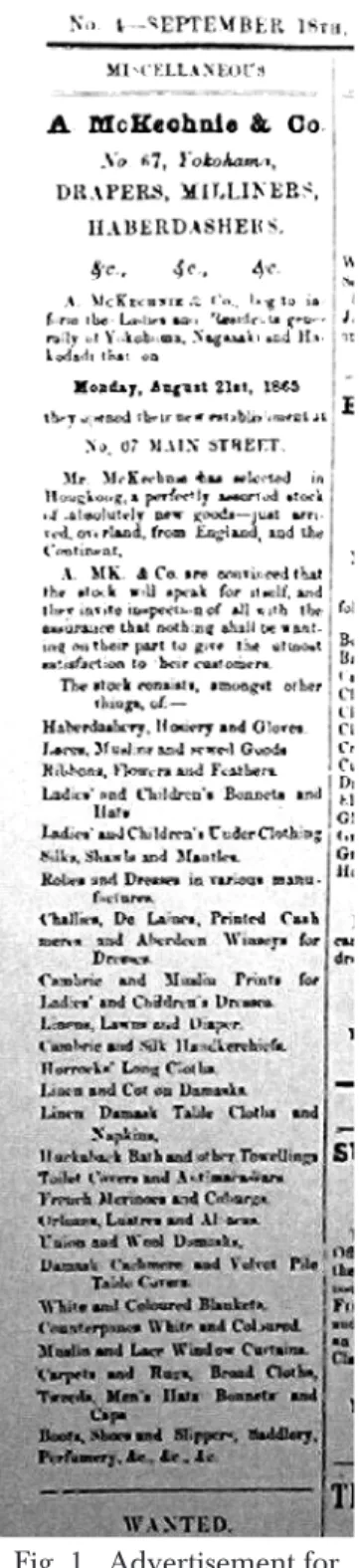
Fig. 1. Advertisement for McKechnie & Co.3)
The case of Glackmeyer vs. McKechniewas held for three days, from October 24 to October 26, before Acting Consul Marcus Flowers in the British Consular Court of Yokohama. Glackmeyer, as noted above, sought five hundred dollars in damages for false imprisonment and defamation of character with regard to the alleged robbery that had taken place in McKechnie’s dry goods store on October 12. In reply to this charge McKechnie entered a plea of not guilty, arguing that he suspected Glackmeyer of robbing his store and very sensibly went to the police to have him arrested. A series of witnesses were introduced; one of them, a saleswoman at the shop testified to call by the defendant McKechnie, stated that on October 12 she had seen Glackmeyer “roll up something that looked like a piece of black luster and speak to a Japanese coolie,” and
“immediately afterward saw the coolie leave the store with the parcel.”4) She added that it was not the first occasion she had witnessed such a scene, and her suspicions led her to question the Japanese servant upon his return. The coolie replied that he had handed over the package to a “China girl” at Glackmeyer’s apartment.
Additional testimony by other Japanese servants in McKechnie’s employ revealed that on several other occasions packages had been delivered into the care of a Chinese woman at Glackmeyer’s apartment. McKechnie, after being sworn in as part of his own defense, testified that he had “at various times lost 200 sterling worth of goods including 33 silk dresses,” and that he had suspected Glackmeyer of the thefts for quite some time: according to McKechnie, Glackmeyer had been “constantly ... meddling with the goods after being repeatedly told to attend to his own business — the books.”
Informed by the saleswoman of Glackmeyer’s actions on October 12, McKechnie had gone to the Superintendent of the Yokohama Municipal Police, who in turn sent the two constables to arrest Glackmeyer. In response to the question of why he did not seek a warrant for Glackmeyer’s arrest, McKechnie replied that he had no idea that such a procedure was necessary, but that “had he been aware of the right method of procedure, he would have adopted it.”5)
Acting Consul Flowers wasted little time in returning a verdict. On October 28, a decision was reached in which the defendant Alexander McKechnie was found not guilty of all charges. A portion of Flowers’ decision, as reported in the Yokohama newspapers, read as follows:
... the Court has no hesitation in finding for the defendants. If a person falsely and maliciously, and without probable cause, puts the law into motion, and gives a party in charge to the police, that is properly the subject of an action on the case. But when a felony has actually been committed, and that either a private individual or a constable has good and probably cause, or reasonable ground for suspecting a party, and has actually suspected that party of having committed the felony, — either the private individual or the constable is authorized to detain the party suspected until inquiry can be made by the proper authorities. The Plaintiff’s [i.e. Glackmeyer’s]
conduct in the Defendant’s store had called forth sundry reproofs, and was such as to force the Defendants to give the Plaintiff both verbal and written notice to leave his employment. ... Goods of considerable value were stolen from Defendant’s shop, and Plaintiff’s conduct excited Defendant’s suspicion. Subsequently, again and again, thefts were committed in Defendant’s store during the hours of business, and the
Plaintiffs conduct still excited Defendant’s suspicion and caused him to communicate with the chief of the Municipal Police, whom he believed to be the proper party to consult in that matter.6)
Flowers added that the evidence produced “fully satisfies this Court that on the 12th instant at least, Plaintiff [i.e., Glackmeyer] did send from Defendants shop to Plaintiffs residence a parcel of Defendants goods without Defendants knowledge or consent, and which goods the Plaintiff had not bought nor accounted for in any manner.” Under such circumstances, Flowers said, it was entirely justified that McKechnie followed the course of action that he did. Therefore “the charge of defamation of character has not been proved, and is dismissed, as well as the charge of false imprisonment.” The Consul also took the opportunity to “remind the Municipal Council of the expediency, and indeed the absolute necessity of clearly defining the duties of the Municipal Police, and of making them understand and confine themselves to their proper functions.” Flowers ordered the Glackmeyer pay the costs of having brought the suit before the court, and the matter might well have rested there had circumstances turned out differently.
Yokohama’s Newspapers
Yokohama in the autumn of 1865 was the home to two weekly newspapers, one relatively venerable and the other only several weeks old. The former of this pair, the Japan Herald, was owned and operated by Albert William Hansard, and edited by perhaps the most famous foreign journalist of Meiji Japan, John Reddie Black. Hansard was the dean of Japanese newspaper publishers, having founded Japan’s first daily paper in Nagasaki in 1861, then moving to Yokohama in that same year. The Japan Times, in contrast, was something of an upstart. It was edited by a former Yokohama banker, an Englishman by the name of Charles Rickerby; along with a group of partners, Rickerby bought the printing press of a former Yokohama publisher and founded his own newspaper in September 1865. As his rival Black noted in Young Japan, Rickerby
“lacked nothing” so far as ability was concerned, but lacked discretion: “had his tact been equal to his talent, the Japan Timesmight have become a power in the land.”7) We shall see the implications for Rickerby’s lack of social propriety in due time.
A Card
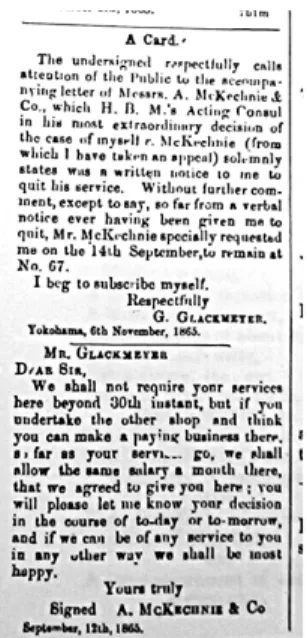
Shortly after the conclusion of Glackmeyer vs. McKechnie, Glackmeyer conducted an unusual public relations campaign in his own defense. In the pages of the Japan Herald beginning on November 7, he submitted for publication in the advertisement section the following statement, under the heading of “A Card,”
The undersigned respectfully calls attention to the Public to the accompanying letter of Messrs. A. McKechnie & Co., which H.B.M.’s Acting Consul in his most extraordinary decision of the case of myself v. McKechnie (from which I have taken an appeal) solemnly states was a written notice to me to quit his service. ... I beg to subscribe myself, Respectfully, G. Glackmeyer.8)
The accompanying letter (see Fig. 2) from McKechnie, dated September 12, stated that
“we shall not require your services here beyond 30th instant, but if you undertake the other shop and think you can make a paying business there ... we shall allow the same salary a month there, that we agree to give you here. ... Yours truly, Signed A.
McKechnie & Co.”9)
Fig. 2. From The Japan Herald, November 11, 1865.
In response McKechnie submitted a letter to the editor of the Japan Herald, which ran on November 11 (the same letter also ran in the Times). “Dear Sir,” it began, “we notice, in your issue of Tuesday 7th instant, an advertisement, headed ‘a card.’ We cannot understand, exactly, the meaning that Mr. Glackmeyer wishes to convey to the public, so [we] think it is right to throw additional light on the subject.” McKechnie explained in the letter that “when the letter referred to by him, was written by us, it was previous to our having suspected him, as it was only on the 19th September, we first missed a parcel of Silks, and the letter published by him was written on the 12th. The fact of our offering Mr. Glackmeyer an engagement in our other establishment at No. 102 clearly proves that, up to that time, we had not the slightest doubt as to his integrity.”
The letter concludes that the reason for giving Glackmeyer notice was “his inability to perform satisfactorily the especial duties required of him.”10) While Glackmeyer did not win this battle, this did not prevent him from using other tactics to defend his reputation — as we shall see shortly.
The Japan Timesand the Japan Herald: Editorial Response
Both Yokohama newspapers — as was the custom of the treaty port press — published the results of consular court cases, and as one would expect both duly reported on Glackmeyer vs. McKechnie in the issues of late October and early November of 1865.
John Reddie Black’s Japan Heraldgave a brief and rather dry account of Glackmeyer vs.
McKechnie, simply running an account of the proceedings with no editorial comment.
We may judge Black’s opinion of the importance of the case by the fact that it was the fourth item that ran in the paper on November 11, following an editorial about Japanese merchants, a report of a military drill, and an account of a recent meeting of the Yokohama Rifle Association.
The Japan Times, in contrast, devoted roughly half of its editorial and local coverage to the case in its issue of November 10. The bulk of this was criticism directed toward the George Fisher, who the author noted was not only Consul of the United States, but was in addition a practicing attorney-at-law. Editor Rickerby noted that this was both
“odd” — imagine a case, he said, in which such a man might serve as judge and lawyer for the same person — as well as overly secretive; “the fact is not so widely known as it should be, nor do we ever remember having seen any announcements of it by advertisement or otherwise.” In Rickerby’s view, Fisher’s having apparently served as Glackmeyer’s unpaid legal advisor as well as his official Consul was a “curious metaphysical problem” at once unethical and possibly illegal, and that in so doing Consul Fisher was “carrying out to excess the theory of the duality of the brain.”11) This was a reference to contemporary research into hemispheric differentiation done by scientists such as Paul Broca and John Hughlings Jackson, who held that the two halves of the brain were dual in nature but nonetheless (like two eyes) acted together in concert like two eyes. A mentally ill person, in contrast, suffered because the two hemispheres of his brain each worked independently of the other. In other words, Rickerby was suggesting in his comments that the Consul General of the United States was insane — and he did not stop there. The editorial added that one might also comment on “the inconsequence of [Fisher’s] logic” with regard to Gustave Glackmeyer.
According to Consul Fisher, the plaintiff Glackmeyer was of the “most excellent, honorable, and amiable character”; Rickerby countered with the fact that Glackmeyer
“admitted himself that he was living with a Chinese prostitute.”12)
The November 10 issue of the Timesalso published a series of letters sent by Fisher to Flowers between October 13-19 establishing the details of the incident. From these letters we learn something of Consul Fisher and his relationship with his fellow American, Glackmeyer: “ I am fully satisfied of the good character of Mr. Glackmeyer,”
the Consul noted. Glackmeyer was “an innocent young man” who was “brutally without an explanation thrust” into jail on October 13.13) We also learn that McKechnie had submitted a complaint against Glackmeyer to Consul Flowers on October 14, with the expectation that Flowers would contact Fisher and the latter would agree to hear the case in the American Consular Court. Fisher responded to this request as follows: “I beg now to call you attention to the fact that the complaint of Mr.
Glackmeyer v. Mr. McKechnie, was sent from this Consulate and left at your office over one and a half hours before your complaint was received at this office and that by every rule that case should take place of the one filed by you and I most respectfully request you will give the matter a hearing on an early date as possible.”14) One is struck not so much by Fisher’s puerile reasoning as by his willingness to draw nationality into the debate: “the rights of men as defined by the law of England,” he wrote in an October 19 letter, “positively forbid such an outrage as was perpitrated [sic] on Mr.
Glackmeyer ... in this case the most fundamental right of personal liberty has been most grossly violated and no Englishman would submit to such illegal treatment.”15)
Fisher later complained that the letters had been published in the Japan Times without his consent — which is likely true — but Rickerby’s decision to run them in his pages was consistent with the editorial content of that issue: both intimated (or stated outright) that the American Consul was dishonest, rash, and vindictive.
“Assault”
Any chance this matter may have faded from public sight evaporated on November 11. As reported in the Daily Japan Heraldof Wednesday, November 13, we learn of the following incident:
Assault. On Monday afternoon at about three o’clock, as Mr. Rickerby was passing through the street at the back of the club, towards his office, he was overtaken by an individual who immediately attacked him from behind, striking him a heavy blow across the ear and side of the face with a stiff riding whip. On turning round to see the source of the attack, he was met by another cut across the eyes, and would have been most seriously injured but for the yielding of his spectacles, which, however, cut the bridge of his nose severely. Mr. Rickerby had only a small umbrella in his hand, with which, being an excellent master of fence, he warded off many more blows that were aimed at him. ... It turned out that the attack was made by Mr.
Glackmeyer, whose indignation at being mentioned unfavorably in the columns of the Japan Timeslast Friday, thus found vent.16)
Rickerby covered this story in the Japan Timesby quoting the above account in extenso from the Herald(with proper citation) — perhaps he felt that referencing his rival would lend an objectivity to what was obviously a matter of personal importance. Rickerby, however, titled the Times’ article “Cowardly and Brutal Assault” rather than simply
“Assault,” and prefaced the report with the comment that Glackmeyer had “displayed the virtues for which he is so remarkable by making what would be called, in the case of any ordinary mortal, a most cowardly and vicious assault with intent &c., on a gentleman connected with the journal in question, whom he imagined to have been the writer of the phrases which had offended him.”17) Rickerby wasted no time in filing charges, and a trial date was fixed for November 18.
“The Great Case” —The People of the United States vs. Gustave Glackmeyer
This leads us to the second and final consular proceeding we will examine in these pages. Rickerby, as one might expect, immediately filed complaint with the British consul, but as Gustave Glackmeyer was an American citizen, any criminal charges filed against him would have to be heard in an American court. The American court, of course, was presided over by Consul George Fisher — the same George Fisher who had earlier described Glackmeyer as a man of “excellent honorable & amiable character,”
and the same George Fisher, one will recall, who had been described by Rickerby in the pages of the Japan Times as dishonest, secretive, and suffering from “duality of the mind.” For Fisher, it was payback time.
The People of the United States vs. Gustave Glackmeyertook three days to complete and was by all accounts the talk of the settlement. From the very beginning it was clear to
all present that something unusual was afoot: after reading out the assault charges, Fisher asked “How say you, Mr. Glackmeyer, guilty or not guilty?” Rather than respond in the requisite one or two words, Glackmeyer offered the following: “Not GUILTY, that is, I am not guilty as charged in Mr. Rickerby’s complaint; I admit that I flogged Mr. Rickerby in the street. I had the most aggravating provocation offered to me that man could have, made by Mr. Rickerby in the Japan Timeson the 10thinstant, to which as a gentleman I could not reply, and which I had no other means at my command than to horsewhip Mr. Rickerby as I would a cur.”18)
One might consider the admission of guilt within a not guilty pleato be odd in and of itself (and possibly evidence enough to end the trial19) ) but there was more. After the testimony and examination of several witnesses — during which time Fisher continually frustrated Rickerby by disallowing several pieces of evidence, such as a medical record detailing the injuries incurred from the assault — Glackmeyer requested that a copy of the Japan Timesthat he had brought with him be admitted into the trial as evidence. It was the issue of November 10, the one that contained such sharp criticism of Fisher as well as the bold revelation that Glackmeyer was living with a “Chinese prostitute.”
Rickerby objected to the admission of the newspaper as evidence, arguing that it was
“out of order and irrelevant” to the criminal proceedings. He was overruled by Consul Fisher, who stated that “Mr. Glackmeyer is quite entitled to hand in this paper as testimony, to prove that a strong provocation had been offered him, by a more disgraceful and personal article having appeared therein.” He then proceeded to take the paper from Glackmeyer and read aloud selections from Rickerby’s editorial in front of the court. Rickerby objected again, on the grounds that “such writing is irrelevant to this criminal inquiry, which is merely to prove whether the prisoner did or did not break the peace.” This was overruled.
Following the newspaper reading, Glackmeyer was sworn in as a witness. He again confessed to the assault, claiming that “on Saturday evening, after reading the Japan Times, of November 10th, I determined, being in an excited state of mind, to horsewhip Mr. Rickerby, for the cowardly way in which he attacked me from behind the columns of his paper.” Upon cross-examination by Rickerby (who was acting as his own counsel), Glackmeyer added that “my feelings were in such an excited state that I did not quite know what I was doing. I remained in this state until I had horsewhipped Mr. Rickerby.” Rickerby continued to question Glackmeyer on the details of the assault; one can imagine the absurdity of such a scene, for example, as when Rickerby asked his assailant such questions as “Did I defend myself?” to which the other replied
“Oh yes, with your umbrella, skillful in fence!”
Finally, several witnesses were introduced by Glackmeyer (also acting in his own defense), and each was asked a series of identical questions. The questions did not address the charges against Glackmeyer specifically, but rather addressed the issue of whether or not Rickerby’s editorial in the Japan Timesjustified the assault. A partial list of the questions reads as follows: “Do you consider it right for one man to attack another, as I have been in the columns of the Japan Times?”; “Do you think Mr. Rickerby was entitled to insert this article in the his paper?”; “Do you think it was gentlemanly in [sic]
Mr. Rickerby to write that article?”; “What is Mr. Rickerby’s general reputation in the settlement — is it quarrelsome?”; “Has not Mr. Rickerby the reputation of being a
quarrelsome, litigious, and meddlesome person?”; did not Mr. Rickerby “leave the bank [i.e., the Central Bank of Western India, where he worked as a manager] as a disgraced, degraded official?”; “What would you do were you attacked in the same manner as I have been?”; and finally “What is your opinion about people who live in glass houses?” This last question, one would assume, intimated that Rickerby either lived with or paid for the services of prostitutes himself. Rickerby, of course, strenuously objected to each and every one of these questions; Fisher in turn overruled the objections on the grounds that they were “quite relevant to the case” (the Japan Timesreported that Fisher actually said “revelant” throughout the proceedings). The witnesses — perhaps reacting to the farce that the trial had become — did not always answer in a way that was critical of Rickerby; in response to the questions above, for example, one witness claimed simply that “I do not feel inclined to be mixed up in this matter” and refused to answer further questions.
On the second day of the trial (November 20), Rickerby attempted one last tactic to extricate himself. He refused to admit that he had written the damning editorial of November 10, and stated that it could not even be proven that he was the editor of the Japan Times; after all, he did not sign his name to any of the words published in the newspaper, nor had he ever publicly admitted to having written any of the editorial comment that had ever appeared in the pages of the newspaper. Consul Fisher accordingly informed Glackmeyer that because “Rickerby has repeatedly occupied the time of this Court in attempting to disprove his editorship of the Japan Times,” he would be permitted to produce any evidence available that might confirm or deny Rickerby’s involvement with the newspaper. Glackmeyer proceeded to call a British citizen by the name of Benjamin Seare as a witness. Seare was a partner of Rickerby’s in an auctioneering and brokering firm that operated under their name, and may have had a stake in the Japan Times.20) Upon taking the stand, however, Seare refused to answer what he considered to be “impertinent” questions about Rickerby’s involvement with the Japan Times; in response, Fisher said that Seare “would never have dared to act in this manner in any court at home or in Her Majesty’s Consulate, here, or they would most undoubtedly have been imprisoned.” “I know no American,” he added, “who would have acted in this manner.”
When the court resumed on the 21, Seare was again called to testify, and again he refused. Fisher ordered him removed from the court (Seare was “dragged from his seat” and taken “forcibly” out of the courtroom, according to the Japan Times) and requested that the British Consul Flowers fine him for contempt of court. The rest of the day was given over to Glackmeyer, who testified and concluded in his own behalf;
when given a similar opportunity before a final decision was reached, Rickerby stated that “as I am unable to obtain justice in his Court, I decline saying anything further.”
The court recessed until the 23, when Fisher returned a verdict of some 2,500 words that expounded not only on specifics of the case itself (“a great deal of personal ill nature and ill feeling has been attempted to be worked into [this case]”) and relevant legal precedents, but also upon the role of the media in a community like Yokohama:
The proper criticisms of a newspaper, the right of free and full discussions, of private character, of public men and public measures, even of severe, no matter how severe,
if true, calm, manly and honourable — cannot be objected to. But there is fair, honourable, manly criticism and review, or animadversion; and there is cowardly, disgraceful, contemptible personality malicious, unprovoked, and envious attack, the latter of which is outrageous and intolerable, and so ought to be held by every man and community loving peace, justice, and fair play.
And the right of lawful criticism and searching ... no man can rightfully complain of ...
but cowardly, covert attacks on private character personalities, and calumnations, especially in a mixed community like this, by one person against another, is and ought to be, nay, must be, frowned upon by every gentleman in it.
...
Every man cannot afford to keep a newspaper, and one nationality — in a mixed community like this, where all have equal rights, where each nationality claims and exercises a national sovereignty, should not be permitted unrestrainedly to attack, malign, defame, slander and hold up to ridicule, scorn, contempt, and outrage, another person, or nationality, and then shield himself behind the so called “privileges of an editor.”21)
Note that Fisher twice referred to the fact that Yokohama was a “mixed community.” By this he did not mean that Yokohama was composed of Western and Japanese residents
— presumably in his mind, the Japanese and Westerners who populated Yokohama did not form a single “community” — but that the foreign population of the settlement was made up of men and women of different nationalities. Furthermore, he noted “one nationality” should not be permitted to ridicule or scorn “another person or nationality”
in the press, especially in a “mixed community” in which extraterritoriality is the norm.
Again we see the American Consul’s willingness to draw nationality into the equation;
by suggesting that a defining characteristic of the conflict between Glackmeyer and Rickerby was nationality — a point that neither party emphasized before, during, or after the proceedings — Fisher used the pronouncement of the decision to express his own frustrations at both the perceived hostility of the British press and the lack of American newspapers in the settlement.
In the end Fisher ruled in favor of Rickerby — “the court feels bound to administer the law, for words alone will not justify an assault and battery,” he noted — but the degree of punishments indicates with whom the Consul’s sympathies lay. Glackmeyer was ordered to pay both the court and the plaintiff six and one-quarter cents each (a single issue of the Japan Times, in contrast, cost fifty cents), with the balance of the court costs to be paid by Rickerby. The outrage over the damages, as well as Fisher’s conduct in the case prompted an unprecedented series of meetings, both public and private. All the foreign Consuls (British, French, Dutch and Portuguese) save Fisher gathered to discuss the issue on November 21, and the Japan Heraldof November 25 noted furthermore that “a public meeting of the mercantile community, at which a memorial to the Consuls of the other nationalities, was adopted — bringing before them the case alluded to, and calling upon them to represent to their respective headquarters the conduct of the American Consul; and expressing sympathy with them, at the insults offered to one of their body.”
Editorial Reply I: The Japan Herald
The case was the talk of the settlement. The Japan Herald printed a four page supplement devoted entirely to a near complete transcript of the proceedings, as well as a fifteen-hundred word editorial. The Heraldstaked out its position from the very outset of its lead editorial of November 25: “The scene is played out, Mr. Rickerby wears the crown of martyrdom, and the Consular Court of the United States of America is a byword and a laughing stock.” However, this did not mean that the Heraldcondoned the editorial which had appeared in the offending issue of the Japan Timesof November 10:
We cannot be supposed to have much sympathy with the editor of the Japan Times
— or with anyone who, connected with that paper, writes, directs, or sanctions such articles as do constantly appear therein. With the article of last Saturday week, which led to the assault that resulted in the trial we are commenting on, we had no sympathy. ... it was a great mistake to make allusion to Mr. Glackmeyer, in the manner he did.22)
Nonetheless, the Herald maintained that justice had not been done: Glackmeyer had admitted in open court his premeditated assault, and it was clear from the onset that the American Consul was biased in favor of one party:
The assault took place, according to the evidence, in a cowardly and atrocious manner ... [and] was a deliberate design. It ought to have been decided according to evidence, and that evidence ought to have been fairly taken as well for the one side as for the other. Above all, the judge ought not to have been the advocate of either party.23) Furthermore, the Heraldsuggested that Glackmeyer — whom we will recall conducted his own defense — did not even organize and prepare his own remarks: “the case of the defense, however, was got up in a manner quite beyond the reach of Mr. Glackmeyer’s intellect, who could not even read correctly the paper on which his defense was written.”
Heraldeditor Black did not speak to the issue of who might have written Glackmeyer’s defense, but noted that “public opinion is very strong on the subject”; we may assume on that basis that Consul Fisher was considered to be the likely culprit. In fact, the Heraldcontinued, it was apparent that Glackmeyer was not the central figure in his own drama: “from a very early period in the trial, it had become the opinion of all, that the case was quite misnamed, and that had it been “Fisher v. Rickerby,” it would have been called more correctly.” Fisher’s lack of objectivity and “absence of tact” amounted, the editorial continued, to a public “self-immolation”: “every effort that was made to hold him back and check him, appears only to have hardened his determination.” While the attacks on Fisher soon diminished in the Herald’spages (replaced by discussion of the major issues of the day, such as imperial treaty ratification and tariff revision), publication of the rancorous official correspondence between Consuls Flowers and Fisher continued to fill the back pages of the Heraldwell into December.
Editorial Reply II: The Japan Times
Rickerby, for his part, went back to editorializing in the pages of the Japan Times, clearly emboldened by the animosity with which the settlement had greeted Fisher’s behavior in court. The Japan Times Daily Advertiser of November 21, noting that a full report would appear in the weekly and overland issues (the latter now lost), hinted at the harsh words that were to appear in the days following: “the utter illegality of the proceedings and the iniquity of the Judgment are patent to all. It is not too much to say now, that no one can hope to obtain justice in the American Consular Court, so long as it is presided over by the present Consul.”24)
Stepping high up upon his soapbox, Rickerby’s lead editorial in the November 24th edition of the Japan Timesstated in part:
Men who come to the east, while they have golden opportunities and great advantages, have, at the same time to make equivalent sacrifices, and yield, in great measure at least, some of their most valuable privileges. Freedom of speech is restricted, public opinion hardly exists, representative government is unknown; [and] Consular despotism takes the place of Constitutional monarchy.25)
He went on to call for the American Consul’s removal, declaring that Fisher “should be forthwith promoted from his present position in the United States Consulate, to some sphere of action where his peculiar talents will be better appreciated.”
Rickerby said that despite the injustices done he was determined to push onward.
He did admit that he had “sinned against the canons of Yokohama taste” in referring to Glackmeyer’s Chinese mistress by a term “more distinct than polite”; it would, he noted, perhaps “more judicious to have availed himself of some such euphemism as ‘soiled dove.’” Nonetheless, the editorial dismissed Glackmeyer as the primary actor in the case:
Considering all the circumstances of the case and the many facts which came out during the trial to prove to an almost moral certainty that he was merely an agent — the Court of public opinion has already dismissed him [Glackmeyer] from its bar, where a more dangerous criminal has been arraigned.26)
The “more dangerous criminal,” of course, was Consul Fisher, who not only flaunted the law but also attempted to “excite an unpleasant feeling between nationalities” — a serious transgression in such a community as Yokohama, where Westerners needed to set aside cultural and national differences in order to present a unified front to the native population. The most serious issue in this regard was Fisher’s attempt to force Benjamin Seare to testify and the latter’s subsequent expulsion from the Consular court. According to the Japan Times, these actions were damnable on multiple fronts:
We maintain that [Seare] was illegally committed — illegally detained in Court on the second day of the trial — illegally expelled therefrom on the third day, — illegally carried through the public streets in durance vile and most illegally assaulted under the shadow of the British flag and in the sacred presence of Her Britannic Majesty’s
representative in the British Consulate. Before this arrogant assumption of authority over subjects of another nationality, most of the points with which the case abounds, sink into comparative insignificance.27)
Thus, Rickerby argued, Fisher’s misconduct extended far beyond the bounds of the case in question: “darkness radiates as well as light and were this assumption of such enormous power by a Magistrate of one nationality over the subjects of another, to pass without severe check, the consequences of the establishment of such a precedent would certainly be most serious.” This was especially true in places such as Yokohama:
For in small and outlying ports, in China, as well as Japan — most important interests are necessarily committed to men, young and comparatively inexperienced, in almost everything but their own special mercantile duties — and certainly unskilled in law. Not having at hand competent legal advice and assistance, such men would not be able to resist any such stretch of arbitary [sic] power as this attempted here, and it is chiefly for this most grave consideration that we take up the matter as seriously as we do.
In the final determination, therefore, “we are sure that we carry with us the great majority of the community when we say that its more accurate denomination would be
— first Fisher v. Rickerby; finally changed to Yokohama v. Fisher.”28)
Later issues of the Japan Timescontinued the discussion of the “great case.” In the December 1 issue of the newspaper, for example, we read the strongest criticism yet: “we say most deliberately and advisedly that so atrocious an instance of mal-administration of law and perversion of power by a public servant to gratify his own private hatred has not occurred for many years in any Consular Court.”29) The editorial added that “no impartial man can peruse the record of the case without feeling the strongest suspicion that another actually prompted the assault and that Glackmeyer was merely his miserable tool.” The editorial of December 1 not only encouraged the Times’readership to ostracize the American Consul, but reported that such action was already being undertaken by the foreign residents of Yokohama: “his colleagues refuse communication with him — the community have most strongly expressed their reprobation of his conduct, he is ostracized officially and socially and he can only avoid dismissal by timely resignation of the office which he has disgraced.” Readers may have been surprised to see such a bald-faced attack on a member of the diplomatic corps, but Rickerby admitted he was trying to goad Fisher into action: “these lines are written with the fervent hope that Mr. Fisher may bring against us an action for libel, when we shall have an opportunity of proving conclusively ... the truth of what we here assert.”30) Apparently Fisher was not inclined to pursue this line of action, which in turn served to fuel Rickerby’s own sense of righteous purpose: “the modern martyrs — in the East at least — are those unfortunate men whose lot happens to be cast in connection with the newspaper press ... he may be independent and pure minded; he must content himself with being treated as a literary Don Quixote — or he may trim his sails to every wind and be a Sancho Panza.”31) Rickerby added that while his position as
“martyr” might seem a pitiable one, in the long term his cause will be proved right:
“when Japan becomes, as we anticipate she must, the Venice of the Pacific, the centre of communication between Europe and China and the entrepot of the China trade — then the YOKOHAMA PRESS will have a voice that will be expected with anxiety and listened to with attention — and for the coming of that time we wait.”32)
The Japan Punchand the “Great Case”
The Japan Timesnoted in its issue of November 24 that among the major news items of the week was “the appearance of a most excellent and humorous number of the
‘Japan Punch’ in which some of the staff of this journal are not spared.”33) The Japan Punch, Yokohama’s very own journal of political and social satire, was written and illustrated by a British citizen named Charles Wirgman. Wirgman had come to Japan from England in 1861 as an illustrator and correspondent for the London Illustrated News, and the following year he founded his journal, based on the very famous magazine Punchin his home country. The Japan Punchwas printed off woodblocks, was usually around fourteen pages in length, and appeared more or less on a monthly basis from 1862 through the 1880s. As the “great case” was a subject of great interest in the settlement, it should not surprise us to find it satirized in the pages of Wirgman’s journal.
The context we have provided thus far should shed sufficient light on jokes that have presumably lain dormant for one hundred and forty years.
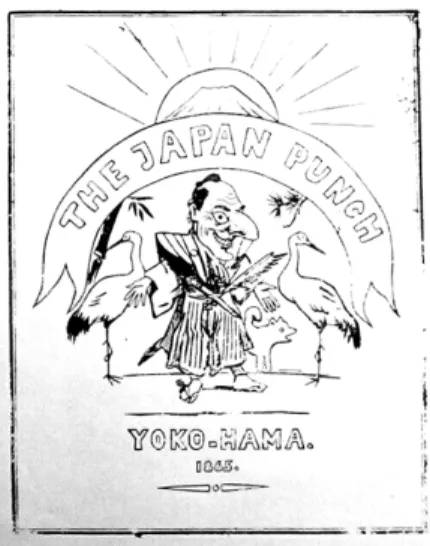
Fig. 3. Front cover of The Japan Punch, 1865.
While Wirgman is primarily known for his illustrations, the issues of the Japan Punch that referenced the case contained humorous versions of some of the letters written by Fisher to Consul Flowers during the duration of Glackmeyer vs. McKechnie. For example, here is Fisher’s original letter of October 19, as later printed in the pages of The Japan Times:
To Marcus Flowers, Esq.
H.B.M.C.
Consulate of the U.S. of America
Kanagawa, Japan Oct. 19th1865.
No. 339.
Sir,
I have the honor to acknowledge your Communication of yesterday evening farther in relation to the complaint of Mr. Glackmeyer [illegible] M. McKechnie, and to thank you for setting the time of hearing on that case as therein stated.
But lest you may take my silence to be an assent to your reasons why it were best in your opinion not to hear that complaint prior to my hearing and adjudicating the complaint of Mr. McKechnie v. Mr. Glackmeyer, I have to say —
That the rights of men as defined by the law of England positively forbid such an outrage as was perpitrated [sic] on Mr. Glackmeyer, and it being an infringement of the clearest of all personal rights of political and civil liberty under those laws, and the laws of nation, Mr. Glackmeyer hasd the most indubitable right to be heard without reference to any other complaint whatever for it is not for Mr. Glackmeyer to prove his innocence but for Mr. McKechnie to prove his guilt.
Is this case the most fundament right of personal liberty has been most grossly violated and no Englishman would submit to such illegal treatment unless under due course and restraint of law.
The law of England and common law of the United States clearly says “to make imprisonment lawful it must be by process from the court of judicature, or by warrant from some legal officer having authority to commit to prison[”] &c and here, while quiet & unsuspecting attending to his ordinary business, writing up the books of the defendant, the defendant without authority, without a writ, without notice, & without positive evidence, indeed without any legal evidence but on the merest and idlest suspicion caused the seizure and arrest of a young man, it is believed by those who know him well, of the most excellent honorable & amiable character and of another nationality and brutally without an explanation thrust him into a British prison as a guilty thief and felon.
Besides, it is not in the power of any man arbitrarily to arrest and imprison his fellow man without authority of law, unless he be taken in the very act of committing a felony and here where the law is ever open and available to protect rights and punish wrong, such an outrage, should be frowned upon and punished to the very utmost rigor and vindication of the law.
It is meet & right therefore that the defendant be held answerable for such (to use the mildest expression) an extraordinary course as he has pursued, and I trust H.B.M.’s executors of her laws and honorable court will do justice in this case as it would do between subjects of her own nationality similarly wronged and outraged.
I have the honor to be Sir, Very respectfully
Your obt Servt,
GEO. S. FISHER U.S.C
Note the clever way Wirgman parodied this letter in the pages of the Japan Punch: Consulate of Ne plus ultra
Kanasawa, Japan Oct 48th1685 No 1500974 Sir
I have the honor to acknowledge your Concatination of tomorrow father in relation to the complaint of Mr. Whackmire Oh Mr. Maycatchme.
But lest you may think that silence gives consent hear what I have to say.
That the rights of man as defined by the law of England and by the uncommon law of Ne plus ultra positively forbid any one being an infringement of all personal, political, social, moral, ethereal, sublunar, verbose, comatose, domestic, civil, subaquareous, subterranean, celestial laws of nations; Mr. Whackmire had the most indubitable right to be heard by me alone without reference to you or any other man. It is not for Mr.
Whackmire to prove Mr. Maycatchme’s guilt but for Mr. Whackmire to prove his own guilt. It only remains for Mr. Maycatchme to prove that Mr. Whackmire is innocent.
In this case the most personal right of fundamental ‘liberty’ has been violated and no Britisher would submit to such illogical treatment unless he were obliged to.
The uncommon law of Ne plus ultra states muddily that to make imprisonment pleasant and lawful the Hab. Corpus must be suspended.
[text continues on page following as though interrupted] and here while silently scribbling in defendants book defendant without writ write reason logic “by your leave”
or any of the usual forms of international courtesy in fact without any suspicion without any evidence but with the municipal police arrested this excellent innocent mild, gentlemanly, inoffensive, angelic, sweetemper’d, orderloving, diligent, honest, brave, good, noble, distinguished and perfect young man hospitable honorable amiable social of another nationality scientifically without condonation, thrust within half a mile of a British prison
Besides it is not in the power of any man to imprison arrest etc. without authority of law unless! —
Such an outrage should be frowned upon. And I trust that H.M.B.S. executioners on her law and honorific court will do the same justice in this case as I always have done in my court!! —
— I have the honor to be Siree Very respectably Your astonished Serf
IXϑ0834)
Of immediate notice is the fact that the names have been changed — Glackmeyer is
“Whackmire” (no doubt in reference to the latter’s assault on Rickerby) and McKechnie is ‘May-catch-me.” Wirgman neatly captured the Consul’s sense of national superiority by changing the “Consulate of the U.S. of America” to the “Consulate of Ne Plus Ultra,”
and furthermore sent up the original letter’s description of Glackmeyer in a most amusing fashion. Wirgman retained Fisher’s awkward wording — “a young man ... of the most excellent honorable & amiable character and of another nationality” — and added a few adjectives of his own: “excellent innocent mild, gentlemanly, inoffensive, angelic, sweetemper’d, orderloving, diligent, honest, brave, good, noble, distinguished and perfect young man hospitable honorable amiable social of another nationality.”
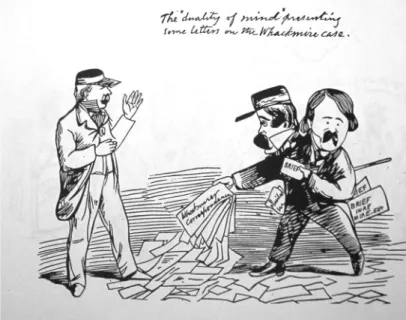
Fig. 4. From The Japan Punch, 1865.35)
Wirgman’s forte, however, was the satirical cartoon, and two later issues of 1865 amply demonstrate the artist’s wit and skill with the pen. The first cartoon we shall examine (Fig. 4) depicts a two-headed figure handing over a large quantity of letters to another figure, who stands at the left. One will recall Rickerby’s comment that Fisher suffered from “duality of the mind” — as revealed in Wirgman’s literal interpretation of this phrase, we see the American Consul depicted with two separate heads. One head (at left) wears the gold-banded cap reserved for the diplomatic corps, while the other (at right) — his pockets stuffed with legal briefs — represents Fisher as a member of the legal profession. The other figure in the cartoon is Acting British Consul Marcus Flowers. The caption above, which reads “the ‘duality of mind’ presenting some letters in the Whackmire case,” aptly depicts the voluminous correspondence that passed between the two in November and December of 1865 (the great majority of which subsequently appeared in the pages of the Japan Timesand Japan Herald).
Fig. 5. From The Japan Punch, 1865.36)
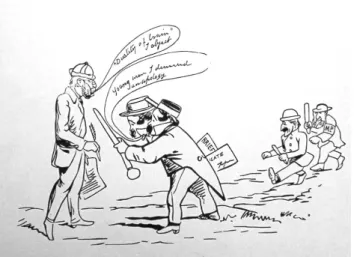
In the second illustration (Fig. 5) we see another two-headed Consul Fisher speaking to a bespectacled man holding a pen and paper. Fisher’s “diplomat head” (at right) says “Young man, I demand an apology,” while the figure at left responds “‘Duality of brain’ I object.” The latter figure, as one might suspect, is Japan Timeseditor Charles Rickerby, who not only wrote the “duality of brain” editorial about Consul Fisher but also raised several strenuous objections during the court proceedings. Upon further examination of the cartoon one also notes that Rickerby wears a bandage on his nose from the “horse-whipping” he received from Glackmeyer. Another mention of Rickerby’s injury came in the page preceding, where Wirgman noted that “The late absence of all excitement has at length been succeeded by trials correspondence recrimination and finally by a charming case of assault and battery in which some serious damage was done to the nose of the Press, we are sorry to say that on this melancholy occasion the above mentioned organ was a little bit out of joint.”37)
Fig. 6. From The Japan Punch, 1865.38)
A third illustration (and accompanying text; see Fig. 6) re-imagines the local conflicts as a series of sporting events. “Sporting intelligence” was often reported in the pages of the Yokohama press; in the 1860s, the sports in question were most often horse races, bowling, shooting, and cricket. Wirgman’s humorous “spoting [sic] intelligence” reports on the “assaults to come” in the coming week. “Ichthos” is most likely Rickerby:
Spoting intelligence Assaults to come
On Wednesday, Whackmire versus the Marquis Thursday, Ichthos versus the — Press
Friday Whackmire versus the — Punch Sat. friend of Whackmire — Marquis
Sun. afternoon Press
M. friend of Punch
T. Ichthos v. Punch W. Whackmire J. H — d
The accompanying illustration depicts a well-armed Rickerby going to his office accompanied by several members of the Municipal Police.
Fig 7. From The Japan Punch, 1865.39)
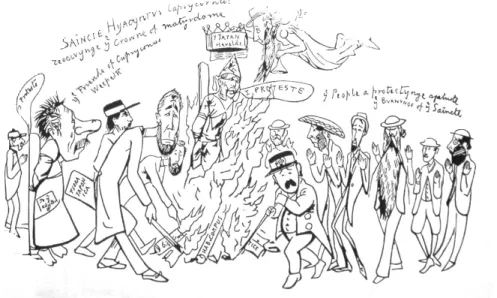
The fourth and fifth cartoon we shall examine both refer to the Japan Herald’s description of Rickerby as wearing the “crown of martyrdom” at the conclusion of United States v. Glackmeyer. In the center of Fig. 7 we see Rickerby (“I proteste”), being burned at the stake, receiving from an angel a crown of martyrdom labeled “Japan Herald.” The angel is a caricature of the Herald’s editor John Reddie Black. Also prominent is Consul Fisher (though reduced to one head here), depicted stoking the fire at Rickerby’s right. While the identity of many of the other figures in the cartoon
cannot be known, it is likely that the bound and teary-eyed figure at left is Benjamin Seare, who was forcibly removed from the courtroom by Fisher during the “great case.”
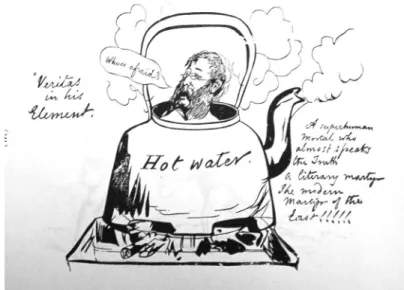
The figure behind Seare, conspicuous by his diplomat’s headgear and comment of “I proteste,” is presumably Consul Marcus Flowers. A fourth and last cartoon (Fig. 8) continues on this theme, except this time Rickerby is martyred a different way — boiled alive in a giant teapot. The caption reads “A superhuman mortal who almost speaks the truth, a literary martyr, the modern martyr of the East!!!!!” Rather than focus on Fisher’s wrongdoings in the Consular Court — as the Japan Heraldand the Japan Times had — Wirgman opted instead to highlight Rickerby’s own histrionics and exaggerations in the pages of his Japan Punch.
Fig. 8. From The Japan Punch, 1865.40) Joseph Heco
Joseph Heco, the famous Japanese castaway, made the following entry in his English- language autobiography:
November, 1865. This month has witnessed a great commotion in the Port, caused mainly by some of the peculiarities of extra-territoriality. A certain English dry-goods dealer had an American employee named G., whom he suspected of pilfering. The dealer invoked the authority of his Consul, and G. was illegally arrested and lodged in the English jail. So the employee brought an action for false imprisonment against the dealer, — in the English Court, of course. In this case the American Consul, who happened to be the only American lawyer in Yokohama, was the Counsel for the plaintiff. This led to the local English paper making some very caustic comments on G.’s character, and these comments in their turn led to a severe cow-hiding, which G. inflicted on the Editor with much gusto in front of the club-house on the Bund.
Thereupon the Editor brought an action for assault and battery against the said G. in the American Court, where the American Consul, G.’s lawyer, was now his judge.
In the course of the case the English community seemed to be filled with the greatest animosity against the defendant and the Court, and several summoned as witnesses refused to answer pertinent questions put by G. as well as by the Court. On the 23rd inst. the following verdict was given, after the quotation and discussion of English and American discussion on similar cases ... [quotation of verdict omitted] ... This decision, as might have been expected, gave rise to a regular commotion among the non-American portion of the foreign community. Public meetings were held and much correspondence passed between the various Consuls. But in the course of the month the whole matter blew over in smoke.41)
Heco’s words are significant for one simple reason: although a native-born Japanese, the former Hamada Hikozo¯濱田彦蔵was raised in the United States, was a naturalized citizen of the country, and worked for a time in the U.S. Consulate. His is the only recorded opinion of any party (other than Fisher) with an American perspective on the matters at hand, and his comments suggest that there are other ways the “great case”
may be interpreted. In Heco’s opinion, it was “a local English paper” that made “caustic comments” about Glackmeyer; furthermore, rather than evincing the sentiment that Fisher was in the wrong, Heco asserts that “the English community seemed to be filled with the greatest animosity against the defendant and the Court.” Heco’s comments pointedly remind us that national sentiments were in evidence on both sides, and that the Yokohama English-language press was by no means the voice of the entire population (despite, one might add, its own frequent claims to the contrary).
Conclusions
Charles Rickerby’s “crime” was to make public an open secret of treaty port life. A significant percentage (if not a majority) of the single men of Yokohama lived with women to whom they were not married. This fact was not kept strictly hidden — the British physician William Willis, for example, noted in an 1867 report prepared for the Foreign Office that “it is computed that there are about one thousand prostitutes at Yokohama, of which number between two and three hundred women are employed as mistresses of foreigners, with an average wage, at the present time, of fifteen to twenty dollars a month each.”42) Nevertheless, by boldly printing in his newspaper that Glackmeyer lived with a “Chinese prostitute,” Rickerby was violating the standards of local taste. The newspaper was a powerful medium, endowed with a far-reaching audience and an air of objectivity — for the Japan Times to comment openly on prostitution was a violation of the unwritten rules of treaty port life. Accordingly, Glackmeyer’s assault aroused little sympathy for Rickerby among the settlement’s residents. However, Consul Fisher’s vindictive behavior and perversion of justice marked a far greater threat to the community, which is why in the final account Rickerby was transformed from a villain into a “martyr.”
If Consul Fisher had adjudicated the case properly, the foreign community of Yokohama could still have ostracized Charles Rickerby. They could have shunned Rickerby’s newspaper, the Japan Times, or refused to patronize the brokerage and auctioneering firm in which he was a partner. However, Consul Fisher had so outstripped the bounds of acceptable behavior that the Japan Herald, and one assumes
the majority of the settlement’s residents, could only sympathize with Rickerby and reluctantly come to his defense. Intruding in one’s personal affairs was one thing, but threatening the judicial system upon which they staked their careers and businesses was another matter altogether. After the case of United States v. Glackmeyer, Fisher was the subject of ostracism himself, in his case by the other members of Japan’s diplomatic community — although it must be said he was never a particularly popular character.
Accordingly, based on official dispatches sent to Washington from December 1865 to the spring of 1866, Fisher reveals himself to be a bitter and paranoid man, positive that the British are trying to ruin his career. Fisher wrote dozens of long letters home to Secretary of State William Seward explaining again and again his side of the argument with regard to his conduct in the trial. “It is a matter of extreme regret,” he wrote in a December 1, 1865 letter to Seward, “that ... I feel compelled in self-defense to write your Department particulars of a recent extraordinary and outrageous combined attempt by British subjects, and a few others influenced by them, in this Port against myself.”43) The extreme length of some of the letters (the letter from which the above quotation was taken runs twelve densely-written pages) makes one question whether Fisher understood that the Secretary of State might have had more pressing matters to attend to — such as work towards the reconstruction of his country after four years of destructive and bloody civil war — rather than read about the misadventures of a consul half a world away.
Fisher eventually petitioned to leave his post, and was reassigned the following spring. Charles Rickerby, for his part, stopped printing his newspaper in 1870 (likely for financial reasons, though this is unclear), and went back into the auctioneering business.44) The merchant Alexander McKechnie, the plaintiff in the original case, eventually went bankrupt and left Japan for his native England. Gustave Glackmeyer disappears entirely from the list of foreign residents published in the years after 1865, and is never heard from again. In the final analysis, we may safely conclude that the ultimate victor of Yokohama’s public squabbles was Charles Wirgman, who continued to poke fun at local residents for another two decades; his Japan Punchran until 1887.
Notes:
1) The Nagasaki Shipping List and Advertiser, August 10, 1861.
2) Benedict Anderson, Imagined Communities: Reflections on the Origin and Spread of Nationalism, (London:
Verso, 1991, revised and extended edition).
3) The Japan Times Daily Advertiser, September 18, 1865.
4) The Japan Times, November 3, 1865.
5) Ibid.
6) The Japan Herald, November 4, 1865.
7) Young Japan: Yokohama and Yedo, 1858–1879,(Tokyo: Oxford University Press, 1968), 377.
8) The Japan Herald, November 11, 1865.
9) Ibid.
10) The Japan Herald, November 11, 1865.
11) The Japan Times, November. 10, 1865.
12) Ibid.
13) The Japan Times, November 10, 1865.
14) Ibid.
15) Ibid.
16) The Japan Times, November 17, 1865.
17) Ibid.
18) This quotation and those following are taken from The Japan Herald(Supplement) of November 25, 1865.
19) In the Japan Times Daily Advertiser of November 20, the same point is made: “[Rickerby] in a most excited manner immediately contradict[ed] himself and admit[ed] his guilt — he was not cautioned by the Consul that such statement [sic] could be used against him. On the contrary, his admission of his guilt was put upon as the record of the trial — substantiated by evidence the most incontrovertible — and yet formed in the mind of the presiding Magistrate, Mr. G. S. Fisher, Consul for the United States of America, no grounds ... for the immediate passing of sentence.”
20) One source lists Seare as a partner in the Japan Times, but I have not been able to verify this elsewhere.
See Yokohama-shi chu¯o¯ toshokan kaikan kinenshi: Yokohama no hon to bunka横浜市中央図書館開館記念誌―
横浜の本と文化, ed. Yokohama-shi chu¯o¯ toshokan kaikan kinenshi henshu¯ iinkai 編集委員会, (Yokohama:
Yokohama-shi chu¯o¯ toshokan, 1994), 436ff.
21) The Japan Herald, November 25, 1865.
22) The Japan Herald, November 25, 1865.
23) Ibid.
24) The Japan Times Daily Advertiser, November 21, 1865.
25) The Japan Times, November 24, 1865.
26) Ibid.
27) Ibid.
28) Ibid.
29) The Japan Times, December 1, 1865.
30) Ibid.
31) The Japan Times, December 15, 1865.
32) Ibid.
33) The Japan Times, November 24, 1865.
34) The Japan Punch, (Tokyo: Yu¯sho¯do¯ shoten 雄松堂書店, 1975), Vol. 1, pp. 106-107. Note that the Japan Punchdid not indicate publication information other than the year of publication. All illustrations in this chapter are from two (presumably subsequent) issues of the Punch, both dated 1865.
35) The Japan Punch, Vol. 1, p. 106.
36) The Japan Punch, Vol. 1, p. 112.
37) The Japan Punch, Vol. 1, p. 110.
38) The Japan Punch, Vol. 1, p. 111.
39) The Japan Punch, Vol. 1, p. 115.
40) The Japan Punch, Vol. 1, p. 141.
41) Joseph Heco, The Narrative of a Japanese: What He Has Seen and the People He Has Met in the Course of the Last Forty Years, vol. 2, James Murdock, ed., (Yokohama, Japan: Yokohama Printing & Publishing Co., Ltd., 1895), 79-80.
42) Hugh Cortazzi, Victorians in Japan: In and Around the Treaty Ports, (London: The Athlone Press, 1987), 278.
43) Dispatches From United States Consuls in Kanagawa, 1861–1897: Volume 3, October 14, 1865– December 31, 1867, (Washington: The National Archives, 1948). File Microcopies of Records in the National Archives: No. 135, Roll 3.
44) Rickerby returned to the newspaper business in 1878, though not for long. His Japan Times, New Series ran from January to July of that year. See Grace Fox, Britain and Japan 1858–1883, (Oxford : Clarendon Press, 1969), 427.