Introduction
This study investigates request speech events represented in English textbooks for Japanese second- ary schools. It analyzes a range of request realization strategies and contextual information in request events.
Since Hymes (1972) introduced the notion of communicative competence, many researchers have elaborated one of its crucial components appropriateness, i.e., sociolinguistic competence (Bachman &
Palmer, 1996; Canale, 1983; Canale & Swain, 1980; Celce-Murcia, 1995, 2007).(1) Among them, Celce- Murcia (2007) incorporates a wide range of language use in her notion of sociolinguistic competence, such as (socio)pragmatic knowledge of politeness strategies and social/cultural factors, functional knowledge of speech acts and speech act sets, discourse knowledge of cohesion, dexis and coherence, and verbal and non-verbal knowledge of turn-taking system in conversation.(2)
A growing number of interlanguage pragmatic research has investigated the range of language use of second/foreign language learners (Blum-Kulka, House, & Kasper, 1989) and the effect of instruction or materials on their language use (Bardovi-Harling, Hartford, Mahan-Taylor, Morgan, & Reynolds, 1991; Crandall & Basturkmen, 2004; Takimoto, 2008). Textbook analysis is another type of research which surveys language use and pragmatic information available in textbooks (Boxer & Pickering, 1995;
Carter, 1998; Gilmore, 2004; Taguchi, 2005; Vellenga, 2004). A common claim across the research is that textbooks provide poor input for pragmatic learning, e.g., learning appropriate speech acts, discourse features, and politeness in context. The claim is twofold: a lack of pragmalinguistic knowledge (i.e., linguistic forms involved in a linguistic action) and that of sociopragmatic knowledge (i.e., culture-based knowledge of a speaker’s assessment of contextual factors on the linguistic action) (Thomas, 1983).(3)
The former, for example, is reported in Gilemore’s (2004) study which compares conversational features (e.g., lexical density, false starts, repetition, pauses, and so forth) in ELT textbooks published between 1981 and 1997 in the UK with their equivalents in natural interactions. It is found that all fea- tures, with the exception of lexical density, occur less in textbooks than in natural interactions. Campillo (2007), who investigates a speech act of requesting in ELT coursebooks used at a tourism department
Analysis of Request Events in English Textbooks for Japanese Secondary Schools
Mayu KONAKAHARA
in Spain, reports a similar result. She focuses on analyzing how a requestive function is mitigated or aggregated by the use of modification devices (e.g., politeness markers and grounders), and finds that these types of modification devices are limited, particularly to the representation of please. Although not all researchers compare their textbook data with equivalents collected from natural interactions, it is claimed that the lack of authenticity of textbook language is attributed to the scarcity of pragmalinguistic information represented in textbooks. Yet this issue of authenticity of language leaves much room for discussion. Widdowson (1979) warns that it is not the quality of language itself that authenticity resides in, but through interactions between the sender and receiver of language that it is created. This indi- cates that some form of mediation is needed to make the language authentic to learners.
The second claim is an under-representation of sociopragmatic knowledge in textbooks in which decontextualized language use is presented. For instance, Vellenga (2004) examines the treatment of speech acts in ESL integrated skills textbooks and EFL grammar textbooks published in the USA.
It is found that the models of speech acts, which are seldom presented to learners, contain very little contextual information such as social relationships between interlocutors, power differences, and other contextual factors. According to Brown and Levinson (1987), these contextual factors can be grouped into three categories: a rank of imposition of a request, relative power between interlocutors, and social distance between interlocutors. Although these factors do not cover every possible factor influencing lan- guage use, fairly broad and sufficient factors have been covered. Since the presentation of contextually appropriate input is reckoned as a necessary condition for learning appropriate language use in context (Judd, 1999), this dearth of sociopragmatic information suggests that a textbook is an insufficient source for it.
Whereas many studies have concentrated on the amount and/or the presence of pragmatic informa- tion in textbooks, research on how a speech act is presented as discourse, more specifically on how textbooks present a request speech event, a larger discourse structure (Hatch, 1992), has received far less attention – despite the fact that a request is realized not only by a single utterance but also within a speech event. In addition, with the exception of Taguchi (2005), it seems that very few attempts have been made to analyze under what contextual factors a request is realized in textbooks regardless of the assumed importance of contextual information for pragmatic learning. Therefore, the main focus in this study is to examine how a request is presented as a request event in English textbooks for Japanese sec- ondary schools. Specifically, this study aims at investigating two aspects: 1) the range of request realiza- tion strategies (i.e., strategy types and modification devices), and 2) the range of contextual information (i.e., contextual factors) available in the textbooks. In what follows, the first section describes textbooks surveyed in this study, and the second section explains the taxonomies employed.
This study
Textbooks
In Japan, textbooks in elementary and secondary schools must be either authorized by the Ministry of Education (MEXT) or published under the copyright of Japanese School Education Law. The present study investigates eight textbooks̶four from junior high and four from senior high schools̶pub- lished under the 2002 and 2003 versions of The Course of Study. They are selected from eighteen English textbooks for junior high schools and twenty-five Oral Communication (OC) I and II textbooks for senior high schools (nineteen and six textbooks respectively). There are four subjects, OC I and II, English I and II, Reading, and Writing in senior high schools. Among them, OC was selected for the investigation because the subject particularly aims at fostering learners’ communication ability in English.
The selected eight textbooks are as follow: Columbus 21 English Course 1, New Crown English Series New Edition 1, New Horizon English Course 2, and Total English 3 for junior high school textbooks; and Mainstream OC 1, Open Door to OC Book 2, Why not? OC 1, and Screenplay OC 2 for senior high school textbooks. All of the eight textbooks employ a topic-based approach, the contents of which are organized by language-use situations and functions of language described in The Course of Study, which describes two types of language-use situation: situations where fixed expressions are often used (i.e., greetings, self-introductions, talking on the phone, shopping, asking and giving directions, traveling, and having meals), and situations that are likely to occur in students’ lives (i.e., home life, learning and activities at school, and local events) (MEXT, 2, (2)). The functions of language are classified into four: facilitating communication (i.e., addressing, giving nods, asking for repetition, and repeating), expressing emo- tions (i.e., expressing gratitude, complaining, praising, and apologizing), transmitting information (i.e., explaining, reporting, presenting, and describing), and expressing opinions and intentions (i.e., offer- ing, promising, giving opinions, agreeing, disagreeing, and accepting) (ibid.). Most textbooks employ devised stories using their own characters to introduce the functions of language, vocabulary and gram- matical structures, with the exception of Screenplay OC 2 which employs films to introduce them.
Analysis
In order to investigate request events, dialogues containing requests were extracted from each text- book. Then request realization strategies and contextual information were analyzed.
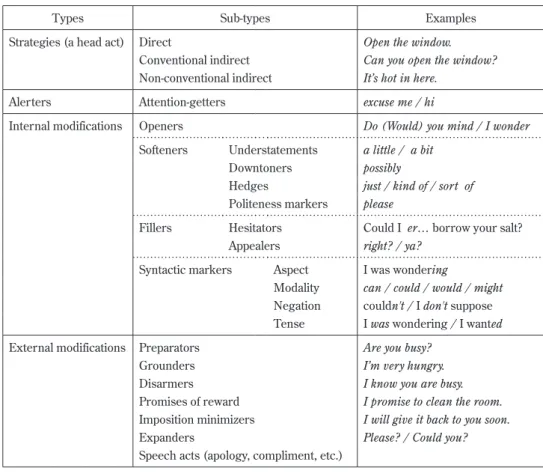
The request realization strategies were coded according to taxonomies based on Blum-Kulka, House and Kasper (1989) and Campillo (2007), which are summarized in Table 1.(4)
A request realization strategy comprises three segments, a minimal unit realizing a request called a head act (HA), an opening element before the HA called an alerter (i.e., attention-getters), and modifica- tion devices which mitigate or aggregate the requestive function realized by the HA (Blum-Kulka, et al., 1989). The HA can be coded into three types according to its strategy and level of directness: direct, con- ventional indirect and non-conventional indirect strategies. The modification devices are categorized into two kinds: internal modifications which are linguistic elements internally modifying a HA, and external modifications which are contexts either pre-posed or post-posed to a HA (i.e., supportive moves).
The following details these two kinds of modification device. Internal modifications contain four types: openers, softeners, fillers and syntactic markers. As suggested by their names, openers are opening expressions to seek the requestee’s co-operation. Softeners are mitigating expressions which are divided into understatements, downtoners, hedges and politeness markers. Fillers are divided into hesitators and appealers; the latter are expressions eliciting the requestee’s consent. The last type is syntactic markers, which mark the aspect, modality, negation and tense. On the other hand, external modifications consist of
Table 1 Taxonomies of request realization strategies in this study
Types Sub-types Examples
Strategies (a head act) Direct Open the window.
Conventional indirect Can you open the window?
Non-conventional indirect It’s hot in here.
Alerters Attention-getters excuse me / hi
Internal modifications Openers Do (Would) you mind / I wonder Softeners Understatements a little / a bit
Downtoners possibly
Hedges just / kind of / sort of Politeness markers please
Fillers Hesitators Could I er… borrow your salt?
Appealers right? / ya?
Syntactic markers Aspect I was wondering
Modality can / could / would / might Negation couldn't / I don't suppose
Tense I was wondering / I wanted
External modifications Preparators Are you busy?
Grounders I’m very hungry.
Disarmers I know you are busy.
Promises of reward I promise to clean the room.
Imposition minimizers I will give it back to you soon.
Expanders Please? / Could you?
Speech acts (apology, compliment, etc.)
(Based on Blum-Kulka, et al. (1989) and Campillo (2007))
seven sub-types. The first type is preparators which prepare the requestee for the ensuing request. The second type is grounders which give reasons and justifications for a request. The third is disarmers which remove potential refusal by the requestee. The fourth is promises of reward which offer compensation to the requestee. Imposition minimizers are the fifth type, which reduce a request’s imposition on the requestee. The last two types are expanders and other speech acts such as apologies, compliments, and so forth. The expanders are repetitions of the same request or other synonymous expressions.
The present analysis of the contextual information examines contextual factors operated in the request events based on Brown and Levinson’s (1987) three factors: the rank of imposition of a request (R), relative power between interlocutors (P), and social distance between interlocutors (D). These three factors are employed because they are sufficient for the present study, which attempts to capture the range of contextual factors available in the textbooks. Two ranks of imposition were identified, low (R-low) and high imposition (R-high). As for power relationship, three types were identified: interlocu- tors equal (P: Speaker (S)=Hearer (H)), hearer dominant (P: S<H), and speaker dominant (P: S> H).(5) Social distance between interlocutors was classified into close and far (D-close and D-far respec- tively). In addition, descriptions of characters in each textbook were investigated in order to reveal kinds of interlocutor information available.
Results and Discussion
This section shows findings based on quantitative and qualitative analyses of request events depicted in the eight English textbooks for Japanese secondary schools. The first section (A) reports findings of request realization strategies, and the second one (B) reports the contextual information contained in the request events. It will be claimed that the textbooks examined in the present study do not provide sufficient pragmatic input – both pragmalinguistic and sociopragmatic – to foster learners’ sociolinguis- tic competence regarding request speech acts and events.
A. Range of request realization strategies in request events
This section addresses the first research question by exploring a range of request realization strate- gies available in the textbooks. It is found that the range of modification devices is narrow and the requests are readily made and accepted. To begin with, quantitative findings will be shown to illustrate request realization strategies available in the textbooks; and then some examples of request events will be given in order to show how a request is realized in a request event. It will be claimed that the textbooks do not provide enough pragmalinguistic input to develop learners’ sociolinguistic competence regarding a request speech act.
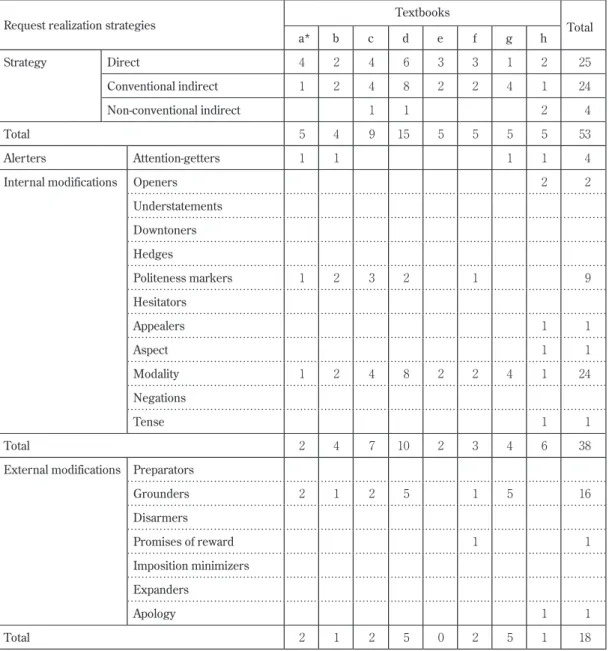
To start with, it is found that the textbooks present a considerably narrow range of modification devic-
es. Table 2 shows the frequency of request realization strategies presented in these textbooks. As shown in the table, the frequency of direct and conventional indirect strategies is almost identical (25 cases and 24 cases respectively). Conversely, the presentation of modification devices is limited to three types:
politeness markers and modality as internal modifications (9 and 24 cases respectively) and grounders
Table 2 Frequency of request realization strategies in the textbooks
Request realization strategies Textbooks
Total
a* b c d e f g h
Strategy Direct 4 2 4 6 3 3 1 2 25
Conventional indirect 1 2 4 8 2 2 4 1 24
Non-conventional indirect 1 1 2 4
Total 5 4 9 15 5 5 5 5 53
Alerters Attention-getters 1 1 1 1 4
Internal modifications Openers 2 2
Understatements
Downtoners
Hedges
Politeness markers 1 2 3 2 1 9
Hesitators
Appealers 1 1
Aspect 1 1
Modality 1 2 4 8 2 2 4 1 24
Negations
Tense 1 1
Total 2 4 7 10 2 3 4 6 38
External modifications Preparators
Grounders 2 1 2 5 1 5 16
Disarmers
Promises of reward 1 1
Imposition minimizers
Expanders
Apology 1 1
Total 2 1 2 5 0 2 5 1 18
*a. Columbus 2, b. New Crown, c. New Horizon, d. Total English
e. Mainstream OC 1, f. Open Door to OC 2, g. Why not? OC 1, h. Screenplay OC 2
as an external modification (16 cases).
Before giving explanations for these figures, examples of request events are shown in order to give a clear picture of how a request(s) is realized and modified within a request event. In the following examples, a HA is typed with bold face, internal modifications are italicized, and external modifications are underlined. A turn containing a HA is identified by an arrow. A title of a unit is given preceding the dialogue.
(1) Shun’s experience in India
Amit: Have you ever eaten Indian food?
Shun: Yes, I have. I like curry.
Amit: Good! Let’s go and eat curry.
Shun: Oh, most people here only eat with their hands. I’ve never used my hands to eat curry.
Amit: Really? You can use either a spoon or your hand.
Shun: I’ll try to eat with my hands.
Amit: Please only use your right hand. It’s a custom here in India.
Shun: Oh, I never knew that. (Total English 3, p. 24)
(2) Requests to a teacher
Shin: Excuse me, Ms. Green. May I ask you a favor?
Ms. Green: Sure. What is it?
Shin: I got a letter from Canada. But I can’t read it. Could you read it for me, please?
Ms. Green: All right. (New Horizon Course 2, pp. 20–21)
Example (1) shows a request between friends. Shun is a Japanese boy and he visits India to see his Indian pen friend, Amit. A request made by Amit is realized by a single turn, which is initiated by Shun’
s utterance about the use of hands to eat curry. The use of HA is a direct strategy, which is internally modified by a politeness marker and externally post-modified by a grounder.(6) The requestee accepts the request by stating that he does not know about the Indian custom.
In contrast, Example (2) is an exchange between a student, Shin, and a teacher, Ms. Green, which is realized by a few turns. As suggested by its title, this request event is offered in the unit about making requests. The request event starts with an attention-getter, and then by a preparator to announce the ensuing request. After the requestee has acknowledged the preparator, the requester use grounders to externally pre-modify the HA. The HA, categorized as a conventional indirect strategy, is internally modified by a modality and a politeness marker. The request is accepted by the requestee without any recognizable difficulty for both interlocutors.
The above findings have yielded three observations. The first one is that a conventional indirect strategy internally modified by a modality and a politeness marker is a recurrent form of making polite requests in the textbooks. Notice that a conventional indirect strategy always contains a modality (e.g., could and can; see also Table 2). Many studies have reported the frequent presentation of modality in textbooks (Chang, 2003, investigating textbooks for Korean middle schools; Nakano, 2005, investigating textbooks for Japanese secondary schools; Usó-Juan, 2007, investigationg English tourism coursebooks in Spain). In addition, Campillo (2007) and Nakano (2005) also reported the frequent occurrences of politeness markers in their studies.(7) These suggest that polite requests are manifested in the combina- tion of a conventional indirect strategy, a modality and a politeness marker in many textbooks.
Secondly, it is found that the range of modification devices used is narrow, with the exception of Screenplay OC 2, which shows a slightly wider range of modification devices (see Table 2, h). The textbook aims at teaching polite request forms and presents a variety of modification devices such as openers, aspect and apology (e.g., I’m terribly sorry to bother you at this time, but I was wondering if it’d be possible to ask you for your help with this assignment., p. 16). Yet for all other textbooks, only modality, politeness markers, and grounders are presented. This raises two questions: 1) Is the amount of modification devices in the textbooks sufficient to foster learners pragmatic learning regard- ing request speech acts, and 2) Under what situations are requests realized in the textbooks?
The answer for the first question is doubtful although the present study did not explore the causal relationship between textbook input and learners’ performance. A previous study has reported a similar- ity between request strategies presented in textbooks and learners’ performance (Nakano, 2005). While this result suggests a positive learning transfer, it is still possible that the narrow range of modification devices conveyed in the current textbooks might have led to the oversimplification of request forms as represented by the recurrent combination mentioned earlier. On the other hand, the second question particularly arises from the over-representation of grounders. While grounders are a natural choice for making requests, their frequent occurrence questions the contextual factors operated in a request event.
This is because the use of external modifications is heavily conditioned by interactional and contextual factors (Usó-Juan, 2007). This inevitably questions the range of contextual factors operated in request events which will be discussed in the section (B).
The third observation, which is clear from the descriptions of request events, is that a request is easily accepted by the requestee without any difficulty shown by both interlocutors. In fact, all requests except one (out of 53 requests) is simply accepted without any negotiations between the interlocutors (an exam- ple of the rejected request will be shown later). This might be explained by the Japanese cultural style of avoiding conflict by readily accepting a request as reflected in the request events. Yet, considering from an educational perspective, it is questionable how learners can achieve their requestive function in situa-
tions not encountered in their textbooks, for example, to persuade their interlocutor who is unwilling to comply with the request. Although The Course of Study aims at developing learners’ communication abil- ity in English, the request events described in the textbooks seem to be unsatisfactory pragmalinguistic models to foster learners’ sociolinguistic competence.(8) In the next section, a range of contextual infor- mation contained in the request events will be analyzed.
B. Range of contextual information contained in request events
This section addresses the second research question which explores the contextual information in the textbooks. It is found that there is an unbalanced representation of contextual factors in the request events, and a lack of interlocutor information in the textbooks. In the first place, several pieces of evi- dence regarding the former findings will be shown; and then, those of the latter will be shown together with a supplementary analysis. It will be claimed that the textbooks do not provide sufficient socioprag- matic information to foster learners’ sociolinguistic competence regarding request events.
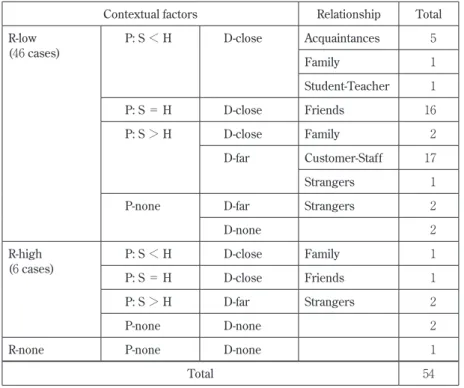
To begin with, it is found that a range of contextual factors operated in the request events is fairly unbalanced. Table 3 summarizes the findings. Since all textbooks show a similar unbalanced representa- tion of contextual factors, only the overall frequency observed across the textbooks is reported.
Table 3 Contextual factors operated in the request events (cases)
Contextual factors Relationship Total
R-low
(46 cases) P: S<H D-close Acquaintances 5
Family 1
Student-Teacher 1
P: S=H D-close Friends 16
P: S>H D-close Family 2
D-far Customer-Staff 17
Strangers 1
P-none
D-far Strangers 2
D-none 2
R-high
(6 cases) P: S<H D-close Family 1
P: S=H D-close Friends 1
P: S>H D-far Strangers 2
P-none D-none 2
R-none P-none D-none 1
Total 54
As shown in the table, low-imposition situations are considerably more dominant (46 cases) than high- imposition situations (6 cases). In addition, among the low-imposition situations, two sets of contextual factors are frequently observed: interlocutors-equal and close-distance (P: S=H, D-close; 16 cases), and speaker-dominant and far-distance (P: S>H, D-far; 17 cases). The interlocutors in the former situations are friends, and those in the latter are customers and staff (see relationship in Table 3). Examples are shown to illustrate the two dominant types of situation. Explanations for contextual and/or interlocutor information are provided if available in the textbook (italicized).
(3) Jenny’s Canadian Friend
Hiro, who is a central character in this textbook, is a first-year student at junior high school. His young- er sister, Sanae, is a fifth-year student at elementary school. An American girl, Jenny, the same age as Hiro, is having a homestay at Hiro’s house (summarized and translated by the current author).
Jenny: Oh, I got a card from Chuck.
Sanae: Who’s Chuck?
Jenny: He’s one of my friends in Canada. He’s cool. I went skiing with him last year. We had a really good time.
Sanae: Do you have any pictures of him?
Jenny: Yeah. I took some in Canada.
Sanae: Oh, can we see them?
Jenny: Hold on … Here.
Sanae: Look, Hiro!
Hiro: Hmm…. (Columbus 21, pp. 88–9)
(4) Shopping
It’s Sunday today. June and Kent are shopping at a shopping center (translated by the current author).
Kent: Excuse me. How much is this watch?
Staff: It’s 130 dollars.
Kent: Oh, it’s too expensive. Could you show me another one?
Staff: How about this one? It’s only 30 dollars.
Kent: Very nice. I’ll take it. It’s a gift. Could you wrap it, please?
Staff: Sure. Please wait a minute.(9) (Total English, p. 19)
Example (3) is a request event between friends. As indicated by the arrow, a request is made by Sanae, the younger sister of the main character Hiro, to Jenny, an American girl staying at their house (R-low, P:
S=H, D-Close).(10) This interlocutor information is available in the character description section, which
is more detailed than other textbooks (this will be discussed in the supplementary analysis below).
On the other hand, Example (4) shows a request event between a customer and a staff member. As indicated by the three different arrows, three requests are sequentially realized, all of which are from a customer, Kent, to a staff member at a shopping center (R-low, P: S>H, D-far).(11) The contextual information of this request event goes with the dialogue. However, interlocutor information about Kent such as his age and social status is not supplied although a picture of him is provided. This may be problematic for pragmatic learning, i.e., learning appropriate language use (this will be discussed in the supplementary analysis).
These two dominant types of request situation, a request between friends and between a customer and a staff member, seem relevant to students’ lives as defined in The Course of Study.(12) However, to borrow Washburn’s (2001) words, characters in textbooks are “one-dimensional” and “their relationship [is] defined in stereotypical ways” (i.e., friends, teacher-student) (p. 22). Moreover, there appears to be no adequate account for considerably low occurrence of high-imposition situations because a request in ordinary life is not always easy to make, which depends very much on factors such as urgency of the request or intimacy between the interlocutors. As pointed out by Carter (1998), most English textbooks reflect “a ‘can do’ society” (p. 47) because the interlocutors are friendly and willing to comply with the requests in almost all request events depicted.
Another finding is that interlocutor information is under-repesentated or not represented in the text- books. As shown in Table 3, there are seven cases in which the three contextual factors are partly or completely lacking. The following are examples of such cases.
(5) Requests, Questions, and Answers
A: Can I use this book?
B: I’m afraid not. I need it to do my homework.
A: Oh, OK. (Mainstream OC 1, p. 8)
(6) Etiquette
A: Would you mind checking this English of mine?
B: I’d be happy to.
A: Thank you very much. I really appreciate it. (Screenplay OC 2, p. 16)
Example (5) shows a request event in which contextual factors are missing (R-none, P-none, and D-none).(13) There are neither explanations for the request situation nor those for the interlocutors from which contextual factors can be judged. Some might say that the imposition of this request can be low, but its imposition can vary according to the information such as social distance between the interlocu-
tors and urgency of the request, which is not given. The same is applicable to Example (6) (R-high, P-none, and D-none).(14) Although the imposition may be judged as relatively high because of the type of request (i.e., a request for actions), information such as the relative power and social distance between interlocutors is totally undefined in the textbook.
A supplementary analysis of interlocutor information reveals how the interlocutor information is dealt with in each textbook. Table 4 summarizes the descriptions of characters in each textbook. It reveals that the interlocutors’ information given in the textbooks is sometimes absent or only limited information such as names of characters, their relationship with other characters, their occupation, and their hometown (pictures of characters are often accompanied with their names) is provided.
Specifically, Open Door to OC 2 (f) and Screenplay OC 2 (h) do not provide any interlocutor informa- tion. For Mainstream OC 1 (e), only names of the characters are given. Other information such as their hometown is only implied by the pictures of the characters and their names (e.g., Bob Johnson and Miho Suzuki).
In contrast, Columbus 21 (a) gives more detailed information. The textbook devotes one page to the prologue of the story, and gives additional information about the main character’s family background such as his father’s new job at a branch office of a company in Los Angeles and an account of an American girls homestay at his family and so forth. This kind of information seems essential for learners because it enables them to internalize the materials or to make the story authentic/meaningful to them (Taguchi, 2005; Widdowson, 1979). It is found that the other textbooks, however, omit or just hint the interlocutors’ information, thus underestimating the importance of sociopragmatic information which is crucial for pragmatic learning. This suggests that the textbooks examined are not adequate sources to Table 4 Summary of descriptions of characters in each textbook
Textbooks If present + Interlocutors’ information
a* + Name, relationship, occupation, hometown, and additional background information to the story in a prologue
b + Name and hometown
c + Name, occupation, and hometown
d + Name, occupation, hobby, and hometown
e + Name
f
g + Name and relationship
h
*a. Columbus 21, b. New Crown, c. New Horizon, d. Total English
e. Mainstream OC 1, f. Open Door to OC 2, g. Why not? OC 1, h. Screenplay OC 2
foster learners’ sociolinguistic competence regarding a request event.
Conclusion
This study has analyzed request events in eight English textbooks for Japanese secondary schools in terms of request realization strategies and contextual information contained in request events. It is found that request realization strategies shown in the textbooks are limited in their use of modification devices (i.e., modality, politeness markers, and grounders), and the range of contextual factors is nar- row, specifically the low-imposition situations are considerably frequent than those of high-imposition.
Some authors have pointed out that materials that learners are exposed to are poor input for pragmat- ic learning because they lack pragmalinguistic and sociopragmatic information and present decontextu- alized language use (Boxer & Pickering, 1995; Campillo, 2007; Crandall & Basturkmen, 2004; Vellenga, 2004). In light of the present findings, it can be added that the textbooks examined in this study give impoverished models of request events. It is because they overwhelmingly describe a request that is easily made and accepted by each interlocutor and provide very limited interlocutors’ information which is, in many cases, only implied by the names of the characters and their pictures.
The fact that this study has only analyzed a small number of textbooks presents a limitation. In addi- tion, although this study reckons a textbook as a primary input in the ELT classroom, other sources of pragmatic input such as teacher’s instruction and classroom discourse may need to be investigated in the future. Nevertheless, some pedagogical implications have emerged from this study, particularly for materials development. First, more varieties of modification devices should be provided in order to increase and diversify learners’ pragmalingusitic knowledge although issues such as learnability and teachability should also be considered. At the same time, modification devices should be provided in appropriate request contexts since the use of modification devices are conditioned by the context.
Moreover, it is useful to present examples of request events in which requests are negotiated by interlocutors. The last but not least, more attention should be paid to contextual and interlocutors’
information contained in speech events in textbooks. Both contextual information of a speech event and descriptions of characters should be devised and explicitly provided so that they can appear meaningful and authentic to learners and internalize/mediate a speech event. It is hoped that the present study on request events in the English textbooks used in Japanese secondary schools can shed light on some problems regarding the presentation of speech events, particularly request events, in English textbooks.
Note⑴ In-depth discussions should be made on the definitions of sociolinguistic competence. In particular, it is necessary to consider a claim that the term competence in many models includes only knowledge of language
and excludes the ability for using the language (Widdowson, 1983).
⑵ Celce-Murcia’s (2007) model of communicative competence consists of six components: linguistic, formulaic, sociocultural, interactional (consisting of actional, conversational and nonverbal/paralinguistic competences), discourse, and strategic competences, although such components remain at knowledge level.
⑶ Yet the distinction between pragmalinguistic knowledge and sociopragmatic knowledge is not clear since the two are not mutually exclusive but intertwined.
⑷ While Blum-Kulka et al. (1989, see the Cross-Cultural Speech Act Realization Project (CCSARP)) take a syntactic approach focusing on the analysis of detailed syntactic downgraders, Campillo (2007) takes a sociopragmatic approach which is simple and comprehensible. In this paper, taxonomies of internal modifica- tions are mainly adopted from those of Campillo’s (2007); however, some syntactic markers such as modality, tense, aspect, and negation are included because such markers appear to be important linguistic elements characterizing politeness encoded in some languages. Taxonomies of external modifications, on the other hand, are mainly adopted from those of the CCSARP (Blum-Kulka, et al., 1989).
⑸ In this study a speaker refers to a requester, while a hearer, requestee.
⑹ Although it is uncertain to what extent the textbook writers intentionally incorporated characteristics of Indian English, please has a stronger function of politeness in Indian English than that in British English:
simply adding please to an utterance makes it a polite request in the former (Mehrotra, 1995).
⑺ Nakano (2005) has examined English textbooks for Japanese secondary school published under the 1993 and 1994 versions of The Course of Study. The present study has examined those published under the 2002 and 2003 versions.
⑻ The similar claim is made by Taguchi (2005), examining exercise types in OC textbooks. The textbooks provide only limited types of exercise, which are structured and mechanical such as simple comprehension and production of information. She argues that the limited exercise types constrain the possible development of learners’ communication ability outside the classroom.
⑼ The utterance Please wait a minute shows a form of request, but is not counted as a request because it is a ritual expression and can be regarded as part of acknowledgement.
⑽ In Example (3), the request is initiated by Jenny’s utterances explaining her experience of skiing with her friend. After checking the possession of the picture by use of preparator, Sanae realizes the HA, which is internally modified with a modality.
⑾ The request event in Example (4) is created to teach a conversation likely to occur at a shop. The first request starts with an attention-getter, and it is followed by a direct strategy. Successively, the second request is given. It consists of a comment on the prior turn, which is coded as pre-posed grounder, and the HA internally modified by a modality. The third request occurs after Kent decides what to buy; and it starts with a grounder externally modifying the succeeding HA which is internally modified by a modality and a politeness marker.
⑿ Adoption of casual and informal situations is also observed in OC textbooks published under the 1994 ver- sion of The Course of Study (Taguchi, 2005).
⒀ The request event in Example (5) is the only example of rejected request across all the textbooks exam- ined. The request event starts with the HA which is a conventional indirect strategy modified by a modality marker (i.e., can). The requestee rejects the request by giving a reason for the rejection. The requester amenably acknowledges its rejection.
⒁ In Example (6), the request event begins with the HA, a conventional indirect strategy, which is internally modified by a modality (i.e., would) and an opener (i.e., [do] you mind). The requestee willingly accepts the request, and the requester expresses her/his appreciation.
References
Bachman, L. F., & Palmer, A. S. (1996). Language testing in practice: designing and developing useful language tests.
Oxford: Oxford University Press.
Bardovi-Harling, K., Hartford, B. A. S., Mahan-Taylor, R., Morgan, M. J., & Reynolds, D. W. (1991). Developing prag- matic awareness: closing the conversation. ELT Journal, 45(1), 4–15.
Blum-Kulka, S., House, J., & Kasper, G. (1989). Cross-cultural pragmatics: requests and apologies. Norwood, N.J.:
Ablex Pub. Corp.
Boxer, D., & Pickering, L. (1995). Problems in the presentation of speech acts in ELT materials: the case of com- plaints. ELT Journal, 49(1), 44–58.
Brown, P., & Levinson, S. C. (1987). Politeness: some universals in language usage. Cambridge: Cambridge University Press.
Campillo, P. S. (2007). Examining mitigation in requests: A focus on transcripts in ELT coursebooks. In E. Alcâon Soler, M. P. S. Jorda & SpringerLink (Online service) (Eds.), Intercultural Language Use and Language Learning (pp. 207–222). Dordrecht: Springer Science+Business Media B. V. Retrieved January 31, 2011 from http://
dx.doi.org/10.1007/978-1-4020-5639-0.
Canale, M. (1983). From communicative competence to communicative language pedagogy. In J. C. Richards & R. W.
Schmidt (Eds.), Language and communication (pp. 2–27). London: Longman.
Canale, M., & Swain, M. (1980). Theoretical Bases of Com-municative Approaches to Second Language Teaching and Testing. Applied Linguistics, 1(1).
Carter, R. (1998). Orders of reality: CANCODE, communication, and culture. ELT Journal, 52(1), 43–56.
Celce-Murcia, M. (1995). The elaboration of sociolinguistic competence: Implications for teacher education. In J. E.
Alatis (Ed.), Georgetown University Round Table on Languages and Linguistics (pp. 699–710). Washington, D.C.:
Georgetown University Press.
Celce-Murcia, M. (2007). Rethinking the role of communicative competence in language teahing. In E. Alcâon Soler, M. P. S. Jorda & SpringerLink (Online service) (Eds.), Intercultural Language Use and Language Learning (pp. 41–57). Dordrecht: Springer Science+Business Media B.V. Retrieved 31st January, 2011 from http://dx.doi.
org/10.1007/978-1-4020-5639-0.
Chang, B. M. (2003). English Textbook Analysis for Developing the 8th National Curriculum: Focused on Discourse Study Using Discourse Completion Tasks. Proceedings of the 8th Conference of Pan-Pacific Association of Applied Linguistics, 35–49.
Crandall, E., & Basturkmen, H. (2004). Evaluating pragmatics-focused materials. ELT Journal, 58(1), 38–49.
Gilmore, A. (2004). A comparison of textbook and authentic interactions. ELT Journal, 58(4), 363–374.
Hatch, E. M. (1992). Discourse and language education. Cambridge: Cambridge University Press.
Hymes, D. (1972). On commnicative competence. In J. B. Pride & J. Holmes (Eds.), Sociolinguistics: selected readings (pp. 269–293). Harmondsworth: Penguin.
Judd, E. L. (1999). Some issues in the teaching of pragmatic competence. In E. Hinkel (Ed.), Culture in second lan- guage teaching and learning (pp. 152–166). Cambridge and New York: Cambridge University Press.
Mehrotra, R. R. (1995). How to be polite in Indian English. International Journal of the Sociology of Language, 116, 99–
110.
Ministry of Education, Culture, Sports, Science and Technology [MEXT]. (2002, 2003). The Course of Study for Junior and High School, Foreign languages, Retrieved 26th April, 2011 from http://www.mext.go.jp/b_menu/
shuppan/sonota/990301.htm
Nakano, M. (2005). Japanese English: Pragmatic competence at the university level - some evidence from Discourse Completion Tasks and Naturally Occurring Data, 1–45. Retrieved 25th January, 2011 from http://www.waseda.
jp/ocw/AsianStudies/9A-77WorldEnglishSpring2005/Calendar/nakano031104.pdf.
Taguchi, N. (2005). Evaluating the communicativness of EFL textbooks for Japanese secondary schools. In J.
Frodesen & C. Holten (Eds.), The power of context in language teaching and learning (pp. 211–224). Boston, Mass: Thomson/Heinle.
Takimoto, M. (2008). The Effects of Deductive and Inductive Instruction on the Development of Language Learners’
Pragmatic Competence. The Modern Language Journal, 92(3), 369–386.
Thomas, J. (1983). Cross-Cultural Pragmatic Failure. Applied Linguistics, 4(2), 91–112.
Usó-Juan, E. (2007). The presentation and practice of the communicative act of requesting in textbooks: Focusing on modifiers. In E. Alcâon Soler & M. P. S. Jorda (Eds.), Intercultural Language Use and Language Learning (pp. 223 –241). Dordrecht: Springer Science+Business Media B.V. Retrieved 31st January, 2011 from http://dx.doi.
org/10.1007/978-1-4020-5639-0.
Vellenga, H. (2004). Learning Pragmatics from ESL & EFL Textbooks: How Likely? Learning, 8(2).
Washburn, G. N. (2001). Using situaitonal comedies for pragmatic language teaching and learning. TESOL Journal, 10(4), 21–26.
Widdowson, H. G. (1979). The authenticity of language data Explorations in applied linguistics (pp. 163–172). Oxford:
Oxford University Press.
Widdowson, H. G. (1983). Learning purpose. In H. G. Widdowson (Ed.), Learning purpose and language use (pp. 5–
31). Oxford: Oxford University Press.
Textbooks
Horiguchi, S. et al., (Eds.). (2006). Total English 3. Tokyo: Gakkou Tosho
Kasajima, J. et al. (Eds.). (2006). New Horizon English Course 2. Tokyo: Tokyoshoseki.
Saito, S. et al. (2007). Mainstream Oral Communication 1 (2nd Ed.). Osaka: Zoshindo.
Suenaga, K. et al. (Eds.). (2008). Open Door to Oral Communication BOOK 2 (New Ed.). Tokyo: Buneido.
Takahashi, S. et al. (Eds.). (2006). New Crown English Series New Edition 1. Tokyo: Sanseido Tougo, K. et al. (Eds.). (2006). Columbus 21 English Course 1. Tokyo: Mitsumura Toshoshuppan.
Tsukada, M. et al. (Eds.). (2008). Screenplay Oral Communication 2. Nagoya: Foin Sukurinpurei Jigyobu.
Yada, Y. et al. (Eds.). (2007). Why Not? Oral Communication 1. Tokyo: Ikeda Shoten.