Inventory( TIPI-K): Comparison among
America, Germany, China, Japan and Korea
著者
松田 英子, 陸 英善, 安藤 清志, 河 尚應
著者別名
Eiko MATSUDA, Youngsun YUK, Kiyoshi ANDO,
Shang E. HA
journal or
publication title
The Bulletin of Faculty of Sociology,Toyo
University
volume
56
number
2
page range
71-78
year
2019-03
URL
http://id.nii.ac.jp/1060/00010425/
Creative Commons : 表示 - 非営利 - 改変禁止Examination of the Reliability and Validity of the Korean Version of
Ten-Item Personality Inventory
(TIPI-K): Comparison among
America, Germany, China, Japan and Korea
1Eiko MATSUDA
松田 英子
Youngsun YUK
*陸 英善
Kiyoshi ANDO
安藤 清志
Shang E. HA
**河 尚應
Introduction
After the person-situation debate in the 1970 s, it seems apparent that the concept of personality trait revived and the five-factor model (FFM, often called the Big Five) has been the predominant taxonomy for personality traits in personality psychology. Among the researchers in this area, the five factors are commonly labeled extraversion, agreeableness, conscientiousness, emotional stability (neuroticism), and openness to experience. Below are brief descriptions of each trait.
Extraversion
Extraversion indicates a personality dimension that is outgoing, highly sociable, energetic, and talkative. Extraverted people seek stimulating situation whereas introverts try to avoid it. Also, they tend to use simple and direct words whereas introverted people tend to choose vague and complex words. Extraversion is one of the most researched personality trait along with emotional stability.
Agreeableness
Agreeableness is a personality trait that indicates kind, sympathetic, cooperative, warm, and considerate tendencies. Individuals high in agreeableness have more social support, as the chance of creating relationship with others is higher than people with low agreeableness. Agreeableness is
* 21st Century Human Interaction Research Center of Toyo University ** Sogang University
1 This study was approved by the research ethics committee of the Graduate School of Sociology, Toyo University (Permission number: P18019).
important in forming first the impression of others. Conscientiousness
Conscientiousness is a personality trait of being careful and vigilant. Conscientious people tend to be systematic, careful, and tenacious in what they do. On the contrary, people low in conscientiousness tend to be improvisational, careless, and rash in what they do. Previous research has revealed that conscientious people are more successful in school and businesses. However, in an environment where things are unpredictable and quickly changing, there will be no effect on conscientiousness.
Emotional stability(Neuroticism)
Emotional stability concerns a person s ability to remain calm or even keel when faced with pressure or stress. Low emotional stability means hige level of neuroticism. Neurotic persons tend to feel negative emotions, have low job satisfaction, and have weaker immune system. Also emotional stability has big effects on other personality traits and can be seen as amplifier of other traits.
Openness to experience
Openness to experience involves six facets, or dimensions: active imagination, aesthetic sensitivity, attentiveness to inner feelings, preference for variety, and intellectual curiosity. People with higher levels of openness are imaginative and insightful, and interpret the world more diverse and complex. On the other hand, individuals that have low openness tend to be reluctant to try new things and would prefer to do things as they ve already done.
The most standard instrument for measuring the dimensions of five-factor model is the NEO-PI-R (Neuroticism [Low Emotional Stability], Extraversion, Open to experience, Agreeableness, Conscientiousness) consisting of 240 items (Costa & McCrae, 1992). Then 60 items NEO-FFI (Costa & McCrae, 1992) and 44 items Big Five Inventory (John & Srivastava, 1999) were developed as a shortened version of the scale to measure the five factors.
Although it is true that scales which involve many items have better psychometric properties, there are some instances when researchers have to give up using these scales even if they want to. For example, when they plan to study some social and cultural aspects of behavior they have to prepare a lot of questions to measure them, leaving little room to add scales to measure individual differences, such as NEO-PI-R, as moderators. This is why Gosling, Rentfrow, & Swann (2003) developed Ten-Item Personality Inventory (TIPI) to assess more briefly the Big Five personality dimensions, stating that If the psychometric costs of using short scales are not as steep as might be expected, their relative
efficiency make them a very attractive research tool. (p.505).
The TIPI was translated to several languages (e.g., Muck, Hell, & Gosling, 2007; Oshio, Abe, & Cutione, 2012; Li, 2015). The Korean Version of TIPI (TIPI-K) was originally introduced by Ha, Kim, & Jo (2013). They examined the relationships between TIPI-K scores and various modes of political participation (e.g., protest participation, rally attendance, financial contributions to political causes, etc.). Although they found some interesting pattern of correlations, the reliability of TIPI-K was not fully examined. Thus the present study aimed at examining the reliability and validity of this scale by analyzing data from Korean high school students, university students and employees. Development and gender differences were also examined and compared with prior cross-sectional studies (Kawamoto, Oshio, Abe, Tsubota, Hirashima, Ito, & Tani, 2015; Soto, John, Gosling, & Potter, 2011).
Methods
Participants were 739 Koreans: fifty high school students (mean age = 18.32), 463 university students (mean age = 21.80), and 226 company employees (mean age = 36.68). In November of 2017, we administered the TIPI-K (Ha, Kim, & Jo, 2013) to these participants. They were asked to rate each of the ten items on a 7 -point scale ranging from 1 (disagree strongly) to 7 (agree strongly). Apart from these samples, we analyzed data of TIPI-K which the fourth author had collected between 2009 2012 to compare with the present data. Furthermore, in order to examine the reliability and validity of TIPI-K, we calculated the internal consistency, correlations between factors as well as descriptive statistics and gender- and age-differences.
Results
To examine the reliability of TIPI-K, we first calculated the Cronbach s alphas for each scales. They are shown in Table1, with those obtained in previous studies: original TIPI (Gosling et al., 2003) and translated versions (Muck, Hell, & Gosling, 2007; Oshio, Abe, & Cutrone, 2012; Li, 2013). As can be seen in Tabe1, Cronbach s alphas of the present study were reasonably high except agreeableness. This is contrasted with the pattern obtained in other studies, where no such variations were revealed. Furthermore, it is interesting to note that the relative low reliability of agreeableness and conscientiousness among five scales had also be found in previous study (e.g., Ha et al., 2013) for Korean samples.
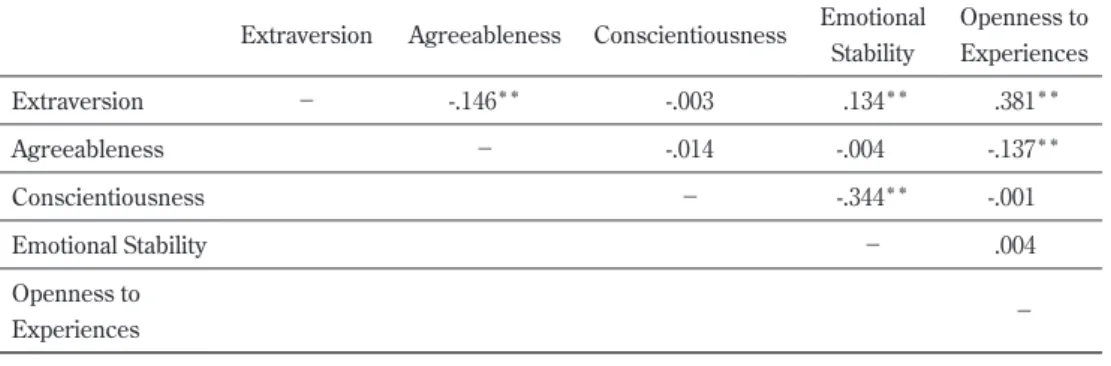
The inter-factor correlations among five factors of TIPI-K are shown in Table 2. In cases of TIPI-J (Oshio et al., 2012), agreeableness was positively correlated with conscientiousness and emotional stability (low neuroticism). In contrast, as seen in Table 2, no significant correlation was found among these factors with the exception of weak positive correlation with extraversion and weak negative correlation with openess to experienas in the present study. Results from inter-factor correlations also showed that the validity of agreeableness was low as well.
Table 3 shows the means and standard deviations of five domains (the rightmost row), with those of previous studies. It seems that for conscientiousness, and openness to experience, the means of Asian countries (e.g., Chinese, Japanese, and Korean) are lower than those of USA, English-speaking Asian in USA, and Germany.
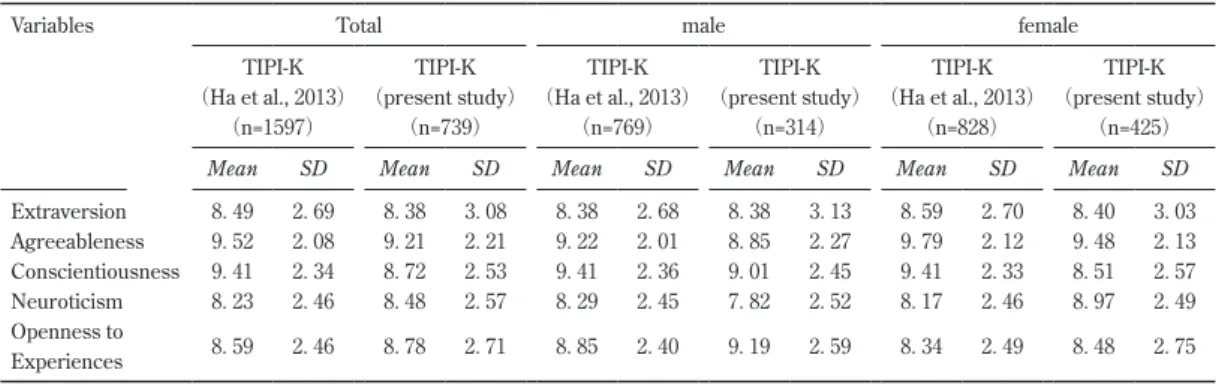
Table 4 shows the average score of each scales broken by gender for Korean samples. The results of t-tests revealed that Korean males had higher conscientiousness and openness to experience than females whereas females had higher neuroticism and agreeableness than males. Also, in America, Japan, and Korea, females had higher neuroticism than males whereas males had higher conscientiousness and openness to experience than females.
Using the Korean data available, we conducted two-way ANOVA (Gender x Age). It showed the
Table 1. Cronbach alpha Five factors of TIPI TIPI (Gosling et al., 2003) TIPI-G (Muck et al., 2007) TIPI-J (Oshio et al., 2012) TIPI-C (Li, 2013) TIPI-K (Ha, 2009 ∼2012) TIPI-K(present study) Extraversion .68 .57 .92 .67 .61 .78 Agreeableness .40 .42 .85 .60 .12 .10 Conscientiousness .50 .66 .82 .64 .25 .40 Emotional Stability .73 .67 .91 .62 .39 .51 Openness to Experience .45 .54 .86 .64 .48 .67 Table 2. Inter-factor correlations among five factors of TIPI-K
Extraversion Agreeableness Conscientiousness Emotional Stability Openness to Experiences Extraversion − -.146** -.003 .134** .381** Agreeableness − -.014 -.004 -.137** Conscientiousness − -.344** -.001 Emotional Stability − .004 Openness to Experiences − **p < .01
significant main effect of gender for agreeableness and neuroticism. Korean females showed higher scores than Korean males in agreeableness and neuroticism. The main effect of age was significant in agreeableness, conscientiousness, and neuroticism. Agreeableness and conscientiousness of Korean data showed positive trends with age, but neuroticism declined with age. There were no significant interaction effects on any factors. These age and gender differences are almost consistent with the results shown for Japanese (Kawamoto et al., 2015) and English-Speaking samples (Soto et al, 2011).
Discussion
The TIPI-K was originally introduced by Ha, Kim, & Jo (2013), but its reliability and validity have not been fully examined. Different from other foreign versions of TIPI, TIPI-K seemed to show lower level of reliability (Cronbach s alpha) as for two dimensions: Agreeableness and Conscientiousness. This seems to urges us to revise these scales with more newly nuanced translation of items. For example, the word critical contained in second item is translated into Korean as bipanttyoida . When bipanttyoida was back translated into Japanese, it came out as critical . As for quarrelsome , another adjective contained
Table 4. Descriptive statistics of five domains of the TIPI-K by gender Variables Total male female
TIPI-K (Ha et al., 2013) (n=1597) TIPI-K (present study) (n=739) TIPI-K (Ha et al., 2013) (n=769) TIPI-K (present study) (n=314) TIPI-K (Ha et al., 2013) (n=828) TIPI-K (present study) (n=425)
Mean SD Mean SD Mean SD Mean SD Mean SD Mean SD
Extraversion 8.49 2.69 8.38 3.08 8.38 2.68 8.38 3.13 8.59 2.70 8.40 3.03 Agreeableness 9.52 2.08 9.21 2.21 9.22 2.01 8.85 2.27 9.79 2.12 9.48 2.13 Conscientiousness 9.41 2.34 8.72 2.53 9.41 2.36 9.01 2.45 9.41 2.33 8.51 2.57 Neuroticism 8.23 2.46 8.48 2.57 8.29 2.45 7.82 2.52 8.17 2.46 8.97 2.49 Openness to Experiences 8.59 2.46 8.78 2.71 8.85 2.40 9.19 2.59 8.34 2.49 8.48 2.75 Table 3. Means and standard deviations of five domains with those of previous studies
Variables TIPI (Gosling et al, 2003) Total (n=1813) TIPI (Gosling et al, 2003) Asian (n=333) TIPI-G (Muck et al, 2007) (n=175) TIPI-C (Li, 2013) (n=830) TIPI-J (Oshio et al., 2012) (n=912) TIPI-K (Ha, 2019-2012) (n=4526) TIPI-K (present study) (n=739)
Mean SD Mean SD Mean SD Mean SD Mean SD Mean SD Mean SD
Extraversion 8.88 2.9 8.24 2.62 9.74 2.42 9.78 2.77 7.83 .10 8.47 2.67 8.39 3.08 Agreeableness 10.46 2.22 10.28 2.12 10.40 1.90 7.51 2.42 9.48 .07 9.50 2.07 9.21 2.21 Conscientiousness 10.80 2.64 10.22 2.32 11.70 1.86 8.82 2.53 6.14 .08 9.42 2.31 8.72 2.53 Emotional Stability 9.66 2.84 9.28 2.64 10.20 2.40 7.84 2.72 9.211 .08 8.361 2.43 8.481 2.57 Openness to Experiences 10.76 2.14 10.14 2.16 10.98 1.94 8.40 2.48 8.03 .08 8.46 2.51 8.78 2.71 1 =neuroticism
References
Costa, P. T., Jr., & McCrae, R. R. (1992). Revised NEO Personality Inventory (NEO-PI-R) and NEO Five-factor
Inven-tory (NEO-FFI) professional manual. Odessa, FL: Psychological Assessment Resources.
Gosling, S. D., Rentfrow, P.J., & Swann Jr., W.B. (2003). A very brief measure of the Big-Five personality domains.
Journal of Research in Personality, 37, 504 528.
Ha, S.E. (2009 2012) Unpublished dataset.
Ha, S.E., Kim, S., & Jo, S.E. (2013). Personality traits and political participation: Evidence from South Korea.
Politi-cal Psychology, 34, 511 532.
John, O.P., & Strivastava, S. (1999). The Big Five trait taxonomy: History, measurement, and theoretical perspectives. In L.A. Pervin & O.P. John (Eds.) Handbook of personality: Theory and research ( 2 nd Edition, pp. 102 139). New York: Guilford Press.
Kawamoto, T., Oshio, A., Abe, S., Tsubota, Y., Hirashima, T., Ito, H., & Tani, I. (2015). Age and gender differences of Big Five personality traits in a cross-sectional Japanese sample. Japanese Journal of Developmental Psychology, 26,
107 122.
Li, J. (2013). Psychometric properties of Ten-Item Personality Inventory in China. China Journal of Health
Psycholo-gy, 21, 1688 1692.
Muck, P. M., Hell, B., & Gosling, S. D. (2007). Construct validation of a short five-factor model instrument: A self-peer study on the German adaptation of the Ten-Item Personality Inventory (TIPI-G). European Journal of
Psycho-logical Assessment, 23, 166 175.
Oshio, A., Abe,S., & Cuttone, P. (2012). Development, reliability, and validity of the Japanese Version of Ten Item Personality Inventory (TIPI-J). Japanese Journal of Personality Psychology, 21, 40 52.
Soto, C.J., John, O.P., Gosling, S.D., & Potter, J. (2011). Age differences in personality traits from 10 to 65: Big Five domains and facets in a large cross-sectional sample. Journal of Personality and Social Psychology, 100, 330 348.
Keywords: Five-factor model, TIPI-K, Reliability, Validity, International comparison
in the second item, means something close to altercation where you fight with words without any regards of other s opinions. In Korean and Japanese translations, the word seemed more closely related to a debate where people would be talking in peace without any negative feelings.
This means that the definition of Gosling s TIPI had a slightly different meaning compared to the Korean version of TIPI. In Japanese version, where the feasibility was validated, their translated version of quarrelsome were translated as having dissatisfaction and cause dispute against others into Korean which had the correct nuance of the definition of quarrelsome compared to the Korean version. Overall, TIPI-K seems to have reasonable reliability and validity except one factor: agreeableness. In the future research, we need to refine TIPI-K by considering more nuanced translation as well as more rigorous tests of reliability and construct validity.
Appendix. Comparison of TIPI, TIPI-K and TIPI-J items Extraversion 1 .Extraverted, enthusiastic. 1 .외향적이다.적극적이다. 1 .活発で,外向的だと思う 6 .Reserved, quiet. 6 .내성적이다.조용하다. 6 .ひかえめで,おとなしいと思う(R) Agreeableness 2 .Critical, quarrelsome. 2 .비판적이다.논쟁을 좋아한다. 2 . 他人に不満をもち,もめごとを起こしやすいと 思う(R) 7 .Sympathetic, warm. 7 .동정심이 많다.다정다감하다. 7 .人に気をつかう,やさしい人間だと思う Conscientiousness 3 .Dependable, self-disciplined. 3 .신뢰할수있다 . 자기 절제를 잘한다. 3 .しっかりしていて,自分に厳しいと思う 8 .Disorganized, careless. 8 .정리정돈을 잘못한다.덤벙댄다. 8 .だらしなく,うっかりしていると思う(R) Emotional Stability (Neuroticism)
4 .Anxious, easily upset. 4 .근심 걱정이 많다.쉽게 흥분한다. 4 .心配性で,うろたえやすいと思う(R) 9 .Calm, emotionally stable. 9 .차분하다.감정의 기복이 적다. 9 .冷静で,気分が安定していると思う Openness to Experiences
5 . Open to new experiences, complex 5 . 새로운 경험들에 개방적이다.복 잡다단하다. 5 . 新しいことが好きで,変わった考えをもつと思 う 10.Conventional, uncreative 10. 변화를 싫어한다.창의적이지 못 하다. 10.発想力に欠けた,平凡な人間だと思う(R).