Original
Effect of Specific Health Checkup Stratifications Based on Stage of
Change, Criteria Values and Healthy Lifestyle at a Particular
Health Checkups for Three Consecutive Years
Tomotaro Dote1), Shin Nakayama2)
, Emi Hayashi2)
and Hirotaka Yokoyama1) 1)Department of Public Health, Faculty of Nursing, Osaka Medical College
2)Department of Hygiene and Public Health, Division of Preventive and Social Medicine, Faculty of Medicine, Osaka Medical College
(Received: December 10, 2014)
Abstract
Objective: This study aimed to evaluate the effect of specific health checkup (SHC) stratification (positive support level (PSL) in particular) based on stage of change (SOC), clinical data and lifestyle modification in an occupational field. Methods: Participants were Japanese male employees aged !40 years who underwent SHCs between 2009 and 2011 at a private university in Osaka, Japan. Participants within each SOC category (I: pre-contemplation; II: contemplation and preparation; III: action and maintenance) were surveyed according to support level. Participants with PSL results were analyzed according to SOC category so that the results indi-cated either abnormal criteria values or behaviors deemed healthy by the SHC over three years. Within each SOC category, participant lifestyle behaviors were compared in 2011. Results: No significant changes were ob-served across the different SOC categories over three years. Within the PSL, the proportion of participants in SOC category III with high body mass index and dyslipidemia scores decreased. However, no significant healthy lifestyle changes were observed in all SOC categories over three years. Within the PSL, only in 2011, the proportion of participants in SOC category III who reported exercising for at least 30 minutes and walking for at least one hour was significantly higher than the proportion of participants in SOC category I. The pro-portion of those in SOC category III who reported eating slowly, no snacking, and getting sufficient sleep was significantly lower than that in SOC category I. Conclusions: Our findings show that support level had little im-pact on participants across all SOC categories. In some PSL participants, lifestyle behavior modifications helped to improve body mass index and dyslipidemia scores. Regardless of SOC category, participants with PSL were likely to modify their physical activities, and not their dietary or sleeping habits.
(JJOMT, 63: 159―166, 2015)
―Key words―
specific health checkups, stage of change, positive support level
Introduction
The Japan Ministry of Health, Labour, and Welfare implemented the practice of conducting Specific Health Checkups (SHCs) in 2008. According to SHC program guidelines, Specific Health Guidance (SHG) coun-seling is important to motivate patients who require lifestyle behavior modification1)
. SHC questionnaires in-clude items relating to lifestyle behaviors (e.g., eating habits and physical activity), stage of change (SOC) cate-gories of behavior modification, and application for health counseling. However, SOC results have not been ade-quately applied to health counseling in Japan. Recent meta-analyses have investigated the effectiveness of the transtheoretical model of SOC in supporting weight management programs worldwide2)∼4)
. However, the long-term effectiveness and sustainability of programs longer than one year have yet to be delong-termined. In a previ-ous survey conducted using data from the same subjects of the present study, abnormal values and healthy
an intensity that causes a slight sweat during the last year? ① Yes ② No
Do you walk for at least one hour every day or have equivalent physical activity in your daily
life? ① Yes ② No ① Yes Walks>_ 1h
Do you walk faster than other people of similar age and sex? ① Yes ② No ① Yes Fast walker Do you get enough sleep? ① Yes ② No ① Yes Sufficient sleep
lifestyle behaviors were investigated according to SHC stratification or SOC category5)
. The present study aimed to conduct a longitudinal and cross-sectional evaluation of the effect of specific health checkup (SHC) stratification on stage of change (SOC), abnormal clinical data and healthy lifestyle behaviors in an occupational field. In particular, participants classified in the positive support level (PSL) were a primary focus.
Participants and Methods Participants
Study participants were 1,138 employees who primarily performed sedentary work at a private university in Osaka, Japan. Of these participants, 851 had undergone SHCs in 2009. Subjects were males aged"40 years (mean±SD, 53.8±7.5 years; n=363) as of 2009.
Lifestyle and Smoking Questionnaire
Data on dietary and exercise behaviors were collected via a questionnaire included in the standard pro-gram of SHCs and SHG, initiated by Japan s Ministry of Health, Labour, and Welfare. Table 1 displays the ques-tions, answers, and abbreviations used for assessment of healthy lifestyle behaviors. Smoking history was as-sessed according to smoking habits in 2011 and!or a smoking index score "100.
SOC Categorization
After completing the questionnaire, participants answered questions concerning the five phrases of SOC. Steps taken by participants to correct problematic behaviors were classified into the following three SOC cate-gories. SOC I, the pre-contemplation phase, was defined as I have no plans to start. SOC II, the contemplation and preparation phase, was defined as I m going to start in the future (e.g., within six months), and I m going to start soon (e.g., in a month). SOC III, the action and maintenance phase, was defined as I already started (e.g., less than six months ago), and I already started (e.g., at least six months ago). Table 1 summarizes the SOC categories used in this study.
Clinical Data
Blood levels of the following parameters were measured after a 12-hour fasting period: triglycerides (TG, mg!dL, enzymatic method by analytical chemistry), high-density lipoprotein cholesterol (HDL-C, enzymatic method by analytical chemistry), low-density lipoprotein cholesterol (LDL-C, mg!dL, calculated by LDL-C=TG - [HDL-C+TG!5]), and glucose (Glu, glucose oxidase method used by the Japan Diabetes Society). Blood pres-sure (BP, mmHg) was also meapres-sured in accordance with hypertension treatment guidelines. Waist circumfer-ence (WC) was measured as the minimum circumfercircumfer-ence at the level of the umbilicus to the nearest 0.5 cm at the end of normal expiration.
SHC Criteria and Determination of Support Level
The following threshold values were used to evaluate SHC criteria: (1) WC"85 cm for men and "90 cm for women; (2) body mass index (BMI)"25; (3) blood pressure (BP): systolic BP "130 mmHg, diastolic BP "85 mmHg, or use of hypertension medications; (4) glucose index (Glu): fasting plasma glucose levels (FPG) "100 mg!dL, HbA1c (JDS) (%) "5.2, or current treatment for diabetes mellitus; (5) dyslipidemia (Lipid): TG "150
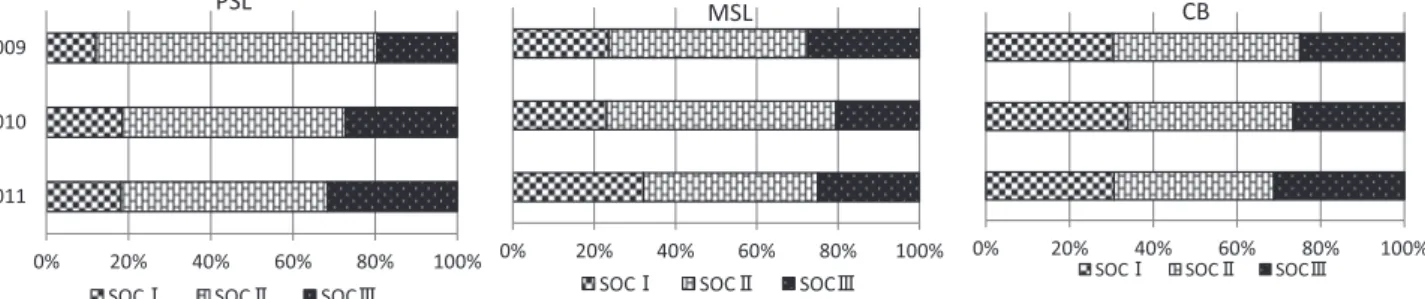
Fig. 1 Participant distribution for stage of change (SOC) according to support levels of specific health checkups (SHCs). Data were
col-lected from male employees aged >_ 40 years (N=363) over a three year period at a private university in Osaka, Japan. PSL, positive support level; MSL, motivational support level; CB, clean bill of health. SOC I, precontemplation; SOC II, contemplation and prepara-tion; SOC III, action and maintenance. No significant changes were observed between any of the three years for any SOC category (Pearson s χ2 test).
mg!dL and!or HDL-C <40 mg!dL, or use of hyperlipidemia medications; and smoking history based on a smoking index score"100 and!or smoking status in 2011. Support level was determined according to a combi-nation of these parameters. The positive support level (PSL) included (1) and two or more from (3), (4), and (5); (2), (3), (4), and (5); (1) and one from (3), (4), and (5) plus smoking history; or (2) and two from (3), (4), and (5) plus smoking history. The motivational support level (MSL) included one from (3), (4), and (5) plus no smoking his-tory; (2) and two from (3), (4), and (5) plus no smoking hishis-tory; or (2) and one from (3), (4), and (5). Any other pa-rameter combinations were categorized as being at a healthy level for a clean bill of health (CB)1)
.
Statistical Analysis
Participants in each SOC category assigned to the three SHC support levels were assessed from 2009 to 2011. Participants with abnormal criteria values and healthy lifestyle behaviors were surveyed for three years according to SHC support levels. Within the PSL group of SHC participants, those with abnormal criteria val-ues and healthy lifestyle behaviors were surveyed for three years according to SOC categories. Within the PSL group of SHC participants, those with healthy lifestyle behaviors in 2011were also compared by SOC cate-gories. Pearson s χ2test was used to analyze categorical variables. Statistical analysis was performed using
SPSSⓇ12.0 J software (SPSS Inc., Chicago, IL), with statistical significance being defined as p<0.05.
Ethical Considerations
This study was approved by the Ethics Committee of Osaka Medical College (No. 679). Both written and oral explanations of the study methods and objectives were provided, and informed consent was obtained from all participants. Anonymity was ensured to protect personal information.
Results
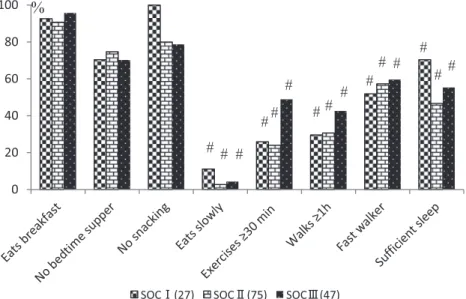
Fig. 1 shows the changes in proportions of participants in each SOC category according to support level. No significant changes were observed between SOC categories over the three years. Fig. 2 shows proportions of participants with abnormal values within each SOC category who were at the PSL over three years. Within SOC I, we identified an increasing trend for Glu scores, while Lipid scores tended to decrease. Within SOC II, BMI scores increased. Within SOC III, we identified significant decreases in both BMI and Lipid scores. Fig. 3 shows proportions of participants in each SOC category deemed as PSL who reported healthy lifestyle behav-iors over the three years. No significant changes were identified in any SOC category over the three-year study period. Fig. 4 shows proportions of participants in each SOC category who were deemed as PSL who re-ported healthy lifestyle behaviors in 2011. The proportion of participants in SOC III who rere-ported exercising for at least 30 minutes and walking for at least one hour was significantly higher than the proportion of partici-pants in SOC I. The proportion of participartici-pants in SOC III who reported eating slowly and getting sufficient sleep was significantly lower than that in SOC I. The proportion of participants in SOC III who reported no snacking trended to be lower than that in SOC I. Of all lifestyle habits analyzed, eating slowly was the least common, and thus showed the lowest proportion of individuals practicing this.
Fig. 2 Participant distribution according to SOC category for participants in the positive support level with abnormal
SHC results. Data were collected from male employees aged >_ 40 years over a three year period at a private univer-sity in Osaka, Japan. SOC I, precontemplation; SOC II, contemplation and preparation; SOC III, action and mainte-nance; BMI, body mass index; WC, waist circumference; Glu, glucose index; Lipid, dyslipidemia; BP, blood pressure. *p <0.05 between three years (Pearson s χ2 test).
Fig. 3 Participant distribution according to SOC category among participants at the positive support level. Data were
collect-ed from male employees agcollect-ed >_ 40 years over a three year period at a private university in Osaka, Japan. SOC I, precontem-plation; SOC II, contemplation and preparation; SOC III, action and maintenance; No significant changes were observed be-tween three years for any SOC category (Pearson s χ2 test).
Discussion
We did not find any significant differences between SOC categories at each of the three support levels (Fig. 1). Although participants at the PSL were obligated to receive support for three to six months1)
, they did not exhibit increased motivation for lifestyle modification, as compared to participants in the MSL and CB groups. It is possible that the low rate of SHG execution was predominantly due to the SHG application proc-ess. Our previous study, which took place in the same institute, reported that fewer than half of males aged >40 years applied for health guidance in 20106)
. Attendance of multiple (ideally, 4―5) sessions may significantly increase participation in physical activities and weight loss regimens7)8)
. Therefore, increasing the number of ap-plicants eligible for health guidance may be beneficial. However, as excessive intervention can have adverse ef-fects, an appropriate duration for intervention should be determined9)
. From a practical standpoint, the fre-quency of health counseling sessions should be kept to a minimum in order to minimize absence from work10) . Indeed, busy employees may avoid overly frequent health guidance sessions.
Fig. 4 2011 distributions for participants at the positive support level with abnormal
specific health checkup (SHC) results, according to SOC category. Data were collected from male employees aged >_ 40 years over a three year period at a private universi-ty in Osaka, Japan. SOC I, precontemplation; SOC II, contemplation and preparation; SOC III, action and maintenance; #p<0.05 between SOC categories (Pearson s χ2 test).
significant association between visceral fat areas and serum triglyceride levels among Japanese metabolically obese subjects of normal weight and normal glucose tolerance11)
. Therefore, lifestyle modification may help im-prove BMI and Lipid scores rather than WC among participants at the PSL.
Fig. 3 shows no significant lifestyle changes within any of the SOC categories. It is unlikely that lifestyle changes were affected solely by SOC categories over the course of the three years. As recent meta-analyses have been unable to verify the effectiveness of the various interventions that target individuals in maintaining behavior or weight change, future research modelling of the long-term effects of interventions across the lifespan would be beneficial12)
.
Within the PSL group in 2011, participants in SOC III were more likely to report exercising for at least 30 minutes and walking for at least one hour than participants in SOC I and SOC II (Fig. 4). On the other hand, participants in SOC III were less likely to report eating slowly, no snacking, and getting sufficient sleep than participants in SOC I. Exercise behavior has been reported to associate more closely with SOC category com-pared to other healthy behaviors13)
. Thus, we surmise that participants at the PSL were more likely to modify physical activity over their eating and sleeping habits. Notably, previous studies have found little evidence to support the hypothesis that exercise alone is a potent strategy for weight loss, as exercise does not create a large enough energy gap required for generating significant weight loss14)
.
Exercise was reported to be important for improving both metabolic and cardiovascular health. To be ef-fective, exercise regimens must include reducing the time spent being sedentary, regardless of the amount of time spent participating in moderate- or vigorous-intensity physical activity15)16)
. In the industrial field, initiatives to reduce sitting time could generate health benefits17)
. It would also be important to reduce the time spent sit-ting in daily life or commusit-ting to work, especially for employees who spend most of their time conducsit-ting desk work.
With regard to dietary practices, Fig. 4 also shows the lowest proportion of those who eat slowly among all lifestyle practices. We previously recommended health counseling for participants who reported eating quickly6)
due to the significant association between eating quickly and an increased risk of metabolic syn-drome18)19)
. Improving the proportion of participants who eat slowly should be a future objective, as very few participants reported this habit in any of the support levels or SOC categories. Weight loss interventions that include both diet and exercise provide significantly greater weight loss than diet-only interventions20)
. Hence, future health promotion approaches should focus on combining diet and exercise programs.
There are a number of limitations to this study worth noting. First, participants were well-educated with a moderate level of healthcare knowledge, despite working in sedentary occupations. Thus, this study is not gen-eralizable across the Japanese population. Second, all SHCs that provided data for this study were imple-mented by the Fraternal Benefit Association of a private university. Attendance rates for SHG health counsel-ing were unknown due to an outsourccounsel-ing agreement. Third, the three year term of this study was not ade-quate for observation of long-term effects. Future studies should further assess the application of SHG, and should include longer follow-up of participants.
Conclusion
Regardless of support level, we identified no apparent changes in SOC across the three years. PSL partici-pants classified as SOC III improved body mass index and dyslipidemia scores. Participartici-pants at PSL were more likely to modify their physical activities over their eating and sleeping habits. Further improvement in SHC re-sults will require the promotion of diet and exercise programs which utilize social support within the occupa-tional fields.
References
1) Ministry of Health, Labor and Welfare: Standard program of mandatory routine health checkup and health counseling (final version), http:!!www.mhlw.go.jp!bunya!shakaihosho!iryouseido01!info03a.html, 2007. (2014.03.05)
2) Toth-Capelli KM, Brawer R, Plumb J, et al: Stage of change and other predictors of participant retention in a behavioral weight management program in primary care. Health Promot Pract 14 (3): 441―450, 2013.
3) Mastellos N, Gunn LH, Felix LM, et al: Transtheoretical model stages of change for dietary and physical exercise modifica-tion in weight loss management for overweight and obese adults. Database Syst Rev 2014; 2: CD008066. [Epub ahead of print] 4) Stephens S, Cobiac L, Veerman L: Improving diet and physical activity to reduce population prevalence of overweight and
obesity: An overview of current evidence. Prev Med 2014 Feb 14. pii: S0091-7435 (14) 00073-5. doi: 10.1016!j.ypmed.2014.02.008. [Epub ahead of print]
5) Dote T, Nakayama S, Hayashi E, et al: Three consecutive years of research on the stratification of specific health checkups, abnormal criteria values and healthy lifestyles among stage of changes. Journal of Occupational Medicine and Traumatology 62: 328―335, 2014.
6) Dote T, Hayashi E, Nakayama S, et al: Association between request for health counseling and mandatory routine health checkups parameters in middle-aged Japanese men with metabolic syndrome. Bulletin of the Osaka Medical College 59: 1―8, 2013.
7) Hardcastle S, Blake N, Hagger MS: The effectiveness of a motivational interviewing primary-care based intervention on physical activity and predictors of change in a disadvantaged community. J Behav Med 35 (3): 318―333, 2012.
8) Hardcastle SJ, Taylor AH, Bailey MP, et al: Effectiveness of a motivational interviewing intervention on weight loss, physical activity and cardiovascular disease risk factors: a randomised controlled trial with a 12-month post-intervention follow-up. Int J Behav Nutr Phys Act 2013 Mar 28; 10: 40. doi: 10.1186!1479-5868-10-40
9) Fukumoto K, Wei C, Matsuo H, et al: An intervention study to promote self-improvement of lifestyle in a Japanese commu-nity: a new health support program. Environ Health Prev Med 16: 253―263, 2011.
10) Munakata M, Honma H, Akasi M, et al: Japanese study to organize proper lifestyle modifications for metabolic syndrome (J-STOPMetS): Design and method. J Vascular Health and Risk Management 4 (2): 415―420, 2008.
11) Katsuki A, Sumida Y, Urakawa H, et al: Increased visceral fat and serum levels of triglyceride are associated with insulin re-sistance in Japanese metabolically obese, normal weight subjects with normal glucose tolerance. Diabetes Care 26 (8): 2341―2344, 2003.
12) Stephens S, Cobiac L, Veerman L: Improving diet and physical activity to reduce population prevalence of overweight and obesity: An overview of current evidence. Prev Med 2014 Feb 14. pii: S0091-7435 (14) 00073-5. doi: 10.1016!j.ypmed.2014.02.008.
[Epub ahead of print]
13) Mizoshita M, Akamatsu R, Yamamoto K, et al: Is the stage of lifestyle change consistent with health behaviors among Japa-nese adults?: A study of a standard questionnaire for specific medical checkups. Jpn J Nutr Diet 69 (6): 318―325, 2011.
14) Donnelly JE, Smith BK: Is exercise effective for weight loss with ad libitum diet? Energy balance, compensation, and gender differences. Exerc Sport Sci Rev 33 (4): 169―174, 2005.
15) Helmerhorst HJ, Wijndaele K, Brage S, et al: Objectively measured sedentary time may predict insulin resistance independ-ent of moderate- and vigorous-intensity physical activity. Diabetes 58 (8): 1776―1779, 2009.
16) Katzmarzyk PT, Church TS, Craig CL, et al: Sitting time and mortality from all causes, cardiovascular disease, and cancer. Med Sci Sports Exerc 41 (5): 998―1005, 2009.
17) Pronk NP, Katz AS, Lowry M, et al: Reducing occupational sitting time and improving worker health: the Take-a-Stand Pro-ject, 2011. Prev Chronic Dis 9: E154, 2012. doi: 10.5888.pcd9.110323
18) Urashima M, Wada T, Fukumoto T, et al: Prevalence of metabolic syndrome in a 22,892 Japanese population and its associa-tions with lifestyle. JMAJ 48 (9): 441―450, 2005.
19) Koetaka H, Ohno Y, Morimoto K: The change in lifestyle data during 9 years: the reliability and continuity of baseline health practices. Environ Health Prev Med 18 (4): 335―340, 2013.
20) Wu T, Gao X, Chen M, van Dam RM: Long-term effectiveness of diet-plus-exercise interventions vs. diet-only interventions for weight loss: a meta-analysis. Obes Rev 10 (3): 313―323, 2009.
21) Lorentzen C, Ommundsen Y, Jenum AK, et al: The Romsås in Motion community intervention: program exposure and psy-chosocial mediated relationships to change in stages of change in physical activity. Int J Behav Nutr Phys Act 30: 4―15, 2007.
Reprint request:
Tomotaro Dote
Department of Public Health, Faculty of Nursing, Osaka Medi-cal College, 7-6, Hattyonishimachi, Takatsuki City, Osaka, 569-0095, Japan.
別刷請求先 〒569―0095 高槻市八丁西町 7―6
大阪医科大学看護学部看護学科 土手友太郎
―キーワード―
特定健康診査,行動変容ステージ,積極的支援レベル
【目的】職域の特定健診(特健)の積極的支援レベル該当者における行動変容ステージ,検査結果および生活習慣改善 への影響を縦断的に検討した.
【方法】大阪の私立総合大学において, 2009 年から 2011 年までの特健が実施された. 対象者は連続 3 年間受診した,
40 歳以上の邦人男性教職員について, 特健の階層および行動変容ステージ(SOC)(I:無関心期, II:関心期・準備期,
III:実行期・維持期)の状況を把握した.積極的支援レベル該当者において,判定基準値の異常該当者割合および良好 な生活習慣項目の実施者割合を,SOC 区分別に,3 年間で比較した.さらに,2011 年において,各良好な生活習慣にお いて,該当者割合を SOC 区分間で比較した.
【結果】各階層において,3 年間の SOC 区分に有意な変化はなかった.積極的支援レベル該当者において,SOC III における BMI および脂質指標の異常該当者割合は減少した.一方,すべての SOC 区分において,良好な生活習慣項目
の実施者割合には 3 年間で有意な差はなかった.2011 年の積極的支援レベル該当者において,「少なくとも 30 分以上の
運動」「少なくとも 1 時間以上の歩行」の実施者割合は SOC III の方が SOC I より高かった.「ゆっくり食べる」「間食をし
ない」「十分な睡眠」の実施者割合は SOC III の方が SOC I より低かった.
【結論】積極的支援レベルに該当したことは,すべての SOC 区分該当者割合に殆ど影響を及ぼさなかった.積極的支 援レベルに該当者の一部においては,BMI および脂質指標の改善に生活習慣の変容が寄与した.しかし,いずれの SOC 区分でも,食事や睡眠の習慣より,身体活動を主に実施する傾向にあった.
利益相反:利益相反基準に該当無し
(日職災医誌,63:159─166,2015)