Abstract
It is now well established that knowledge created through innovation and technological progress is the long-term driver of economic growth. The fundamental challenge in an emerging k n o w l e d g e - b a s e d e c o n o m y i s t o h a r n e s s k n o w l e d g e f o r development by providing an enabling environment of competitive education system and highly qualified human resources, excellent information and communication technology infrastructure (ICT) and innovation infrastructure. Science and technology are at the heart of knowledge-based economic growth and development. Identifying the factors, policies and institutional arrangements that promote technology diffusion is the first step in ensuring a country to secure access to and use of technologies developed by technology leaders. As such, it is needless to say that the whole process of knowledge creation and diffusion in a knowledge-based economy heavily depends on appropriate government policies that are usually the outcome of economic incentives and institutional regimes. Many East Asian governments have shown remarkable success in creating a knowledge-based economy by pursuing appropriate policies. This paper attempts to identify the key determinants of economic incentives and institutional regimes to promote knowledge-based economy in East Asia.
Key Determinants of Economic Incentives
and Institutional Regimes to Promote
Knowledge-based Economy in East Asia
D
EBNATH, Sajit Chandra
*RITSUMEIKAN INTERNATIONAL AFFAIRS Vol.10, pp.183-218 (2011).
* Correspondence to: Dr. Sajit Chandra Debnath, Assistant Professor, College of Business Administration, Ritsumeikan University, 1-1-1 Noji-higashi, Kusatsu-shi, Shiga-ken, 525-8577 Japan, E-mail: [email protected]
Keywords:
Economic Incentives, Institutional Regimes, Good governance, Knowledge-based Economy, Japan, Korea, Taiwan,
Hong Kong and Singapore
1. OVERVIEW
It is now well established that knowledge created through innovation and technological progress is the long-term driver of economic growth. In an emerging global knowledge-based economy fuelled by the fast pace of hu-man capital development through creating excellent education and train-ing sectors and the development of the enabltrain-ing environment for highly qualified human resources through technological innovation, it is impor-tant for any country to lay solid foundations for building self-capability to acquire and create knowledge by acquiring, creating and using new and dynamic technology for innovation. This would ensure the appropriate ex-ploitation of the opportunities offered by globalization, and at the same time, help meeting the rising challenges of an emerging global knowledge-based economy.
The fundamental challenge in an emerging knowledge-based economy is to harness knowledge for development by providing an enabling envi-ronment of competitive education system and highly qualified human re-sources, excellent information and communication technology infrastruc-ture (ICT) and innovation infrastrucinfrastruc-ture. Science and technology are at the heart of knowledge-based economic growth and development. However, diffusion and transfer of technology for economic development is not straightforward. Identifying the factors, policies and institutional arrange-ments that promote technology diffusion is the first step in ensuring a country to secure access to and use of technologies developed by technolo-gy leaders. As such, it is needless to say that the whole process of knowl-edge creation and diffusion in a knowlknowl-edge-based economy heavily de-pends on appropriate government policies that are usually the outcome of economic incentives and institutional regimes. Many East Asian govern-ments have shown remarkable success in creating knowledge-based econo-my by pursuing appropriate policies. In this regard, governments play a very crucial role, because knowledge creation and diffusion cannot simply
depend on market mechanisms alone. An appropriate framework of eco-nomic incentives and institutional regimes is necessary for facilitating the interaction among different sectors in a knowledge-based economy. This paper attempts to identify the key determinants of economic incentives and institutional regimes to promote a knowledge-based economy in East Asia.
After the Second World War the government of Japan had shown great success in attracting large amount of FDI to enhance economic growth. During the high growth era of 1970s and 1980s, Japanese govern-ment policies enabled the transformation of Japanese economy into a knowledge-based economy. The efforts by the government were fully paid off as Japan gradually became world’s second largest economy after the U.S. Following the similar foot step, the governments of other East Asian Economies have shown remarkable success in creating a knowledge-based economy by introducing various economic incentives and by bringing in in-strumental changes in institutional regimes. Korea, Taiwan, Hong Kong and Singapore had been tremendously successful in the regard. Malaysia and China have also shown great success in this regard as late comer in the region. Consequently, this study focuses on Japan, Korea, Taiwan, Hong Kong, Singapore, Malaysia and China to investigate the key deter-minants of economic incentives and institutional regimes to promote knowledge-based economy in East Asia.
2. UNDERSTANDING THE KNOWLEDGE-BASED ECONOMY
The capacity to generate and apply knowledge efficiently has been a tool of innovation, competition and economic success since the old days (Knowl-edge Economy Forum, 2002: 4). However, classical economic theories failed to consider knowledge as an important input of productivity function of an economy although this has been a very important force of economic and so-cial development for any country. However, many recent scholars have ar-gued for the knowledge as an important input of knowledge-based econo-my by recognizing its contribution to the overall economic and social development. In an increasingly globalized world, the physical barriers such as distance or geographical disadvantages are becoming narrower; the knowledge becomes more and more important to competitiveness both locally and globally. As the knowledge flows both vertically and
horizontal-ly, it creates better fit between research and development (R&D) and downstream innovation and thereby increases the rate of innovation.
The Knowledge Economy Forum (2002) organized by World Bank has mentioned the following contemporary aspects to understand the knowl-edge-based economy from broader perspective:
The increase in global trade and foreign direct investment in recent years, itself facilitated by the ease of information flows, accelerates the impact of these changes. In an increasingly global economy, where knowledge about how to excel competitively and information about who excels are both more readily available, the effective creation, use and dissemination of knowledge is increasingly the key to success, and thus to sustainable economic and social development that bene-fits all. Innovation, which fuels new job creation and economic growth, is quickly becoming the key factor in global competitiveness.
The impact of global information flows, and of the knowledge economy, on governmental and societal institutions is no less profound or im-portant. In information-rich environments where knowledge flows freely and communications are abundant and multi-directional, pres-sures increase on governments to be more transparent, accountable and participatory. At the same time, the ability of governments to ac-cess and control information, and the uneven acac-cess to information and knowledge among sectors of society can, in certain circumstances, increase inequality and further entrench existing political and social elites. Unequal access to education and training can perpetuate and deepen inequality.
The growth of a global knowledge-based economy creates great oppor-tunities, and poses great challenges, for all countries, but particularly for those that are still struggling to combat widespread poverty and create sustainable development that reaches all, or those dealing with difficult transitions from centralized forms of economic organization. To create these opportunities and navigate these risks, a country must do three difficult things. It must develop a coherent, multi-faceted na-tional strategy for building and sustaining a knowledge-based econo-my. It must develop this strategy in a participatory, broad-based
fash-ion that includes and empowers all major sectors of society, including the private sector, educators, scientists and innovators, civil society, the media and others. And it must implement this strategy in a sus-tained and patient fashion, carefully balancing competing priorities, difficult tradeoffs, and interdependent changes with different time ho-rizons, all in the context of opening progressively to a fast-paced, rap-idly changing, unpredictable and highly competitive global economy.
Knowledge Economy Forum (2002:4-5) The Knowledge Economy Forum (2002:5-6) also recognized four essential dynamics for building a knowledge-based economy such as:
1. Creating an appropriate economic incentive and institutional regime that encourages the widespread and efficient use of local and global knowledge in all sectors of the economy, that fosters entrepreneur-ship, and that permits and supports the economic and social trans-formations engendered by the knowledge revolution;
2. Creating a society of skilled, flexible and creative people, with oppor-tunities for quality education and life-long learning available to all, and a flexible and appropriate mix of public and private funding; 3. Building a dynamic information infrastructure, and a competitive
and innovative information sector of the economy that fosters a va-riety of efficient and competitive information and communications services and tools available to all sectors of society. This includes not only high-end information and communication technologies (ICTs) such as the Internet and mobile telephony but also other ele-ments of an information-rich society such as radio, television and other media, computers and other devices for storing, processing and using information, and a range of communication services. 4. Creating an efficient innovation system comprising firms, science
and research centers, universities, think tanks and other organiza-tions that can tap into and contribute to the growing stock of global knowledge, adapt it to local needs, and use it to create new prod-ucts, services, and ways of doing business. Designing and imple-menting a coherent and sustained response to these challenges is not easy, particularly for developing countries and countries in transition, which face additional burdens from limited resources,
weak institutional capacity, and a legacy of centrally-controlled eco-nomic development.
The various contemporary aspects of knowledge-based economy mentioned by the Knowledge Economy Forum provides us with the overall under-standing of various factors that are contributing to the development of knowledge-based economy while four essential dynamics portrait the basic skeleton of a knowledge-based economy. In the absence of a universal defi-nition, the above factors mentioned by the Knowledge Economy Forum (2002) help us to understand the basic mechanism of knowledge-based economy in the contemporary world. For this study, we investigated the key determinants of economic incentives and institutional regimes to pro-mote knowledge-based economy in East Asia.
3. FUNCTIONALITY IN A KNOWLEDGE-BASED ECONOMIC SYSTEM
The emergence of the knowledge-based economy reinforces the capacity of the economic system to develop solutions through continuous innovations. In a knowledge-based economy, future-oriented planning are considered more important than current trends in the market because institutions and markets usually develop historically whereas the knowledge-based structure of expectations functions in an anticipatory mode (Leydesdorff, 2005:25). The dynamics of innovations in a knowledge-based economy are, thus, non-linear (Leydesdorff, 2005). Such non-linearity is the natural con-sequence of complex interaction of different subdynamics in a knowledge-based economy.Although, historically, interactions among the subdynamics were first enhanced by the national proximity, the dynamic scale effects through in-novations became more important than static ones as the economic and technological dimensions are globalized and this was first realized by the multinational corporations which later became the concern of the govern-ments in advanced, industrialized countries after the global oil crisis in the 1970s (Galbraith, 1967; Brusoni et al., 2000 and OECD, 1980). Creat-ing a functional knowledge-based economy became priority of these coun-tries as they were recognizing the knowledge-based innovations as the main driver of their economic growth (Freeman, 1982 and Irvine and Mar-tin, 1984). Globalization induces an oscillation to the nation states to use
their resources for the continuation of an endless transition’ through knowledge creation and diffusion to compete in a global knowledge-based economy whereby, in many cases, the institutional make-ups of the nation states must get restructured (Etzkowitz and Leydesdorff, 1998).
The creation and diffusion of knowledge in a knowledge-based econo-my does not have a single frame of reference yet (Leydesdorff, 2005:29) and thus the governance or making up of a knowledge-based economy can only be based on a set of assumptions about the relevant systems and as such, this research investigated the determinants of economic incentives and institutional regimes of the knowledge-based economy in East Asia to understand its governance to promote knowledge-based economy in the re-gion.
4. THE ECONOMIC INCENTIVES IN EAST ASIAN KNOWLEDGE-BASED
ECONOMIES
The appropriate economic incentives are very crucial to the growth of knowledge-based economy. Without appropriate economic incentives, it is difficult to foster growth in a knowledge-based economy. Openness to-wards trade (Chen and Dahlman, 2005), stable financial and monetary systems that allow minimal price distortions and create sound investment opportunities (Heritage foundation, 2009), competitive business and in-vestment environments and presence of appropriate property rights legal system are some of the main factors of the economic incentives that en-courage entrepreneurships and competition which ultimately lead to con-tinuous innovation in the knowledge-based economic growth.
Openness
Openness reflects the openness of an economy to imports of goods and services from around the world and the ability of citizens to interact freely as buyers and sellers in the international marketplace (Heritage Founda-tion, 2009: 13). In most of the East Asian knowledge-based economies, the presence of greater trade freedom has been contributing to their high growth for couple of decades. The weighted average tariff rate in Japan and Korea was 1.5 percent and 7.4 percent in 2006 respectively. Import and ex-port restrictions, imex-port quotas, services market access barriers, non-trans-parent and burdensome regulations and standards, restrictive sanitary and
phytosanitary rules, state trade in some goods, subsidies, and inefficient customs administration add to the cost of trade in Japan while in Korea, prohibitive tariffs, import restrictions, quantitative restrictions, services market access barriers, some import taxes, use of adjustment tariffs and taxes to increase import costs, burdensome and non-transparent standards and regulations, weak enforcement of intellectual property rights, and sub-sidies add to the cost of trade (Heritage Foundation Online, 2009). Japan and Korea have less trade freedom than that of Hong Kong and Taiwan (See Figure 1).
Taiwan’s weighted average tariff rate was 2.4 percent in 2006. The government has been improving the trade regime, but import and export bans and restrictions, services market access barriers, import taxes and fees, burdensome standards and certification requirements, restrictive pharmaceutical regulations, cumbersome sanitary and phytosanitary rules, state trade in rice, and weak enforcement of intellectual property rights add to the cost of trade. Weighted average tariff rate in Hong Kong and Singapore was, however, 0 percent in 2006. In Hong Kong, restrictive pharmaceuticals regulation, market access restrictions for some services, limited import licensing, and issues involving the enforcement of intellec-tual property rights add to the cost of trade, while in Singapore import
re-Figure 1: Tariff & Nontariff Barriers, East Asia
strictions, services market barriers, import taxes, import licensing, non-transparent regulations, burdensome sanitary and phytosanitary rules, weak enforcement of intellectual property rights, and export incentive pro-grams add to the cost of trade.
Supporting Business Environment
A supporting and pleasant business environment is about an individu-al’s right to create, operate, and close an enterprise easily which does not courage unnecessary regulatory rules to be barriers to the free conduct of en-trepreneurial activities (Heritage Foundation, 2009: 12). The major East Asian knowledge-based economies have been maintaining a pleasant busi-ness environment for busibusi-nesses to flourish and contribute to the economic growth.
In the case of Japan, Korea, Taiwan, Hong Kong, and Singapore, the business environment is regulated through their regulatory system which allows smooth procedures for businesses to open, operate or close. In all these countries, starting a business and obtaining necessary licenses take much less time than the world average. However, Singapore and Hong Kong have relatively better business freedom than that of Japan, Korea and Taiwan (See Figure 2).
Figure 2: Business Freedom, East Asia
Suitable Investment Environment
In an investment-friendly environment, capital flows to its best use where it is most needed and the returns are greatest and the State plays an important role in facilitating such an investment-friendly environment so that both the investor and the people seeking capital can match easily. The alternative is the lowered entrepreneurial activity that hinders eco-nomic growth (Heritage Foundation, 2009: 14). Foreign investment is offi-cially welcomed and inward directed investment is subject to few restric-tions in Japan and Korea. There are no controls on the holding of foreign exchange accounts or on transactions, current transfers, repatriation of profits, or real estate transactions by residents or non-residents in Japan, while Korean government offers such incentives as cash grants and zero– corporate tax zones, has a one-stop shop for foreign investments, and as-signs an official to facilitate each project, but regulatory administration is still non-transparent and can appear to be arbitrary1).
In Taiwan, foreign and domestic investments are equal under the law, and private investment is welcomed in most sectors. There are relatively few restrictions on converting or transferring direct investment funds, however, there are quantity restrictions on the level of total outbound in-vestment and inin-vestments in China are subject to additional restrictions. In the case of Hong and Singapore, foreign and domestic businesses are treated equally, and nearly all sectors are open to 100 percent foreign own-ership and there are no controls or requirements on current transfers, payments, or repatriation of profits2). In creating an investment-friendly
environment, Hong Kong and Singapore performed better than that of Ja-pan, Korea and Taiwan over the last ten years (See Figure 3).
Functional Monetary System
A good and sound monetary system is necessary for a stable currency and market-determined prices. A stable monetary system with monetary freedom is necessary to create long-term value in the economy. The value of a country’s currency is controlled largely by the monetary policy of its government that maintains stability so that inflation cannot distort
1) Heritage Foundation Online, 2009 available at http://www.heritage.org/index/Ranking.aspx 2) Heritage Foundation Online, 2009 available at http://www.heritage.org/index/Ranking.aspx
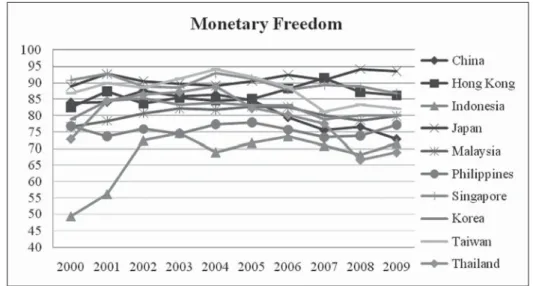
ing, misallocate resources, raise the cost of doing business, and undermine a free society that people can rely on market prices for the foreseeable fu-ture (Heritage Foundation, 2009: 14).
Inflation in Japan has been extra ordinarily low, averaging 0.01 per-cent between 2005 and 2007 while Korea, Taiwan, Hong Kong and Singa-pore have experienced average inflation rate of 2.5 percent, 1.5 percent, 1.9 percent and 1.7 percent respectively during the same period. According to the Heritage Foundation’s Monetary Freedom score, Japan is the lead-ing country in East Asia followed by Slead-ingapore, Hong Kong, Taiwan and Korea (See Figure 4).
Sound Financial System
Virtually all countries provide some types of prudential supervision of banks and other financial services for ensuring that financial services firms meet basic fiduciary responsibilities (Heritage Foundation, 2009: 14). Most of the East Asian countries have developed quite strong financial system as they were experiencing high economic growth during the high growth era. Almost all the countries’ financial systems are subject to gov-ernment control to prevent financial disasters that some of the economies experienced during the Asian financial crisis and the current global
finan-Figure 3: Investment Environment, East Asia
cial crisis. Deregulation and competition in Japan have led to consolida-tion in an effort to create banks large enough to be major players abroad while the Japanese corporations maintain tight relationships with the banks to have access to cheap credit and lessening accountability. The Jap-anese government supports bank mergers to speed up the transformation of the financial sector and continues to update laws and regulations to fa-cilitate them.
Korea’s modern financial sector has become more open and competi-tive, providing positive momentum for reforms in other sectors. After the 1997 Asian financial crisis, the government has succeeded in recapitaliz-ing banks and non-bank financial institutions. Taiwan’s modern financial sector has become more competitive as many restrictions on financial ac-tivities, particularly those of foreign financial institutions, have been re-duced while Hong Kong is a global financial center with a regulatory and legal environment focused on enforcing prudent minimum standards and transparency. On the other hand, Singapore’s financial sector is also very modern and competitive. Although, the capital market is quite strong in all the selected countries in East Asia, however, the Tokyo Stock Exchange and Hong Kong Stock Exchange (HKSE) are the two of the 10 most capi-talized stock exchanges in the world. If we look at the Heritage Founda-tion’s Financial Freedom score which is an indicator of sound financial
Figure 4: Monetary System, East Asia
system, we see that Hong Kong is the leading center in East Asia (See Fig-ure 5).
Domestic Credit to Private Sector is one of the important components of a sound financial system. In the selected East Asian countries, although there is a negative trend in domestic credit to private sector, however, as compared to the percentage of GDP, they still provide huge domestic credit to the private sector (See Figure 6)
Property Rights Protection
The ability to accumulate private property is the main motivating force in a market economy, and the rule of law is vital to a fully function-ing free-market economy (Heritage Foundation, 2009: 14-15).
Secure property rights system that requires an effective and honest judicial system available to all, equally and without discrimination, gives citizens the confidence to undertake commercial activities, save their in-come, and make long-term plans because they know that their income and savings are safe from expropriation or theft. In most of the selected coun-tries in East Asia, real and intellectual property rights are generally se-cure. However, in Hong Kong and Singapore, property rights are more strongly protected than that of Japan, Korea and Taiwan (See Figure 7).
Figure 5: Financial System, East Asia
5. INSTITUTIONAL REGIMES IN EAST ASIA
An effective, accountable and corrupt-free government and an appropriate legal system that ensures rule of law and efficient regulatory quality are
Figure 6: Domestic credit to private sector, East Asia
Source: World Bank, 2009.
Figure 7: Property Rights Protection, East Asia
necessary to support and enforce the basic rule of business to allow fair and competitive business environment for continuous innovations (Chen and Dahlman, 2005: 8-9). Many scholars argued that good governance is absolutely necessary for having a functional institutional regime that would include an effective, impartial and transparent legal system that protects property and individual rights; public institutions that are stable, credible and honest; and government policies that favor free and open markets. In East Asia, these conditions encourage FDI and presumably private domestic investment as well, by protecting privately held assets from arbitrary direct or indirect appropriation. Generally, good govern-ance indicators have six dimensions: i) Voice & Accountability, ii) Political Stability, iii) Government Effectiveness, iv) Regulatory Quality, v) Rule of Law, and vi) Control of Corruption (Kaufmann et al., 1999). Using the data from 1996-2008 for the above six indicators, a comparative analysis has been made for selected East Asian countries.
Voice and Accountability
Voice and Accountability is a composite indicator and comprises a number of individual indicators measuring various aspects of the political process, civil liberties and political rights. This index measures the extent to which citizens of a country are able to participate in the selection of governments including measuring the independence of the media, which plays an important role in monitoring those in authority and holding them accountable for their actions. Figure 8 asserts that all the East Asian countries indeed performed much better than China in terms of voice and accountability measures of good governance. This is because all the coun-tries except China are democratic. Being a socialistic country China’s per-formance, in this regard is below 40% in the percentile ranking.
Political Stability
Political Stability index combines several indicators which measure perceptions of the likelihood that the government in power will be destabi-lized or overthrown by unconstitutional means and/or violent means which may negatively affect the institutional functioning in a country3). 3) World Bank KBE online, 2009 available at
http://web.worldbank.org/WBSITE/EXTER-NAL/WBI/WBIPROGRAMS/KFDLP/EXTUNIKAM/0,,contentMDK:20584288~menuPK:14 33258~pagePK:64168445~piPK:64168309~theSitePK:1414721,00.html
Figure 9 indicates that almost all East Asian countries have been perform-ing consistently well in terms of political stability. Although China’s per-formance in this regard is below all the other East Asian countries, yet China has been successful in maintaining the political stability around 40% level as shown in the percentile rank.
Figure 8: Voice & Accountability, East Asia
Source: Computed data collected from Worldwide Governance Indicators, 1996-2008 available at http://info.worldbank.org/governance/wgi/sc_country.asp.
Figure 9: Political Stability, East Asia
Source: Computed data collected from Worldwide Governance Indicators, 1996-2008 available at http://info.worldbank.org/governance/wgi/sc_country.asp.
Government Effectiveness
Government Effectiveness combines into one grouping perceptions of the quality of public service provision, the quality of the bureaucracy, the competence of civil servants, the independence of the civil service from po-litical pressures, and the credibility of the government’s commitment to policies4). Figure 10, indicates that all the East Asian countries have been
performing consistently well in terms of government’s effectiveness. China is performing above 60% level while other East Asian countries’ perfor-mance in 2007 was above the 80% level in the percentile ranking, which indicates that China’s performance in this regard has improved over the last 10 years.
Regulatory Quality
Regulatory quality measures the incidence of market-unfriendly poli-cies such as price controls or inadequate bank supervision, as well as per-ceptions of the burdens imposed by excessive regulation in areas such as
4) World Bank KBE online, 2009 available at http://web.worldbank.org/WBSITE/EXTER-NAL/WBI/WBIPROGRAMS/KFDLP/EXTUNIKAM/0,,contentMDK:20584288~menuPK:14 33258~pagePK:64168445~piPK:64168309~theSitePK:1414721,00.html
Figure 10: Government Effectiveness, East Asia
Source: Computed data collected from Worldwide Governance Indicators, 1996-2008 available at http://info.worldbank.org/governance/wgi/sc_country.asp.
foreign trade and business development5). Figure 11 shows that regulatory
quality in East Asian countries. From the graph, it is evident that all the East Asian countries except China are performing well above the 60% lev-el whereas China is performing above the 40% levlev-el in the percentile ranking. However, China’s performance has been gradually improving over the years.
Rule of Law
Rule of Law includes several indicators which measure the extent to which agents have confidence in and abide by the rules of society and these include perceptions of the incidence of both violent and non-violent crimes, the effectiveness and predictability of the judiciary, and the en-forceability of contracts6). In terms of rule of law, all the East Asian
coun-tries except China are performing well above the 60% level whereas China
5) World Bank KBE online, 2009 available at http://web.worldbank.org/WBSITE/EXTER-NAL/WBI/WBIPROGRAMS/KFDLP/EXTUNIKAM/0,,contentMDK:20584288~menuPK:14 33258~pagePK:64168445~piPK:64168309~theSitePK:1414721,00.html
6) World Bank KBE online, 2009 available at http://web.worldbank.org/WBSITE/EXTER-NAL/WBI/WBIPROGRAMS/KFDLP/EXTUNIKAM/0,,contentMDK:20584288~menuPK:14 33258~pagePK:64168445~piPK:64168309~theSitePK:1414721,00.html
Figure 11: Regulatory Quality, East Asia
Source: Computed data collected from Worldwide Governance Indicators, 1996-2008 available at http://info.worldbank.org/governance/wgi/sc_country.asp.
is performing above the 40% level in the percentile ranking (See Figure 12). China, although falls behind in this regard, has shown steady develop-ment in the last 10 years.
Control of Corruption
Control of Corruption indicator corresponds to graft measures of cor-ruption, notably, corruption measured by the frequency of additional pay-ments to get things done and the effects of corruption on the business en-vironment7). From Figure 13, we can note that all the East Asian countries
are performing above 60% level in the percentile rank in controlling cor-ruption. Only China has been experiencing poor performance in this re-gard with the below average level of 50%. China’s performance has been declining since 2003.
If we combine all the six indicators of good governance, we will see that Singapore, Hong Kong, Japan, South Korea, Taiwan and Malaysia have been performing well above the 60% level in the percentile ranking which is much better than China. Although China has performed relative-ly poor in terms of all six indicators compared to the advanced
7) World Bank KBE online, 2009 available at http://web.worldbank.org/WBSITE/EXTER-NAL/WBI/WBIPROGRAMS/KFDLP/EXTUNIKAM/0,,contentMDK:20584288~menuPK:14 33258~pagePK:64168445~piPK:64168309~theSitePK:1414721,00.html
Figure 12: Rule of Law, East Asia
Source: Computed data collected from Worldwide Governance Indicators, 1996-2008 available at http://info.worldbank.org/governance/wgi/sc_country.asp.
based economies, the country, however, maintained above 40% level on av-erage which is quite significant achievement compared to many other latecomers in the region.
6. THE ECONOMIC INCENTIVES AND INSTITUTIONAL REGIMES AND
DEVELOPMENT OF KNOWLEDGE-BASED ECONOMY IN EAST ASIA
The institutional framework should ensure a good flow of knowledge be-tween scientific research and technological applications, as well as a good flow of information among researchers and users. Here, the governments play a crucial role, as knowledge creation cannot rely on market mecha-nism alone. As the market for knowledge is often characterized by imper-fections – that is to say, social and private returns derived from knowledge can widely differ (UNCTAD, 2007) and in the area of knowledge creation, any market failure’ may lead to private underinvestment in knowledge. Thus, policies to support knowledge creation through various efforts such as government funding, government procurement, tax subsidies, intellec-tual property rights protection and so on, as well as knowledge diffusion such as establishment of libraries, communication networks, access cost subsidies, etc. are to be formulated by the government.As we postulate the role of government as indispensible in creating knowledge-based economy our hypothesis for this study is that economic
Figure 13: Control of Corruption, East Asia
Source: Computed data collected from Worldwide Governance Indicators, 1996-2008 available at http://info.worldbank.org/governance/wgi/sc_country.asp.
incentives and institutional regimes are required for creating knowledge-based economy. While examining how economic incentives and institution-al regimes play a role in creating knowledge-based economy, we investi-gate the determinant factors of economic incentives and institutional regimes that contributed to the growth of knowledge-based economies in East Asia.
Figure 14 shows the relationship among the three components of our study such as economic incentives and institutional regimes, FDI inflows and domestic investments and development of KBE infrastructure. The two black arrows show the first-order development of KBE infrastructure which indicates that economic incentives and institutional regimes lead to attract more FDI and allow more domestic investment to develop KBE in-frastructure in the initial stage. Once the first-order development works steadily, the second-order developments take place where all the three in-teract with each other mutually or independently to improve all the three components to create a complete knowledge-based economy.
Economic Incentives and
Institutional Regimes
Attracts FDI and allows Domestic
Investment
Development of KBE Infrastructure KBE
Figure 14: Conceptual Framework of Economic Incentives and Institutional Regimes in the East Knowledge-based Economies
7. THE IMPACT OF ECONOMIC INCENTIVES AND INSTITUTIONAL
REGIMES IN ATTRACTING FDI TO PROMOTE KNOWLEDGE-BASED
ECONOMY IN EAST ASIA
The role of economic incentives and institutional regimes in promoting knowledge-based economy in East Asia has been to attract large volume of FDI and increase domestic investment to build the KBE infrastructure to bring better economic growth. FDI can increase competition in the host economy, making domestic companies more efficient and improving living standards. A recent study found that for 1 percent increase in FDI in de-veloping economies, there will be a GDP per capita growth of about 0.5% (McLean and Shrestha, 2002). Recent available data indicates that all East Asian countries have positive FDI inflows. This indicates that the stable sociopolitical environment in the East Asian countries, a product of good governance is one of the core reasons for the large volume of FDI in-flows in East Asian countries compared to South Asia or Africa. On the other hand, the domestic investments in education, Research and Develop-ment (R&D) and ICT has been quite steady for most East Asian countries, which indicate that the governments in East Asian countries while at-tracting more FDI also put efforts to develop knowledge-based economic infrastructures.
Among the selected countries in East Asia, Japan, South Korea, Hong Kong, Singapore, Taiwan, and Malaysia have shown superior performance in maintaining better economic incentives and institutional regimes than China. If we consider the knowledge base of each country which is meas-ured by investments in KBE infrastructures and FDI inflows, we see that the same countries achieved better development in strengthening the knowledge base of their economies in all the other pillars of knowledge-based economy such as education and human resources, innovation infra-structure, and information communication infrastructures.
Now, if we investigate the six good governance indicators further, we will find that Taiwan, Japan, Singapore and Hong Kong are leading while Malaysia has been performing better than China taking the fifth position in all indicators. The positive impact of having good governance has been observed in growth of overall productivity in the East Asian Countries. Overall productivity indicates the steadiness of the economy and the coun-tries that are leading in terms of economic incentives and institutional
re-gimes in East Asia are also leading the economic growth in East Asia. In terms of FDI inflows, China has shown much better performance than other East Asian countries although FDI has played a major role in advancing all the East Asian Knowledge-based Economies. However, the inward FDI within China flows disproportionately into provinces with less corrupt governments and governments that better protect private proper-ty rights. This, therefore, suggests that if China had higher qualiproper-ty govern-ance across all the provinces, the country as a whole would have attracted even more FDI. Among the East Asian countries, China attracts the high-est FDI as the country has maintained political and ideological stability with growing wealth. Although China ranks at the bottom in the good gov-ernance rankings among the selected East Asian countries, China’s suc-cess story in attracting FDI is largely attributed to the spectacular growth track record, the relatively better government executive power, a relative political stability, good infrastructure, abundant educated labor force, and its large domestic market. So, China’s case is not exceptional in East Asia.
8. IDENTIFYING THE CONTRIBUTING FACTORS OF ECONOMIC
INCENTIVES AND INSTITUTIONAL REGIMES
From the analysis, it is clear that the creation of knowledge-based econo-my in East Asia is positively correlated with economic incentives and in-stitutional regimes. In East Asia, good governance played an important role in attracting FDI, which helped developing the knowledge-based eco-nomic infrastructures to create knowledge-based economy. In the case of China, the country is still a long way behind the other selected East Asian countries in terms of knowledge-based economy. The same can be said about the overall productivity which is a powerful indicator of economic growth. If China wants to be similar to other East Asian knowledge-based economies, China has to further improve its economic incentives and insti-tutional regimes quality.
From the above discussion and trend analysis of various empirical data of the East Asian countries it is quite evident that advanced knowl-edge-based economies such as Japan, Korea, Taiwan, Hong Kong and Sgapore are highly successful in the development of functional economic in-centives and institutional regimes. Openness, supporting business environment, suitable business environment, functional monetary system,
sound financial system, and property rights protection have been the key contributing factors of the economic incentives in the East Asian countries. In terms of institutional regimes, voice and accountability, political stabili-ty, government effectiveness, regulatory qualistabili-ty, rule of law and control of corruption are the key contributing factors identified. These key factors contributed greatly to the development of a functioning economic incentive system and institutional regimes in East Asia.
9. ANALYSIS FOR ECONOMIC INCENTIVES AND INSTITUTIONAL
REGIMES IN EAST ASIA
In the earlier section, we discussed on the economic incentives and institu-tional regimes, one of four pillars of knowledge-based economy. There we found seven factors for economic incentives and six factors for institution-al regimes that are contributing to the development of superior economic incentives and institutional regimes in the East Asian economies. Tariff and nontariff barriers, business freedom, investment freedom, monetary system, financial system, domestic credit to private sector, property right protections are the variables; we discussed that function for the economic incentives of a country. On the other hand, good governance indicators such as voice and accountability, political stability, government effective-ness, regulatory quality, rule of law and control of corruption are core com-ponents of any sound institutional regime.
Table 1 Descriptive Statistics
N Minimum Maximum Mean Std. Deviation Economic Incentives &
Institutional Regimes 10 3.66 9.68 6.36 2.196
Tariff and Nontariff Barriers 10 70.20 95.00 80.22 7.94
Business Freedom 10 46.70 98.30 72.63 18.93
Investment Environment 10 20.00 90.00 52.50 22.64
Monetary System 10 66.40 88.80 76.67 6.72
Financial System 10 30.00 90.00 55.00 17.16
Domestic Credit to Private
Sector 9 27.00 164.00 100.89 45.69
Property Right Protection 10 20.00 90.00 57.00 24.97 Voice and Accountability 10 5.80 76.00 46.11 21.51
Political Stability 10 10.50 96.20 51.62 32.02 Government Effectiveness 10 47.40 100.00 75.84 18.28 Regulatory Quality 10 45.40 100.00 70.43 20.75 Rule of Law 10 28.70 93.80 65.42 22.94 Control of Corruption 10 26.10 99.50 62.61 26.23 Valid N (listwise) 9
As the first step, we have investigated the descriptive statistics to study the minimum, maximum, mean and standard deviation of all varia-bles. Table 1 shows the descriptive statistics of all the variables for eco-nomic incentives and institutional regime in East Asia that describes the characteristics of each variable by the measuring the total number of ob-servance, minimum, maximum, mean and standard deviation of each vari-able.
As for second step, Table 2 shows the correlation of each independent variable with the dependent variable economic incentives and economic regimes. From the correlation analysis, we can see that the dependent var-iable is not equally significantly associated with all the independent varia-bles. The association of Tariff and nontariff barriers, business freedom, in-vestment environment, monetary system, political stability, government effectiveness, regulatory quality, rule of law, and control of corruption with economic incentives and institutional regimes are highly significant at 0.01 level while the association with financial system, domestic credit to private sector, property right protection and voice and accountability is not statistically so significant.
Table 2 Correlation V1 V2 V3 V4 V5 V6 V7 V8 V9 V10 V11 V12 V13 Economic Incentive & Institutional Regimes Pearson Correlation .847**.879**.861**.798** .505 .497 .602 .482 .929**.910**.986**.950**.962** Sig. (2-tailed) .002 .001 .001 .006 .136 .174 .066 .159 .000 .000 .000 .000 .000 N 10 10 10 10 10 9 10 10 10 10 10 10 10
**. Correlation is significant at the 0.01 level (2-tailed). *. Correlation is significant at the 0.05 level (2-tailed).
Note: V1: Tariff and Nontariff Barriers, V2: Business Freedom, V3: Investment Environment, V4:
Mon-etary System, V5: Financial System, V6: Domestic Credit to private Sector, V7: Property Right Protection, V8: Voice & Accountability, V9: Political Stability, V10: Government Effectiveness,
V11: Regulatory Quality, V12: Rule of Law, and V13: Control of Corruption.
In the third step, we have investigated the curvilinear regression for each statistically significant independent variable against the dependent variable to explore the linear and growth relationship between them. Ta-ble 3 provides the model summary and parameter estimates for curviline-ar regression while Figure 20 shows the curvilinecurviline-ar regression results in graphs.
The R square value and the significance level in Table 3 shows that the independent variables that have been explained in section 4 and 5 have close association both in terms of linear and growth with the depend-ent variable. In Figure 15, these findings are graphically represdepend-ented.
Table 3
Model Summary and Parameter Estimates for Curvilinear Regression Dependent Variable: Economic Incentives and Institutional Regimes Equation
Model Summary Parameter Estimates
R Square F df1 df2 Sig. Constant b1
The independent variable is Tariff and Nontariff Barrier
Linear .718 20.390 1 8 .002 -12.450 .234
Growth .635 13.899 1 8 .006 -1.038 .035
The independent variable is Business Freedom
Linear .773 27.190 1 8 .001 -1.044 .102
Growth .807 33.500 1 8 .000 .582 .017
The independent variable is Investment Environment
Linear .740 22.827 1 8 .001 1.979 .083
Growth .723 20.918 1 8 .002 1.101 .013
The independent variable is Monetary System
Linear .637 14.061 1 8 .006 -13.641 .261
Growth .651 14.911 1 8 .005 -1.443 .042
The independent variable is Political Stability
Linear .863 50.509 1 8 .000 3.072 .064
Growth .852 46.061 1 8 .000 1.272 .010
The independent variable is Government Effectiveness
Linear .828 38.431 1 8 .000 -1.925 .109
Growth .857 47.882 1 8 .000 .444 .018
The independent variable is Regulatory Quality
Linear .972 281.020 1 8 .000 -.988 .104
Growth .960 191.532 1 8 .000 .625 .017
The independent variable is Rule of Law
Linear .902 73.802 1 8 .000 .413 .091
Growth .939 122.474 1 8 .000 .823 .015
The independent variable is Control of Corruption
Linear .925 99.165 1 8 .000 1.319 .081
10. DISCUSSION ON THE KEY DETERMINANTS OF
KNOWLEDGE-BASED ECONOMY IN EAST ASIAIn section 2-6 of this paper, we discussed on how the creation of knowl-edge-based economy in East Asia is positively correlated with economic in-centives and institutional regimes by analyzing various factors of econom-ic incentives and institutional regimes. We found that, in East Asia, good governance played an important role in attracting FDI, which helped de-veloping the knowledge-based economic infrastructures to create knowl-edge-based economy. Many knowlknowl-edge-based economies in the region such as Japan, Korea, Taiwan, Hong Kong and Singapore are highly successful in the development of functional economic incentives and institutional re-gimes. Openness, supporting business environment, suitable business
vironment, functional monetary system, sound financial system, and prop-erty rights protection have been the key determinants of the economic incentives in the East Asian countries while in terms of institutional re-gimes, voice and accountability, political stability, government effective-ness, regulatory quality, rule of law and control of corruption are the key determinants identified. However, from the statistical analysis in section 7, it is evident that not all the factors are equally significant for creating better economic incentives and institutional regimes for a knowledge-based economy. From the statistical analysis we found that some factors such as tariff and nontariff barriers, business freedom, investment envi-ronment, monetary system, political stability, government effectiveness, regulatory quality, rule of law, and control of corruption are highly signifi-cant at 0.01 level while the other factors such as association with financial system, domestic credit to private sector, property right protection and voice and accountability are not statistically so significant. From discussion in section 2-6 and the quantitative analysis in section 7, we therefore, can argue that tariff and nontariff barriers, business freedom, investment envi-ronment, monetary system, political stability, government effectiveness, regulatory quality, rule of law, and control of corruption are the key deter-minants of economic incentives and institutional regimes in East Asia.
11. A COMPARATIVE LOOK AT WORLD BANK KNOWLEDGE-BASED
ECONOMY INDEX FOR EAST ASIA AND FINDINGS OF THIS STUDY
From the empirical data analysis and discussion in section 2-6, we see that Japan, Korea, Taiwan, Hong Kong and Singapore are the most suc-cessful countries in East Asia in their pursuit to become a knowledge-based economy in terms of economic incentives and institutional regimes. From analysis and discussion in section 2-6, we realize that foreign direct investment (FDI) has greatly contributed in the initial development of knowledge-based economy in most of the countries in East Asia. Only Ja-pan is exception of this trend. However, JaJa-panese FDI inflow in the other East Asian countries has been one of the very strong forces that contribut-ed to the growth of knowlcontribut-edge-bascontribut-ed economy in the region. We discusscontribut-ed many factors for economic incentives and institutional regimes to observe how the factors have been shaping the development of knowledge-based economy in the East Asian economies. After the vivid discussions onvari-ous factors of economic incentives and institutional regimes of knowledge-based economy in section 2-6, we, then, carried out quantitative analysis in section 7. From the quantitative analysis, we uncovered the key deter-minants of economic incentives and institutional regimes of knowledge-based economy in East Asia.
To further understand our findings in a more meaningful manner, we compared our findings with World Bank’s knowledge economy indices. The Knowledge Economy Index (KEI) provided by the World Bank takes into account whether the environment is conducive for knowledge to be used effectively for economic development. The KEI score an aggregate index that represents the overall level of development of a country towards the Knowledge Economy. The index is calculated based on the average of the normalized performance scores of a country on all 4 pillars - economic centive and institutional regime, education and human resources, the in-novation system and information and communications technology (ICT). In making the KEI indices, World Bank considered 3 key variables for eco-nomic incentives and institutional regimes tariff and nontariff barriers, regulatory quality and rule of law. These three key variables are found to be the most significant variables for each pillars of knowledge-based econ-omy for all the countries of world.
For economic incentives and institutional regimes, we found that tar-iff and nontartar-iff barriers, business freedom, investment environment, monetary system, political stability, government effectiveness, regulatory quality, rule of law, and control of corruption are highly significant. If we look at the World Bank’s three variables for this pillar, we realize that all three are found significant for economic incentives and institutional re-gimes in East Asia.
12. TRACKING THE RELATIONSHIP BETWEEN THE KEY
DETERMI-NANTS OF KBE AND EAST ASIA’
S OVERALL DEVELOPMENT The purpose of creating knowledge-based economy is to have a globally strong and competitive economy to maintain sustainable economic growth towards overall development of a country. The East Asian economies have been pursuing necessary policies to create knowledge-based economy in order to continue their economic development in the post-industrial era and to be globally competitive. In doing so, some economies in the regionbecame exceptionally successful in creating a functional knowledge-based economy while some others are behind. Countries like Japan, Korea, Tai-wan, Hong Kong and Singapore have shown remarkable achievements in creating a successful knowledge-based economy. To understand the devel-opment trend in the East Asian knowledge-based economies, we did not investigate the GDP growth because the bigger the economy grows, the lower the GDP growth rate becomes although the absolute value of GDP is always higher in the advanced countries. For this reason, we considered the human development index (HDI), which is a composite measure of three components: longevity (measured by life expectancy); knowledge (adult literacy rate and mean years of schooling); and standard of living (real GDP per capita in purchasing power parity) to understand the devel-opment pattern in the East Asian knowledge-based economies. HDI pro-vides information on the human development aspect of economic growth.
Table 4 shows the HDI for the East Asian economies for the year 1980, 1985, 1990, 1995, 2000, 2005, 2006, and 2007. From the table, we ob-serve that there has been a positive growth trend of human development in all the economies of East Asia while the advanced knowledge-based economies achieved incredible success in this regard which can be com-pared with the most advanced nations of the world. From this finding, it is obvious that most of the East Asian economies have achieved excellent growth in life expectancy, adult literacy rate and mean years of schooling, and real GDP per capita in purchasing power parity.
Table 4
Human Development Index Trends in East Asia
Country 1980 1985 1990 1995 2000 2005 2006 2007
China 0.533 0.556 0.608 0.657 0.719 0.756 0.763 0.772 Hong Kong N/A N/A N/A N/A N/A 0.939 0.943 0.944 Indonesia 0.522 0.562 0.624 0.658 0.673 0.723 0.729 0.734 Japan 0.887 0.902 0.918 0.931 0.943 0.956 0.958 0.960 Korea 0.722 0.760 0.802 0.837 0.869 0.927 0.933 0.937 Malaysia 0.666 0.689 0.737 0.767 0.797 0.821 0.825 0.829 Philippines 0.652 0.651 0.697 0.713 0.726 0.744 0.747 0.751 Singapore 0.785 0.805 0.851 0.884 N/A N/A 0.942 0.944
Taiwan N/A N/A N/A N/A N/A N/A N/A 0.943
Thailand 0.658 0.684 0.706 0.727 0.753 0.777 0.780 0.783
Source: Human Development Report 2009 available at http://hdrstats.undp.org/en/indicators/81. html and http://www.dgbas.gov.tw/public/Data/910616273671.pdf for Taiwan’s data
We, then, investigated the correlations between the key determinants of economic incentives and institutional regimes of knowledge-based econ-omy in East Asia from our findings with HDI. Table 5 shows the correla-tion of each determinant with the HDI. From the correlacorrela-tion analysis, we can see that the correlations of all the determinants of economic incen-tives and institutional regimes with HDI are highly significant at 0.01 lev-el except for tariff and nontariff barriers (See Table 5). This indicates that the determinants factors of economic incentives and institutional regimes of East Asian knowledge-based economies have very close positive rela-tionship with overall human development.
Table 5 Correlations
Economic Incentives and Institutional Regimes
Human Develop-ment Index Tariff and Nontar-iff Busi-ness Freedom Invest-ment Envi-ronment Mon-etary System Political Stability Govern-ment Effec-tiveness Regula-tory Quality Rule of Law Control of Corrup-tion Pearson Correlation .576 .840** .857** .862** .917** .878** .910** .932** .907** Sig. (2-tailed) .081 .002 .002 .001 .000 .001 .000 .000 .000 N 10 10 10 10 10 10 10 10 10
**. Correlation is significant at the 0.01 level (2-tailed). *. Correlation is significant at the 0.05 level (2-tailed).
13. CONCLUDING REMARKS
Through qualitative discussions and empirical data analysis, the key fac-tors of economic incentives and institutional regimes became very evident for the selected East Asian countries. From the analysis in the above sec-tions, we also found that there has been a very positive growth trend of most of the factors of economic incentives and institutional regimes in the East Asian countries. In their pursuit of becoming knowledge-based econo-my in East Asia, some countries performed extraordinarily well while some countries are still in way of development.
In terms of economic incentives and institutional regimes, we found openness, supporting business environment, suitable business environ-ment, functional monetary system, sound financial system, and property rights protection have been the key factors of the economic incentives in the East Asian countries while in terms of institutional regimes, voice and
accountability, political stability, government effectiveness, regulatory quality, rule of law and control of corruption are the key factors identified. However, from statistical analysis we discussed in section 7, it is evident that not all the factors that are mentioned and discussed in section 2-6 are equally significant for creating better economic incentives and institution-al regimes for a knowledge-based economy. From the statisticinstitution-al aninstitution-alysis we identified the key determinants of economic incentives and institution-al regimes in East Asia and they are tariff and nontariff barriers, business freedom, investment environment, monetary system, political stability, government effectiveness, regulatory quality, rule of law, and control of corruption.
Our objective in this paper was to investigate the key determinants of economic incentives and institutional regimes in East Asia to promote knowledge-based economy in the region. From the analysis, it is clear that there are some key determinants of economic incentives and institutional regimes in the successful East Asian knowledge-based economies. Overall, in all the selected East Asian countries, the economic incentives and insti-tutional regimes are playing very important role in promoting knowledge-based economy in the region.
REFERENCE
Brusoni, S., Prencipe, A. and Pavitt, K. (2000). Knowledge Specialization and the Boundaries of the Firm: Why Do Firms Know More Than They Make?
Adminis-trative Science Quarterly, 46, pp. 597-621.
Chen, D. H. C. and Dahlman, C. J. (2005). The Knowledge Economy, the KAM Method-ology and World Bank Operations. The World Bank, Washington DC, 19 October, 2005.
Etzkowitz, H. and Leydesdorff, L. (1998). The Endless Transition: A Triple Helix of University-Industry-Government Relations. Minerva, 36, 203-208.
Freeman, C. (1982). The Economics of Industrial Innovation. Penguin: Harmondworth. Galbraith, J. K. (1967). The New Industrial State. Penguin: Harmondsworth.
Heritage Foundation. (2009). 2009 Index of Economic Freedom. Available at http:// www.heritage.org/index/PDF/2009/Index2009_Chapter1.pdf.
Heritage Foundation 2009 Online available at http://www.heritage.org/index/Ranking. aspx.
Irvine, J. and Martin, B. R. (1984). Foresight in Science: Picking the Winners. London: Frances Printer.
and Challenges for EU Accession Countries. Paris, February 19-22.
Kaufmann, D., Kraay, A. and Zoido-Lobatón, P. (1999a). Aggregating Governance Indi-cators. World Bank Working Paper, No. 2195, available at: http://www.worldbank. org/wbi/governance.
Leydesdorff, L. (2005). The Knowledge-based Economy: modeled, measured, simulated. Boca Raton, Fla.: Universal Publishers.
McLean, B. and Shrestha, S. (2002). International financial liberalization and econom-ic growth. Research Discussion paper, available at http://www.rba.gov.au/Publeconom-ica- http://www.rba.gov.au/Publica-tionsAndResearch/RDP/RDP2002-03.html, accessed 14 November, 2008.
OECD (1980). Technical Change and Economic Policy. Paris.
UNCTAD. (2007). Science and technology for development: the new paradigm of ICT.