Japan Advanced Institute of Science and Technology
JAIST Repository
https://dspace.jaist.ac.jp/
Title
Does the network coding technique work well for
congestion control in wireless sensor networks?
Author(s)
Kho, Lee Chin; Yasuo, Tan; Lim, Azman Osman
Citation
IEICE Technical Report on Ubiquitous and Sensor
Networks (USN), 112(31): 7-11
Issue Date
2012-05-10
Type
Journal Article
Text version
publisher
URL
http://hdl.handle.net/10119/11583
Rights
Copyright (C) 2012 The Institute of Electronics,
Information and Communication Engineers (IEICE).
Kho Chin Lee, Tan Yasuo, and Lim Azman Osman,
IEICE Technical Report on Ubiquitous and Sensor
Networks (USN), 112(31), 2012, 7-11.
This article is a technical report without peer review, and its polished and/or extended version may be published elsewhere. Copyright ©2012 by IEICE
無線センサネットワークの輻輳制御におけるネットワークコーディング技術
の有効性について
コー リーチン
丹 康雄
リム アズマンオスマン
北陸先端科学技術大学院 情報科学研究科 〒923-1292 石川県能美市旭台 1-1
E-mail: {s1120203, ytan, aolim}@jaist.ac.jp
あらまし ネットワークコーディング(NC)は、無線センサネットワークのスループットを向上させる有望な手法であるが、 ネットワークが輻輳している状況での有効性についてはまだ明らかではない。そこで本論文では、無線センサネットワークにお
けるNC ベースの輻輳制御の有効性について検討を行う。詳細な定量分析を行った結果から結論として、現状の NC ベースの輻
輳制御はいかなるネットワークトポロジにおいてもうまく機能していないことが分かる。 キーワード 無線センサネットワーク, ネットワークコーディング技術, 輻輳制御
Does the Network Coding Technique Work Well for Congestion Control in
Wireless Sensor Networks?
Chin Lee KHO Yasuo TAN Azman Osman LIM
Japan Advanced Institute of Science and Technology, 1-1 Asahidai, Nomi, Ishikawa 923-1292, Japan
E-mail: {s1120203, ytan, aolim}@jaist.ac.jp
Abstract Network
Coding (NC) is a promising technique to increase network throughput in wireless sensor networks. There are still some questions whether NC technique can be used for controlling congested networks. This paper presents a study of NC-based congestion control in wireless sensor networks. By revealing the in-depth quantitative analysis of this issue, it is discovered that the current NC-basedcongestion controls are yet to fully optimize the performance of any kind of network topology
.
Keyword
wireless sensor networks,network
coding technique, congestion control1. INTRODUCTION
Wireless sensor networks (WSNs) are widely used in health, agriculture, military, environment and others for supervisory functions. Generally, it deploys a large number of sensor nodes at the interest field with one or more data sinks located either at the centre or out of field [1]. The basic function of the sensor networks is to deliver the data from neighbourhood event detection to the sink or assemble the samples of the environment through the continuous data collection and sending to the sink.
However, the congestion in WSNs occurs when (1) concurrent data transmission over different source to one node, (2) buffer overflow, (3) packet collision, and (4) report rate change causing uncongested path of the network become underutilize or congested [2]. Congestion will deteriorate the quality of service in the network. For instance, network delay due to the long queue in router, throughput diminish that is caused by the packet loss, and fairness event among the nodes and reliable data
transmission degradation. Fig. 1 shows the structure of WSNs with different data paths from several source nodes to sink. The path 2 in the Fig.1 shows congested network.
Fig. 1: WSNs
Various researches have been conducted to mitigate the congestion in WSNs. For examples, hop-by-hop flow control technique [2,3], rate allocation techniques [4], adaptive reliability transport protocol [5], Network
technique is first introduced [8] by allowing the local network nodes to perform coding operations. Then, the following related researches have successfully shown that the NC technique achieves multicast capacity in lossless networks. Now, NC technique is widely applied in WSNs. NC technique can effectively control the energy consumption and increase the throughput [9]. But, the effectiveness of NC technique for congestion control in WSNs is yet to be evaluated.
In this paper, we consider an important of congestion control problem in WSNs. In particular, we study the network transmission rate and capacity under the congestion condition with overhearing in NC technique. NC technique is used to combine the packets in the network to reduce the transmission capacity. It is delivering lesser information data than the traditional store and forward approach. In other words, congestion in the WSNs will also be reduced. Therefore, our interest is to find out how well the NC technique can be used in congestion control and network congestion avoidance with overhearing in WSNs.
The paper is organized as follows. The next section briefly discusses some related work. The details of congestion control scheme, overhearing, and NC technique are presented in Section 3 and Section 4 presents some findings and discussions. Section 5 concludes this paper and introduces some future works.
2. RELATED WORK
In this section, we provide briefly summaries on existing work on the conventional way and NC techniques on the transmission rate control to avoid congestion. WSNs have an unpredictability of channel conditions and workloads, so the congestion can happen anywhere in network. Congestion may cause the increase in noise with dramatically decreased packet delivery rate. There are a lot of research works on congestion control techniques performed by researchers throughout the years.
The most common ways of transmission rate control techniques and NC technique in WSNs are discussed in this paper. Fusion [2] combines three different techniques to mitigate congestion: hop-to hop flow control, rate limiting and prioritized medium access control. In [3], the depth of congestion (DC) was introduced to measure the level of congestion on node and adapts its transmission rate according to DC to control congestion. This scheme
focused on the concurrent transmission with hop by hop. Rate Controlled Reliable Transport (RCRT) protocol [10] uses end-to-end explicit loss recovery by employing NACK based scheme. In addition, RCRT uses congestion detection and rate adaptation in sinks to produce a centralized congestion control scheme.
Jiao et al. [11] have proved that NC technique can improve the total number of transmission and path routing of the delivered packet with a limited broadcast way to reduce unimportant transmissions. Besides, Tornado code with priority based NC scheme [9] showed the energy of sensor is effectively control and the important data on the node failures still keep on. While Zheng et al. [12] used the Slepian-Wolf Coding in distributed data aggregation with clustering based WSNs to decode the data within a single cluster according to the distributed optimal compression clustering rate allocation for minimize the intra-cluster communication cost. Finally, Kumar et al. [7] proposed a selective channelization scheme which reserved the communication resources for the link that experience with congestion level that cannot be overcome by NC technique.
3. QUANTITATIVE ANALYSIS
3.1 Congestion Control Overview
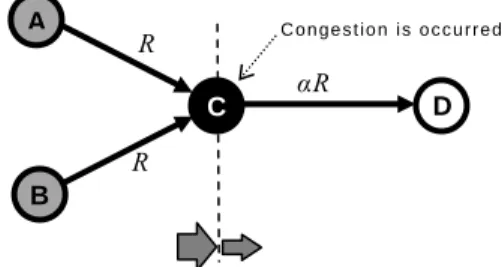
In this section, we describe the basic congestion control of a network topology. For simplicity, we consider the most fundamental ʻYʼ network, which consists of 4 nodes as shown in Fig. 2. A packet from either node A or B is sending to node C with a basic transmission rate, R. Since the transmission rate from node C to node D is the same, a congestion may occur at node C.
Fig. 2: Fundamental ʻYʼ network.
In Fig. 2, we define the transmission rates from node A
to node C and from node B to node C are RAC and RBC,
respectively. Also a congestion-free coefficient is defined
as α, which is an non-negative integer. This
A D R R αR C o n g e s t io n i s o c c u r r e d B C
congestion-free coefficient means that how much output rate increment should be made in order to balance the incoming rate at node C. Since the transmission rate of
RAC and RBC is the same and let say it is equal to R, we can
obtain the total input rate is 2R. On the other hand, we can model the total output rate is equal to αR. If the
transmission rate from node C to node D (RCD) is twice,
i.e., the congestion-free coefficient (α) is also twice, then there is no congestion in the said network topology. In mathematical representation, we can express the congestion-free coefficient of the said network topology, in which the input rate is less than or equal to the output rate as given below:
CD BC
AC R R
R 2 (1)
For the sake of simplicity, we assume that RAC = RBC =
RCD = R. Therefore, the total channel capacity of node C
without congestion when the channel is ideal can be written as R R R R C AC BC2 CD4
Generally, WSNs consist of N sensor nodes, which are uniformly distributed throughout a coverage network of interest, whereby each sensor node may has a periodical data to be sent a sink. Those sensor nodes that act as an intermediate node to forward the data are usually faced traffic congestion. When the congestion happened, it may cause packet loss, high latency, and high energy consumption for each sending data packet. A few congestion control methods are proposed, e.g., congestion detection scheme and optimal rate allocation scheme.
3.2 Overhearing Overview
In this section, we describe the overhearing phenomena. Regardless of the transmission rate, the broadcast nature of wireless networks leads to the possibility and the probability that other nodes except the intended recipient node overhear the transmission.
Figure 3 shows sender nodes, S1 and S2 transmit their
data packet independently to receiver nodes, D1 and D2,
respectively through a relay, R, which is within the transmission range of those said nodes. In such node
placement, node D2 can overhear node S1’s data packet
because node D2 is located within the transmission range
of node S1. Similar to D1 can overhear node S2’s data
packet. According to [13], node overhears its neighboring transmission and gathers a data packet in order to be used in the coding, which is done by performing an exclusive-or (XOR) operation on the overheard packet and
its native packet.
Fig. 3: Overhearing phenomena.
3.2.1 Perfect Overhearing
Perfect overhearing is assumed that node can perfectly decode the overheard data packet and stores it in its memory stack. We assume that node D can perfectly overhear data packet from node B as shown in Fig 4. Upon receiving data packets from both node A and node B, node C encodes the data packets as a coded packet (e.g., AB packet) by using XOR coding scheme. This coded packet is sent to node D with the transmission rate of R.
Fig. 4: ʻYʼ network with overhearing.
As we can see, even though the congestion-free coefficient, α = 1, there is no congestion happened at node C due to the perfect overhearing. On the other hand, comparing with the conventional communication way, the number of data transmissions is four transmissions, whereas the number of data transmissions is three when the perfect overhearing is performed. Therefore, the network throughput gain at media access control (MAC)
layer is 1.33. Similarly, we assume that RAC = RBC = RCD =
R. We can summarize that the total channel capacity of node C without congestion when the channel is ideal as
R R R R
C AC BC CD3
Although this perfect overhearing works very well in
solving congestion, the aforementioned network conditions are very difficult to accomplish. This is because the perfect overhearing depends on the channel quality and the node placement of network.
O ve r h e a r in g O ve r h e a r in g D2 R S2 S1 D1 P e rf e c t O ve r h e a r in g AB A B A D R R αR
Total input rate is 2R Total output rate is αR
B
3.3 Network Coding Overview
In this section, we describe the NC techniques. The basic idea of NC is to encode the data that send from different senders to reduce the number of transmissions and to increase the overall throughput gain. For example, the most common NC that often used, XOR operation that takes two bits as input and combines them into one bit as output.
Figure 5 shows the node A and node B transmit the packet A and packet B with transmission rate of R to node C, respectively. Node C encodes both receiving packets as a coded packet with transmission rate of αR to node D. The congestion coefficient, α in here is depended on the type of coding being used. In next subsection, we will discuss the Slepian-Wolf Coding (SWC).
Fig. 5: ʻYʼ network with NC.
3.3.1 Slepian-Wolf Coding (SWC)
SWC [14] is a distributed source coding technique that able to eliminate data redundancy of the samples without inter-sensor communication. The basic assumption of SWC at each sensor node is that it has knowledge of correlation structure or joint distributed source code word, which depends on the distances between sensor nodes and the characteristics of observation phenomena [15]. One of the SWC advantages is that nodes need not collaborate while encoding their packets, which saves valuable communication overhead and leads to great practical potentials.
According to the SWC theorem, the node C can jointly encode the incoming packets if it satisfies the three constraints as below:
| (2)
| (3)
, (4)
In particular, the node A and node B is assumed to have an equal probability when they transmit “0” and “1”. If both sources transmit the same symbols, “0” or “1”, the node C can identify it easily. But, when they transmit
different symbols, the node C will receive “0”, where it cannot identify the symbol that was transmitted by each individual node. This condition is declared as erasure, which has the probability of 0.5. So, although the node A uses a half rate code, all erased symbols still can be completely recovered by the node C. Therefore, the node B can fully utilize the transmission rate of R. The same argument work for node B too, as shown in Fig. 5. Hence, the congestion-free coefficient, α in this situation is equal to 1.5. In [16], Stankovic et al. proven that this value is also a SWC bound.
Similarly, we assume that the transmission rate of RAC
and RBC is the same and it is equal to R. As we obtained,
the α = 1.5 and we can represent the congestion-free of the said network topology while we consider the SWC as given below:
CD BC
AC R R
R 1.5 (5)
Thus, the total channel capacity of node C without congestion when the channel is ideal can be written as
R R
R R
C AC BC1.5 CD 3.5
3.3.2 SWC with Imperfect Overhearing
In this section, imperfect overhearing is defined as node (e.g., node D as shown in Fig. 6) can decode more than 50% of the overheard data packet. In such situation, SWC can be applied to accomplish a better congestion-free coefficient. For example, node D can decode the coded packet from node C by using the joint coding or the linear network coding.
Fig. 6: ʻYʼ network with NC and imperfect overhearing.
3.3.3 SWC with Limited Overhearing
In this section, limited overhearing is defined as node (e.g., node D as shown in Fig. 7) can decode less than or equal to 50% of the overheard data packet. In such situation, SWC can be applied to accomplish the congestion-free coefficient is not less than 1.5. In other words, the network coding is applied directly without the help of overhearing at all.
H(A,B) A B A D R R αR
Total input rate is 2R Total output rate is αR
B C I m p e rf e c t O ve r h e a r in g H(A,B) A B A D R R αR
Total input rate is 2R Total output rate is αR
B
Fig. 7: ʻYʼ network with NC and limited overhearing.
4. DISCUSSIONS
In this section, we will discuss the effects of the congestion-free coefficient and the overhearing towards the application of NC technique in wireless sensor networks. As we can see in Table 1, the congestion control scheme requires node C to increase the most output rate to balance the incoming rate compared with the overhearing and NC technique. As a result, node C contributes the highest total channel capacity, which leads to the low throughput gain.
Table 1: Comparison of congestion control scheme, overhearing, NC technique. Congestion Control Overhearing NC α 2 1 1.5 Total channel capacity (node C) 4R 3R 3.5R
notes: R denotes the transmission rate.
NC technique can be one of the potential solution for congestion control in WSNs. This is because NC technique still work well regardless of the overhearing level. However, NC technique cannot fully solve the congestion problem in WSNs if there is no perfect overhearing.
5. CONCLUSION
In this paper, we studied how the NC technique can be used for controlling the congested WSNs. Based on the quantitative analysis, we reveals that the NC-based congestion control is applicable as one of the potential solution for congested WSNs, but it is discovered that the NC-based congestion control is still not able to fully solve the congestion issue for any kind of network topology in WSNs. We also can conclude that new scheme is required to adaptively work with the NC-based congestion control. As a future work, we will focus on the joint coding and
communication protocol schemes for NC-based congestion control.
References
[1] I.F. Akyildiz, W. Su, Y. Sankarasubramaniam, and E. Cayirci, “Wireless sensor networks: A survey,” Computer Network, Elsevier, vol.38, no.4, pp.393–422, 2002. [2] B. Hull, K. Jamieson, and H. Balakrishnan, “Mitigating
congestion in wireless sensor networks,” Proc. ACM Conf. on Embedded Networked Sensor Systems (SenSys), pp.134–147, 2004.
[3] R. Chakravarthi, and C. Gomathy, “Hop-by-hop rate control techniques for congestion due to concurrent transmission in wireless sensor network,” World of Computer Science and Inf. Tech. Journal (WCSIT), vol.1, no.8, pp.351–356, 2011. [4] L. Su, Y Gao, Y. Yang, and G. Cao, “Towards optimal rate allocation for data aggregation in wireless sensor networks,” Proc. ACM Int. Symposium on Mobile Ad Hoc Networking and Computing (MobiHoc), 2011.
[5] H. Ahmadi, T. F. Abdelzaher, and I. Gupta, “Congestion control for spatio-temporal data in cyber physical systems,” Proc. First Int. Conf. on Cyber-Physical Systems (ICCPS), pp.89–98, 2010.
[6] L. Chen, T. Ho, M. Chiang, S. H. Lo and J. Doyle, “Optimization based rate control for multi-cast with network coding,” Proc. IEEE Int. Conf. on Comp. Commun. (INFOCOM), 2007.
[7] R. Kumar, H. Choi, J. S. Shin, and T. L. Porta, “Channelization for network coding in wireless network,” Proc. IEEE Int. Conf. on Comp. Commun. (INFOCOM), pp. 366–370, 2008.
[8] R. Ahlswede, N. Chai, S.Y.R. Li, and R.W. Weung, “Network information flow,” IEEE Trans. on Inf. Theory, vol. 46, no.2, pp.1204–1216, 2002.
[9] L. Li, J. Zou, “Tornado code-based priority network coding in wireless sensor network,” Proc. Conf. on Wireless, Mobile and Sensor Networks (CCWMSN), pp. 426–429, 2007.
[10] O.B. Akan and I.F. Akyildiz, “Event to sink reliable transport in wireless sensor network,” IEEE/ACM Trans. on Networking, vol.13, no.5, pp.1003–1016, 2005.
[11] W.W. Jiao, C.F. Chen, D.L. Xie, and J. Ma, “Efficient data collection in wireless sensor network coding,” Proc. IEEE Int. Conf. on Broadband Network & Multimedia Technology (IC-BNMT), pp.90–94, 2009.
[12] J. Zheng, P. Wang, C. Li, “Distributed data aggregated using slepian-wolf coding in cluster-based wireless sensor network,” IEEE Trans. on Vehicular Tech., vol.59, no.5, pp.2564–2574, 2010.
[13] C. Fragouli, D. Katabi, A. Markopoulou, M. Medard, and H. Rahul, “Wireless network coding: opportunities & challenges,” Proc. IEEE Military Communications Conf. (MILCOM), pp.1–8, 2007.
[14] D. Slepian and J. Wolf, “Noiseless coding of correlated information sources,” IEEE Trans. on Inf. Theory, vol.19, no.4, pp.471–480, 1973.
[15] T.M. Cover and J.A. Thomas, Elements of Information Theory. John Wiley & Sons, New York, 1991.
[16] V. Stankovic, A.D. Liveris, Z. Xiong, and C.N. Georghiades, “On code design for the slepian-wolf problem and lossless multiterminal networks,” IEEE Trans. on Inf. Theory, vol. 52, no.4, pp.1495–1507, 2006. L im i te d O ve r h e a r in g H(A,B) A B A D R R αR
Total input rate is 2R Total output rate is αR
B