Japan Advanced Institute of Science and Technology
JAIST Repository
https://dspace.jaist.ac.jp/
Title CEO problem based analysis of D2D cooperative user pairing
Author(s) He, Xin; Juntti, Markku; Zhou, Xiaobo; Komulainen, Petri; Matsumoto, Tad
Citation
2015 IEEE 16th International Workshop on Signal Processing Advances in Wireless Communications (SPAWC): 685-689
Issue Date 2015
Type Conference Paper
Text version author
URL http://hdl.handle.net/10119/12949
Rights
This is the author's version of the work. Copyright (C) 2015 IEEE. 2015 IEEE 16th International Workshop on Signal Processing Advances in Wireless Communications (SPAWC), 2015, 685-689. Personal use of this material is permitted. Permission from IEEE must be obtained for all other uses, in any current or future media, including reprinting/republishing this material for advertising or promotional purposes, creating new collective works, for resale or redistribution to servers or lists, or reuse of any copyrighted component of this work in other works.
CEO Problem based Analysis of D2D Cooperative
User Pairing
Xin He∗†, Markku Juntti†, Xiaobo Zhou†, Petri Komulainen† and Tad Matsumoto∗† ∗Japan Advanced Institute of Science and Technology (JAIST)
1-1 Asahidai, Nomi, Ishikawa, 923-1292, Japan Email:{hexin, matumoto}@jaist.ac.jp
†Centre for Wireless Communications, FI-90014 University of Oulu, Finland
Email:{first name.last name}@ee.oulu.fi
Abstract—We interpret the device-to-device (D2D) co-operative relaying framework as an instance of a two-node binary chief executive officer (CEO) problem. Noise-corrupted versions of a binary sequence are transmitted by two nodes to a single destination node over orthogonal multiple access channel. A lower bound of the bit error probability (BEP) is obtained by minimizing a distortion function subject to constraints on inequalities based on the source-channel separation theorem. We derive the rate-distortion function for a binary multiterminal source coding problem. The distortion function is then established by evaluating the relationship between two problems for majority and optimal decision criteria. Our proposed encoding/decoding algorithms using concatenated convolu-tional codes and joint decoding scheme are used to verify the lower bound of the BEP. The results are interpreted as a criterion to select cooperating D2D user pairs.
I. INTRODUCTION
Cooperative relaying is an enabler for improving the reliability of connectivity. In a multiuser system with several communicating devices, the routing protocol must form pairs of cooperative users to aid each other to obtain reliable communication via relaying. In other words, the device-to-device (D2D) link can be used to enable cooperative transmission to a destination node. In the case that the relay node is not able to reliably decode the transmitted message of the source node, the information theory tells us to use compress-and-forward (CF) or estimate-and-forward (EF) relaying with Wyner-Ziv type compression. If the quality of the source-to-relay (SR) link is good enough, decode-and-forward (DF) type relaying is the optimal cooperation strategy.
For practical reasons like processing simplicity, the DF relaying is often preferred over CF. If successful decoding is not possible, the forwarding can be dropped, which is the conventional DF policy. Another option
is to forward the decoded frame with some erroneous bits, a method sometimes called lossy forwarding (LF). This methodology can be seen as one suboptimal real-ization of EF relaying strategy. In the D2D cooperative setting, a simple scheme would be to share the bits locally with uncoded connectivity, because that would avoid the processing complexity and latency imposed by the encoding, decoding and the interleaving. In many delay critical application, the imposed latency cut can be crucial. However, the uncoded communication would make the data sharing even more prone to errors also resulting in the erroneous data forwarding. Therefore, we are interested in analyzing the performance of such LF schemes.
In this paper, we interpret the D2D cooperative relay-ing as an instance of the chief executive officer (CEO) problem, where a CEO aims at reproducing a common source which cannot be directly observed [1]. In the D2D setup, the source and the relay are modeled as the correlated sources and the destination decoder corre-sponds to the CEO. We focus on the binary case, where a binary source is transmitted by cooperative relaying to a destination node. Our goal of this work is to theoretically provide a lower bound of the bit error probability (BEP) and to compare it to the performance of the practical encoding/decoding algorithms. Subsequently, the error probability can then be used as a criterion to form cooperating D2D user pairs. We derive a theoretical lower bound of the BEP for a two-node communication network which estimates a single binary source over noisy orthogonal multiple access channel (MAC), corre-sponding the relaying phase of the cooperative relaying. The theoretical lower bound of the BEP is equivalent to minimizing a distortion function subject to a series of inequalities based on the source-channel separation theorem for lossy source coding.
II. PROBLEMSTATEMENT
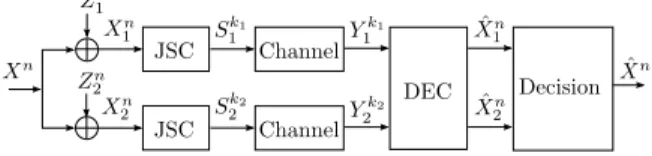
The CEO based system model of estimating a single source through two nodes is depicted in Fig. 1. A common i.i.d source Xn={xt}nt=1 taking values from a binary set X = {0, 1} with equal probability is for-warded by two nodes to a single destination. In general, both of the sequences observed by the nodes contain errors. The nodes forward the erroneous sequences to the destination, which is referred as LF [2], [3], which in the relay channel is one special instance of EF relaying. The error probabilities Pr(xt1̸= xt) and Pr(xt2̸= xt) are denoted as p1 and p2, respectively, i.e., Pr(zit= 1) = pi
for the binary noise sequence Zin={(zi)t}nt=1, i = 1, 2.
At the nodes, the noisy versions X1n = {(x1)t}nt=1 and
X2n={(x2)t}nt=1 of Xn are separately encoded by two
joint source channel (JSC) encoders to generate symbol sequences Sk1
1 ={(s1)t}kt=11 and S k2
2 ={(s2)t}kt=12 with
coding rates ri = n/ki, i = 1, 2. We focus in most of our
discussion to the case where X1nis error-free data stream of interest and X2n is the decoded and forwarded data stream of the cooperating relay node containing possibly some bit errors. However, the theoretical framework herein is more general.
Both streams are transmitted to the destination over orthogonal MAC (i.e., using time-division multiple- ac-cess (TDMA) or some other scheduled multiple-acac-cess scheme), as Yki i = hi· S ki i + W ki i , i = 1, 2, (1) where hiand Wiki ={wt} ki
t=1represent the channel gain
and the additive white Gaussian noise (AWGN) sequence at the destination, respectively. The destination performs JSC decoding to form estimates ˆXin of the sequences
Xin, i = 1, 2. We define the expected Hamming distor-tion measures E[n1 ∑nt=1d(xti, ˆxti)] to evaluate the error probability Pr(xti̸= ˆxti) with
d(xti, ˆxti) = {
1, if xti̸= ˆxti,
0, if xti= ˆxti. (2)
Finally, the destination reconstructs the source informa-tion Xn of which the estimate is denoted as ˆXn based on a decision rule from ˆX1n and ˆX2n. Therefore, the distortion measure E[n1∑nt=1d(xt, ˆxt)] can be formu-lated as a function of E[1n∑nt=1d(xti, ˆxti)], i = 1, 2, as
D = f (D1, D2), where function f (·) which is detailed in section IV calculates distortion D based on D1 and
Fig. 1. The abstract system model of estimating a single source through two independent nodes.
D2, and E[1 n n ∑ t=1 d(xti, ˆxti)]≤ Di+ ϵ, i = 1, 2, (3) E[1 n n ∑ t=1 d(xt, ˆxt)]≤ D + ϵ, (4) with ϵ representing an arbitrarily small positive number. According to the source-channel separation theorem for lossy source coding [4], [5], [6], [2], distortion D =
f (D1, D2) can be achieved if the following inequalities hold:
R1(D1)· r1 ≤ C(γ1)
R2(D2)· r2 ≤ C(γ2) }
, (5)
where Ri(Di) is the rate-distortion function for the
source coding and C(γ) is the Shannon capacity1 with the argument γ denoting the signal-to-noise ratio (SNR) of the channel. Our goal is to derive the theoretical lower bound of the BEP for the system shown in Fig. 1. It is equivalent to the minimal expected Hamming distortion
D can be achieved if the conditions shown in (5) are
satisfied, as
min
D1,D2
D = f (D1, D2) (6)
s.t. (5).
To achieve this goal by solving (6), we turn to derive the rate-distortion function Ri(Di) for the problem shown in
Fig. 1 and to establish the function D = f (D1, D2) for the decision rule used at the destination.
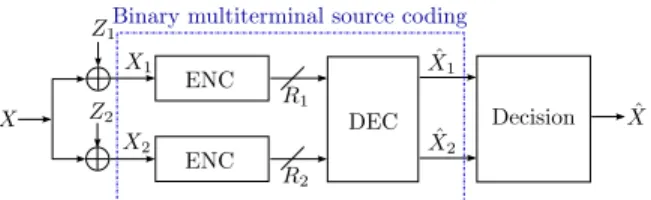
III. RATE-DISTORTIONREGIONANALYSIS In network information theory, the source coding of the communication system shown in Fig. 1 is modeled by the binary CEO problem. The abstract model of the binary CEO problem is illustrated in Fig. 2. In order to derive the rate-distortion function Ri(Di), we first reduce
the binary CEO problem to a binary multiterminal source coding problem. An outer bound of the rate-distortion
1For one dimensional signal, C(γ) =1
2log2(1 + 2γ), and for two
Fig. 2. The abstract model of the binary CEO problem with two independent nodes.
region which is determined by the rate-distortion func-tion Ri(Di) is then derived for the binary multiterminal
source coding problem through the converse proof, as in the Gaussian case [8].
Since X1n and X2n originate from the same source
Xn, the random variable pair [(x1)t, (x2)t] follows joint probability distribution Pr(x1, x2) given by
Pr X1,X2 (x1, x2) = { 1 2 · ρ if x1 ̸= x2, 1 2 · (1 − ρ) otherwise, (7) where ρ = Pr(x1 ̸= x2) is the correlation parameter between the sources X1 and X2, i.e., X2 can be seen as the output of a binary symmetric channel (BSC) with the crossover probability ρ where X1 is the input, which is also directly the relay channel interpretation. Two encoders separately encode the data sequences X1n and
Xn
2 at rates R1 and R2 as
φ1 :Xn→ M1={1, 2, · · · , 2nR1},
φ2 :Xn→ M2={1, 2, · · · , 2nR2}.
The encoder output sequences U1 = φ1(X1n) and
U2 = φ2(X2n) are transmitted to a common receiver. It jointly decodes the received samples to construct the estimates ( ˆX1n, ˆX2n) of the source pair (X1n, X2n) denoted as ( ˆX1n, ˆX2n) = ψ(φ1(X1n), φ2(X2n)). In the relaying context, these transmissions typically take place during different time intervals.
For given distortion values D1 ∈ [0,12] and D2 ∈ [0,12], the rate-distortion regionR(D1, D2) is defined as
R(D1, D2) ={(R1, R2) : (R1, R2) is admissible such that E1 n n ∑ t=1 d(Xit, ˆXit)≤ Di+ ϵ, i = 1, 2}.
We provide an outer bound Ro(D
1, D2) of the rate-distortion region R(D1, D2).
Theorem 1 ([9]): The outer bound is the intersection
of three rate-distortion regions, as
Ro (D1, D2) =Ro1(D1) ∩ Ro 2(D2) ∩ Ro 12(D1, D2), where Ro 1(D1) ={(R1, R2) :∀R2 ≤ 1 R1 ≥ Hb(ρ∗ Hb−1(1− R2))− Hb(D1)}, (8) with Hb(a) =−a · log2(a)− (1 − a) · log2(1− a) and
Hb−1(a) representing the binary entropy function and its inverse function, respectively. It should be emphasized here that Hb−1(a) only takes values from the interval [0,12] since distortion is assumed to be within this range. The operator ∗ calculates the binary convolution of the two variables, i.e., a∗ b = a(1 − b) + b(1 − a).
Ro 2(D2) ={(R1, R2) :∀R1 ≤ 1 R2 ≥ Hb(ρ∗ Hb−1(1− R1))− Hb(D2)}, (9) Ro 12(D1, D2) ={(R1, R2) : R1+ R2 ≥ 1 + Hb(ρ)− Hb(D1)− Hb(D2)}. (10) Since regionsRo1(D1), Ro2(D2) andRo12(D1, D2) are the outside of the regions of R(D1, D2), the following theorem holds
Theorem 2 ([9]): R(D1, D2)⊆ Ro(D1, D2).
Remark 1: Because we are interested in
reconstruct-ing X1, the set-up is equivalent to the Wyner-Ziv com-pression problem. It is found that the rate-distortion region of the Wyner-Ziv problem lies inside ofRo
1(D1) in this case, i.e., Ro
1(D1) is not tight.
In summary, the rate-distortion function Ri(Di) is
given by R1(D1)≥ Hb(ρ∗ Hb−1(1− R2))− Hb(D1), R2(D2)≥ Hb(ρ∗ Hb−1(1− R1))− Hb(D1), ∑2 i=1Ri(Di)≥ 1 + Hb(ρ)− ∑2 i=1Hb(Di). (11) IV. BEP LOWERBOUND
As stated in Section II, distortion D is a function of distortions Di, i = 1, 2. Function f (D1, D2) is obtained by evaluating the relationship between the binary CEO and the binary multiterminal source coding problems in terms of distortions, where the model of the relationship is shown in Fig. 3. ˆX is obtained based on the
deci-sion rule from the outputs of two parallel BSCs with crossover probabilities p1∗D1, p2∗D2 and input X. The distortion D largely depends on the decision rule used by the destination. Here we only consider two decision rules. One is the weighted majority decision and the other the optimal decision.
Fig. 3. The distortion model of the binary CEO problem. BMTSC represents binary multiterminal source coding.
Distortion D is obtained by evaluating the probability of an error event. Let θ1 = p1∗ D1 and θ2 = p2∗ D2. Without loss of generality, we assume that θ1 ≤ θ2. Hence, the error event is composed of two independent events: node 1 makes a wrong decision and node 2 makes correct decision or both node 1 and node 2 make erroneous decisions. Therefore, the distortion D in this case is approximated by D ∼= θ1· (1 − θ2) + θ1· θ2 = θ1. Since the block length is assumed to be infinite and the code is random, an optimal lower bound of the distortion
D is determined by utilizing the rate-distortion function
for the binary source [7], as
1− Hb( ˜d) = I(X; ˆX) (12)
≤ 1 + Hb(θ1∗ θ2)− Hb(θ1)− Hb(θ2). (13) Thus, it is obvious from (13) that for 0 ≤ ˜d ≤ 12,
˜
d ≥ Hb−1[Hb(θ1) + Hb(θ2)− Hb(θ1 ∗ θ2)]. Therefore, the distortion D is the minimum value of ˜d, as
D = Hb−1[Hb(θ1) + Hb(θ2)− Hb(θ1∗ θ2)]. (14) It should be emphasized here that the optimal decision acts as a universal lower bound of the BEP. However, in the design of practical encoding/decoding algorithms, we do not consider this decision rule.
In summary, the distortion level D of the two decision rules described above is given as
D =
{
min{θ1, θ2}, majority decision,
Hb−1[Hb(θ1) + Hb(θ2)− Hb(θ1∗ θ2)], optimal. (15) The minimum distortion value D⋆ can be shown to be [9]
D⋆ = {
min{θ⋆1, θ⋆2}, majority decision,
Hb−1[Hb(θ⋆1) + Hb(θ⋆2)− Hb(θ1⋆∗ θ2⋆)], optimal, (16) where θ⋆1 and θ⋆2 are p1∗ D⋆1 and p2∗ D2⋆, respectively.
−10 −9 −8 −7 −6 −5 −4 −3 −2 −1 0 10−4 10−3 10−2 10−1 100 per−node SNR (dB) BE R/ BE P Simulation (p1= p2= 0.05) Lower bound (majority) Lower bound (optimal) Simulation (p1= p2= 0.005)
Lower bound (majority) Lower bound (optimal)
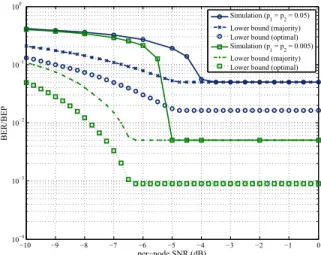
Fig. 4. Symmetric P and SNR. BPSK is used for both nodes.
V. NUMERICAL EXAMPLES
The encoding/decoding algorithm which we pro-posed in [10], [11] is considered. Each node encodes its erroneous sequence by using a serially concate-nated memory-1 convolutional code and an accumulator (ACC). The encoder output sequences are then modu-lated and transmitted to the destination over statistically independent AWGN and block Rayleigh fading channels, where the channel gain hi is static within each block but
varies independently block-by-block. At the destination, iterative decoding process is carried out between the decoders of the convolutional code and the ACC, as well as between the two decoders of the convolutional codes through the LLR updating function fc to modify
the extrinsic LLR, according to the error probabilities p1 and p2.
The lower bounds of the BEP for different SNR values γ1, γ2 are obtained through solving the convex optimization problem [9] The common parameters used in the simulations are
• Frame length: n = 10000 bits for AWGN channels and n = 2048 bits for block Rayleigh fading channels.
• The number of frames: 1000 for AWGN channels and 10000 for block Rayleigh fading channels.
• Interleavers: random.
• Encoder Ci: half-rate nonrecursive systematic
con-volutional code with generator polynomial G = [03, 02]8, where [·]8 represents the argument is an octal number.
• Modulation: binary phase-shift keying (BPSK) and quadrature phase-shift keying (QPSK) with coher-ent detection, where channel state information is
as-0 0.05 0.1 0.15 0.2 0.25 0.3 0.35 0.4 −12 −10 −8 −6 −4 −2 0 10−3 10−2 10−1 100 p SNR (dB) BEP Majority decision Optimal decison
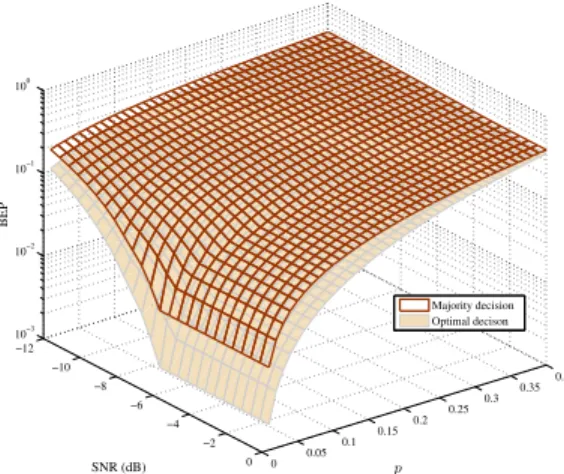
Fig. 5. The lower bound versus the error probabilities p1, p2 and
SNR between the relay nodes and the destination.
sumed to be known to the receiver. Natural mapping is used as the mapping rule in QPSK [12, Example 18.2].
• Doping ratio Pd: 1 for BPSK and 8 for QPSK. • Decoding algorithm for DCCi and ACC−1:
log-maximum a posteriori (MAP).
• The number of iterations: 30 times.
Fig. 4 shows the error probability lower bounds and the BER versus SNR when p1, p2 and SNRs of the two nodes are set identically; this is referred as the symmetric case. It can be found that, the BER curves obtained by simulations and the theoretical lower bounds of the BEP exhibit a similar tendency. Furthermore, it is clearly found that the error floor of the BER obtained by the simulation and the lower bound of the BEP based on majority decision match exactly. The reason is that if the SNRs of two nodes are large enough, the distortion levels D1 and D2are almost 0, which results in the error floor is determined by the error probabilities p1 and p2. Fig. 5 shows the error probability lower bound for the cooperative relaying case as a three dimensional surface vs. SNR and the error probability parameter of the SR link. The BEP value can then be used for system level user pairing optimization.
VI. CONCLUSION
We examined theoretically the lower bound of the BEP for the binary CEO problem to approximate the BEP of lossy DF based relaying. The results can be used as an approximation to find D2D cooperating user pairs. Further work will focus on finding efficient algorithms for that.
ACKNOWLEDGEMENTS
The authors wish to acknowledge the helpful dis-cussions with Prof. Yasutada Oohama. This work has been in part performed in the framework of the FP7 project ICT-619555 RESCUE (Links-on-the-fly Technol-ogy for Robust, Efficient and Smart Communication in Unpredictable Environments) funded by the European Commission. The work has been funded also in part by the Academy of Finland.
REFERENCES
[1] T. Berger, Z. Zhang, and H. Viswanathan, “The CEO problem,”
IEEE Trans. Inform. Theory, vol. 42, no. 3, pp. 887–902, May
1996.
[2] X. Zhou, M. Cheng, X. He, and T. Matsumoto, “Exact and ap-proximated outage probability analyses for decode-and-forward relaying system allowing intra-link errors,” IEEE Trans.
Wire-less Commun., vol. 13, no. 12, pp. 7062–7071, Dec 2014.
[3] P.-S. Lu, X. Zhou, K. Anwar, and T. Matsumoto, “Joint adap-tive network-channel coding for energy-efficient multiple-access relaying,” IEEE Trans. Veh. Technol., vol. 63, no. 5, pp. 2298– 2305, Jun 2014.
[4] A. Gamal and Y. Kim, Network Information Theory. Cam-bridge University Press, 2011.
[5] C. E. Shannon, “Coding theorems for a discrete source with a fidelity criterion,” IRE Nat. Conv. Rec, vol. 4, no. 142–163, p. 1, 1959.
[6] F. Vazquez-Araujo, O. Fresnedo, L. Castedo, and J. Garcia-Frias, “Analog joint source-channel coding over MIMO chan-nels,” EURASIP J. Wireless Comm. and Netw., vol. 2014, no. 1, 2014.
[7] T. Cover and J. Thomas, Elements of Information Theory, 2nd ed. USA: John Wiley & Sons, Inc., 2006.
[8] Y. Oohama, “Gaussian multiterminal source coding,” IEEE
Trans. Inform. Theory, vol. 43, no. 6, pp. 1912–1923, Nov.
1997.
[9] X. He, X. Zhou, P. Komulainen, M. Juntti, and T. Matsumoto, “A lower bound on bit error probability for a binary CEO problem,” IEEE Trans. Commun., submitted, Mar. 2015. [10] X. Zhou, X. He, K. Anwar, and T. Matsumoto,
“GREAT-CEO: larGe scale distRibuted dEcision mAking Technique for wireless Chief Executive Officer problems,” IEICE Trans.
Commun., vol. E95-B, no. 12, pp. 3654–3662, Dec. 2012.
[11] X. He, X. Zhou, K. Anwar, and T. Matsumoto, “Estimation of observation error probability in wireless sensor networks,”
IEEE Commun. Lett., vol. 17, no. 6, pp. 1073–1076, Jun. 2013.
[12] S. Lin and D. J. Costello, Error Control Coding, 2nd ed. Upper Saddle River, NJ, USA: Prentice-Hall, Inc., 2004.