JAIST Repository
https://dspace.jaist.ac.jp/
Title
Applying Real Options Approach Method to SMEs Financing : A Case Study of Smart House Company in Indonesia
Author(s) Wardani, Ida Sri; Fujiwara, Takao
Citation 年次学術大会講演要旨集, 31: 496-499
Issue Date 2016-11-05
Type Conference Paper
Text version publisher
URL http://hdl.handle.net/10119/13946
Rights
本著作物は研究・イノベーション学会の許可のもとに 掲載するものです。This material is posted here with permission of the Japan Society for Research Policy and Innovation Management.
2E20
Applying Real Options Approach Method to SMEs Financing:
A Case Study of Smart House Company in Indonesia
○Ida Sri Wardani, Takao Fujiwara (Toyohashi University of Technology)
Abstract Small and medium enterprises (SMEs) or start-ups play strategic role in developing Indonesia’s economy.
They create employment and support the country’s National Gross Domestic Product by 57.9% in 2015. Over the years, SMEs face typical problems for financing and investment. Due to the small company size, most SMEs are price takers and they find it difficult to raise long term finance. However, SMEs offer greater growth potential and better flexibility than large firms. Under conditions of uncertainty, real options approach allows decision makers to add value to their investment decision by adding flexibility values. This study examines possible scenarios for SMEs financing to assess investment value by real options valuation and to explore its effect of for SMEs growth. We also illustrate how the proposed model is applied to financing scheme in one of SMEs in Indonesia as our case study. This company is focused on developing low-cost smart home system by utilizing integrated power controller for household appliances.
Keywords: real options approach, SMEs, start-ups, financing, flexibility, smart house company
Introduction The purpose of most enterprises is making gains, performing effective business activity and increasing
its growth. The lack of access to affordable finance is often cited as the most significant barrier to SMEs expansion, especially for business operating in new or relatively unknown sector, including energy product or services (Wang, 2010). Financing plays a significant role in the setting up and running of SMEs. However, most SMEs prefers internal financing to external financing. While external financing offers higher values of money, it also poses serious constraints such as high interest rate, complex application procedures and high collateral requirement. Investment evaluation plays a significant role in business financing and also an important prerequisite for the success of a business operation (Wang and Tang, 2010).
Currently, real options analysis (ROA) has emerged to replace the traditional discount cash flow method (Net Present Value-NPV). ROA is able to capture management’s flexibility to adapt and revise later decisions in response to unexpected market development (Copeland and Antikarov, 2003; Aye and Fujiwara, 2014). But it depends on the manager capability to flexibly take real managerial actions, which is sometimes quite troublesome in large enterprises. Unlike large enterprises, SMEs or start-ups have the ability to react quickly to changes in newer niche marketplace as innovative smart house. There is no hierarchy in place that slows down the decision-making process. If the business owner or entrepreneur sees that there is an opportunity to challenge a competitor, she/he can do it without obtaining approval from a board of directors and also dare to enter even into a risky but promising niche market.
This paper focuses on providing investment valuation for financing alternatives in SMEs, especially in the early stage of SMEs. There are a number of types of real options, but we will focus on options to defer and options to choose. The first option is a type of option that occurs naturally, it is an option to wait before taking an action until more is known or timing is expected to be more favorable. This option applies when a company intends to introduce a new product or an innovation. The second option is a planned option, which is intended to increase or decrease the scale of operation in response to demand. In actual business practices, this option can be translated as action to simultaneously adding or subtracting a service offering, or simply increasing or reducing production volumes.
Methodology In our case study, we analyze a new company called SED (System of Electronic Devices), which is
also the name of its main product. The idea is to allow home owners to manage and monitor electricity usage easily. It is designed to meet major housing residential in Indonesia, which comprise low to medium economy housing type. SED is intended to be up for sale during 5 years. Initial investment is amounted up to 75 million IDR (Indonesian Rupiah). We have simulated company cash flow for the next 5 years. Using Monte Carlo Simulation of Crystal Ball, we have managed to obtain value of the underlying at time zero (So) equals to IDR 5,698 million shown as Figure 1, while volatility factor amounts to 21%. This result will be our base input for real options analysis.
2E20
Applying Real Options Approach Method to SMEs Financing:
A Case Study of Smart House Company in Indonesia
○Ida Sri Wardani, Takao Fujiwara (Toyohashi University of Technology)
Abstract Small and medium enterprises (SMEs) or start-ups play strategic role in developing Indonesia’s economy.
They create employment and support the country’s National Gross Domestic Product by 57.9% in 2015. Over the years, SMEs face typical problems for financing and investment. Due to the small company size, most SMEs are price takers and they find it difficult to raise long term finance. However, SMEs offer greater growth potential and better flexibility than large firms. Under conditions of uncertainty, real options approach allows decision makers to add value to their investment decision by adding flexibility values. This study examines possible scenarios for SMEs financing to assess investment value by real options valuation and to explore its effect of for SMEs growth. We also illustrate how the proposed model is applied to financing scheme in one of SMEs in Indonesia as our case study. This company is focused on developing low-cost smart home system by utilizing integrated power controller for household appliances.
Keywords: real options approach, SMEs, start-ups, financing, flexibility, smart house company
Introduction The purpose of most enterprises is making gains, performing effective business activity and increasing
its growth. The lack of access to affordable finance is often cited as the most significant barrier to SMEs expansion, especially for business operating in new or relatively unknown sector, including energy product or services (Wang, 2010). Financing plays a significant role in the setting up and running of SMEs. However, most SMEs prefers internal financing to external financing. While external financing offers higher values of money, it also poses serious constraints such as high interest rate, complex application procedures and high collateral requirement. Investment evaluation plays a significant role in business financing and also an important prerequisite for the success of a business operation (Wang and Tang, 2010).
Currently, real options analysis (ROA) has emerged to replace the traditional discount cash flow method (Net Present Value-NPV). ROA is able to capture management’s flexibility to adapt and revise later decisions in response to unexpected market development (Copeland and Antikarov, 2003; Aye and Fujiwara, 2014). But it depends on the manager capability to flexibly take real managerial actions, which is sometimes quite troublesome in large enterprises. Unlike large enterprises, SMEs or start-ups have the ability to react quickly to changes in newer niche marketplace as innovative smart house. There is no hierarchy in place that slows down the decision-making process. If the business owner or entrepreneur sees that there is an opportunity to challenge a competitor, she/he can do it without obtaining approval from a board of directors and also dare to enter even into a risky but promising niche market.
This paper focuses on providing investment valuation for financing alternatives in SMEs, especially in the early stage of SMEs. There are a number of types of real options, but we will focus on options to defer and options to choose. The first option is a type of option that occurs naturally, it is an option to wait before taking an action until more is known or timing is expected to be more favorable. This option applies when a company intends to introduce a new product or an innovation. The second option is a planned option, which is intended to increase or decrease the scale of operation in response to demand. In actual business practices, this option can be translated as action to simultaneously adding or subtracting a service offering, or simply increasing or reducing production volumes.
Methodology In our case study, we analyze a new company called SED (System of Electronic Devices), which is
also the name of its main product. The idea is to allow home owners to manage and monitor electricity usage easily. It is designed to meet major housing residential in Indonesia, which comprise low to medium economy housing type. SED is intended to be up for sale during 5 years. Initial investment is amounted up to 75 million IDR (Indonesian Rupiah). We have simulated company cash flow for the next 5 years. Using Monte Carlo Simulation of Crystal Ball, we have managed to obtain value of the underlying at time zero (So) equals to IDR 5,698 million shown as Figure 1, while volatility factor amounts to 21%. This result will be our base input for real options analysis.
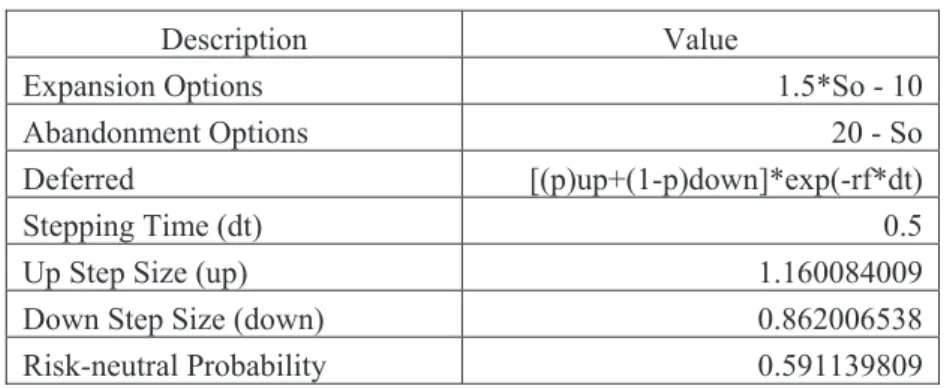
During initial stage of prototyping and idea generation, available financing usually comes from internal source due to lack of access to outer financial sources. Once the product is commercialized, company has several available alternatives: to expand, abandon or continue business as usual. All those options are available to exercise at any time prior to the last time step. However, at the time of maturity, deferral option is invalid, since the decision to invest or disinvest can no longer be delayed. We design binomial lattice to illustrate available alternatives for SED business as Table 1. Expansion will cost another 10 million IDR to the project, but promising sales increase as of 1.5 times. The abandon option means that the company will sell and liquidate all of its assets at the amount of 20 million. Parameters of the binomial lattice is described as follows:
Table 1 Binomial Lattice Parameters
Description Value
Expansion Options 1.5*So - 10
Abandonment Options 20 - So
Deferred [(p)up+(1-p)down]*exp(-rf*dt)
Stepping Time (dt) 0.5
Up Step Size (up) 1.160084009
Down Step Size (down) 0.862006538 Risk-neutral Probability 0.591139809
Figure 1 Underlying asset lattice (IDR million)
As there are ten time steps in the lattice, each time steps represent half a year of the time periods. Starting with the simulated PV at the time zero, the lattice is developed forwards. Using the value of the underlying at each node, the value of options is calculated backwards, taking the maximum value of the options. In this case, we treat each option as mutually exclusive, thus company can only select one option at a time. Binomial lattices are illustrated in Figures 1 and 2.
Underlying Asset Lattice 25.15
21.68 18.69 18.69 16.11 16.11 13.89 13.89 13.89 11.97 11.97 11.97 10.32 10.32 10.32 10.32 8.90 8.90 8.90 8.90 7.67 7.67 7.67 7.67 7.67 6.61 6.61 6.61 6.61 6.61 5.70 5.70 5.70 5.70 5.70 5.70 4.91 4.91 4.91 4.91 4.91 4.23 4.23 4.23 4.23 4.23 3.65 3.65 3.65 3.65 3.15 3.15 3.15 3.15 2.71 2.71 2.71 2.34 2.34 2.34 2.02 2.02 1.74 1.74 1.50 1.29
Figure 2 Option Value Lattice (IDR million)
The value at the starting node determined by backward induction is calculated as 14.30 million IDR illustrated as Figure 2. This figure represented expanded net present value taking into consideration the identified real options. This value identifies that business owner shall be able to improve its business value if the decision is currently deferred for at least until fourth year of the product commercialization. We also performed sensitivity analysis by changing the volatility value and comparing the option value with different volatility. The result indicate that option value remains constant until it reaches volatility rate of 40% shown as Figure 3. It also shows that option value increase as the volatility raises. That is, real options analysis is suitable to start-ups’ business as innovative but risky smart house projects.
Figure 3 Option Value against volatility
Discussion This study present a simple application of real options to SMEs financing alternatives, focusing on initial
investment valuation for product development. It elaborates the management flexibility to defer or chooser option during business process, thus allows business owners to perform proper response according to market changes. It is also important to note that actual application of real options require further scenario planning to assist managers in their actions. There are more uncertainties that have not been included in this study, such as price volatility and market performance. We also have not considered the role of competitors in the market. Therefore, future studies will be focused more on scenario planning, uncertainties and competitors action in doing business for SMEs or start-ups operations. In our case study, we provide calculations for short term investment, due to our company business scale in its initial stage. Thus for further study, we would like to improve the timeline for strategic SMEs business in longer term, and provide better understanding of SMEs business management on long term investment.
(Aye and Fujiwara, 2014, Copeland and Antikarov, 2003, Van Reedt Dortland et al., 2014, Wang, 2010, Wang and Tang, 2010)
References
Option Valuation Lattice 27.73
23.15 19.53 18.69 16.59 16.11 14.29 13.89 13.89 12.64 12.31 11.97 11.67 11.43 11.19 10.32 11.50 11.37 11.23 11.10 12.33 12.33 12.33 12.33 12.33 13.39 13.39 13.39 13.39 13.39 14.30 14.30 14.30 14.30 14.30 14.30 15.09 15.09 15.09 15.09 15.09 15.77 15.77 15.77 15.77 15.77 16.35 16.35 16.35 16.35 16.85 16.85 16.85 16.85 17.29 17.29 17.29 17.66 17.66 17.66 17.98 17.98 deferred 18.26 18.26 abandon 18.50 expand 18.71
Figure 2 Option Value Lattice (IDR million)
The value at the starting node determined by backward induction is calculated as 14.30 million IDR illustrated as Figure 2. This figure represented expanded net present value taking into consideration the identified real options. This value identifies that business owner shall be able to improve its business value if the decision is currently deferred for at least until fourth year of the product commercialization. We also performed sensitivity analysis by changing the volatility value and comparing the option value with different volatility. The result indicate that option value remains constant until it reaches volatility rate of 40% shown as Figure 3. It also shows that option value increase as the volatility raises. That is, real options analysis is suitable to start-ups’ business as innovative but risky smart house projects.
Figure 3 Option Value against volatility
Discussion This study present a simple application of real options to SMEs financing alternatives, focusing on initial
investment valuation for product development. It elaborates the management flexibility to defer or chooser option during business process, thus allows business owners to perform proper response according to market changes. It is also important to note that actual application of real options require further scenario planning to assist managers in their actions. There are more uncertainties that have not been included in this study, such as price volatility and market performance. We also have not considered the role of competitors in the market. Therefore, future studies will be focused more on scenario planning, uncertainties and competitors action in doing business for SMEs or start-ups operations. In our case study, we provide calculations for short term investment, due to our company business scale in its initial stage. Thus for further study, we would like to improve the timeline for strategic SMEs business in longer term, and provide better understanding of SMEs business management on long term investment.
(Aye and Fujiwara, 2014, Copeland and Antikarov, 2003, Van Reedt Dortland et al., 2014, Wang, 2010, Wang and Tang, 2010)
References
Option Valuation Lattice 27.73
23.15 19.53 18.69 16.59 16.11 14.29 13.89 13.89 12.64 12.31 11.97 11.67 11.43 11.19 10.32 11.50 11.37 11.23 11.10 12.33 12.33 12.33 12.33 12.33 13.39 13.39 13.39 13.39 13.39 14.30 14.30 14.30 14.30 14.30 14.30 15.09 15.09 15.09 15.09 15.09 15.77 15.77 15.77 15.77 15.77 16.35 16.35 16.35 16.35 16.85 16.85 16.85 16.85 17.29 17.29 17.29 17.66 17.66 17.66 17.98 17.98 deferred 18.26 18.26 abandon 18.50 expand 18.71
AYE, N. N. & FUJIWARA, T. 2014. Application of Option-Games Approach to the Irreversible Investment for a New Energy Industry in Myanmar by Simple One-Stage Strategic Model: Focused on Potential of Smart House. Global Journal of Flexible Systems Management, 15, 191-202.
COPELAND, T. & ANTIKAROV, V. 2003. Real Options, Revised Edition: A Practitioner's Guide, Texere. VAN REEDT DORTLAND, M., VOORDIJK, H. & DEWULF, G. 2014. Making sense of future uncertainties using
real options and scenario planning. Futures, 55, 15-31.
WANG, Y. 2010. What are the biggest obstacles to growth of SMEs in developing countries? – An empirical evidence from an enterprise survey. Borsa Istanbul Review.
WANG, Z. & TANG, X. 2010. Research of Investment Evaluation of Agricultural Venture Capital Project on Real Options Approach. Agriculture and Agricultural Science Procedia, 1, 449-455.