Distribution and Abundance of Primates After
the Forest Fire in the Lowland Forest of East
Kalimantan 1983-1986
著者
AZUMA Shigeru
journal or
publication title
南方海域調査研究報告=Occasional Papers
volume
14
page range
94-116
URL
http://hdl.handle.net/10232/16246
DISTRIBUTION AND ABUNDANCE OF PRIMATES AFTER THE FOREST FIRE IN THE LOWLAND FOREST OF
EAST KALIMANTAN 1983-1986
Shigeru Azuma
Primate Research Institute, Kyoto University 484 Inuyama, Aichi, Japan
I. INTRODUCTION
Vast stretches of lowland tropical rainforest of East Kalimantan was swept over by forest fire in early 1983.
Most of the forest where logging was done were burnt. Apparently networks of forest road and conditions produced by the local people in the forest, favoured the outbreak and spread of the fire after 8 months of no rain spells. In the interior of the
Kutai National Park (Taman nasional Kutai: abbreviated as Kutai
NP or KNP) a few stretches of forest are found to remain intact
from the fire (Wirawan et al 1983, Suzuki 1987).
The former Kutai Game Reserve (Suaka Margasatwa Kutai) was
promoted in grade of protection and is declared as National Park after the fire by the Government of Indonesia, in 1985.
Large scale forest fire of the tropical rain forest is a rare ecological event. In the present research project which intends
to document the ecological effect of fire and to monitor the
early stages of succession in the process of recovery of the forest, I took a part, of the survey of primates and other ar
boreal mammals.
This project apparently attempts to tackle with the problem of ecosystem succession. In recent years, with the progress of the studies of life history of tropical forest trees, and ecology of primates and birds of the tropical forest, role played by animals in the pollination and seed dispersal of the tropical
forest trees is gradually called to attention.
As one of the parameters which may influence the later course and
speed of succession, the present distribution and abundance of primates are surveyed. Since the study areas in KNP did not
cover major variety of habitat, survey of additional areas out
side of the Park was also made in two areas to the south and west of KNP.
II. SOURCE OF DATA AND STUDY AREA
The primate fauna within the Kutai National Park was studied by Rodman (1973, 1978 a,b,) around the Mentoko Camp, in the upstream of the Sengatta River, and at lOKm downstream from there by Lindburg and others (Fittinghoff et al 1980, Kurland 1973, Wheatley 1980).
For the rest of the Kutai Reserve and its neighbouring areas no thing was Known as to the conditions of primate fauna before the
forest fire.
After the forest fire of 1983, the study of orang-utan at Mentoko was taken up by Suzuki with largely extending the study area (Suzuki 1988 in this volume). In 1983, distribution and abundance of primates was studied at two plots south of the KNP boundary. These were around 10 and 35Km inland (north) of Sebulu, on the northern bank of the Mahakam River (Azuma et al
1985) .
Reconnaissance into the interior of the KNP was done several
times by N.Wirawan and PPA Staffs in order to evaluate the condi tions of the forest affected by the forest fire. His sighting records of animals during the period shortly after the fire is very valuable, although they are limited in cases.
In 1986, field work was done from 16th., August to 10th., September along the Kayu Mas Forest Road from Teluk Kaba going
into
the
interior
of
the KNP.
Survey was
made
around
the
camps
set up at 45Km, 37Km N, 24Km and 9Km. Supplementary survey was done at 9Km and at Teluk Kaba from 6th., to 15th., October.
Replicate census was made from 19th., to 28th., September around 7-14Km and 30-40Km of Sebulu forest Road, the same areas studied
in 1983.
Survey by boat along R. Mahakam and its tributary Kedang
Rantau
up
to
Sudulang
and
Puhun Cepak,
was
made
from
28th.,
Sep
tember to 1st, October, 1986.
III. CENSUS METHOD
Sighting record along the Forest Road: The Kayu Mas forest road (originating) from Teluk Kaba to Km 45, and route branching from Km 35 to former Kayu Mas Camp at 2Km to the North (abbreviated as
37Km N) were covered by research members, and PHPA guards and lo
cal
porters
on
their
route
between camps and
Teluk Kaba.
Records
-95-of their encounter with animals were gathered. The chances of
encounter or chances of noticing the presence of animals on the
route, is obviously not high ; in most cases, they are laden with
heavy luggages and part of the route is covered during later
hours of the morning and at high noon when the activity of
animals are remarkably reduced. Travel between 5:00-8:00 and
17:00-21:00 or later yielded by far the abundant records of en
counter even for primates as well as for cats and ungulates (Doi,
in this volume). But these cases are limited. The second dis advantage concerns with the nature of the route taken. It is in
variably along the forest road. Originally, the road was opened
through the forested area, with a width of 6-15m. At the time of
forest fire the road functioned as a corridor for the spread of the fire with concentration of easily inflamable material accumu
lated along it. Therefore, destruction of the vegetation on both
sides of the road was usually greater. Even before that, logging
was done starting from the road in most part of the area.
Transect Census: In normal rain forest habitat this is the method
most commonly adopted for censusing the primates (Wilson and Wilson 1975). During the present survey, transect census was
done at Km 45, Km 37 N and Km 9. The lengths of transects made
in the forest were, 2200m, 1800m and 4400m, respectively.
Some species of primates may be sensitive to the practice of cut
ting the transect. In the present survey, although some con
sideration for this was paid, census had to be done shortly after
the outline was made. I do not claim it was enough.
Grid Census: In the present survey, owing to the limited period of field study and to limited availability of man-power for the
cutting of transects and grids, this was possible only for the
study plot at km 9.
Vocalization Census: Some of the primates utter territorial and
other calls, that carry a long distance. The gibbons, leaf
monkeys and Orang-utans are among these species. Owing to their
reduced density, terrestrial call (long distance call) of leaf
monkey species were heard only on two occasions during the period
of this study. Bornean gibbons uttered' their morning calls.
Orang-utans gave out their loud calls or murmured when dead trees
be-cause the survey was done during their mating season.
Direction and time of these calls were recorded, If these
data are measured from two different, points by two persons, the location of the source of the sound can be determined by t.rian gulation . The baseline between the two points was traverse sur veyed with 25m measuring tape and a Blanton Compass. Stadia sur
vey was sometimes used to know the distance across the river at
the
fallen
bridges
with
instantly made
mesuring
pole
and
Spiegel
RELA SKOP.
During the early part of the field study, owing to unavail ability of the assistants trained for the purposes, vocalization census was done by the auther alone, at either end of the baseline on alternate days (single observation).
Simultaneous recording from the two points were possible twice at 9Km and 3 times at, Sebulu (paired observation).
In the case of paired observation, a Blanton Compass and a SUNTO compass (made in Finland) were used. Since the latter was easy for reading the direction, it was used by the assistants.
For the survey, along the River Mahakam (between Sugihan and Muara Kaman) and its tributary Kedang Rantau, small local boat 15m Jong, with inboard Diesel engine was chartered. Observation
was
done
sitting
on
its
roof
top,
cruising
at
a speed
of
6 to
8Km/hr.
RESULTS
9 species of primates were found altoge the localities sur
veyed
in
1983,
and
8
species
in
1986.
Besides,
two
species
of
prosimians
were
sighted.
Table
1 summarizes
the primate
species
found in the localities surveyed.
1. Western tarsier (Tarsius banoanus Horsefield) and slow loris
(Nyotioebus
couoang
Boddaert) were not confirmed
of their presence
during repeated night surveys at Km 45 (2 nights) Km 37 N (3
nights)
and
Km 9
(3 nights)
of the Kayu
Mas
Road,
and
around
Km
34
north
of
Sebulu
(3* nights).
(At Km
45
night
search
was
done
together
with
Mr.
Harie
of PHPA
who
had
some
experience
with
these
animals
at
Selawesi.)
I suspect
these
nocturnal
small
primates are gone or extremely reduced in number around these areas at the time of our survey in 1986.
Slow
loris was sighted near PPA camp Mentoko in 1984
(by a
PPA guard)
and tarsier somewhere between 37 and 24Km of Kayu Mas
-97-Road by N. Wirawan in June, 1983.
These two are only informations available after the fire.
At Sebulu, workers at. the logging camp have not sighted nor heard
them'. Perhaps they don't discriminate these animals, although
they know the word 'Binatang hantu'.
Bekara LK| ,
2. Proboscis monkey (Basalia larvatus van Wurmb) Bekantanll]
This species is commonly considered to live in fair density
in the mangrove forest. Records were obtained from lower delta
of the Mahakam, estuary of Sengatta River and coastal forest of
Teluk Kaba. These places are typical of these vegetation. They
are also found in the upper reaches of the river. The density of
troops found per length of the river in Kedang Rantau was 0.26
group/Km. The actual density would be higher, since some groups could have been passed unnoticed.
On the banks of main stream of the Mahakam River, their dis
tribution is extremely fragmentai and discontinuous.
On the left bank of R.Mahakam at 3Km and 3.8Km downstream of Teratak two sightings were made of small group(s) on different
days. The first was composed of 4 animals and the second 2 or 3.
The latter sighting was just a casual observation on the edge of
a small plantation of banana and kapok about 30m from a small
stand of good secondary forest.
On the right bank of Mahakam lKm downstream of Bunua Puhun,
a group of 11 animals were found in an isolated forest of 30m wide x 100m long in 1983, This group was not to be found in 1986. The patch of forest remained fairly intact except that the ad joining hill forest downstream was opened for slash and burn
farming.
Along the banks of the main stream surveyed, most of the
land is turned into cultivation, either permanent or shifting, settlements and rubber plantation.
While silvered leaf monkeys and long tailed monkeys were found also in the native riibber plantations, proboscis monkeys
were mostly confined to natural secondary riparian forest which
in most cases contain some number of Sonneratia trees.
3.
Leaf
monkeys
(
Presbytis spp.)
Silvered leaf monkey ( P.art status Raffles) was found in several types of vegetation along the river - seasonally
rub-ber plantation mixed with other native trees, and Nippa-hardwood
mixed forest on the alluvial on the delta. Their d i s t r i b u t i o n seem to be discontinuous, rather more so in comparison with other
speci es.
Along the Kayu Mas Road which extends through the inland
hilly regions, no records were obtained indicating the presence
of this species. Foot prints of several colobid primates found near the junction of the path to the mangrove area at lKm point might possibly be of this species.
P.hosei, rubioundusand frontatus were found in the forest
even away from the banks of big rivers. They were found in small
groups but groups were seldom found in continuous distribution.
Groups were found ranging close together only in 3 instances - 3 groups near the Sebulu Camp, more than 3 groups around 8-10Km north of Sebulu in 1983 and those (perhaps two groups) at 36Km
north of Sebulu found in 1986. In all other areas, the sightings
were each done once for all and only one individual was seen.
They uttered vocalization very infrequently. Dense growth
of scrubs and broken canopies produced by forest fire make these
animals extremely difficult to find. There would have been more
groups of leaf monkeys than were found. P. frontatus were found
in two locations in 1983; at Km 31 Sebulu Road and in a small un
burnt. forest patch on the hill of Sugihan village on the River Mahakam. From both these places no monkeys were found uhen
revisited in 1986.
In localities surveyed in 1986 P. frontatus were not encoun tered. Local loggers told me, monkeys with white patches on
their
foreheads
(apparently
frontatus
) are found
only
in the
Hutan lepas - wild (natural) forest, presumably - such as was
found around Km 30-40 of the Sebulu Forest Road. The white-fronted leaf monkey seems to be more limited in distritution than
gray and maroon leaf monkeys in the present fire affected forest.
Judging from the limited cases of finding them, they survive in
the remnant patches of the lowland forest, which were originally the best deveiopped, and tallest part of the high forest in the original pre-fire conditions.
The burnt forest on top of the ridges were clad with green leaves at the time of the present survey, the frontatus group may well have expanded or shifted their range into (their original home range of) the interior. Otherwise they have perished during
the
three
years.
To
determine
between
these
two
possibilitees,
-further
intensive
study
would
be necessary.
In the back country
of
Sebulu
carrying
inland
up
to
40Km ,
the
Presbytis
species found and confirmed were all
rubioundus
(12
groups were seen).
In the interior of KNP, 3 sightings of Presbytis were ob
tained and foot-prints of Colobid monkeys were found at 2 places
(Fig.2).
Two of the sightings, one in burnt forest of Km 47 and the other in unburnt logged forest of Km 37 were made in the adverse light condition of the evening. Hue of the coat colour which is discriminative of the two forms was hard to tell. The third
animal
sighted,
in the unburnt natural
forest of Km 45 by a field
assitant at high noon,
had grayish
coat charactristic of
hosei •
In each of these cases only one animal were sighted.
Foot prints were marked on the soft soil around the
water-holes
on the road passing near top of the ridges,
at 14Km by the
burnt forest and at 38Km by the unburned logged forest. Both
places had unburned
forest
patches
in the
headwater
of
valleys
near by.
In 1983,
Suzuki saw
hosei
to the north of the Kayu Mas Camp
at. Km 37N.
If
rubioundus
is present
somewhere along
the Kayu Mas
Road
is yet open to question.
Rodman
(1973,1978)
reported
both
rubioundus
and
hosei
from Mentoko
study
area,
but
he
wrote
'my
observation on rubioundus is rare----'.
In September and October 1983, about 6 months after the
fire, the
Presbytis spp.
were hardly encountered
in Mentoko
Study
Area (Suzuki and Yayat pers comm.). Chances of sighting gradual
ly increased.
In 1985 and
1986,
hosei
is found
in the Study
Area
that is on the right bank of Sengatta River. P.rubioundus is
found
only
on
the
left
bank
of
the
same
River.
Although
a
solitary
p.frontatus
was encountered,
group of this leaf monkey
was not seen.
4. Pig-tailed Monkey (Maoaoa nemestrina Linnaeus)
Along the Kayu Mas Road there were four sighting records: at 24Km a solitary male (A) and a group (B), at 38 Km two sightings each of a group (C,D).
Partial troop composition was obtained in (D). Although a
few
animals
may
have
failed
to
be
counted,
it
was
evidently
a
small
group
(Adult ¥ ) , Adult
¥ , J,
J,
Adult
d* , J,
J
= 6-7
Road (Azuma et al 1984). All these records are from the inland
hill forest and no records were available from the riparian
forest habitat.
This species is considered as dwellers of tropical high forest.
5.
Long-taled monkey
iMacaca fascicularis
Raffles)
KeralK&I]
In the KNP, troops of this macaques was found twice between
Km 24 and 26, and once at Km 0.5 Teluk Kaba. The species is
usually found in riparian forest secondary scrubs and in mangrove habitat. A couspicuous ecological segregation between M.nemestrina is found, the latter favouring the hill forest habitat,
(Fittinghoff et al 1980, Wilson and Wilson 1980, Roaman 1978,
Caldecott 1986, Oi in prep.). That, they were not found in the Km 4 5 study area is hardluy believable, and problematical as well as apparently low density of Presbytis spp.. Habitat around Km 24 is severely burnt forest. How do this troop live in such an
environment? Conditions at Km 26 is much better. Gently sloping
headstream of several small streams, is scattered with tall trees
remaining alive. The sighting was a group feeding on a tall
fruiting (Dillenia?) tree. In the coastal mangrove forest of
Teluk Kaba, at least two groups seem to live. They a also wander
into the Accasia scrub bordering the salty marsh.
6. Gibbons and Orang-utans
Both the apes were fairly common around the Kayu Mas Road.
Nests of orang utans and calls of gibbons were good indicators of
their presence. They were visually encountered (sighted) fairly frequently along the Kayu Mas Road (Fig.2).
Orang-utans: Km 45 (0), Km 37N (2), Km 24 (0), Km 9 (4),
Km 9-24 (2+?), Km 35-40 (4+)
Gibbons: Km 45 (4), Km 37 (2), Km 24 (0), Km 9 (3),
Km 37-45 (2), Km 37-24 (0), Km 24-9 (1),
Km 9-Teluk Kaba (1)
The number in the parentheses shows number of encounters.
6.1 Orang-utan
(
Pongo pygmaeusLinnaeus)
Orang-utans were encountered in the unburnt natural forest
(Km 45), unburnt logged forest (Km 37N - Km 38N) and also in the
-101-burnt and unburnt logged forest mosaics !Km 9 - Km 12). No signs
of them ^c^rQ found i n the large tract of intensively burnt
forest.
S o m st.imes e v en in the moderately burnt forest, nests and
feeding scars of orang utans are found (9-24 Km) and one sighting
is recorded. It may be that female orang utans are strongly ter
restrial and they tend to remain in their original home ranges
even if they are deteriorated in quality.
Around the study plot at Km 9 call or murmer of Orang-utans
were heard; they were often heard during the morning auditory
censuses, and also at another hours of the day and night.
They were encountered on 3 occasions. Small nests of juvenile(s)
are Found near the adult's nest and independently. Judging from
these, at least 6 individuals (1-2 large adult (males?), 1-2
young adult ma.le(s), 2-3 adult or young adult females and at
least 1 juvenile) seemed to be present in the area. The total
populati on may be about 10. From Km 7 to Km 12, a habitable
space of Orang-utans continues. The population living in whole
this area would amount to 20 animals.
Nest, counts were made in the KNP at Km 45, Km 37N and Km 9.
At Sebulu along several transects between Km 40 and 30 and be
tween km 9-14. These data are not included in the presnet paper.
6.2 Bornean Gibbon (
Eylobates muelleriMart
in)
The number of calls audible during the early mornings from
the observation points near the camps are given in Fig.4.
The distance categories near/midd1e/far/very far were subjec
tively judged by the sound intensity of a series of calls from
each group (source of call) and direction was measured.
Observation hours correspond with the beginning and end of
the 'morning chorus'. The chorus began later and did not last
long on mornings of fog or drizzle. Excluding these cases number
and direction of calls were found more or less stable from day to
day for each observation points: 11-15 at 45N, (9-111 at Km 45S,
20-21 at Km 37, 4-6 at Km 24, 19-26 (maximum:36-39) at Km 9, and
20 from Teluk Kaba. The caiIs seldom carry by soft breeze (of
Grade' 1 of Beaufort) from the lee of the wind. They are at
tenuated to next class in distance category. By wind of Grade 2
of Beaufort the calls audible are only those from the wind-ward. The area that can be scanned by auditory (vocalization) cen
topographically exposed to auditory observation, the gibbon calls were invariably from the area where tall trees are remaining
alive
in a continuous
forest,
in a smaller
patch
(stand)
or
in
a
grove of a few trees. For instance, the directions of source of calls at Km 24 is limited to the groves that remain in scattered spots along the narrow slopes bordering a small river. Around the
Camp
24, forests
are
intensively
burnt
and
taken
over
by
dense
scrub of pioneer trees.
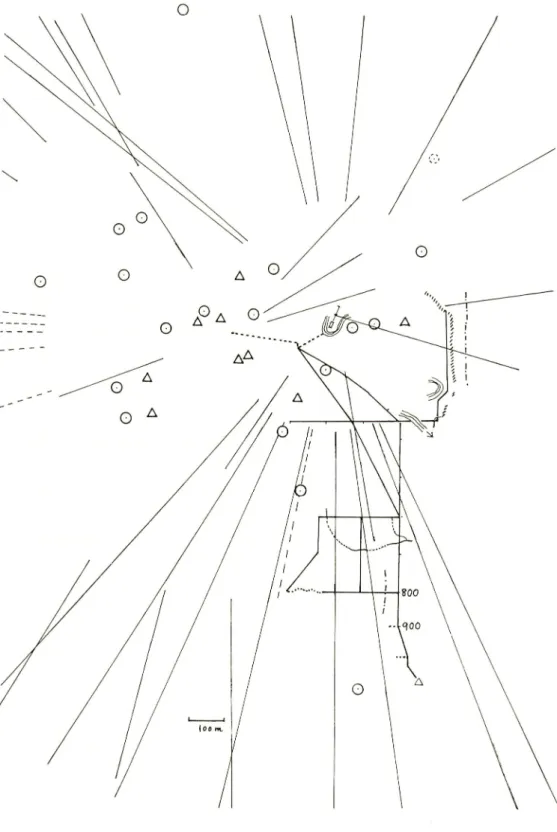
By paired observation of calls at 9 km made on 11th, October
37 (Nj) and 39 (N2) different
directions were
obtained from the
both ends of the baseline. The baseline was 275m long. From
these,locations of
18 groups were
fixed
by triangulation
(Fig.7).
For fixing the location of a group, following criteria were used: i) proximity in timing of the calls (within 2 or 3 minutes
difference)
ii)
directions
from
observation
points
intersect
with
each
other
and
iii) distance
to
the
located
point
of
the
group is within the range of relative distance category recorded. If any one of the 3 criteria is not met, that location is dis qualified and not adopted.
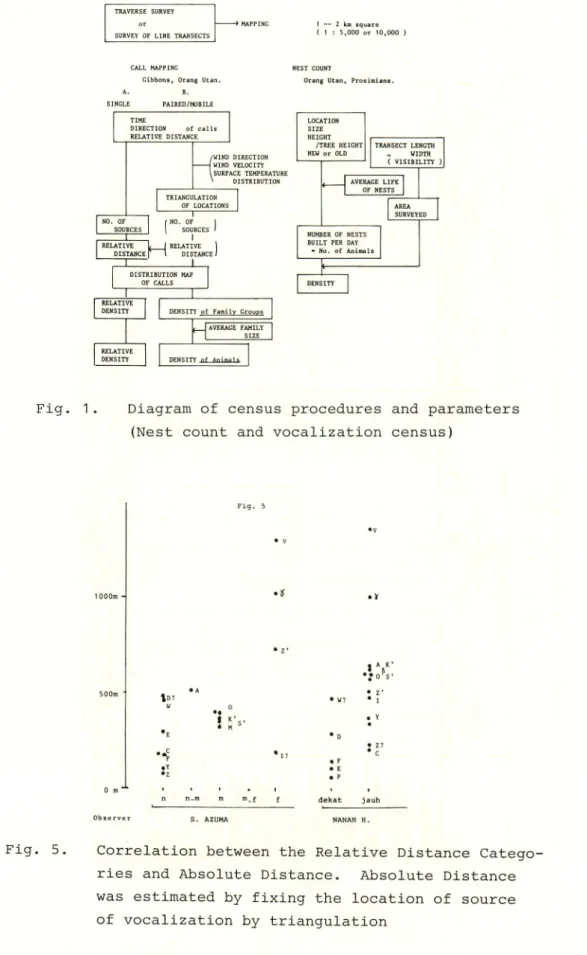
Fig.6 shows the relation between absolute distance and rela tive distance category for the fixes obtained. (Where these dis tances do not fit very well, question marks are put to the Name of the groups.)
Now, maximum estimate of the number of groups N max is given
by
N max = F + (NpF) + (N2~F)
= N-|+ N2- F.
where F is the number of successful fixes. Hence, N max = 37 + 39 - 18 = 58 groups.
Looking for the more
conservative minimum estimate
(N min);
Out
of the rest
of the directions,
which
failed to be fixed,
that
is [N-F],
(1)
combinations of directions which meet
only geometrically are
sorted out, and number of these are counted (G). This is done al
lowing for the possibility that calls of a group may be logged by
two observers at different times.
(2)
the rest of the directions [N-(F+G)]
is a set of 'odd pairs'
that are logged by either of the observers alone and that have no possibility of intersection. (~G)
N min
= F + G + Gt + G2=F + G+
(Nj-F-G)
+ (N2-F-G)
= N1 + N2 - (F+G)
-103-N min = 18 + 9 + 7 + 1.0 = 4 4
Actual number of groups (source of calls) (N) is given by
N max > N > N min
So, N is somewhere between 58 and 44.
The largest distance obtained between the source of call and the observation points was 1370m (to the South) and 1260m to the north. These and some other points fell on the crest of ridges bordering the area. The calls from beyond these seem to be shel
tered. (On the other hand, those calls uttered near the top of
the ridges could carry a long distance.)
This suggests a possibility of delineating the "area exposed to auditory scann" (AEAS) if enough number of fixes are avai
1.-able. At Km 9 it is effectively bound by low ridges of say 20
anil 40m high to the east and the north.
In order to assess the density, AEAS should be estimated.
Instead of drawing it empirically from many fixes, this could be approximated by reading a good, contoured topographical map. If this is done, data obtained by (single observations) can also be
converted to density estimates.
DISCUSSION
1. On the census method
Some species are easy to find and others are not. This depends on the behaviour patterns of the species and experience
with habit of the animal on the side of the observer. To make a
census, or just to confirm if the species is present in an area, parameter of species' proneness to sighting, trapping etc, should be checked and incorporated into the procedure of estimation.
Transect census commonly used for the estimation of density
of forest primates is done assuming that probability for the animal to be sighted is almost equall with any species (Wilson and Wilson 1975). And this would be approximately true in most
cases in the situation of the high forest. When animals are in
the foliage, their flight distance (Hediger 1964) is largely covered by the bole height of the trees.
However, in the post-forest-fire situation this is not al ways the case. Implicitly presupposed requisite for the transect census would no more hold good. In fact the results obtained by
2.
Less
conspicuous
or
low density species
For 3 species of leaf monkeys, white-fronted, maroon and
gray (
P.frontatus^ rubicundusand hosei)
and pigtailed monkeys no
sightings were obtained nor their feeding and other scars found during the transect censuses at Km 45, Km 37N and Km 9. It was almost surprising, and disappointing, that even at Km 9 where transect census was done in a fairly satisfactory condition, none of these monkeys were found. Since there are a few casual en counters they are not completely wiped out by the forest fire. I
suggest
the
situation
is that
a small
number
of
groups
of
these
monkeys are surviving in sectors very much restricted in dis
tribution.
Low frequency
of vocalization
is either
because
; 1)
the species
found
there
is
P.hosei
and
this
species
somehow
or
other gives out calls rather infrequently or
2)
number of groups
is reduced so much that their chances of uttering territorial
calls are reduced
to minimum.
In the case
of
frugivorous
pig
tailed monkeys,
they
might
be ranging
over
a very wide
area.
In
any case,
overall density may well
be very' low.
In a 3 sq .
kilometer area of
Mentoko,
Rodman (1973)
found 7 groups of P.
aygula{ =P. hosei )
.
Their Density was calculated at 2.6 groups/
sq.Km.
In
the
study area
10-15Km downstream,
orang
utans,
gibbons
and
Sunda
Island
leaf
monkeys
(=grey
leaf
monkey)
were
seen
frequently,
but pigtailed monkeys
only occasionally
(Fitting hoff
et al 1980) .
Between
the present
way of distritution
of
these
monkeys
in
the hill
forest and the former abundance
in Mentoko,
discrepancy
is so great.
What produced
the very low present density of Pres
bytis spp. Macaca spp. and Prosimians?
3. Effect of the fire
Riparian forest on the bank of Sengatta River and hill forest of the interior Kutai NP may not have been the same in their original condition before the forest fire.
Although
it is most
probably so,
is it
really
a new
situation
created by the events associated by forest fire?
What happened to them in relation to their habitat condition would be as follows,
1)
unfavourable
survival conditions during the long drought
2) direct mortality caused by forest fire
3) unfavourable survival conditions after the fire
-105-Proceeding the fire selective logging alone would not have given
severely detrimental effect to the primate population, so long as
it was done deliberately. (Wilson and Wilson 1975)
In my impression, the poorly represented prosimian and
forest leaf monkey and macaque fauna may be due to the effect of the fire and drought. If the poor fauna seen at Km 45 is really
typical of the present conditions of the unburnt natural forest,
it would follow that drought alone could severely reduce the
population. For smaller, less agile animals, 2) would have been
most critical but 1) and 3) also could be detrimental.
To determine the effect of fire, data is yet poor. Present
survey was after all a preliminary survey. The points on which
further research work is necessary were understood and some of
them were referred to in this report.
One approach which is definitely possible is to monitor the
way the remnant population of primate species builds up and dis
perse into the area that now appears vacant. In the different
types of fire affected forest, the population process is expected
to differ. If a saturation density is observed or become pre
dictable and if it is higher than the present density level, then
we can assume either that the present density is the product of fire and drought or that the species is a serai species.
Although it is easy to refer to a seemingly abnormal phenomena
found in the burnt over areas as the effect of fire, it may or
may not be so. Crucial point in our discussion has been how in
ference toward the reconstruction is possible concerning the
pre-fire, original condition of the Biotop of the interior of the
Kutai NP.
REFERENCE
AZUMA,S., A.SUZUKI and Y.RYHIYAT (1985): Distribution of Primates
in Sebule and along River Mahakam. KUORR-Asia (1983) 4
DAVIS,D.D. (1962): Mammals of the lowland rainforest of North
Borneo. Bull. Singapore Natnl. Mus. 31;1-129
FITTINGHOFF Jr.,N.A. and D.G.LINDBURG (1980): Riverine Refuging
in East Bornean Macaea fascicularis. in D.G. Lindburg (ed) The
Macaques;182-214.
HEDIGER H. (1964): Wild, animals in Captivity. An outline of the
biology of Zoological Gardens. Dover, N.Y.
KURLAND J.A. (1973): A natural history of Kra Macaques (Macaea
Timur, Indonesia. Primates 14;245-262
MEDWAY L. (1965): Mammals of Borneo. Monograph of the Malayau Branch of the Royal Asiatic Society. No.7 172 pp.
PEARSON D.L. (1975): A preliminary survay of birds of the Kutai Reserve, Kalimantan Timur, Indonesia. Treubia 28(4 ) ;157-162 RODMAN P.S. (1973 a): Synecology of Bornean Primates. I.A test
for interspecific interaction in spatial distribution of five species. Amer. J. Phys. Anthrop.
38(2);665-RODMAN P.S. (1973 b): Synecology of Bornean Primates, with
Special Reference to the Behaviour and Ecology of Orang utans. Ph. D.Dissertation Harvard University Combridge Mass.
RODMAN P.S. (1978): Dynamics of male-female relations during
breeding season of bonnet macaques.
Amer.J.phys.Anthrop.48;430
WILSON & WILSON (1980): The Ecological Separation of Macaea
nemestrinaand M.fascicularis
in Sumatra,
P.G.Lindburg (ed)
The Macaques; 148-181
CALDECOTT J.O. (1986): An Ecological and Behavioural Study of the Pig-Tailed Macaque. F.S.Szalay (ed) Contributions to
Primato-logy Vol.21
SUZUKI,A. (1987): The ecological survey on the effects of the forest fire and droughts in 1982-83 and the distributions and
populations
of primates along
the middle-upper
streams
of
Sengai
Sengata
in Kutai
National Park,
East
Kalimantan,
Indonesia. KUORR Asia (1986) 5;13-22
SUZUKI,A. (1987): The socioecological study on the orang utans in the Mentoko BT. Sinara Study Area, in Kutai National Park E. Kalimantan. KUORR Asia (1986) 5; 23-28
WHEATLEY,B.P. (1980): Feeding and Ranging of East Bornean Macaea
fascicularis.
D.G.LINDBURG (ed) The Macaques;215-246
WILSON,C.(Crockett)
and W.L.Wilson (1975): Methods for censussing
forest dwelling primates.
In S.Kondo et al(eds)
Contemporary
Primatology S.Karger, Basel 345-350
WIRAWAN,N.
and Ir.HUDIYONO,
(1983):
Survey to the Eastern part of
the Proposed Kutai National Park (mimeo.)
WIRAWAN,N. (1985): Kutai National Park, Management Plan 1985-1990 WWF/IUCN Report, No.10 124 pp.
"Kyoto University Overseas Research Report of Studies on
Asian Non-human Primates.
Primate Research
Institute,
Kyoto University, Inuyama" is abbreviated as KUORR Asia.
-107-Table 1. Primate fauna in and around the Kutai National Park, 1983-1986 Note: Kfound. ++:abundant. ±:rare. --:not to be found,certainly non-existent (-):not found, possibly non-existent judg Kuta National Park Mahakam R. Delta Sanga tta R. Kayu Mas Forest Rd. Sebulu Tributaries 0 Upper Lower km 45 k. 37 km 24 km 9 Teluk Kaba km 3C -40 km 9 -14 River bank Suduran Sabi ntul. Puhun-cepak Orang utan Pongo pyg.aeus ++ + t ++ + ++ t + ++ + (*) t + + + + seasonal + + Bornean gibbon Hylobates duelleri + ++ + + + + + ++ ++ + t + + + (±) ± Maroon leaf monkey Presbytis rubicundus Cray I .«". Presbytis hosei * 1) + + +? + + + + + White-fronted l.m. Presbytis frontatus + (-) -(-) -(-) * 3) + + 3) + Si Ivered I ... Presbytis cristatus + + (-) (-) (-) (-) (-) (-) + + (-) + + + + Proboscis monkey Nasal is larvatus + ++ ++ (-) + + + ++ Pi gtai led macaque Macaea nemestri na ♦ 2) •f -+ -+ . + + 3) t Longta iIed macaque Macaea fascicular is + + --(-) --+ -+ + -. ++ ++ + ++ Slow loris Nycticebus coucang + 2) - - --Western Tarsier Tarsius bancanus ( + ) + ...j ..«.. «.*.«...i,v, :not found,yet to be confirmed by further studies. ing from habitat types. + wi th indication of sources:+ in the previous reports (for Sangatta befor v y.nvi. iuuiiu, pu&siuiy iwir ex i s lent juuging t rom naoiiat types. + w 1982,and for Sebulu in 1983) but -or ± in later studies, (see text) Source: Upper basin of Sengatta River : 1) Suzuki,A.1984. 2) Rodman 1973,1 Sebulu(1983) : 3) Azuma. Suzuki. Vayat lDofl c-k ""»> --' ••••••• -. -« „,1978, Fittinghoff and Lindburg 1980. Sebulu(1986) and other localities(1986) by present study.
TRAVERSE SURVEY
SURVEYOE LINETRANSECTS
- 2 km square
: 5,000 or10,000 )
CALLMAPPING
Cibbons, Orang Ut,
NEST COUNT Orang Uta> .E PAIRED/MOBILE TIKE DIRECTION of c a l l s RELATIVEDISTANCE NO.OF SOURCES /WINDDIRECTION iWIND VELOCITY I SURFACE TEMPERATURE * DISTRIBUTION TRIANCULATION OFLOCATIONS r I NO. OF j 1 SOURCES I I RELATIVE | DISTANCE J L_^ RELATIVE DISTANCE
H
DISTRIBUTIONMAP OF CALLS RELATIVE DENSITY RELATIVE DENSITYDENSITY of Family Groups
f I AVERAGE FAMILY
1 SIZE
DENSITYfi#Animal.
LOCATION SIZE HEIGHT /TREE HEIGHT NEWor OLD TRANSECT LENGTH „ WIDTH ( VISIBILITY ) AVERAGELIFE OF NESTS NUMBER OFNESTS
BUILTPERDAY - No. of Animal.
AREA
SURVEYED
Fig. 1. Diagram of census procedures and parameters
(Nest count and vocalization census)
Fig. l»i * H ^ n n _ m .* •i •Jo's' • Z'
Correlation between the Relative Distance Catego
ries and Absolute Distance. Absolute Distance was estimated by fixing the location of sourceof vocalization by triangulation
109-I SIGHTINGS/ FIELD SIGNS • • Orang utan ^ <^> Bornean gibbon
m
Q
Pig-tailed
monkey
• o Long-tailed monkey <^ «^ Proboscis monkey • £> Silvered leaf monkey A A G^ay leaf monkey A 2^ Maroon leaf monkey A A either of the above ~^~ two species • A White-fronted leaf monkeyFig.
2.
Distribution
of
primates
along
the
Kayu
Mas
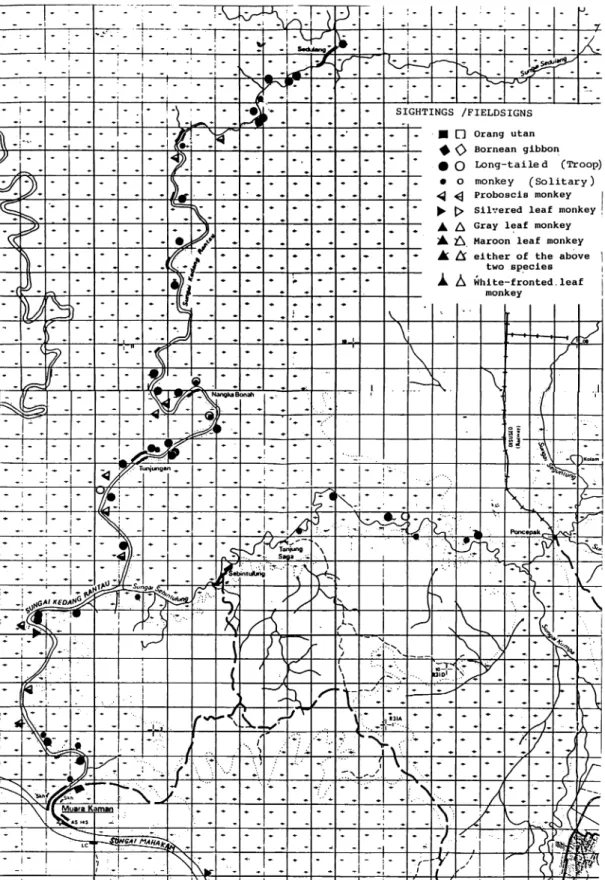
Forest Road in the Kutai National Park, 1986Fig. 3 Distribution of primates on the banks of «i
Midstream of Mahakam River and its tributary Kedang Rantau
-111-6:00-6:30 6 (7:00) Fig. 4-1-a 6:15 -6:55 Km45 N n m f ff T Km 45 N n m f ff T Hill 46 Aug.22 2 5 2 1 11 Aug.2 3 5 4 2 2+1 13 + 1 Sept.0 3 11 6:45 -7:03 12 5:50-6:10 -7 05 13 Km 45 N T n m f ff T 5 Aug.31 3 6 3 1 15 Sept.01 Fig. 4-1-b 7:15 -7:27 Fig. 4. Relative distance and direction of the sources of gibbon calls during their 'morning chorus' in 5 study areas along Kayu Mas Road -Km 4 5, Km 3 7N, Km 24, Km 9 and Teluk Kaba -in the Kutai National Park
I (( EXAMPLE )) O' O f ff T 37K S n m f ff T 6 14 Sept.07 3 2 + 12 1 8 + 1 Fig. 4.-1-3 6:10 -7:46
23 A Camp 9 S (Loc S) Oct.11 Fig. 4,-2-c 6:00 -7:50 23 B 7:55 n m f ff T Camp 9 (Loc N) (n) (m) (f) T 8 4 8 2 111 2 36 + 3 Oct.11 6 4 22 32 + 3
6:38
^
/x
8'07*
*7:21
1011 9 CamP n m f ff Oct.10 2+12+13 5 6 4 7:03 -7:36 5 07 Km 9 Camp 22+2 Oct.12 Fig.4.-2-d2 f ff T 2 6 18 Teluk Kaba Teluk Kaba n m f ff T Oct.06 ' 3 1I 3 7 Oct. 14 n m f ff 2 17 , 20Fig. 6. Distribution of Bornean gibbon groups in Km 9 study area. O location by fix, - probable range of location of the groups (sources of call), on