The Regression of Marine Foods Consumption in
Fiji : Changes 2002-03 to 2008-09
著者
NARSEY Wadan Lal
journal or
publication title
南太平洋研究=South Pacific Study
volume
32
number
2
page range
105-127
Materials
The Regression of Marine Foods Consumption
in Fiji:
Changes 2002-03 to 2008-09
NARSEY Wadan Lal
Research Center for the Pacific Islands, Kagoshima University Korimoto 1-21-24, Kagoshima, 890-8580 Japan
Abstract
Fiji is a group of islands in the South Pacific. As with most developing countries, Fiji's patterns of consumption are becoming globalized, with many nutritious local foods being replaced by modern processed imported foods. This is accompanied by negative impacts on foreign exchange reserves, domestic employment and incomes, and good nutrition.
This study examines Fiji's patterns of consumption of marine products and the current changes that may be taking place, by analyzing the data from Fiji's Household Income and Expenditure Surveys for 2002-03 and 2008-09, the first such analysis in the Pacific using national HIES data.
The results indicate that marine food consumption is declining as a proportion of total food expenditure, aggregate expenditure on local marine foods is declining in real terms, while that on canned fish (mostly imported) is increasing. Expenditure per capita on fresh fin fish and other marine products comprising of invertebrates, molluscs and seaweeds, is declining in real terms (both in urban and rural areas), while the proportion of the population consuming marine products is declining amongst all ethnic groups. Urban consumption of other marine products remains low, compared to that for rural Fijians.
While there is clearly scope for increasing the consumption of marine products for target groups, greater attention needs to be paid to the packaging and presentation of marine products, while marketing infrastructure and ice preservation must be enhanced. The universality of demand for prawns and kai (a freshwater shell fish), amongst both locals and tourists, may suggest that these two products could receive greater attention for aquaculture.
Key words: canned fish, fish, food security, household income and expenditure survey, marine foods
Introduction
Fiji comprises more than 800 islands in the middle of the South Pacific ocean, of which just over a hundred are inhabited. There are two large islands, Viti Levu and Vanua Levu, of which no parts are more than 100 kilometers from the sea. Most of the inhabited towns and cities are on the coast. Fisheries resources are therefore relatively easily available geographically throughout Fiji, in contrast to many developing countries, some of which are land-locked and quite far from the ocean.
Received: 4 September, 2011 Accepted: 14 November, 2011
106 South Pacific Studies Vol.32, No.2, 2012
Fiji's population at the last 2007 Census comprised some 828,000 people, of whom 57% were ethnic indigenous Fijians (mostly Melanesian in origin but with small mixtures of Polynesian), 38% were Indo-Fijians (mostly descended from indentured labourers brought from India more than a century ago), and 5% of Others (small numbers of Mixed Races, former Solomon Islanders, Chinese, Micronesian and Polynesian).
Amongst the "Others" are also significant numbers of new Chinese migrants and residents, who have also been associated with a significant increase in Chinese restaurants. They (the new Chinese residents and the restaurants) have dramatically increased the demand and hence prices for many marine foods, especially crabs, prawns, and lobsters.
The diets of the Fiji citizens are generally typical of all Island diets, with heavy consumption of island root-crops (cassava, dalo, kumara and yams), marine products, meats (like chicken, beef, and increasingly lamb), introduced foodstuffs such as flour products (bread, noodles and rice) and island vegetables (rourou, bele and small amounts of seaweeds). Indo-Fijians have somewhat lower and different patterns of consumption of marine products from the other ethnic groups.
Given the local availability of the marine foods and their generally nutritious nature, marine resources have been important in Fiji's system of production and consumption, although imported food-stuffs have been making inroads continuously over the last century.
An excellent description of the marine resources available in Fiji may be found in RICHARDS (1994). Although dated, this authoritative document has a good profile of the various marine foods which are found throughout Fiji: their relative abundance, distribution and exploitation; the existing legislation, and advice on future regulations necessary to control the existing fisheries for those resources then not protected.
Even as early as 1994, the Richards study expressed concerns regarding the possible depletion of artisinal fishery and its effects on Fiji's near shore resources. While area closures and bans on gill-netting for reef fish seemed to have improved stocks of fish species such as nuqa and kanace, they hoped that the promotion of Fish Aggregating Devices (FAD) would shift fishing pressure away from "demersal reef fish to pelagic species". The Richards study also thought that at that time stocks of some sedentary organisms such as civa, sici, vasua and dairo were "generally in very poor condition" (RICHARDS 1994: xiv-xv). This was attributed to the proliferation of underwater diving equipment, water-borne pollution, dredging, removal of sand and degradation of existing mangrove stands. The stocks of some non-fish species, such as qari and kai seemed to be in reasonable condition. It was thought important to have stock assessment surveys, as the subsistence fishery was an important source of protein for Fiji, and especially the rural population. The Richards study had a very rough guess that the size of the subsistence catch was between 10,000-20,000 metric tonnes per year. 1
SECRETARIAT OF THE PACIFIC COMMUNITY (2009) gives a good perspective on the vital role that fish played in the food security of Pacific Island states. Secretariat of the Pacific Community (SPC) had recently developed an approach to assist PICTs provide
1 The Government was expecting that the results of a subsistence fisheries survey of 2,553 households among Fijian villages and Indian settlements conducted during 1993 would offer better estimates.
consumption needed for good nutrition; estimating current fish consumption; forecasting the fish needed for food to 2030; and outlining practical ways to provide access to the fish required" (BELL et al. 2009). The study gave national estimates of per capita fish consumption in various Pacific countries, based on Household Income and Expenditure Surveys.
SECRETARIAT OF THE PACIFIC COMMUNITY (2009) concluded that fish consumption was high, rural communities had an extraordinary dependence on fish, subsistence fishing was very important, fresh fish dominated their diets, and fish provided the majority of the animal protein in their diets. Other studies such as GILLETT and CARTWRIGHT (2010) and SECRETARIAT OF THE PACIFIC COMMUNITY (2008) may be perused for general Pacific concerns about the contribution of marine foods to food security in the Pacific.
GILLETT (2009) noted that in the Pacific in general, there appeared to be stagnation of coastal fishery production which inevitably meant that marine foods had to be spread among a growing number of people, with the consequence that the benefits from employment and nutrition were also stagnating. He noted the serious lack of data on coastal fisheries in most countries. GILLETT (2009: xxi) emphasized "Protection of village food fish supplies is arguably the most important objective of the management of coastal fisheries in the Pacific islands, but to know if such management efforts are effective overall, some idea of the gross coastal fisheries production is required".
What is surprising for a maritime nation is the extreme paucity of good statistics on the production and consumption of marine foods. Between 2000 and 2007, the official estimates of fisheries contribution to Fiji's GDP ranges from 1.8% to 2.9%, with wide variation in the dollar values (GILLETT 2009: 47). Using alternative methodology based on value added, Gillett's estimates were some 12% lower. The estimates by the Department of Fisheries of the main products (such as fish, prawns, kai, etc) also show great variation from year to year, with a very poor ability to properly account for local sales of catch from the fishing fleets.
Fiji's fisheries consumption was very roughly estimated by GILLETT (2009: xxix) to be between 44 to 66 kg per person per year. GILLETT (2009: xxix) observed that Household Income and Expenditure Surveys provided a good opportunity to improve the measurement of small-scale fisheries. Unfortunately, one of the weaknesses of the HIES was that their estimates of coastal fisheries production appeared to be relatively lower than that estimated by other survey techniques or specialists familiar with national fisheries. Nevertheless, GILLETT (2009) felt that a HIES improved to derive better information on fisheries, possibly could represent the "only cost-effective mechanism for obtaining information on small-scale fisheries".
In none of these studies, however, is there any detailed analysis of household patterns of fish and other marine product consumption within each country, despite the considerable effort by Government ministries and other institutions to increase and control the production of marine fisheries. This paper attempts to fill this gap for Fiji.
108 South Pacific Studies Vo1.32, No.2, 2012
Household Income and Expenditure Survey (HIES) Data Source
for Marine Food Consumption
For the first time in Fiji, there have now been two national Household Income and Expenditure Surveys (one in 2002-03 and one in 2008-09) conducted by the Fiji Islands Bureau of Statistics (FIBoS) within five years of each other, using similar methodology, which gives a rich data set to examine patterns and possible time changes occurring in food consumption, including that of marine foods. The Report on the 2002-03 HIES was published by the Fiji Islands Bureau of Statistics and the Report on the 2008-09 HIES has now also been launched. 2
While these household surveys are generally small samples (of 3% and less) and cannot be expected to give very accurate information on the consumption of one category of foods, such as marine products, there is still enough robustness in the surveys to give some broad indicators of the relative consumption (both market and subsistence) of marine products in Fiji. Additional advantage may also be derived from the fact that the HIES database enables the consumption of marine products to be analyzed not in isolation, but relative to other foods, while comparisons are also possible on a area (rural: urban), regional (division or province), ethnicity, and income class levels. Of course, with the HIES within five years of each other, it is also possible to bring out some useful time trends.
These household surveys have apparently not been put to this use previously. It may be noted that most Pacific countries have been conducting similar household income and expenditure surveys, and this study may give some indications of how the other HIES may be similarly analysed to obtain a Pacific-wide perspective on marine food consumption patterns and changes that may be occurring currently.
This study took the raw consumption data provided by FIBoS at the household level, and produced all the statistical tables and figures presented in this paper. Because of the frequency of their occurrence, the following abbreviations are used in the text, tables and figures: ch hh pa pc R % Ch. change household per annum per capita percentage
Real percentage change (adjusted for price changes)
2 Report on the 2008-09 Household Income and Expenditure Survey for Fiji, 2011. The author analyzed and wrote both these reports.
Fiji's Economic Performance
Fiji' Gross Domestic Product (GDP) gives a fairly good indication of the health of the economy over this period. GDP was generally increasing from 2002 to 2006, following which it declined somewhat, to 2009 (Fig. 1). With a growing population, the GDP per capita indicates a much larger decline after 2006, reverting to just below the 2002 level by 2009 (Fig. 2).
Fig. 1. Index numbers for gross domestic product (2002 = 100).
South Pacific Studies Vol.32, No.2, 2012
Overall incomes and expenditure between the two HIES was generally increasing nominally (by 44% and 42% respectively) and in real terms by about 12%, allowing for CPI inflation of around 27.1% over the period (Table 1).
Table 1. Household income and expenditure per capita (2002-03 to 2008-09).
2002-03 2008-09 % Ch. R % Ch.
Total household income pc ($) Total household expenditure pc ($m) Expenditure as percentage of income (%)
2600 2209 85.0 3738 3144 84.1 44 42 13 12
These changes were not uniform however. Rural areas saw a moderate decline in expendi-ture per capita of -7% while urban areas saw a large increase of 21% (Table 2). These rural: urban differences will need to be kept in mind when we discuss rural:urban differences in consumption of marine products.
The Engels relationship generally posits that as incomes and standards of living rise, then Food as a percentage of total expenditure generally declines. Table 3 indicates the expected result for Fiji consistent with Table 2 results, that food as a percentage of expendi-ture, while falling slightly for Fiji in aggregate, increased for rural areas by a large 15%, while decreasing for urban areas by -6%.
Table 2. Percentage change in total expen-diture per capita 2002-03 to 2008-09.
Area % Ch. R % Ch. Rural Urban Fiji (total) 18 53 42 -7 21 12
Table 3. Food as percent of total expenditure.
Area 2002 2008 % Ch. Rural (%) Urban (%) Fiji (total) (%) 40.5 26.4 32.5 46.5 24.7 31.9 15 -6 -2
Table 4 indicates that with food prices generally rising by 42.5% in this period, food expenditure per capita in rural areas also declined by -5% in real terms. This would suggest that while urban households may have improved their standards of living slightly, standards of living in rural areas may have been declining over this period.
Table 4. Food expenditure per capita per annum.
Area 2002 ($) 2008 ($) % Ch. R % Ch. Rural Urban Fiji (total) 705 733 718 955 1050 1002 35 43 40 -5 1 -2
Consumption of Marine Foods
While the consumption of canned fish would normally not be included in "marine food" consumption, the analysis here initially will include it as there is a certain degree of substitutability between fresh marine foods and tinned marine foods. The consumption of canned fish also gives a good idea of the potential to increase fish consumption amongst the population. Canned fish is especially important for the Indo-Fijian community whose consumption of non-fish products is generally quite low.
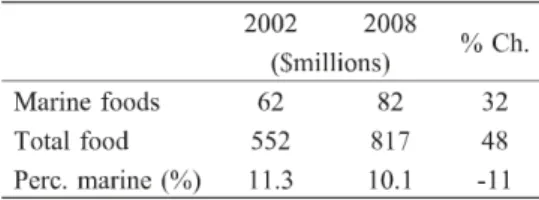
Table 5 indicates that marine prod-ucts consumption comprised a tenth of total food expenditure in Fiji. The con-sumption of all marine products increased by 32% in nominal terms while Total Food increased by 48%.3 The share of total marine consumption in food there-fore declined by -11% from 11.3% to
10.1%. Despite the small decline, marine products are still a large component of food consumption and an important source of protein and other nutrients es-sential for good health.
Table 6 indicates that total marine products (including canned fish) increased in nominal value by some 48% which would also probably be a real increase, as fish prices increased by around 41% be-tween the two HIES. 4
While the dollar value of fresh fish
Table 5. Share of marine foods in total food expenditure. 2002 2008 % Ch. ($millions) Marine foods 62 82 32 Total food 552 817 48 Pere. marine (%) 11.3 10.1 -11
Table 6. Importance of main marine products.
2002 2008 ($millions) % Ch. R % Ch. Fresh fish Other marine Tin fish Total marine 36 47 11 11 16 24 62 82 32 0 53 32 -6 Prob. (-ye) 43 Prob (0)
increased by 32% this may reflect a real
decline of -6% as Fresh Fish prices generally increased by around 42%.
Other marine products (shell-fish, prawns, crabs, octopus etc.) remained constant in nominal dollars, and probably significantly declined in real terms. 5
Canned fish consumption on the other hand increased by 53% in nominal terms and by a large 43% in real terms, with a small 7% increase in canned fish prices. By 2008-09,
3 This should not be taken to imply that the increase in real consumption of marine products was less than that of food, since the deflators for the two will not be the same. While food prices went up by 42% during the HIES (as also roughly did the prices of fresh fish), that of canned fish apparently only increased by 7%.
4 It would be difficult to have an accurate estimate of the real increase for two reasons. First, the average fish price increase is measured by FIBoS for species which are not the same composition in volume as the volumes of species of fish actually consumed by households. Second, a large part of fish consumption measured by the HIES is "own consumption" whose prices will not have been consistently estimated by interviewers on the ground.
5 There are no price indices for other marine products. It is generally perceived, however, that the prices of prawns, shrimp, crabs and other marine products have risen sharply in recent years, probably more than fresh fish prices.
112 South Pacific Studies Vol.32, No.2, 2012
canned fish consumption was more than twice that of other marine products, thus represent-ing a sizeable market into which the consumption of fresh fish and other marine products may be able to expand.
Table 7 indicates that fresh fish maintained its 57% share of all marine products. Of concern, however, is that other marine products lost 24% of its share, declining from 18% to 13%. Canned fish, on the other hand, gained ground, increasing from 25% to 29%. This is not a good indicator for other marine products, including shell fish like kaikoso, the subject of study by Kagoshima University Research Center for the Pacific Islands (KAWAI) et al. 2008, KAWAI 2011).
Table 8 gives the disturbing results that with a moderately rising population, the per capita consumption of fresh fish declined by -12% between the two HIES, while that of other marine products declined nominally by -6% and in real terms probably far more.
Canned fish consumption per capita, on the other hand increased by 44% in nominal terms, and 35% in real terms.
Table 7. Composition of marine foods. Table 8. Marine products per capita per annum.
2002 2008 % Ch. Fresh fish (%) Other marine (%) Tin fish (%) Total marine (%) 57 18 25 100 57 13 29 100 0 -24 16 2002 2008 ($ pc pa) % Ch. R%Ch. Fresh fish Marine other Tin fish Total marine 46 58 14 14 20 30 81 101 25 -6 44 24 -12 n.a.* 35 n.a.* * There are no price indices for all the many prod
-ucts that go into "Marine other".
Household Consumption Patterns
In countries where dietary patterns are homogenous, per capita statistics are useful. In Fiji, where a large segment of the population live inland and are not close to sea, and there is a large vegetarian component to the Indo-Fijian population, per capita statistics may not give an accurate picture. It is important therefore to first look at the household distribution of marine food consumption.
Table 9 indicates that just over a half of all households (and population) consume some marine products (i.e. any marine product). However, the proportions of both have declined
Table 9. Percent of households and population
with some marine food consumption.
2002 2008 % Ch. Percent of households (%) Percent of population (%) 56 58 51 54 -8 -7
quite significantly between the two HIES- by 8 % and 7 % respectively (Table 9).
Table 10 (and Fig. 3) indicates that a much larger proportion (more than 60%) of indigenous Fijian households consume marine products than Indo-Fijian households (less than 40%). However, for both, the proportion has declined- by -9% for indigenous Fijians and -11% for Indo-Fijians. All ethnic groups saw decreases in the proportions of households consuming some marine products.
Table 10. Percent of households with some ma-rine food consumption (by ethnicity).
Ethnicity 2002 2008 % Ch. Fijian (%) Indo-F (%) Other (%) Fiji (total) (%) 68 42 58 56 62 37 53 51 -9 -11 -9 -8
Fig. 3. Percentage of households with some marine products consumption (by
ethnicity).
The relatively low consumption by Indo-Fijians represents a challenge to increase this market for the consumption of domestically produced marine products. This is discussed below with respect to specific products.
Table 11 indicates that of those households consuming marine foods, some 46% spent less than $400 per annum in both years, with some 18% spending more than $1000 per annum in 2008-09.
Table 11. Household distribution of expenditures on some marine foods.
$ expenditure per household pa 2002 (%) 2008 (%) 0-200 200-400 400-600 600-800 800-1000 1000-2000 > 2000 28 27 16 10 6 10 2 18 28 17 12 6 14 4
114 South Pacific Studies Vol.32, No.2, 2012
Table 12. Percent of occupants in households with some marine consumption.
Area 2002 2008 Ch. Rural (%) Urban (%) Fiji (total) (%) % (R-U)/U 66 48 58 38 62 45 54 38 -6 -6 -7
Table 13. Total marine food expenditure per capita per annum (only for households with some ma-rine food consumption).
Area 2002 2008 Ch Rural Urban Fiji (total) % (R-U)/U 115 88 105 31 147 113 133 30 28 29 27
Table 12 indicates the differences between rural and urban populations in the propor-tions of their populapropor-tions consuming marine products. For both rural and urban households, the proportion consuming some marine products declined by -6%, with the gap between rural and urban areas remaining the same at 38%. Nevertheless, even in 2008-09, some marine foods were important to two thirds of the population in rural areas.
Table 13 gives the per capita consumption of marine products per annum, only for households with some marine product consumption.
While the nominal change was an increase of around 28% for both, the real change may well have been a decrease, if deflated for the price inflation. A weighted deflator for total marine products comes to roughly 1.32.6
What is clear is the greater importance of marine product consumption in the rural households, of which some 30% more consume marine products than urban households.
The data above clearly indicates that there is considerable potential for increasing the consumption of marine products in Fiji. This is elaborated further in sections below.
Figure 4 gives an income profile of the consumption of all marine products. The rural consumption steadily rises as the quintiles increase, while the urban consumption clearly levels out at the upper quintile levels. This may indicate substitution by alternative protein sources. This aspect may be investigated with more differentiation of the products.
Fig. 4. Expenditure on all marine products per capita per annum (regional income quintiles).
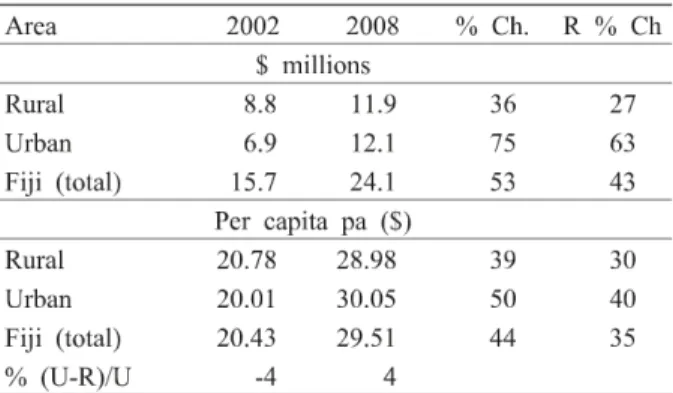
Table 14 indicates the very large growth of total and per capita consumption of canned fish between the two HIES. On a per capita basis, it rose by 35% in aggregate in real terms, but a much higher 40% in urban areas and a still high 30% in rural areas.
A quite unexpected result is that there is virtually no difference between the rural and urban levels of consumption.
Table 14. Tin fish consumption.
Area 2002 2008 % Ch. R % Ch $ millions Rural Urban Fiji (total) 8.8 11.9 6.9 12.1 15.7 24.1 36 75 53 27 63 43 Per capita pa ($) Rural Urban Fiji (total) % (U-R)/U 20.78 28.98 20.01 30.05 20.43 29.51 -4 4 39 50 44 30 40 35
Table 15 indicates an interesting ethnic development that while all have shown large per capita increases (both nominally and in real deflated terms), Indo-Fijians have caught up with the other ethnic groups so that by 2008-09 they were pretty much the same. The Fijian margin of 16% in 2002-03 had declined to barely 1% in 2008-09. This may be seen as a good interesting development with potential for also increasing the consumption of fresh fish, if the relevant obstacles can be overcome.
Table 15. Tin fish expenditure per capita per annum ($, %) (by ethnicity). Ethnicity 2002 ($) 2008 ($) % Ch R%Ch Fijian Indo-F Other Fiji (total) % (F-I)/I 22 19 21 20 16 30 29 31 30 1 36 55 49 44 27 45 39 35
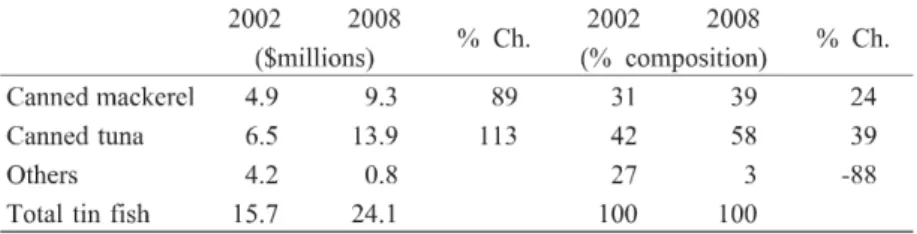
Table 16 indicates that canned tuna has increased its dollar value dramatically by 113% and its share of the total canned fish consumption from 42% to 58%. This may be of importance given that the one local cannery in Fiji (PAFCO) cans tuna but it is unclear what
116 South Pacific Studies Vol.32, No.2, 2012
is the share of locally canned tuna in total canned tuna consumption. While some of the locally canned tuna is also exported, the increasing importance of canned tuna in domestic consumption suggests a possibility of import substitution if the price of local tuna can be made competitive with that of imported tuna.
Table 16. Tin fish consumption and composition ($m and %) (by variety).
2002 2008 ($millions) % Ch. 2002 2008 (% composition) % Ch. Canned mackerel Canned tuna Others Total tin fish
4.9 9.3 6.5 13.9 4.2 0.8 15.7 24.1 89 113 31 39 42 58 27 3 100 100 24 39 -88
Figure 5 gives the interesting results on the percentage changes in canned fish consumption at different income quintile levels in rural and urban areas. What ought to be of concern is that there appears to be higher increases in rural consumption at the upper income levels, where one would have expected decreases because of the ease of obtaining fresh marine produce. This trend would need to be further analysed to examine whether this change is the result of increasing hardships in rural areas or changing tastes. The upper quintiles in urban areas saw declining percentage increases.
Overall, however, what stands out is that the moderate real increases were taking place at all quintile levels, and not just at the low income levels (which one may have expected on price grounds).'
The analysis below will focus largely on the consumption of local marine products (fresh fish and other marine products), excluding canned fish.
Regional Income Quintles
Fig. 5. Percentage change in tin fish consumption per capita per annum (regional quintiles 8) (2002-03 to 2008-09).
7 Given that the price increases for canned fish were estimated by the FIBoS to be only around 7% while that for fresh fish was around 41%.
Fresh Fish
Fresh fish is a popular part of the diets of nearly all ethnic and regional groups in Fiji. Table 17 gives a break-down of the main species consumed. Unfortunately, the "Others" category is indicated to have the largest share of around 62% in 2008.
Table 17. Fresh fish species consumed ($000 and %).
2002 2008 ($000) % Ch. 2002 2008 (% composition) % Ch. Saqa Kabatia
Cod (Kawakawa etc) Sabutu Kanace Kawago Ogo Nuqa Walu Kalia Kacika Snapper Other fin fish All species 2454 4458 2059 3797 1923 2730 1268 2239 1961 1688 655 898 764 777 418 669 1026 481 67 251 45 95 120 59 22853 28941 35614 47082 82 84 42 77 -14 37 2 60 -53 273 111 -51 27 32 6.9 9.5 5.8 8.1 5.4 5.8 3.6 4.8 5.5 3.6 1.8 1.9 2.1 1.6 1.2 1.4 2.9 1.0 0.2 0.5 0.1 0.2 0.3 0.1 64.2 61.5 100.0 100.0 37 40 7 34 -35 4 -23 21 -65 182 59 -63 -4 0
Of the fin fish group, cod, sabutu and kawago are generally considered to have higher preference as "A" grade fish, with a price premium of 30% or more compared to the other species.
Nearly all the species look to have increased consumption in nominal dollars, between 2002-03 and 2008-09.9 Three of the species (kanace, walu and snapper) are indicated to have declined in nominal value between the two HIES. It would be useful to examine whether this may be an indication of over-fishing.
Table 18 indicates that fresh fish consumption per capita in rural areas was more than 60% higher than the urban consumption per capita, with both changing by 27% between the two HIES nominally, but by -10% in real terms.
Table 19 gives some interesting
Table 18. Fresh fish consumption per capita per annum ($, %). Area 2002 2008 ($ pc pa) % Ch. R%Ch Rural Urban Fiji (total) % (R-U)/U 55.9 71.2 34.7 44.0 46.3 57.7 61 62 27 27 25 -10 -10 -12
118 South Pacific Studies Vol.32, No.2, 2012
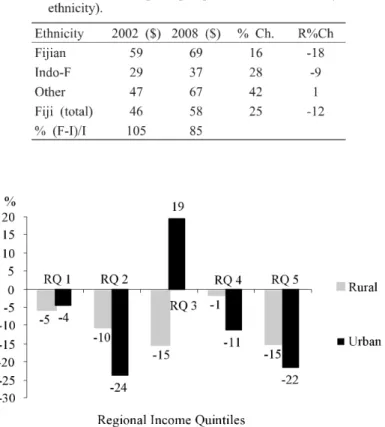
ethnic differences in fresh fish consumption per capita. While indigenous Fijian consump-tion declined by -18% in real terms, that of Indo-Fijians declined by a smaller -9%. That for "Others" remained about the same.
Figure 6 gives the unusual patterns of changes at all the quintile levels, with large declines at the upper quintile levels for both rural and urban households.10
Table 19. Fresh fish per capita per annum ($ and %) (by ethnicity). Ethnicity 2002 ($) 2008 ($) % Ch. R%Ch Fijian Indo-F Other Fiji (total) % (F-I)/I 59 29 47 46 105 69 37 67 58 85 16 28 42 25 -18 -9 1 -12
Regional Income Quintiles
Fig. 6. Percentage changes in fresh fish consumption per capita per annum (by regional quintiles) (2002-03 to 2008-09).
Other Marine Products (Excluding Fresh and Canned Fish)
The statistical results for other marine products give great cause for concern. The total aggregate consumption expenditure declined in both rural and urban areas, with a bigger decline of -31% occurring in rural areas, with only a slightly lower decline of -23% in urban areas (Table 20). The per capita declines were larger and fairly similar in magnitude in both areas -33% and -37% correspondingly.
(excluding fresh and canned fish). Area 2002 2008 % Ch. R%Ch $millions Rural Urban Fiji (total) 8.5 8.3 2.6 2.8 11.1 11.1 -3 8 0 -31 -23 -29 $ pc pa Rural Urban Fiji (total) 20.09 20.02 7.44 6.93 14.38 13.55 0 -7 -6 -29 -34 -33
Ethnic differentiation indicates that while indigenous Fijians con-sumption is roughly double that of Indo-Fijians, the real decline in Fi-jian consumption per capita pa has been much larger (-39%) than that of Indo-Fijians (-21%). The decline in the other marine foods not specified previously has been greater (Table 21).
Table 21. Consumption of other marine products by ethnicity. Ethnicity 2002 2008 ($ pc pa) % Ch. R%Ch Fijian Indo-F Other Fiji (total) 19.30 16.54 7.79 8.70 14.70 12.04 14.38 13.55 -14 12 -18 -6 -39 -21 -42 -33
Figure 7 is again a repeat of the results for fresh fish in that there have been real large negative changes in per capita consumption at the lower quintiles and upper quintiles, but less so at the middle quintiles.
Regional Income Quintiles
Fig. 7. Percentage changes in other marine product consumption per capita per annum (by regional Quintiles) (2002-03 to 2008-09).
120 South Pacific Studies Vol.32, No.2, 2012
There may be two different sets of forces at work here - one driven by price - at the lower quintiles, and perhaps one driven by taste at the upper quintiles.
Table 22 gives the breakdown of the main items of consumption amongst "other marine products". Crabs and prawns are by far the more important items followed by kai (freshwater mussels) and other shellfish (which also includes kaikoso).
Table 22. Other marine products.
Marine Product 2002 2008
($000)
% Ch. Crab (including land crab)
Prawns Kai
Other shell-fish* Turtle
Others excluding above** Total 3413 4977 1903 2036 1836 1364 1288 1363 457 504 2160 806 11057 11051 46 7 -26 6 10 -63 0 * This category includes kaikoso which is the item being researched
by a team from KURCPI.
** Other marine product excluding fresh and canned fish and those specified in Table 22.
While in aggregate there appeared to be zero growth between the two HIES in nominal dollar terms (and undoubtedly negative growth in real terms), that for crabs showed a 46% increase in dollar terms. It is unclear whether this would still represent a real increase, or as is more likely, even a decrease if the price of crabs has risen by more than the 41% that has been indicated for inflation of fresh fish prices.
Table 23 (and Fig. 8) gives the ethnic dimension to the consumption of other marine products. Crabs, prawns and kai are three products which the Indo-Fijians also consume. As can be seen by the last column, however, the per capita consumption by Indo-Fijians is significantly less than that for Fijians by - 48% for prawns, - 56% for kai and -80% for other marine products.
Table 23. Consumption per capita per annum of other marine products (by ethnicity).
Fijian Indo-F Others Fiji (total) % (I-F)/F
Crabs Prawns Kai Others 5.96 3.04 2.69 6.24 4.23 1.58 1.20 1.23 5.95 3.08 0.94 3.40 5.27 2.49 2.03 4.18 -29 -48 -56 -80
Fig. 8. Consumption per capita per annum ($) of other marine products (major ethnic groups).
There are also extremely interesting income profiles to the consumption of these three products- crabs, prawns and kai. Both crabs and prawns are in high demand by Indo-Fijians and other non-indigenous Fijian groups, such as the new Chinese migrants and restaurants. Crabs
In order to get reasonable statistics for quintile estimates, the data for 2002-03 was pooled with the data for 2008-09. 11 Figure 9 gives the interesting result that the crab consumption levels for Rural Fijians is way above that for the others, and showing very clear and high income elasticity. Crabs would seem to be a "superior" good for rural Fijians.
Rural Fijian Urban Indo-F Rural Indo-F Urban Fijian
Regional Income Quintiles
Fig. 9. Crab consumption per capita per annum ($) (by ethnicity) (average for 2002-03 and 2008-09).
11 The 2002-03 figures were inflated by the factor 1.41 (the fish price inflator) to 2008-09 prices. A similar procedure was followed for prawns and kai. The results are therefore to be used cautiously.
122 South Pacific Studies Vol.32, No.2, 2012
While all the other groups (Urban and Rural Indo-Fijians and Urban Fijians) show sharp increases for the 5th quintile, both Urban and Rural Indo-Fijians have an upwards blimp at the middle quintile. Quite surprisingly Urban Fijians have very low consumptions of crabs.
Prawns
Prawn consumption shows more unusual results. For Fijians, while consumption rises from the 1st to the 3rd quintile, it sharply declines to the 4th and further to the 5th quintile (Figure 10).
Rural Fijian Rural Indo-F Urban Indo-F Urban Fijian
Regional Income Quintiles
Fig. 10. Prawn consumption per capita (by ethnicity).
For both Rural and Urban Indo-Fijians there are increases at the 4th and 5th quintile, while for Urban Fijians there is an increase only at the 5th quintile, while the consumption levels are quite low at the lower quintiles.
Kai (fresh water mussels)
Figure 11 of kai consumption by major ethnic groups and quintiles indicate very similar patterns to that for prawns, except that Rural Indo-Fijians show very low consumptions of kai. Rural Fijians once again show strong declines at the upper quintile level. The other groups, both Urban Fijians and Indo-Fijians show low consumption of kai at the lower income quintiles.
It would be a useful exercise to ascertain why urban Fijians indicate very low consumptions of crabs, prawns and kai. Given that these would need to be purchased using cash, given that the prices of crabs and prawns have certainly increased dramatically in the last decade, then it is possible that budgetary constraints have discouraged urban Fijians from these items. With generally larger families, these items also do not have sufficient
Rural Fijian Urban Indo-F Urban Fijian Rural Indo-F
Regional Income Quintiles
Fig. 11. Kai consumption per capita per annum ($) (by ethnicity) (average for 2002-03 and 2008-09) (by quintiles).
"bulk" to enable them to "fill the stomachs"
, although crabs go a long way in Indo-Fijian households.12
Other marine products (including kaikoso)
Figure 12 gives quintile consumption patterns for all other remaining marine products such as kaikoso and other shell-fish, octopus, squid, lairo, dairo, seaweeds, etc.
What stands out is that the Rural Fijian consumption levels are way above that of all other groups. This may be expected for Urban and Rural Indo-Fijians, given their dietary
Rural Fijian
Rural Indo-F
Urban Fijian
Urban Indo-F
Regional Income Quintiles
Fig. 12. Marine products consumption per capita per annum ($) (by ethnicity) (average for 2002-03 and 2008-09) (excluding crabs, prawns and kai).
12 Indo-Fijians usually make a soupy curry out of crabs, and the strong flavour of the crab, even if small in quantity, therefore goes a long way.
124 South Pacific Studies Vol.32, No.2, 2012
preferences.
However, the results are unusual for urban Fijians. One factor may be the large work effort and time required to process these other marine foods, and urban Fijians no longer have the time nor the inclination to do this, especially since there has been a significant increase in employment of Fijian females and reducing proportion of "full-time housewives".
It may be observed, especially in urban markets such as in Suva, that rural producers of these other marine foods have in recent years, been semi-processing the marine foods to encourage purchases by urban Fijians, as well as associated inputs such as grated coconut which is often cooked with the marine foods. This trend may be expected to continue and needs to be channeled into safe health practices.
Conclusion
The evidence indicates that marine food consumption is declining as a proportion of total food expenditure. Aggregate expenditure on local marine foods is witnessing real declines, while that on canned fish is increasing. Expenditure per capita on fresh fish and other marine products is declining in real terms (both in urban and rural areas), while the proportion of the population consuming marine products is declining amongst all ethnic groups. Urban consumption of other marine products is extremely low, compared to that for rural Fijians. These are all conclusions that should be of concern to those involved with policy making on the encouragement of greater consumption of local marine foods.
While not the subject of this study, it may be observed that the marketing and presentation of marine foods in Fiji is extremely under-developed. Fresh fish are sold on road-sides hanging from sticks, rarely with any ice to preserve the condition. Often the fish may not be sold for hours, by which time Fiji's tropical heat will have taken its toll and the fish will have deteriorated. Of course, most rural fresh outlets do not have access to ice on which the fish can be stored. If they do have access to ice, few retailers will bother to store their fish on ice.
Few fresh fish outlets bother to provide scaling, cleaning and elementary cutting and filleting of the fish. Modern day working people (both men and women) rarely now have the patience to buy fresh fish which has to be scaled and cleaned at home. Much of the shell-fish are sold in baskets, or in heaps on wet and dirty market floors. In sharp contrast, Japanese outlets for marine foods go to a lot of trouble to prepare marine foods ready for consumption, and post-harvest care and presentation are extremely important.
While some marine foods in Fiji are now being semi-processed, again there are no ice preservation methods used by the sellers in the market: the shell-fish is merely extracted and perhaps boiled and mixed with coconut milk and packaged in plastic containers, which also often sit in the sun. All it needs is one bad experience with such products to turn off families, especially if children are at risk.
There is of course, the major problem that urban consumers (and rural) are now heavily bombarded with advertisements to consume modern processed (and often imported)
this switch in consumption habits from local foods to imported foods may be seen in NARSEY (2011, 2012).
There is considerable scope for increasing the consumption of these marine products amongst the Indo-Fijian population, provided harvesting can be maintained on a sustainable basis from coastal fisheries and the natural environment.
Of course, there should be considerable scope for marine product farming, especially for prawns (established in many other countries), but for a possibly unexplored area - kai farming. Farmed kai may also be able to overcome one of the factors that discourage many consumers from using kai - which is that there is usually sand in the kai stomachs which give an unpleasant gritty texture to kai. Indo-Fijians who typically make kai in curry either discard the stomach contents altogether, or they keep kai alive in water at home, feeding it bread or flour in order to get the kai to empty the stomachs and the grit out before cooking. Presumably farmed kai would not have grit in the stomachs.
GILLETT (2009: xxxii to xxxiii) had strongly recommended, that given the importance of fisheries in the region and given that most Pacific Island Countries were reaching the limits of their coastal fisheries, there was a need to safeguard existing jobs and incomes, from the coastal zone. It is important to determine more accurately production levels of coastal fisheries by improving the conduct of HIES through cooperation of fisheries and HIES specialists. He concluded that it was also important to conduct analyses of the fisheries, independently from the agencies involved in promoting that sector, especially as they might be seen to have a vested interest in over-estimating the outputs and benefits. Gillett also recommended that it was important that this somewhat neglected sector be given greater importance, perhaps through some new "champions".
This paper has attempted to bring out more salient facts about the importance of household consumption of marine products in Fiji and analysing the trends through time. This data should be useful for policy purposes.
References
BELL, J. D., KRONEN, M., VUNISEA, A., NASH, W. J., KEEBLE, G., DEMMKE, A., PONTIFEX, S. AND ANDREFOUET, S. 2009. Planning the Use of Fish for Food Security in the
Pacific. Marine Policy, 33: 64-76.
GILLETT, R. 2009. Fisheries in the Economies of the Pacific Island Countries and Territories,
483 pp., Asian Development Bank, Manila, Philippines.
GILLETT, R. and CARTWRIGHT, I. 2010. The Future of Pacific Island Fisheries, 110 pp., Secretariat of the Pacific Community, Noumea and the Forum Fisheries Agency,
Honiara.
KAWAI, K. 2011. Molluscan Biodiversity in Replanted and Natural Mangrove Forests: A Study on the Island of Viti Levu in Fiji. The Journal of Island Studies, 11: 25-34 (in
Japanese with English Summary).
126 South Pacific Studies Vol.32, No.2, 2012
KAWAI, K., KOBARI, T., MANABE, H. AND ZANN L. 2008. Fisheries and Marine Environments
in the Coastal Area in the Island Coexisting Mangrove Forest and Coral Reef: A Case Study at the Village in Viti Levu Island, Republic of the Fiji Islands. The Journal of
Island Studies, 7: 1-16 (in Japanese with English Summary).
NARSEY, W. 2011. The Report on the 2008-09 Household Income and Expenditure Survey, 97 pp., Fiji Islands Bureau of Statistics, Suva, Fiji.
NARSEY, W. 2012. Poverty in Fiji: Changes 2002-03 to 2008-09 and Policy Implications,
117 pp., Fiji Bureau of Statistics, Suva, Fiji.
RICHARDS, A. 1994. Fiji Fisheries Resources Profiles, 231 pp., South Pacific Forum Fisheries, Honiara, Solomon Islands.
SECRETARIAT OF THE PACIFIC COMMUNITY 2008. Fish and Food Security: Policy Brief 1/2008, 4 pp., Secretariat of the Pacific Community, Noumea, New Caledonia. SECRETARIAT OF THE PACIFIC COMMUNITY 2009. Fish for Food Security in the Pacific
Working Paper 5. Marine Resources Division, SPC. Heads of Fisheries Meeting., 8
pp., Secretariat of the Pacific Community, Noumea, New Caledonia.
Fijian names, English names and scientific names of marine resources in Fiji Fijian name Common English name Scientific name
Fish
kabatia variegated emperor L. variegatus
kacika slender emperor Lethrinus xanthochilus
kalia double-headed parrotfish Bolbometopon muricatus
kanace mullet Valamugil seheli
kawago spangled emperor L. nehulosus
kawakawa cod Cephalopholis argus
nuqa rabbit fish Siganus vermiculatus,
ogo barracuda Sphyraenidae
sabutu yellow-tailed emperor Lethrinus atkinsoni
saga great trevally C. ignobilis
walu spanish mackerel Scomberomorus commerson
Other Marine Products
cawaki sea urchin Tripneustes gratilla
dairo sandfish Metriatyla scabra
kai fresh-water mussels Batissa violacea
kaikoso ark shell Anadara cornea
kukaloa, kukavulu black mangrove crab Metopograpsus messor
laird land crab, red-clawed crab Cardisoma carnifex
lumievata, lumivakalolo maidenhair Hypnea pannosa
mana mud-lobster Thalassina anomala
mnci small shrimps Palaemon
mudra sea cucumber Stichopus sp.
nama sea grapes Caulerpa racemosa
qari mud crabs or mangrove crab Scylla serrata
quita octopus Octopus sp
sici, leru turban snail Trochus niloticus
taku hawksbill Turtle Eretmochelys
vasua, katavatu, kativatu giant clam Tridacna maxima
vonudina green turtle Chelonia mydas