A Qualitative Analysis of Effective and Ineffective Active learning Practices in Japanese Undergraduate Programs
Eric Des Marais, Division of Language and Culture Education Risa Tsushima, Faculty of Health and Welfare
This paper examined effective and ineffective attempts to integrate active learning into Japanese undergraduate classes. We found that effective programs had high teacher involvement, clearly explained learning objectives, and clear lines of communication between instructors and field settings.
Keywords: Active learning, Undergraduate Education, Faculty Development Introduction
In a rapidly globalizing world, it is difficult to predict what a national workforce needs to look like in the future. Instead of a set of clearly defined skills, workers need the capacity to adapt to new situations through critical and creative thinking. In Japan, there has been concern regarding the mismatch between the needs of industry and the skills of university graduates (Ito & Kawazoe, 2015). Universities need to help students develop their capacity for critical thinking, analytical reasoning, problem-solving, and writing to make them more competitive on the job market (Ito, 2014).
Within this context, active learning has been gaining popularity within the Japanese educational system. Ito (2017) links its rise to two policy papers, a 2012 report published by the Central Council for Education and a summary report of the 2012-2015 MEXT funded project entitled “Improving Higher Learning Education for Industrial Needs” (IHEIN). Ito (2017) goes on to argue that active learning is often misunderstood in the Japanese context due to the difficulties of translating terms such as “active” (often
misunderstood as meaning physically active), “critical thinking” (often misunderstood as meaning criticizing), and “engagement” (often misunderstood as meaning a contract or battle). The misunderstanding of these terms is compounded by confusion of an active learning is often misunderstood as mere teaching techniques such as collaborative learning and project-based learning.
The difficulties of implementing Active learning are further complicated by the difficulty of distinguishing Active learning techniques, strategies, or methods from a full Active learning Methodology. According to the
Cambridge Dictionary
(https://dictionary.cambridge.org/), a methodology is “a system of ways of doing, teaching, or studying something” while a method is “a particular way of doing something.” Sometimes a class is considered to be “active learning” merely because of the inclusion of some class discussions or free-form journal writing. Ito (2017) argues that without a well-organized methodology to guide the process of active learning, it might not be any more successful than more traditional teacher-centered approaches.
Active learning
“Learning” is generally defined as the gaining of knowledge and skills through studying, being taught, and experience (dictionary.com). Many learning theories differentiate between: 1) the acquisition or retention of information without necessarily understanding it; and 2) understanding and using information to construct new knowledge (Beattie, Collins, & McInnes, 1997). These are sometimes referred to as “surface” and “deep” learning.
In the same way, active learning is sometimes contrasted with passive learning. passive learning is considered to be learning that occurs when students passively receive information. Listening to lectures, reading books, and memorizing information are all considered to be passive modes of learning. During active learning, on the other hand, students are involved in activities in which they use and apply concepts and knowledge (Collins & O’Brien, 2003). This involves students engaging in gathering information, thinking about the information, and problem solving using the information.
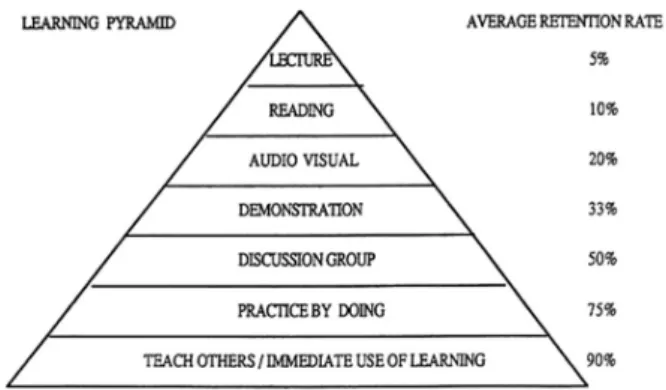
Reference is sometimes made to a “Learning Pyramid” which claims that learners only retain 5% of what they hear while retaining 90% of what they teach to others. However, while this pyramid is often cited as evidence that active learning is superior to passive learning, there is no empirical evidence support its stated retention rates (Letrud, 2012).
Fig1. Learning Pyramid (Masters, 2013).
Another descriptive taxonomy is more helpful in conceptualizing the relationship between memory retention and knowledge construction. Both the original and revised versions of Bloom’s Taxonomy are empirically derived from years of empirical investigation of the cognitive domains of learning (Krathwohl, 2002).
These cognitive domains cover the range of ways a student can interact with information and knowledge. The original taxonomy was designed with the goal of helping to classify lesson objectives and test measurements. As research continued, it was found that objectives and testing rarely move beyond the knowledge (or remembering) domain (Krathwohl, 2002). Importantly, neither Bloom nor the other researchers denied the importance of the lower domain skills of remembering and understanding. Indeed, these are the foundation upon which the more complex (such as creating, evaluation, analyzing, and applying) depend (Kratwohl, 2002). Therefore, if the real world goal is to grow students into adults who are able to work creatively with information and knowledge to solve problems and create solutions, then educators cannot neglect any of the domains.
It is this very point that Ito (2017) makes in his critique of the application of active learning in Japanese universities. Without using an overarching methodology to integrate the six cognitive domains within a class, active learning is not necessarily more effective than passive learning. In fact, Waniek & Nae (2017), in comparing European and Japanese university usage of active learning, believe that insufficient application of Active learning could actually demotivate students. It is therefore important to carefully consider how to implement Active learning in undergraduate education in Japan so that students are engaged in the process.
The purpose of this paper is to compare two reports regarding the implementation of active learning in Japanese universities. By comparing effective implementation and ineffective implementation of active learning, the researchers will be able to show some of the pitfalls to be avoided when implementing active learning and to make recommendations betters ways to implement active learning. Methodology
This project seeks to determine how active learning is being implemented in Japanese universities. We performed a qualitative analysis on secondary data from two reports regarding the implementation of active learning at the undergraduate level of Japanese universities. Our analysis examines what kinds of active learning techniques were used, which
kinds of programs utilized them, and draws contrasting case examples from both effective and ineffective examples whenever possible. Effective Implementation
Effective implementation of active learning was extracted from a report entitled “Changing the Teaching Methods of Japanese Universities” ( 教 授 法 が 大 学 を 変 え る ) complied by the Japan Private University Association (日本私立大学協会). This report compiled data from 26 cases in which active learning was utilized in most lessons for a course. One of the cases related to graduate school, so for our analysis, only the 25 undergraduate cases were utilized.
Ineffective Implementation
Data regarding the ineffective implementation of active learning came from a report entitled “active learning Failure
Handbook” (アクティフラーニング失敗
事例 ハンドブック) compiled by中部地
域大学グループ・東海 A チーム which analyzed 23 undergraduate programs that had unsuccessfully utilized active learning. Problems were grouped into categories of: 1) Issues with guidance (9 cases); 2) Issues with evaluation (5 cases); and 3) Miscellaneous issues (7 cases). Unlike the other report, this one does not identify the kinds of classes, grade year, or even what kind of university was involved.
Results
Effective Implementation
In the examples showing effective implementation, the majority of the cases came from programs that focus on services including, nutrition, pharmacy, law, child
care/pedagogy, and social welfare. Approximately 40% of the programs targeted first year students, which suggests that effective active learning begins relatively early in the school career.
Lecture materials mixed in Active learning
In terms of the objectives and format of the lessons, active learning was mixed in with the lecture materials. That is, there was a mixture of learning on a range of cognitive domains. Role-plays and small group discussions were mixed in with lectures, and project-based learning was also used. Instructors made sure classes were lively and everyone felt included. For example, during orientation, students were given a statement stressing that they were free to talk to faculty members, and they were given opportunities to get know their instructors and the other students.
PBL case’s objectives
In the case of project-based learning, the lessons included activities such as collaborating with companies to design PR activities, researching local community issues, and creating health activities for older adults. Importantly, the goals of these projects was not to actually make a real product-students understood that it was a learning experience in which they needed to be conscious of the outcome, but they didn’t need to feel stress about the reality of their final product for the field placement’s use.
Ineffective Implementation
Problems with implementation were broadly grouped into three categories. 1) Guidance issues include problems regarding student behaviors during group work in class and
during field experiences outside of the classroom. 2) Evaluation issues includes problems around the assessment of deliverables and discrepancies in evaluation between field placements and school faculty. 3) The miscellaneous category was a catch-all category that included issues such as the differences in motivation among different departments and university-wide issues such as the uncertain support for the curriculum within the university.
Guidance issues
Guidance issues reflected both lack of leadership by the teacher and that lack of leadership among students. This was generally observed in group work. Uneven balance of workloads often arose with some students much more engaged than other students. In terms of field experiences, students were not properly respectful of the hosting organization’s staff or their clients, and did not engage in professional behaviors. Also, without guidance either within the field placement or from faculty, the students’ performance often did not improve over the course of the term.
Evaluation issues
Problems regarding evaluation dealt with problems around how to assess active learning effectively and how to keep students motivated. Faculty often had problems devising effective measures of learning. This was even more pronounced in field placements, especially in terms of how to assess the objective features of a project (such as the deliverables for a PR campaign) versus the more subjective features such as student willingness to take risks or be creative. In other
cases, the lack of a clear grading scheme made unmotivated students harder to manage.
Other issues
Miscellaneous problems generally dealt with institutional dynamics. One main factor was the difference in levels of enthusiasm for active learning between departments within a university. Pressure from either resistant or uninvolved departments sometimes made it difficult to fully implement active learning appropriately. Another major problem was that there was often not enough attention paid to training faculty in active learning nor enough resources dedicated to adjust curriculum to an active learning approach. A final problem involved the difficulty with judging how much faculty involvement is needed to successfully facilitate active learning models.
Case Comparisons
Field Work
One major problem was that students did not reach the expectations or grading criteria of the class, especially regarding field work. In one case, students were lounging around, playing with their smartphones, and ignoring clients. Reasons for this included field work not having a clear goal, students only taking the class for credits, students learning the patterns of the class and becoming less engaged, and students not using professional social skills.
In the successful implementation, it appears that criteria for field work are met when field work is directly related to the students’ professional motivation. The use of role plays to set up and practice the situations students would face in the field was also helpful in
clarifying expectations to students. These role plays included focusing on professional behaviors that are expected in the workplace.
Group work/projects
Project-based learning and collaborative learning depend upon students working in groups. Ineffective groups, in the worst case, found it difficult to complete assignments. There was also evidence of unfair work balances and no clear group leadership, which lead to arguments among group members.
In the successful cases, instructors were careful to help coordinate groups that were struggling. In another situation, second year students were brought in to help mentor the first year students. This peer learning (a hallmark of social constructivist approaches) helped the first year students better understand the expectations of both the class and the field placement.
Psychological or Emotional Stress
Ineffective implementation sometimes leaded to psychological or emotional stress for students. This occurred during group work, especially when there were no clear group leaders, or little/no guidance from teachers.
In effective implementation, mental stress stayed low because the students had a cooperative relationship with the instructors, and teachers stayed involved with students throughout the class.
Loss of Trust
One case had a problem with a lack of trust between the field placement and the instructor in a project-based learning activity. Students
were involved in a real PR project that was expected to produce useful outputs. Students did not have clear boundaries drawn to protect their learning environment.
In the effective placement case, it was clear to everyone involved that the students were involved in a learning experience and not actually working. Even though they had outputs (for example, teaching something at community center), the measurement of their activity was not results-oriented. That is, the learning measure was not related the whether they were successful or not at their designed program.
Conclusion
During active learning, students must be actively engaged in the learning process. Instructors act as facilitators. Student activity can be seen as the driving force for learning. Viewed from a distance, it might appear that instructors are doing very little. However, as the above examples show, effective implementation of active learning requires extensive preparation and planning from the instructors, as well as flexibility. Clear goals and measurements, even if not by multiple choice test, are necessary to keep students focused and engaged. Teachers must be willing to step in when there are problems, especially when group work and personality dynamics are involved. Clear expectations between the instructor and field settings are necessary to protect student learning. As opposed to passive learning, where the main role of the teacher is to impart knowledge, in active learning, instructors must be ready to assume a variety of roles, including facilitator, counselor,
mentor, and advocate. Based on our findings, we suggest the following recommendations.
First, for instructors with no experience incorporating active learning into their classes, it is beneficial to get training in designing curriculum based on active learning. Although geared for primary and secondary education, one possibility for training would be an International Baccalaureate workshop. These workshops cover a variety of academic subject areas and explain how to design an entire curriculum using active learning. Since the International Baccalaureate’s Diploma Programme is recognized as the equivalent of first or second year university-level difficulty, this would be especially beneficial for faculty working with first or second year students.
Another recommendation would be for faculty to design their classes utilizing Bloom’s taxonomy. Designing unit plans so that all six of the cognitive domains are covered would mean that active learning is braided into the entire class. Everything from lower level knowledge-acquisition to higher level evaluation and perhaps even knowledge creation could be included.
There are also a variety of books and resources in Japanese that instructors could use for self-study of active learning techniques. One such book is called “Active Learning” (ア クティブラーニング)edited by Professor Nakai (中井). This book contains a range of recommendations such as icebreakers for starting activities, how to increase success of group work, or how to evaluate active learning.
There are, however, some limitations to our findings. As we used secondary data from two separate reports, it is not clear if the cases of the two reports are equivalent. The two reports had different methodologies and different measurement tools.
One future research goal is a comparison of syllabi from effective and ineffective cases of implementation. By examining syllabi using Bloom’s taxonomy, it could be better determined which kinds of activities are best for which cognitive domains. Another research direction would be a qualitative study of Japanese faculty members to determine how to support them in implementing active learning. One more approach would be to which factors in Active learning affect student motivation.
Globalization is a complex process, one in which it is difficult to determine the final outcome and thus how a country can best succeed in a globalized world. By building a workforce that is flexible and able to adapt to a changing international scene, Japan will be able to maintain its standing in the world. Active learning is an important way to help students build their critical thinking skills and creativity, thereby ensuring their success in globally competitive markets.
References
Anderson, L.W. (Ed.), Krathwohl, D.R. (Ed.), Airasian, P.W., Cruikshank, K.A., Mayer, R.E., Pintrich, P.R., Raths, J., & Wittrock, M.C. (2001). A taxonomy for learning,
teaching, and assessing: A revision of Bloom’s Taxonomy of Educational
Objectives (Com- plete edition). New York:
Longman.
Bloom, B.S. (Ed.), Engelhart, M.D., Furst, E.J., Hill, W.H., & Krathwohl, D.R. (1956).
Taxonomy of educational objectives: The classification of educational goals. Handbook 1: Cognitive domain. New York:
David McKay.
Beattie, V. B., Collins, B., & McInnes, B. (1997). Deep and surface learning: A simple or simplistic dichotomy? Accounting
Education, 6(1), 1–12.
Collins JW 3rd and O’Brien NP (editors). The
Greenwood Dictionary
of Education. Westport, CT: Greenwood,
2003.
中 部 地 域 大 学 グ ル ー プ ・ 東 海 A チ ー ム (2014)アクティブラーニング失敗事例ハ ンドブック–産業界ニーズ事業・成果報告, 一粒書房.
Ito, H. (2014). Shaping the first-year experience: Assessment of the vision planning seminar at Nagoya University of commerce and business. International
Journal of Higher Education, 3(3), 1–9.
Ito, H. (2017). Rethinking active learning in the context of Japanese higher education.
Cogent Education, 4(1), 1298187.
Ito, H., & Kawazoe, N. (2015). Active learning for creating innovators. International
Journal of Higher Education, 4, 81–91.
Krathwohl, D. R. (2002). A revision of Bloom's taxonomy: An overview. Theory
Letrud, K. (2012). A rebuttal of NTL Institute’s learning pyramid. Education,
133(1).
Masters, K. (2013). Edgar Dale's Pyramid of Learning in medical education: a literature review. Medical teacher, 35 11, e1584-93. 中井俊樹編著(2015)アクティブラーニン
グ,玉川大学出版部.
日本私立大学協会 教育学術新聞編(2012) 教授法が大学を変える−アクティブ・ラーニ ングを探求する,日本私立大学協会。 Waniek, I., & Nae, N. (2017). Active learning
IN JAPAN AND EUROPE. Euromentor
Journal, 8(4), 82-97.
日本の学士課程教育における効果的/非効果的アクティブ・ラーニングに関する質的分析 Des Marais, Eric(語学教育推進室)
都島梨紗 (保健福祉学部) 要旨 本稿は,日本の高等教育における効果的/非効果的とされているアクティブ・ラーニ ングの実践を考察した。その結果,効果的だったアクティブ・ラーニングの実践では, 教員がしっかりと学生活動に関与し,学習の目的を明確に説明しており,大学と活動先 との間でしっかりとコミュニケーションが図られていた。 キーワード アクティブ・ラーニング;学士教育;ファカルティ・ディベロップメント