Urban Renewal and Changing Spatial Unit in
Beijing, China
著者
Onodera Jun
雑誌名
The science reports of the Tohoku University.
7th series, Geography
巻
51
号
1
ページ
1-17
発行年
2001-06
URL
http://hdl.handle.net/10097/45254
1
Urban
Renewal and Changing
Spatial Unit in Beijing,
ChinaJun ONODERA*
Abstract Under Beijing's rapid economic development and systemic reforms in the 1990s, not only the expansion of the city area but also the spatial restructuring of the inner city is in progress. This paper considers the recent transformation of urban spatial structure in China through an examination of urban redevelopment projects in Beijing. While some business centres have been redeveloped on a large scale, many dangerous and old houses in the inner areas have been razed one after another since the mid-1990s. The redevelop-ment projects often forced inhabitants to move to the outskirts of the city and swept away small-scale but energetic businesses in the cluttered areas. When a redevelopment project is controlled for the preservation of cultural artifacts, a lot of old houses and living infrastructures are deserted without sufficient repair. Local governments are, however, chronically short of funds to improve urban infrastructure. The mosaic society in the inner city, complicated by various housing ownership and administration, has been changing into a regional society based on local community. Such a regional society, instead of work units, will positively participate in regional problems including urban redevelopment.
Key words : urban spatial structure, housing system, redevelopment, Beijing, China
1. Introduction
A considerable number of studies have been made on the changes in spatial
structure that have accompanied China's economic reforms and liberalisation.
Domestic and foreign geographers in China first paid attention to extensive urbanisa-tion in rural areas where township and village industries (xiangzhen qiye) and small cities and towns (xiao chengzhen) had developed rapidly in the 1980s (Onodera 1999). The changes in the rural landscape were promoted by the introduction of a responsibil-ity system for agricultural production (nongye shengchan zerenzhi) and by the influx of foreign direct investment.
During China's economic development in the 1990s, the changes in spatial structure
* Faculty of Humanities and International Studies, Yokohama Kanazawa-ku, Yokohama 236-0027, Japan
Science Reports of Tohoku University, 7th Series (Geography) Vol, 51, No. 1, June, 2001, 1-17
finally reached the cities. Large cities, such as Shanghai, Beijing, and Guangzhou, began to alter their spatial structures intensively, steadily improving infrastructure,
while high-rise office buildings, shopping centres and hotels replaced traditional
buildings one after another. Such intensive urban redevelopment captured the
atten-tion of some geographers.
However, we still know little about what is taking place and what problems are arising within cities as a result of redevelopment. This paper considers the recent
transformation of urban spatial structure in China through an examination of urban
redevelopment projects in Beijing. To begin with, it surveys Chinese social and
economic systems that directly affect urban spatial structure (Chapter 2). Next, after understanding the fundamental spatial structure of Beijing (Section 3.1.), it examines the present conditions of urban redevelopment within the city (Section 3.2. and 3.3.). Lastly, it summarises emerging issues caused by the spatial reorganisation in urban China (Chapter 4). The descriptions in this paper are based on interviews, conducted from January to March 2000, with urban planners, cadres at the basic level and some residents of redeveloped areas. Related materials published in China are also used as sources.
2. The characteristic systems of urban China
2.1. Work unit (Gongzuo danwei)
When China commenced socialist construction in the 1950s, its approach to urban
planning was strongly influenced by the Soviet Union. The general plan of 1957
followed in the footsteps of the Soviets ; it required the equal distribution of public facilities for all residents and close proximity between industrial and residential zones in order to economise on time and traffic (Xue 1996). A result of this was the creation of an urban space consisting of many work units, such as enterprises and institutions, called `gongzuo danwei' or simply danwei'.
Under the planned economic system, most resources were allocated to each work unit according to an economic plan. Every work unit therefore developed, by itself,
its own built environment for production and residence. The whole production
process used to be completed without any division of labour among other work units. Living space also used to be relatively independent by every work unit, because almost all public facilities that were necessary in daily life were provided within the
residen-tial zone. As a whole, an urban space had a huge honeycomb structure bringing
together a lot of relatively independent work units (Wu and Cui 1999).
Actually, there is a considerable difference among work units in their degree of spatial completion (Chai 1999). An urban space is not always fully organised by work units, especially in the old, pre-liberation sections of the city and in new towns in the
Urban Renewal and Changing Spatial Unit in Beijing, China 3
suburbs. Moreover, since 1978 the economic system has become market-oriented by
economic reform policies, which has led to the diversification of economic units and to
the gradual dissolution of work-unit space (Wu and Cui 1999). However, as an
already existing built environment is hard to modify and the manners of production and living are also inertial, the spatial structure based on the work unit still character-ises China's cities.
2.2. Land system
The land system is also an important factor in the formation of China's urban
spatial structure. The planned economic system did not require a land market ;
urban land was administratively allocated to work units. Since work units could
obtain land with no charge, occupy it exclusively, and be exempted from any payment of rent or taxes, they had no incentive to utilise their land effectively. They got more land than they actually needed, stored it idly, and used it roughly. Once land use was decided, it was quite difficult for a work unit to obtain another lot of land for new
purposes. Consequently, urban land use was fixed and left inefficient under the
planned economic system.
The land system has been reformed since the late 1980s. A land market has
started to function by charging for land use (Onodera 1997). Increasing industrial production and diversification of the industrial structure have added to a demand for
land and have required adjustments to land use. At the same time, the improved
standard of living has led people to pay attention to their living environment. Local governments, having profited by charging for urban land-use rights, have invested that capital to develop and build infrastructure, not only for production but also for living environments. Thus we see that the new land system has promoted the change in the urban spatial structure.
In practice, only a minority of urban land is leased from the government, while the majority is still used on a free basis. This differential pricing system causes specula-tion and a black market for urban land (Cong 1999).
2.3. Housing system
The reform of the housing system has also strongly influenced the restructuring of urban space since the early 1990s. For the moment, let us look closely at the housing system in work units, which accounts for a majority of the urban housing in China. In the past, work units provided housing virtually free of charge to their workers as a benefit in kind. This also allowed the work units to keep the workers by controlling the housing supply. Work units used to build almost all houses together in a residen-tial zone near a production zone, according to plan. As a result, these work units took on the structure of a honeycomb, as mentioned above.
It was possible for work units to provide free housing, because a housing fund was included in the welfare fund of their internal reserves, not in the wages of each worker. Under the soft budget constraints of state-owned enterprises, a considerable amount
was applied to housing investment, with money being drawn even from production
funds. The uncertainty of housing construction costs led not only to blind investment in housing but also to unfair housing distribution. Consequently, demand for housing increased indefinitely, without any of the restraints of individual solvency. Housing
construction, distribution and consumption were administratively controlled only in
the redistribution phase of national income (Dong 1999).
The heart of housing system reform since the early 1990s has been the
establish-ment of a market mechanism to adjust housing supply and demand effectively. Work
units stopped the practice of housing their workers for nominal rates. Instead, they have raised the housing rate on the one hand while giving a housing allowance to every
worker on the other hand. The government has established systems that encourage
workers to save money in order to buy a house, as well as systems to issue mortgage
loans. All these measures motivate workers to purchase housing within their work
units. The residents (workers) become investors as well as consumers of housing it follows that they will then pursue the maximisation of the return on their investment
that is, to improve their living circumstances (Dong 1999).
However, we cannot say that the workers have already achieved independence from their work units in terms of housing. The houses administered by a work unit are sold only to the workers in that unit, and at a discount. This is partly because the land in residential zones was allocated without compensation and is still not being charged for, and partly because these houses contain a certain accumulation of owner equity that should have been included in workers' wages. Some work units purchase
houses from developers at market prices and sell the houses to their workers at
preferential prices. Since such work units purchase a huge quantity of the houses on
the market, housing prices soar. Therefore, individuals cannot easily buy houses
these days. The commercial housing market has not developed in a uniform manner.
That is, disparities in housing conditions among work units continue to exist, and those who are not assigned to work units still cannot enjoy housing security (Zhang 1996).
This chapter has examined some peculiar features of Chinese socio-economic
systems that affect the urban spatial structure in China. As China has reformed these systems in recent decades, urban space has been restructured gradually but surely. In China, it is not enough merely to understand the developers and individuals who follow
market mechanisms. It is also necessary to understand local governments and work
units that are positively involved in restructuring the urban space. We shall now look
at the actual conditions of urban redevelopment as an aggressive measure of urban
redevelop-Urban Renewal and Changing Spatial Unit in Beijing, China 5
ment has heated up since the mid-1990s.
3. Urban renewal in Beijing
3.1. Urban spatial structure of Beijing
To begin with, let us look at the dynamics of Beijing's population. The popula-tion of the inner city area, roughly equivalent to the Dongcheng, Xicheng, Xuanwu and
Chongwen wards, increased slightly from 1964 to 1982, while it decreased somewhat
from 1982 to 1990. In the 1980s, the population of inner suburban wards, Chaoyang,
Haidian, Shijingshan and Fengshan, grew drastically ; outer suburban wards also
increased in population. This trend continued in the 1990s. According to a
large-scale questionnaire survey, a great number of people migrated from the inner city to the inner suburbs in this period (Zhou and Meng 2000 : 48, 66). It seems reasonable to
suppose that Beijing has come to the stage of suburbanisation. In addition, the
workforce data also show a decrease in the inner city and an increase in the inner suburbs. It is worthy of attention that there was a slight increase in the workforce service industries, especially real estate business and financial services, in the inner city and its vicinities (Zhou and Meng 2000 : 88, 92).
From a sociodemographic viewpoint, the suburbanisation of Beijing spreads out in the shape of a fan (Gu 1999). The wealthy, including entrepreneurs and executives, are likely to live in the northeast in an area extending from the business district near the second ring road to the international airport. In the southwest, where many factories
are agglomerated, new industrial parks have been built on the outskirts.
Low-in-come, unskilled labourers are likely to reside in this direction. Many universities,
research institutes and high-technology enterprises are located in the northwest
around Zhongguancun. Professionals and other middle-class white-collar workers
reside there. The southwest has many middle-class engineers. In the inner area of
the city, people of the lower classes are left behind and aging steadily.
There is little data on the transient population, but it is said that most of them settle down at construction sites or vacant grounds in the suburbs, except for those who come into the inner area to work in service industries. Those who are from the same home town often gather and stay together ; Zhejiang village in the south, Henan village in the north and Xinjiang village in the west are well-known examples (Gu 1999).
Based on this demographic picture, what urban landscape has been formed ?
Generally speaking, because land rents are highest at the centre of a city, the rate of building volume to lot is also the highest there, in order to optimise land use.
Therefore, the centre of a city bristles with skyscrapers. As land rents decline
Zhongguancun The 4th ring road The 3rd ring road
rinR road FuchengnieO, Jinrongj ii (Finance Fuxingme niatri 4) x :T The 2n an idan um n anm 0:. C 0 Qi n ng a a nm Cimoyang ••• • Jianeuom ire; kfongyv6*n en Liaomahe en n
Built-up areas since
preliberation days
0 2 4 km
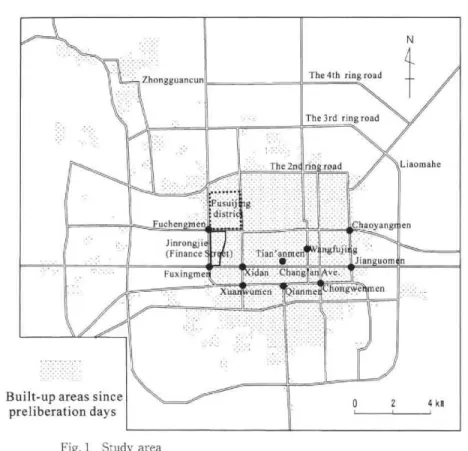
Fig. 1 Study area
Source : China City Atlas Editorial Department (1994) p. 4.
however, the buildings at the geometrical centre of the city, where Tian'anmen Square and the Imperial Palace are situated, are not so high. Urban planning strictly controls the rate of building volume to lot there, because there are many landmarks of cultural heritage and politically symbolic buildings. This controlled area covers seven or eight square kilometres surrounded by the second ring road, which overlaps with the former castle walls and moats of the Qing dynasty. There are numerous high rises between the second and third ring roads. Buildings become shorter still from the third ring road to the outskirts of the city, as is typical of urban landscapes (Fig. 1).
The inside of the second ring road has government offices and large-scale
commer-cial districts, such as Wangfujing, Xidan and Qianmen, along main streets. On the
other hand, there are thousands of courtyard houses (siheyuan) that were built before liberation along a mesh of narrow lanes (hutong). Since liberation, each courtyard house has been subdivided (dazayuan) so that several families can live in it.
Office buildings stand in line along Chang'an Avenue crossing Tian'anmen Square.
Urban Renewal and Changing Spatial Unit in Beijing, China 7
Fuxingmen, Chaoyangmen, Liangmahe and so forth among the neighbourhoods of the second and third ring roads. The old residential zones of work units, which still maintain low-rise apartment buildings built from the 1950s to the 1970s, are distributed outside the second ring road. In recent years, taller apartment complexes have been built in the suburbs beyond the third and fourth ring roads.
3.2. Progress and problems of urban redevelopment in Beijing
The emergence of the market-oriented economy has promoted functional and
spatial differentiation within the city of Beijing. While built-up areas have expanded to the outskirts, the redevelopment of Beijing's old section has been essential. As a
consequence of redevelopment, state-of-the-art offices have agglomerated in
particu-lar areas with well-equipped infrastructures, forming new business districts. The
recent improvement in living standards has greatly increased demand for housing.
However, since the end of the real estate boom around the mid-1990s, various prob-lems have come to the surface : a high vacancy rate from the over-supply of office space, the mismatch of housing supply and demand in terms of grade, the shelving of
redevelopment projects because of budget shortages, and a bad influence of urban
redevelopment on the local communities of old inhabitants.
3.2.1. Recent trends
Let us survey the recent trends in real estate development. Fig. 2 shows the
changing areas of real estate development in Beijing since 1986. The land
develop-ment areas fluctuated violently between booms and recessions. Although the land
development area reached its lowest point in 1993, the government had already sold off a large quantity of land by this time. This sell off led to the land development boom
from 1994 to 1995. Housing construction has been increasing in response to actual
demand. The construction of offices and shops, though only a small portion of the total, increased remarkably in the latter half of the 1990s.
Table 1 presents the construction funding for commercial building properties in
Beijing by sources. Our data are limited to three recent years, but these data suggest that foreign capital played an important role in the real estate market. The means of raising funds by deposit and advance payment from the buyers of properties have come
into wide use. Domestic financing has also been increasing markedly. The
invest-ment from the national budget is very small. Except that houses owned by
state-owned work units are sold to their workers, governments no longer involve themselves directly in real estate development.
Table 2 indicates the market prices of commercial building properties in Beijing by concentric zones defined by the ring roads. Although these data do not cover all real estate deals, we may say that they represent a regional tendency in 1998. The
(Thousand sq. metres) 9,000 8,000 7,000 6,000 5,000 4 4,000 3,000 2,000 1,000 01 19 Fig. 2 La 1998) Note : 1986 1988 1990 1992 1994 1996 1998
2 Land develoment area and completed floor space o commercial 1998)
Note : No data for completed floor space of office in 1992 and h building in 1992, 1993 and 1998.
Sources : Meng, Mo and Zhang (1998) pp. 305-308 and Meng and M
Table 1 The sources of construction fund for commercial bui
Beijing (1995-1997)
—go—Land development area
—a— Completed floor space of house
—A— Completed floor space of office
—*-^ Completed floor space of shop
-Completed floor space of other building
f commercial buildings (1986- 1992 and )93 and of other Meng and o (1999) p. 138. mmercial building in RMB million, (%) 1995 1996 1997 Total National budget Domestic loan Bond Foreign capital Funds on hand
Deposit and prepay
Others 58,135 238 5,991 30 14,024 8,013 12,842 16,997 (100.0) (0.4) (10.3) (0.1) (24.1) (13.8) (22.1) (29.2) 42,633 293 8,165 30 10,804 6,708 13,422 3,211 (100.0) (0.7) (19.2) (0.1) (25.3) (15.7) (31.5) (7.5) 41,089 341 9,798 8,160 5,708 14,737 2,345 (100.0) (0.8) (23.8) (19.9) (13.9) (35.9) (5.7)
Source : Meng, Mo and Zhang (1998) p. 310.
data on the prices of houses and upscale residences suggest a spatial structure for Beijing in which rent declines from the neighbourhoods of the second ring road toward the outskirts. It seems that office buildings are located mainly within and near the second ring road, while villas are distributed near and beyond the fourth ring road.
Urban Renewal and Changing Spatial Unit in Beijing, China 9
Table 2 The market prices of commercial buildings in Beijing by area (1998)
Thousand sq. metres, RMB/sq. metres
Ordinary High-grade Complex Office Villa
house house building building Office
Within the second ring road
Total area
Average price
Around the second ring road
Total area
Average price
Around the third ring road
Total area
Average price
Around the fourth ring road
Total area
Average price
The suburbs beyond the
fourth ring road
Total area Average price 100 10,283 594 7,320 704 5,870 160 4,200 172 1,840 60 12,650 60 9,300 30 8,230 40 4,700 30 3,200 30 7,300 20 5,800 160 15,000 70 9,600 20 5,880 10 3,500 29 10,500 20 8,900 2 7,800
Note : These data do not cover all deals. Source : Meng and Mo (1999) p. 123.
3.2.2. Development of business districts
The transfers of land use rights have been accelerated in Beijing since 1992. The land use rights of 62 lots, about 210 hectares, were sold off by local governments to foreign-funded enterprises in the first half of 1993 alone. This area was roughly 3.4 times that of the total sold off in all of 1992. The land profit obtained by local
governments in this period amounted to RMB600 million and US$2.5 million, more
than 10 times as much as in 1992. The land profit was invested in the improvement of
infrastructure in the urban area. This overheated the development of industrial
parks, villas, high-end condominiums and business buildings (Zhou and Meng 2000 :
183). Large-scale developments have been carried out in Jinrongjie, Wangfujing,
Xidan, Chongwenmen, Longfusi, Xuanwumen-wai, Guang'anmen Avenue,
Chaoyang-men-wai and so forth.
For instance, the Beijing Jinrongjie (Finance Street) project stretches from
south-ern Fuxingmen-nei Avenue to northern Fuchengmen-nei Avenue for 1,700 metres and
from the western second ring road to eastern Taipingqiao Avenue for 600 metres. Its planned area is 103 hectares. It is convenient to main roads and subway lines, and it lies 3 kilometres west of Tian'anmen. This project is planned to include more than 20
Square. Dozens of national-level financial institutions have already moved to this area, which is expected to become a national financial centre (Ministry of Construction 1999). According to my observations as of March 2000, there were several large office buildings along the second ring road and Fuxingmen Avenue, which seemed to have rather many vacant rooms. It appeared that the area on the north side of Wuding lane near the second ring road would be developed in the near future. A lot of traditional streets and houses still survived in other parts of the planning area.
3.2.3. Redevelopment of dangerous and old houses
The development of business districts is closely related to the redevelopment of dangerous and old houses. According to the building safety census in 1998, the total area of dangerous houses in Beijing was 4.76 million sq. metres ; dangerous houses under direct public administration reached 2.226 million sq. metres in area and account-ed for 7.83% of all houses under direct public administration ; dangerous private houses reached 1.492 million sq. metres in area and accounted for 20% of all private houses. It is estimated that 80% of the dangerous houses are concentrated in the four inner wards and that nearly 10,000 additional houses will be recognised as dangerous and old every year (Ministry of Construction 1999). Still, it is observed that the rate of dangerous and old public houses is liable to be underestimated in order to reduce governments' repair burdens, and that the rate of private ones is liable to be
overes-timated in order to push forward with redevelopment projects (Ni 1999).
From 1990 through 1997, the redevelopment of dangerous and old houses was
started in over 110 areas, 3.3 million sq. metres of dangerous and old buildings were razed, redevelopment in 28 areas was completed, 121,000 families of inhabitants were
removed, and 94,000 of those families returned and resettled. Such redevelopment
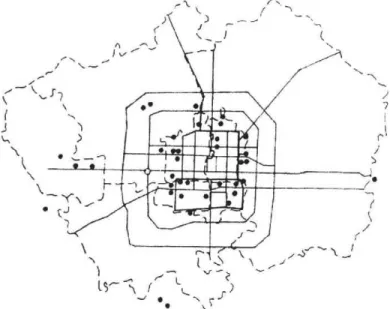
projects were carried out near former castle walls in the early years, and then near the heart of the inner city in the later years (Fig. 3 and 4).
Because of funding shortages, local governments cannot carry out redevelopment
by themselves. Therefore, they offer land use rights to real estate developers at low prices, reduce the cost of redevelopment, and promote redevelopment in inner areas.
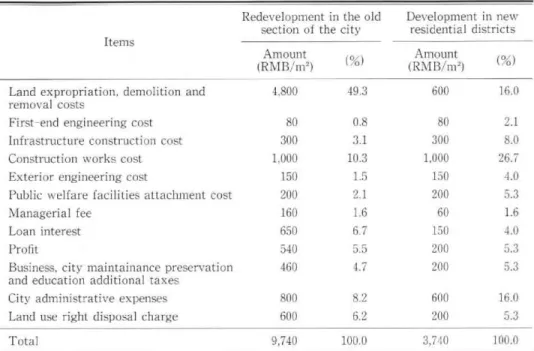
However, since the cost of redevelopment in inner areas is much more expensive than the cost of new development in the suburbs (Table 3), developers have not been eager
to touch redevelopment projects (Zhou 1999). They avoid areas with strict building
regulations that protect nearby cultural remains. They would prefer to take part in redevelopment projects that are on a larger scale, with a higher rate of building volume to lot, with higher-grade properties, and with smaller numbers of former inhabitants returning after the redevelopment is finished.
On the contrary, after learning a lesson on forcible redevelopment in the mid-1990s, people came to regard the preservation of cultural artifacts, including
tradi-Urban Renewal and Changing Spatial Unit in Beijing, China 11 li j f "" ) ) • f 1 *N . • L J • • • I-ts- ‘.\ I • L t ,
Fig. 3 Redevelopment projects of dangerous and
Source : Zhou and Meng (2000) p. 149.
I j
old houses in
tr
Beijing (th e first stage)
) N
• 5
• -\ • I • ti • • • • 1 • • • • ) • 7 JI 1 • 1 ‘1 \ • r S`' rFig. 4 Redevelopment projects of dangerous and old houses in Source : Zhou and Meng (2000) p. 150.
Table 3 Construction cost of ordinary houses in Beijing
Redevelopment in the old section of the city
Development in new residential districts Items Amount (RMB/m2) (%) Amount (RMB/m2) (%)
Land expropriation, demolition and
removal costs
First-end engineering cost
Infrastructure construction cost
Construction works cost
Exterior engineering cost
Public welfare facilities attachment cost
Managerial fee
Loan interest Profit
Business, city maintainance preservation
and education additional taxes
City administrative expenses
Land use right disposal charge
4,800 80 300 1,000 150 200 160 650 540 460 800 600 49.3 0.8 3.1 10.3 1.5 2.1 1.6 6.7 5.5 4.7 8.2 6.2 600 80 300 1,000 150 200 60 150 200 200 600 200 16.0 2.1 8.0 26.7 4.0 5.3 1.6 4.0 5.3 5.3 16.0 5.3 Total 9,740 100.0 3,740 100.0 Source : Wang (1997).
tional lanes (hutong) and courtyard houses (siheyuan), as a big problem in Beijing. Furthermore, some people came to insist that it is necessary to preserve the living spaces of inhabitants and their communities so as to maintain urban vitality (Ni 1999).
As a consequence, it is quite difficult for developers to collect enough rent to cover the extremely high cost of redevelopment. These difficult conditions hinder orderly
redevelopment and result in uncontrolled redevelopment projects occurring at random.
Inhabitants of the inner city cannot enjoy a good living environment so easily. They may even be ordered to leave their home suddenly. Thus they always feel dissatisfied and anxious.
3.3. The case of Fusuijing district
3.3.1. Conditions over redevelopment
Fusuijing district is situated in the west of old Beijing and is surrounded by the
second ring road (west), Fuchengmen-nei Avenue, Xisi North Avenue, Xinjiekou South
Avenue, Xizhimen-nei Avenue ; the area stretches about 1.5 kilometres from east to west and about 1.8 kilometres from south to north (Fig. 1). In this district, narrow lanes (hutong) run irregularly, a great deal of dangerous and old one-storey houses
Urban Renewal and Changing Spatial Unit in Beijing, China 13 remain, and public facilities and the infrastructure that inhabitants need are in short supply. Still, hundreds of small-scale businesses are thriving in this cluttered area.
This district is studded with a number of cultural assets, such as Miaoying Temple
(Baita Temple), Luxun former residence, the shrine of past emperors and Guangji
Temple. Along Ping'an Avenue, which crosses the district from east to west,
devel-opers have constructed a shopping mall that imitates historical appearances.
Espe-cially, Baita (white pagoda) in Miaoying Temple has become a symbol for the preser-vation of cultural assets and the conserpreser-vation of landscape, and it is therefore a great
influence on how urban planning should be in this district (Huang 1996).
Beijing Jinrongjie Development Company, which has developed Jingrongjie in the
south of Fusuijing district, also has the right to develop the Baita Temple area in southwest Fusuijing district. According to the plan, the development is 400,000 sq. metres in area (Ministry of Construction 1999). As for business-use floor space, the development company planned to demolish an area of 17,261 sq. metres and build an area of 58,200 sq. metres to make a profit by selling and leasing portions. As for residential floor space, they planned to demolish an area of 182,657 sq. metres on the one hand, but to build on an area of only 174,700 sq. metres on the other hand. In
terms of the number of households, the demolition is removing 6,272, whereas the
construction is putting in 2,950 ; in terms of population, 15,862 people are scheduled to move out, whereas only 9,440 people can live here after the construction. Even if former inhabitants would be able to return to the newly built houses, the rate of return would be less than 60 per cent. However, because the newly built houses are sold as high-end commercial properties, in practice it is almost impossible for the majority of former inhabitants to purchase those houses. It is supposed that the return rate of former inhabitants would be very low. Objections to this point have begun to surface
in recent years. In reality, funding shortages at the development company have
forced the company to freeze the plan for the time being. As the trend toward
preserving cultural heritage grows, the control of redevelopment by urban planning has
been strict recently. Developers are anxious about the declining rentability of
re-development projects.
3.3.2. Conditions over housing
Many houses administered by the work units of central organisations, such as the State Council and the Chinese People's Liberation Army, are distributed in the district.
In general, each large work unit has a number of houses throughout Beijing. Some
work units directly administer their houses, while other work units commit their
houses to regional setups for administration, for it is very troublesome to administer large numbers of dispersed houses.
houses, excluding the ones that work units are responsible for ; one is public direct
administration houses owned by the housing administration bureau of Xicheng ward,
Beijing, and the other is privately owned houses. These two types account for 39% of all houses ; accordingly, work units own 61% of the houses in the district. In the
whole of Beijing, approximately 20% of houses are administered by housing
adminis-tration stations.
There are about 280,000 sq. metres of floor space or 20,831 rooms of direct
administration houses : 4,120 multi-storey houses in 37 places and 16,711 rooms in one-storey houses in 1,416 places. The majority of one-storey houses were built before
liberation and were requisitioned for various reasons by the authorities.
Further-more, there are about 190,000 sq. metres or 14,008 rooms of private houses, including both the houses that owners live in for themselves and the ones that are rented out. Consequently, the housing administration station administers about 470,000 sq. metres or 34,839 rooms in this district.
With the reform of the housing system, the multi-storey houses of work units have been sold to the employees. One-storey houses are permitted to be let, but not to be
sold, before redevelopment begins. Even though people are allowed to buy and sell
private houses, the number of such trades is small, as most houses are old and
outmoded. The conditions of ownership and administration are quite complicated
among lots in the districts. Although it is desirable to carry out a redevelopment project all at once, it is extremely difficult to adjust the differences of property rights in an area, which is a prerequisite condition of redevelopment.
Decaying houses need repair. Some work units have management companies in
charge of repairing their houses, whereas others consign the repair of their houses to external repair shops. In the case of direct administration houses, because house rent is at a very low rate (RMB1.3 per sq. metre), it cannot cover the expenses of repair. It is difficult to collect enough house rent from poor inhabitants. In the case of private houses, owners have to pay for repairs by themselves. The repair of private houses
is apt to be behind, which results in the deterioration of the living environment.
Since work-unit housing has been sold to individuals at an increasing tempo, the range of local authorities in housing administration has been extending. To put it another way, the principle of housing administration has changed from a work-unit basis to a district basis. The minimum unit of spatial structure has been changing in urban China. In spite of the difficulties of administrating and razing, dangerous and old houses, a new, district-based social system might coordinate various interests in each district and make it possible to carry out appropriate redevelopment projects.
Urban Renewal and Changing Spatial Unit in Beijing, China 15
4. Concluding remarks
Under Beijing's rapid economic development and systemic reforms, not only the
expansion of the city area but also the spatial restructuring of the inner city is in
progress. From this process, however, some issues have been emerging.
The first point is whether or not the interests of the communities of former inhabitants were sufficiently considered before redevelopment projects began. In the
background of land system reform, urban redevelopment was aggressively pushed in
the 1990s. Local governments positively permitted large-scale developments for the
purpose of improving the urban function as a central place. These redevelopment
projects often forced inhabitants to move to the outskirts of the city. At the same time, these projects swept away small-scale but energetic businesses and active human
networks that had flourished in the cluttered areas. We should value highly the
diversity of local communities to ensure a vibrant urban society.
The second point is how the living environment of a local community should be
improved within the framework of urban redevelopment. When a redevelopment
project is controlled for the preservation of cultural artifacts or for other reasons, a lot
of old houses and living infrastructures are deserted without sufficient repair.
Because it is difficult for governments to raise funds by disposing of land use rights in such areas, governments are chronically short of funds to improve urban
infrastruc-ture. Some urban planners maintain an extreme idea that it is necessary to force
many inhabitants occupying courtyard houses (dazayuan) to move out to the suburbs so that the original courtyard houses can be rehabilitated and occupied by only one family in the upper income bracket. In this way, they expect, the traditional landscape of courtyard houses (siheyuan) and lanes (hutong) will be preserved well (Ma 1999).
Now, governments have to present clear future prospects : how they are planning to use urban land in inner areas, how they are planning to maintain or renew local communities, and how they are planning to raise funds for redevelopment. With such guidelines in place, it will be possible to form a sound real estate market and let individuals and developers make rational and preferable choices concerning redevelop-ment. It is also necessary to restructure the mosaic society, complicated by various housing ownership and administration, into a regional society based on local commu-nity. Such a regional society, instead of work units, will positively participate in
regional problems including urban redevelopment. This will make it possible to
proceed with orderly and sustainable redevelopment projects.
The actual circumstances of urban redevelopment remain little known. This
calls for further investigation of the conditions of local community and the compli-cated relations over land and housing in the inner city before and after redevelopment. Only after the actual circumstances are clarified can the process of urban
redevelop-ment be thoroughly explained in the context of urban spatial restructuring.
Acknowledgement
I wish to express my gratitude to Professors Zhang Wenchang, Chen Tian and Zhang Wenzhong at Institute of Geographical Sciences and Natural Resources Research, Chinese Academy of Sciences, for supporting my stay in Beijing. This research was financially supported by a grant from Finance Research Institute, Ministry of Finance, Japan. An early form of this paper first appeared in Japanese in the annual research report of the Institute.
References (*in Japanese, **in Chinese)
Chai, Y. W. (1999): Zhongguo chengshi neibu kongjian jiegou (China's Urban Inner Spatial Structure).** C.L. Gu, Y.W. Chai, J.M. Cai, Y.F. Niu, Y. Sun, T. Chen and G.A. Ye :
Zhongguo chengshi dili (Urban Geography in China). Shangwu Yinshuguan, Beijing,
394-417.
China City Atlas Editorial Department (1994) : Zhongguo chengshi dituji (shangce) (China City Atlas (Volume One)).** Zhongguo Ditu Chubanshe, Beijing.
Cong, Y. (1999) : Cunliang rushi : Chengshi yongdi zhidu shang xu jinyibu chuangxin (To Market Storage : Urban Land Use System Needs Further Innovation).** Zhoongguo
Tudi Kexue, 13(4), 24-26.
Dong, L.M. (1999) : Zhongguo zhufang fenpei zhidu de jizhi zhuanhuan (The Mechanism over of Housing Distribution System in China).** S.W. Cheng ed. : Zhongguo
hen zhufang zhidu gaige : Mubiao moshi yu shishi nandian (China's Urban Housing
System Reform : Target, Model and Practical Difficulties). Minzhu Yu Jianshe
Chubanshe, Beijing, 359-408.
Gu, C.L. (1999) : Zhongguo chengshi shehui kongjian jihua yu shehui kongjian fenyi (Polarization
and Differentiation of Social Space in Urban China).** C.L. Gu, Y.W. Chai, J.M. Cai, Y. F. Niu, Y. Sun, T. Chen and G.A. Ye : Zhongguo chengshi dili (Urban Geography in
China). Shangwu Yinshuguan, Beijing, 473-504.
Huang, Y. (1996) : Ruhe zai gaizao jiucheng de tongshi baohu qi Iishi wenhua huanjing : Yi Beijing Baitasi diqu gaijian guihua wei li (How to Preserve Historical and Cultural
Environment in Redeveloping the Old Section of the City : A Case Study of Beijing
Baita Temple area Reconstruction Plan).** Beijing Guihua Jianshe, 2, 16-23. Ma, B.J. (1999) : Beijing siheyuan Jianszhu (Beijing Courtyard House Architecture).** Tianjin
Daxue Chubanshe, Tianjin.
Meng, X.S. and T.Q. Mo (1999) : Zhongguo fangdichan tongji nianjian 1999 (China Real Estate Statistical Yearbook 1999).** Zhongguo Chengshi Chubanshe, Beijing.
Meng, X.S., T.Q. Mo and J.Z. Zhang (1998) : Beijing fangdichan nianjian 1998-1999 (Beijing Real Estate Yearbook 1998-1999).** Zhongguo Jihua Chubanshe, Beijing.
The Ministry of Construction (Information Centre and Sino-Foreign Construction tion Limited Liability Company) (1999) : 1999nian Beijing-shi fangdichan shichang
diaocha baogao (Beijing Municipality Real Estate Market investigation Report).**
Zhongguo Jianzhu Cailiao Gongye Chubanshe, Beijing.
Ni, Y.H. (1999) : Dangqian Beijing jiucheng gaizaozhong de wenti yu jiyu : Fengsheng-bei diqu gengxin gaizao yanjiu (Current Problems and Opportunities in Beijing Inner City
Urban Renewal and Changing Spatial Unit in Beijing, China 17
Redevelopment : A Study of Fengsheng North District Renewal).** Chengshi Guihua, 4, 42-46.
Onodera, J. (1997) : Chugoku ni okeru tochi seido kaikaku to tosi keisei : Shukou deruta chiiki, Shinsen-shi no jirei kara (Land System Reform and Urban Formation in China : A Case
Study of Shenzhen Municipality, the Pearl River Delta Region).* Ajia Keizai, 38(6),
18.
Onodera, J. (1999) : A Mechanism of Urban Formation in Developing Asia : A Case of the Pearl River Delta Region, China. Geographical Review of Japan, Series B 72, 111-121. Wang, S.H. (1997) : Jiasu putong zhuzhai shangpinhua de jidian jianyi (Some Prospects to
Accelerate the Commercialization of Ordinary Housing).** Beijing Guihua jianshe, 4,
16-18.
Wu, Q.Y. and G.H. Cui. (1999) : Nanjing-shi juzhu kongjian fenyi tezheng ji qi xingcheng jizhi (Characteristics of Living Space Differentiation and its Formation Mechanism in
Nanjing Municipality).** Chengshi Guihua, 1, 23-26 and 35.
Xue, F.X. (1996) : Beijing : You chuantong guodu dao shehui zhuyi shoudu (Beijing : From Traditional Capital to Socialist Capital).** University of Hong Kong Press, Hong
Kong.
Zhou, Y.X. (1999) : Dui chengshi jiaoquhua yaoyin shilidao (Factors of City Suburbanization).**
Chengshi Guihua, 4, 13-17.
Zhou, Y.X. and Y.C. Meng (2000) : Beijing de jiaoquhua ji qi duice (Beijing's Suburbanization