page range
1-25
year
2013-09
Oil Palm Plantation Sustainable Management Model :
A Community
-Based Cooperative
Fatwa RAMDANI* and Masateru HINO
Abstract Indonesia is under intense pressure from the international community
regarding the remarkable expansion of oil palm plantations there. Despite this con-cern, the national government plans to keep on expanding. In order to find a sustain-able way to manage oil palm plantations, we need to assess sustainsustain-able development within oil palm villages. This study assessed and documented the development of a transmigration village in which oil palm was the main resource and source of livelihood for villagers. This study also developed and used an extension of the KJ method. Interac tions between stakeholders, and stakeholders’ various roles, were input into the simple scheme, which yielded the best explanation of the sustainability assessment in the village. As a result, we determined that the following items should be considered major factors in sustainable oil palm plantation management : (1) social capital embed-ded among smallholders ; (2) a community-based cooperative production organization
that sustains the livelihood of smallholders and protects their bargaining power ; (3) local government that has a good relationship with the cooperative production organiza-tion ; (4) a company that establishes mutual trust with smallholders ; and (5) govern-ment policies for maintaining long-term sustainable management.
Key words : oil palm plantations, sustainable development, community-based
organi-zation, Indonesia
Geoenvironment, Institute of Geography, Earth Science Department, Graduate School of Science, Tohoku University, 6-3, Aramaki Aza-Aoba, Aoba-ku, Sendai 980-8578, Japan
*E-mail : [email protected] 1. Introduction
Indonesia is seen as an important player in the fight against climate change and is under intense international pressure to curb its rate of deforestation due to oil palm plantation expan-sion. Oil palm plantings in Indonesia are estimated to occupy a record 10.8 million hectares, with a mature “harvested” area of 8.9 million hectares (BPS, 2012). Palm oil production in Indonesia hit a record 31.0 million tons in 2013 (USDA, 2013).
The palm oil industry is a pillar of the national economy in Indonesia, employing over 3.0 million people, representing roughly 4.5% of GDP, and generating export earnings totalling $10.4 billion in 2009. It is a vital agricultural industry, capable of delivering both substantially higher levels of hard currency earnings and job growth over the next 2-3 decades on the back of
nesian part of the island of Borneo), and on the island of Sulawesi.
Indonesian production costs, including labour, are very low, averaging $250-300 per ton of
crude palm oil (CPO). Profitability for processors is also quite high, and in the current market amount to $500-600 per ton. With this kind of demonstrated profitability, it is not surprising
that there has been a surge of interest from both poor farmers and commercial investors con-cerning palm oil ventures in the country, which are perceived to be a huge opportunity (USDA, 2010).
Smallholders account for around 40% of national output, equaling about 8.5 million tons (BPS, 2011). The expansion of oil palm plantations has continued unabated to the present day, although more than 25 years have passed since Suharto introduced his transmigration policy. In addition, many transmigration villages have reached the point at which the oil palm trees must be rejuvenated. Therefore, now is a good time to ask what factors are important for smallholders in the sustainable management of oil palm plantations? In this study, we exam-ined these factors ; in order to accomplish this, we chose to study the Ukui Sub-district, in
Riau Province, Sumatra. This study assesses the development of oil palm plantations from the perspective of sustainability, and discusses the application of best practices at the farm level.
2. Study area and transmigration for the development of oil palm plantations 2.1 Location of the study area and physical characteristics
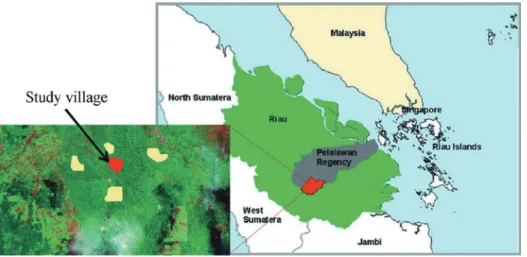
The study area is situated in Ukui Sub-district, Pelalawan Regency, Riau Province, on
Sumatera Island (Figure 1). The Ukui Sub-district is located at the coordinates 00°07´S and
102°08´E in the southern part of the Pelalawan Regency. This sub-district is 75 km from
Pan-gkalan Kerinci, the Regency Capital of Pelalawan, which is itself 200 km southeast of Pekan-baru, the capital of the province. Lintas Timur, the national highway that traverses Sumatera Island, runs through Riau Province.
The topography of the Ukui sub-district consists mainly of hills (52%) punctuated by flat
plains (48%). The average elevation is 7.3 meters above sea level. Before the development of the oil palm plantations, the area was covered by tropical rainforest.
Climatic conditions in the study area are suitable for oil palm plantations. The Ukui sub
-district has a wet, tropical climate influenced by the monsoon. Precipitation in this area ranges from 2,200-3,000 mm per year, and average temperature is 22-32°C, with a relative humidity
that hovers around 80-88%.
2.2 Transmigrant village
The Ukui Sub-district consists of five villages established by transmigrants from Java
Island in 1987. The survey village is one of these (indicated by red in the inset in Figure 1). This village, Bukit Java, is located in the central part of the sub-district. It was founded by
government transmigrants who had received training on plantation-management skills such as
administration, fertilizing techniques, and tree treatment techniques from government agencies in home areas such as Central and East Java. A large number of these transmigrants were tenants in home areas. These workers cleared the tropical forest in cooperation with a palm oil plantation company located in the same area (a member of the Group of Asian Agri. group). Furthermore, the transmigrants worked as labourers at the plantation of this company until they could harvest their own plantations. An intimate, interdependent relationship between the oil palm plantations and the company continues to this day. The company pur-chases fresh fruit bunches from smallholders and provides technical assistance with the control of pests and disease. The survey village had a population of 1,722 individuals living in 521 households in 2012 (Village Report, 2012). The area is 1,800 ha.
During the Suharto government, in order to reduce the overpopulation of Java Island, as well as increase the socio-economic level of the people, the government established the policy
of transmigration. The policy worked as follows : the government selected the transmigration destination, established settlements, and chose a company to help transmigrants initially
others in places distant from their parents’ houses. The district where the houses of the sec-ond generation have clustered is around the residential area of village.
2.3 Transmigration policy in Suharto era
Policies regarding farmers transmigrating for the purpose of plantation development go back to the year 1905, which was during the colonial occupation of the Netherlands. The pol-icy was then continued during the period of Japanese occupation (1942-1945), as well as after
Indonesia became independent. However, more recent transmigration policies are distin-guished from previous policies both in size and in their relationship to national economic devel-opment. In the Suharto era, five-year economic development plans were approved five times,
and development projects were executed on the basis of these plans. Transmigration policy was at the centre of these plans throughout this period. As a result, the area under develop-ment grew extremely large. During the third of these five-year economic development plans
(1979-1984) 591,000 ha of forest was converted to plantation. And during the fourth plan
(1984-1989) 600,000 ha of forest was opened to plantation development. All information about
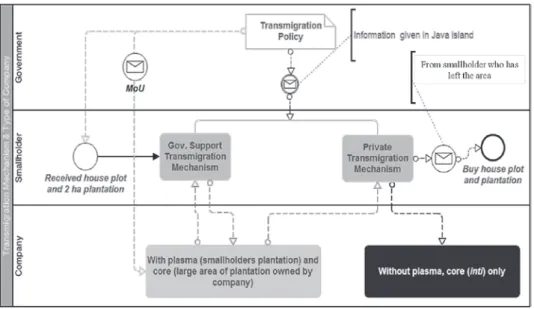
the transmigration process was presented to potential smallholders on Java Island, before the transmigration started (Figure 2).
The PIR-Trans (which extended up until October 1993) is the name given to the period
when the government of Indonesia divided the palm plantation business into two parts, namely the inti (core) and the plasma parts of the business. The inti (core) part (green box in Figure 2) was development undertaken by the company on a large scale ; meanwhile, the plasma part consisted of palm plantation businesses developed by smallholders through the transmigration program. The inti (core) has supported transmigrants from the beginning until the present
day. New transmigrants work first as inti (core) employees before they are allowed to have their own plantations. Once the oil palm has produced fresh fruit bunches, transmigrants can stop working as employees and manage their own plantations, selling the fresh fruit bunches to the inti (core). The inti (core) also has a responsibility to support the management and main-tenance of the smallholder’s plantation. This regulation was first published in 1986, and in 1990, efforts were made to ensure better coordination among government agencies to ease the
permit process in an effort to replace forestland with oil palm plantations. Most PIR-Trans
schemes allocated only 2 hectares to each transmigrant family.
On the other hand, multinational companies with large capital and huge plantations of oil palm appeared mostly during the period from 2000-2010. Such companies do not have any
memorandum of agreement (MoU) with smallholders (without plasma). The only form of transaction is that smallholders sell their fresh fruit bunches to these companies after harvest. However, although Asian Agri (AA) is a multinational company in the study area, it was estab-lished at the same time as the transmigration settlements, in 1987. Thus, at present, AA owns 100,000 ha of oil palm plantation and has cooperative agreements with 29,000 smallholders.
2.4 Land utilization and ownership
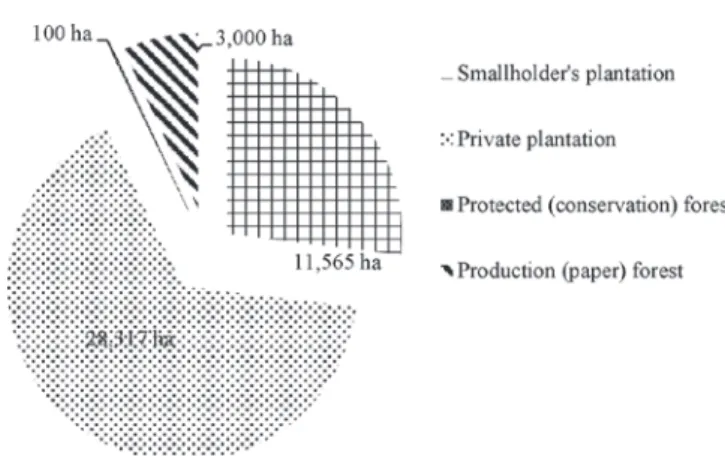
Most of the land in the study area is used for oil palm plantations, and only a very small area of land is protected or set aside as conservation forest (Figure 3). In the 1980s, the land on which the village sits was primarily tropical rain forest, and there are no historical records indicating the presence of the Dutch oil palm company in the area. The transmigration pro-gram began in 1987 ; at that time, most of the migrants came from Java Island, especially from Central and East Java Provinces. Land clearing on a large scale began in 1987, and the first planting of oil palm trees was implemented in 1988. At first, the government provided the migrants with two hectares of oil palm plantation and 0.5 hectares for a house plot.
The layout of the village, as is typical of transmigration villages in Indonesia, is based on a grid or block (Figure 4). Houses are well spread out and situated “face-to-face” along the
Figure 3 Land utilization in Ukui sub-district, Pelalawan Regency, Riau Province Source : Village Report, 2012
dential road. Public areas are concentrated in the centre of the village, and government facili-ties are located along the main road. The Bukit Jaya village is located in the centre of other settlements ; therefore the seasonal market (held every Thursday) is located in this village.
In addition, the supply of electricity to households in the village is limited to the hours between 5 pm and 7 am, so that from 8 am to 4 pm, there is no electricity. Electricity in the village is managed independently by the community.
3. Data and method
In this study we obtained data from interviews and fieldwork. Fieldwork was conducted in two sessions, from May-June 2012 and April-May 2013. In the first survey, we collected
fundamental statistics about the village from village administrators, and executed a naire survey on the characteristics of the average smallholder. Items on the survey question-naire included : composition of family, location of oil palm plantation, family origins, job of householder, participation in cooperative group, cooperation with the company, income level and source. We obtained replies from 42 householders. At the same time, we interviewed senior villagers and village officers about the village’s history.
For the second survey, we confirmed the information gathered from the first, mainly through interviews, and asked again about the production system of smallholders, especially in terms of management of the cooperative group. The following analysis and discussion is based on the results of the two surveys.
In addition, we explored smallholders’ opinions using the KJ method to help us understand their thoughts about the future of their plantation management. The KJ method was devel-oped by Kawakita Jiro. He published an application book on the method in 1970 (Kawakita, 1970), and a comprehensive book about it in 1986 (Kawakita, 1986). Following the KJ method, we gathered seven smallholders in a room, asked them to reply to our questions, to discuss and coordinate their replies, and then to share their common answers, opinions, and beliefs.
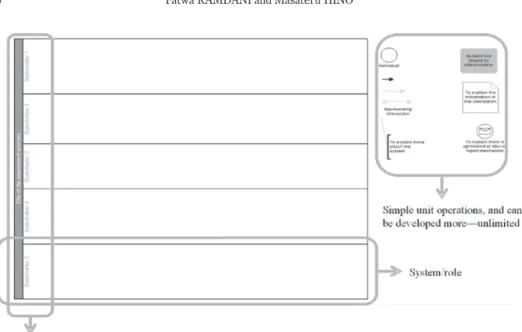
An extended version of the KJ method was developed in this study. In this approach, the information from smallholders was input into a simple scheme (Figure 5). In the figure, the left-vertical side is the list of stakeholders, while the right-horizontal side is the system/role
played by every stakeholders. Through the stakeholder roles as informed by the smallholders, simple unit operations are identified. Simple unit operations can then be combined, and an interrelation chart of all stakeholders can be created. To verify the results, we consulted the chart and had deep discussions with smallholders.
Through this approach, we tried to understand smallholders’ thoughts on the key factors involved in the sustainable management of oil palm plantations, and on the difficulties they might face in the near future in terms of plantation management sustainability.
4. Demographic and socio-economic characteristics of the village
4.1 Demographic composition
The total population of this village as of 2012 was 1,722, with 521 households. Figure 6 shows the age composition of the village population.
According to the results of the surveys, the village population may be largely classified into three groups : the first generation who moved to the village from Java island at the age of about 20-30 years old and are currently about 40-70 years old ; the second generation who are
descendants of the first and are now approximately 16-39 years old ; the third generation,
chil-dren of the second generation, who are largely 15 years old or less.
The variety in age of the first generation indicates that the original transmigrant group included both comparatively older persons with their families, and young single persons. In addition, other, relatively young private transmigrants joined the development of the plantation in this village at a later time. This added to the diversity of the age composition of the first generation. At present, the second group constitutes the majority of population (Figure 6). This suggests that a large part of the first generation has passed their property on to their suc-cessors. However, a significant number of second generation sons and daughters left the vil-lage after graduating from institutions of higher education. For example, household No. 43 in Table 1 had five children. At present, all but one of them have moved to other regions after graduating from university ; only one daughter remains with the first-generation father.
Like-wise, in the case of household No. 44, an elder daughter moved out in order to get a job after
graduating from university. In other words, there are very few white-collar jobs for the more
highly educated children around the village.
In addition, most households consist of core family members. In this village, if individuals in the second generation marry, they generally move out of their parents’ house. Even if they live on the same plot as their parents, they build their own houses and become an independent household. The district where most of the second generation’s houses are clustered can be seen at the west edge of the village. Extended families were limited to households No. 18, 22 and 25 among respondents (Table 1). All households excluding the above were composed of core family members.
4.2 Job composition of householders
Sixty-one percent of households are smallholders in oil palm (Figure 7). About 20% of
working villagers are labourers in plantation. The plantation company located in this village employs a lot of temporary labour to maintain and harvest the plantation. Seven percent of householders engage mainly in raising domestic animals such as chickens, cows and fish. They do this kind of animal husbandry on their oil palm plantations, or in the back or side yards of the house plot (Figure 8). Household No. 42 recently began a new business producing fish
Figure 6 Population pyramid of Bukit Jaya village Source : Village Report, 2012
food from the compound of kitchen waste and artificial minerals (Figure 9). It is suitable for optimum growth of fish. Although it is expected to develop, growth of the business is cur-rently slow.
Six percent of householders engage in small service and trading businesses, working for example as barbers and retailers of miscellaneous goods. Four percent are small manufactur-ers, for example, constructing the exterior and interior of houses. The smallest proportion of jobs include those such as palm oil company employees, government officers and other private companies’ employees ; these consititute only 1% of the total population (Figure 8).
In addition, some smallholders have side businesses. They will work as contract labour-ers, harvesting fresh fruit bunches for other smallholders and company plantations (Table 1).
In smallholder’s households, the male is usually dominant as the active-productive
worker. It is he who manages the oil palm plantation. Most of these men are in the produc-tive ages of between 40-60 years old. The number of members in each household is higher
than in the Provincial capital ; it is not uncommon in this village for one household to consist of five or six members.
Each household owns two to four hectares of oil palm plantation, on average. Two hect-ares of oil palm plantation can support 250 oil palm trees, so four hecthect-ares average about 500 oil palm trees. Most of the smallholders came originally from Java Island, and were employed as
Figure 7 Types of jobs in the village Source : Village Report, 2012
oil palm labourers. Each householder is a member of the farmers’ group, and has a coopera-tive agreement with the oil palm company located nearby.
Some of the smallholders in the village have oil palm plantations outside the study area ; some also have other sources of income (i.e. animal husbandry) ; a small percentage do not have oil palm plantations but perform service or trade work as their source of income (this lat-ter characlat-teristic usually applies to second-generation transmigrants). A small portion of this
second generation is composed of traders who bought oil palm plantations fairly recently (2009
-2010).
4.3 Income
This study collected income information on the questionnaire survey. Forty-two
small-holders were involved in the field survey. Respondents were classified into one of three income categories : low (≤2 million rupiahs), middle (2-5 million rupiahs), and high (≥5
mil-lion rupiahs). Following this classification system, 32 smallholders (76%) belonged in the mid-dle class (Table 1). This indicates that disparity in income among smallholders is relatively small.
Three householders, however, belonged to the low-income category. They are all
sec-ond-generation individuals (Table 2), and two of them do not have their own palm oil plantation.
Figure 8 Animal husbandry in the village. Clockwise from upper left : hen house ; cattle raiser ; chicken feed ; fishpond in the middle of oil palm plantation
▲ ▲ ■ ○ ● 9 Second ■ ○ ● - 2 √ 10 Second □ ■ ● - - √ 11 Second □ ■ ● - - √ 12 First □ □ ■ ● 4 - √ 13 First ▲ ■ ○ ○ ● 2 - √ 14 First ▲ ▲ ■ ● 2 - √ 15 First □ ■ ◙ ○ ● 2 - √ 16 First □ ▲ ■ ◙ ● 4 - √ 17 First ▲ ■ ◙ ◙ ● 2 - √ 18 First ▲ ▲ ■ ◙ ● 2 - √ 19 First ■ ◙ ● 2 1 √ 20 First □ □ □ ■ ● 2 - √ 21 First ■ ◙ ● 2 - √ 22 First □ ■ ○ ● 2 - √ 23 First □ ▲ ■ ○ ● 2 - √ 24 First ▲ ■ ○ ● 2 - √ 25 First □ ▲ ■ ◙ ● 2 - √ 26 First ▲ ■ ◙ ◙ ◙ ● 3 2 √ 27 First ▲ ■ ◙ ● 2 - √ 28 First ▲ ■ ● 2 - √ 29 First ▲ ▲ ■ ○ ● 2 - √ 30 First ▲ ■ ○ ● 2 - √ 31 First ▲ ■ ● 2 - √ 32 First □ ■ ◙ ● 2 - √ 33 First ▲ ■ ○ ● 2 - √ 34 Second □ □ ■ ● 2 - √ 35 Second ■ ○ ● 2 - √ 36 First ■ ○ ○ ◙ ◙ ● 4 4 √ 37 First □ ■ ○ ○ ● 2 - √ 38 First □ □ ■ ◙ ● 2 - √ 39 First □ ■ ○ ● 2 - √ 40 First □ □ ■ ● 2 - √ 41 First ▲ ■ ● 2 - √ 42 First ■ ◙ ◙ ● 2 - √ 43 First ■ ◙ ● 2 - √ 44 First ■ ○ ○ ○ ◙ ● 4 4 √ Source : Fieldwork.
Table 1 (Continue) Household characteristics of oil palm plantation village Labour tani (Farmer’s Group)Member of kelompok Income
level
Income source from
other plantation management Cooperation with company Yes No Yes No husbandryAnimal servicesTrade, Others Yes No
√ √ High ⌂ - - √ √ √ High ∆ - - √ √ √ High ʘ - - √ √ √ High - - - √ √ √ High - - - √ √ √ High - - - √ √ √ Mid - - - √ √ √ High - - - √ √ √ Low ʘ √ - √ - - Low - - √ √ - - Low - √ - √ √ √ High - - - √ √ √ High ∆ - - √ √ √ Mid - - - √ √ √ Mid ʘ - - √ √ √ High - - - √ √ √ Mid - - - √ √ √ Mid - - - √ √ √ Mid ʘ - - √ √ √ Mid - - - √ √ √ Mid - - - √ √ √ Mid - √ - √ √ √ Mid - - - √ √ √ Mid - - - √ √ √ Mid ʘ - - √ √ √ High - - - √ √ √ Mid - - - √ √ √ Mid - - - √ √ √ Mid - - √ √ √ √ Mid - - - √ √ √ Mid - - - √ √ √ Mid - - - √ √ √ Mid - - - √ √ √ Mid - - - √ √ √ Mid - - - √ √ √ High - √ - √ √ √ Mid - - - √ √ √ Mid - - - √ √ √ Mid - - - √ √ √ Mid - - √ √ √ √ Mid - - - √ √ √ High ⌂ - - √ √ √ Mid - - - √ √ √ High - - - √ Source : Fieldwork.
Symbol information :■ : Householder, productive, ● : Housewife, □ : Son, student, ▲ : Son, produc-tive, ○ : Daughter, student, ◙ : Daughter, productive
smallholders. It shows that the income from palm oil plantations is relatively high compared to other jobs in this village.
On the other hand, eight smallholders were classified into the high economic class. They all had oil palm plantations larger than 2 ha. Among them there were smallholders with oil palm plantations outside the village. For example, households Nos. 1, 2, 36 and 44 all have more than 4 ha of plantations outside the village. In general, it can be said that smallholders’ income increase in proportion to the size of their oil palm plantations. In addition, although the palm oil plantation of No. 13 is only 2 ha, this household earns a relatively high income due to the raising of a cow.
5. Cooperative organization of oil palm production 5.1 Cooperative organisation of smallholders
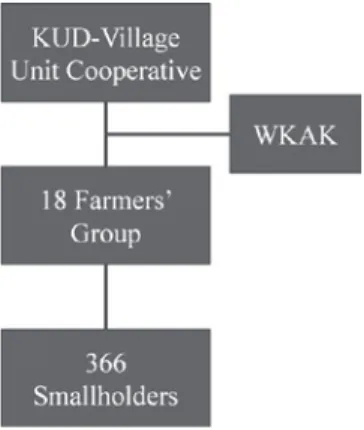
Each smallholder in this village is a member of a farmers’ group. One farmers’ group consists of 20-30 smallholders, and every smallholder in the group has a land area of 2 ha of oil
palm plantation, on average. In the study area, there are 18 such farmers’ groups, which have been integrated into the Village Unit Cooperative (KUD-Koperasi Unit Desa in the Indonesian
language) (Figure 9). All smallholders, especially those from the first generation, are actively involved in the group, and have a high sense of belonging and high commitment to the village unit cooperative.
Each farmers’ group involves a small organization consisting of a chairman, secretary and treasurer. Regular meetings for each group are usually held every week to ten days.
For example, the active male in household No. 43 (Table 1) is the secretary of a farmers’ group that has 20 members. He is 65 years old, and one of the first transmigrants. He came from East Java with his family in 1986. His relatives followed him to this village. They joined the group. The male No. 22 smallholder in the table is his nephew. In addition, he also works in the village office as a chairman of the neighbourhood association (RT-Rukun Tetangga in
Indonesian).
village government function is accomplished by cooperation with the Village Government Offi-cer (Pemerintah Desa) and the Agency Village Consultative (BPD-Badan Permusywaratan Desa)
in order to regulate and manage the interests of the local community. The village administra-tion office has only a few staff members. Only five full-time staff work in the village office,
including the village chief. Villagers elect a chief in a general election every five years. Management of roads, bridges, and other infrastructure related to the oil palm business are managed by WKAK (Wadah Kerja Antar Kelompok — Inter-Farmers’ Working Group). This
group is coordinated with the village unit cooperatives ; each KUD has only one WKAK. Every farmers’ group has its own leader, secretary, and treasurer. These positions are filled by election from members within the group. While the leader, secretary, and treasurer of the KUD are selected by election every year in a member meeting, the tenures of those in the
Figure 9 Structure of smallholders’ organisation in the study area
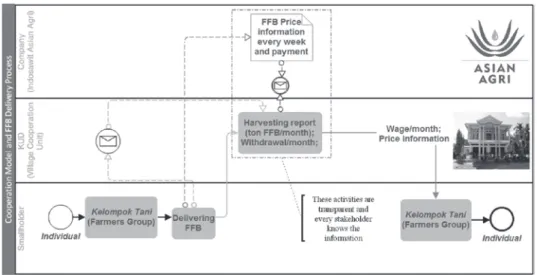
After every harvest, fresh fruit bunches are collected at weighing points, and the next day the bunches are sent to a processing plant owned by the company. When delivering the fresh fruit bunches, every smallholder is supposed to make a report for KUD through their farmers’ group.
The company then pays the smallholders through the KUD (cooperative unit village), which is also partnered with banks. The smallholders can thus withdraw money from the farmers’ group. Every week the company sends information about the price of fresh fruit bunches to the smallholders through KUD. All of these activities are transparent, and every stakeholder knows the information (Figure 11).
Figure 12 shows the sheet for recording shipments that smallholders present to KUD. Information such as truck number, driver’s name, departure time, the age of the oil palm trees, the amount of fresh fruit bunches, and date of harvesting are recorded.
5.2.1 Cooperation with company
In the early periods of the oil palm plantations, smallholders received training on plantation management, including administration, fertilizing techniques and tree treatment techniques. After a couple years, however, smallholders were expected to work independently. The com-pany now only purchases fresh fruit bunches from the smallholders, and provides technical assistance in the effort to control pests and diseases ; it will also assist with the replanting pro-gram plan in the near future.
A. Selling fresh fruit bunches
One company that buys fresh fruit bunches from the smallholders is PT. Inti Indo Sawit (Groups of Asian Agri), which already has an RSPO certificate.
When delivering fresh fruit bunches to the company, smallholders are required to fill out the proof of delivery form (Figure 12). The form consists of two sheets ; smallholders submit the first to the company and keep the second. The important information recorded on the form include :
1. Truck number 2. Driver’s name
3. Departure time from collecting point 4. Age of the oil palm trees
5. The amount of fresh fruit bunches (kg)
6. The amount of fruit detached from the bunches (kg) 7. Date of harvesting
There is a sorting process inside the company processing plant. Only completely ripe and good quality fresh fruit bunches are purchased. Fresh fruit bunches that do not pass the sort-ing process are sold to middlemen outside of the company. Money from the sale of fresh fruit bunches is paid at the end of each month to the KUD.
Each group has a notebook for recording sales of fresh fruit bunches (Figure 13). This hand-written notebook is very important, especially in noting income and expenditures relating
to oil palm plantation management. The notebook also contains notes about the role of each member of the group ; the greater the role and contributions made to the group, the greater the income of the group.
B. Control of pests and disease
Control of oil palm plantation pests and environmental monitoring are carried out by the company, because the smallholders do not have the necessary knowledge and qualified capacity to do this themselves. Control of pests and disease is usually done once a year. The com-pany collects leaves, soil, and water samples, and analyses them. The result is delivered to
the smallholders soon after the laboratory analysis is finished. The company instructs the smallholders about what to do and about the decisions they will need to make for their oil palm plantation if it finds pest or disease problems.
C. Replanting and rejuvenation program
An issue that is currently evolving and becoming an important concern for every small-holder is the replanting and rejuvenation program. Replanting and rejuvenation are expected to take about 3 years, beginning in 2012. As long as palm trees produce more than 2 tons of fresh fruit, however, the trees will not be cut down for replanting and rejuvenation. Smallhold-ers will wait until production goes down under 2 tons.
However, financial preparations must be made for the replanting and rejuvenation plan. The financial plan will be the loan agreement (Akad Kredit in Indonesian), which is prepared during the process of replanting. The company provides financial assistance, and in return, smallholders provide 30% of their fresh fruit bunches to the company for a period of five years.
5.2.2 Cooperation with KUD
The name of the Village Unit Cooperative in our study area is KUD Bina Usaha Baru (New Business Development). It was established in 1989 (Figure 14). To become a member of the
month.
A. Transportation of fresh fruit bunches
One day after the fresh fruit bunches are harvested, dropped off, and weighed at the collec-tion point, they are transported by truck to the processing plant (Figure 15). The trucks used are privately owned, but expenditures involved in transportation, such as gasoline and engine oil, are deducted from smallholders’ savings accounts at the KUD every month. The cost of transportation services is dependent on the distance to the closest processing plant and varia-tion in fuel prices.
B. Fertilizer
Smallholders have cooperative agreements with their KUD to procure fertilizer for oil palm trees (Figure 16) ; KUD in turn cooperates with the company to get a lower price. There are three possible cost variations for cooperation in the procurement of fertilizer : (1) 550,000
ahs per month ; (2) 650,000 rupiahs per month ; (3) 800,000 rupiahs per month. The type chosen depends on the needs and financial capacity of smallholders, and it is usually discussed in the musyawarah mufakat (consensus agreement).
C. Infrastructure maintenance
As mentioned in the previous chapter, management of roads, bridges, and other infrastruc-ture related to oil palm is managed by the WKAK (Wadah Kerja Antar Kelompok — the Inter
-Farmers’ Working Group). This group works in coordination with the village unit coopera-tives, and each KUD has only one WKAK. In our study area, the WKAK consisted of 18 farmer groups directly under KUD coordination. There is no charge for this type of coopera-tion, all smallholders work together for the good of the oil palm plantations in their villages. If there is a need for expenditure on infrastructure maintenance, it will be shared among them. The national and provincial roads, however, are the responsibility of the provincial and central governments, and are usually maintained by the provincial public works department.
6. Community cultural values
6.1 Gotong royong (Mutual cooperation)
Rural economic development cannot be separated from the social values embodied in the community. Social capital has become important in sustainable development at the local level. In Indonesia, there are two important phrases concerning social capital — gotong royong (mutual cooperation) and musyawarah mufakat (consensus agreement).
Hahn (1999) wrote :
because in the rainy season the drainage system had frequently caused flooding. We also found other groups in the community working together to build a new small mosque for Muslim prayer.
To better manage their oil palm plantations, villagers are working together to maintain roads and bridges, canals, drainage and small rivers around the plantations. Such activity is facilitated by WKAK, and in this mutual cooperation, involves no charge for individuals. Everything is done willingly together for the sake of community.
6.2 Musyawarah mufakat (Consensus agreement)
Musyawarah mufakat (consensus agreement) is a traditional decision-making process in
Indonesia, and has been applied in village meetings.
To make decisions regarding the management of oil palm plantations, villages hold regular weekly meetings. The attendance level at these meetings is more than 75% (from question-naire survey) for each group of farmers. Farmers conduct musyawarah in these meetings to reach consensus in all matters relating to the management of the oil palm plantations, such as the purchase of fertilizer, and whether to buy the fertilizer from KUD or another place. If there is a member who wishes to sell his oil palm plantation to an outside party, this should be discussed first in the musyawarah of farmer groups.
6.3 Smallholders’ consciousness concerning the sustainability of oil palm plantations
To gain an understanding of the sustainability scheme model, we posed the following ques-tion to the smallholders :
“Since 1988, the oil palm plantation has been very beneficial to smallholders ; what is the key to the success of this sustainable development? (from the beginning to the present day)?”
Using the extended version of the KJ Method (Figure 17), this study documented the keys (past and present) to sustainability in the study area.
Managing the oil palm plantation as a main resource and livelihood requires cooperation between all stakeholders, and the social capital of smallholders plays an important role. Mutual aid, the consensus agreement, and leadership within the farmers’ groups produces well
-organized smallholders. Large areas of oil palm plantation must be managed together to reap the benefits of lower costs and optimum results. Knowledge about management and mainte-nance is received from the company. Long-term sustainability depends on all stakeholders, as
well as on government policies that protect and maintain the oil palm plantations as primary resources. The Bank also provides financial support to smallholders ; if smallholders want to expand their plantation or establish new businesses to earn more income, they can submit an application to the Bank through the farmers’ group and village administration.
Smallholders shared thoughts concerning how to continue this cooperation model into the future and keep the oil palm plantations going in a sustainable way. They want to continue to cooperate as shown in Figure 18 below.
7. Conclusion
This study has documented that social capital within smallholder groups plays an important role in the management of oil palm plantations. Mutual aid and consensus depended on this social capital. Therefore, it can be said that smallholders collaborate for long-term resource
management using social capital, and that social bonds and norms among smallholders are the most important conditions for constructive and sustainable production. In addition,
commu-Figure 17 Extension of the KJ method : Writing down the facts (A, B) ; Organizing facts into group/categories (C) ; Discussion of the meaning of facts and their relationships (D)
nity-based cooperative production organizations such as KUD are necessary for sustainable
development. Smallholders can share knowledge and information about sustainable develop-ment from outside of the village via the organization. Furthermore, KUD plays the role of negotiator between smallholders and the company. As a result, smallholders maintain their bargaining power. As for the management of the cooperative organization, democratic meth-ods are employed. In the case of the KUD, the leaders of both the KUD and the farmers’ groups are elected by the members. Officials in these positions in the cooperative organiza-tions are supposed to obtain the members’ agreement when making decisions.
Besides the cooperative production organization, the administrative body of the community plays an important role in supporting the livelihood of smallholders. Its performance is also an important factor for sustainable development. In the study village, the village office had a good relationship with KUD through daily contact. In addition, the cooperative production organiza-tion had established mutual trust with the company in the study area. The company supported smallholders technically and economically in order to develop and maintain the oil palm
tions. As a result, smallholders do not harbour negative feelings towards the company. This suggests that the company works as a business partner with smallholders to stabilize produc-tion. Finally, government policies that support smallholders’ plantation management are nec-essary for long-term sustainability.
Acknowledgements
This research was partly funded by a Grant-in-Aid for Scientific Research (B), “Research
on the fate of human being and the development of views of nature from the history of thought and the applied ethics” (Representative, Yutaka Zatoka, No. 24320001) of Japan Society for the Promotion of Science. The authors would like to thank to the people of Bukit Jaya Village and all Village Officers to support the field work. The author would also like to thank to Monbu-kagakusho (Japan Ministry of Education, Culture, Sports, Science and Technology) for Phd scholarship.
References
Altieri, M. (1995) : Agroecology : the science of sustainable agriculture. West View Press, Boulder, CO BPS (National Statistical Beaureu) (2010) : Indonesian oil palm statistic. Sub Directorate of Estate Crops
Statistics. Statistics-Indonesia.
BPS (National Statistical Beaureu) (2012) : Indonesian oil palm statistic. Sub Directorate of Estate Crops Statistics. Statistics-Indonesia.
Hahn, Robert A. (1999) : Anthropology in Public Health : Bridging Differences in Culture and Society. Oxford, UK. Oxford University Press.
Kawakita, J. (1967) : Hassohou. Tokyo, Chukoshinsho. Kawakita, J. (1970) : Zoku Hassohou. Tokyo, Chukoshinsho. Kawakita, J. (1986) : KJ hou. Tokyo, Chuokoronsha.
Minister of Home Affairs (2005) : Government Regulation No. 72 Year 2005 on the Village. Minister of Home Affairs, Indonesia.
Pretty, J. (2003) : Social capital and the collective management of resources. Science, Vol. 302
Shimura, Kenichi (2005) : Compare and contrast of grounded theory and KJ method. Bulletin of Faculty
of Social work, Hirosaki Gakuin University, 5, 46-57.
USDA (2010) : INDONESIA : Rising Global Demand Fuels Palm Oil Expansion. Commodity Intelligence Report. Foreign Agricultural Services.
USDA (2013) : INDONESIA : Palm Oil Expansion Unaffected by Forest Moratorium. Commodity Intelli-gence Report. Foreign Agricultural Services.
Whitten, A.J. (1987) : Indonesia’s transmigration program and its role in the loss of tropical rain for-ests. Conservation Biology, 1, 239-246.