Portrait feature detection and its
applications to clothes matching and
caricature synthesis
肖像写真からの特徴検出とその服装検
索及び似顔絵生成への応用
山梨大学大学院
医学工学総合教育部
博士課程学位論文
2018年 9 月
李宏林
Abstract
Portrait photos are widely used in social daily life not only in formal
occasions but also in cascual occasions, such as applying for job, making
certificates, synthesizing caricatures and so on. Recently, with the
development of Internet and mobile phone, generating various styles of
attractive caricatures according to portrait photos or selffiles is more and
more popular in social media and commercial activities, which can bring
attractive impression and protect privacy at the same time. Another
interesting application is recommending appropriate clothes according to
input portraits, that is to say, to collocate portrait faces with upper clothes
for personality recommendation. In addition, since collar is one of the most
important components in upper clothes due to its horizontal perspective
position closest to the observers’eyes, retrieving clothes with desired collars
in online shops is of practical meaning.
Portrait feature detection for upper clothes (especially for collars), hair,
and face, which are the core elements in portrait photos, is very important
for conducting the above applications. In Chapter 2, Chapter 3 and Chapter
4, we introduced the hand-crafted features specially designed for collar
detection, capturing the characteristics of facial components and hair styles,
and deep features related to the collocation of upper clothes and portrait
faces, respectively. Using these features, three applications are developed or
designed which are similar collar retrieval, attractive caricature synthesis,
and appropriate upper clothes recommendation, in Chapter 2, Chapter 3, and
Chapter 4, respectively. Details of the three applications are shown as
following.
Collar is a crucial part of the clothes due to its horizontal perspective
position closest to the observers’eyes and serving as the frame for one’s
face in portrait photos. Searching for clothes with desired collars is very
important for recommending clothes collocation. Content-Based Image
Retrieval (CBIR) methods are developed to help people find what they
desire based on preferred images instead of linguistic information. Chapter 2
focuses on retrieving clothes with similar collars according to input clothes
images based on three types of combined features called Spread-Sift,
Spread-Saliency-Sift and Spread-Saliency. In addition, a prototype of
clothes image retrieval system based on Relevance Feedback approach and
the Optimum Forest (OPF) algorithm is also developed to improve the query
results iteratively. A series of experiments are conducted to test the qualities
of the three types of combined features and validate the effectiveness and
efficiency of the RF-OPF prototype from multiple aspects.
Portrait caricatures have been serving as icons, avatars and so on in real
life and internet. Most caricature synthesis systems can be classified into
three categories based on the approaches they used, which are
photo-transformed, example-based and style-transfer-based frameworks.
Recently, caricature synthesis techniques based on deep learning have also
been developing rapidly. Chapter 3 proposes a new caricature synthesis
system under the example-based framework based on the feature deviation
matching method, a cross-modal distance metric, which employs the
deviation from average features rather than the values of features themselves
to search for similar components from caricature examples. The proposed
system does not require a paired photo-caricature database, and the designed
geometric features can effectively capture the visual characteristics of input
portrait photos. In addition, the proposed system can control the
exaggeration of individual facial components, and provide several
similarity-based candidates to satisfy users’ different preferences. Extensive
experiments are conducted to evaluate the results: 1. Similarity of the three
types of caricatures (expressive, photo-realistic and drawing) with input
portrait photos. 2. Comparison with the paired-example method. 3.
Effectiveness of the designed hair and facial component features.
Upper clothes part is an important element in portrait photo. How to
coordinate upper clothes with given female portraits is valuable for daily life.
Traditional clothing coordination focuses on clothing component collocation
or situation-clothing collocation without considering human personalities,
such as human face and hairstyles. By regrading features of the female
hair-face part and the upper clothes part as coming from different domains,
we adapted deep learning and cross-modal retrieval techniques for upper
clothes recommendation. The Deep Canonical Correlation Analysis (DCCA)
method is one of the traditional cross-modal retrieval methods. It uses deep
learning frameworks to project extracted features from different modalities
into a common feature space. By maximizing the correlations between the
paired projected features from different modalities, the DCCA framework
tries to make them as similar as possible, which can thus be mutually
retrieved directly in the common feature space. The Unsupervised
Domain-Adversarial (UDA) method is inspired by Generative Adversative
Networks (GAN) and used for cross-modal retrieval. By embedding a label
predictor into the feature projector to preserve the orginal semantic
distribution and conducting adversarial learning between the feature
projector and the modality classifier to reduce the gap across different
modalities, the UDA method is effective to generate similar common feature
representations from different modalities maintaining their original
distributions. In Chapter 4, we proposed two preliminary frameworks based
on the DCCA and UDA methods, respectively, for upper clothes
recommendation, which focused on investigating the collocation relations
between upper clothes and female faces and hairstyles. Firstly, we divide the
portrait photos into two parts, hair-face and upper clothes parts, and extract
features from them with deep learning frameworks. Secondly, feature
projectors made up of fully connected layers or linear projectors are used to
embed the extracted upper clothes features and hair-face features into a
shared common feature space. Thirdly, the DCCA and UDA methods are
used in the first and second preliminary frameworks, respectively, to make
the projected feature representations from upper clothes and hair-face as
similar as possible.At last, by conducting direct distance comparison in the
common feature space, for each input portrait face, appropriate upper
clothes will be recommended which is with the smallest distance to it.
Keywords: Collar retrieval, Relevance Feedback, Optimum-Path Forest,
Caricature synthesis, Cross-modal distance metric, Feature deviation
matching, Upper clothes recommendation, Deep learning, Cross-modal
retrieval.
Directory
Abstract ... III
Chapter 1 Introduction ... - 1 -
1.1 Retrieval of Clothing Images based on Relevance Feedback with Focus on Collar Designs - 1 - 1.2 Caricature Synthesis with Feature Deviation Matching under Example-Based framework . - 2 - 1.3 Preliminary frameworks for upper clothes recommendation based on deep learning and cross-modal retrieval techniques ... - 3 -
1.4 Structure of the thesis ... - 4 -
Chapter 2 Retrieval of Clothing Images based on Relevance Feedback with Focus on Collar Designs ... - 5 -
2.1 Introduction ... - 5 -
2.2 Related researches ... - 6 -
2.3 Collar design ... - 6 -
2.4 Designand extract feature vector ... - 8 -
2.4.1 Collar spread ... - 8 -
2.4.2 Turnover and Front design ... - 10 -
2.5 The RF-OPF prototype ... - 14 -
2.6 Experiment and discussion ... - 16 -
2.6.1 Experiment ... - 16 -
2.6.2 Comparisons of feature vectors (Spread+Sift, Spread+Saliency-Sift, Spread+Saliency)- 18 - 2.6.3 Improvement by RF-OPF... - 19 -
2.7 Conclusion ... - 22 -
Chapter 3 Caricature Synthesis with Feature Deviation Matching under Example-Based framework ... - 25 -
3.1 Introduction ... - 25 -
3.2 Related researches ... - 28 -
3.2.1 Caricature synthesis techniques ... - 28 -
3.2.2 Feature deviation applications and cross-modal comparisons ... - 29 -
3.3 Proposed methods ... - 30 -
3.3.1 Overview of framework ... - 30 -
3.3.2 Feature vectors ... - 31 -
3.3.3 Deviation-based feature matching... - 33 -
3.3.4 Synthesis of resulting caricature ... - 36 -
3.4 Results and evaluation ... - 38 -
3.4.1 Results ... - 38 -
3.4.2 Evaluation ... - 44 -
3.5 Conclusion ... - 48 -
Chapter 4 Upper Clothes Recommendation according to Portrait Faces based on Deep Learning and Cross-modal Retrieval ... - 49 -
4.1 Introduction ... - 49 -
4.2 Cross-modal mutual retrieval, CCA and UDA methods ... - 54 -
4.2.1 Cross-modal mutual retrieval methods ... - 54 -
4.2.3 UDA methods ... - 56 -
4.3 The preliminary framework for upper clothes recommendation based on the DCCA framework ... - 58 -
4.4 The preliminary framework for upper clothes recommendation based on the UDA framework- 60 - 4.5 Future work ... - 62 -
Chapter 5 Conclusions and discussions ... - 63 -
5.1 Conclusions ... - 63 - 5.2 Discussions ... - 63 - List of Publications ... - 65 - Journal Articles ... - 65 - Acknowledgements ... - 67 - References ... - 69 -
- 1 -
Chapter 1 Introduction
Portrait photos are widely used in social daily life not only in formal occasions but also in cascual occasions, such as applying for job, making certificates, synthesizing caricatures and so on. Recently, with the development of Internet and mobile phone, generating various styles of attractive caricatures according to portrait photos or selffiles is more and more popular in social media and commercial activities, which can bring attractive impression and protect privacy at the same time. Another interesting application is recommending appropriate clothes according to input portraits, that is to say, to collocate portrait faces with clothes for personality recommendation. In addition, since collar is one of the most important components in upper clothes due to its horizontal perspective position closest to the observers’eyes, retrieving clothes with desired collars in online shops is of practical meaning.
Based on the above considerations and inspired by the fact that most of standard portrait photos and selfiles are made up of hair, face and the upper clothes, We conduct the below projects for similar collar retrieval, attractive caricature generation and appropriate upper clothes recommendation,as shown in Fig.1.
Fig.1 Proposed research projects in this thesis
1.1 Retrieval of Clothing Images based on Relevance Feedback with
Focus on Collar Designs
- 2 -
online shops for clothing items. However, sifting through the massive amounts of available products to find an item that suits one’s tastes and preferences can be an arduous, time-consuming task. In addition, it is difficult to detect human body size online automatically, which is very important for clothes collocation. Collar is a crucial part of the clothes due to its horizontal perspective position closest to the observers’eyes and serving as the frame for one’s face in portrait photos. In Chaper 2, we focus on searching for clothes with desired collars. Content-Based Image Retrieval (CBIR) method [1] involves expressing image content in feature vectors and then comparing the similarities between various images. Although CBIR methods eliminate the need to build queries out of keywords or other linguistic information and allow users to search for visual information with visual information input, their efficiencies largely depend on the quality of the designed features. Some researchers [2] have attempted to use color and texture, but few researchers have delved into the possibilities of developing feature vectors to capture the designs of clothing in detail.
The main contribution of Chapter 2 is two-fold. One is a novel method for extracting the detailed designed features of collars from 2D clothes images. The other is a prototype of clothes image retrieval system based on Relevance Feedback approach and Optimum Forest algorithm for allowing users to find clothes images with preferred designed collars. HSV color model, Tamura texture, Gabor texture, SIFT feature, SURF feature, MSER (Maximally Stable Extremal Regions) and so on, which are colors, texture, shape and local features, are usually used to detect prominent features for upper clothes.In our study, we consider collar spread, turnover and the front design as three important design factors of a collar and develop new methods for automatically extracting those features from clothes images. For the turnover and front design, different feature vectors based on Sift feature and Saliency Map are designed. We further apply Optimum-Path Forest algorithm to perform image search procedures. By incorporating the Relevance Feedback approach into the OPF process [3], our method enables users to search for images based on his or her subjective preferences on collar design. A series of experiments are conducted to validate the above proposed ideas and methods.
1.2 Caricature Synthesis with Feature Deviation Matching under
Example-Based framework
Portrait caricatures have been serving as icons, avatars and so on in real life and internet. Since the early 1980s, many computer-based methods have been developed for synthesizing caricatures [4]. These can be roughly classified into photo-transformed [5-8, 14-16, 27] and example-based [9-13, 17-20] techniques. Recently, style-transfer-based [21-26] and deep-learning [27] based approaches are developing quickly. In Chapter 3, we propose a new example-based caricature generation technique that can synthesize stylized caricatures with a small number of unpaired examples of portrait photos and caricatures. It is very important to design appropriate features to describe facial and hair components before applying similar component retrieval and synthesis.For hair feature detection, some researchers deploy shape matching and classification using height functions, and some further align their outer contours with Horn’s quaternion-based method to achieve robust hair matching. The PCA (Principal Component Analysis) method is used to extract prominent features from the whole face. Various methods, such as HOG (Histogram of Oriented Gradients), Fourier spectrum and landmark-based distance, were employed for detecting local component features for eye, eyebrow, mouth, nose and face contour. Recently, deep learning techniques are deployed to extract features from various objects based on huge number of samples. In Chapter 3, we proposed some effective hand-crafted geometric features for describing hair and facial components.
- 3 -
The proposed caricature synthesis system incorporates component-specific learning based on feature vectors that intuitively match the features that people employ to perceive or communicate the characteristics of faces, which can also provide users with control over the individual facial components. By using a new cross-modal distance metric called feature deviation matching, we can compare the component features of different modalities in different feature spaces directly. Thus, we search caricature components similar to input portrait facial components and synthesize the output caricatures.
The main contributions of Chapter 3 are shown as below:
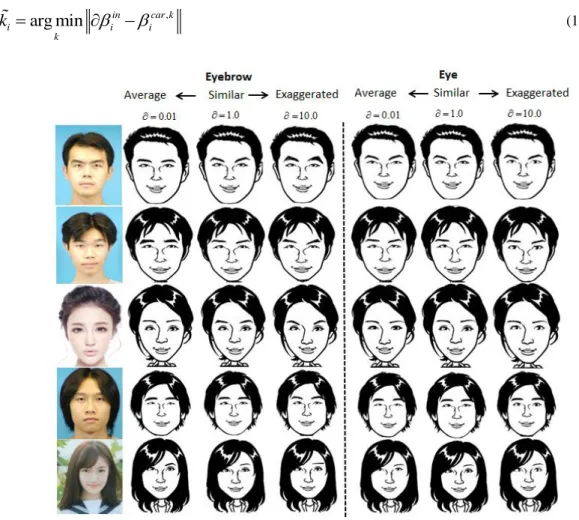
1. The newly proposed cross-modal distance metric called feature deviation matching technique makes it possible to generate various styles of caricatures under the conventional example-based framework without requiring paired photo–caricature training sets.
2. By focusing only on the perceptually prominent features, the designed feature vectors are robust and effective for capturing the visual facial features of input portrait photos.
3. The proposed system enables users to control the exaggeration of individual facial components. Various combinations of individual facial and hairstyle components, based on different exaggeration coefficients and similarity rankings, can provide users with different candidates to satisfy their particular preferences; this has not been achieved in most existing style-transfer-based and deep-learning-based approaches.
Extensive experiments are conducted to validate effictiveness of the proposed ideas and methods from the following aspects: 1. Similarity of the three types of caricatures (expressive, photo-realistic and drawing) with input portrait photos. 2. Comparison with the paired-example method. 3. Effectiveness of the designed hair and facial component features.
1.3 Preliminary frameworks for upper clothes recommendation based
on deep learning and cross-modal retrieval techniques
In Chapter 4, we proposed two preliminary frameworks for upper clothes recommendation according to input portraits based on deep learning and cross-modal retrieval techiniques. Different from Chapter 2 and Chapter 3, we employ deep learning frameworks to extract features from portrait and upper clothes photos automatically instead of hand-crafted features.
These two prelimary frameworks are designed for upper clothes recommendation according to given female portrait faces based on the Deep Canonical Correlation Analysis (DCCA) [28] and Unsupervised Domain-adversarial (UDA) [96] methods. There are two core ideas in DCCA and UDA methods. Firstly, both of them use deep learning frameworks to extract cross-modal features and project them into a common feature space. Secondly, the CCA and UDA modules are employed, respectively, to make the projected features from different modalities as similar as possible for direct comparison. Thus, the mutual retrieval in the common feature space can be used for recommending appropriate upper clothes according to input female portrait faces.
- 4 -
1.4 Structure of the thesis
Portrait photos taken by cameras and mobile phones are widely used in real life and internet for certificates, communication, entertainments and so on. This thesis focuses on researches of portrait feature extraction and its applications for desired collar retrieval, extractive caricature generation and appropriate clothes with desired collars recommendation.
In Chapater 1, we make a short introduction for the research background on the above issues at first. Then the corresponding reseach backgrounds and the congtributions of the proposed three projects are discussed. At last, the structure of the thesis is displayed.
In Chapter 2, we make a detailed introduction for the first project: Retrieval of Clothe Images based on Relevance Feedback with Focus on Collar Designs. Three types of hand-crafted features (Sift feature, Saliency feature and Saliency-Sift feature) are applied to capture prominent features of collars for clothes retrieval. In addition, we employ a relevant feedback system based on optimum forest (OPF) algorithm to improve the query results iteratively.
In Chapter 3, an example-based caricature synthesis framework based on feature deviation cross-modal distance metric is employed to synthesize three types of caricatures (expressive, photo-realistic and drawing) according to input portrait photos. Exaggeration control and similarity-ranking based functions make it possible to satisfy different users’ preferences.
In Chapter 4, two preliminary frameworks based on deep learning and cross-modal retrieval techniques are proposed to recommend upper clothes according to input female portrait faces.
In Chapter 5, we make a conclusion and summary for the whole thesis and discuss the future research work.
The structure of this thesis is shown as Fig.2.
- 5 -
Chapter 2 Retrieval of Clothing Images based on
Relevance Feedback with Focus on Collar Designs
Chapter 2 mainly describes details of the proposed clothes retrieval framework. The proposed framework combines the OPF algorithm to improve the query results iteratively online.
2.1 Introduction
As e-commerce develops quickly, more and more consumers are searching online shops for clothes items. Many sites support keyword-based searches, but items in online shops often lack specific design-related tags and include technical names that few shoppers are familiar with. One image search approach that researchers have proposed as visual query-based alternatives to keyword-driven searches is the Content-Based Image Retrieval (CBIR) method, which involves expressing image content in feature vectors and then comparing the similarities between various images. Although CBIR methods eliminate the need to build queries out of keywords or other linguistic information and allow users to search for visual information with visual information input, their efficiencies largely depend on the quality of the feature vectors, and it remains to be challenged to extract the image features capturing the design of clothes well. Some researchers have attempted to use color and texture, but few researchers have delved into the possibilities of developing feature vectors to capture the designs of clothing in detail.
The main contribution of this paper is two-fold. One is a novel method for extracting the detailed design features of collars from 2D clothes images. The other is a prototype of clothing image retrieval system based on Relevance Feedback approach and Optimum Forest algorithm for allowing users to find clothes images with preferred designed collars. We focus on collars because it is a well-known fact for garment designers that collar is a crucial part of a garment as it serves as the frame for one’s face [29-31]. Since face is the most important visual attribute for characterizing a person, the design of a collar can largely affect the look of a garment and the overall impression of a person. In addition, the artistic formation of a collar is usually the most eye-catching part when people look for clothes due to its horizontal perspective position closest to the observers' eyes [32]. Although computer assisted 3D garment design technologies [33, 34] and virtual fitting systems [35, 36] become available recently, E-commerce websites for clothes shopping mainly show 2D clothing images for users to choose. Our proposed method allows users to retrieve the clothes with preferred designed collars from such online shopping sites first, which will narrow down the candidates and speed up the procedure of virtual fitting based on image rendering technique [36].
In this Chapter, we consider collar spread, turnover and the front design as three important design factors of a collar and develop new methods for automatically extracting those features from clothes images. For the turnover and front design, three dependent and combined feature vectors based on Sift and Saliency Map methods are designed. We further apply Optimum-Path Forest algorithm to improve image query results iteratively. By incorporating the Relevance Feedback approach into the OPF process, our proposed framework enables users to search for clothes images based on his or her subjective preferences on collar design. To validate the above proposed ideas and methods, a series of experiments are conducted. The
- 6 -
experiment results presented in [37] could not provide sufficient validation to the proposed methods. First, only four subjects were involved in the experiments and thus the results might not be reliable enough. Secondly, neither the effects of the different collar types on the evaluation scores nor the bias caused by the difference in the number of images of different collar types was considered. Thirdly, the improvements of the RF-OPF prototype on the three feature extraction methods were not discussed. In this work, we redesign the experiments and succeed in achieving reliable and detailed results to validate the effectiveness and efficiency of the proposed methods for all referred collar types.
2.2 Related researches
The ongoing spread of e-commerce, among other factors, has prompted numerous researchers to explore the possibilities of applying search methods to clothes. Liu et al. [38], for example, proposed a method that makes it possible to use snapshots to search for clothes available in online marketplaces. The method developed by Liu et al. involves taking a picture of a person’s body, separating the body into its constituent parts (feet and legs, for example), and determining the features of each part to enable users to search for images on a fashion website. Bossard et al. [39] proposed a method for classifying apparel in photographs. Using SVM and Random Forest allows their method to establish clothes categories like long skirts and coats and classify clothes according to sleeve length, material and other attributes, but these classification schemes were the ultimate purpose of the research; Bossard et al. did not include the idea of searching for clothing based on specific design elements. A project by Hsu et al. [2] used images with uniform backgrounds as queries for retrieving a limited scope of clothing items that one might find in an online shop. With a piece of clothing serving as the input for the method, their approach involved comparing items based on the features—color, texture, Sift features, and outline—that the pixels in the clothing regions of the given images form. Sift features were also used in our study, which aimed to extract the designs and other characteristics of collars. None of these existing methods are capable of searching for detailed information that collar designs represent. One recent study proposed the idea of using sketches to search for clothing items with the desired design [40]. However, the method presents problems for people who lack sufficient sketching skills.
In the CBIR field, meanwhile, Relevance Feedback (RF) method has been drawing substantial attention for its use of dialogic feedback between the users and the system for learner-driven learning and searching purposes. Searching based on Relevance Feedback method makes it possible to update classifiers by showing results to users. Researchers have already tested this approach in searching for images with ambiguous thematic content, such as ocean scenes, cats, and sunsets. One study has proposed a method that produces high-quality results via minimal amounts of feedback by incorporating different types of classifiers and reusing past classification results [41]. By employing a prototype with the RF approach for learning and the OPF algorithm for searching procedures, our method enables users to search for collars that align with their personal preferences, which may have positive effects on choosing the whole clothes.
2.3 Collar design
Generally, image searches operate on the similarity of visual attributes of multiple images. Finding a collar that suits one's tastes, however, would require the matching of design elements in greater detail. For our study, we begin by interviewing instructors at fashion colleges about the design elements of collars. Then we take their suggestions into consideration to design feature vectors that can enable fine-tuned
- 7 -
search functionality. Clothes experts have suggested that collars generally come in the following ten types (Fig. 3) [42].
Fig.3 Main collar types
Three important elements should be taken into consideration in describing the collar designs. The first is the collar spreads-the ways they open. The second is Turnover. Fig. 4 shows two examples of the collar design with turnover. The existence and shape of the turnover is one of the most distinctive features affecting the preferences of many consumers looking for buying clothing. The third is front designs, which refers to the types of ribbons and frills as shown in Fig. 5.
Fig. 4 Turnover collars Fig. 5 Collar with Front designs
Collar design preferences vary considerably according to buyers’tastes and needs. A person looking for work clothing, for example, would probably prefer a simple, clean look to a busy, loud design. On the other hand, a buyer trying to find something flashier to wear for a fancy occasion might opt for an ensemble that features frills or a gather. Personal tastes affect people's clothes choices in a wide variety of other ways, for instance, the likelihood of a person with a reserved, quiet personality buying a frilly design is rather slim. In hopes of enabling a search approach that reflects user preferences, we design feature vectors to describe detailed collar designs and build a search system using the Relevance Feedback method based on OPF algorithm. For the preliminary feature extraction process, our method involves obtaining feature vectors describing three designed elements-collar spread, turnover, and front design-for each clothes item in the clothes database. Three kinds of feature extraction methods based on Sift, Saliency and Saliency-Sift, respectively, are implemented. In the runtime phase, OPF algorithm is used to classify the images into relevant or irrelevant based on the initial training images. The OPF classifier is refined through iterative relevance feedback from the users. The proposed clothes retrival framework is shown as Fig.6.
- 8 -
Fig. 6 The proposed clothes retrival framework
2.4 Designand extract feature vector
In order to adopt the RF approach and use the OPF algorithm to search the items of preferred collar design, it is necessary to build a feature vector space that effectively reflects the design features of collars. To describe the three important elements, which are spread, turnover and front designs, the feature vectors are designed and extracted as below.
2.4.1 Collar spread
For our study, we limit our scope to images of tops that showed the wearer's upper body only. We also assume that each image has a monochromatic background showing a human subject from the front and the color of which is at least somewhat different from that of the subject's skin. Incorporating more advanced image processing technologies would make it possible to ease these restrictions, but doing so would deviate from the main focus of our study. Fig.7 illustrates the process of extracting feature vectors that represent the collar spread (opening). We use the following steps to extract features.
- 9 - Fig. 7 Compute the feature vectors of the collar spread
Step 1: Dividing the image into background, clothes and skin regions.
This step is the preparation work for identifying the collar line (the clothes-skin boundary) of Step 2 and determining the outline of the clothes in the image (the clothes-background boundary) of Step 5.The collar spread features can be expressed according to the depth value for each angle emanating from the subject's neck, as indicated by the result of Step 7 in Fig. 7.
We separate the background and the foreground of the input image. To extract the skin color region, we use skin color S, the dominant color of the area between the neckline and the chin, as our learning data and extract the pixels with the shortest Mahalanobis' generalized distances from skin color S and use their color t as the skin color. And thus we can define the collar line and clothes outline by locating the skin, clothes and background boundaries. The Watershed algorithm was used to place single seeds in the skin, clothes and background areas respectively and divide the image into the three regions based on these seeds.
Step 2: Extracting collar line
With the image divided into three regions, we then extract pixels from where the skin and clothes regions meet to identify the collar line.
Step 3: Getting the l, r, c points
This step involved extracting the coordinates of the left end 1, center c, and right end r of the collar line, which will be used in Step 7 to compute the feature vectors representing the spread of collar. We use chain codes to trace the contour of the entire collar line identified in Step 2, which allow us to determine the coordinates of left end 1 and right end r. Then the coordinates of 1 and r are used to determine the center c of the collar.
Step 4: Obtaining the intersection points
Then we extend radial lines from the center c in the direction of αi= i × π/36(i = 0, ⋯ ,36) until the lines intersect with the collar line that we extracted in Step 2. The intersections are defined as points pi(i =
- 10 -
Step 5: Extracting clothes outline
With the image divided into three regions in Step 1, we extract pixels from where the clothing and background regions meet to generate the clothing outline.
Step 6: Estimating shoulder width S
Using the clothes outline founded in Step 5, we next calculate shoulder width. Its value serves as the basis for normalizing the feature vector calculations in Step 7. By normalizing the feature vectors, we ensure that the feature quantities obtained are independent of image size.
To calculate shoulder width, we use the differential of body width. Denoting the body width at height y in the clothing outline as W(y), the shoulder width S is given as W(ys) at the height ys where the
second order derivative of W(y) exceeds a given threshold.
S = W(ys) W′′(ys) > thw (1)
Step 7: Calculating feature vectors
With the intersection points pi(i = 0, ⋯ ,36) obtained in Step 4 and the center c obtained in Step 3, the lengths |c − pi|(i = 0, ⋯ ,36) are computed and normalized based on shoulder width obtained in Step 6.
Finally, the normalized values constitute the 36-d feature vector of the collar.
Fig.8 shows the searching results by using the above spread feature vector only. We can see the collar spread feature is well captured (the first two rows), but the feature of turnover and front design cannot be distinguished (the last two lows).
Fig. 8 Comparison of the result by Spread feature vectors on clothes with V opening ,Square opening, Turn over and Front design collar
- 11 -
To capture the features of turnover and front design, we design three different feature vectors based on Sift, Saliency map and Saliency map plus Sift, which are described in the following as Sift feature, Saliency feature and Saliency-Sift feature.
Sift feature
Sift is the most commonly used size and orientation invariant feature. Using a gradient histogram around arranged points makes it possible to capture local details of image contents. It can be expected to capture ribbon shapes and other design details. To accelerate the feature matching in image retrieval, we combined the Bag-of-visual-word method [44-46] with the Sift feature extraction. First we compute the 128-d local Sift feature. Then K-means method is used to cluster the Sift feature vectors into 500 clusters (500 here is empirically given). The centers of clusters are used as codewords. Finally, each Sift feature vector is mapped to the closest codeword to obtain the histogram of the codewords, which is a 500-d feature vector. We compute the above feature vector for the region from the collar to the chest (Collar-Sift) and the whole image (Whole-Sift).
Saliency feature
Fig.9 illustrates the comparison of searching results between a piece of plain front design clothes and a striped V collar one using Sift feature. While this approach manages to find relatively good matches (the first row) for the plain clothing image, it fails to produce the same quality results (the second row) for a striped one. The second row results shows that images with similar clothing textures-not collar designs-appear in the top search results. In other words, the Sift features can be too dominated by texture features.
Fig. 9 Comparison of the result by Spread feature vectors on clothes with V opening ,Square opening, Turn over and Front design collar
In order to reduce the effects of the texture features on the collar designs, we propose a new feature extraction method using Saliency Map proposed by Xiaodi etal [46]. Drawing on the mechanisms of human visual attention, the Saliency Map method allows users to determine the area of an image that observers are most likely to focus on. A Saliency Map calculates the degree of attention not based on the presence of patterns, but on the differences between a given location of an image and its surroundings. This method can be expected to be effective for obtaining features from the front designs as well as turnover, which are the decorative embellishments serving for attracting attention. As long as the design is distinct in some way from its surroundings, the Saliency Map method can get good matches even if the clothes
- 12 -
consist of textures.
Fig. 10 shows the results from two examples consisting of textures. The frill area of the example shown in Fig.10 (a) exhibits prominent differences from its surroundings on the Saliency Map. Even though the clothes consists of large checked textures, the turnover can still be captured by the Saliency Map(Fig.10 (b) ).
(a) (b)
Fig. 10 The results of Saliency Map acting on two clothing images. (a) An example with front design. (b) An example with turnover
The appearance of a front design, meanwhile, depends heavily on the size, length and breadth of their attention-drawing elements. Various shapes and sizes of ribbons and frills have an impact on personal preference. Frills that cover a considerable area on a piece of clothes, for example, create quite a different visual impression from minimal, dainty frills on the top of the collar. One can also locate areas with the highest concentrations of elements that diverge from the general look of a given clothes item. The frills in the images of Fig. 11 (a), for example, spread out across the width of the wearer's chest to create a relatively showy impression. The ribbons in the images of Fig.11 (b), meanwhile, give the clothes a more extravagant but vertically oriented appearance. To capture these design-related differences, the proposed method lays a given grid (3×5) over the Saliency Map as shown in Fig. 11 (b). We obtain a 15d feature map, where the pixels values’ sum in each grid cell represents a dimension of the feature vector.
(a) (b)
Fig. 11 Feature vector design for capturing front designs. (a) Examples of ribbons. (b) 3× 5 Grid arranged on Saliency map for capturing the spatial distribution of front designs
Saliency-Sift feature
This approach, however, can capture the overall shape of front design only. If the clothes in the input images feature a small group of frills, the design details of the frills cannot be captured. We thus propose a method that combines the Saliency Map and Sift feature. Fortunately, Saliency Map proposed by Xiaodi et. al allows controlling the level of detail. Using the high frequency band to compute the difference from the average, we obtain results that retain the frill details (Fig. 12(c)). Fig.13 shows the result of using a
- 13 -
Saliency map over a striped shirt with a turnover collar. If we are to apply normal edge detection to this image, with its prominent pattern, it will be difficult to determine where the turnover is. Using a Saliency Map with the proper level of detail, however, allows us to limit the impact of the pattern to a certain degree. Then by computing the Sift features from the saliency map image, we are able to obtain the details of collar design while eliminating the influence of texture features of the clothes item.
(a) (b) (c)
Fig. 12 Saliency map computed with the method given in [20]. (a) Input image. (b) Saliency Map computed using low frequency band. (c) Saliency Map computed using high frequency band
Fig. 13 Extract turnover features in a high-detailed Saliency Map
In Fig. 14, the images of the top row are the search results by using Sift feature only. The clothes items with round neck are also included in the results as those items have the gather pattern similar to the strip texture of the input clothes. Most of those items are eliminated in the results shown in the bottom row by combining Saliency Map and Sift feature. In addition, more items with turnover collar or similar collar spread are included in the search results. However, the query results are still not good enough. So a prototype combining Relevance Feedback approach with OPF classifiers is proposed to improve the qualities of the query results as follows.
- 14 -
Fig. 14 Results by Sift feature (top) and Saliency-Sift (bottom)
In Fig. 14, the images of the top row are the search results by using Sift feature only. The clothes items with round neck are also included in the results as those items have the gather pattern similar to the strip texture of the input clothes. Most of those items are eliminated in the results shown in the bottom row by combining Saliency Map and Sift feature. In addition, more items with turnover collar or similar collar spread are included in the search results. However, the query results are still not good enough. So a prototype combining Relevance Feedback approach with OPF classifiers is proposed to improve the qualities of the query results as follows.
2.5 The RF-OPF prototype
Relevance feedback (RF) method is a critical component in our CBIR prototype, which makes it possible for users to interact with the system and thus reflects their design preference in the query. The classifiers, another critical component of our CBIR system, are used for processing queries. Their efficiency (related with response time) and effectiveness (related with users’ satisfaction) are very important for evaluating the quality of this CBIR system. In our prototype, we use the Optimum-Path Forest (OPF) [3, 48, 49] classifier for query and classification. OPF works by modeling the classification as a graph partition in a given feature space. It starts as a complete graph, whose nodes represent the feature vectors of all images in the database. All pairs of nodes are linked by arcs which are weighted by the distances between the feature vectors of the corresponding nodes (referred as costs here and after). As illustrated by Fig.15, given a set of training nodes, a minimum spanning tree (MST) can be generated from the complete graph. Then the adjacent training nodes are marked as prototypes if they belong to different classes, which are relevant and irrelevant in our case. The partition of the graph is carried out by the competitions process among prototypes, which offer optimum paths to the remaining nodes of the graph. The optimum paths from the prototypes to the other samples are computed by the algorithm of the image foresting transform (IFT), which is essentially Dijkstra’s algorithm modified for multiple sources and more general path-value functions. At last, all the non-prototypes are connected with a prototype directly or indirectly with the minimum costs. With the prototypes as the roots and the non-prototypes as the intermediate and terminal nodes, the Optimum Trees are built, which constitute the Optimum-Path Forest (OPF). Compared with SVM, ANN-MLP and K-NN, OPF is usually superior to ANN-MLP and K-NN in accuracy and significantly outperforms SVM in computation time [3, 48, 49], which is very important in a prototype based on RF approach that generates results in a dialogic fashion.
- 15 - Fig. 15 Generate the OPF Classifier
All the images in the database are represented by the feature vectors extracted with one of the three methods referred in the section 2.4. The first is Spread+Collar-Sift+Whole-Sift represented by 1036-d (36-d+500-d+500-d). The second is Spread+Saliency represented by 51-d (36-d+15-d). The last is Spread+Saliency-Sift represented by 1036-d (36-d+500-d+500-d).
Based on the OPF classifier described above, we build our RF-OPF prototype, which works as following steps:
1. The initial training set containing images of 10 different collar types plus front design type is presented to user. When the users choose one desired collar type from the initial training set, the five images with smallest L2 distance to the chosen image in the feature spaces are returned to the users.
2. The user evaluates the results. If he/she is satisfied with the initial query result, the RF ends up without using the OPF classifier. If not satisfied, he/she should mark the images with × representing irrelevant or O representing relevant.
3. The first five images marked with × or O constitute the original training set for building an OPF classifier mentioned above. The procedure is illustrated as Fig.14 below and the detail of the OPF algorithm was described in [48]. Then we use the OPF classifier to sort the unclassified images of the database into two classes, relevant and irrelevant.
4. The RF-OPF prototype then chooses five images with the maximum degree of relevance as the query results and five images with the minimum degree of relevance as the training samples from the relevant class and returns them to the users. The new marked training samples will be merged into the former training samples to build a new OPF classifier for the next RF phase if the users are not satisfied. This procedure continues until the users are satisfied.
The framework and operating mechanism of our RF-OPF prototype is shown in Fig.6 and Fig.16, respectively.
- 16 -
Fig. 16 The operating mechanism of the RF-OPF prototype
When selecting the query results and the training samples, we compare the costs of paths from all non-training images to all relevant and irrelevant prototypes. The five images which belong to relevant class with the largest ratio of costs to the relevant prototypes over costs to the irrelevant prototypes are chosen as the query results. The training samples are the five images which belong to relevant class and having the smallest ratio of costs to the relevant prototypes over costs to the irrelevant prototypes. In our implementation, the cost of the arc connecting two adjacent nodes of the OPF feature space is calculated with the L2-norm. And the cost of a path is the maximum value of the costs of all arcs constituting the path.
Assuming the number of relevant prototypes and irrelevant prototypes to be k and m and denote the k relevant prototypes and m irrelevant prototypes as pi(i=1, 2 …k) and qj(j=1, 2 …m), we consider k×m pairs of (pi, qj) in computing the ratio of the costs of paths to the relevant and irrelevant prototypes. Let
CRU→pi and CIU→qj represent the costs of the path from a non-training sample U to the relevant prototype
pi and the irrelevant prototypeqjrespectively. RelevanceU→(pi,qj) , which represents the ratio of CRU→pi
over CIU→qj , is computed as:
RelevanceU→(pi,qj)= ‖CRU→pi− CIU→qj‖ (2)
We use subtraction instead of ratio to avoid encountering the overflow problem when CIU→qj is very small.
2.6 Experiment and discussion
2.6.1 Experiment
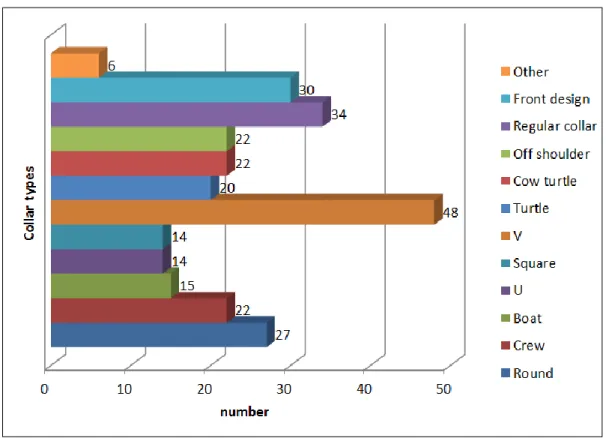
The images used for experiments are gathered from the Internet. All images have monochromatic background and show upper bodies from the front. Totally there are 274 images including ten different collar types and the clothes with front design as shown in Fig. 3 and 5. The number of images for each of the ten collar types and the clothes with front design is shown in Fig.17. Because it should be easier to find
- 17 -
a certain collar type if the number of it in the database is high, we take into consideration the proportion of image numbers of different collar types in evaluating the efficiency of proposed methods.
Fig. 17 Number of images for the ten collar types and clothes with front design
For all images, we pre-computed their Spread, Sift, Saliency and Saliency-Sift feature vectors. The Spread feature vector has 36 dimensions representing the distance from the neck center to the collar line measured everyπ/36 as shown in Fig. 7. The Sift feature vector is computed for the collar area and the whole upper clothing area, which consists of 500 dimensions separately (Fig. 9). When being used alone, the Saliency feature vector has 15 dimensions (Fig.11). When combined with Sift, it has 500 dimensions.
As described in Section 2.5, our RF procedure starts by letting the users to choose one desired image out of an initial training set containing images of 10 different collar types plus front design type. This step is used to build the initial OPF classifier and has big impact on the results of the following RF steps. In other words, the type of collar the users choose at the initiation step should be an important parameter in designing the experiment for two reasons. One is its relationship with the feature vectors; the effectiveness of the proposed feature vectors should be different for different collar types. The other is its number used in the experiment as it should be easier to find a certain collar type if there are more images of such type in the database. The experiments presented in [37], however, ignored these factors completely. To solve the problems, in our new experiments, each subject is asked to test all the ten collar types plus one front designs for the three different combinations of feature vectors: Spread+Sift, Spread+Saliency and Spread+Saliency-Sift. Therefore, each subject performed 33 tests in total and we compared the effects of the three feature vectors for each collar type respectively. To eliminate the bias caused by the population of collar types in the database, the number of images of each collar type is used to weight the score inversely when compare the average score of the three feature vectors for all images. While previous experiments used only 4 subjects [37], we improved the reliability of experiment results by expanding the number of subjects to 10. The 10 subjects are female college students from school of nursing. For each of the three
- 18 -
feature vectors, they were asked to initiate the RF with each collar type in the initial training set. At each step of RF, the subjects were asked to mark each of the 5 training images as “relevant” (O) and “irrelevant” (×) and evaluate each of the query results as “satisfactory” (O) and “unsatisfactory” (×). Then a score ranging 0-5, which corresponds to the number of satisfactory images, is automatically computed for the query results of each step.
2.6.2 Comparisons of feature vectors (Spread+Sift, Spread+Saliency-Sift,
Spread+Saliency)
Fig.18 shows the evaluation scores (averaged by ten subjects’scores) of the initial query results for the three feature vectors. We can observe that Sift and Saliency-Sift perform well at the first six collar types especially for the Square and the V types. Saliency-Sift works well for the Crew type also and Saliency is excellent for the Off shoulder type. We use the weighted (inversely proportional to their number percentage of total) average scores of the collar types to compare the overall qualities of the three methods, which will reduce the bias caused by the different number of images of different collar types. As is shown in Fig.19, the weighted score of the Saliency-Sift method is higher than those of the other two. One-tailed paired t-test reveals that the average score of Saliency-Sift in Fig.19 is significantly higher than that of Sift and Saliency at significance level 5% (p=0.05).
- 19 -
Fig. 19 Comparison of the weighted average scores of the three methods on the collar types
2.6.3 Improvement by RF-OPF
Although the results shown in Fig. 19 demonstrate that Saliency-Sift is more effective than the other two feature vectors, the initial query results of each feature vector is not good enough. It is because that the weighted average score of even the best case (Saliency-Sift) is just 3.08 against the full score of 5. We expect that continuing the RF iterations illustrated in section 2.5 can further improve the qualities of the query results.
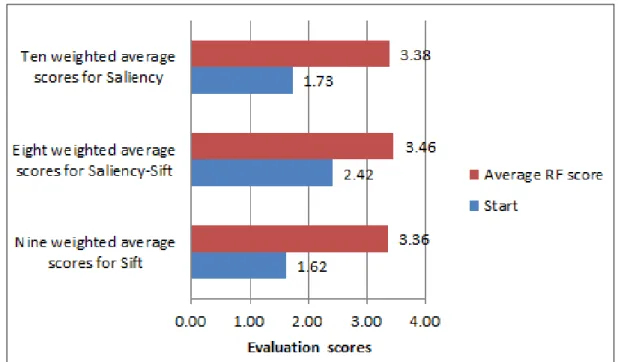
So if the subjects get few satisfactory images from the first query results, they are asked to continue the query and evaluation process until they are satisfied with the number of the satisfactory images returned by the RF-OPF prototype. The evaluation scores at each RF step are also averaged by the ten subjects and inversely weighted by the number of collar types as we have done in dealing with the initial query results. Since the subjects always terminated the RF when the query results contain 4 or 5 desired images (the evaluation scores are correspondingly 4 or 5), the times of RF iteration they took also reflects the efficiency of our RF-OPF prototype. To validate whether RF-OPF is useful for improving the query results, we compare the average evaluation scores of all RF steps with the first query scores. Please note that not all collar types are used in computing the average evaluation scores of all RF steps. It is because that the results of the Square and the V collar types with the Sift and the Saliency-Sift methods satisfy the subjects at the initial query phase, and the Crew collar type with the Saliency-Sift method satisfies the subjects at the initial query phase too. On the other hand, Square collar type with the Saliency cannot get any suitable image at the initial query phase, which generates a score of zero that cannot be compared in this experiment. Therefore, as is shown in the left title of Fig.20, there are 10, 8 and 9 collar types with the above three feature vector combinations to be compared. Fig.20 shows that the RF-OPF prototype makes great improvement on the initial query results for all the three feature vectors, which are 107.69%, 43.28% and 95.47% respectively. But for those collar types not involved in the RF phases, the effectiveness of the RF-OPF prototype cannot be validated in this way. We partially address this problem with another experiment described later.
- 20 -
Fig. 20 The improvement of the RF-OPF prototype on the proposed features
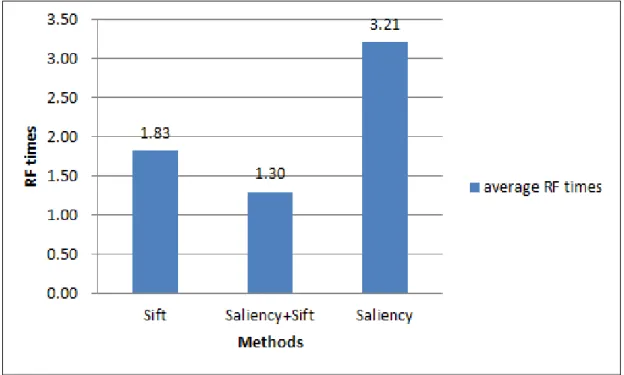
The average RF iteration times the subjects take to reach their objects are the evidences to validate the efficiency of the RF-OPF prototype directly and the corresponding feature vectors indirectly. We compare the average RF times of the three methods from the ten subjects on each collar type in Fig.21. From this figure, some useful information about the efficiency of the RF-OPF prototype on the collar types can be observed, such as the Square collar type being still very difficult to be found with the Saliency feature vector even with the help of RF-OPF prototype. Fig.22 shows that the Saliency-Sift feature vector needs the least average RF times (1.30) to make the users satisfied, which demonstrates the efficiency of it. A one-tailed paired t-test for the RF times in Fig.22 shows that the difference between the Sift and Saliency-Sift and that between the Saliency-Sift and Saliency are statistical significance (p=0.05).The difference between the Sift and Saliency is statistical significance at some extent (p=0.1).
- 21 -
Fig. 22 Comparison of the average RF times of the three methods
Since the experiment results of Fig.20 do not contain the entire collar types, the effectiveness of the RF-OPF prototype cannot be validated completely. To solve this problem, we ask all the subjects to perform 5 times RF steps no matter what the results are at each step. Since the highest average RF times of the three feature vectors shown by Fig.22 is 3.21, 5 times is considered to be enough for this experiment. With the evaluation scores of the initial query and the five RF steps’results, we get Fig.23. It shows that the RF-OPF prototype improves the first query scores of the three feature vectors from 2.15, 2.82 and 1.53 to 4.54, 4.77 and 4.28 respectively. The improvements are significant and the scores trends are incremental in general.
Fig. 23 Scores trends of five RF steps on the three feature vectors
- 22 -
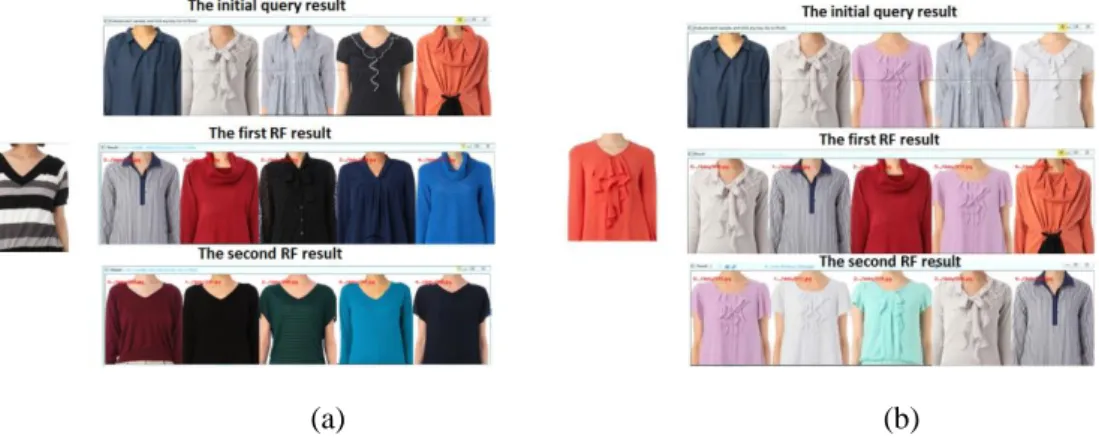
two given images mentioned in Fig. 9. The results are shown in Fig.24, which shows that the striped V collar type image can get five image of similar collar design at the second RF step and the image with front design can get four images of similar design at the second RF step too. Note that, although the initial query results or even the first RF results may be very unsatisfactory, we can always get better results after several RF iterations.
(a) (b)
Fig. 24 (a) The top five results for a striped V collar image with the Saliency-Sift method by the second RF phase. (b) The top five results for a front design image with the Saliency-Sift method by the second RF phase
2.7 Conclusion
Collar design plays an important role when people choose the desired clothing. In this paper, we focus our research on the retrieval of clothes image based on the collar design. Three different feature vectors Sift, Saliency and Saliency-Sift combined with Spread for capturing the detailed features of collar design and a CBIR prototype based on RF method and OPF classifiers are proposed. Through experiments, it is proved that Saliency-Sift is the best among the three feature vectors in terms of both effectiveness and efficiency. Our experiment results also demonstrated that the proposed RF-OPF prototype improves the qualities of the query results significantly.
But there are still some technical problems to be solved. 1. The Saliency-Sift feature vector still does not react well to some collar types, such as the Off shoulder and the Regular collar types. 2. The subjects may be confused by some similar collar types, such as the Round and the U collar type, the Crew and the Boat collar type during the RF phases in the experiment. In addition, the collars combing multiple design features, such as a collar combing turnover with V spread or front design are difficult to be classified by the subjects. 3. The scores of the query results are computed as the number of satisfactory images without considering the degree of satisfactory of each image in the query results. To solve the first problem, we plan to develop and experiment with other new feature vectors for capturing the collar design. The second problem can be solved by improving the spread feature vectors for better describing the roundness, width and angle, so as to better discriminate collar types of similar shape, like the Round, Crew, Boat and U collar types. The 3rd problem can be solved by asking subjects to score each of the retrieved images and analyze the trend of highest and average scores of RF iterations. The current image database is relatively small. We need to gather more images for improving the reliability of the experiment results. Another important issue is that the initial image sets for letting user to select one collar type to initiate the RF have large impact on the results of succeeding steps. We need to explore some new methods which can always
- 23 -
avoid misleading the building of the classifier.
3D Garment design is a rapidly developing field [33, 34]. Presenting 3D clothing images in clothes-shopping websites will help people find the desired clothes more easily. So it is very important for us to extend our research to deal with 3D collar design features in the future. Although collar is very important for choosing clothing, Color, texture and the design of other parts of garments also affect how people choose clothes at different extent. We are going to extend our retrieval system by considering other features. It should be easy to capture color and texture features with existing computer vision technologies. The technology provided in [38] can be employed for capturing the overall shape of garments. Moreover, the proposed RF-OPF system should have high potential to deal with more design factors as it is reported that OPF is superior to conventional learning algorithms such as ANN-MLP, K-NN and SVM in both computation time and accuracy especially in complex situations, i.e., with a large amount of overlapped regions [48,50].
- 25 -
Chapter 3 Caricature Synthesis with Feature
Deviation Matching under Example-Based framework
Chapter 3 mainly describes details of the proposed caricature synthesis framework, which is an example-based framework based on a cross-modal distance metric called feature deviation. It can generate various types of caricatures without paired example databases.
3.1 Introduction
Since the early 1980s, many computer-based methods have been developed for synthesizing caricatures [4]. These can be roughly classified into photo-transformed and example-based techniques. Photo-transformed approaches [5-8, 14-16, 27] achieve caricature styles by applying certain kinds of image filtering or geometric deformation to input portrait photos. In these systems, filters and deformations are usually tailor-designed for a particular style, and hence cannot be generalized to different styles without changing the underlying algorithms. Example-based systems [9-13, 17-20] require a large number of photo–caricature pairs as example data. In principle, the example-based approach has the advantage that a single framework can be used for generating caricatures of various styles given corresponding styles of example databases. However, obtaining sufficient sets of paired photo–caricature images is usually difficult. Many existing example-based systems asked artists to draw caricatures from a large number of example portrait photos, which is not always possible in real applications. Recently, approaches using deep-learning have attracted substantial attention. While supervised deep-learning approaches [27] may suffer from the problem of requiring even larger number of photo–caricature pairs than traditional example-based methods, unsupervised approaches using the concept of style-transfer-based or image analogies have also been developed [22-27]. With style-transfer-based systems, it is easy for users to apply a specific form of artwork stylization to their own photos for sharing and entertainment purposes. The basic principle of neural-style transferring is to separate a given style from the content of an image by considering different layers of a neural network. Since the stylistic information is mainly represented by low-level textural and color features, these methods are not suitable for achieving geometric stylization, such as deforming (exaggerating) the shapes of individual facial components, which is a technique commonly found in real caricatures. Essentially, deep-learning is an end-to-end approach, and its existing implementations do not provide users with any control over the details of stylization, such as the degree of exaggeration of individual facial components.
In this Chapter, we propose a new example-based caricature generation technique that can synthesize stylized caricatures with a small number of unpaired examples of portrait photos and caricatures. Our technique incorporates component-specific learning based on feature vectors that intuitively match the features that people employ to perceive or communicate the characteristics of faces, which can also provide users with control over the individual facial components. While existing component-specific learning methods [9-13, 17, 18, 51, 52] require paired photo-caricature examples and search for a matching
- 26 -
caricature component via its corresponding photo component, the proposed method searches for the matching caricature components in their feature spaces directly. However, caricatures of expressive styles will not always provide an entirely faithful reflection of the features evident in source portrait photos, and hence a direct comparison of feature vectors between the feature space of caricatures and the feature space of photographs is meaningless. To solve this problem, we propose a new cross-modal distance metric called feature deviation matching. The key idea is that, given fact that a caricature is an expressive representation of a person's prominent features, the feature spaces of both the original photographs and resulting caricatures should show strong correlation between these deviations from their corresponding averaged features. Therefore, the extent of deviation from averaged features across corresponding photo and caricature facial component feature spaces, despite of the modality difference between photo and caricature components, can be used to search for matching facial caricature components directly under the example-based framework. To compute the deviation, the proposed method uses one set of example photos and one set of example caricatures to learn the distributions of their respective feature spaces. The images in these two example sets are not necessarily photo-caricature pairs of the same persons, and the building of such training sets becomes much easier.
In summary, the contributions of this proposed framework are:
1. The newly proposed cross-modal distance metric called feature deviation matching technique makes it possible to generate various styles of caricatures under the conventional example-based framework without requiring paired photo–caricature training sets.
2. By focusing only on the perceptually prominent features, the designed feature vectors are robust and effective for capturing the visual features of input portrait photos.
3. The proposed system enables users to control the exaggeration of individual facial components. Various combinations of individual facial and hairstyle components, based on different exaggeration coefficients and similarity rankings, can provide users with different candidates to satisfy their particular preferences; this has not been achieved in most existing style-transfer-based and deep-learning-based approaches.
Fig.25 shows the comparison of our synthesized caricatures of expressive style with three state-of-art systems (The first and second rows: Comparison with sketch example-based system [15]. The third and fourth rows: Comparison with deep-learning based photo-transformed system [53]. The fifth to eighth: Comparison with component-based system [52].). It can be found that the caricatures generated by the sketch example-based system and the photo-transformed system resemble the input portrait photos the best, but lack artistic feelings. Example or component based systems can provide various styles of caricatures with artistic feelings. The caricatures by our proposed system are competitive with [52] method for similarity and are comparable with [15, 53] for as an expressive style.
The remaining part of the paper is organized as follows: Section 3.2 reviews related works. Section 3.3 presents the proposed method. Section 3.4 demonstrates some results and describes the evaluation experiments. Section 3.5 presents conclusions from the study.
- 27 -
Fig.25 Comparison of the expressive style synthesized by our proposed system with those generated by three state-of-art systems (a sketch example-based system [15], a deep-learning based photo-transformed system [28] and a component-based system [52]), A and B columns show the results of the other systems and our system respectively.

![Fig. 12 Saliency map computed with the method given in [20]. (a) Input image. (b) Saliency Map computed using low frequency band](https://thumb-ap.123doks.com/thumbv2/123deta/7692815.1216458/23.892.148.751.241.529/saliency-computed-method-given-input-saliency-computed-frequency.webp)