語彙機能文法と計算量
Lexical-Functional Grammars and Computational Complexity
西野哲朗
Tetsuro Nishino
東京電機大学理工学部情報科学科
Department ofInformation Sciences, Tokyo Denki University
Abstract
Lexical-functional grammars (LFGs) have been widely used to formally specify the syntax
ofnatural languages. In this paper, we show the followings : (1) the emptiness problem
for LFGs is undecidable, and (2) the membership problem for LFGs with at least one
$\epsilon$-production is $EXPTIM$E-haxd.
1
Lexical-Functional
Grammars
In this section, we describe the overview of LFG necessary for understanding the material
in this paper. For details, see [3]. We first illustrate the LFG machinery by a linguistic
example, then describe the formal definition of LFG.
In a sentencedescriptionof LFG, thereare two types ofcomponets, aconstituent
struc-ture (c-strucstruc-ture) and a
functional
structure (f-structure). Using these two structures,a LFG systemspecify a set ofgrammatical sentences. A c-structure is astandard parsing
tree of acontext-free grammar, which represents the superficialarrangements ofwords and
phrases in the sentence. While an f-structureis ahierarchical structureconstructed by the
pairs of
names
of grammatical functions and their unique values. The f-structure mainlyrepresents the configurationofthe surface grammatical functions.
An LFG systemis specified by a set of annotated phrase structure rules. An annotated
phrase structure rule is a context-free rule associated with functional equations. Fig. 1
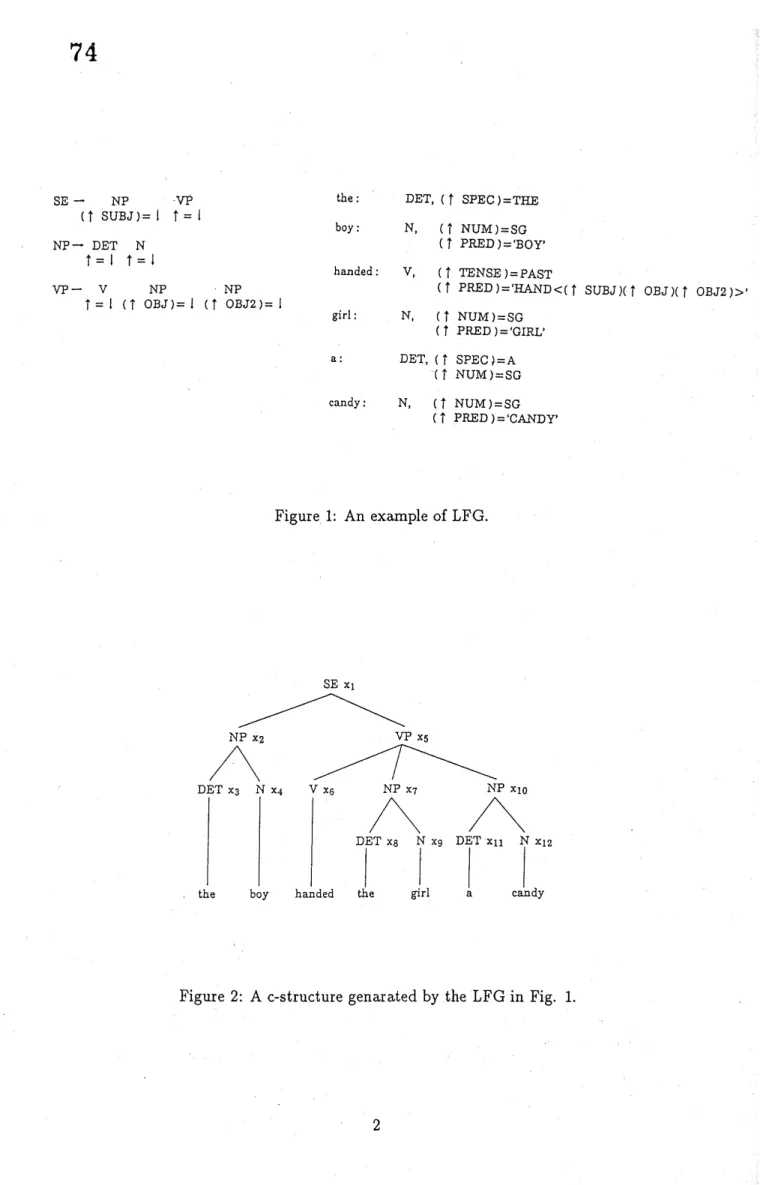
illustrates a simple example of LFG. We deal with this LFG throughout the examples
in this paper. A c-structure is generated using annotated phrase structure rules ignoring
the functional equations appearing in them. Fig. 2 illustrates an example of a c-structue
genarated by the LFGin Fig. 1 (The meaning of variables $x;,$ $1\leq i\leq 12$ in Fig. 2 will
be explained later.).
Each node in ac-structureis assumed to have anassociated f-structure. The
metavari-$able\downarrow attached$ to the node $n$ in a c-structure represents the f-structure associated to $n$
.
While the metavariable $\uparrow$ attached to $n$ represents the f-structure associated to the parent
of $n$
.
Therefore a defining equation of the form $\uparrow=\downarrow attached$ to $n$ represents that thef-structure associated to $n$ is equal to the f-structure associated to the parent of$n$.
Fur-thermore a defining equation of the form $(\uparrow OBJ)=\downarrow$ attached to $n$ represents that the
f-structure associated to$n$is equal to the value of the OBJ of the f-structure associated to
the parent of$n$
.
Given a c-structure $t$, the f-structure corresponding to$t$ is determined by the following
74
SE – NP $VP$ the: DET, ($\uparrow$ SPEC)
$=THB$
($\uparrow$ SUBJ)$=$ } $\uparrow=|$
boy: $N$, ($\uparrow$ NUM)$=SG$
$NParrow$ DET $N$ ($\uparrow$ PRED)
$=BOY’$
$\uparrow=|$ $\uparrow=\mathfrak{l}$
handed: V, ($\uparrow$ TENSE)
$=PAST$
$Vp-$ V NP NP ($\uparrow$ PRED)
$=^{t}HA_{1\dagger D<(}^{\backslash }\uparrow SUBJ$)$(\uparrow OBJ)$($\uparrow$ OBJ2)$>’$
$\uparrow=|$ ($\uparrow$ OBJ)$=\downarrow$ ($\uparrow$ OBJ2)$=$ }
$gir1$: $N$, ($\uparrow$ NUM)
$=SG$
($\uparrow$ PRED)$=GIRL^{\cdot}$
a: DET, ($\uparrow$ SPEC}$=A$
($\uparrow$ NUM)$=SG$
candy: $N$, ($\uparrow$ NUM)$=SG$
($\uparrow$ PRED)
$=$ CANDY’
Figure 1: An example of LFG.
($x_{1}$ SUBJ)$=x_{2}$, $x_{1}=x_{5}$, $x=x$ , $x_{2}=xg$, (x3 SPE$C$)$=THE$, (x4 NUM)$=SG$, (x4PRED)$=BOY’$, $x_{5}=x_{6}$
.
(x50BJ)$=x_{7}$, (x5 OBJ2)$=x_{10}$, $tx_{6}$TENSE)$=PAST$, ($x_{6}$ PRED)$=HAND<$($\uparrow$ SUBJ)($\uparrow$ OBJ)($\uparrow$ OBJ2)$>’$,
$x_{7}=x_{8,}$ $x_{7}=x_{9}$, ($x_{8}$ SPEC)$=THE$, (x9 NUM)$=SG$, (x9 PRED)$=$ GIRL’, $x_{10}=x_{11}$, (b) $x_{10}=x_{12}$, ($x_{11}$SPEC)$=A$, ($x\iota\iota$ NUM)$=SG$, ($x_{12}$ NUM)$=SG$, (a) ($x_{12}$PRED)$=$ CANDY’
Figure 3: (a) An f-description and (b) an f-structure corresponding to the c-structure in
Fig. 2.
1. Assign a unique variable to each internal node of $t$ which represents the f-structure
associated to the node.
2. Using the variables of (a), instantiate (i.e. have the appropriate variables filled in
for the arrows) all the equations associated to the nodes in $t$
.
The set of equationsthus produced is called the f-description of$t$
.
(The f-description produced from thec-structurein Fig. 2 is shown in Fig. 3 $(a)$
.
)3. Solve the f-description of (b) algebraically to obtaine the value in the f-description’s
unique minimal solution of the $\downarrow$-variable of the $SE$ node. (This value is called the
f-srtucture assigned to the string. The obtained value for $x_{1}$ of the f-description in
Fig. 3 (a) is the f-structure shown in Fig. 3 (b). This f-structure is the one assigned
to the string the boy handed the girl a candy. ) For details of this solution algorithm,
see [3].
As shown in Fig. 3 (b), an f-structure is a hierarchical structure constructed by the
ordered pairs each of which consists of a function name and its unique value. The
f-description solution algorithm in [3] constructs one solution (f-structure) for a properly
instantiatedf-description if it is possible.
Grammatical functions whose values can serve as arguments to semantic predicates are
called governable grammatical
functions.
Thewell-formedness
conditions on f-structuresare defined as follows:
Well-formedness
conditions onf-structures
76
2. (completeness) An f-structure is locally complete ffl it contains all the goveranable
grammatical functions that serve as arguments to its predicate. An f-structure is
complete iff it and its subsidiary f-structure are locally complete.
3. (coherency) An f-structure is locally coherent iff all governable grammaticalfunctions
that it contains serve as arguments to a local predicate. An f-structure is coherent iff
it and all its subsidiary f-structures are locally coherent.
Astring is grammatical only if it has a valid c-structure and it is assigned awell-formed
f-structure. A language generated by $LFGG$, denoted by $L(G)$, is a set of grammatical
strings of $G$
.
The class oflanguages generated by lexical functional grammars is denotedby $\mathcal{L}_{LFG}$
.
From the definition of LFG, it is obvious that the class of languages generatedby LFGs includes the class ofcontext-free languages.
Inthis paper, we deal with a subclass of LFGs which is called restricted LFGs. We now
describe a formal definition of restricted LFGs. The following definition is based on the
one of Pinker [4].
Definition 1 A restricted lexical
functional
grammar (RLFG for short) is a 7-tuple$G=(\Sigma, \Gamma, S, FN, FV, PR, AR)$ consists of 1-7 as follows :
1. $\Sigma$ is a finite terminal alphabet.
2. $\Gamma$ is afinite nonterminal alphabet.
3. $S$is a start symbol.
4. $FN$ is a finite set of
function
names.5. $FV$ is a finite set of
function
values.6. $PR$is a finite set of predicates.
7. $AR$is a finite set of annotated phrase structure rules. An annotated phrase structure
rule is of the form
$Aarrow(B_{1}, E_{1})(B_{2}, E_{2})\ldots(B_{m}, E_{m})$,
where $A\in\Gamma,$ $B_{1},$ $B_{2},$
$\ldots,$$B_{m}\in\Sigma\cup\Gamma$ and
$E_{i}$ is a functional equation set, with the
constraint that for all $i,j$ such that $i\neq j,$ $(B_{i}, E_{i})\neq(B_{j}, E_{j})$
.
Afunctional
equationset is a set ofstatements ofthe form
$M_{1}F_{1}F_{2}=M_{2}F_{3}F_{4}$,
where $M_{1},$$M_{2}\in\{\uparrow, \downarrow\}$ ( $\uparrow and\downarrow are$ called metavariables), and $p_{:}\in FN\cup FV$ for
each $i,$ $1\leq i\leq 4$
.
In the above equation, any symbol except $=may$ be null, but theleft-hand side of the equation must be one of the following forms : $M_{1}F_{1}F_{2},$ $M_{1}F_{1}$,
$M_{1}$ or $F_{1}$, and this is the same for the right-hand side of the equation. An annotated
phrasestructure rule of the form$Aarrow(B_{1}, E_{1})$, where $B_{1}\in\Sigma$ and $E_{1}$ is a functional
equation set, is especially called a lexical insertion rule or a lexical entry.
Example 1 The LFG in Fig. 1 is indeed an RLFG defined as follows:
$G=$ ($\Sigma,$ $\Gamma,$ SE, $FN,$ $FV,$ $PR,$ $AR$), where
$\Sigma=$
{the,
boy, handed, girl, $a$,candy},
$\Gamma=\{SE, NP, VP, DET, N, V\})$
$FN=$
{SUBJ,
$OBJ$, OBJ2, SPEC, $NUM$, PRED,TENCE},
$FV=$
{
$A$, THE, $SG$,PAST}
$PR=$
{’BOY’,
’GIRL’, ’CANDY’, ’HAND $<(\uparrow SUBJ)(\uparrow OBJ)(\uparrow\backslash OBJ2)>’$}
and $AR$ contains the following rules :
$SEarrow$ ($NP,$ $\{(\uparrow$ SUBJ) $=\downarrow\}$)$(VP, \{\uparrow=\downarrow\})$,
$NParrow(DET, \{\uparrow=\downarrow\})(N, \{\uparrow=\downarrow\})$,
$VParrow(V, \{\uparrow=\downarrow\})(NP, \{(\uparrow OBJ)=\downarrow\})$($NP,$ $\{(\uparrow$ OBJ2) $=\downarrow\}$),
$DFTarrow$ (the, $\{(\uparrow$ SPEC) $=THE\}$),
$Narrow$ (boy, $\{(\uparrow NUM)=SG,$ $(\uparrow$ PRED) $=’$
BOY’}),
etc.Remarks.
(1) Let $A\in NV,$ $X\in TV$ and $E$ be a functional equation set. As shown in
Fig. 1, alexical insertionrule $Aarrow(X, E)$ is usually writtenas
$X$ : $A,$ $E$
.
(2) As can be seen from the definition, no
more
than two function names mayappearon either side of functional equation. This constraint is identical to the
following
functional
locality constraint of Kaplan and Bresnan [3] : no rule inthe grammar may refer to symbols separated by more than a single level of
embedding in an f-structure.
(3) As mentioned in [4], entries for predicates taking a number of arguments
can bebroken down into a set of equations, each one specifying the gramatical
function assigned to one argument of the predicate. For example, the lexical
entry for the word handed in Fig. 1 would be translated into the following
annotated
phrase structure rule:$V$ $arrow$ handed
$(\uparrow TENSE)=PAST$
($\uparrow$ PRED) $=’HAND’$
($\uparrow$ ARGI) $=$ ($\uparrow$ SUBJ)
($\uparrow$ ARG2) $=(\uparrow OBJ)$
$(\uparrow ARG3)=$ ($\uparrow$ OBJ2)
So, without loosing generality, we can assume that functional equations are of
the form described in the above definition. But, for the simplicity sake, we
write thelexical entries as in Fig. 1.
(4) Metavariables are left-associative, i.e. $M_{1}F_{1}F_{2}=((M_{1}F_{1})F_{2})$
.
In ordertoimprovethe readability, we oftenwrite $((M_{1}F_{1})F_{2})$ ratherthan $M_{1}F_{1}F_{2}$
.
(5) In the general LFG machinery, there are two types ofmetavariables. They
are (a) immediate domination metavariables (i.e. $\uparrow and\downarrow$ ) and (b) bounded
domination metavariables (i.e. $\Uparrow and\Downarrow$ ). We have already seen
78
metavariables
fr
$and\Downarrow are$ used to represent long distance binding used forhandling $wh$ movement inexamples such as Which boy did the girl kiss.
Theorem 1 $CFL\not\subset \mathcal{L}_{RLFG}$
Proof
Since any CFG generates c-structures with no functional equations, the class CFLis obviously contained in $\mathcal{L}_{RLFG}$
.
In order to show that this containment is proper, it issuffice tosee that the following RLFG $G$generates thelanguage $\{a^{n}b^{n}c^{n}|n\geq 1\}$ which is
a famous example of the language that is known not to be a context-free language. This
LFG is originally given in [3].
$G=(\Sigma, \Gamma, S, FN, FV, PR, AR)$, where
$\Sigma=\{a, b, c, \},$ $\Gamma=\{S, A, B, C\},$ $FN=\{N\},$ $FV=\{0\},$ $PR=\emptyset$ and $AR$ contains the
following rules :
$Sarrow(A, \{\uparrow=\downarrow\})(B, \{\uparrow=\downarrow\})(C, \{\uparrow=\downarrow\})$ ,
$Aarrow(a, \emptyset)(A, \{(\uparrow N)=\downarrow\})$,
$Barrow(b, \phi)(A, \{(\uparrow N)=\downarrow\})$,
$Carrow(c, \emptyset)(A, \{(\uparrow N)=\downarrow\})$,
$Aarrow(a, \{(\uparrow N)=0\})$,
$Barrow(b, \{(\uparrow N)=0\})$, $Carrow(c, \{(\uparrow N)=0\})$
.
口We denote the class of context-sensitive languages by $CSL$
.
The following theorem isknown.
Theorem 2 [3] $\mathcal{L}_{LFG}\subseteq CSL$ $\square$
Corollary 3 $\mathcal{L}_{RLFG}\subseteq CSL$ $\square$
2
The Emptiness Problem for LFGs
The emptiness problem for LFGs is as follows: given an LFG $G$, decide whether $L(G)=\emptyset$
.
In this section, we first show that the emptiness problem for LFGs is undecidable. We
reduce Post’s Corresponding Problem to the emptiness problem. An instance of Post’s
Corresponding Problem ( $PCP$ for short) consists of two lists, $A=(x_{1}, x_{2}, \ldots, x_{k})$ and $B=(y_{1}, y_{2}, \ldots, y_{k})$ of strings over some alphabet $\Sigma$
.
An instance of PCP is said to have asolution if there exists asequence ofintegers $i_{1},$$i_{2},$
$\ldots,$$i_{m}(m\geq 1)$ such that
$x;_{1}x$;
...
$x_{i_{m}}=y;_{1}y_{i_{2}}$...
$y;_{m}$.
In this case, the sequence $i_{1},$$i_{2},$ $\ldots,$
$i_{m}$ is called a solutionto this instance of PCP, and the
strings $x_{i_{1}}x_{1_{2}}\ldots x_{i_{m}}(=y;_{1}y;_{2}\ldots y_{i_{m}})$ is called a value of this instance. The following
theoremis well known (see for example [2]).
Theorem 4 PCP is undecidable. $\square$
Example 2 Let $\Sigma=\{0,1\},$ $A=(01,11)$ and$B=(1011,1)$
.
This instance of PCP has asolution $i_{1}=2,$ $i_{2}=1$ and $i_{3}=2(m=3)$
.
Then $x_{2}x_{1}x_{2}=y_{2}y_{1}y_{2}=110111$.
Theorem 5 The emptiness problem for RLFGs is undecidable.
$(x_{1}, x_{2}, \ldots, x_{k})$ and $B=(y_{1}, y_{2}, \ldots, y_{k})$ be an instance of PCP, where for each $i(1\leq i\leq k)$, $x_{i}=a_{1}a_{2}\ldots a_{m(i)}$ with $a_{j}\in\Sigma$ for each $j,$ $1\leq j\leq m(i)$, and $y_{i}=b_{1}b_{2}\ldots b_{n(i)}$ with
$b_{j}\in\Sigma$ for each $j,$ $1\leq j\leq n(i)$
.
From the lists $A$ and $B$, we construct the following RLFG$G(A, B)=(\Sigma, \Gamma, S, FN, FV, PR, AR)$ :
$\Gamma=\{S, I, A, B\}\cup\{A_{j}^{i}|1\leq i\leq k, 1\leq j\leq m(i)\}\cup$
$\{B_{j^{1}}|1\leq i\leq k, 1\leq j\leq n(i)\}$,
$FN=$
{TAPE,
LIST, REST,$H,$ $T,$$L$},
$FV=\{0,1,2, \ldots, k, }$, $PR=\emptyset$ and
$AR$ contains the following annotated phrase structure rules:
1. $Sarrow(I, E_{1})(A, E_{2})(B, E_{3})$, where
$E_{1}=\{(\uparrow TAPE)=\downarrow\}$ and
$E_{2}=E_{3}=$
{
$(\downarrow$ TAPE) $=(\uparrow$ TAPE), $(\uparrow$ LIST) $=(\downarrow$ LIST), $(\downarrow$ L)=$}.2. $Iarrow(I, E_{1})(0, E_{2}),$ $Iarrow(I, E_{3})(1, E_{4})$, where $E_{1}=E_{3}=\{((\uparrow TAPE)T)=\downarrow\}$,
$E_{2}=\{((\uparrow TAPE)H)=0\}$ and $E_{4}=\{((\uparrow TAPE)H)=1\}$
.
3. $Iarrow(O, E_{1}),$ $Iarrow(1, E_{2})$, where
$E_{1}=$
{
$((\uparrow$ TAPE) $H)=0,$ $((\uparrow$ TAPE) T)=$} and$E_{2}=$
{
$((\uparrow$ TAPE) $H)=1,$ $((\uparrow$ TAPE) T)=$}.4. $Aarrow(A, E_{1})(A^{i}, E_{2}),$ $Barrow(B, E_{3})(B_{i^{1}}, E_{4})(1\leq i\leq k)$, where
$E_{1}=E_{3}=$
{
$(\downarrow$ TAPE) $=(\uparrow$ REST), $((\downarrow L)H)=i,$ $((\downarrow L)T)=(\uparrow L)$}
and $E_{2}=E_{4}=${
$(\downarrow$ TAPE) $=(\uparrow$ TAPE), $(\uparrow$ REST) $=(\downarrow$ REST)}.5. $A_{i}^{j}arrow(A_{i}^{j+1}, E_{1})(a_{j}, E_{2}),$ $B^{l}\cdotarrow(B^{l+1}, E_{3})(b_{l}, E_{4})$ $(1\leq i\leq k, 1\leq j\leq m(i)-1$, $1\leq l\leq n(i)-1)$, where
$E_{1}=E_{3}=$
{
$(\downarrow TAPE)=((\uparrow$ TAPE) $T),$ $(\uparrow$ REST) $=(\downarrow$ REST)}, $E_{2}=\{((\uparrow TAPE)H)=a_{j}\}$ and$E_{4}=\{((\uparrow TAPE)H)=b_{l}\}$
.
6. $A_{i}^{m(1)}arrow(a_{m(i)}, E_{1}),$ $B_{j}^{n(i)}arrow(b_{n(i)}, E_{2})(1\leq i\leq k)$, where
$E_{1}=$
{
$((\uparrow TAPE)H)=a_{m(i)},$ $(\uparrow$ REST) $=((\uparrow$ TAPE) $T)$}
and $E_{2}=${
$((\uparrow TAPE)H)=b_{n(:)},$ $(\uparrow$ REST) $=((\uparrow$ TAPE) $T)$}.
7. $Aarrow(A^{i}, E_{1}))Barrow(B!, E_{2})(1\leq i\leq k)$, where
$E_{1}=E_{2}=\{$($\downarrow$ TAPE) $=$ ($\uparrow$ TAPE), $((\downarrow L)H)=i$
,
$((\downarrow L)T)=(\uparrow L),$ ($\uparrow$ LIST) $=(\downarrow L),$ ($\downarrow$ REST)=$}.
From the construction, it is easy to see that an instance $(A, B)$ of PCP has a value $y$
(i.e. has a solution) iff $(y^{R})^{3}\in L(G(A, B))$ iff $L(G(A, B))\neq\emptyset$, where $y^{R}$ denotes the
reverse of $y$
.
$\square$80
3
Lower Bounds
on
the Membership Problem
In this section, we show that the membership problem for LFGs which have at least one
e-production is $EX$PTIME-hard. We first briefly describe the basic concepts in
compu-tational complexity. For details, see $[1, 2]$
.
Definition 2 A one-tape alternating Turing machine (ATM for short) is a 6-tuple
$M=(Q, \Sigma, \Gamma, \delta, q_{0}, F, U)$ where :
1. $Q$ is the finite set ofstates.
2. $\Sigma$ is the finite input alphabet.
3. $\Gamma$is thefinite tape alphabet.
4. $\delta$ is the next move relationmapping an element of $Q\cross\Sigma$to asubset of $Q\cross\Sigma\cross D$, where $D=\{L, R\}$
.
5. $q_{0}\in Q$ is the initial state.
6. $F\subseteq Q$ is the set of accepting states.
7. $U\subseteq Q$ is the set of universal states. $Q-U$ is called the set of existentialstates.
A machine move is represented as follows. Let $\delta(q, x)$ be of the following form.
$\delta(q, x)=\{(q_{1}, y_{1}, d_{1}), (q_{2_{-}},y_{2}, d_{2}), \ldots, (q_{m}, y_{m}, d_{m})\}$,
where $q,$$q_{1},$$\ldots,$$q_{m}\in Q,$
$d_{1},$$d_{2},$
$\ldots,$ $d_{m}\in D$ and $x,$$y_{1},$$\ldots,$ $y_{m}\in\Sigma$
.
In state $q$, scanning symbol$x,$ $M$ takes the following action ACT(i) for some $i,$ $1\leq i\leq m$if $q$ is an existential state,
and takes ACT(i) for all $i,$ $1\leq i\leq m$ if$q$ is a universal state.
ACT(i) : Rewrite $x$ as $y_{i}$, move the tape head one position in the derection of $d_{i}$, and
change the state to $q_{i}$
.
A configuration of$M$ consists ofthestate, head position, and contents of thetapw. Let
$C$ be a configurationof $M$
.
We denote the set ofpossible configurations after one move of$M$ by Next$(C)$
.
A configuration is existential (resp. universal, initial, accepting) if thestate of$M$ in that configuration is an existential (resp. universal, initial, accepting) state.
A value $v(C)$ of$C$ is either true or false defined by the followingprocedure.
Procedure EVAL ( $C$ : a configuration of an ATM);
begin
if$C$ is an accepting configuration
then $v(C):=true$
else if$C$ is an existential configuration
then if there is $C’\in Next(C)$ such that $v(C’)=true$
then $v(C):=true$
else $v(C):=false$
iffor every configuration$C’\in Next(C),$ $v(C’)=true$
then $v(C):=true$
else $v(C):=false$
end
An ATM accepts an input string $x$ iff$v(C_{0})=true$, where $C_{0}$ is the initial configuration
for $x$
.
Let $n$ be $t$he length of an input to a Turing machine. DTIME(T(n)) is the class
of languages accepted by deterministic Turing machines within $T(n)$ time. We define
$EX$PTIME$= \bigcup_{\{\geq 0}DTIME(2^{n^{i}})$
.
ASPACE(S(n)) is the class oflanguages accepted byATMs within space $S(n)$
.
The following theorem states that the time complexity of therecognitionproblem for linear space-bounded ATMs is exponential in terms of deterministic
Turing machine.
Theorem 7[1] $EX$PTIME$= \bigcup_{\{\geq 0}ASPACE(n^{i})$ $\square$
Theorem 8 The membership problem for RLFGs which have at least one e-production
is $EX$PTIME-hard.
Proof
Sketch. Let $M=(Q, \Sigma, \Gamma, \delta, q_{0}, F, U)$ be a one-tape linear space ATM. We assumethat the length of the tape is exactly $n$, where $n$ is the length of the input string. Let
$w=x_{1}x_{2}\ldots x_{n}$ be an input for $M$, where $x_{i}\in\Gamma$ for all $i,$$1\leq i\leq n$
.
We will construct anRLFG $G(M, w)=(\Sigma, \Gamma, S, FN, FV, PR, AR)$ such that $M$ accepts $w$ iff$w\in L(D(M, w))$
.
Without loosing generality, we assume that $\Sigma=\{a, b\}$
.
$G(M, w)$ is constructed as follows.$\Gamma=\{[q]|q\in Q\}\cup\{S, A_{1)}A_{2}, \ldots, A_{n-1}, B_{1}, B_{2}, \ldots, B_{n}\}$,
$FN=\{L, R, H, T, X, ACC\}$, $FV=$ $\{\, 0,1\}\cup\Sigma$,
$PR=\emptyset$ and
$AR$is constructed based on $\delta$ as follows:
1. Let
$\delta(q, x)=\{(q_{1}, y_{1}, d_{1}), (q_{2}, y_{2}, d_{2}), \ldots, (q_{m}, y_{m}, d_{m})\}$
.
If $q\in Q$ then add the following rule to $R$ :
$[q]arrow([q_{1}], E_{1})([q_{2}], E_{2})\ldots([q_{m}], E_{m})$
,
else $(q\in Q-U)$ add the following rules to $R$ :
$[q]arrow([q_{1}], E_{1}),$ $[q]arrow([q_{2}], E_{2}))$ ,$[q]arrow([q_{m}], E_{m})$
.
For each $i(1\leq i\leq m),$ $E_{1}$ is constructed as follows : if$d_{i}=R$ then $E_{i}$ contains the
following rules:
(a) $(\uparrow C)=x$
(b) $((\downarrow L)H)=y_{i}$
(c) $((\downarrow L)T)=(\uparrow L)$
(d) $(\downarrow C)=((\uparrow R)H)$
82
(f) $(\downarrow ACC)=1$
(g) $(\uparrow ACC)=1$
else $(d;=L)$ then $E_{i}$ contains the following rules:
(a) $(\uparrow C)=x$
(b) $(\downarrow L)=((\uparrow L)T)$
(c) $(\downarrow C)=((\uparrow L)H)$
(d) $((\downarrow R)H)=y$;
(e) $((\downarrow R)T)=(\uparrow R)$
(f) $(\downarrow ACC)=1$
(g) $(\uparrow ACC)=1$
2. For $q\in F$, add the following rule to $R$ :
$[q]arrow(\epsilon, \{(\uparrow ACC)=1\})$
.
3. Add the following rules to $R$ :
(a) $Sarrow(A, \{\uparrow=\downarrow\})([q_{0}], \{\uparrow=\downarrow\})$
(b) $A_{n-1}arrow$ ($B_{n},$$\{((\uparrow R)H)=(\downarrow X),$ $((\uparrow R)$ T)=$})
$(B_{n-1}, \{(\uparrow C)=(\downarrow X), (\uparrow L)=})$
(c) $A_{k}arrow(A_{k+1}, \{((\uparrow R)H)=(\downarrow C), ((\uparrow R)T)=(\downarrow R)\})$
($B_{k},$$\{(\uparrow C)=(\downarrow X)$, (\uparrow L)=$}) for all $1\leq k\leq n-2$
(d) $B_{k}arrow(x_{k}, \{(\uparrow X)=x_{k}\})$ for all $1\leq k\leq n$
口
Corollary 9 The membership problem for LFGs which have at least one e-production is
EXPTIME-hard. $\square$
4
Conclusion
Wesummarize the results in this paper inthe following table.
References
[1] Chandra, A. K., Kozen, D. C., and Stockmeyer, L. J. : Alternation, $JA$CM, 28(1981),
pp.114-133.
[2] Hopcroft, J. E., and Ullman, J. D., Introduction to Automata Theory, Languages, and Computation, Addison-Wesley (1979).
[3] Kaplan, R. M., and Bresnan, J. : Lexical Functional Grammar: A Formal system
for Grammatical Representation, In: J. Bresnan (Ed.) The Mental Representation