Video Streaming over Vehicular Networks
Using Scalable Video Coding
RUIJIAN AN
Doctor of Philosophy
Department of Informatics
School of Multidisciplinary Sciences
SOKENDAI (The Graduate University for
Advanced Studies)
定
Video Streaming over Vehicular Networks Using
Scalable Video Coding
RUIJIAN AN
A dissertation submitted to the Department of Informatics
School of Multidisciplinary Sciences
in partial fulfillment of the requirements for the degree of
Doctor of Philosophy
at
SOKENDAI (The Graduate University for Advanced Studies)
March 2017
Abstract
Intelligent Transport System (ITS) is the next generation transport system, which is introduced to improve road safety, driving experience and efficiency, by employing vehicular networks on the road. The vehicular networks are consist of two kinds of communications, thus Vehicular-To-Infrastructure (V2I) and Vehicle-To-Vehicle (V2V). New information and communication technologies are applied in the scope of traffic configuring, road transport and mobility management, etc. Besides road safety, vehicular network communication is also a promising way to provide a lot of services, such as traffic monitoring, driving assistance and entertainment.
Video is an important medium for information sharing and entertainment (info- tainment). In several years, video contents dissemination would extend 80%–90% of the entire Internet traffic load, referring to the recent CISCO report. Recently, more attention is caught for the video streaming in vehicular networks. Compared with smart phones, the car engine can provide ample power for intensive data computation and communication. Vehicles can also equip large on-board storage. As a result, the vehicles in the vehicular networks are powerful enough to transmit continuous video data among other vehicles or Road Side Units (RSUs). Furthermore, the recent ve- hicular communication standard can support up to 54 Mbps transmission rate. Even between high speed driving vehicles, it is reasonable to expect a 1Mbps data rate.
However, compared with the conventional networks, wireless communication in vehicular networks is challenged by the following problems. Firstly, the wireless chan- nel suffers from the time-varying fading, shadowing and interference, which lead to high variation of link throughput. Secondly, vehicular communication is also affected by the high moving speed of vehicles. To accommodate the QoS constraints posed by video services in vehicular networks, the Scalable Video Coding (SVC) scheme in H.264/AVC standard family offers spatial and temporal scalabilities for video stream- ing.
We describe the scenario setting in this thesis as follows. While vehicles are 3
services for all vehicular users. The videos are encoded into multiple layers with SVC mechanism. Besides the users who are using the video streaming services, vacant users are willing to help the communications between the RSUs and the video users, in a cooperative way.
In this thesis, SVC coded videos over cooperative vehicular networks are inves- tigated to improve the performances of the video streaming services. We target the optimization problems of how many video layers should be transmitted for each ve- hicle, how to select the relay vehicular users to assist the receiver vehicles, and how to assign network resources to direct and cooperative communications.
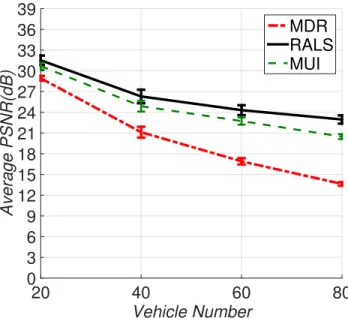
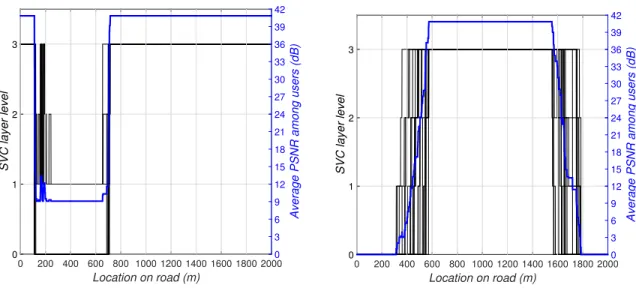
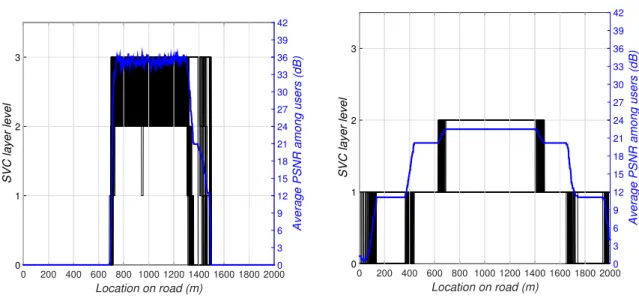
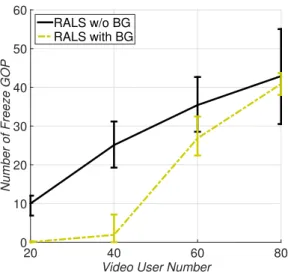
The joint SVC layer selection and resource allocation for the multi-user video streaming over highway scenario was investigated at first. We proposed a Resource Allocation and Layer Selection (RALS) algorithm, which explicitly takes account of the utility value of each Group Of Picture (GOP) among all vehicular users. We decoupled this problem to two subproblems, i.e., the SVC layer selection subproblem and the resource allocation subproblem. The proposed RALS algorithm was designed to solve these subproblems separately. In RALS, we solved the SVC layer selection subproblem with dynamic programming method, and used a greedy based resource allocation scheme to deal with the resource allocation subproblem. The performance of RALS was evaluated by extensive simulations. Simulation results showed that RALS outperformed the comparison schemes in typical scenarios. Despite the system utility values, the GOP distributions of the comparison schemes were also shown in the simulation results section. The GOP distributions illustrated the detailed performance in the perspective of each user. As an extension of RALS, we designed RALS with Base layer Guarantee (BG) scheme to reduce the playback freeze. The performance of RALS with BG was also evaluated in the simulation results section and compared with RALS.
Then, we later investigated the joint SVC layer selection, resource allocation and 4
relay assignment problem in cooperative vehicular networks. We formulated the relay assignment problem as a Maximum Weighted Bipartite Matching (MWBM) problem, and solved this problem with the proposed Maximum Utility Increment (MUI) algo- rithm. In MUI, we employed the Hungarian algorithm and Bellman-Ford algorithm to solve the MWBM problem. To solve the resource allocation and SVC layer se- lection problem, we explicitly considered the segment utility increment in MUI. The performance of MUI was evaluated by exploiting extensive simulations. Simulation results showed that MUI outperformed the comparison schemes in typical scenarios. In the perspective of each user, the GOP distributions of each comparison scheme were also shown in the simulation results section. In order to reduce the number of freezed GOPs in the playback, we extended the MUI to MUI with base layer guar- antee scheme. According to the simulation results, MUI with base layer guarantee could eliminate playback freeze with quite little PSNR loss in most cases.
The limited network resources do not allow all vehicular users to receive the videos with the highest SVC layer levels simultaneously. However, the proposed scheduling algorithms have the ability to improve the system performance in the perspective of the quality of perceived videos, or the quality of experience. At the same time, pro- portional fairness is approximately achieved as well. As a result, the video streaming over vehicular networks is able to perform much better than before, and we are a small step forward to the bright future of in-vehicle infotainment.
5
Acknowledgments
Though only my name appears on the cover of this dissertation, many people have contributed to its production. I owe my gratitude to all those people who have made this dissertation possible and because of whom my graduate experience has been one that I will cherish forever.
My deepest gratitude is to my advisor, Prof. Yusheng Ji. I feel quite fortunate to have an advisor who gave me the freedom to explore on my own, and at the same time the guidance to recover when my steps faltered. Prof. Ji taught me how to question thoughts and express my ideas. Her patience and support helped me overcome many crisis situations and finish this dissertation.
I am obliged to my thesis committee members: Professor Shunji ABE, Professor Kensuke FUKUDA, Professor Michihiro KOIBUCHI, Professor Shigeki YAMADA and Professor Celimuge WU. My committee was always flexible in scheduling and judicious in their application of both carrots and sticks.
Many friends have helped me stay happy through these difficult years. Among all of my dear friends, I want to express my most sincere gratefulness to Prof. Zhi Liu and Prof. Hao Zhou, who are always there when I have a problem in my research, as well as in my life.
Most importantly I would like to express my heart-felt gratitude to my family in China. The love and support from my family is the light to guide me to my happiness for ever. Thank you and I love you.
7
Contents
Cover page 1
Abstract 3
Acknowledgments 7
Contents 9
List of Figures 13
List of Tables 17
List of Abbrevations 18
List of Notations 22
1 Introduction 27
1.1 Background . . . 27
1.2 Motivation . . . 30
1.3 Application . . . 32
1.4 Related Work . . . 34
1.4.1 Cooperative network and relay assignment . . . 34
1.4.2 Resource allocation schemes in cooperative vehicular networks 35 1.4.3 Video streaming in vehicular networks . . . 36
9
1.6 Organization . . . 39
2 Video Streaming over Vehicular Networks: Resource Allocation and SVC Layer Selection 41 2.1 Introduction . . . 41
2.2 System Model . . . 43
2.2.1 System Architecture . . . 43
2.2.2 Video Coding Model . . . 44
2.2.3 Resource Model . . . 45
2.2.4 Utility Model . . . 47
2.3 Formulation . . . 50
2.4 Problem Decoupling and Algorithms . . . 52
2.4.1 Problem Decoupling . . . 52
2.4.2 SVC Layer Selection Subproblem . . . 53
2.4.3 Resource Allocation Subproblem . . . 55
2.4.4 RALS with Base Layer Guarantee . . . 58
2.5 Simulation Results . . . 60
2.5.1 Simulation Setup . . . 60
2.5.2 PSNR Calculation . . . 62
2.5.3 Comparison Schemes . . . 65
2.5.4 Analysis . . . 65
2.5.5 Base Layer Guarantee . . . 70
2.5.6 Quality of Experience Evaluation . . . 72
2.6 Summary . . . 75
3 Video Streaming over Cooperative Vehicular Networks: Resource Allocation, SVC Layer Selection and Relay Assignment 77 3.1 Introduction . . . 77
10
3.2 System Model . . . 79
3.2.1 System Architecture . . . 79
3.2.2 Relay Assignment Model . . . 80
3.2.3 Resource Model . . . 85
3.2.4 Utility Model . . . 87
3.3 Formulation . . . 87
3.4 Algorithm . . . 89
3.4.1 Segment Utility Increment . . . 89
3.4.2 Relay Assignment (RA) Phase . . . 90
3.4.3 Resource Allocation and SVC Layer Selection (RS) Phase . . . 93
3.4.4 MUI with Base Layer Guarantee . . . 94
3.5 Simulation Results . . . 95
3.5.1 Simulation Setup . . . 95
3.5.2 Comparison Schemes . . . 97
3.5.3 Analysis . . . 98
3.5.4 Base Layer Guarantee . . . 105
3.6 Summary . . . 107
4 Conclusion 109 4.1 Discussion . . . 109
4.2 Future Work . . . 111
4.2.1 Video Streaming over LTE/D2D Networks under Vehicular En- vironment . . . 111
4.2.2 Video Streaming in Heterogeneous Networks for Vehicular Users112 4.2.3 Video Streaming over Vehicular Information-Centric Network 112 4.2.4 Pre-caching in Vehicular Networks Video Streaming . . . 113
4.3 Conclusion . . . 113
Bibliography 115
11
List of Figures
1-1 Cooperative Vehicular Networks. . . 28
1-2 SVC coded video streaming. . . 29
2-1 Video streaming over vehicular networks. . . 42
2-2 SVC coding scheme for two layers with I-frames (blue), P-frames (green) and B-frames (red). . . 44
2-3 The capacity of the link between the RSU and a vehicle. . . 46
2-4 SVC layer selection and resource allocation for user A in 5 GOPs (J = 4 and B = 1), 3 SVC layer levels, 8 resource segments and M = 2 scenario. 48 2-5 Comparison of staircase PSNR utility function and fitted logarithm function, generated with real video data. . . 50
2-6 The curves of ˜ui(·) and ¯ui(·) over 3 SVC layers. . . 55
2-7 Example of resource allocation graph. (2 users, 3 resource segments) . 56 2-8 Simulation time and sampling interval. . . 61
2-9 Performance comparison with Optimal, MDR and MUI. . . 66
2-10 Performance comparison with MDR and MUI. . . 67
2-11 RALS for 20 users scenario. . . 68
2-12 MDR for 20 users scenario. . . 68
2-13 MUI for 20 users scenario. . . 68
2-14 RALS for 80 users scenario. . . 68
2-15 MDR for 80 users scenario. . . 69 13
2-17 The average PSNR values varying the number of video users. . . 70
2-18 The average playback freeze GOP number varying the number of video users. . . 70
2-19 RALS with base layer guarantee for 20 users scenario. . . 71
2-20 RALS with base layer guarantee for 80 users scenario. . . 71
2-21 MOS comparison of RALS and RALS with BG. . . 74
3-1 Cooperative video streaming over vehicular networks. . . 78
3-2 A three users example of cooperative communication. . . 81
3-3 The feasible relay range when the distance between the RSU and the relay user is 300 m in AF mode. . . 84
3-4 Cooperative SVC layer selection, resource allocation and relay selection for user A in 5 GOPs (J = 4 and B = 1), 3 SVC layer levels, 8 resource segments, 2 available relay users and M = 2 scenario. . . 86
3-5 MWBM problem for 3 video users and 2 relay users. . . 91
3-6 Average PSNR values varying the number of video users with 20 relay users and STW is 3 second. . . 98
3-7 Average PSNR values varying the number of relay users with 20 video users and STW is 3 second. . . 99
3-8 Average PSNR values varying the STW time with 20 video users and 20 relay users. . . 100
3-9 MDR w/o relay for 10 users scenario. . . 101
3-10 MDR with relay for 10 users scenario. . . 101
3-11 MUI w/o relay for 10 users scenario. . . 101
3-12 MUI with relay for 10 users scenario. . . 101
3-13 RALS w/o relay for 10 users scenario. . . 102
3-14 RALS with relay for 10 users scenario. . . 102
3-15 MDR w/o relay for 40 users scenario. . . 102 14
3-16 MDR with relay for 40 users scenario. . . 102
3-17 MUI w/o relay for 40 users scenario. . . 103
3-18 MUI with relay for 40 users scenario. . . 103
3-19 RALS w/o relay for 40 users scenario. . . 103
3-20 RALS with relay for 40 users scenario. . . 103
3-21 Average PSNR values varying the number of video users with 20 relay users and STW is 3 second. . . 106
3-22 Number of freeze GOPs varying the number of video users with 20 relay users and STW is 3 second. . . 106
3-23 MUIB with relay for 40 users scenario. . . 107
3-24 MOS comparison of MUIB with relay and MUI with relay. . . 108
15
List of Tables
2.1 Parameter Setting of Video Sequences . . . 60
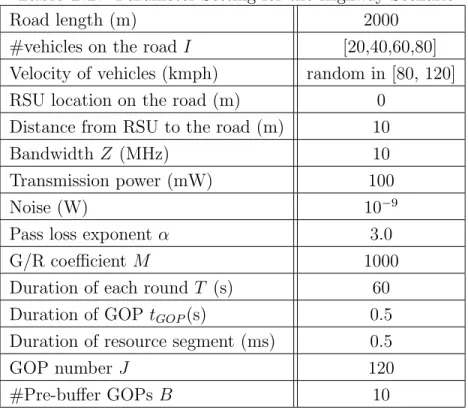
2.2 Parameter Setting for the Highway Scenario . . . 63
2.3 The ITU-T 5 point ACR scale . . . 72
2.4 PSNR to MOS conversion . . . 73
3.1 Additional Parameter Setting for the Highway Scenario . . . 96
17
List of Abbrevations
ACR Absolute Category Rating
BG Base layer Guarantee
BS Base Station
CT Cooperative Transmission
D2D Device-to-Device
DP Dynamic Programming
DSRC Dedicated Short Range Communications
DT Direct Transmission
G/R coefficient GOP playback time over Resource segment time coefficient
GOP Group Of Picture
HCCA Hybrid coordination function Controlled Channel Access HetNet Heterogeneous Network
ICN Information Centric Network
ILP Integer Linear Problem
ISP Internet Services Provider ITS Intelligent Transport System
LTE Long Term Evolution
MAC Media Access Control
19
MEC Mobile Edge Computing
MOS Mean Opinion Score
MSE Mean Square Error
MUI Maximum Utility Increment
MUIB Maximum Utility Increment with Base layer guarantee MWBM Maximum Weighted Bipartite Matching
OFMD Orthogonal Frequency Division Multiplexing OFMDA Orthogonal Frequency Division Multiple Access PSNR Peak Signal to Noise Ratio
QoE Quality of Experience
RALS Resource Allocation and Layer Selection
RSU Road Side Unit
SNR Signal to Noise Ratio
STW Scheduling Time Window
SVC Scalable Video Coding
TDMA Time Division Multiple Access
TXOP Transmit OPportunities
V2I Vehicle-To-Infrastructure
V2N Vehicle-To-InterNet
V2P Vehicle-To-Pedestrian
V2R Vehicle-To-Road infrastructure
V2V Vehicle-To-Vehicle
V2X Vehicle-To-Everything
VANET Vehicular Ad-hoc NETwork 20
WLAN Wireless Local Area Network WWAN Wireless Wide Area Network
21
List of Notations
B Number of Pre-buffer GOPs C(s, p) The capacity between s and p
CAF(s, r, p) The capacity between s and p in AF cooperative communication with relay r
CDF(s, r, p) The capacity between s and p in DF cooperative communication with relay r
E The edge set between V1 and V2
I Number of Video Users
J Number of GOPs in each round
K Number of resource segments in one round
L The maximum number of SVC layer levels among all users Li Number of SVC layer levels for video user i
M The GOP playback time over resource segment time coefficient N0 Background noise
P Transmission power
R Number of relay users
SN Rs,p The SNR value between s and p
T The length of time for each round/STW
23
ment GOP index
V1 Vertex set for all video users
V2 Vertex set for all resource segments Z Bandwidth of the channel
∆ui,k The utility increment of user i if the resource segment k is assigned for it
∆ui,r,k The utility increment when assigning resource segment k for video user i, assisted by relay user r
γ Path loss exponet
αi,k Resource allocation 0-1 integer for video user i and resource segment k
T¯ The time cost when one vehicle runs through the road with highest speed
¯k The resource segment located in the middle of T
¯
ui(d) The utility value when assigning as much as d data volume for video user i
βi,r Relay assignment 0-1 integer for video user i and relay user r E The edge set for the relay assignment problem
I The set of video users
IjB The set of video users that have not received the base SVC layer for the next GOP j
R The set of relay users
R¯ The extended set of relay users
| Xs− Xp | Euclidean distance between s and p
24
µi(j, d) Maximum system utility for j GOPs with given data volume d φ The transformed bipartite graph for the resource allocation subprob-
lem
ψ Subset of edge set E
~
α Resource allocation vector β~ Relay assignment vector
d~reci Received data vector for video user i
~l SVC layer selection vector
~linit Initially received SVC layer levels vector
dreci,j The received data before the playback of GOP j
dsegi,k The data volume of resource segment k if it is assigned for video user i
dsegi@r,k The data volume of the resource segment k for user i assisted by relay user r
di,l The data volume needed to playback one GOP from SVC layer level 1 to l for user i
i Video user index i
j GOP index j
k Resource segment index k
l SVC layer level
li,jinit Initially received SVC layer level of user i about GOP j li,j SVC layer selection for user i about GOP j
p Destination in cooperative network
r Relay user index r
s Sender in cooperative network
25
t0 Start time of one round
tGOP The time duration of each GOP
ui,l The utility value of user i’s GOP with the SVC layer level l w(e) The weight over edge e
~l |i The SVC layer selection vector for video user i
Chapter 1
Introduction
1.1 Background
As one of the most important enabling technologies in the envisioned intelligent trans- portation system (ITS) [1][2], vehicular networks [3][4][5] are introduced to improve the road safety [6][7][8] by employing two transmission categories, i.e., Vehicle-To- Infrastructure (V2I) [9][10] communications which enable vehicles to communicate with Road Side Unit (RSU), and Vehicle-To-Vehicle (V2V) [11][12][13] communica- tions which enable vehicles to communicate with each other. Nowadays, vehicles can exchange information with other vehicles (V2V), with the roadside infrastructure (V2I), with a backend server (e.g., from a vehicle manufacturer or other mobility service providers) or with the Internet, thus Vehicle-To-InterNet (V2N) [14][15], with a pedestrian, thus Vehicle-To-Pedestrian (V2P) [16][17], with road infrastructure, thus Vehicle-To-Road infrastructure (V2R) [18][19], etc. To refer to all these types of vehicular communication, the term Vehicle-To-Everything (V2X) [21] has been proposed.
Connected vehicle services have existed in the market for more than 10 years with the provision of automated crash notifications, vehicle breakdown notifications, traffic information and infotainment services, among others. With the explosive growth
of information technology, vehicular networks [22][23] contribute to a more efficient driving experience by acting as a promising medium to provide a number of innovation applications, such as traffic monitoring, driving assistance, and multimedia services [24]. Recently, the development of cellular communication supported V2X services has received broad attention from both industry and academy. The cellular systems, such as Long Term Evolution (LTE) or 5G, are considered as a promising technique for vehicular communication due to its nice properties in terms of high data rate, low latency, large coverage area, high energy efficiency, robust interference control, high penetration rate, and high-speed terminal support [25]. In the near future, vehicular networks are promising to be integrated with cellular networks heterogeneously, for an example, 5G networks.
HWY 101
®
®
®
®
Cellular BS
WiFi AP
Footprint of wireless access infrastructure
Traffic Information Parking
Service Speed Control
Content Delivery
Road Infrastructure V2I V2R V2V
RSU RSU
Figure 1-1: Cooperative Vehicular Networks.
In Fig. 1-1, a well-developed street scenario enhanced by vehicular networks is shown. The vehicular networks integrated with cellular networks help to build the
1.1. BACKGROUND 29
intelligent transport systems and become an important fraction of the smart city. The V2I communications provide vehicular users different kinds of services, including content delivery/video streaming, in the cellular base stations as well as other RSUs. The V2V communication let vehicular users communicate with each other and share local information. Also, V2V allows vehicular users to relay data for other vehicular users, as we discussed later in this thesis. The road infrastructures deployed on different locations provide different road services with V2R communication, like traffic information sharing, parking service, speed control and advertisement. The future vehicular networks are able to provide us a much safer road traveling experience and a more convenient life style.
The fast varying channel conditions and connectivity in vehicular networks lead to additional challenges compared with wireless communications in low mobility scenar- ios [26]. In fact, wireless communications in ITS systems should operate with minimal errors while reliably delivering vital data in real time. Hence, challenges imposed by the dynamic surroundings such as multi-path fading, shadowing, and path loss should be surmounted by the ITS system [27].
Due to maturity of multimedia processing and network technologies, i.e., H.264 codec and 3G/3.5G/4G wireless network, the demands of universal multimedia service are increased significantly. In future years, video contents dissemination would extend 80%–90% of the entire Internet traffic load, referring to the recent CISCO report [28]. More attention is caught for the video streaming in vehicular networks recently [29][30][31][32].
1080P 30fps 720P 30fps 360P 30fps 180P 15fps
360P 1080P
720P
180P
MCU
Figure 1-2: SVC coded video streaming.
Video streaming over vehicular networks has considerable benefit for both road safety and entertainment. However, high quality video streaming for fast-moving vehicles faces fundamental challenges attributed to the high mobility and dynamic nature of the network. To eliminate the negative impact of the wireless channel fading and exploit spatial diversity, we introduce SVC [33][34] over cooperative vehicular networks to improve the performance of the video streaming services. SVC is an attractive method to address the heterogeneity of networks and end-user capabilities. A SVC encoded video stream consists of one base layer that provides a minimum quality of the video, and multiple enhancement (also referred as higher) layers that represent the same video but with gradually increased quality, as shown in Fig. 1-2. The transmitter may send only a subset of layers according to the receiver’s channel condition. The core idea of the cooperative communications in vehicular networks is that when the channel between the RSU and the receiver vehicle is unreliable, another vehicle that has much better channel conditions forwards the data to the receiver vehicle, and thus, a significant gain for the whole system is achieved.
1.2 Motivation
The video streaming over cellular networks has been well investigated in recent years, for an example, LTE networks. However, employing the same mechanisms of LTE networks in the vehicular environment instead of the general environment is not sufficient, due to the high mobility and dynamic nature of vehicular communication. Compared with the LTE networks, vehicular networks are usually assumed to employ the license free frequency. Also, the new Mobile Edge Computing (MEC) technology enables the information sharing betweens RSUs. The current LTE net- works assign the network resources based on the estimation of the channel condition. However, by utilizing the shared information like locations, velocities, buffer levels, video information etc., a smarter scheduling is possible when MEC is implemented in
1.2. MOTIVATION 31
the RSU.
Research about comparing the performance of LTE networks and vehicular net- works, like VANET, has been done by some researchers. Vinel investigates the abilities of LTE to support beaconing for vehicular safety applications in [35]. As a result, the LTE network easily becomes overloaded even under the idealistic assumptions. A detailed performance evaluation study of the IEEE 802.11p and LTE standards are given in terms of delay, reliability, scalability, and mobility support in the context of various application requirements in Mir et al.’s work [36]. The results indicate that IEEE 802.11p offers acceptable performance for sparse network topologies with limited mobility support. On the other hand, LTE meets most of the application requirements in terms of reliability, scalability, and mobility support; however, it is challenging to obtain stringent delay requirements in the presence of higher cellular network traffic load.
Meanwhile, employing SVC in vehicular networks has not been well investigated in literature [37][38][39]. There lies three challenges in the video streaming over cooperative vehicular networks issue, due to the limited network resource. The first is how to assign the limited network resource for multiple users, thus the resource allocation problem. The second is how to decide the SVC layer level for the received video, thus the layer selection problem. The last is how to assign proper relay users for video users, thus the relay assignment problem.
Regarding the resource allocation phase, each resource segment can be assigned for only one user. However, each user wants to get more resource segments to buffer enough number of GOPs for current/further playback. How to assign the limited number of resource segments for all the users to support a smooth playback is a great challenge.
Since the videos are encoded with H.264/SVC scheme, each GOP has multiple layer levels. With the limited network resource assigned by the RSU, the leverage between buffering more GOPs with lower SVC layer levels, and less GOPs with higher
SVC layer levels is a problem as well. The first choice promise a smooth playback for further GOPs, while the second will play the current GOP with better quality.
Cooperative communication could improve the network throughput by employing relay users in the communication range. However when there are multiple relay users to be assigned for multiple video users, the relay assignment mechanism should be designed carefully to cope with the main objective we want to achieve.
1.3 Application
The vehicular networks have many potential applications in public services as well as in the industry, like road safety services, automated parking system, emergency stop, adaptive cruise control, etc. In recent years, a lot of companies invested in the development of vehicular networks-related systems and applications. When 5G is im- plemented, video applications are able to support a more convenient and comfortable in-vehicle road trip. The applications of video streaming over vehicular networks are discussed in four instances.
Improving Road Safety: Overtaking Assistance
In the overtaking assistance application, a video stream captured by a windshield- mounted camera in a vehicle is compressed, broadcast to the vehicle driving behind it, and displayed to its driver. Such a “see-through” system is aimed at helping drivers overtake long and vision-obstructing vehicles, such as trucks on rural roads using the oncoming lane. Moreover, dangerous road situations or even rear-end collisions can be avoided when information about the obsta- cle is provided to the driver well in advance, following observation from the vision-obstructing vehicle [40][41].
Improving Public Security: In-vehicle Video Surveillance
The in-vehicle video surveillance application captures video data by means of an internal cabin-mounted camera in a vehicle. After compression, this information
1.3. APPLICATION 33
is transmitted to the emergency security services such as the police and ambu- lance. The application will allow real-time monitoring of public transportation to help counteract terrorism, vandalism and other crimes. The efficiency of in-vehicle video surveillance can be enhanced by means of video data analysis and the detection of criminal activity using the state-of-the-art video analytics methods [42].
Traffic Control: Traffic Conditions Video Surveillance
For traffic control purposes it might be necessary to ascertain the current situ- ation at a given road section, intersection or even lane. Thanks to the benefits of global positioning systems, traffic management center can activate the ex- ternal cameras of vehicles located in the geographical area of interest. Video information with the current road views is then compressed at the vehicle side and transmitted back to the management center. Real-time reaction to traffic jams caused by accidents can be achieved if the video surveillance system of traffic conditions is combined with the eCall [43] or a similar system, which automatically notifies the emergency services of the crash.
Infotainment
Of course video streaming provides in-vehicle passengers information as well as entertainment services. For a long travel on the road, how to spend the time becomes a problem for the passengers who do not need to care much about driving the vehicle. In the future, when auto-mobile vehicles are widely used, there will be no more drivers. The infotainment services are becoming the most important use cases in video streaming over vehicular networks scenario.
In this thesis, we investigate the downlink video streaming for vehicular video users, which is more likely related to infotainment services. However, the proposed schemes are not limited to provide only infotainment services, depending on different application scenarios.
1.4 Related Work
1.4.1 Cooperative network and relay assignment
There were some researches concentrating on the idea of cooperative downloading [44][45]. In [46], the authors proposed a cooperative strategy for content delivery and sharing in vehicular networks, in which the proposed strategy did not focus on streaming and is designed to gather part of the data from one-hop helpers only. In [47], authors proposed a system for mobile devices that receive the same video stream and thus can share received video data over Wireless Local Area Network (WLAN). In their algorithm for the cooperative system, and analytically showed that the pro- posed system is outstanding in terms of energy consumption and channel switching delay. However, in the vehicular network environment, the considered mobile nodes are unlike the traditional mobile devices in two aspects: (1) the power consump- tion is no longer the main issue and (2) the computing capability is more powerful to run complicated tasks. Regarding the cooperative streaming scenario, a collab- orative downloading system called COMBINE was designed by Ananthanarayanan et al. [48]. COMBINE integrates neighboring nodes’ Wireless Wide Area Network (WWAN) interfaces to download resources for an active node. Then, neighboring nodes deliver data to the active node using their WLAN links. Furthermore, the cooperative streaming scenario may adopt different codecs to encode video data. For example, Leung and Chen proposed a protocol called Collaborative Streaming among Mobiles (COSMOS) using the MDC codec in wireless networks [49]. On the other hand, Fan et al. described a joint session scheduling (JOSCH) mechanism using layer-encoded streaming in heterogeneous wireless networks [50]. In [51], Guan et al. proposed a cross layer scheme using rate control, relay selection and power control for video streaming. However, their proposed system considered single hop network and the scenario is for multimedia sensor network. Our proposed system considers multiple hop network and the corresponding scenario is for the vehicular networks.
1.4. RELATED WORK 35
Thus, the considered technical issues are different.
Except those one-hop cooperative helpers, a helper may use multiple routing paths to send the data to the requester. In [52], the authors presented an architecture sup- porting transmission of multiple video streams in ad-hoc networks by establishing multiple routing paths to provide extra video coding and transport schemes. In [53], the proposed multi-path transmission control scheme not only aggregates the avail- able bandwidth of multiple paths, but also reduces the unnecessary time of packet reordering at the receiver. In [54], authors proposed a protocol that selects multi- ple maximally disjointed paths without causing flow congestion. Although a lot of researches have addressed the problem of multi-path routing, most of them concen- trated on how to find paths providing good quality to send data back, but how to find appropriate cooperative helpers is left without answers.
1.4.2 Resource allocation schemes in cooperative vehicular
networks
The authors in [55] proposed a downlink resource allocation scheme in vehicular networks where both an infrastructure and a vehicle can form multiple direction beams via smart antenna in order to transmit multiple data streams simultaneously. The work was focused on how to avoid the co-channel interference between V2I/V2V links, and did not consider the issue of relay selection. A cooperative social network and its dynamic bandwidth allocation algorithm were proposed in [56] where the closest relay station was selected to forward data without consideration of link quality. The authors in [57] considered the scenario where the long range transmission is based on LTE and the short range transmission is based on IEEE 802.11p. The resource allocation process was focused on LTE links and the V2V links adopted multicast. Zheng et.al. proposed a scheme to allocate the V2I and V2V links for both one- hop and two-hop communications by solving the maximum weighted matching of the constructed bipartite graph of the vehicular networks through Kukn-Munkres
algorithm [58]. The scheme was suboptimal because the radio resources are equally allocated to each link. In [59], the authors proposed a two-dimensional-multi-choice knapsack problem (2D-MCKP) based scheduling scheme to select the coordinator vehicles for the destination vehicle and allocation radio resource to V2V/V2I links to maximize sum utility of the networks. However, these schemes are designed for data transmission in vehicular networks, and cannot be directly applied for the SVC streaming services.
1.4.3 Video streaming in vehicular networks
There are dozens of researches about video streaming in conventional networks, in- cluding resource allocation for video over network [60], energy aware video stream- ing [61][62]. However, less work have been done investigating the video streaming over vehicular networks. Yan et al. [63] proposed an analytical model to utilize the multihop throughput over vehicular highway networks. Zhang et al. [64] developed a platoon-based content replication algorithms to improve the data access. Li et al. [65] focused on multicasting video contents on the highway by employing symbol- level network coding scheme. A density-aware relay selection scheme, VIRTUS, was developed by Rezende et al. [66] as to provide a reactive and scalable unicast solu- tion for video streaming over vehicular networks. Rezende et al. proposed a VIdeo Reactive Tracking based UnicastSt (VIRTUS) protocol for unicast streaming over vehicular networks [67][66]. The work focused on the suitability of a node to relay packets based on balance between geographic advancement and link stability. Asefi et al. proposed an adaptive retransmission limit selection scheme to improve the per- formance of IEEE 802.11p protocol for video streaming applications over vehicular networks [68].
Due to the characteristics of IEEE 802.11p standard, these schemes cannot be directly applied to the cellular communication-supported vehicular networks. How- ever, video streaming in cellular communication supported vehicular networks has not
1.5. CONTRIBUTION 37
been well investigated in literature. An et al. considered the SVC video streaming scheduling problem over vehicular networks in the perspective of only one user [69]. The scheme proposed by Yaacoub et al. was based on grouping the moving vehicles into cooperative clusters [70]. Within each cluster, the LTE system was used to send the data over long range cellular links to a selected cluster head, which multicasts the received video over IEEE 802.11p links to vehicles in its cluster.
In our perspective, SVC could offer us a new point of view of the video streaming issue over vehicular networks. In the literature, SVC coding scheme is well investi- gated by researchers, focusing on conventional networks. Schaar et al. [72] developed the cross-layer optimization strategies for HCCA-based video streaming using SVC. Ji et al. [73] investigated the problem of scheduling and resource allocation for mul- tiuser video streaming over downlink Orthogonal Frequency Division Multiplexing (OFMD) channels, in which the video is encoded by SVC.
Although SVC coding scheme has been introduced to the conventional networks, employing H.264/SVC for video streaming in vehicular networks is not trivial in literature. Xing et al. [74] proposed relay selection and adaptive SVC layer selection schemes over the highway Vehicular Ad-hoc NETwork (VANET) scenario. Xu et al. [71] developed a dynamic programming based algorithm for the resource allocation problem of scalable video streaming over VANETs [75]. They focus on a small window size of GOPs and one user cannot buffer more video data when this window size is full, even though the network resource is redundant. Belyaev et al. [76] proposed a low-complexity unequal packet loss protection and rate control algorithm for scalable video coding for road surveillance applications.
1.5 Contribution
The contributions of this thesis is two-fold. As first we target the resource allocation and SVC layer selection problem in SVC video streaming over one-hop vehicular
networks in Chapter 2.
• We investigated the resource allocation and layer selection problem for the multi-user SVC video streaming over highway scenario. A centralized network in RSU was assumed, and the network resources were shared by all video users on the road. Such network resources, in the form of resource segments were used to watch realtime video encoded with SVC.
• We proposed a Resource Allocation and Layer Selection (RALS) algorithm to cope with the problem. Specifically, we decouple the optimization problem into two subproblems, i.e., the SVC layer selection subproblem as the lower layer subproblem, and the resource allocation subproblem as the upper layer subproblem. We solved the SVC layer selection subproblem with dynamic pro- gramming method, and used a greedy based resource allocation scheme to deal with the resource allocation subproblem.
• In order to reduce the playback freeze, we extended RALS to RALS with base layer guarantee algorithm, and explained the detailed steps to execute the base layer guarantee scheme.
• Simulation results showed that the proposed RALS algorithm outperformed the comparison schemes in typical scenarios. We also analyzed the SVC layer dis- tributions of different comparison schemes to show how the video would be like while users were running through the RSU coverage. At last, the performance of RALS with base layer guarantee is shown.
In Chapter 3, the resource allocation, SVC layer selection and relay selection problem over the SVC video streaming in cooperative vehicular networks environment is discussed, the contributions of this chapter is as follows,
• The resource allocation, SVC layer selection and relay assignment problem for SVC video streaming over cooperative vehicular networks scenario is investi-
1.6. ORGANIZATION 39
gated. We follow the resource model and video model as introduced in Chapter 2. For the relay assignment problem, we assumed that the relay users and video users were one to one matches.
• We proposed a Maximum Utility Increment (MUI) algorithm to solve the afore- mentioned problem. In MUI, we explicitly took account of the utility value increment of resource segment among all video users. We formulated the relay assignment problem as a Maximum Weighted Bipartite Matching problem, and solved this problem using Hungarian and Bellman–Ford algorithms.
• Similar with Chapter2, we designed the Maximum Utility Increment with Base layer guarantee (MUIB) scheme to reduce the playback freeze.
• The proposed MUI algorithm was evaluated in extensive simulations. Simula- tion results showed that not only MUI outperformed other comparison schemes with the objective to maximize the system utility value, MUI also prevented playback freeze in most of time, by comparing with the performance of MUIB.
1.6 Organization
The outline of this thesis is shown as follows:
We first presented the background, motivation, application, related work and contribution of this thesis in Chapter 1.
In Chapter 2, we introduced the resource allocation and layer selection problem for the multi-user SVC video streaming over highway scenario. The RALS algorithm was designed to solve this problem, and evaluated according to the simulation results. We also designed RALS with BG algorithm to reduce the playback freeze of RALS in this chapter.
As an extension of Chapter 2, Chapter 3 described the resource allocation, SVC layer selection and relay assignment problem for SVC video streaming over cooper-
ative vehicular networks scenario. Such problem was solved with the proposed MUI algorithm. Simulations were done to evaluate the performance of MUI. In order to reduce the playback freeze, MUI with base layer guarantee scheme was investigated as well.
Chapter 4 concluded this thesis, discussed the solutions proposed and introduced some research issues that had not been well addressed.
Chapter 2
Video Streaming over Vehicular
Networks: Resource Allocation
and SVC Layer Selection
2.1 Introduction
Before we investigate the video streaming over cooperative vehicular networks, we start with one-hop video streaming scenario [77][78][79]. The video streaming issue over one-hop vehicular networks issue can be considered as preliminary work. But the research about this issue is also quite meaningful when dealing with the one-hop scenario, which is also very common in reality.
In this chapter, we discuss the video streaming over vehicular networks in highway scenario. Refer to Fig.2-1, when several vehicles running on the highway road, some of the passengers want to watch realtime videos through the vehicular networks. In this case, video streaming over vehicular networks would make it possible for the video playback.
Due to the limited network resource, there are two challenges in the video stream- ing over vehicular networks issue as explained as follows. The first is about how to
RSU RSU Video
Video Server
Vehicle
Gateway
Core Network
Figure 2-1: Video streaming over vehicular networks.
assign the limited network resource for multiple users, i.e., the resource allocation problem. The second one is how to decide the SVC layer level for the received video, i.e., the layer selection problem.
In the resource allocation phase, each resource segment can be assigned for no more than one user. However, each user wants to receive more resource segments to buffer more SVC layers for current/further playback. As a result, the problem of how to assign the limited network resource for all users is a great challenge.
As a property of SVC scheme, each GOP is encoded with multiple SVC layers. Constrained by the limited network resource assigned by the RSU, the leverage be- tween receiving more GOPs with lower SVC layer levels, and receiving less GOPs with higher SVC layer levels is a problem as well. Usually, the first choice promise a smooth playback for more GOPs, while the second choice may let users play the current GOP with much better quality.
The contributions of this chapter are listed as follows. At first, we investigate the resource allocation and layer selection problem for the multi-user SVC video
2.2. SYSTEM MODEL 43
streaming over highway scenario. Secondly, we propose a Resource Allocation and Layer Selection (RALS) algorithm to cope with the problem. Thirdly, simulation results show that the proposed RALS algorithm outperforms the comparison schemes in typical scenarios. At last, we extend RALS to RALS with base layer guarantee scheme to reduce the playback freeze.
The organization of this chapter is shown as below. Section2.2presents the system model and Section 2.3 illustrates the formulation of the resource allocation and layer selection problem. In Section 2.4, we decouple this problem to two subproblems and propose the RALS algorithm with or without the base SVC layer level guarantee. Section 2.5 shows the setup of the simulations and the analysis of the simulation results. At last, the chapter is concluded in Section 2.6.
2.2 System Model
2.2.1 System Architecture
We establish our highway scenario as follows. The highway road is bidirectional, straight and has multiple tracks. RSUs are located along the road. Assume that the information of the vehicular users in each RSU’s coverage, such as locations and velocities, is shared by the adjacent RSUs. We focus on the video streaming problem for the vehicular users in one RSU coverage.
Our algorithm executes in a round-by-round fashion. The length of time for each round is T . For each highway road, usually there is a speed limit for the vehicles running on it. We let T be the length of time that is needed for one vehicle to go through the RSU coverage with the highest speed. Suppose t0 is the start time of one round. Denote I as the number of users that can communicate with the RSU in the time period [t0, t0+ T ], and want to watch realtime videos via the vehicular networks. The network resource provided by the RSU is shared by all these users.
2.2.2 Video Coding Model
In our system model, the videos are encoded by the H.264/SVC scheme. The videos are encoded in the unit of GOP. Each GOP contains a fix number of frames. Each GOP has multiple layers.
GOP
B B
I I I
P P
I I I
Base LayerBase Layer + Enhancement Layer
P P P P
Figure 2-2: SVC coding scheme for two layers with I-frames (blue), P-frames (green) and B-frames (red).
To introduce the H.264/SVC scheme, Fig. 2-2 shows an example with two SVC layers, thus one base layer and one enhancement layer. There are three kind of frames shown in the figure: I-frame (blue), P-frame (green) and B-frame (red). The P-frame can only be decoded with the previous I/P-frame. The B-frame can only be decoded with the previous and the next frames. In the example, each GOP contains one I- frame, two P-frames and one B-frame. The base layer contains I-frame and P-frame. While the enhancement layer contains the P-frame and the B-frame. Dislike the base layer, the enhancement layer cannot be decoded by itself. With the aid of the enhancement layer, the frequency of the video is doubled. The more enhancement layers are decoded, the higher video quality is achieved.
Denote the number of SVC layers for user i as Li. Let L be the maximum number
2.2. SYSTEM MODEL 45
of layers among all users, thus L = max{Li | 1 ≤ i ≤ I}. If we want to decode one GOP with layer level l, we need to receive all the layers from layer 1 to layer l. Due to the nested dependency among layers, we define the data volume of one GOP from layer 1 to layer l as di,l. Remark that the layer level 0 stands for freeze.
During the time period [t0, t0 + T ], J GOPs will be played by each user, where J = ⌈T /tGOP⌉. Furthermore, we also pre-buffer a few number of GOPs, in order to support a smooth playback after one user runs out of the communication range. The number of pre-buffered GOPs is denoted as B. The value of B is usually constrained by user’s buffer size or the length of realtime video that is already generated in the server.
We assume the duration of each GOP is uniform for all users, and the playback of each GOP is synchronized. This is reasonable when the SVC coding scheme is performed by the same video providers, like YouTube, Netflix, etc.
Before we execute our algorithm regarding time interval [t0, t0 + T ], the users may have already buffered some SVC layers of different GOPs in the previous round. Denote ~linit := {liniti,j ∈ {0, 1, 2, ..., Li} | 1 ≤ i ≤ I, 1 ≤ j ≤ J + B} as the initial received layer status vector. liniti,j is the initially received SVC layer level of GOP j for user i. After the execution of our algorithm, the layer selection vector ~l = {li,j ∈ {li,jinit, ..., Li} | 1 ≤ i ≤ I, 1 ≤ j ≤ J + B} represents the expected received layer status at t0+ T .
2.2.3 Resource Model
In this chapter, we employ centralized Media Access Control (MAC) layer control over the vehicular networks. The access to the medium is divided into small resource seg- ments. Such resource segments can be comprehended similarly as the resource blocks employed in the OFDM networks, the Transmit OPportunities (TXOP) allocated by Hybrid coordination function Controlled Channel Access (HCCA) in 802.11e, or time slots given by Time Division Multiple Access (TDMA). For simplification, we assume
that all the resource segments are derived from the time domain.
0 200 400 600 800 1000 1200 1400 1600 1800 2000 0
2 4 6 8 10 12 14 16 18 20 22 24 26 28 30
Vehicle location on the road (m)
Capacity (Mbps)
Figure 2-3: The capacity of the link between the RSU and a vehicle.
We assume the time duration of each resource segment is fixed and there are M resource segments in the duration of one GOP. The integer constant M is defined as the GOP playback time over Resource segment time coefficient (G/R coefficient). Thus the number of resource segments is K = M J.
The data volume contained in each resource segment depends on the data rate between the RSU and the user. The distance from the RSU to the user is one of the most important factor to affect the data rate. The Signal to Noise Ratio (SNR) [24][80] of the link between the RSU s and a vehicular user p is shown as below.
SN Rs,p = P
| Xs− Xp |γ ·N0
, (2.1)
where P is the transmission power, | Xs − Xp | stands for the Euclidean distance between the RSU (source s) and the video user (destination p), and γ is the path loss exponent. The noise is denoted as N0. Given the SNR value, we can calculate the link capacity as follows [81][44],
C(s, p) = Z log2(1 + SN Rs,p), (2.2)
2.2. SYSTEM MODEL 47
where Z stands for the bandwidth.
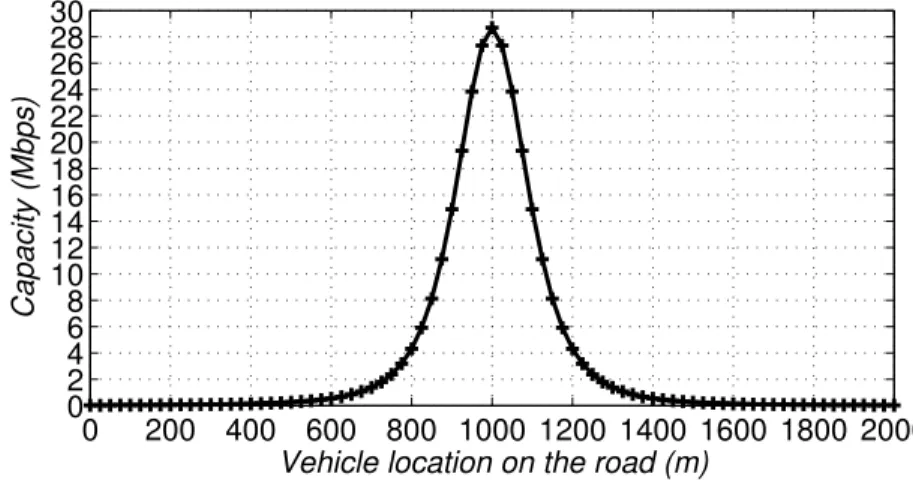
In Fig. 2-3, the capacity of the link between the RSU and a vehicle user is varying according to the different locations on the road. In this figure, the length of the highway is set as 2000 meters. The RSU is located along the road, the vertical distance to the middle point (1000 m point) of the road is 30 m. We set Z as 10 MHz, P as 10 dBm, α as 3 and N0 as 10−10 W.
Assume that the SNR values between the users and the RSU at each time are already known. The data volume contained in each resource segment can be obtained from the Shannon capacity formula. Define the data volume of the resource segment k for user i as dsegi,k.
Even though the handover between RSUs are not considered in this thesis, we assume that the user informations are shared by adjacent RSUs using the MEC technologies. The user informations contain the locations, velocities, directions etc. As a result, the data volume contained in each resource segment can be precisely calculated even though the user has not entered the RSU coverage. By this way, the resource allocation can be done seamlessly for the users that go through different RSU coverages.
Denote ~α := {αi,k ∈ {0, 1} | 1 ≤ i ≤ I, 1 ≤ k ≤ K} as the resource allocation vector. We assign the resource segment k for the user i when αi,k equals one and vice versa.
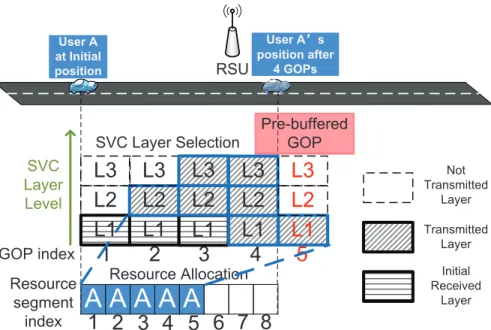
Figure 2-4 shows a valid SVC layer selection and resource allocation result for a simple scenario. The G/R coefficient M is 2. There are 8 resource segments, in which the first 5 resource segments are assigned for A. The layer selection results are {1, 2, 3, 3, 1} for these GOPs.
2.2.4 Utility Model
We define the utility of user i’s GOP with the SVC layer level l as ui,l. Assume that ui,l is non-decreasing and concave over the discrete {1, 2, ..., Li} values for user i.
RSU
User A at Initial position
L1
1 2 3 4
GOP index
A A A A A
Resource segment
index
1 2 3 4 5 6 7 8
SVC Layer Selection
Resource Allocation
Not Transmitted
Layer Transmitted
Layer Initial Received
Layer
5
Pre-buffered GOP
L2
L3
L1
L2
L3
L1
L2
L3
L1
L2
L3
L1
L2
SVC
L3
Layer Level
User Aÿs position after
4 GOPs
Figure 2-4: SVC layer selection and resource allocation for user A in 5 GOPs (J = 4 and B = 1), 3 SVC layer levels, 8 resource segments and M = 2 scenario.
These properties of ui,l help us to solve the resource allocation problem in the latter part of this chapter.
The utility ui,l can be expressed in another form ¯ui(d), where d stands for the data volume. ¯ui(d) is the utility value when user i gets data volume d to buffer one GOP. We have ¯ui(d) = ui,l, when d ∈ [di,l, di,l+1). Then ¯ui(·) is a staircase function over a continuous value.
The utility values can be comprehended as the quality of the videos, or the quality of human experience when watching these videos, etc. For an example, we can use the Peak Signal to Noise Ratio (PSNR) value of each GOP as the utility value, which is a commonly used metric to depict the similarity of the decoded video compared with the original video.
The definition of the utility function is very important, since it directly affects the properties of the optimization process. For an example, the fairness of the schedul- ing. In the field of wired/wireless communication, usually three kinds of scheduling mechanisms are considered, each of which stands for a different fairness level, shown
2.2. SYSTEM MODEL 49
as below:
Maximum C/I
In wired communication, the maximum C/I scheduling finds a user which max- imize the system throughput instantly. This offers excellent throughput but it is not fair. Because the users with poor channel quality will not be served until the channel quality of one of these users becomes the highest. The fairness of the system is often unachievable.
Max-Min
The max-min scheduling in wireless communication always assigns the network resources for the users with less channel gain, regardless of the system through- put. By this way, the absolute fairness is achieved. However, the throughput is sacrificed.
Proportional Fair
The proportional fair mechanism in wireless communication can be considered as a compromise between the maximum C/I (not fair) and max-min (absolute fair). In this scheduling mechanism, the scheduler assigns more resources to a user with relatively better average throughput, based on the history information of the average throughput. This offers a better trade off of the throughput as well as fairness satisfactorily.
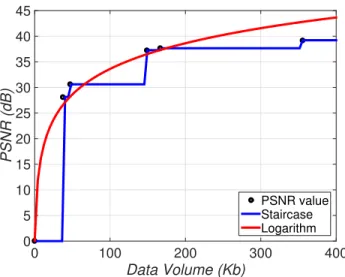
The proportional fairness will be achieved if and only if the utility function is a logarithm function [82][83]. Following the thought of proportional fairness, we seek for a log-like utility function to approximately achieve the proportional fairness. PSNR is a log scaled function. The utility function itself is a staircase function as we explained before. If we fit the PSNR utility function to a logarithm function, we find that the PSNR utility function is close to the fitted function, shown in Fig. 2-5. As a result, the proposed PSNR utility function can be considered as a proportional fairness based utility function, approximately.
Data Volume (Kb)
0 100 200 300 400
PSNR (dB)
0 5 10 15 20 25 30 35 40 45
PSNR value Staircase Logarithm
Figure 2-5: Comparison of staircase PSNR utility function and fitted logarithm function, generated with real video data.
Our objective is to maximize the system utility, i.e.,
I
P
i=1 J +B
P
j=1
(ui,li,j − ui,liniti,j ). Since
li,jinit is a fixed value, we can eliminate ui,li,jinit in the expression. In the objective function, the GOP number of each user is the same and each GOP of each user is calculated only once in the objective function. Moreover, the function to calculate the utility value, like PSNR value, of each GOP is usually a log-like function, i.e., as the SVC layer level increases, the increment of the utility value is becoming smaller.
2.3 Formulation
We define dreci,j as the received data before the playback of GOP j, i.e.,
dreci,j :=
M Vj
X
k=1
αi,kdsegi,k, 1 ≤ i ≤ I, 1 ≤ j ≤ J + B, (2.3) where Vj is defined as
2.3. FORMULATION 51
Vj :=
j, 1 ≤ j ≤ J; J, J < j ≤ J + B.
(2.4)
The meaning of V (j) is that, since {J + 1, ..., J + B} are pre-buffered GOPs and there is no more resource segment to assign by the RSU after GOP J, the received data before the playback of the pre-buffered GOPs is equal to the received data before the playback of GOP J. We define ~dreci := {dreci,j | 1 ≤ j ≤ J + B} as the received data vector for user i.
The problem formulation is shown as follows,
max
{~α,~l} I
X
i=1 J +B
X
j=1
ui,li,j, (2.5)
subject to
τ
X
j=1
(di,li,j − di,linit
i,j ) ≤ d
rec
i,τ, 1 ≤ i ≤ I,
1 ≤ τ ≤ J + B, (2.5C1)
li,jinit≤ li,j ≤ Li, 1 ≤ i ≤ I, 1 ≤ j ≤ J + B, (2.5C2) αi,k ∈ {0, 1}, 1 ≤ i ≤ I, 1 ≤ k ≤ K, (2.5C3)
I
X
i=1
αi,k ≤ 1, 1 ≤ k ≤ K. (2.5C4)
Constraint (2.5C4) shows the constraint that each resource segment cannot be assigned for more than one user. Constraint (2.5C1) shows the network resource constraint for the SVC video playback. Before the playback of GOP j, the user should have already received enough data to playback the GOPs {1, ..., j} with the selected SVC layer level li,j.
We found that the problem shown in Eq. 2.5 is an Integer Linear Problem (ILP) and is NP-hard [84]. In order to get a solution that has comparable utility value
with the optimal solution, and can be computed in polynomial time, we introduce the decoupling of this problem.
2.4 Problem Decoupling and Algorithms
2.4.1 Problem Decoupling
We observe that the total utility of user i’s GOPs is only constrained by the received data before the playback of each GOP, i.e., ~dreci . Therefore, we can decouple the original problem to two subproblems: the SVC layer selection subproblem as the lower layer subproblem, and the resource allocation subproblem as the upper subproblem.
1) Lower layer subproblem: SVC layer selection
Let Gi(~dreci ) be user i’s maximum total utility with a given ~dreci . We have
Gi(~dreci ) := max
~l|i J +B
X
j=1
ui,li,j, (2.6)
subject to
τ
X
j=1
(di,li,j − di,liniti,j ) ≤ dreci,τ, 1 ≤ τ ≤ J + B, (2.6C1)
li,j ∈ {liniti,j , ..., Li}, 1 ≤ j ≤ J + B. (2.6C2)
where ~l |i is the SVC layer selection vector for user i.
2) Upper layer subproblem: resource allocation
2.4. PROBLEM DECOUPLING AND ALGORITHMS 53
The maximum system utility can be expressed as
maxα~ h(~α) = max~α I
X
i=1
Gi(~dreci )
= max
~ α
I
X
i=1
Gi(dreci,1, dreci,2, ..., dreci,J +B) (2.7) subject to
αi,k ∈ {0, 1}, 1 ≤ i ≤ I, 1 ≤ k ≤ K, (2.7C1)
I
X
i=1
αi,k ≤ 1, 1 ≤ k ≤ K. (2.7C2)
In Section 2.4.2 and 2.4.3, we design the Resource Allocation and Layer Selec- tion (RALS) algorithm to solve these two subproblems. The optimal solution of the SVC layer selection subproblem is given by the Dynamic Programming (DP) [85][86] method with a given ~dreci . For the resource allocation subproblem, we prove that the greedy algorithm yields a (1 − 1/e)-approximation of the optimal solution.
2.4.2 SVC Layer Selection Subproblem
Dynamic programming (also known as dynamic optimization) is a method for solving a complex problem by breaking it down into a collection of simpler subproblems, solving each of those subproblems just once, and storing their solutions ideally, using a memory-based data structure. The next time the same subproblem occurs, instead of recomputing its solution, one simply looks up the previously computed solution, thereby saving computation time at the expense of a modest expenditure in storage space. For an example, the knapsack problem [87] can be solved by DP in pseudo- polynomial time.
To use DP, the problem itself should have the characteristics of overlapping sub- problems and optimal substructure. A problem is said to have overlapping subprob- lems if it can be broken down into subproblems which are reused multiple times,